Tad Callin has been working on family history and genealogy since the late 1990s. He does most of his research on Ancestry and posts what he learns to WikiTree.
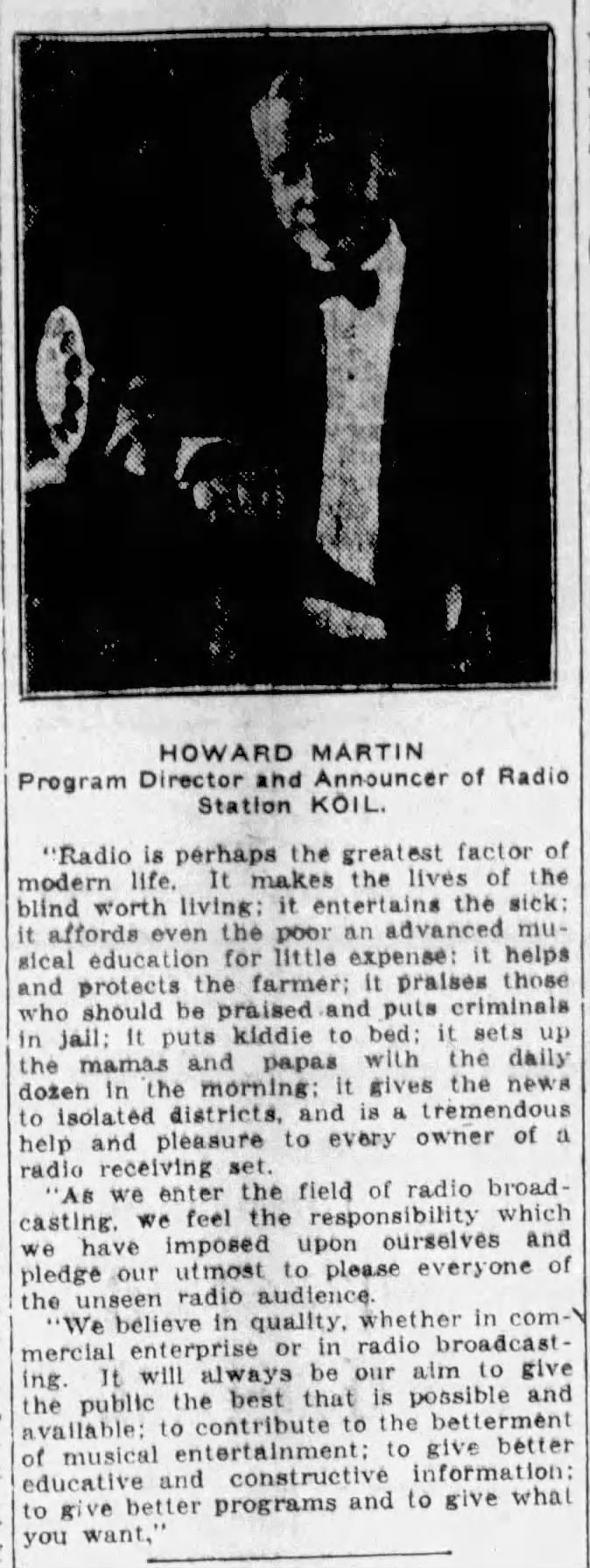
Howard Martin was a World War I army veteran and businessman in 1920s Iowa. He ran his own Texaco filling station and held positions at several successful companies. He even had his own radio program on the local Omaha radio station, KOIL, where he was known as “Here-We-Go Howie”. You can see from this 1925 opinion piece that he thought very highly of the radio:
The Stockman’s Journal Omaha, Nebraska • Thu, Nov 5, 1925
Howard was the only child of William Findley Martin (1874–1943) and Harriet Jenevereth “Hattie” Shepard (1874–1923). His father worked in the railyards, and Howard grew up and attended school in Kane Township, Iowa, near Council Bluffs.
Balloon Man
Howard enlisted in the U.S. Army on 25 Oct 1917 and served as a corporal in the Balloon Corps organized under the Aviation Section, U.S. Signal Corps. He was assigned to the 6th Balloon Company, 3rd Balloon Squadron, and shipped out from New York aboard ship No. 501 on 31 Jan 1918.
The 6th Balloon Company arrived in France on February 20, 1918, under the command of Major Arthur Boettcheer. After training at artillery firing centers in the Services of Supply, they went to the front in July 1918. The Company was assigned to the V Corps at Ravine Jouy-en-Argonne at the opening of the Meuse-Argonne offensive. They brought down two enemy planes within 24 hours. They directed artillery fire, sometimes using carrier pigeons to transmit messages, as regular telephone and radio communications were difficult to maintain with the daily redeployment of balloon units. By 11 Nov 1918, they had advanced to Montfaucon. One of their missions involved dropping propaganda leaflets over enemy lines.
In a 1961 dissertation, Sam Hager Frank1 described balloon operations like this:
On September 17, 1918, at Dommartin-la-Montagne in the St. Mihiel salient, the first eight balloons were successfully floated over the German lines by the 6th Balloon Company. These balloons and the ones subsequently used were supplied by the French. About nine feet long, they were made of chemically treated paper and could carry four pounds of leaflets (about 600 sheets). The ballons utilized a simple release consisting of a fuse and hangers to which bunches of leaflets were attached. As the fuse burned, the wire-bound bunches of paper fell free and scattered.”
Family Man
Sgt. Howard Martin was discharged from the service on 19 May 1919, and he married Aletha Putnam (1899–1981) on 3 Jul 1919 in Pottawattamie County, Iowa. They resided with Aletha’s family in 1920.
Howard and Aletha raised three children in Council Bluffs and Omaha. (Omaha, NE, and Council Bluffs, IA are located on either side of the Missouri River.) Douglas was born in 1920, followed by Merilyn in 1923, and Charles in 1928.
Howard started out as a salesman, then became successful running a filling station for the Mona Motor Oil Company. As mentioned above, he was the first announcer and program director for their radio station, KOIL, during the 1920s. After 1930, he worked in sales for several companies, including Firestone and Texaco. In the 1940s, after the Second World War, he gave his son-in-law, Bud Holmquist, a start in one of his businesses.
Howard was 73 when he died at an Omaha hospital on August 10, 1970. He was remembered as a former member of the Broadway United Methodist Church and as an organist for the Elks Club.
The Callan Name Study keeps growing, and as it does, I keep finding interesting people to tell you about.
If you know of an interesting Callan (no matter what spelling they used), take a look at the master list (a spreadsheet you can find here or on WikiTree) and see if I have them in the database. If not, you can add them with this form!
An Acoustic Personality
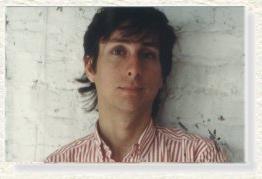
Meet Michael Callen, a singer, songwriter, and activist known for raising awareness about AIDS in the late 1980s and early 1990s. Here he is with The Flirtations, an a cappella group that was featured on the soundtrack of the 1993 Tom Hanks/Denzel Washington film, Philadelphia.
In this TV appearance, Mike is the tenor in the white shirt:
Born in Rising Sun, Indiana, Mike died at age 38 at Midway Hospital Medical Center in Los Angeles, California, from AIDS-related complications of pulmonary Kaposi’s sarcoma.
Despite his short time on Earth with us, he was an author, activist, and singer-songwriter who released a solo album, Purple Heart, in 1988. He wrote most of the songs for the album, and to my ear, there are some sonic similarities to folks like Joe Jackson as well as the obvious nods to Elton John. (Track one is a cover of “Where the Boys Are.”) A 2-CD collection was released after Mike’s death, and you can find all of his music on his website if you’re interested.
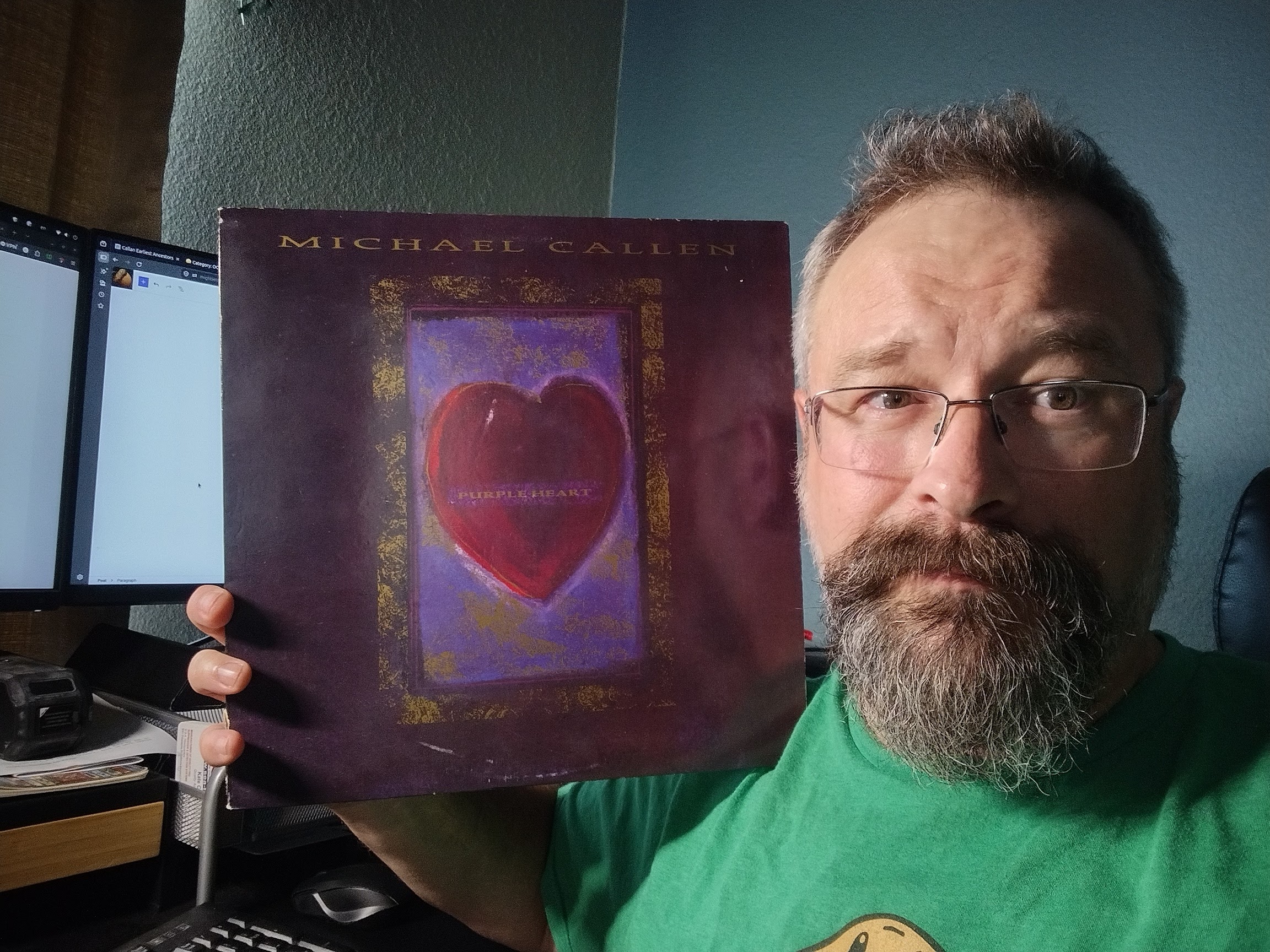
Your author with a copy of Purple Heart.
The Family Connection
I don’t yet know whether Michael and I share a common ancestor, but his ancestors are already included in the Callan Name Study on WikiTree. Beginning with his WikiTree Profile, I can see that his 2nd-great-grandfather was James A. Callen (1833-1862), whose family lived in Kenton County, Kentucky. As best I can tell, the paternal grandfather of James A. Callen was John Callen, who was probably born around the time of the Revolutionary War and settled in Kentucky before the birth of his son in 1806.
Since my most distant known ancestors were the brothers, James and John, who settled in Ohio between 1810 and 1816, it is almost certain that John Callen of Kentucky was not another son of their father, James Callin, whom The Callin Family History refers to as “James 1st.” I can’t rule out the possibility that John was a nephew of James 1st, because we don’t know if James had any brothers, but without more information about both men, there is no reason to think that they were related that closely.
But regardless of how distant our common ancestry may be, we share a surname, and our ancestors shared similar experiences settling the interior of the North American continent during the late 18th century.
Or, to put it more broadly… we’re all cousins if we go back far enough!
Morality Plays
I was a junior in high school when Purple Heart was released, and I probably would not have related to the subject matter or the style of the music Michael was making at the time. I later owned a copy of the Philadelphia soundtrack, but never noticed that a Callen was in the vocal group singing “Mr. Sandman,” despite being passionate about the a cappella groups performing at the time and compulsively reading the liner notes in every album I bought.
When Michael was alive and active as an artist, I was just beginning my journey away from being the conservative evangelical kid I used to be toward whatever it is I am now. As a Gen-X kid heading into adulthood, I harbored a cynical aloofness that came from having moral arguments pushed at me through media – after-school specials, public service announcement campaigns, and ham-handed story lines embedded in the types of TV programs aimed at teenagers during the 1980s. It felt like the adults in our lives thought that the best way to deal with things they were scared of – teen pregnancy, teen suicide, teen drug use – was to simply tell us “Don’t do that,” and call it a day.
The cringe-inducing earnestness and moralizing of those campaigns made it hard to take any public figure pitching a pet issue seriously. It didn’t help that most of these stories were framed as morality plays: these people made THIS choice, and THAT was the consequence. Even those rare stories that tried to capture the nuances of what human beings actually deal with struggled to escape that framing.
And the implication of that framing is that if you are suffering from the consequence, you did something wrong to deserve it.
Germ Theory vs. God
Our 18th and 19th-century ancestors in America occupy an interesting and unique place in history. Before the 1850s, when Louis Pasteur’s work became known, poor sanitation and hygiene allowed the frequent spread of diseases that we now think of as entirely preventable. Anyone who does genealogy research has dozens of examples of children and adults in their family who were lost to yellow fever, dysentery, typhus, typhoid fever, tuberculosis, influenza, whooping cough, and various kinds of pox. And if you look for it, you will probably find a connection between the religion your ancestors practiced and their fear of those diseases.
We tend to downplay the tension between the old ways of thinking about disease as something mysterious that only God could control and the Enlightenment-era progress that led to the germ theory of disease. The idea that God alone inflicted disease and that man was defying God whenever we found ways to prevent or treat diseases has plagued us throughout our history (pun intended), and we like to tell ourselves that science has allowed us to outgrow those old, superstitious ways of thinking.
But if I learned anything from watching people respond to the COVID-19 outbreak, it is that people still don’t understand how diseases spread, and when they are afraid, they still fall back on superstition and religion to deal with that fear.
After he was diagnosed with AIDS in 1982, Michael began to advocate for more research into, and better awareness of, the disease that would lead to his death in 1993. I see now that he was not only fighting against people who believed that he deserved to suffer from his disease, but he was also working uphill against people like me, who had become tired of the emotional manipulation of public awareness campaigns.
The Element of Truth
There is no shame in being wrong. It happens to all of us, all the time. It happened to Michael, too.
Michael lived with AIDS for 11 years, and during that time, he worked as an advocate for better public policies, not only in the prevention and treatment of the disease, but also in the treatment of gay, lesbian, and queer people. He co-authored an essay in 1982 arguing that the promiscuity that gay men had associated with their identity and with their liberation ideology was dangerous. The 1983 manual How to Have Sex in an Epidemic: One Approach, which Michael also co-authored, outlined practices for safe sex that were controversial both to religious conservatives (who believed people like Michael were trying to teach their children to have sex) and to the gay community (who believed that “safe sex” was part of an agenda to take away their hard-won freedoms).
In his 1990 book, Surviving AIDS, Michael called out public health officials and what he called the “propaganda of hopelessness,” drawing attention to the stories of 13 long-term AIDS survivors of different sexes, ethnic backgrounds, and sexual backgrounds. By that point, he had come under suspicion and resentment from people who thought he might have fabricated his diagnosis to get attention. In response, he released his medical records.
What Michael got wrong doesn’t really change anything he did or undermine any of his work. He questioned the HIV theory of AIDS, and commented in a 1992 interview, “The HIV paradigm has produced nothing of value for my life and I actually believe that treatments based on the arrogant belief that HIV has proven to be the sole and sufficient cause of AIDS has hastened the deaths of many of my friends.”1
Despite being an activist and advocate for more than a decade, Michael was still not a scientist. His expertise was in music and writing. And even within the worldwide community of HIV/AIDS research, there were questions about how the virus worked. Conspiracy theories about the origin of AIDS, as an intentionally crafted biological weapon, were fueled by lingering questions, such as why HIV took up to a decade to cause symptoms. There were also legal issues over which research team deserved credit (and patent royalties) for the development of treatments, which fed into those conspiracy theories.
How to Embrace a Lost Cousin
In the end, it was Kaposi’s Sarcoma in his lungs that took our courageous musical cousin away from us. Even if you remain uncomfortable with who he was and what he fought for, you can’t avoid the cruel irony of lung disease in a singer.
But I hope that if you are uncomfortable thinking about who Michael Callen was, you won’t ignore the discomfort. Think about how many people didn’t dare to be themselves and take the risks that he took. How many people were stuck in a time and place where they were forced to hide? How many people do we not know of simply because they were erased for being different?
Discomfort is there to teach us a lesson. You might even say it is a consequence of our choices.
Her father, Gust, had immigrated from Sweden in 1882, when he was 18. Ingeborg’s family was from Norway, and they began migrating to Minnesota after 1880, when Ingeborg’s older brother, Erik, brought his wife to Todd County. Ingeborg seems to have arrived in the U.S. about 1884 and quickly married Gust. They had their first daughter, Augusta, in Connecticut in 1885, and their second, Hildur, in Brooklyn in 1886. Then they moved to Stillwater, Minnesota.
From Elsewhere
Gust Leander moved his family around quite a bit, probably following work opportunities. The Leander family resided in Minnesota for a few years. Hildur’s brother, Martin, was born in Stillwater, and her sister, Mamie, was born in Saint Paul. The family moved to Illinois around 1894. Her brother Arthur was born in Chicago, and her youngest sister, Anna Cecelia, was born in Crystal Lake, in McHenry County.
By 1903, they were back in Saint Paul, where they would remain until Gust left the family about 1912 and moved to Tacoma, Washington.
It’s hard to imagine what Hildur and her siblings thought about their childhood, since to them, the frequent moves would have seemed normal. I don’t know whether they would have had a hard time adjusting to new places, or whether being the children of immigrants prepared them for that. I imagine they grew up only knowing English, but I wonder whether they were exposed to their father’s Swedish and their mother’s Norwegian, or if they spent time on the farms of their aunts and uncles.
Perhaps always being from somewhere else was a challenge, or perhaps that made it easier to adapt.
Stability in Stillwater
Hildur married William Holmquist on 26 June 1912 in Saint Paul. They made their home in Mahtomedi, where William worked for the public schools, and they raised their son and three daughters there. After a childhood spent moving every few years, life with William may have been a welcome contrast.
And then there is Gust’s departure for the West Coast. It is to find reliable records around divorce, and it’s even harder to know what happened when there are no records. I can only imagine that Hildur’s parents must not have been very happy, and I can speculate about how that may have affected their children. But at least Hildur and William were able to make a different life for themselves and their children.
And Then the Mysteries Pile Up
Life is not static, though, even when you settle down in Mahtomedi.
If you don’t count the mystery of what happened to her father after he left Minnesota, unanswered questions about Hildur’s life begin to accumulate after 1940.
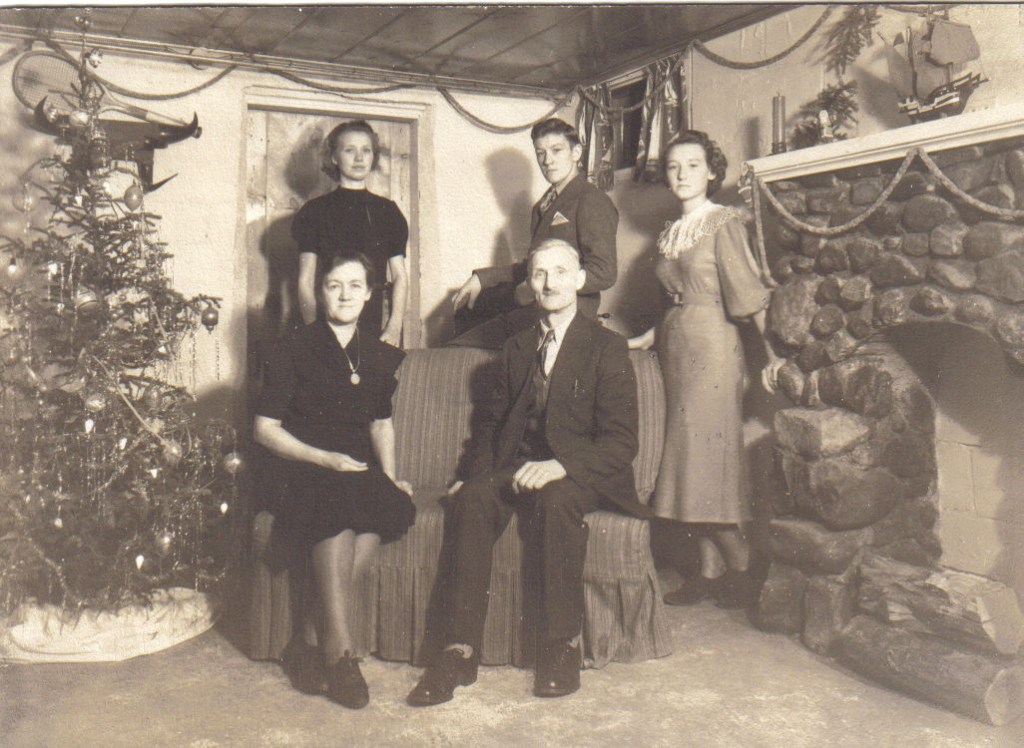
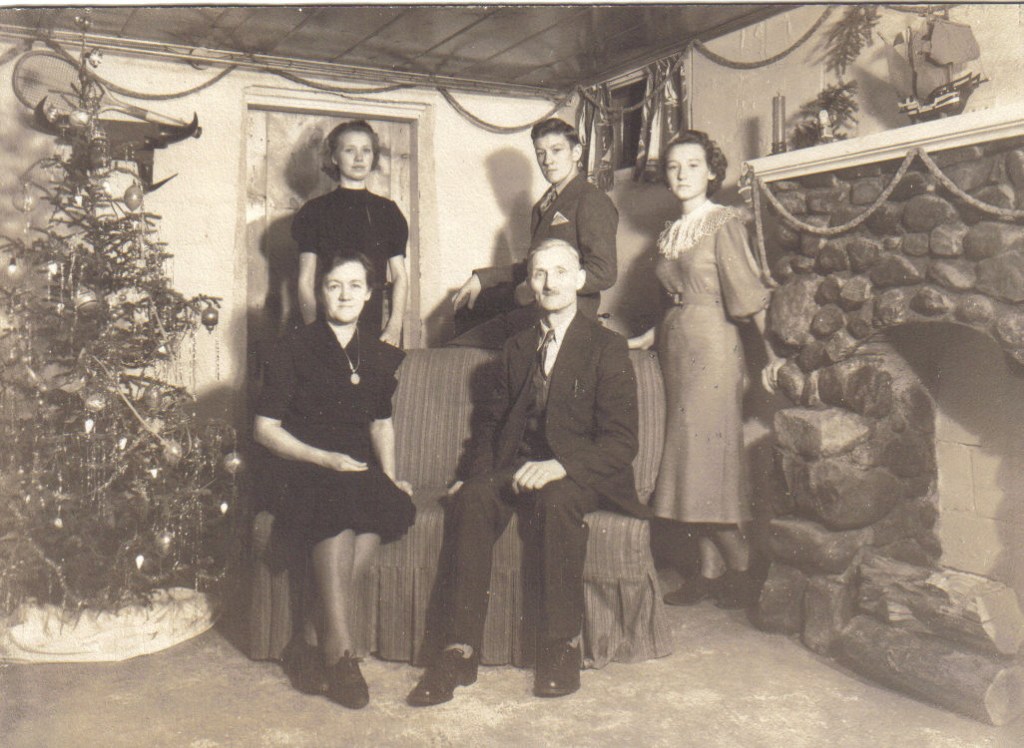
The photo above shows Hildur and William with three of their four children in their cottage at Christmas time near Bear Lake, probably around 1938. They all appear in that household on the 1940 Census – William, Hildur, Ruth, Lillian, Wesley, and Dorothy. But that is the last record I have found that tells me where Ruth was. After 1940, I don’t see her in any records – and the clues I see in other people’s trees lead me to other women named Ruth Holmquist who are clearly not the same person.
Lillian married Marvin Robertson in 1940, and they raised their family in Mahtomedi. In 1950, they were listed in the Census with their four children, but nobody else was in the household. Wesley (aka Bud Holmquist) married in 1943, and he and Merilyn Martin lived in Omaha. Their 1950 household also included only their immediate family. Dorothy married Sidney Woodcock in 1944, and their family lived in Bremerton, Washington. In 1950, they appeared in Coeur d’Alene, Idaho, with their two children.
As I told you last week, when Dorothy married, William and Hildur also moved to Bremerton, Washington. In May of 1947, they lived in Seattle, where William asked Hildur for a divorce on the grounds of cruelty.
And that’s where I lose track of Hildur.
After 1947, Hildur does not appear in any more records. She isn’t listed in the census on her own, that I can find, and she is not in the home of any of her children (unless she was residing with Ruth, whom I also can’t find). She also did not live with her three surviving siblings in 1950: Martin, who resided in Dayton, Ohio; Arthur, in Saint Paul; or with Anna Zimmerman in Moline, Illinois.
Perhaps one day, I’ll catch a break or find a clue that tells me what happened to Hildur, her father, or her daughter. But for now, I’m stuck.
Family history research thrives on dates of significance. Birth, marriage, and death, of course, but also immigration dates, decadal census, and annual taxes all give us milestones to mark the stories of our ancestors and cousins. Some of these dates feel more important to us, whether it is the birthdate of someone you particularly admire, or the date you lost someone.
Whether the observance is celebratory or solemn, humans like to commemorate things. That’s why this is only a partial list of monthly holidays and observances that fall in June:
Adopt a Shelter Cat Month
African-American Music Appreciation Month
Alzheimer’s & Brain Awareness Month
Audiobook Appreciation Month
Celibacy Awareness Month
Cucumber Month
Dairy Alternatives Month (but, also, Dairy Month)
Fireworks Eye Safety Month
International Childhood Cancer Awareness Month
International Men’s Month
International Surf Music Month
Lemon Month
Lesbian, Gay, Bisexual, and Transgender Pride Month
I have several favorites on this list (I am more than aware of accordions, for example), but one in particular stands out as important to my family.
The Response to Shame
People express many different feelings about the existence of LGBTQ+ people, and about Pride Month. Some of them are very strong feelings, and are not kind.
As a result of the long history of strong, unkind feelings being expressed towards anyone who did not fit the straight, cisgendered mold, people have historically tended to hide who and what they were, and the feeling associated with hiding themselves was Shame.
Shame is unpleasant. Shame does harm. And shame meant that people who did not fit into a specific expectation of their sex or gender were either brutalized, driven away, or forced to pretend to fit. Finding evidence of an ancestor who would have been what we call LGBTQ+ is highly unlikely, precisely because those individuals and their families are unlikely to have left a record behind.
There have been societies and places where Shame did not rule the day. They are also rare, and they tend not to be obsessed with record-keeping, which makes it difficult to tease out the evidence that a genealogist needs. Our society has only recently begun to behave in a way that does not automatically suppress the existence of LGBTQ+ people.
Pride Month was established to counteract that history of Shame. It is celebrated in June because that is when the Stonewall riots took place in 1969, a tragic event in which people demanding basic rights were met with violence. But because they insisted and demanded those rights, my family has benefited.
Thanks to the activism and persistence of those who came before them, my children are part of the first generation in American history where those on the queer spectrum can live openly, marry, or have their own families.
The Difference Between Us
My wife and I are both Gen-X cisgender heterosexual people who chose to marry young (compared to others in our generation) and to have double the average number of children for our age group. We were teenagers during a time when pop stars or celebrities “coming out” was often the subject of national news, and was often treated as a scandal. From our perspective, it quickly became clear that who a person chose to love should not matter to the rest of us. Artists like Prince and Michael Stipe of the band R.E.M. each demonstrated in extremely different ways that whether a person’s differences were overt and over-the-top (like Prince) or understated and private (like Stipe), it wasn’t anyone else’s business.
I may not have been gay or queer, but because I disliked sports and preferred chorus and theater, I was a frequent target for bullying that almost always included questioning my sexuality. I can’t pretend that I didn’t pay some of that forward. When I reflect on how I treated others during high school, I, too, could bully others, and did. But I eventually learned that bullying is the problem, and that treating others with respect is simply the better way to behave.
Accepting that others are different from us should not be a radical idea. That is the foundation that any healthy society is built on. Those differences are what make our stories interesting. At least, that’s what I’ve learned from reading other people’s family histories.
This Family’s History
Despite not being LGBT ourselves, my wife and I are still unconventional. She is more interested than I am in things like power tools and grilling, and I am… well, you see how I spend my time. Two of our kids are openly queer with queer partners, whom we love spending time with. From the outside, our growing clan probably seems odd to those with an expectation of what a family should look like, but that’s who we are. To us, this is normal.
Pride Month is a time when we celebrate the things about us that are different. It is also, for me, a reminder of how normal the rainbow of human diversity is.
There are still those who have strong feelings about people like us, who are different. They may choose to focus on the spectacle, and they may react in ways that are not well thought out or kind. But most people are kind to us, and most people get that “live and let live” is a better way to behave.
And eventually, when our descendants and cousins look back at us, they should at least have a record that we were here. Because we have nothing to be ashamed of.
So, whether you celebrate Dairy Month or Dairy Alternatives Month, I hope you are well. Use sunscreen and hydrate. Don’t be afraid to be who you are. And don’t be the kind of person who treats others poorly because of who they are.
William Holmquist is the first person in this Ahnentafel series who was not born in the United States.
He was born on 6 October 1880 in Norra Vram, which, since 1997, has been located in the county (or “Län“) of Skåne. He was 29 years old when he arrived in New York from Liverpool aboard the Arabic on 3 May 1910. An uncle, John Spence, was listed as the “Person in the US” to meet him in Stillwater, Washington County, Minnesota.
In 1910, immigrants faced no passport or visa requirements. Anyone could purchase passage to the United States. Upon arrival, they were processed at centers like Ellis Island or Angel Island. The process relied on a pre-existing ship manifest, medical check-ups, and legal cross-examination to filter out inadmissible individuals, and typically took three to five hours. On average, two percent of arriving immigrants were excluded from entry. The most common reasons for exclusion were a doctor diagnosing an immigrant with a contagious disease that could endanger public health, or a legal inspector being concerned that an immigrant would likely become a public charge or an illegal contract laborer.1
William was naturalized in 1921, a process that took 11 years. In the 1920s, U.S. immigration laws began to shift from a system of “qualitative exclusion” (banning specific categories of people) to a system of quantitative restriction (strict numerical caps, visas, and digital security screenings). It’s worth keeping in mind that when you read about “Open Borders” in America, that was more or less what we had for the first 150 years of our national existence, and for the 400 years before that. So when people talk about their immigrant families coming in “the right way,” they probably don’t realize that “the right way” was to simply show up and start living here.
Boyhood In Sweden
Born “Arvid William Holmquist,” William was the only son of Anders Holmquist and Elna Mårtensson. Anders listed his occupation as “husägare” in the Swedish clerical surveys available online, which tells us a bit about the family’s lifestyle.
That title was most commonly used in towns and cities. Husägare generally owned the physical tenement or building, which often contained multiple apartments rented out to tenants, making them akin to small-scale landlords or property developers. In 1895, holding the title of Husägare usually indicated middle-class respectability. It implied a level of financial stability and social standing, as these individuals paid municipal taxes and often had voting rights in local town elections.
The Holmquist family consisted of Anders and Elna, William, and four daughters, two of whom did not survive to adulthood. The eldest child, Gerda Elna, was born in 1874 and married Karl Kristian Rasmussen in 1910. A second daughter, Estrid Svedenborg (or Svenborg), was born in 1876 and died in 1890 at age 13. After William’s birth in 1880, Anders and Elna had Julia, who died in infancy in 1885, and Lydia Ruth, who was born in 1887. She married Hans Johan Björkeroth in 1915.
Sweden in 1910 was going through some difficult transitions, which eventually led to the downfall of their monarchy. In the southern county of Malmöhus, where the Holmquists lived, deep class tensions were forming over a brewing political struggle for universal suffrage. The Malmöhus plains were incredibly fertile and dominated by large-scale farming, which required a large rural workforce. Still, the land was largely controlled by a wealthy, politically conservative landowning elite. The labor movement was making progress, but the violence and disruption from nationwide strikes threatened everyone.
A small-scale, middle-class landlord like Anders Holmquist would have been caught between those opposing forces, with no real opportunity to move up and no desire to give up what he had. And his son, facing the same bleak outlook if he stayed in Sweden, decided to head where so many others were finding better opportunities.
Living the American Dream
Only two years after settling in Stillwater, Minnesota, William married Hildur Agda Leander, the daughter of Swedish immigrants, on 26 June 1912.
After arriving in Minnesota, William worked as a carpenter until finding a job as a janitor in the Mahtomedi Public Schools during the 1920s. In 1932, he was elected as vice president of the Minneapolis public schools. As the children grew older and more independent, Hildur also found work as a custodian in the public high school.
They raised three daughters, Ruth (b. 1915), Lillian (b. 1917), and Dorothy (b. 1923), and of course, their son, Bud Holmquist. But then the years of World War II came, and their children began to marry and leave home.
In 1944, their youngest daughter, Dot, married Sidney Herbert Woodcock (1924–2011) and moved with him to Bremerton, Washington. William and Hildur decided to move there, too, and that’s where they lived in 1946. But in May of 1947, they lived in Seattle, where William asked Hildur for a divorce on the grounds of cruelty.
A Full Circle
The year after his divorce, William took a trip back to Sweden. When he returned to Seattle, he found work as a dishwasher in the restaurant of the Amherst Hotel. He probably lived off a pension from the Mathomedi schools, but worked part-time, too. In 1954, he married Ruth (Hart) Stevenson, the widow of Frederick George Stevenson (1884–1953), and in 1957, they lived in the Lorrington apartment building, where William was the manager.
Being the manager of an apartment building where he lived seems like the exact sort of life William could have had if he had stayed in Sweden. He and Ruth were still living there in 1962, when he lost a battle with cancer and died on 26 September at age 81.
The Callan Name Study keeps growing, and as it does, I intend to tell you about it. If you know of anyone with a Callan surname (no matter what spelling they used), take a look at the master list (a spreadsheet you can find here or on WikiTree) and see if I have them in the database. If not, you can add them with this form!
What’s In a Name?
“Why would I care about a Callan Name Study if I’m not a Callan?”
I can’t really answer that for you. Maybe you can trace one of your ancestral lines to a woman born with a Callan surname; maybe you’ve discovered an adoptee in your line who was born a Callan. Your motivations and interests are your own.
But one reason I’m posting these updates is that I think a lot of people out there are hesitating to dive in and run a study on their own surname. I figure if you are thinking about it, seeing the steps I take and the lessons I learn could help you get yours going.
And if you want to practice on my Callan study before signing up to do your own, I won’t be sad!
Deciding what name variations count as “Callan” has been an interesting puzzle.
The obvious variations are Callan, Callen, Callin, and Callon, and in most cases, it’s easy to see that the newer spellings were often chosen by a generation of educated siblings who were born to a generation or more of (usually) farmers who (usually) emigrated from Ireland and whose records were written down by clerks who weren’t familiar with their accents or the spellings used in the homeland. In other words, most roads lead back to people from Ireland using the spelling “Callan,” which itself is supposedly a simplified spelling of one of the older forms of the name in Gaelic.
Deciding which spelling is “correct” often comes down to the question of how the family spelled the name on their headstones. If there are no headstones or if the family left no Bible or didn’t have a consistent spelling to use on their official documents, you may be stuck guessing which spelling they might have used.
I did say “most roads,” and even though it’s too early for me to say much, I can see a few alternate origins emerging for a few groups of “Callan” folks.
For example, sometimes the spelling “Calen” is just a variation of “Callen” that dropped an “L” – but there is at least one family group that originated in Sweden or Norway, and took the surname from the land or township where they were living when the law regulating the use of surnames was passed.
There are also some French and German lines that bear some resemblance to one of the Irish variations, and I don’t know yet whether that is because Irish immigrants to those lands were “localized,” or if those variations trace from another name, like Kälin. Several American “Callen” families came from Russia, and were either originally rendered as “Calinoff” or “Kalinov” or simply adopted an “American” spelling like “Calin” or “Callen” on arrival.
I’m excited to learn more, but it will require some digging once the initial collection is done.
Organize, Organize, Organize
According to the advice I was able to find online before I started this endeavor, the first step in compiling a Name Study is to collect as many individual names as possible from available records.
This means pulling together variations of the name that show up in local vital records, census records, cemetery databases, etc. The Callan One Name Study spreadsheet is where I’m trying to compile all of that information, which is why I keep sharing that link and inviting people to look through it.
I’ve also taken some of the work I did based on the 1901 and 1911 Ireland Census for County Louth and folded it into the Ancestry tree, which can be found here:
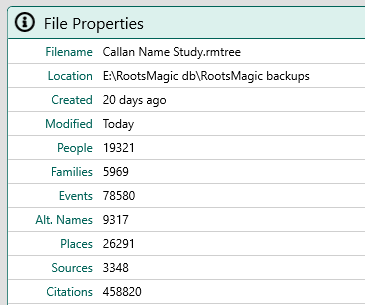
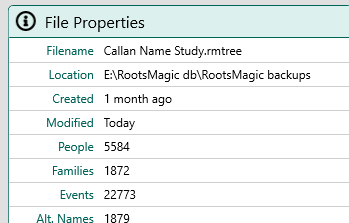
That took some effort, because I exported the GEDCOM from my Calln Family History tree, and then “pruned” it down from more than 19,000 names to just under 6,000, which took half of the month of May. Before and after:
May 15May 31
Barbara Tien, of Projectkin, asked whether I had considered joining the Guild of One Name Studies (GOONS), and while I’m not opposed to doing so, I haven’t seen a benefit to doing so right now. The services they offer seem like things that I will benefit from later, after I get things together and have something to publish. They seem to offer web-hosting and networking/advertising, which I will need at some point, but I’m not ready to take those steps yet.
I did take some of the advice I’ve read about leveraging AI tools, and asked Gemini for help compiling lists from available census records, so I have a collection of spreadsheets that it was able to generate for each publicly available census in the U.S., UK, Australia, and Europe. What I don’t know is whether these are “complete” or accurate.
Another reason I am hoping to attract more eyes to the spreadsheet – the more people I have going through it and looking for matches (to their family trees, to WikiTree, to FamilySearch, etc.), the better and more complete picture we will have of how many Callans there were in each of those censuses.
This month promises to be busy enough to keep me away from the keyboard, so I don’t expect to make much progress until the end of the summer – but I’ll keep you posted, anyway!
Before I get into the substance of Esther’s story, I feel like I should address something about photographs.
Specifically, there is an ethical grey area created by Ancestry’s end-user agreements and copyright law that makes it hard to know if or when I can share a photograph that I find on Ancestry. Genealogy is at its best when we can follow academic standards, cite our sources to stable, reliable data, and trust the provenance of the artefacts we come across, such as photographs of people or even of the things they made and/or passed down. But personal photos and artifacts rarely come with the sort of documentation that allows us to treat them with academic rigor.
For example, I found a photograph of Esther and Don Shuffler on Ancestry. The user who uploaded the photo had a username similar to “IowaCousin123,” which makes it hard to trust that they are who they appear to be (are they in Iowa? are they a cousin?). The right thing to do before sharing that photograph here would be to reach out to that user and get their permission – except…
a) Ancestry’s privacy rules protect their identity. I don’t have any way to know whether they are who they say they are or whether they have any knowledge (trustworthy or otherwise) about the photo’s origins.
b) Under Ancestry’s copyright policy, photos and artifacts uploaded to their site belong to the user who uploaded them. But I can’t tell who originally uploaded a given photo.
I took a chance last week and posted a found photo of Don Shuffler with his brothers, mother, and grandmother. After I did that, I found additional copies of the same photo, and others shared by several people, including this one of Don and Esther (which you might or might not be able to see, depending on Ancestry’s sharing rules):
I’m not too worried about getting into trouble because I’m a small, independent publisher, not profiting from the use of these photos, and posting them for educational purposes. But I don’t want to upset anyone, either, or frighten others away from sharing, so unless I have express permission to post what I find here, I’m probably not going to do it.
Lena was born in Chicago, where her parents had married soon after immigrating, so technically, she was first-generation American, but Lena and Tom passed her middle name to their first daughter, Marion Dagmar, so I think it’s safe to assert that their family was still in close touch with their Danish heritage.
That said, living in Iowa in the early decades of the Twentieth Century, the “Thomsen” family more often appears as the English-sounding “Thompson” in official records and newspaper references.
The Thompson sisters grew up in Council Bluffs, and their father made a steady living as a car inspector for the railroads. They were educated in local schools, married local boys, and modeled the Midwestern middle-class lifestyle that so many people seem nostalgic for. Of course, the foundation of that middle-class lifestyle depended on the strength of the unions keeping wages high and work sites safe; high taxes paying for good schools; and the heavily subsidized railroads keeping commerce afloat. I’m sure the Thompson sisters didn’t have to think about those things, though.
Four Weddings and a Funeral
Esther’s eldest sister, Dagmar, born in 1901, married Hans Paulson Ranum (1896–1963) on 16 March, 1923. Hans was a recent immigrant from Denmark, arriving in New York in 1920. Hans and Dagmar had a son and a daughter, whom they raised in Council Bluffs.
Esther, as you may know, married Don Shuffler on 4 June 1926, when both were 17 years old. Their elder daughter, Elaine, was born six months later, on 11 December 1926.
Middle sister, Ruth, married William T Miller (1902–1935) at age 24 on 6 July 1929. They had a daughter named Bernice in 1930, but Ruth divorced William in 1932, accusing him of desertion. He died in a sanatorium in Missouri in 1935, at 33 years of age, another victim of tuberculosis.
Ruth married Harry William Roundtree (1902–1985) on 2 December, 1936, and soon, they had a son together.
A Quiet Life
Clearly, life in Council Bluffs was not without its share of drama and tragedy. And yet, when we want to see our ancestors’ lives a certain way, we tend to look past those small, less fatal dramas and hold on to the nostalgia of what we think of as a better time. This is the puzzle for the family historian: finding ways to acknowledge the difficult while also capturing the welcome mundane moments in between.
Dagmar and Hans divorced in 1945. Their son, Raymond, fought in World War II and in Korea, and served in the Naval Reserves for 40 years before retiring to teach middle school in Ventura, California. He died in 1993, leaving a wife, four children, and several grandchildren. Their daughter, Joyce, married in 1949 and moved with her husband to Washington, DC, where she worked for the government. She died in 1979 after battling cancer, also leaving behind four sons.
Ruth’s daughter, Bernice, was adopted by her stepfather and grew up as Bernice Roundtree. She married Dick Fowler and had two daughters. Bernice was only 37 when she died in 1970. Ruth’s son, Thomas K. Roundtree, served in the U.S. Army and worked for the Council Bluffs Water Works for 40 years before retiring in 2001. He died in 2022, leaving behind two sons and a grandson, as well as several step-children.
As for Esther and Don, their daughters married two McCullough brothers. Elaine married John Edward McCullough in 1945. They had a baby son, Earl Randolph McCullough II, who did not survive infancy. They remained together until 1959, when they divorced. Coincidentally, John’s second wife, Caroline “Kay” Taylor, was also a divorcee. Her first husband was Tom Roundtree.
And, of course, you already know the story of their second daughter, June, who married John McCullough’s younger brother, Bob.
The Story That Isn’t A Story
Throughout all of this, Don and Esther seem to have remained a steady presence in Council Bluffs, as part of this extended family. When I started composing what I wanted to say about them, there didn’t seem to be a whole lot of information to work with, but as I looked at their loved ones, I realized how important that role is – being a calm center and just showing up for decades on end.
Sometimes, when a lot is going on, I forget how appealing that calm center can be.
The Callan Name Study keeps growing, and as it does, I keep finding interesting people to tell you about.
If you know of an interesting Callan (no matter what spelling they used), take a look at the master list (a spreadsheet you can find here or on WikiTree) and see if I have them in the database. If not, you can add them with this form!
An Electric Personality
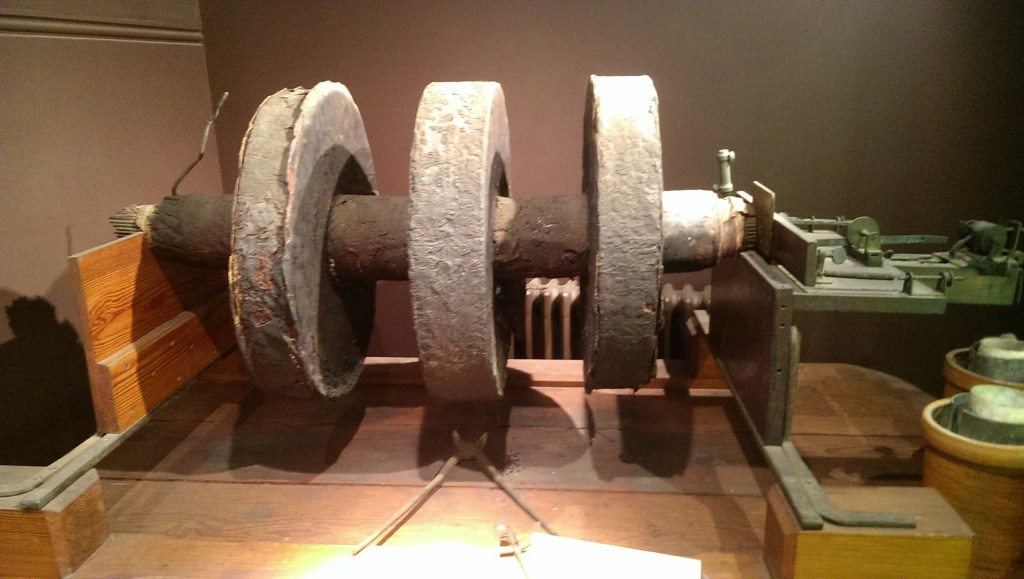
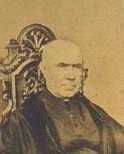
Nicholas Callan (1799-1864) was a boy from Dundalk in County Louth, Ireland, who became a Catholic priest and physics professor. He invented the world’s first primitive induction transformer, developed new galvanization techniques, and improved designs for large batteries while teaching at Maynooth University in County Kildare.
His WikiTree profile tells us his father’s name was Denis Callan. Catholic Church records, which usually record the Latin version of a person’s name, recorded Denis as “Dionysa” and Nicholas as “Nicholaum.” This may be useful information to factor into your searches, since we don’t always think to search for Latin spellings or Latin translations of names.
The source cited on WikiTree describes Denis’s family as “a well-to-do family of considerable local reputation who, in addition to farming extensively, were bakers, maltsters, brewers and distillers.” There is a long tradition in European societies of families passing family assets or businesses to the first-born son and “giving” younger sons to the military or the ministry. And it appears that Nicholas had at least one older brother, Thomas, and possibly another called John, who did not enter the clergy.
What Gets Remembered
If you visit both of Nicholas’s profiles, on WikiTree and on Wikipedia, you quickly see how the two sites differ in the types of information they collect.
Wikipedia has rules about notability and rules against including “original research” in its articles, which means that if I were to try to add the information I’ve found about Nicholas’s father, Denis, or any of his other siblings to his Wikipedia article, I would probably violate those rules.
WikiTree doesn’t have the “notability” problem, in that anyone we can attach to the World Tree deserves their own profile page. And by the nature of the work we’re doing, most of our WikiTree work would be considered “original research,” because while the facts are in the sources we cite, we often draw conclusions about relationships between people that are not directly stated in those sources.
“Articles must not contain any new analysis or synthesis of published material that reaches or implies a conclusion not clearly stated by the sources themselves.”
When we find a birth record for Nicholas and then pull together additional records for his siblings by searching for the names of his parents, we’re analyzing the records and synthesizing that information to reach a conclusion. In WikiTree, that is our bread and butter; on Wikipedia, that is a poison pill.
So, “what gets remembered” on Wikipedia is very different from what gets remembered on Wikitree. As we look at notable people on Wikipedia who belong to the Callan Name Study, you’ll see other situations where the information that belongs in one place does not belong in the other.
Which means that we have to be mindful to put info where it belongs, and link the profiles and articles to each other so nothing gets lost.
Who Gets Remembered
I’m sharing Nicholas’s story today because I think that highlighting notable cousins makes the Callan Name Study seem more interesting and relevant to general readers. If the only things I said about the Name Study were “come look at this massive spreadsheet” or “come help do a bunch of work,” I doubt many of you would pay attention. And if you’re still reading, I suspect that proves the point!
People tend to be more invested in a history project if they can see a direct connection to their own story, or if there is a chance that their family might have notable people in it. That’s not a criticism – that’s just how the brains of social primates work!
But this presents its own set of challenges, because when we’re chasing what people tend to be interested in, we don’t always think to record things that they are less interested in. And that means that the record of a notable person, like Nicholas Callan, may not include information about his family. And the family record becomes important when our goal is to tie Nicholas – a celibate priest who had no known children – to the larger family tree.
And remembering all of those people, or as many as we can, is the point of a Name Study.
Your Call to Action
If you’ve come this far, I hope you’ll feel interested and invested enough to do a little digging and take note of what needs work in Nicholas’s family. I know the WikiTree profiles for his parents and siblings need more work; see if you can find them on FamilySearch, and maybe add some sources to their WikiTree pages?
Or maybe all of this reminds you of someone in your family tree you think of as “Notable” – maybe they are, but nobody has made a page for them, yet?
If their surname is Callan, be sure to let me know what you find!
(If you noticed that this post is going out later than usual, I apologize. I had an unexpected technical failure. If you didn’t notice, then I accept your apology. Just kidding – we’re all busy.)
As We Go Back Further…
I find writing family history to be very different when I’m writing about people I don’t (or didn’t) know than when I’m writing about people I did (or do) know. The burden of the task shifts from an exercise in taking my perceptions and flawed memories and turning them into an interesting narrative that can be backed up with facts from documents, to the opposite task of spinning what I know about the context of the facts into a relatable story.
It’s important that you, the audience, understand that neither story ends up being entirely “true,” because, even when I’m familiar with the person I’m writing about, I can’t possibly know all of the context. But I learned an important lesson when I wrote my own memories down and put them in a book: even I don’t know my whole story.
So, as we go farther back along the Ahnentafel tree, the people I write about will become increasingly unfamiliar to me, and to you, and we’ll glean whatever truths we can from what we can learn about their lives.
The Eldest Son
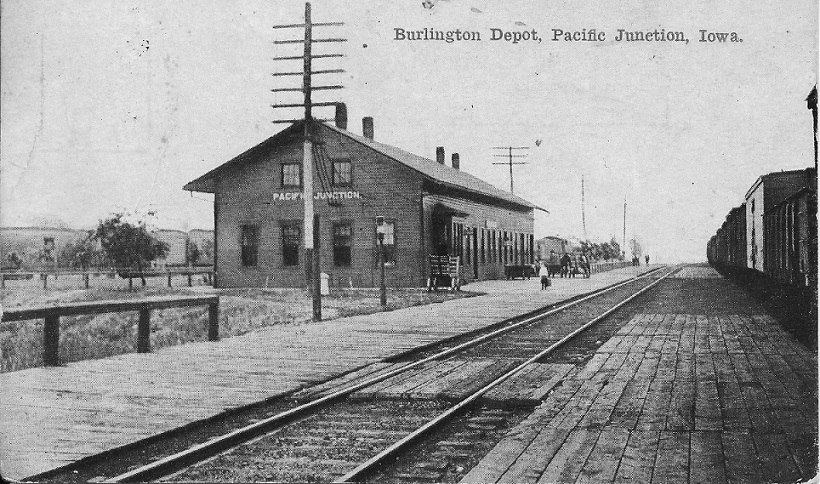
Don Shuffler was born on 13 May 1909 in Pacific Junction, Mills, Iowa. He was a few months shy of his tenth birthday when his father, Frank, was killed in an accident at the railyard where he worked. In 1920, Don lived in a household with his mother, Virgie, his four younger brothers, and his grandmother, Virgie’s mom, Mary Ann Ballard.
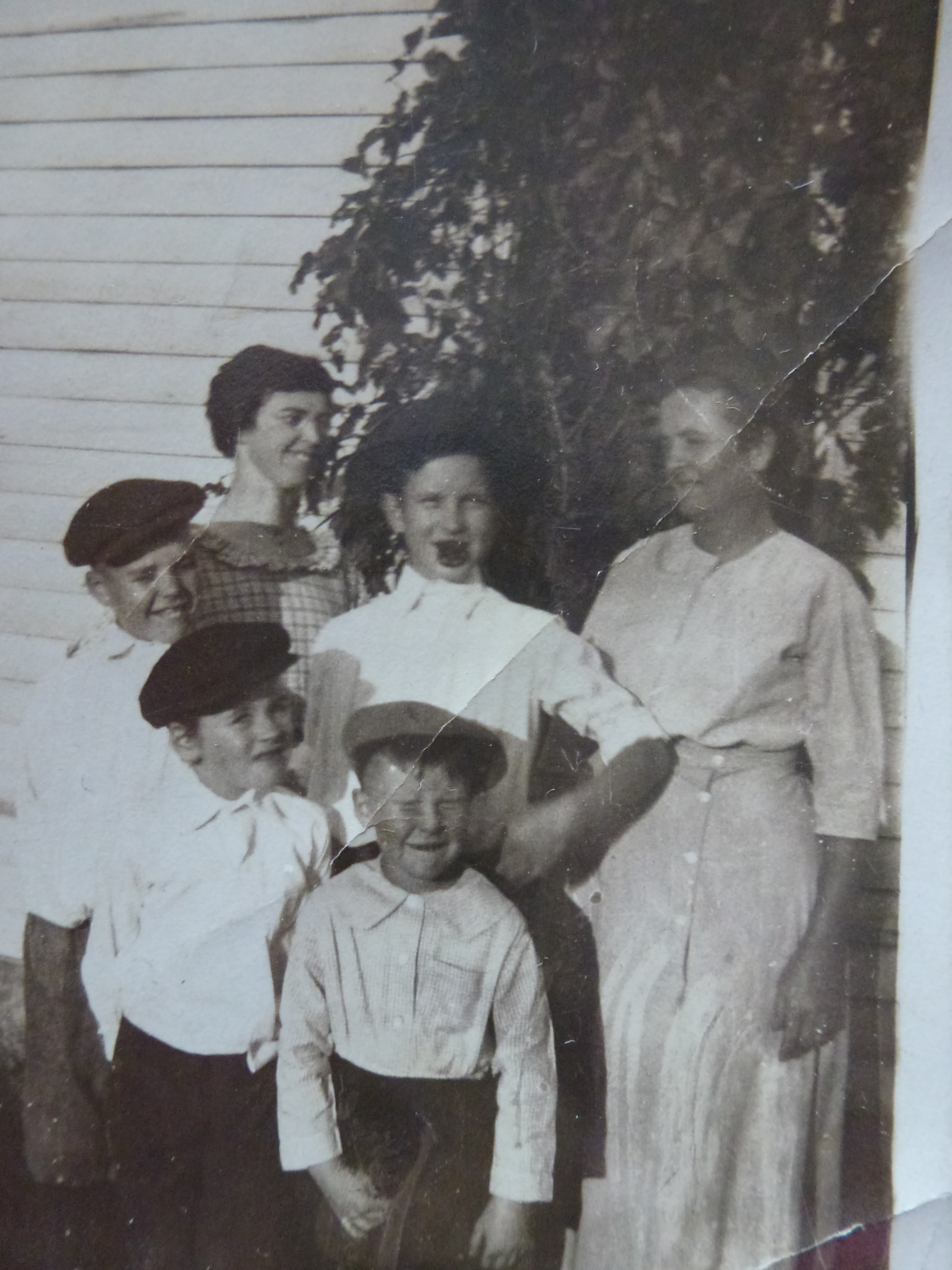
As you might expect, times were hard for the Shufflers after Frank’s death. Virgie had to work to support the family, and that probably wasn’t a problem as long as her mother was there to help tend the boys. But sometime between when this photo was taken and 1925, Mary Ann moved to Oregon to live with her oldest daughter (Virgie’s sister), Florence Kim.
The Shuffler boys: Don (center), Darrell (back, left), Dale (center, left), and Duane (front), flanked by Virgie (back, left) and Mary Ann (right); probably photographed about 1922.
In 1925, Don (15) and Duane (9) lived with Virgie in Council Bluffs, but the two middle boys, Darrell (13) and Dale (11), resided in the IOOF children’s home in Mason City, halfway across the state. The International Order of Odd Fellows (I.O.O.F.) dedicated the Orphans’ Home in 1903, and it housed both orphans and elderly residents. Sending her boys to live in another part of the state was probably difficult, but there is evidence that they were well cared for:
Luella “Susie” BOUCK left the Iowa Odd Fellows and Orphans Home in 1930, at the age of 18. …”It was a good place to be,” said BOUCK of her early years at the home. … There were 123 children in the home when the ROSE children came. Her other siblings — Genevieve, Barney, Fred, and Dorothy — were placed in different departments, but “we were able to see each other; we were in close contact,” she said. … Unlike the Dickensian caricature painted of many orphanages of that era, the I.O.O.F. Home “was a wonderful place,” BOUCK said. … “I tell people that those were the best years of my life and I mean it,” BOUCK said.
~”Orphan Comes Home,” The Globe Gazette, Mason City, Iowa, published Sat. January 3, 2009; archived on IAGenWeb.
By 1930, of course, Virgie had married Orin Steele and moved with him and her three younger sons to Cambridge, Maryland.
And Don stayed behind, because his life was in Council Bluffs.
An Early Start
It’s not clear when Don Shuffler was hired to work for Pacific Fruit Express, but in 1930, he was listed as an iceman, which means he was working on the icing platforms built to cool produce as it was shipped cross-country.
But what truly kept him in Council Bluffs was his young family. At 17, he married Esther Thompson on 4 June 1926. By the time his mother and brothers moved back East, he and Esther were the parents of two girls, Elaine Winifred (born December 1926) and June Margery (1928).
The 1930s were hard on everyone, but Don’s steady job with PFE meant that his family was provided for during the Great Depression. Don worked for PFE for 45 years, working in both the Council Bluffs and Omaha plants. He retired in 1974, just two years before he became ill with leukemia, and three years before he died in 1977.
Don outlived all but one of his younger brothers, Dale, who died in 1987. Their lives were in Maryland, but the impression I have is that they remained close despite the distance, probably because of their difficult beginnings.
An Early End
It feels like it’s too early to end Don’s story. There are bound to be stories and memories that his family can share that aren’t captured in records or newspaper items. Ending his story now feels like we’re eliding the years in between, but we should also remember that 45 years with the same company, making a full and complete life out of that career, is something that is hard to duplicate. Working for that long with the same company is almost unheard of these days, and “moving on” is often the key to success.
And while 68 may seem very old to you, especially if you are young, it represents a longer life than many deserving people get. Don got to see his daughters grow up and meet his grandchildren. He had friends and a family who loved him.
I may be leaving the years between his marriage and his death unexplored today, but it’s worth recognizing that he did lead a full life in those years because of his partner and his daughters.
And we will fill in some of those years next time.
I went to vote yesterday. San Antonio’s primary runoff elections.
I hand the poll worker my voter registration card and my ID, and she looks for the word “Veteran” on my Texas driver’s license, and says, “Thank you for your service.” I usually thank her for her service, too, because working the polls is also a civic duty that few people bother to think about.
San Antonio bills itself as “Military City,” and whenever I buy things, at the register, they will ask me if I am a veteran/active duty/first responder, because almost every business in town has a discount or rewards program. I usually say “No,” because in order to receive the “honor” of a 5%-10% discount, I would have to register with their marketing department, which comes with the additional honor of having my personal information sold.
And of course, there are the endless public displays of patriotism. The flags everywhere, on bumperstickers, flag lapel pins on executives, Stars & Stripes truck nuts, and yard signs/statuary/decals of soldiers or cowboys bowing their heads to a Christian cross with the command, “Honor the fallen.” A house in my neighborhood bought a covering for their garage door with that artwork – crosses, rifle planted barrel down in a grave, helmets and flags displayed, soldier on one knee – emblazoned with the slogan “Honor the Fallen, Thank the Living.”
I find it hard to see where the “honor” is in these displays.
The Honor We Gave
To say that most Americans have a poor grasp of our history is like saying a mountain is tall: it is both obviously true and, because it’s rare that we can see a whole mountain from bottom to top, it is also impossible to grasp how tall it is.
Most Americans know that we have holy days for Memorial Day and Veterans Day, and they assume that we have always had those holy days set aside to honor those who served. But in reality, both are relatively new concepts. Veterans Day was first recognized in 1954 as a holiday to commemorate service members of all of our wars, but its predecessor was Armistice Day, which recognized the end of World War I in 1918.
Memorial Day was established in 1868 to honor the fallen on both sides of the Civil War, which, if you spend any time thinking about it at all (as my great-grandfather would have done), is not the kind of honor most people think it is. People who commit treason against their country are rarely honored alongside those who died defending the country from that treason.
But despite strong public sentiment in favor of “supporting our troops” throughout our history, the country has rarely been eager to actually provide that support in a meaningful way.
Pensions and land bounties were promised to attract enlistments during the Revolutionary War, and Congress passed legislation to fund additional benefits in 1818, 1820, 1822, and finally in 1832, when they made full-pay benefits available to anyone who served two years or more and removed the poverty means-testing.
After World War I, promised benefits were slow to come, and veterans and their families turned out to protest in the Bonus Army of 1932, which was met with armed resistance and led to the shooting deaths of two veterans.
After soldiers returned from Vietnam and began joining the anti-war movement in large numbers, treating them like traitors and ignoring their service experiences became a part of the government’s reaction to the protests, adding official neglect to the popular disapproval of the war. Even when Vietnam veterans began to receive more popular support in culture and media during the 1980s, it was framed as if the protesters were dishonoring the service of those soldiers, even when those soldiers were the ones leading the protests.
In other words, it is common for people who have never served to pay lip service to honoring or supporting the troops – and since 9/11/2001, increasingly including first responders – while remaining fiercely ignorant of what “support” is or what “honor” actually looks like.
To Honor Them, Have Honor
The concept of “honor” is a broad topic full of nuance and contradictions. I don’t have time or space in this post to do a deep dive on what it means to different groups today, or what it meant to our ancestors.
But it shouldn’t require a great deal of effort to think about what you mean when you say you want to honor someone. Usually, that kind of honor refers to respect. At a minimum, it means acknowledging that the service the person gave was given in good faith, in order to benefit everyone. That can be difficult to acknowledge, especially if you don’t believe their service was of benefit to everyone, or that it was made in good faith.
And that’s the elephant in the room. The impolite thing that we don’t want to think about, let alone articulate.
Because we don’t see our history in full, we see only the parts we want to see. We look at the lives of people in different times and places with curiosity and rarely apply our critical thinking skills to questions about what their actions were or what motivated them.
We want to imagine glory and pageantry when we think about the Revolutionary War; that’s why the celebrations are so popular and large. But we don’t like to think about the grubby, human motivations of the people who took sides either against their King, or for the radical new idea that kings weren’t necessary. We don’t want to think about how badly the soldiers were treated, how badly they treated others, or how their families were ignored after their deaths.
We don’t want to think about what the Army was doing between the wars.
We don’t want to think about what our duties are. While we celebrate the benefits that we receive because of the events that transpired, we don’t like to think about who was harmed to get us those benefits, or what we are obligated to do to maintain them, or to make up for the harm we have done.
And bringing any of that up is more likely to get you screamed at by someone wearing illegal American flag clothing1 than any kind of honor.
When it comes to “honoring the troops,” it is less often about contemplating the honor of those troops, and more often about making sure everyone is acknowledging the beliefs of the person making the display. And that isn’t honor.
An Honorable Apology
If you feel that I’ve insulted you or called you out for behavior that you are uncomfortable acknowledging, I humbly apologize for my rudeness.
I know that most people don’t intend to cause harm by carrying on thoughtlessly on their special day. But harm is often caused unintentionally, and if the only way to alleviate the harm is to say something, I feel obligated to say something.
In 1994, I raised my hand and took an oath.
I, _, do solemnly swear (or affirm) that I will support and defend the Constitution of the United States against all enemies, foreign and domestic; that I will bear true faith and allegiance to the same; and that I will obey the orders of the President of the United States and the orders of the officers appointed over me, according to regulations and the Uniform Code of Military Justice. So help me God. (Title 10, US Code; Act of 5 May 1960 replacing the wording first adopted in 1789, with amendment effective 5 October 1962).
A lot of us took that oath. And judging by current events, few of us have revisited it, or read the document(s) we swore to support and defend. That includes the President, unfortunately, and 70 million people who cast their votes for him without considering what that would say about their honor.
And this year, especially, when I’m at a register or otherwise thanked for my service, I’ll be thinking about what that service meant, what it accomplished, and what I still need to do to make it right.
All I ask is that you think, too.
The flag should never be used as wearing apparel, bedding, or drapery. It should never be festooned, drawn back, nor up, in folds, but always allowed to fall free. Bunting of blue, white, and red, always arranged with the blue above, the white in the middle, and the red below, should be used for covering a speaker’s desk, draping the front of the platform, and for decoration in general. 4 USC, Ch. 1↩︎

 Mightier Acorns
You must be logged in to post a comment.