
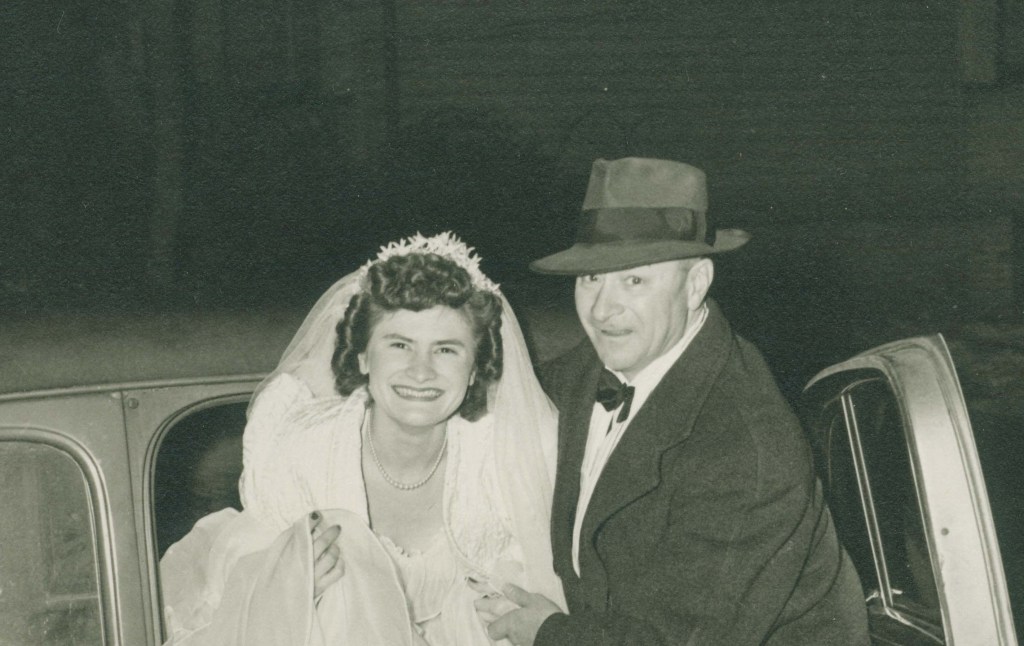
Alfred Tuttle died before I had a chance to meet him, but I heard from my grandmother stories about his wit and friendly manner. I’m 100% certain that all of the impressions I have of him being jovial and friendly, with an easy laugh and a pronounced New Jersey accent, come from Grandma.
When I look at these photos of Alfred, I can see his eyes and his mannerisms in myself and my family. That has to be projection, since, as I said, I never met him, but I did meet my Great-Aunt Lyle, and Great-Grandma Edna, and they all talked about him in the same warm and wistful way.
But does that tell me who Alfred Tuttle was?
Fun and Funny
I don’t know why, but my sister and I found the name “Tuttle” to be funny, which led us to ask about Grandma’s family as often as we could, just so we had an excuse to say “Tuttle.” And while none of the memories I have retained have a lot of detail, the family I learned about from Grandma’s answers was happy and well cared for.
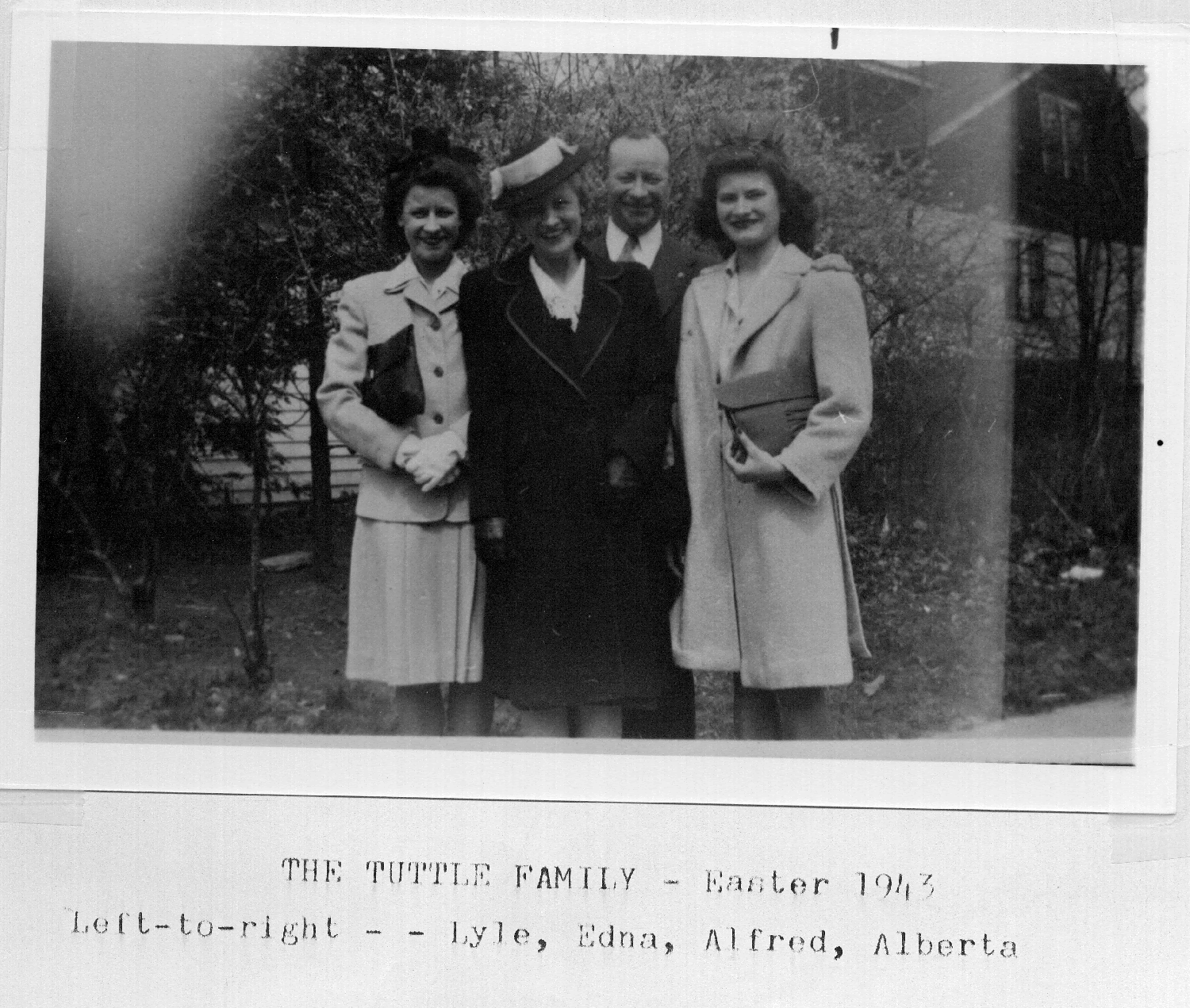
Here they are in 1943, when Grandma Alberta (on the right) was in high school.
From Grandma’s stories, I thought I recalled that her father was a grocer or a milkman, but the records tell a slightly different story. He was a grocery clerk in 1910, when he was 17, and he was a store manager for an A&P store in Irvington in 1917. But later, Alfred was a foreman and manager for the East Orange Coal Supply Co., listed on census records as either a “foreman” or “manager,” or as a coal salesman.
When the First World War broke out, he had enlisted in about 1914 and served as a bugler in the New Jersey infantry. By the time the U.S. entered the war, he was newly married, but he enlisted in the U.S. Army anyway, on 22 October 1918, a few weeks before the famous end of that war on 11 November 1918. He was discharged on 6 December.
Looking back, I wonder if I didn’t misunderstand a joke about “the milkman” being grandma’s father! That was the kind of thing grandma would say, because it was so absurd and outlandish, no one could possibly think it was true. And I wonder where she got that odd, naughty sense of humor, if not from her father.
At some point, I repeated a story back to Grandma that I thought I had heard from her: I remembered being told that Grandpa Tuttle didn’t want to pass gas in church, so he snuck to the back and stuck his backside out of the double doors. My sister and I had giggled over this (especially at church), but Grandma was horrified.
“My father would NEVER!” she insisted. “He was a dignified and respectful man!”
When I was older and began to take an interest in the family history, I remembered that story and her reaction to it, and I wondered a) where it came from and b) if that was why she was reluctant to tell me anything about the family.
After all, she would not want to spread gossip.
Watching For Bias
Knowing that my memory is flawed and that I can’t trust stories I’m told without some way to verify them is important. Equally important, though, is to capture what we think we know about people. Records can’t tell my descendants about Alfred’s sense of humor, or the fondness his wife and daughters carried for him, so we have to do that.
But I have to take care not to fall victim to the same biases that work when we don’t hear from people with a contradictory opinion. Just as we can’t assume that Grandpa Russ’s reluctance to talk about his family meant that there were skeletons in their closets, we can’t assume that Grandpa Tuttle was without his flaws. We just don’t know what they are!
The Tuttle Family
Alfred and Edna raised two daughters and led a quiet life in suburban New Jersey. From a genealogy standpoint, Lyle and Alberta stopped being Tuttles when they married Gus Kuebler and Russ Clark, and for years, I only vaguely knew that Grandpa Tuttle had siblings. When the name isn’t obvious, it’s easy for a new genealogist to lose track of who’s who in a family, and I think that’s what happened to me. Whether Grandma didn’t know them, or I didn’t recognize them by surname, my concept of Alfred Tuttle’s family always ended with him and his parents, John and Florence.
It wasn’t until I started looking in the census records later that I found out he was the oldest of a family of twelve! Born in 1892, Alfred had six younger sisters before a little brother came along in 1906, and two more in 1908 and 1913.
I don’t think Grandma knew her aunts or their children very well. If she did tell me anything about them, the names didn’t stick in my memory: Trautz, Hopkins, Geiler, Bogert, Langbein, and Limeberger. About half of them remained in New Jersey, and the rest married and moved away to Georgia, North Carolina, or Florida.
Alfred’s oldest brother was John S. Tuttle, born when Alfred was 14 years old. John had a son named Raymond, but Ray was a U.S. Marine who was killed in the Korean Conflict in 1954 at age 21. Robert and Richard, like Alfred, had only daughters, so none of my living Tuttle cousins carry that surname.
The End of The Line
That nagging bias towards patriarchy that genealogy forces on us because of how our surnames are passed down would look at the lack of living Tuttles as the end of that line, but the reality is that the family continues. And while the truth is that those of us who become aware of our connection to the Tuttle family through Alfred and his siblings are just at the beginning of discovering where we fit in the long history of that surname.
The earliest Tuttle I have found bore that name in 1185 A.D., and it shows up with a wide variety of spellings, mostly originating in England as a location-based name. How far back we can trace ourselves depends on the availability of records, the prominence of the individuals we’re looking for, and our determination.
But I don’t think of Alfred and his daughters as the end of the Tuttle line. For me, they are the beginning.


Say hello, cousin!