
It fills the “cup of woe” to brim,
The captives chains it rivets more,
And coldly tears the heart of him,
Who oft have drained the “cup” before.from “Ingratitude” – in War Poems, by John H. Callin
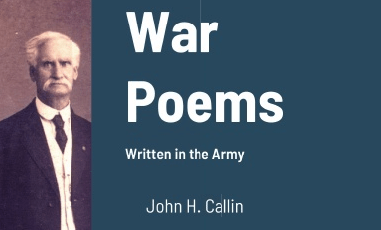
John H. Callin, my great-great-grandfather, was a Union artillery soldier during the Civil War. He wrote a book of poems about his experiences during and after that war, which we published a couple of years ago. (Learn more about that book at this link.)
We don’t know his whole story, but John suffered a lot during that war. Two of his brothers enlisted, and one of them, James, was wounded in action in two different battles. John wrote a poem about one of those battles in “The Assault on Ft. Wagner,” and even though we know that James survived, I suspect John did not know that when he composed the verse:
Then fallest from up a parapet,
But canst not fall from a brother’s love;
Though wounded by a rebel Sett1,
Yet still thou art thy mother’s dove.
John and James did lose cousins in that war, and probably neighbors, and certainly comrades in arms. John’s poetry captures his fears and the horrors he either witnessed or heard about on the battlefield. Reading John’s poems, you can get a sense of what was important to one Union soldier. His commitment to the Union cause, his distaste for the institution of slavery, his admiration for the officers who demonstrated courage, and his disappointment in the character of the rebels permeate these poems.
But something is missing from John’s body of work that I find surprising: not once does he mention the name Lincoln.
The Hero of the Story
By the time I came along, Abraham Lincoln’s assassination was more than a century in the past, and Lincoln was one of the few characters whose name survived the compression of American history into our middle school textbooks. Too many Americans only know that “Abraham Lincoln freed the slaves,” and almost no one knows how reluctant he was to do that much. He was pushed into many of the choices he made after the war began by people he considered to be “too radical” for demanding the banning of slavery–and even some of them were not radical enough to talk about giving freed men the vote!
I suspect that John might have been somewhat more radical than Lincoln, which could explain why he never included the President’s name in his poems. What I can’t tell is what it was that John was more radical about – because the philosophy he seems to adhere to sounds like that of the modern centrist, positioning himself as an Everyman, part of a “silent majority” that just wants stability.
John seems to blame “faction” (a word I see used by early Americans to describe party politics) for the war, acknowledging the evil of slavery, but hinting that partisans agitating for change were the cause of the conflict. He wrote poems praising or condemning both commanding generals, “Grant” and “Rebel General Lee,” as well as several heroes and villains of the battlefield. But as far as John was concerned, the “leaders” were to blame for the conflict, and he and the other simple patriots were doing the work of serving God and saving the promise of the country.
But still wage deep tainted harangues,
The politician!
Our country driven to madness, waste
Her loved fruition,
Sunk in the earth to be unretrieved
Till patriots combine.from “Our Government”
When Lincoln gave his Second Inaugural address one month before the end of the war, he ended on a conciliatory note that probably didn’t sit right with John Callin:
With malice toward none; with charity for all; with firmness in the right, as God gives us to see the right, let us strive on to finish the work we are in; to bind up the nation’s wounds; to care for him who shall have borne the battle, and for his widow, and his orphan–to do all which may achieve and cherish a just and lasting peace among ourselves, and with all nations.
That passage has been used many times over the past century to suggest that the North should let bygones be bygones with the South, while ingnoring the fact that the South refused to change its behavior towards the poor and towards the former slaves. But at least Lincoln said that following a paragraph in which he suggested the war was God’s punishment for slavery, saying, “Yet, if God wills that it continue until all the wealth piled by the bondsman’s two hundred and fifty years of unrequited toil shall be sunk, and until every drop of blood drawn by the lash shall be paid by another drawn with the sword…”
There is no guarantee that Lincoln would have been able to wrest the reparations he suggests were due to the formerly enslaved people of America out of the defeated oligarchy of the South, but at least we can see that it was on his mind, and he wasn’t afraid to say it out loud.
Enter, a Villain
The Confederate Army surrendered on 9 April 1865, and five days later, Abraham Lincoln was shot. His Vice President was Andrew Johnson, a Tennessee Democrat who had opposed the secession of Tennesse, and who had become Lincoln’s running mate in a bid to lure skittish voters worried that Lincoln’s Republican party was too radical.
After Lincoln’s death, Johnson was sworn in and immediately sought to “bind up the nation’s wounds” by pardoning Confederate officers and office holders, insisting that the States had never really left the Union, and demanding that Southern Congressmen – many of whom would not swear an oath to the Constitution or repudiate their actions during the war – be seated by Congress.
If you don’t know much about this episode in American history, I recommend that you find a copy of Brenda Wineapple’s The Impeachers, and give it a read. Much of it may feel familiar, considering that a large number of people were pardoned after attempting to overthrow the Constitutional government, those people were supporting an oligarchy that intended to disenfranchise as many people as it could to maintain a grip on power, and the President (who was rumored to be operating under diminished capacity) kept provoking Congress and usurping their Constitutional powers.
As I read about Johnson’s actions and the affect they had on the country, I can’t help seeing the events play out from the point of view of an angry veteran living in Ohio. I don’t know when he wrote “Our Government,” but as Johnson’s hobbling of the Freedmen’s Bureau and his betrayal of the Union he helped save progresses, I wonder which news compelled John to write:
And hovering round our fated land,
Clouds political,
Which point the dreaded agonies near,
The hour critical,
When demon worse than traitors dare
Imbrue our land.
Binding the Wounds
John married his first wife, Lucy Patterson, on 27 October 1865. I suspect (but don’t know) that she was related to his commander during the war, a Captain James Patterson. John’s pension record revealed that the couple divorced, having had no children. It also revealed John had been a Sergeant in his unit, but he was discharged as a private. It is possible that he received a temporary field promotion or that he got into trouble that resulted in a reduction in rank.
There are all kinds of reasons why a couple might divorce. We will never know what John and Lucy’s reasons were, but a lot of things could have happened in the nine years between the end of the war and John’s marriage to my great-great-grandmother, Amanda, in 1874.
All I can be certain of is that there was a girl named Lucy Patterson listed in the household of Martin and Abigail Patterson in Plain Township, Wood County, Ohio, and a marriage record for her and John H. Callin in 1865. I also know that John H. Callin is missing from the 1870 Census.
And I suspect that whether we’re talking about national events, like the betrayal of the former slaves and the failure of Reconstruction to form a more perfect Union, or more local, personal events, John H. Callin learned a hard truth about reconciliation. One can only wonder what influence his wartime experiences and his post-war frustrations had on him, and whether his marriage to Lucy was part of that story.
America’s story is littered with examples of our collective failure to learn from our mistakes. Every time we reach a crisis so dire that someone has to suffer the consequences, we either let the villains off the hook or give them a token reprimand and pretend to be “healed.”
The historical record tells me that Andrew Johnson should have been removed from Office, and the “radical” Republicans should have done more to protect the civil rights of the Black Americans they abandoned during the 1870s. Perhaps, had there been accountability for Johnson’s actions, Nixon might not have been pardoned. Bill Clinton might have been held accountable (though they hadn’t thought to make what he did a crime, yet, in 1997). Failing to follow through with accountability because that would be “too divisive,” and jumping from conviction to pardon without punishing the crime has become our national method for “binding our wounds” – but only for the powerful.
We are still doing that, as a nation. Lyndon Johnson, Ronald Reagan, and at least one Bush should have been impeached for war crimes. I could go on; I could include people lower on the order of succession than the president (Kissinger? Cheney?) and the obvious current examples, but the point is that we keep trying to bind the wounds without treating the injuries.
You can’t ask someone to forgive and forget if you aren’t willing to own up to the harm you did in the first place and make it right. And so, the wounds fester, and the infection breaks out again and again.
I will never know John’s whole story, but I have my suspicions about the outline of his dark decade. And I can’t help but think he could have been writing about any chapter in our history when he penciled his poems into his notebook.
Have we a broken, false, vile unjust,
Administration,
That statesmen derisively tender,
Their resignations?
Must great America blush in shame,
Her government fall?Ah, ‘Tis men who strive to supersede,
By self promotion,
The nobler, greater; and stoop to feed
This dark commotion!
‘Tis traitors false to their country, God,
Thus betray their trust.
- In this context, “Sett” most likely refers to a formation or emplacement “crowning” the fort – the word is also used in another of John’s poems, “Only a Private” (stanza 4): “His brow undecked by diamond setts”. ↩︎


Say hello, cousin!