
“What’s an ‘Ahnentafel’?” you ask – read this introductory post for my explanation.
TW: Part of this post deals with several tragic deaths, including a mention of suicide.
A Story of Strength
Our brains are full of shortcuts.
Some of these are biases we are taught by others. We carry some because when we were small, we observed the world around us, and those observations shaped us. Some of these shortcuts are “wired” into our brains from birth: behaviors we don’t think about unless we are forced to.
While some of these cognitive tricks can be explained as survival traits honed by evolution to help us quickly assess whether something rustling in the bushes is food or a predator, we tend to use them today to make snap judgments. Then we spend the time we would have been using to flee or to attack trying to justify our own hasty conclusions with confirmation bias and post-hoc rationalization.
All of that is to say that I made two different hasty judgments about Mary McCullough at two different times, and neither is based on solid evidence.
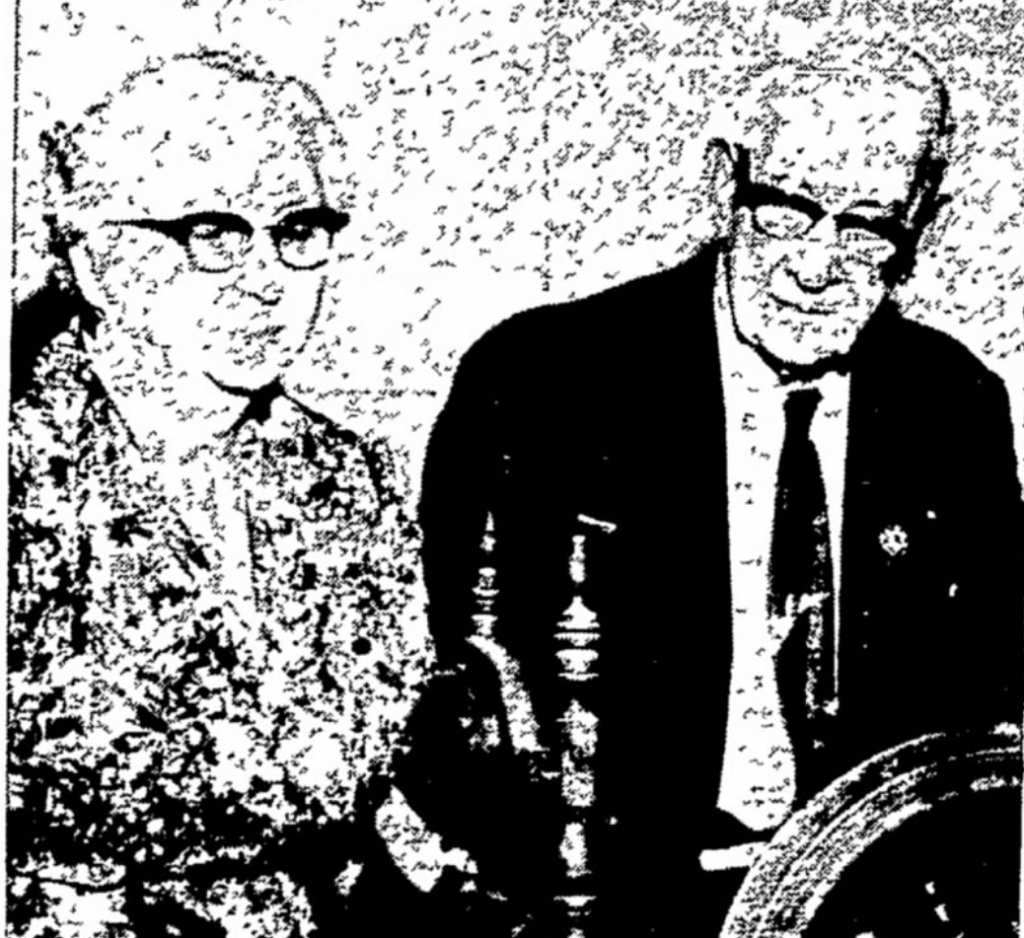
The first time I studied this family, I only knew her name and that there wasn’t much information about her available. My first impression was based on that lack of information, and I came away thinking of her as vaguely insubstantial. Elusive. Unknowable.
Later, when I had more experience and took more time to dig, my impression changed to that of a strong woman at the center of two large families.
So which version is true?
A Child of Immigrants
Mary Elora Blom was the oldest of five daughters born in 1886 to Bernard and Ida (Slight) Blom. They lived in Ackley, Iowa, where Bernard (known as “Barney”) worked as a carpenter and cabinet maker. Barney was born in the Netherlands, and his family settled in the United States around 1871. Ida was born in Ackley, but her parents were born in the German state of Prussia and had met and married in Illinois after immigrating with their families in the 1850s.
Unlike the poor treatment faced by Eastern European or Irish immigrants in the 19th century, the German Lutherans and the Dutch Calvinists were respected for their tight-knit, well-organized communities and their general work ethic. The German communities often formed local groups to help newly arrived families learn English and assimilate into their new country.
Mary’s sisters, Florence (born 1888) and Alice (1890), had survived at least one tragedy in 1893, when a fourth sister, Carrie, died at eleven months of age. Barney and Ida had one more daughter, whom they named Johanna, in 1900. They called her Jennie when she was little, but by the time she was 9 years old, “Jennie” had changed her name to Edith, and when she was old enough to insist on the spelling, “Edythe.”
When Mary married Earl McCullough in 1906, she was 19 years old and a graduate of the local school. Considering that her two maternal aunts, Anna Brinkman and Hilke Muller, lived in Ackley with their substantial population of cousins, and her paternal aunts and uncles mostly lived in Iowa, too, it’s easy to imagine that she didn’t want to leave her family behind.
I suspect that since Ackley was not a railroad town, Fort Dodge was a compromise between Earl’s hometown and her own. But she moved the 70 miles or so to a new town and started her life there with Earl.
When Family Is Lost
If you read Earl’s post, you know that in their first ten years together, Earl and Mary had two sons, Harry (1908) and Elbridge (1912), and then two daughters, Helen (1915) and Caroline (1917). Helen died at age two in February 1918, probably a victim of the Spanish Flu. But Helen’s death was not the first tragedy to hit Mary’s side of the family.
Those years were difficult ones for the Bloms. First, Mary’s sister, Anna Brinkman, died in September 1915 at only 53 years of age. Then, in 1916, Mary’s widowed grandmother, Anna Marie Blom, died in a house fire at 85 years of age.1 Two months later, Mary’s uncle George, who seems to have blamed himself for his mother’s death, committed suicide near the site of the fire.2 The following May, Mary lost her father in a tree-trimming accident:
While trimming a tree on Fred Trainer’s lawn, on Saturday, May 12, Mr. Blom was in the act of shifting his position, when the limb he was sawing broke down, and, coming in contact with a dead branch near, the limb turned and struck him in the abdomen. He sank into the crotch of the two remaining limbs of the tree, stunned by the force of the blow. Succeeding, a few minutes later, in climbing down the ladder, he finally reached home and Dr. Miller was called to give medical assistance. The case was so serious that the patient was kept under the influence of anesthetics to alleviate his suffering. The first glimmering hope of the family for his speedy restoration to health and strength soon vanished, especially as the patient could take no nourishment. Wednesday morning found him visibly worse. He was removed to the Miller hospital. A partial examination and operation were, however, that gangrene of the phlegmating, and he died in the faint hope that had centred about this last resort died away. … He died May 19, 1917, at the age of 55 years, 10 months and 16 days. (Ackley World Journal, 24 May 1917)
All of these losses would seem too much in normal times, but these were also the years of the First World War, and when seen against the backdrop of those events, these three years must have taken a toll. But Mary and her family carried on, and the 1920s seemed much happier in contrast.
Filling In Gaps
We can see the evidence of these events, and we know how people usually respond to these kinds of tragedies. But I can only guess at how the McCullough family weathered them. I can form an impression of what Earl’s and Mary’s personalities might have been like, because I know some of their grandchildren and great-grandchildren. I have some idea what they are like.
But I don’t know how Mary and her family related to each other or how they dealt with these events. Were they stoic in the face of grief, carrying on with the business of life? Did they bottle up their emotions, or did they spend more time with the rest of their family, sharing stories and talking about their loss?
I suspect the answer depends on factors that never show up in records. Even when I find a heartfelt obituary or expression of sympathy in a newspaper, I don’t usually know who wrote it. Or, if I do know that, I know that it was written by a pastor or social organization, and may not be an accurate reflection.
What we do know is that Earl and Mary raised their family through the 1920s and the Great Depression, saw their grandchildren grow up, and lived into the 1960s. Earl was 80 when he died in 1961, and Mary was 79 when she died in 1965.
As for the details that live between those dates, they kept those to themselves.
- Evening Times-Republican, “Mrs. Bernard Blom Cremated In Her Own Home,” Marshalltown, Iowa, Mon, Mar 6, 1916, Page 5 ↩︎
- Evening Times-Republican, “Blom Ends Own Life,” Marshalltown, Iowa, Mon, May 8, 1916, Page 4 ↩︎


Say hello, cousin!