
Remember the Callin family of Milton Township, Ohio? That link will give you an organized list of previous posts.
In the origin story we tell ourselves, our pioneer ancestors entered an empty wilderness and built something enduring and lasting out of it using only their rugged individualism. The Callin family did help build a new town in what had been (to them) wilderness, but they were part of the fabric of a larger community, and they moved in after more than a century of fighting between the indigenous populations and the French and British colonies had finally ended after the Revolutionary War.
Versions of that origin story are abundant, especially as we approach the 250th anniversary of the Declaration of Independence. Few of us know enough about the details of our ancestry to see past the myths, but you can see examples of the work done to learn those details by visiting Projectkin’s Stories250 (which, for full disclosure, includes some of my work).
For me, the journey from not knowing to knowing began with the myth I inherited about William Callin, the son of John Callin and Elizabeth Simon, who was brought to Milton Township as a small boy.
Classical Greek Myth-making
The first information I learned about William Callin was published by his son, George W. Callin, in The Callin Family History:
“William Callin was 3 years old when his father moved from Penn. To Ashland, Ohio. He grew to manhood on the old farm. Married and lived there till 1849 when he moved to Huron Co., Ohio; bought and cleared up a new farm. In 1861 he bought and moved his family on to a farm in Wood Co., near Bowling Green.
“He was a perfect specimen of physical manhood, six feet tall, weight 200 pounds; all bone and muscle. Few men equaled him in strength. He followed clearing timber land and was badly crippled with rheumatism in old age.”
That second paragraph is the writer’s equivalent of creating an idealized marble bust for display.
Another two paragraphs about William appear in the biographical sketch of his son, John H. Callin, which was published in the Commemorative, Historical and Biographical Record of Wood County, Ohio, published in 1897.
His father, William H. Callin, was born at Callinsburg, Clarion Co., Penn., September 10, 1813, and was the fourth son in a family of nine children. He was an industrious, hardy, persevering man, possessing great physical strength, but had only a limited knowledge of books. He had a mind of keen perception and sound judgment, and was well fitted for pioneer life. In 1831 he accompanied his parents to Ashland county, Ohio, where his father entered a tract of land from the government, becoming one of the first settlers of that locality. William Callin aided in clearing and improving this property, and finally, on the death of the father, in paying it out of the land office and receiving title (the land having been entered on what was termed the ninety-nine-year lease). In 1835, he married Elizabeth, daughter of John Barlin, of Ashland, and of their union were born eight children, the eldest and youngest dying in infancy…
In 1849 William Callin removed from Ashland county to Peru, Huron Co., Ohio, locating on a farm of eighty acres which he sold in 1860, preparatory to his removal to Wood county. Here he settled on 160 acres of land in Plain township, and, on his retirement from farming, took up his residence in Bowling Green. He was an exemplary man, of high Christian character, and a consistent and faithful member of the Methodist Episcopal Church. He supported the first Republican presidential candidate, John C. Fremont, and was ever afterward a stanch advocate of the party. His death occurred in Bowling Green, December 11, 1881. His widow still makes her home there, and is now in her seventy-ninth year.
The author of this sketch is not credited, but I suspect it was either written or drafted by Byron Herbert Callin1, John Henry’s son and William’s grandson, who would have been 7 years old when William died in 1881. If Herbert wrote this sketch in 1896, he was 18 years old, and his own biographical sketch appears later in the same book. If he did not write these sketches, I suspect he at least provided the information to whoever did
It might seem odd that a publisher would simply print the unverified hagiography of a young family member, but that tracks with what we know about how these sorts of books were compiled. As Jennifer Shakshober wrote for American Ancestors2, “Often the uncited histories still include an author’s note regarding sources, but in many instances the book presents information on families derived from the author’s own correspondence with descendants rather than from contemporaneous records.”
What We Choose to Believe
When I first saw the claim that William “was born at Callinsburg, Clarion Co., Penn., September 10, 1813,”3 I dismissed it as a mistake. Callensburg is a real town in Pennsylvania, and when I read about its history, I learned that the town was not surveyed or laid out until 1826, on land purchased by Hugh Callen in 1812.
Who Hugh Callen was, and what his relationship to James and John Callin might have been, is a question for the Callan Name Study, but my first thought was that William could not have been born in a town that did not exist until 13 years after his birth. Yet, if we ask why the author of the sketch thought he was, or why the author wanted to believe that, we might reveal a clue about the Callin family’s origins.
George Callin told us the families came from Westmoreland County, PA. Clarion County was created in part from Armstrong County in 1839, and Armstrong County was formed from parts of other counties, including Westmoreland County, in 1800. If he were three years old when his father moved the family, William might not have known precisely where he was born. So, when his son began digging into the family history and learned of the existence of this town, it’s possible William said, “Oh, that’s where I was born!”
The facts don’t conflict with the image we are given of William, though. Both accounts agree he was strong, and he cleared timber from a lot of land. He either built or improved two or three farms before retiring to live in Bowling Green. George’s emphasis on William’s physical strength and Byron’s statements about William’s education suggest that William may not have been more than basically literate.
We know from the memoir of George’s daughter, Rosemary (see Silk or Satin), that William and his brother, George, were committed to ending slavery, which would seem to agree with the Wood County account’s description of his political leanings. Rosemary also recalled that “William paid his taxes by cutting wood and hauling it into town, 50 cents a load.”
When I moved into my house in Maryland in 2005, I had to remove two young pine trees. Chopping them down, trimming and bundling the branches, and digging out the stumps took me weeks, and I can still feel the ache from the hard work twenty years later. Imagining William toiling for half a century across Ohio is a visceral image accompanied by a deep physical appreciation for the work that he did. That picture of William as a strong, hard-working man who put his beliefs ahead of his own safety feels correct and admirable.
And that is the basis for a Family Myth.
Things Happen In Stories
Another common element of the sketches is how static William’s portrait is. I attribute that to the Classical education that George and Byron (again, assuming he wrote the second sketch) were given. They would have been taught to think of historical figures as a single thing, characterized by what they accomplished, not as whole, evolving people with their messiness and their inner thoughts.
But William was a person, and people don’t sit still. They change as they grow, and whatever strength we hear about after they’re gone was seen by those who tell the stories.
Life in Milton Township was, technically, frontier life, and William’s family was part of the community that would someday grow into Ashland. His aunt Mary was a founding member of the Hopewell church, and his mother was almost certainly a member there, too. He may have been taught to read by Olive Montgomery, the sister of the three Montgomery kids who married three of his Callin cousins, though he would not become a scholar.
William was seventeen when his uncle James was killed by a man named Fowler, possibly a neighbor. His father died fifteen years later, the year before William married Elizabeth Berlin, a girl whose family had come from the Pennsylvania-Maryland state line, and whose German heritage was strong enough that no one in Richland County knew exactly how to spell her name. (“Barlean? Berline? Barlin?”)
We know now that William’s farms were successful and that his children would grow and thrive, but those first ten years of his marriage would not have been easy. He and Elizabeth lost their first infant, and then his family began moving away, a few at a time. His girl cousins and older sisters married and either died young or moved further west with their husbands. His boy cousins married and took their mother, Aunt Mary, to Iowa. His cousin James married his baby sister, Margaret, and took her away to Iowa.
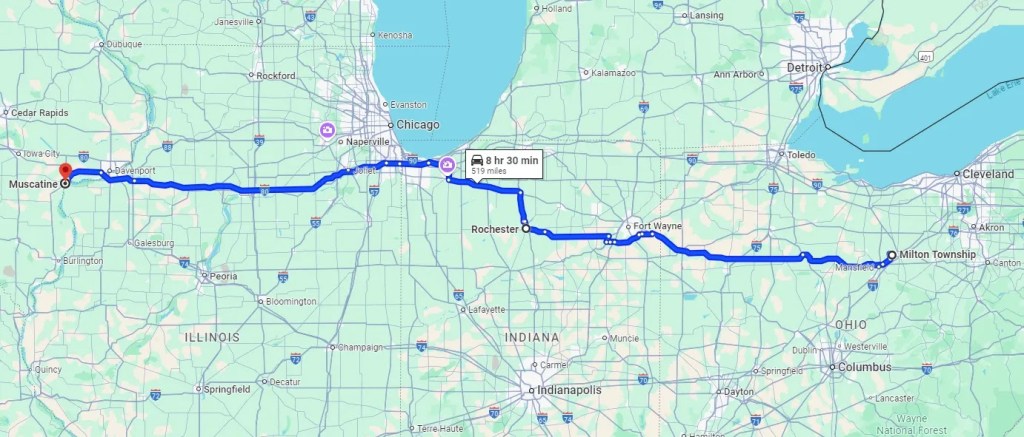
Then, around 1844, he probably got a letter telling him of an outbreak of one of the horrible prairie diseases that frequently claimed so many lives. His cousin Hugh, Aunt Mary, and his cousin James: all gone. Being a practical man, I would guess that he took a strong horse and rode the 500 miles to Muscatine, Iowa, then outfitted a wagon with oxen to bring back Margaret and her two small boys.
What William thought about on that 1,000-mile journey must have shaped the man we later saw running enslaved people through a network toward freedom, risking his own life and the sweat equity he had poured into Ohio. And we may not be able to know what he thought, but because of the efforts of his descendants to capture his likeness in their sketches, we can tell ourselves this story about people who took care of each other and worked hard. And maybe we can relate that to our identity and build it into our stories.
Because that is what Myths are for.
- If you haven’t read Prof’s Progeny, my earlier piece about Herbert’s colorful life, it’s worth remembering that his sketch in the Wood County book was published when he was only 20. ↩︎
- Shakshober, Jennifer, Vita Brevis (American Ancestors), “The Origins of County Histories, Biographical Sketches, and Mug Books“, February 10, 2026. ↩︎
- More than one error, actually: I think there is a misprint in the text: “In 1831 he accompanied his parents…” should read “In 1813…” ↩︎
 Mightier Acorns
Say hello, cousin!