
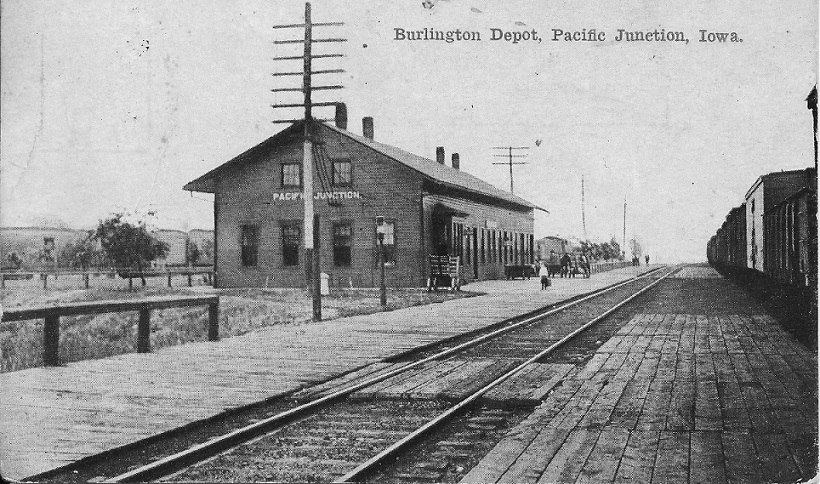
“What’s an ‘Ahnentafel’?” you ask – read this introductory post for my explanation.
(If you noticed that this post is going out later than usual, I apologize. I had an unexpected technical failure. If you didn’t notice, then I accept your apology. Just kidding – we’re all busy.)
As We Go Back Further…
I find writing family history to be very different when I’m writing about people I don’t (or didn’t) know than when I’m writing about people I did (or do) know. The burden of the task shifts from an exercise in taking my perceptions and flawed memories and turning them into an interesting narrative that can be backed up with facts from documents, to the opposite task of spinning what I know about the context of the facts into a relatable story.
It’s important that you, the audience, understand that neither story ends up being entirely “true,” because, even when I’m familiar with the person I’m writing about, I can’t possibly know all of the context. But I learned an important lesson when I wrote my own memories down and put them in a book: even I don’t know my whole story.
So, as we go farther back along the Ahnentafel tree, the people I write about will become increasingly unfamiliar to me, and to you, and we’ll glean whatever truths we can from what we can learn about their lives.
The Eldest Son
Don Shuffler was born on 13 May 1909 in Pacific Junction, Mills, Iowa. He was a few months shy of his tenth birthday when his father, Frank, was killed in an accident at the railyard where he worked. In 1920, Don lived in a household with his mother, Virgie, his four younger brothers, and his grandmother, Virgie’s mom, Mary Ann Ballard.
(You may recall reading about Frank and Virgie’s story in The Ballad of Mrs. Steele, and Mary Ann’s in Raising the Rupes.)
As you might expect, times were hard for the Shufflers after Frank’s death. Virgie had to work to support the family, and that probably wasn’t a problem as long as her mother was there to help tend the boys. But sometime between when this photo was taken and 1925, Mary Ann moved to Oregon to live with her oldest daughter (Virgie’s sister), Florence Kim.
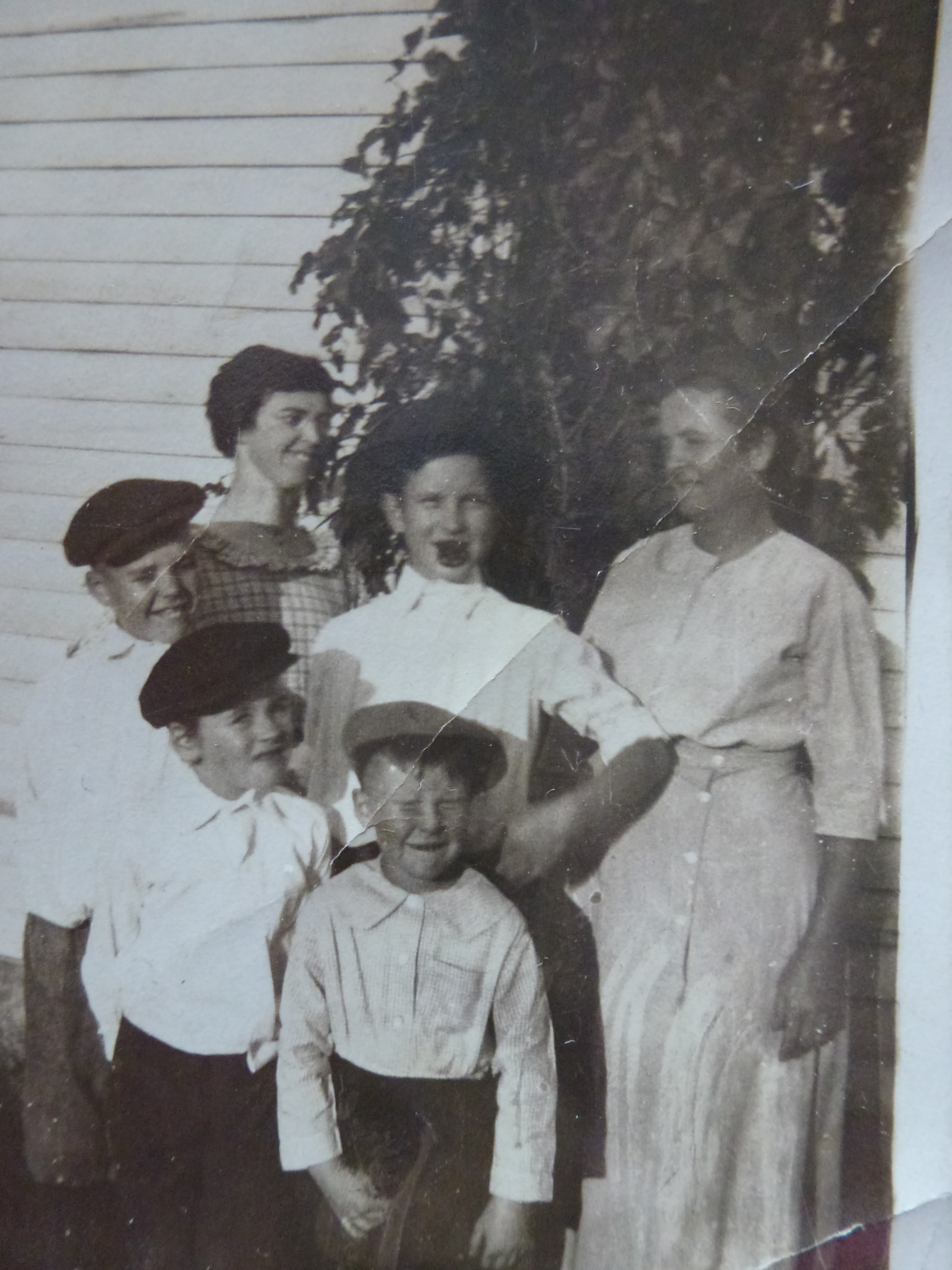
In 1925, Don (15) and Duane (9) lived with Virgie in Council Bluffs, but the two middle boys, Darrell (13) and Dale (11), resided in the IOOF children’s home in Mason City, halfway across the state. The International Order of Odd Fellows (I.O.O.F.) dedicated the Orphans’ Home in 1903, and it housed both orphans and elderly residents. Sending her boys to live in another part of the state was probably difficult, but there is evidence that they were well cared for:
Luella “Susie” BOUCK left the Iowa Odd Fellows and Orphans Home in 1930, at the age of 18. …”It was a good place to be,” said BOUCK of her early years at the home. … There were 123 children in the home when the ROSE children came. Her other siblings — Genevieve, Barney, Fred, and Dorothy — were placed in different departments, but “we were able to see each other; we were in close contact,” she said. … Unlike the Dickensian caricature painted of many orphanages of that era, the I.O.O.F. Home “was a wonderful place,” BOUCK said. … “I tell people that those were the best years of my life and I mean it,” BOUCK said.
~”Orphan Comes Home,” The Globe Gazette, Mason City, Iowa, published Sat. January 3, 2009; archived on IAGenWeb.
By 1930, of course, Virgie had married Orin Steele and moved with him and her three younger sons to Cambridge, Maryland.
And Don stayed behind, because his life was in Council Bluffs.
An Early Start
It’s not clear when Don Shuffler was hired to work for Pacific Fruit Express, but in 1930, he was listed as an iceman, which means he was working on the icing platforms built to cool produce as it was shipped cross-country.
But what truly kept him in Council Bluffs was his young family. At 17, he married Esther Thompson on 4 June 1926. By the time his mother and brothers moved back East, he and Esther were the parents of two girls, Elaine Winifred (born December 1926) and June Margery (1928).
The 1930s were hard on everyone, but Don’s steady job with PFE meant that his family was provided for during the Great Depression. Don worked for PFE for 45 years, working in both the Council Bluffs and Omaha plants. He retired in 1974, just two years before he became ill with leukemia, and three years before he died in 1977.
Don outlived all but one of his younger brothers, Dale, who died in 1987. Their lives were in Maryland, but the impression I have is that they remained close despite the distance, probably because of their difficult beginnings.
An Early End
It feels like it’s too early to end Don’s story. There are bound to be stories and memories that his family can share that aren’t captured in records or newspaper items. Ending his story now feels like we’re eliding the years in between, but we should also remember that 45 years with the same company, making a full and complete life out of that career, is something that is hard to duplicate. Working for that long with the same company is almost unheard of these days, and “moving on” is often the key to success.
And while 68 may seem very old to you, especially if you are young, it represents a longer life than many deserving people get. Don got to see his daughters grow up and meet his grandchildren. He had friends and a family who loved him.
I may be leaving the years between his marriage and his death unexplored today, but it’s worth recognizing that he did lead a full life in those years because of his partner and his daughters.
And we will fill in some of those years next time.


Say hello, cousin!