
“What’s an ‘Ahnentafel’?” you ask – read this introductory post for my explanation.
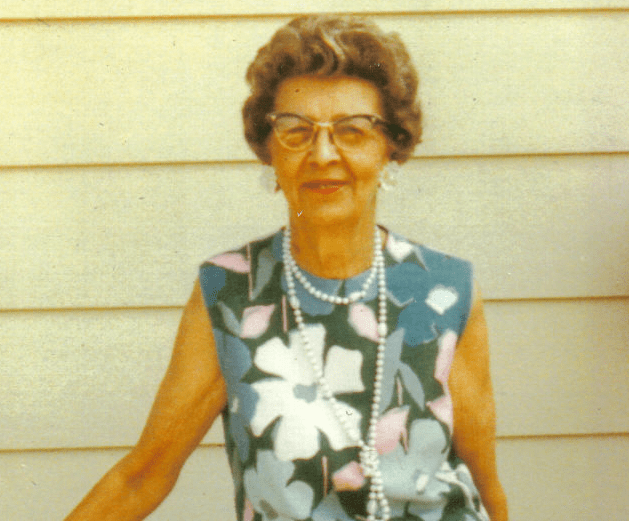
Aletha Putnam was born a month and a half before the 20th century in New Albany Township, Indiana.
Her family moved to Council Bluffs, Iowa, about 1905, and Aletha spent the rest of her life there and in nearby Omaha, Nebraska. She married Howard Martin, and like many of the women we will write about as this Ahnentafel series continues, it will be hard to separate her story from that of her husband and children.
But we do have one important source that other, earlier families will lack, and I think you’ll agree that it provides a great deal of light and color that would otherwise be missing from Aletha’s story.
Douglas’s Memories
Howard and Aletha had three children: Douglas (1920-1997), Merilyn (1923-1997), and Charles (1928-2016). Douglas left an unpublished memoir in which he recorded memories of his childhood. Any quotes in this post come from him, and while I have no reason to question the general facts of his account, I will point out that it’s difficult to cite an unpublished source like this on any of the usual family history platforms.
“Howard William Martin was my father and Frederick Aletha Putnam was my mother. Dad called her ‘Putty’ before they were married and then referred to her always as ‘Aletha’ or just ‘Leath’ for short. To everyone, she was known as ‘Aletha’ or ‘Leath’. …My maternal grand-mother was a very headstrong person. I could not say her real name, Daisy, so I called her ‘Deedaw’ and everyone else called her ‘Deedaw’ too. This is how her name became ‘Deedaw or Deed’ for short and everyone thought this was her real name. Nothing has ever been found, and nothing was ever written on this important subject.”
Douglas’s joke that “nothing was ever written” about his family is technically incorrect (since he wrote about it), but it also makes the larger point about what does and doesn’t make it into the historical record. There are always things that we “just know” about our families that never seem to get written down, like the origins of nicknames or what people’s personalities were like.
The thing to keep in mind about a memoir like Douglas’s is that it captures one person’s limited perspective. It’s less of a photograph and more of a pencil sketch, and we might be able to find enough records to support some facts, but we’ll never really know what the full color reality might have been.
“Most of her married years, my mother spent enjoying being a housewife though, after a highschool major in domestic science. Dad was working regularly days as a city salesman for Mona-Motor Oil Co. and was actually a salesman all of his life. But he still volunteered evenings as the first KOIL radio announcer and he and a friend, Ed Hess Jr, played in the radio station’s orchestra. Mother and I were also ‘volunteered’. She answered the phones and I delivered all of the requests in the other room to Dad to be announced over the air ways.”
Building a picture of who Aletha was may never be a completed project, but we can at least begin to sketch it with these few lines.
One Family’s Faith
For Aletha’s story, Douglas tells us this pertinent fact about her father:
“I knew my grandfather Charles Walter Putnam for only the last 2 years perhaps of his life. … This person was a Christian Scientist through and through.”
Christian Science originated when the Church of Christ, Scientist was founded in 1879 in Boston by Mary Baker Eddy, author of Science and Health with Key to the Scriptures. Charles Putnam was 20 years old in 1879 and had spent part of his childhood in Rochester, New York, and part in Brownstown, Michigan. He moved to Indiana from Rochester in 1880 to live with his maternal grandparents.
We may not know much about how or when Charles became a Christian Scientist, or what specifically that meant to him, but we can find some clues in the stories that were handed down.
“My father was raised in the Methodist Church next door to where they lived and my mother was raised a Christian Scientist in New Albany, IN, before moving to Council Bluffs. I can’t remember either of them ever going inside a church of any kind after I was born. After I was able to drive a car, Dad would let me drive his car only to the Christian Science Sunday School if I would drive Merilyn and Charles. He finally found out that I only left Merilyn and Charles at Sunday School and then I drove all over town till it was time to pick them up. After that any driving of his car ended rather abruptly. That was the end of my church-going days too. Merilyn was later married in and joined the Lutheran Church in the Maplewood section of Omaha and Charles joined the Episcopal Church, I guess.”
The story that I heard from my wife’s family (shared over the course of several holiday gatherings, so I couldn’t attribute it to anyone in particular) was that Aletha’s family was unhappy that she married someone who was not a believer in Christian Science, but that she insisted on raising her children in her faith.
I was told that when he was young, Charles broke his leg in an accident. The family (probably referring mainly to Aletha and Deedaw, by that point) believed, as a tenet of the Christian Science faith, that the physical realm is an illusion, and medical treatment is not necessary. So Charles’s broken leg was not treated, and during his youth, his legs were different lengths. But by the time he enlisted in the service (during the Korean War), the bones had evened out enough for him to pass his physical. This was treated at the time as evidence of a miracle.
When I heard this story from Merilyn’s family in the late 1990s, the consensus was that there was a more conventional, physical explanation for Charles’s recovery. Given Douglas’s few comments about religion, he might have agreed with that assessment, and if Charles joined the Episcopal church later on, that would suggest he felt the same way.
By then, of course, Aletha was no longer around to present or defend her point of view.
Homemaking
Douglas’s memoir is a gold mine of casual references to his family, but some of these references are difficult to parse into a description. The memoir itself is 29 pages (including one page that reads, in its entirety, “Since retirement there has been nothing consequential that I have done that I am proud of.”) and the narrative tends to ramble and contradict itself.
Still, there are insights about Aletha and the home she made throughout his recollections.
“Deedaw being widowed at a very young age [Charles died in 1922] spent most of her years as a baby sitter for us Martin kids. She was also a great companion and occupied most of her time in needle-work except when she could con Mother into creating the latest craze of needle-work, crotcheting, decaling, knitting, or ornamental furniture painting. They both loved doing things of that sort during their spare time. … When I was about 13 or 14, as a craze, Mother began knitting and took to it feverishly. Her entire wardrobe was all of knitted things, dresses, shawls, light coats, Anything that was knitted, she made and wore them. She also was very good at it and very, very fast. She was encouraged to start a knitting shop in the Chieftain Hotel selling yarns and supplies and teaching her clientele knitting. She was very well known in Council Bluffs and had accumulated a large group of girls. This she did and made a very livable wage from it. But she soon tired of it and complained. We then moved to Omaha.
“Every Saturday morning after I had helped with the breakfast dishes and put them away, my mother instructed me to help her with the upstairs cleaning. … I began these chores by shaking and then sweeping all of the small throw rugs followed by my helping Mom change the top sheets to the bottom and put fresh top sheets on all of the beds and then dusting everywhere. I couldn’t go out to play until all of this was done. Generally these chores took all of each Saturday morning. After many of these Saturdays my interest in general housework became natural and even likable. My mother soon found out that I was very interested in girls, so one Saturday during our usual cleaning chores she took it upon herself to tell me about “the birds and the bees” and where kids really came from and all of that ‘neat’ stuff. This was very timely and a very natural surrounding to talk about this subject. I felt very close to Mother for this revelation. Dad would have never have done anything like this and left it entirely to Mother. He also personally would have given me HELL if I got into any kind of trouble with a girl. What a coward he was about things like that!!”
Meal times in the 1920s and 1930s provide some color:
“I do remember that Mother was famous for all of the foods that she prepared. Though her selection of foods was, by my imagination now, very limited. She won that water heater and its installation by submitting her “Burnt Sugar Cake’ with ‘Burnt Sugar’ frosting. I can still remember that her cakes were never taken from the pan they were baked in, but kept covered neatly with a folded but clean ‘TEA towel’. How was that for quick access? She graduated from highschool majoring in domestic science. What else? We always ate the dinner meal in our dining room. Dad insisted on Bean Soup once in while. He insisted on any fish on occasion but never got that. We had chili with kidney beans and baked potatoes, round steak, Welch Rarebit over crackers just to name a few of my favorites. Many vegetables with those meals and always a salad. Dad never got his way about the fish for dinner though.”
And the family’s traditions, like many families, did not change just because the law did:
“Remember these were PROHIBITION days! We positioned the “beer” crock close to the floor drain on a special box that was just the right height and covered the crock with a clean “TEA” towel. We could peek now and then to watch it “work” daily until it was time to bottle it. With my help, Dad and I would wash the old quart bottles and rebottle his “home-brew” that he was so very famous for and then age it in Mother’s “cool cabinet” that he built. After the beer had sufficiently aged, we would share it with guests or neighbors all standing around the porcelain topped kitchen table with a special aluminum cook pot that we had, with one piece of ice in the center of it and the beer, of course, from quart bottles poured over the ice. The pot was then passed around and all of us drank from that same pot. I got to taste some of it. That was good stuff!”
While it may be hard to read between the lines and tease facts out of this kind of narrative, it does give us some rich impressions of the way these ancestors lived. The key to reading between the lines, though, is to have as many lines to read between as you can get.
For most ancestors, that’s the only way you have left to get to know them.
 Mightier Acorns
Say hello, cousin!