
“What’s an ‘Ahnentafel’?” you ask – read this introductory post for my explanation.
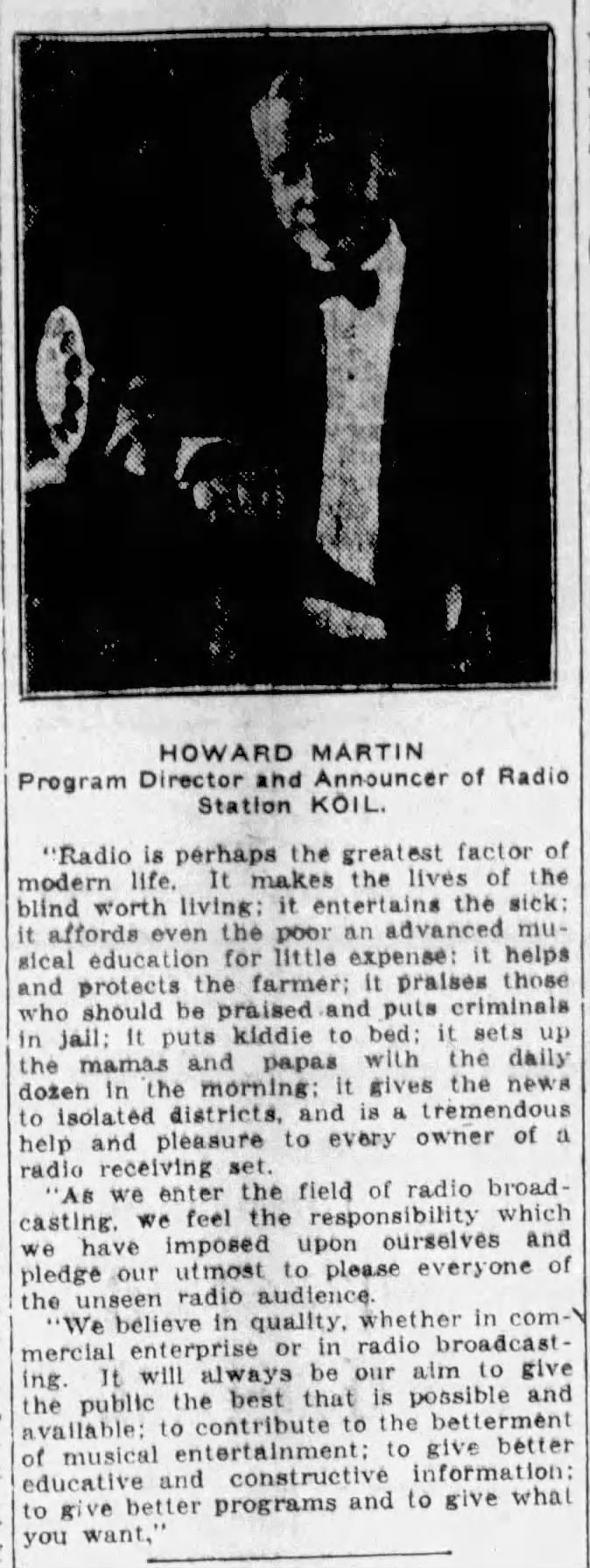
Howard Martin was a World War I army veteran and businessman in 1920s Iowa. He ran his own Texaco filling station and held positions at several successful companies. He even had his own radio program on the local Omaha radio station, KOIL, where he was known as “Here-We-Go Howie”. You can see from this 1925 opinion piece that he thought very highly of the radio:
Howard was the only child of William Findley Martin (1874–1943) and Harriet Jenevereth “Hattie” Shepard (1874–1923). His father worked in the railyards, and Howard grew up and attended school in Kane Township, Iowa, near Council Bluffs.
Balloon Man
Howard enlisted in the U.S. Army on 25 Oct 1917 and served as a corporal in the Balloon Corps organized under the Aviation Section, U.S. Signal Corps. He was assigned to the 6th Balloon Company, 3rd Balloon Squadron, and shipped out from New York aboard ship No. 501 on 31 Jan 1918.
The 6th Balloon Company arrived in France on February 20, 1918, under the command of Major Arthur Boettcheer. After training at artillery firing centers in the Services of Supply, they went to the front in July 1918. The Company was assigned to the V Corps at Ravine Jouy-en-Argonne at the opening of the Meuse-Argonne offensive. They brought down two enemy planes within 24 hours. They directed artillery fire, sometimes using carrier pigeons to transmit messages, as regular telephone and radio communications were difficult to maintain with the daily redeployment of balloon units. By 11 Nov 1918, they had advanced to Montfaucon. One of their missions involved dropping propaganda leaflets over enemy lines.
In a 1961 dissertation, Sam Hager Frank1 described balloon operations like this:
On September 17, 1918, at Dommartin-la-Montagne in the St. Mihiel salient, the first eight balloons were successfully floated over the German lines by the 6th Balloon Company. These balloons and the ones subsequently used were supplied by the French. About nine feet long, they were made of chemically treated paper and could carry four pounds of leaflets (about 600 sheets). The ballons utilized a simple release consisting of a fuse and hangers to which bunches of leaflets were attached. As the fuse burned, the wire-bound bunches of paper fell free and scattered.”
Family Man
Sgt. Howard Martin was discharged from the service on 19 May 1919, and he married Aletha Putnam (1899–1981) on 3 Jul 1919 in Pottawattamie County, Iowa. They resided with Aletha’s family in 1920.
Howard and Aletha raised three children in Council Bluffs and Omaha. (Omaha, NE, and Council Bluffs, IA are located on either side of the Missouri River.) Douglas was born in 1920, followed by Merilyn in 1923, and Charles in 1928.
Howard started out as a salesman, then became successful running a filling station for the Mona Motor Oil Company. As mentioned above, he was the first announcer and program director for their radio station, KOIL, during the 1920s. After 1930, he worked in sales for several companies, including Firestone and Texaco. In the 1940s, after the Second World War, he gave his son-in-law, Bud Holmquist, a start in one of his businesses.
Howard was 73 when he died at an Omaha hospital on August 10, 1970. He was remembered as a former member of the Broadway United Methodist Church and as an organist for the Elks Club.
- Frank, Sam Hager; American Air Service Observation in World War I, PH.D Dissertation, University of Florida, Aug 1961; pgs. 141, 341, 378, 380. ↩︎


Say hello, cousin!