
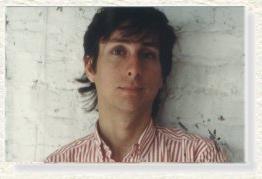
The Callan Name Study keeps growing, and as it does, I keep finding interesting people to tell you about.
If you know of an interesting Callan (no matter what spelling they used), take a look at the master list (a spreadsheet you can find here or on WikiTree) and see if I have them in the database. If not, you can add them with this form!
An Acoustic Personality
Meet Michael Callen, a singer, songwriter, and activist known for raising awareness about AIDS in the late 1980s and early 1990s. Here he is with The Flirtations, an a cappella group that was featured on the soundtrack of the 1993 Tom Hanks/Denzel Washington film, Philadelphia.
In this TV appearance, Mike is the tenor in the white shirt:
Born in Rising Sun, Indiana, Mike died at age 38 at Midway Hospital Medical Center in Los Angeles, California, from AIDS-related complications of pulmonary Kaposi’s sarcoma.
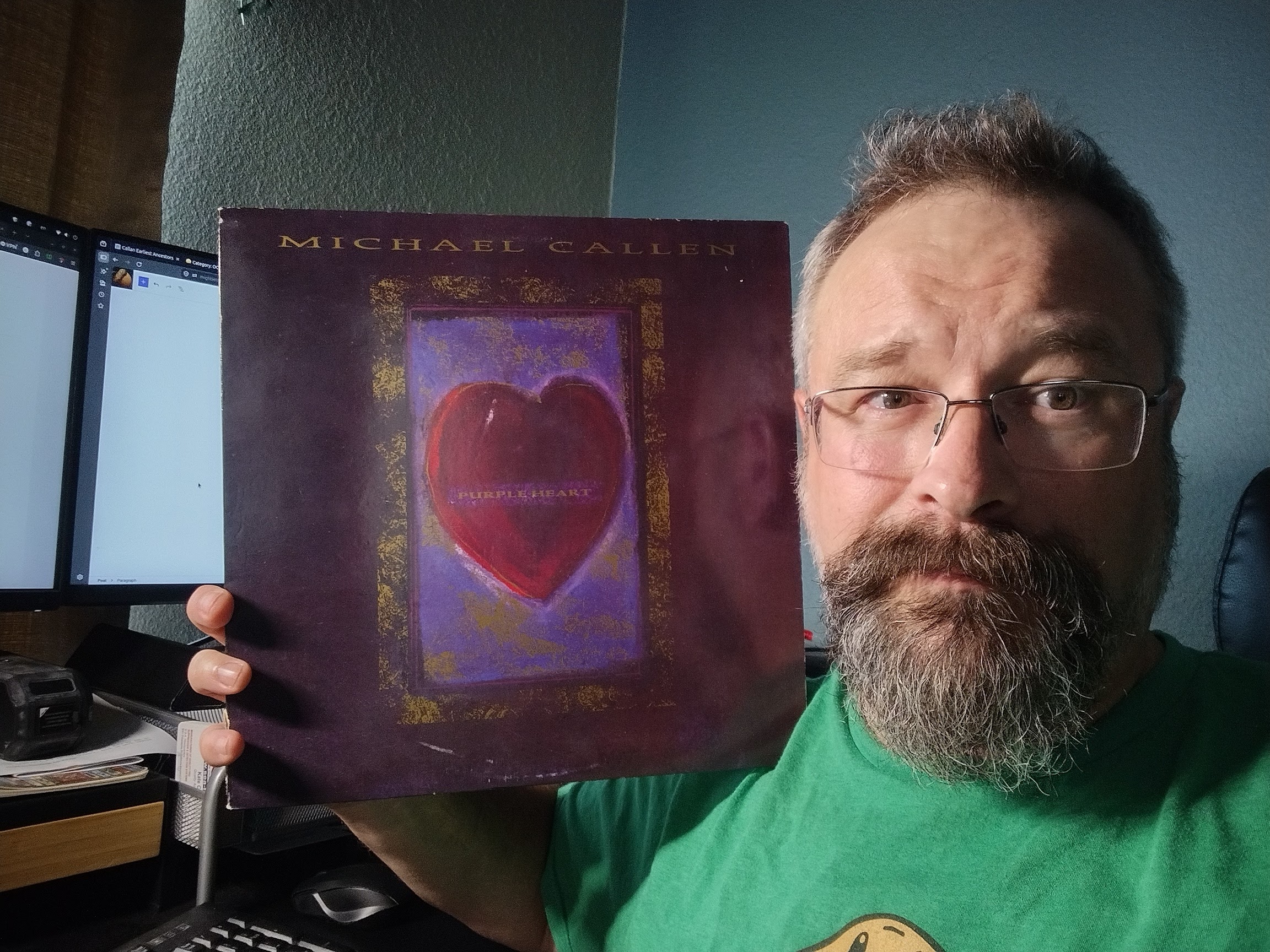
Despite his short time on Earth with us, he was an author, activist, and singer-songwriter who released a solo album, Purple Heart, in 1988. He wrote most of the songs for the album, and to my ear, there are some sonic similarities to folks like Joe Jackson as well as the obvious nods to Elton John. (Track one is a cover of “Where the Boys Are.”) A 2-CD collection was released after Mike’s death, and you can find all of his music on his website if you’re interested.
The Family Connection
I don’t yet know whether Michael and I share a common ancestor, but his ancestors are already included in the Callan Name Study on WikiTree. Beginning with his WikiTree Profile, I can see that his 2nd-great-grandfather was James A. Callen (1833-1862), whose family lived in Kenton County, Kentucky. As best I can tell, the paternal grandfather of James A. Callen was John Callen, who was probably born around the time of the Revolutionary War and settled in Kentucky before the birth of his son in 1806.
Since my most distant known ancestors were the brothers, James and John, who settled in Ohio between 1810 and 1816, it is almost certain that John Callen of Kentucky was not another son of their father, James Callin, whom The Callin Family History refers to as “James 1st.” I can’t rule out the possibility that John was a nephew of James 1st, because we don’t know if James had any brothers, but without more information about both men, there is no reason to think that they were related that closely.
But regardless of how distant our common ancestry may be, we share a surname, and our ancestors shared similar experiences settling the interior of the North American continent during the late 18th century.
Or, to put it more broadly… we’re all cousins if we go back far enough!
Morality Plays
I was a junior in high school when Purple Heart was released, and I probably would not have related to the subject matter or the style of the music Michael was making at the time. I later owned a copy of the Philadelphia soundtrack, but never noticed that a Callen was in the vocal group singing “Mr. Sandman,” despite being passionate about the a cappella groups performing at the time and compulsively reading the liner notes in every album I bought.
When Michael was alive and active as an artist, I was just beginning my journey away from being the conservative evangelical kid I used to be toward whatever it is I am now. As a Gen-X kid heading into adulthood, I harbored a cynical aloofness that came from having moral arguments pushed at me through media – after-school specials, public service announcement campaigns, and ham-handed story lines embedded in the types of TV programs aimed at teenagers during the 1980s. It felt like the adults in our lives thought that the best way to deal with things they were scared of – teen pregnancy, teen suicide, teen drug use – was to simply tell us “Don’t do that,” and call it a day.
The cringe-inducing earnestness and moralizing of those campaigns made it hard to take any public figure pitching a pet issue seriously. It didn’t help that most of these stories were framed as morality plays: these people made THIS choice, and THAT was the consequence. Even those rare stories that tried to capture the nuances of what human beings actually deal with struggled to escape that framing.
And the implication of that framing is that if you are suffering from the consequence, you did something wrong to deserve it.
Germ Theory vs. God
Our 18th and 19th-century ancestors in America occupy an interesting and unique place in history. Before the 1850s, when Louis Pasteur’s work became known, poor sanitation and hygiene allowed the frequent spread of diseases that we now think of as entirely preventable. Anyone who does genealogy research has dozens of examples of children and adults in their family who were lost to yellow fever, dysentery, typhus, typhoid fever, tuberculosis, influenza, whooping cough, and various kinds of pox. And if you look for it, you will probably find a connection between the religion your ancestors practiced and their fear of those diseases.
We tend to downplay the tension between the old ways of thinking about disease as something mysterious that only God could control and the Enlightenment-era progress that led to the germ theory of disease. The idea that God alone inflicted disease and that man was defying God whenever we found ways to prevent or treat diseases has plagued us throughout our history (pun intended), and we like to tell ourselves that science has allowed us to outgrow those old, superstitious ways of thinking.
But if I learned anything from watching people respond to the COVID-19 outbreak, it is that people still don’t understand how diseases spread, and when they are afraid, they still fall back on superstition and religion to deal with that fear.
After he was diagnosed with AIDS in 1982, Michael began to advocate for more research into, and better awareness of, the disease that would lead to his death in 1993. I see now that he was not only fighting against people who believed that he deserved to suffer from his disease, but he was also working uphill against people like me, who had become tired of the emotional manipulation of public awareness campaigns.
The Element of Truth
There is no shame in being wrong. It happens to all of us, all the time. It happened to Michael, too.
Michael lived with AIDS for 11 years, and during that time, he worked as an advocate for better public policies, not only in the prevention and treatment of the disease, but also in the treatment of gay, lesbian, and queer people. He co-authored an essay in 1982 arguing that the promiscuity that gay men had associated with their identity and with their liberation ideology was dangerous. The 1983 manual How to Have Sex in an Epidemic: One Approach, which Michael also co-authored, outlined practices for safe sex that were controversial both to religious conservatives (who believed people like Michael were trying to teach their children to have sex) and to the gay community (who believed that “safe sex” was part of an agenda to take away their hard-won freedoms).
In his 1990 book, Surviving AIDS, Michael called out public health officials and what he called the “propaganda of hopelessness,” drawing attention to the stories of 13 long-term AIDS survivors of different sexes, ethnic backgrounds, and sexual backgrounds. By that point, he had come under suspicion and resentment from people who thought he might have fabricated his diagnosis to get attention. In response, he released his medical records.
What Michael got wrong doesn’t really change anything he did or undermine any of his work. He questioned the HIV theory of AIDS, and commented in a 1992 interview, “The HIV paradigm has produced nothing of value for my life and I actually believe that treatments based on the arrogant belief that HIV has proven to be the sole and sufficient cause of AIDS has hastened the deaths of many of my friends.”1
Despite being an activist and advocate for more than a decade, Michael was still not a scientist. His expertise was in music and writing. And even within the worldwide community of HIV/AIDS research, there were questions about how the virus worked. Conspiracy theories about the origin of AIDS, as an intentionally crafted biological weapon, were fueled by lingering questions, such as why HIV took up to a decade to cause symptoms. There were also legal issues over which research team deserved credit (and patent royalties) for the development of treatments, which fed into those conspiracy theories.
How to Embrace a Lost Cousin
In the end, it was Kaposi’s Sarcoma in his lungs that took our courageous musical cousin away from us. Even if you remain uncomfortable with who he was and what he fought for, you can’t avoid the cruel irony of lung disease in a singer.
But I hope that if you are uncomfortable thinking about who Michael Callen was, you won’t ignore the discomfort. Think about how many people didn’t dare to be themselves and take the risks that he took. How many people were stuck in a time and place where they were forced to hide? How many people do we not know of simply because they were erased for being different?
Discomfort is there to teach us a lesson. You might even say it is a consequence of our choices.
But you don’t have to say that.
- “Immunity Resource Foundation – Meditel Film and Video Archive”. Immunity.org.uk. Archived from the original on August 7, 2013. Retrieved March 31, 2013. ↩︎


Say hello, cousin!