
Family history research thrives on dates of significance. Birth, marriage, and death, of course, but also immigration dates, decadal census, and annual taxes all give us milestones to mark the stories of our ancestors and cousins. Some of these dates feel more important to us, whether it is the birthdate of someone you particularly admire, or the date you lost someone.
Whether the observance is celebratory or solemn, humans like to commemorate things. That’s why this is only a partial list of monthly holidays and observances that fall in June:
- Adopt a Shelter Cat Month
- African-American Music Appreciation Month
- Alzheimer’s & Brain Awareness Month
- Audiobook Appreciation Month
- Celibacy Awareness Month
- Cucumber Month
- Dairy Alternatives Month (but, also, Dairy Month)
- Fireworks Eye Safety Month
- International Childhood Cancer Awareness Month
- International Men’s Month
- International Surf Music Month
- Lemon Month
- Lesbian, Gay, Bisexual, and Transgender Pride Month
- National Accordion Awareness Month
- National Camping Month
- National Candy Month
- National Caribbean-American Heritage Month
- National DJ Month
- National Microchipping Month
- National Safety Month
- National Seafood Month
- National Soul Food Month
- Potty Training Awareness Month
- PTSD Awareness Month (Post-Traumatic Stress Disorder)
- Women’s Golf Month
- World Infertility Month
- Zoo and Aquarium Month
I have several favorites on this list (I am more than aware of accordions, for example), but one in particular stands out as important to my family.
The Response to Shame
People express many different feelings about the existence of LGBTQ+ people, and about Pride Month. Some of them are very strong feelings, and are not kind.
As a result of the long history of strong, unkind feelings being expressed towards anyone who did not fit the straight, cisgendered mold, people have historically tended to hide who and what they were, and the feeling associated with hiding themselves was Shame.
Shame is unpleasant. Shame does harm. And shame meant that people who did not fit into a specific expectation of their sex or gender were either brutalized, driven away, or forced to pretend to fit. Finding evidence of an ancestor who would have been what we call LGBTQ+ is highly unlikely, precisely because those individuals and their families are unlikely to have left a record behind.
There have been societies and places where Shame did not rule the day. They are also rare, and they tend not to be obsessed with record-keeping, which makes it difficult to tease out the evidence that a genealogist needs. Our society has only recently begun to behave in a way that does not automatically suppress the existence of LGBTQ+ people.
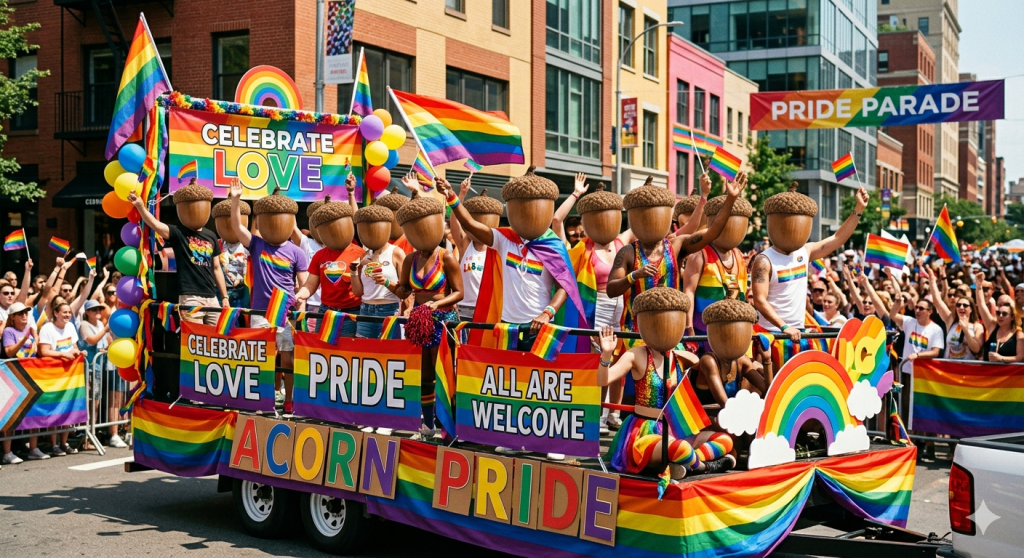
Pride Month was established to counteract that history of Shame. It is celebrated in June because that is when the Stonewall riots took place in 1969, a tragic event in which people demanding basic rights were met with violence. But because they insisted and demanded those rights, my family has benefited.
Thanks to the activism and persistence of those who came before them, my children are part of the first generation in American history where those on the queer spectrum can live openly, marry, or have their own families.
The Difference Between Us
My wife and I are both Gen-X cisgender heterosexual people who chose to marry young (compared to others in our generation) and to have double the average number of children for our age group. We were teenagers during a time when pop stars or celebrities “coming out” was often the subject of national news, and was often treated as a scandal. From our perspective, it quickly became clear that who a person chose to love should not matter to the rest of us. Artists like Prince and Michael Stipe of the band R.E.M. each demonstrated in extremely different ways that whether a person’s differences were overt and over-the-top (like Prince) or understated and private (like Stipe), it wasn’t anyone else’s business.
I may not have been gay or queer, but because I disliked sports and preferred chorus and theater, I was a frequent target for bullying that almost always included questioning my sexuality. I can’t pretend that I didn’t pay some of that forward. When I reflect on how I treated others during high school, I, too, could bully others, and did. But I eventually learned that bullying is the problem, and that treating others with respect is simply the better way to behave.
Accepting that others are different from us should not be a radical idea. That is the foundation that any healthy society is built on. Those differences are what make our stories interesting. At least, that’s what I’ve learned from reading other people’s family histories.
This Family’s History
Despite not being LGBT ourselves, my wife and I are still unconventional. She is more interested than I am in things like power tools and grilling, and I am… well, you see how I spend my time. Two of our kids are openly queer with queer partners, whom we love spending time with. From the outside, our growing clan probably seems odd to those with an expectation of what a family should look like, but that’s who we are. To us, this is normal.
Pride Month is a time when we celebrate the things about us that are different. It is also, for me, a reminder of how normal the rainbow of human diversity is.
There are still those who have strong feelings about people like us, who are different. They may choose to focus on the spectacle, and they may react in ways that are not well thought out or kind. But most people are kind to us, and most people get that “live and let live” is a better way to behave.
And eventually, when our descendants and cousins look back at us, they should at least have a record that we were here. Because we have nothing to be ashamed of.
So, whether you celebrate Dairy Month or Dairy Alternatives Month, I hope you are well. Use sunscreen and hydrate. Don’t be afraid to be who you are. And don’t be the kind of person who treats others poorly because of who they are.

 Mightier Acorns
Say hello, cousin!