
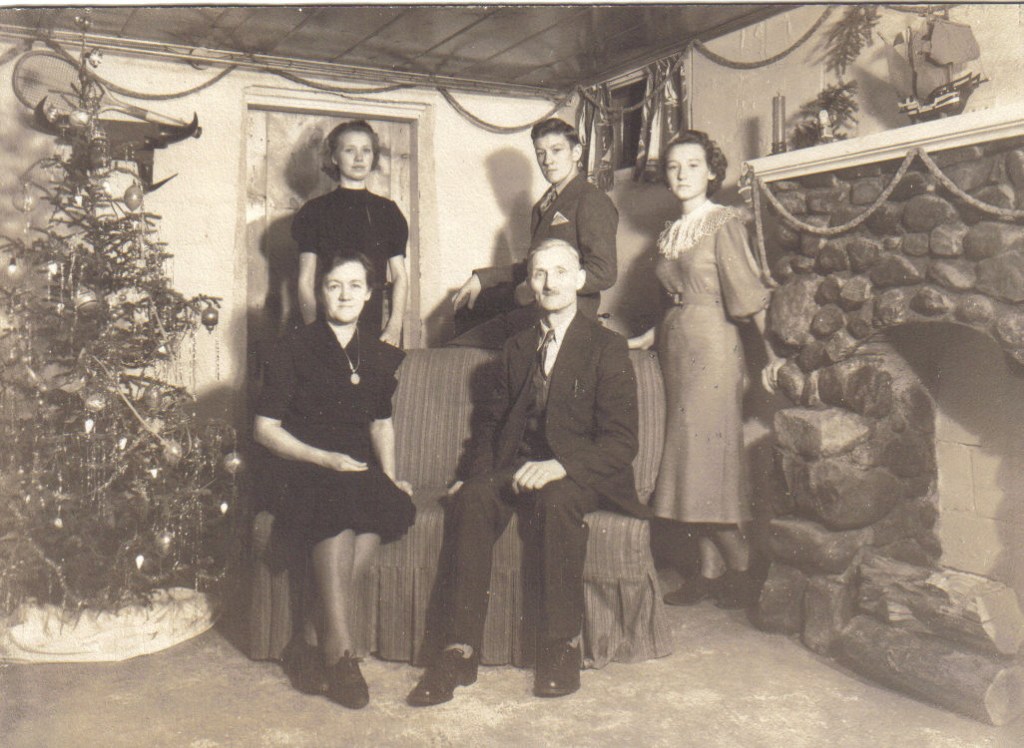
“What’s an ‘Ahnentafel’?” you ask – read this introductory post for my explanation.
Our First Immigrant
William Holmquist is the first person in this Ahnentafel series who was not born in the United States.
He was born on 6 October 1880 in Norra Vram, which, since 1997, has been located in the county (or “Län“) of Skåne. He was 29 years old when he arrived in New York from Liverpool aboard the Arabic on 3 May 1910. An uncle, John Spence, was listed as the “Person in the US” to meet him in Stillwater, Washington County, Minnesota.
In 1910, immigrants faced no passport or visa requirements. Anyone could purchase passage to the United States. Upon arrival, they were processed at centers like Ellis Island or Angel Island. The process relied on a pre-existing ship manifest, medical check-ups, and legal cross-examination to filter out inadmissible individuals, and typically took three to five hours. On average, two percent of arriving immigrants were excluded from entry. The most common reasons for exclusion were a doctor diagnosing an immigrant with a contagious disease that could endanger public health, or a legal inspector being concerned that an immigrant would likely become a public charge or an illegal contract laborer.1
William was naturalized in 1921, a process that took 11 years. In the 1920s, U.S. immigration laws began to shift from a system of “qualitative exclusion” (banning specific categories of people) to a system of quantitative restriction (strict numerical caps, visas, and digital security screenings). It’s worth keeping in mind that when you read about “Open Borders” in America, that was more or less what we had for the first 150 years of our national existence, and for the 400 years before that. So when people talk about their immigrant families coming in “the right way,” they probably don’t realize that “the right way” was to simply show up and start living here.
Boyhood In Sweden
Born “Arvid William Holmquist,” William was the only son of Anders Holmquist and Elna Mårtensson. Anders listed his occupation as “husägare” in the Swedish clerical surveys available online, which tells us a bit about the family’s lifestyle.
That title was most commonly used in towns and cities. Husägare generally owned the physical tenement or building, which often contained multiple apartments rented out to tenants, making them akin to small-scale landlords or property developers. In 1895, holding the title of Husägare usually indicated middle-class respectability. It implied a level of financial stability and social standing, as these individuals paid municipal taxes and often had voting rights in local town elections.
The Holmquist family consisted of Anders and Elna, William, and four daughters, two of whom did not survive to adulthood. The eldest child, Gerda Elna, was born in 1874 and married Karl Kristian Rasmussen in 1910. A second daughter, Estrid Svedenborg (or Svenborg), was born in 1876 and died in 1890 at age 13. After William’s birth in 1880, Anders and Elna had Julia, who died in infancy in 1885, and Lydia Ruth, who was born in 1887. She married Hans Johan Björkeroth in 1915.
Sweden in 1910 was going through some difficult transitions, which eventually led to the downfall of their monarchy. In the southern county of Malmöhus, where the Holmquists lived, deep class tensions were forming over a brewing political struggle for universal suffrage. The Malmöhus plains were incredibly fertile and dominated by large-scale farming, which required a large rural workforce. Still, the land was largely controlled by a wealthy, politically conservative landowning elite. The labor movement was making progress, but the violence and disruption from nationwide strikes threatened everyone.
A small-scale, middle-class landlord like Anders Holmquist would have been caught between those opposing forces, with no real opportunity to move up and no desire to give up what he had. And his son, facing the same bleak outlook if he stayed in Sweden, decided to head where so many others were finding better opportunities.
Living the American Dream
Only two years after settling in Stillwater, Minnesota, William married Hildur Agda Leander, the daughter of Swedish immigrants, on 26 June 1912.
After arriving in Minnesota, William worked as a carpenter until finding a job as a janitor in the Mahtomedi Public Schools during the 1920s. In 1932, he was elected as vice president of the Minneapolis public schools. As the children grew older and more independent, Hildur also found work as a custodian in the public high school.
They raised three daughters, Ruth (b. 1915), Lillian (b. 1917), and Dorothy (b. 1923), and of course, their son, Bud Holmquist. But then the years of World War II came, and their children began to marry and leave home.
In 1944, their youngest daughter, Dot, married Sidney Herbert Woodcock (1924–2011) and moved with him to Bremerton, Washington. William and Hildur decided to move there, too, and that’s where they lived in 1946. But in May of 1947, they lived in Seattle, where William asked Hildur for a divorce on the grounds of cruelty.
A Full Circle
The year after his divorce, William took a trip back to Sweden. When he returned to Seattle, he found work as a dishwasher in the restaurant of the Amherst Hotel. He probably lived off a pension from the Mathomedi schools, but worked part-time, too. In 1954, he married Ruth (Hart) Stevenson, the widow of Frederick George Stevenson (1884–1953), and in 1957, they lived in the Lorrington apartment building, where William was the manager.
Being the manager of an apartment building where he lived seems like the exact sort of life William could have had if he had stayed in Sweden. He and Ruth were still living there in 1962, when he lost a battle with cancer and died on 26 September at age 81.
- Ellis Island, Overview and History; https://www.statueofliberty.org/ellis-island/overview-history/ ↩︎


Say hello, cousin!