
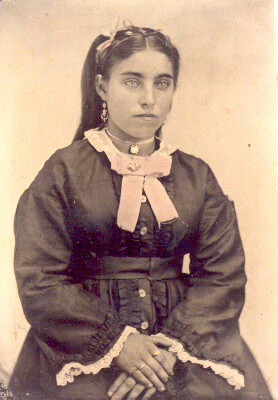
Amanda Walker was the eldest child of William Walker and Lydia Bowen.
Sometimes referred to as “Manda,” she was born on 14 Mar 1857 in Scotch Ridge, Wood County, Ohio, a small, unincorporated community in Webster Township that was settled by several families who departed from Glasgow, Scotland, in 1834. Her father came to Ohio from Ithaca, New York, and married her mother on 13 May 1856 in Fairfield, Huron, Ohio. He was known as “Yankee” Walker, probably due to his origins in upstate New York.
A Pioneer Childhood
Webster Township was incorporated in 1846, and by the time the Walker family arrived, the area had been settled for more than twenty years. The last federally recognized tribe of native Americans, the Wyandot, was officially forced out of Ohio in 1843 and sent to reservations in Kansas and Oklahoma. Still, there were scattered encampments of those who refused to go west, living quietly and peacefully in the area around Dowling.
Manda would have been four years old when the Civil War began, and eight when it ended. Her father did not enlist during the war, probably because his children were so young and he was their sole means of support. It seems likely that young Manda would have been central to running her household from an early age.
Ohio law mandated that township boards of education should maintain a network of one-room schoolhouses so that no child lived more than a few miles from a school. Manda and her eight younger siblings almost certainly got their basic education attending one of these schools. They were probably taught using McGuffey Readers, which were commissioned in the 1830s by a Cincinnati publisher.
By 1872, fifteen-year-old Amanda would have been a competent homemaker with a basic education.
Becoming Mrs. Callin
After the Civil War ended, Union veteran John Henry Callin married Lucy Patterson on 27 Oct 1865. The following year, he was awarded a teaching certificate in Wood County.1 John and his brother George, and another man named John Patterson (no known relation to Lucy), all received their certificates as part of class 4 in October 1866.
Obviously, there is a lot that we don’t know – and probably can’t know – about the events that took place between October 1865 and 1873, when John’s NARA pension file says he and Lucy Patterson were divorced. John’s file says that there were no children from his first marriage, but that doesn’t tell us much about the relationship. And Patterson is such a common surname; I haven’t been able to identify Lucy’s family with any certainty. She could be the daughter of Martin Patterson (1818–1891) and Abigail Osgood (1820–1908). If so, she appeared in her parents’ home in Wood County under her maiden name on the 1870 Census.
Based on this shaky foundation of uncertainty, we can speculate that a teacher in Wood County might have been assigned to teach in the one-room schoolhouse in Webster Township where Amanda Walker and her siblings attended school. Webster Township is only twenty miles or so from John’s home in Plain Township. Either he or his brother, George, could have taught there and become acquainted with the William Walker family.
For modern Americans, there are a lot of red flags waving, no matter which version of events we think might have taken place. John was sixteen years older than Amanda, and might have even been her teacher, when she was between 10 and 17 years old. Evidence suggests that his marriage failed between 1866 and 1870, and his divorce was only made official a year before his second marriage. All of the “most likely” scenarios suggest that he was a lonely young man, estranged from his wife and uncertain about his future, possibly in a position of authority over his future wife.
The best/least cringeworthy version of this story, at least for a modern audience, is that his brother was Amanda’s teacher and learned that William Walker was seeking a match for his oldest daughter. George could have recommended his brother, recently divorced and looking to start a family. Whatever the case, this would have been a private matter between the families, and there was no mention of scandal or outcry in the local newspapers of the time.
Whatever may have taken place, Amanda and John were married on 8 Apr 1874.
The Post-War Generation
When they first married, the Callins were not as well off as they would be in later years. Her 1933 obituary described their early years in the hyper-romanticized language of a 1933 newspaper writer:
In the spring of 1885, her husband purchased 80 acres of land eight miles north of Bowling Green in what was known as the “Black Swamp,” or “Devil’s Hole.” Herself the daughter of pioneers, she shouldered her full share of the toils and hardships of making a new home with her pioneer husband. In the lean years of the struggle, her indefatigable spirit kept before her a vision – a better home and a log hut, clear fields in place of forest, dry land where lay the swamp, good roads in place of boggy trails – a vision which was only realized after 17 long years.
Amanda and John were married for 38 years, 11 months, 9 days. In those years, they raised a family of five exuberant boys and one daughter who survived infancy. Their firstborn son, Byron Herbert, was born on November 5, 1874. If you do the math, the time between April 8, 1874, and November 5, 1874 is 211 days, or just under 7 months. Babies born 2 months premature in that era could survive, but it is more likely that he was conceived a month or two before the wedding. Make of that what you will.
The following year, they had a little girl who died before her first birthday. They named her Leota. The couple seems to have taken Leota’s death hard. It isn’t clear whether she was a victim of the numerous childhood diseases of that time, or if Amanda’s health was a factor. If Byron Herbert was premature, perhaps Leota was, too?
Four years later, they had my great-grandfather, John Q. Callin, in July 1879. A few months after that, in October, Amanda’s mother died. Amanda is listed twice in the 1880 Census, recorded in June 1880, both in her own home in Plain Township and in her father’s household in Webster Township.
In 1879, Amanda was a 22-year-old mother of two small boys, and the wife of a man of some prominence in Bowling Green. These were years when the railroads were both driving a series of nationwide economic booms and creating new opportunities and disruptions for America’s laborers. The world around her was changing drastically from an idyllic, if rustic, pioneer farming life to a more crowded, faster, more socially demanding “city” life. But the evidence seems to suggest that she and John were both close to their families, and they probably had an extensive support network of friends and neighbors.
There is a six-year gap between the birth of John Q. and his next-youngest sibling, Emma Beatrice. But after Emma was born in 1885, the three younger brothers came in regular succession: Prentice (1887), Welles (1889), and Ray (1890). Perhaps by then, John H.’s success as a local community leader and his business relationships with men like George D. Matcham had improved their lives so they could afford to grow their family.
It is interesting to consider how their experiences shaped the lives of each of their children in different ways.
The Kids Were (Mostly) Alright
If you read Byron Herbert’s biography, you know that he was a precocious scholar and an ambitious young man. Receiving his teaching certificate at 16 (in 1890) was a considerable achievement, and evidence that his father likely put pressure on him to succeed. I wonder how much of that pressure came from living in a household that doubled in size between 1885 and 1890? He took on teaching posts in Dayton and other parts of Ohio, but by the early 1900s, still in his twenties, Byron left Ohio (and his first wife) and began his rather colorful life in Montana and North Dakota.
John Q. was only 11 in 1890, but he eventually followed his older brother’s profession of teaching and followed Byron (who began calling himself “Herbert” or just “H.B.”) to New York, where John taught school during the early 1920s. He seemed to give up teaching in the 1930s and moved back to Ohio to sell insurance in Fostoria before eventually retiring to Florida.
Emma B. was still very young when she married George Matcham, who appears to have been a friend and business associate of her father. She stayed in Ohio and gave George a large family. After he died in 1923, she remarried, but remained in Ohio raising her children.
Welles notoriously left at an early age to work on the railroads, and married his first wife in Canada in 1908, at age 24. Then, in 1911, he eloped with his second wife, which caused a scandal in her hometown. He left behind three sons when he was killed in a train accident in 1921 at age 36.
Prentice made a few ventures away from his Ohio home as a young man, but after he married in Michigan, he and his wife, Miss Hattie Owen, raised their two sons in Bowling Green. After he retired, he and Hattie moved to California.
After Ray grew up and married Mary DelCamp, he seems to have made a living building and selling lakeside resort cottages in Lorain County, Ohio. He was 43 when their son, Glenn, was born. Ray, Mary, and Glenn divided their time between Ohio and Florida before eventually settling down near Orlando, where John Q. resided.
Ending Up in Oberlin
Amanda and John saw their children grow up and find their way, until John died in 1913. He received many honors as a Union veteran. Amanda sold their Bowling Green home and worked as a live-in housekeeper in Vermillion, Erie County, with young Ray. After Ray married, she lived with him and Mary in Florence, also in Erie County, and helped care for a number of foster children they raised.
She probably got to meet most of her grandchildren, and most of them grew up in the vicinity of Bowling Green, so she likely got to spend time with many of them. The exceptions being Glenn, who was born the year after she died, and Herbert’s children. The five children born to Herbert’s second wife, Ruby Cole Callin, spent most of their lives in South Dakota. And the children of his third and fourth wives were born in 1931 and 1932 in Florida; it is unlikely that Amanda was able to travel by then, and I don’t see any evidence that Herbert was able to bring them to Ohio before the events that unfolded in 1933.
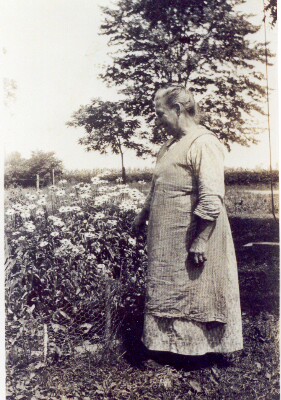
Amanda spent her final years living with her daughter, now Emma Heimsath, in Oberlin, Lorain County. On a Wednesday night in February 1933, “she was stricken with paralysis of the throat, and her weak heart could not stand the strain of her fight for breath.” She died at 2 a.m. the following Sunday, February 12, 1933. She had already survived her husband and two of her children.
A few months later, her eldest son, Herbert, was shot and killed in Florida during a disagreement with his wife’s family. Fortunately, Amanda did not have to deal with that loss, too.
- Perrysburg Journal, October 19, 1866, Page 3. via Newspapers.com (https://www.newspapers.com/article/perrysburg-journal-teachers-certificate/205817364/ : accessed September 12, 2026), clip page for Teachers’ Certificates – John H. and Geo. W. Callin; John Patterson by user callintad ↩︎
 Mightier Acorns
Say hello, cousin!