
A wise friend gave me counsel a few years ago when we talked about my future retirement.
I’m turning “Ol’ 55” next spring, and while I still enjoy doing… whatever it is that I am doing… I have been doing it since the mid-1990s, more or less. If my math is correct, the month I turn 55 will also be my 30th anniversary in federal service.1
Randy’s advice was this, paraphrased: Figure out the two things you love doing most. Whatever the second favorite thing is, do that to earn a living. Doing the thing you love most for money will ruin it for you, and you need to keep doing that for the rest of your life.
For me, the calculus came down to choosing between music and genealogy, but to be honest, I don’t like the idea of ruining either one.
Monotonized Monetization
An outside observer might tell you I have not been effectively monetizing my genealogy work.
When I left Substack in 2025, I only had two paid subscribers. And in the decade or so that I have had books for sale on Lulu and Amazon, I have never sold more than a handful in a given month. (Did you know I have books for sale? That link is probably the second time I’ve mentioned them this year! Master Monetizer!)
I could probably work on improving my marketing and SEO strategies, and generate content aimed at driving clicks and ad traffic… but that’s not who I am, or what I’m trying to accomplish. This blog and the projects I’ve done are meant to serve as a platform for the numerous cousins who will come behind me, seeking to learn where our common ancestors came from and what they were like. I don’t want to Enshittify my work for the sake of earning what I need to do the work.
Still, Money is unavoidable because it is important to what I do in two ways:
- 1. It costs money to access the resources I need.
- 2. Supporting myself & my family takes time I would otherwise spend making use of those resources.
If I had more time to spend, there are several large projects I would love to tackle. But that time requires money.
Thus, the first half of the problem.
Playing Well With Others
The other half of the problem is “other people.”
That doesn’t mean that I think other people are the problem; it means that the projects I have in mind are the types of projects that require a group effort. My Callin Family History ran to 800 pages, and took me seven years to compile and edit. I did all the work myself, so I can claim a minor triumph at getting it done, but I also have to own the flaws.
Lesson: if I do another book project, I need to hire an editor.
And I have several ideas for book projects.
I’ve already talked about trying to update the Berlin Family History (or, at least, the volume that my family appears in). I’ve also been looking at other branches of my family that might not already have a published history. The Tuttles or the Clarks would be an interesting focus on my mother’s side; the Witters and Huffs would make a large study on my father’s side.
Then there are all of those maddening local histories from the late 1880s and 1890s that are in the public domain. Technically, you can go buy a copy of the J.H. Beers Commemorative Historical and Biographical Record of Wood County, Ohio on Alibris or AbeBooks… but you are going to get a printout of the PDF from the Internet Archive bound by whatever print-on-demand service is available in Bangladesh.
I have the ability to take those PDFs, clean the images, run OCR on the files, and adjust fonts and images. But hiring a copy editor would cost a minimum of $2.50 per page, and these books run into the 900 to 1,200 page range.
No matter what projects I choose, I need to assemble a team to get the best results, and to make it worth the time and effort.
The Pledge, The Turn…
The idea I keep circling back to is to create an educational non-profit. While I don’t like the idea of trying to make my work into a business, I quite like the idea of creating something that would benefit the community.
If I did this, I would need at least two partners – the sites I have been reading suggest having a President, a Secretary, and a Treasurer – to form the initial non-profit organization. Once formed, we would need to establish some required language about our purpose that explains what we are trying to do and what makes it an educational non-profit instead of a commercial business.
For that first part (what we are trying to do), our purpose would be to republish public domain texts and family histories and donate copies to libraries and genealogical societies. As a non-profit, we could crowdfund our projects to hire editors and to fund the donation of the books. We could also offer the books for sale, as long as they are priced “at cost” and the profits go to the non-profit/educational activities.
While print-on-demand companies can be hit-or-miss, I’ve been using Lulu.com for my family history books, and I’ve been very happy with their quality. Their hardcover options are sturdy and make fine additions to the public library shelves.
There are existing organizations doing similar things already, but not quite filling the niche I’m looking to fill. NEHGS and American Ancestors are probably the best-known genealogy publishers, but they focus on producing new historical works. I have not found an imprint that reproduces reputable, quality versions of public domain texts, yet. (Otherwise, my bookshelves would be full.)
What I envision is building up a library of these texts in a format that is accessible to people and to libraries, and will support the preservation and distribution of books like these for the next generation.
The Prestige
If I can find a couple of partners with expertise that I lack – particularly in accounting – I think we might start small, building a workflow for finding and processing the texts, building out our crowdfunding platforms, and raising what we need to hire editors for the first couple of projects.
But if this works out, and we can sustain the growth, I can see this non-profit publishing several volumes per year.
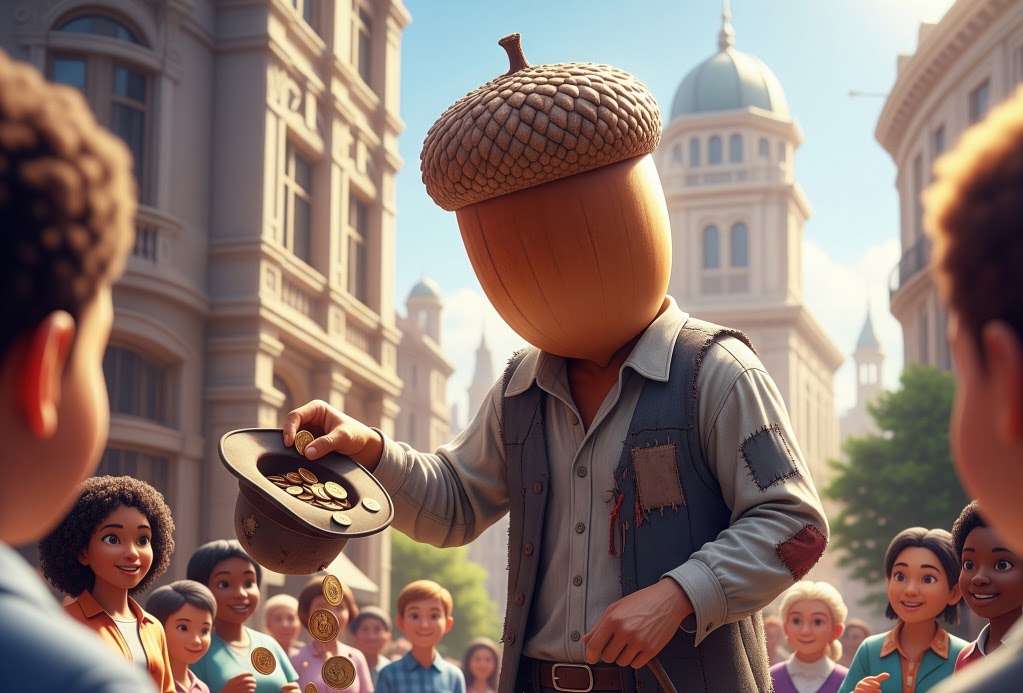
What do you all think? Is this already being done by someone I just haven’t connected with? Or is there a need for the Mighty Acorns Foundation?
- Because America doesn’t value human beings unless they are employed, that’s not enough for me to pack it in and expect a pension. Depending on which option I choose, I can’t claim my full pension until I meet the Social Security age, which for me is (I think) 67. So, another 12 years. ↩︎


Say hello, cousin!