
John H. Callin was the second child and eldest son of William Callin and Elizabeth Berlin. He had an older sister, Harriet (Callin) Sly, and five younger brothers: James, George, Hugh, Zimri, and Milton.
As a young genealogist, John’s biography was critical to my learning process. His grandson, Herbert “Prof” Callin, probably authored the glowing biographical sketch of John that appeared in the Commemorative Historical and Biographical Record of Wood County, Ohio (J. H. Beers & Co., Chicago, Illinois, 1897), and his record as a soldier in the Union army provided plenty of records for me to practice acquiring and analyzing.
But despite nearly three decades of research, reevaluating, and rewriting, there are still things I don’t know about John’s life, and probably never will. He makes a fantastic example of the kind of ancestor who was built up and presented as an epic war hero and influential Midwestern man of the community, and then, over time, revealed himself to be something more interesting: a flawed human being with unfulfilled dreams and desires.
The Young Poet Soldier
Most ancestors don’t manage to pass their thoughts and feelings down through more than a generation or two. Usually, they are remembered by grandchildren for stories they told, songs they sang, or recipes they shared, and we are lucky if any of that survives in a tangible form to the present day.
We got hints of John’s early life as recorded by Herbert in that Wood County sketch, and more indirectly, in the memories of his niece, Rosemary, who wrote Silk or Satin before she died. But John was also a poet who wrote down more than 70 poems in a ruled notebook before he died.
I was able to publish those in War Poems a couple of years ago. As the title suggests, many of those poems were about his experiences serving in the Union Army. He put thoughts about love, God, who he most admired, and what he missed about home into his poetry. Even if you’re not a fan of amateur poetry from the mid-19th century, you have to acknowledge that we get a rare glimpse into the heart of a young man from that era.
By design, our first impression of John H. Callin is that of an intellectual and principled warrior. Herbert told us that John was a scholar who, in 1861, began teaching his first classes in Wood County, Ohio. Of course, that April saw the start of hostilities between the states. John dismissed his students in the middle of their term and enlisted in the 21st Battery of the Ohio Light Artillery. In Herbert’s telling, John was “placed in command of detachment B of the battery,” and “was present in the final capture of Morgan” – an event John recorded in his poem, The Morgan Raid. After an honorable discharge, John went back to school at Hillsdale College, and then taught school for 22 years.
But Herbert’s version glosses over some details that we can learn from John’s pension files in the National Archives. He probably didn’t know these details, and I wonder now about the meaning of some of John’s poems, now that I have this information.
The Heart and the Horror of War
The facts of John’s war record, as recounted by Herbert, seem to be confirmed in the pension files held by the National Archives and Records Administration. He did reach the rank of Sergeant in Detachment B, but at some point, he was reduced in rank back to private. We also learn, from several affidavits, that John was married in the 1865, near the end of the war. He divorced in 1873, with a note in the file that there were no children from this first marriage.
This first wife was named Lucy Patterson. Coincidentally, the Captain of John’s Battery was James W. Patterson. I have not been able to determine whether Lucy and Captain James were related (Patterson is a very common name, after all). I was not able to identify Captain Patterson in Census records. If the Lucy Pattterson John married was the daughter of Martin Patterson (1818–1891) and Abigail Osgood (1820–1908), she appeared in her parents’ home under her maiden name in 1870.
Among John’s war poems, like “The Morgan Raid,” or “Chickamauga,” John also included “The Maiden’s Friend” and “I Loved Thee Once,” which may draw on his experiences with love. In some of his poems about love, as in the pair of poems “Lines to Willimminnie” and “Willimminnie Reply,” he imagines a soldier dying far away from his love, and while he certainly projects his own ideas into his characters, it’s hard to tell whether he used his own love life as inspiration, or borrowed from the experiences of his fellow sodiers. But in particular, “I Loved Thee Once” feels more direct and personal. It begins:
It is too true; and yet I’ll own
As deep a love was thine;
For oft I felt thy genial charms,
Around my heart entwine.
This first person verse dispenses with the imagined death of the Willimminnie poems, or the ghostly visitations of “The Divers Bride.” Without the distancing factor of those fictional settings, he describes his feelings and his sense of rejection in a way that feels more immediate:
But O, my love it was too pine,
And could not, could not last;
And though affection lavished smiles,
Thy spirit was o’er-cast.
For several stanzas, you see this couple come apart. And then, in the final two verses, I think I can see a clue to the end of John’s first marriage.
But ah, the dream has passed away,
The past the bitter sped;
And memory hath its part to bear,
As well the heart, the head.

The bitter word I will not say,
It was not meant for thee,
It is enough to think of thy
Ingratitude to me.
The Honored Veteran
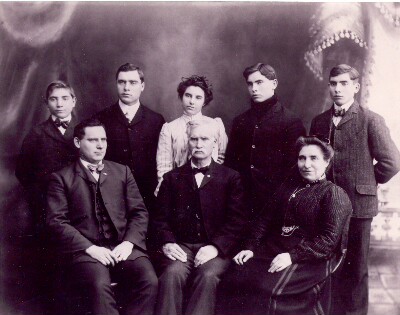
John married Amanda Walker in 1874, and you can see their family in the photo above, proabably taken before 1905. Herbert, seated to John’s right, survived a shotgun blast to the right side of his face in November 1905, which disfigured him for life and would have been fully visible in this portrait had it been taken any later. Amanda is, of course, seated to John’s left, and standing behind them, from the viewer’s left, are: Ray, John Q., Emma B., Welles, and Prentice.
John raised his family in Wood County, residing and teaching in Plain City and Bowling Green. After retiring from teaching, he and Amanda lived in Fostoria. He was active in the Grand Army of the Republic, where he served for a time as a post commander with the honorary rank of colonel. Thus, even though his highest military rank was that of an artillery sergeant, his neighbors referred to him as “Colonel Callin.”
John was fortunate that he was able to practice his teaching profession, as he was apparently disabled after his war experience, making him “unfit for manual labor.” This affidavit was included in his NARA pension file:
John H. Callin, of lawful age, being first duly sworn, deposes and says that he was a Private in 21st Battery, Ohio Volunteer Artillery, in the Civil War; that he received, during the service, injury to right eye and resulting (partial) loss of sight of same and adherent cicatrix of right side and back causing impaired motion of right leg, result of small-pox. Affiant states further that the injuries received in the service in the Civil War has unfit him for manual labor, reference being made to Certificate No. 431027. Affiant further states that he makes application this 23rd day of May, 1912, for the purpose of being placed upon the pension roll at the rate of Thirty Dollars ($30.00) per month.In terms of purchasing power, $30 in 1913 is equivalent to approximately $1,011.87 today. He collected that pension for nearly a year, until his death on 17 March 1913.
Always More To Learn
Perhaps it is only fitting that a man who would be the first of four generations of professional teachers would provide us such an excellent example of a life that requires such deep examination. Records can tell us facts about who he was and where he was; his family’s recollections can tell us what he did; and his poetry gives us hints to his motives and his private thoughts.
The important lesson is not to leave any life unexamined.


Say hello, cousin!