
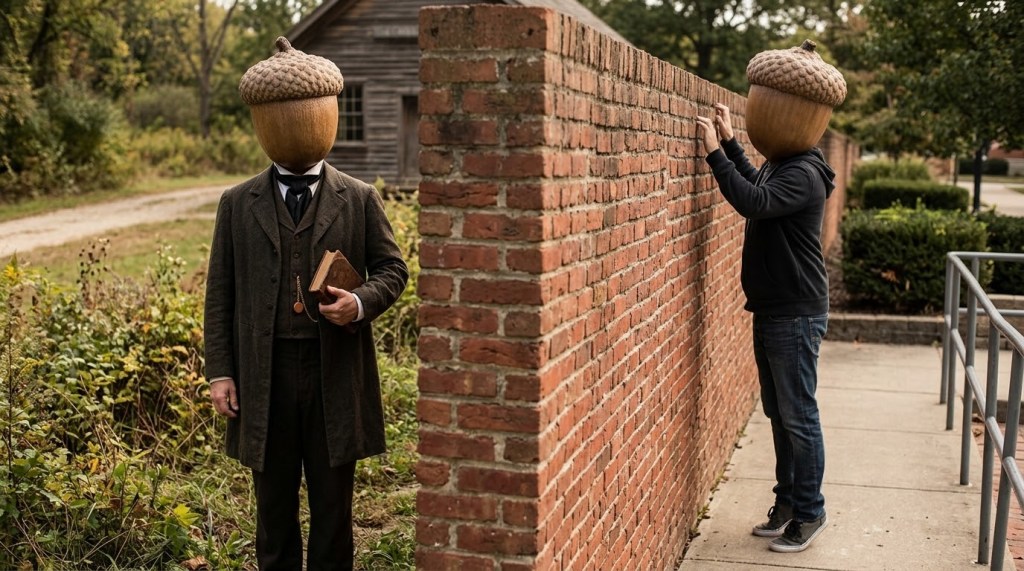
Allen Greenlee was my first real genealogy challenge. No one living seemed to know anything about him – starting with his name! – and even the records I could find were parsimonious with the information they collected.
Peering Over Brick Walls
Grandpa Bob was the one who first showed me the Callin Family History, so when I had questions, he’s the one I asked. But when those questions came to the origins of his mother, Bertha Greenlee-Cramer, he didn’t have many answers.
He knew that she had been adopted by her stepfather, George Cramer, when she was very little, but beyond that, he knew nothing about her biological father. Great-grandma Bertha died the year before I was born, so I couldn’t ask her; but even my dad and his sister, my aunt Vicki, had no recollection of ever discussing her birth father with her.
I was so new to genealogy that I didn’t yet know the term “brick wall,” but that’s not the metaphor I would have reached for. This sensation of facts being just out of reach or out of sight felt more like a weather event, like a dust storm or a heavy fog, where you can tell that there is something out there, but your light can’t reach it to tell you what it is.
I could see the place where my great-grandfather should be, and I knew the shape of the hole that he left there, but I didn’t know how to start answering those questions. I didn’t even know what questions I should have been asking!
A.M., Ellen, and Eleanor
For a long time, “I think his name was Greeley or Greenlea” was the only clue I had. Then I found a marriage record for Alice A. Hale and “A.M. Greenlee” in Hancock County, Ohio, dated 16 (granted) and 17 (return) August 1884.
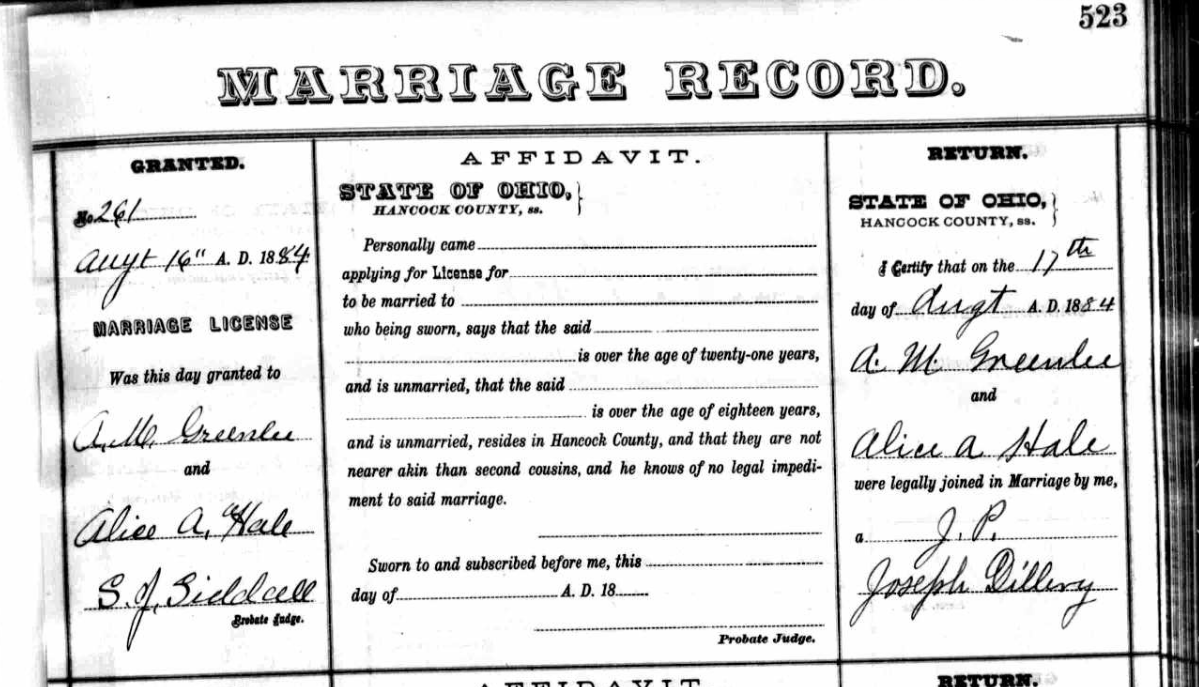
I knew Grandma Bertha’s birthdate was 5 December 1885, so the timing wasn’t a big surprise, but when you are relying on freely available census records for all of your research, it is an inconvenient mid-decade to get lost in. Only having his initials made it that much harder to know who to look for on the 1880 census. (And, as you may know, the 1890 Census was lost, so no joy there!)
With some guesswork, I did find Allen Greenlee living with his grandmother, Eleanor Bollman, in Cass Township, Hancock County, Ohio, on the 1880 Census. His occupation was listed as farmer, and his father’s birthplace was Ireland, while his mother’s was Ohio. In 1870, I found them again: Eleanor (with her name transcribed as “Elesur”), and “Ellen Greenlee,” a male, 9 years of age. This time, a 31-year-old woman named Sarah C. Bollman was also listed. She would prove to be Allen’s mother, but it would take many years and a paid Ancestry subscription to find enough pieces of the puzzle to be sure.
The Will and the Newspapers
When I decided to revise the Callin Family History in 2015 and paid for the full Ancestry subscription to help me do it, I found Sarah’s 1875 will. In it, she named her son, Allen Marion Greenlee, and left him all of her property and named Ezra Karn his legal guardian. This confirmed many guesses I had made, based on what I could see in the census.
About that same time, Newspapers.com began digitizing The Weekly Jeffersonian, and as I found small mentions of Allen Greenlee in their pages over the years, a figure began to emerge from the fog.
In April of 1882, Allen Greenlee reported that 11 of his sheep were killed by dogs, and, in a later item, that he and Elizabeth McComb exchanged property. Elizabeth McComb’s maiden name turns out to have been Bollman, making her a sister of Allen’s mother.
In 1882, he turned 21 and came into his inheritance. He exchanged land with his aunt, raised sheep on what was now his land, and got a teaching certificate. In 1883, he was elected clerk of Cass Township (as a Democrat!) and served as umpire for Wineland and Marion baseball clubs in 1884.
As we saw from his marriage certificate, he married Alice in 1884, and in December 1885, they had Bertha. But in September 1885, the papers mentioned on the 10th that Allen suffered from typhus, and reported he was “up and round again, yet very feeble” a couple of weeks later. In October he and Alice moved into her father’s house.
For a long time, I assumed he died because of that typhus infection, but in December 1886, the paper named him as one of the men paying the “Dow Law tax,” which was a tax on businesses that sold liquor. Since that news placed him in Arcadia, it suggests he and Alice moved out of her father’s house and started a business that involved selling alcohol. That suggests that he recovered from the typhus, at least.
And sometime during 1887, he died and was buried in Bechtel Cemetery, with no mention in the papers and no obituary. But there is one more twist in Allen’s story, and it happened before he married Alice Hale.
Ohio Progressivism
In June of 1882, a few months before Allen’s 21st birthday, the paper reported what sounded like a scandal to me:1
“Allen Greenlee, a young school teacher residing north of this city, was arrested on Tuesday and brought before Justice Beardsley, on a charge of bastardy preferred by Miss Dora Nickey, a lass aged seventeen years. Greenlee was bound over to court in the sum of $500.”
While that language sounds punitive, it was apparently a legal mechanism for a woman to claim financial support and legally name a father without having to marry him. Based on what I was able to learn online, it seems from the language of being “bound over…in the sum of $500” that the court found Allen responsible, but there was no follow-on report to say either way.
One unanswered question raised by this: was Dora one of Allen’s students? They both grew up in Cass Township, so they may have gone to school together there as students or otherwise been childhood sweethearts, even being four years apart in age. Dora was 7 years past Ohio’s age of consent, so this would not have been considered statutory rape as it would be today.
We don’t know if he was her teacher, but in 1882, there was no law prohibiting student-teacher relationships. That law passed on 22 April 1886, four years after Allen was sued by Dora. And judging by the fact that he was elected to local office and held positions of trust after this, it seems the community considered this matter settled after the court ruled.
I found no evidence of a child in Dora’s family that was born in 1882, so it seems most likely that she gave the baby up for adoption. That suggests I might have a whole set of cousins descended from Allen who have no idea where they came from. For now, I don’t have any clues to go on, but I will keep an eye out for leads to help find them.
Perhaps one day, I can help them peep over this brick wall, too.
- Newspapers.com, The Weekly Jeffersonian, Findlay, Ohio, 1 Jun 1882, Thu, Page 3, “Allen Greenlee, a young school teacher“. ↩︎


Say hello, cousin!