Mightier Acorns

Journeys through Genealogy and Family History

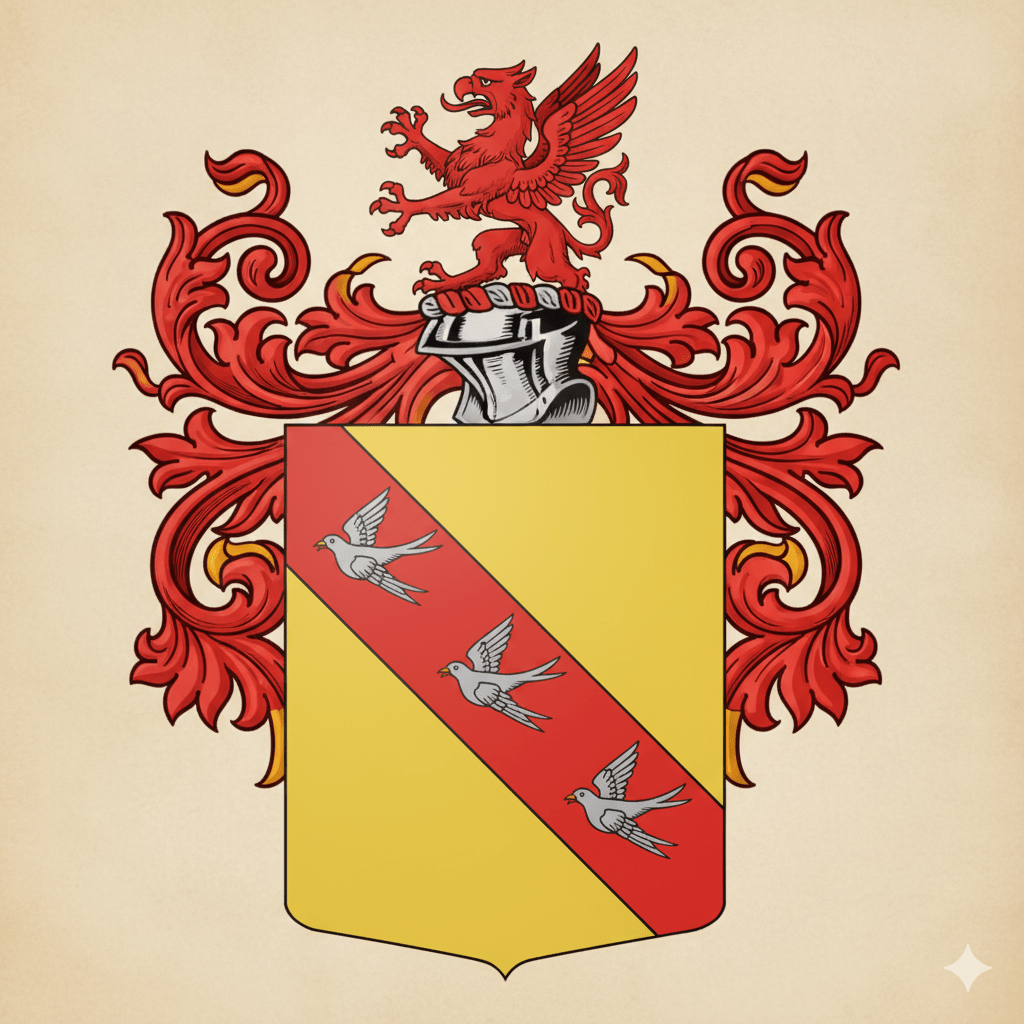
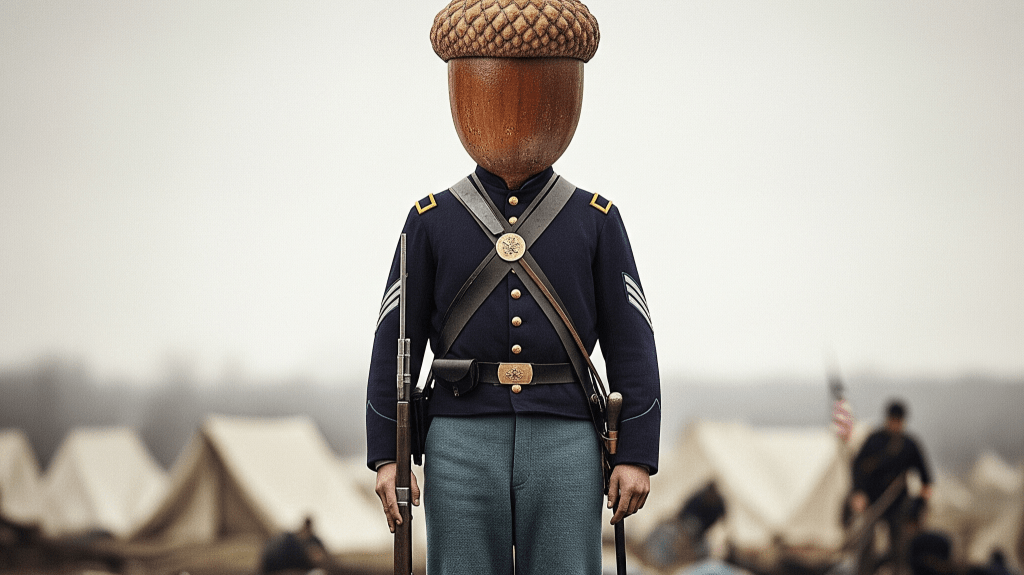
A parody of a family coat of arms designed with acorns as elements, with the motto "ex gladnis potentioribus" Latin for "from Mighty Acorns"
From Mighty Acorns
  • The Absence of Evidence

    Sometimes it might be evidence of absence.

    When George W. Callin published The Callin Family History in 1911, he didn’t give us a thorough biography of his great-grandfather, James Callin.

    “As far as we know the Callins in this country all descended from one man, James Callin, who with his brother John (who never married), emigrated from Ireland to America about the commencement of the Revolutionary War.

    “Our fathers tell us that these two brothers enlisted in the Continental Army and fought under Lafayette at the battle of Brandywine and remained in this army till the close of the war. These brothers settled on government land in Westmoreland Co. in Western Penn., where they remained the remainder of their lives, John sharing the home of James, who married about the year 1778.”

    When George refers to “Our fathers,” he is most likely referring to his father (William) and uncle (George), and perhaps their younger brother, James. Their father, John, died in Ohio in 1835, a year before William was married, so George W. and his generation never knew their grandfather.

    Likewise, I suspect that William, Uncle George, and Uncle James never met their grandfather James, but instead heard the stories about his experiences in the Revolutionary War from their father and uncle.

    Fortunately, there are muster rolls from the Revolutionary War1 showing that a man named James Callin did serve in a unit that would have put him at the Battle of Brandywine, although Lafayette did not have a command in that battle. Considering that Lafayette went on a triumphant national tour in 1824 and 18252, it makes sense that the Callin men would emphasize their ancestor’s possible connection to this celebrity, and James does appear to have served when and where they claimed.

    But when it comes to the land records, we have been less fortunate.

    Where Did James Callin Live?

    Several of James Callin’s descendants have tried to find the records that would tell us where he lived – starting with requests sent to the National Archives, and branching out into online databases as they become available. So far, our searches have come up empty.

    His name does not appear in the Bureau of Land Management – General Land Office (BLM-GLO) database. (Not for PA, OH, KY, or anywhere else.)

    He does not have a Revolutionary War pension application on file – not for any Pennsylvania unit, not for his Virginia unit, and I have found no “James Callin” of any spelling in other states.

    If you read my previous posts (see footnotes), you know that the muster rolls show James and Edward Callin serving in the Revolutionary War and James and John Callin serving in the Kentucky Cavalry under General Scott. Assuming the James Callin in the Kentucky Cavalry is the same James Callin, it is possible that he “settled on government land in Westmoreland Co. in Western Penn.” after the War (so, after 1783), but sold that land and moved to Kentucky by 1794, when he appeared in the Kentucky unit.

    A fire destroyed Revolutionary War pension and bounty land warrant applications and related papers on November 8, 1800, so we wouldn’t expect to find an application submitted before that date.3 Congress passed a pension law in 1818, granting pensions for life to Revolutionary War veterans who had not been disabled, based on financial need. Congress amended the 1818 law in 1820 and again in 1822. The pension legislation enacted in 1832 gave full pay for life to officers and enlisted men who had served for two or more years and partial pay for service of six months to two years. We saw two examples of applications for Revolutionary War soldiers who filed under the 1832 law in “William Bowen: Two Revolutionary War Veterans” – but no such application exists for James Callin.

    The Evidence of Absence

    I need to emphasize that I am still speculating here – failing to find records does not mean that the records didn’t exist, and may not mean that they don’t exist. But looking unsuccessfully in the places they should be may tell us something. The fact that no veteran or widow applications exist for James Callin or his widow after the 1832 law suggests strongly that he and his wife might have died before that date. The lack of an application under the earlier laws may suggest they died as early as 1818.

    Of course, I have yet to find any evidence of a James Callin (of any spelling) who died in Pennsylvania, Virginia, Ohio, or Kentucky between 1794 and 1832, and I don’t know where, within that vast area, I should be looking.

    I suspect that the answer is in a box of records from one of the many small places that existed within that territory that was claimed by Virginia before the Revolution and were later displaced by a state or county government after the end of the War. Until someone finds that box, we will remain…

    1. I’ve written extensively about my quest to find James Callin’s Revolutionary War record – see Still Finding James Callin and Theoretical: James Callin’s Military Career ↩︎
    2. Barbara Tien at Projectkin put together a wonderful timeline of Lafeyette’s Tour if you’d like to explore the story of one of the country’s first Superstars! ↩︎
    3. Nudd, Jean; U.S. National Archives, “Prologue Magazine,” Summer 2015, Vol. 47, No. 2; Genealogy Notes, “Using Revolutionary War Pension Files to Find Family Information↩︎

  • The Morgan Raid – from War Poems

    A few years ago, my Aunt Vicki entrusted me with a priceless artifact: a water and heat-damaged notebook full of poems written by our ancestor, John H. Callin (1840-1913).

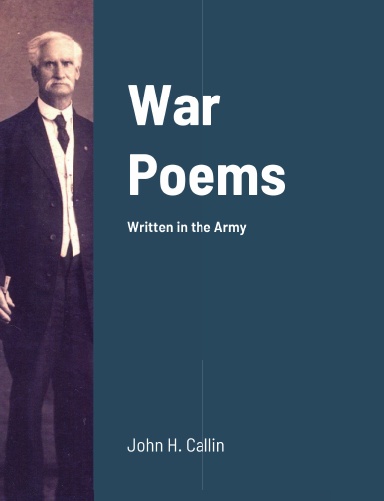
    Transcribing the handwritten poems became my COVID project in 2020, and if you have ever worked with handwritten materials, you know it was no easy task. I am proud of the finished product, which you can find for sale on Lulu.com:

    War Poems:Written in the Army
    Hardcover (only): $38.10

    The Making Of…

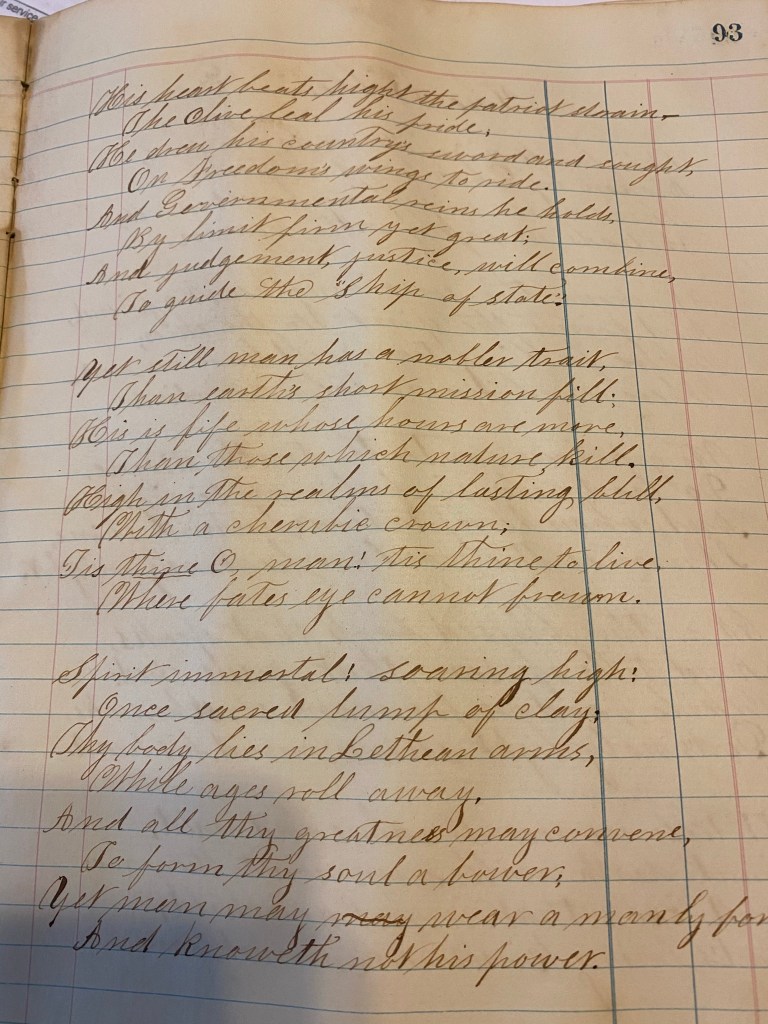
    Here’s a sample of what I had to work with. At first, Vicki sent me images like these, rather than risking the loss or further damage to the book from sending it through the mail. But this proved to be unworkable, if only because I kept having to pester her with questions about specific words or lines.

    With some research in the Library of Congress archives, I was able to illustrate a few of the poems with public domain images. My goal was to make all of the poems legible and understandable to a modern audience, so there are a few endnotes to explain some of the background experiences that informed John’s poems.

    This poem was most likely written after he and his men of the 21st Independent Battery of the Ohio Light Artillery were dispatched to head off General Morgan’s army. The 21st was deployed to Camp Dennison, Ohio, at the end of May 1863, and they put up a solid resistance in July when the Confederates attempted to capture the area. Morgan and his troops entered Ohio on 13 July, and battled their way north. Eventually, Morgan was flanked and cut off by Union forces on July 26, 1863 at the Battle of Salineville, near Lisbon, Ohio. At 2:00 p.m., they surrendered to Union Maj. George W. Rue of the 9th Kentucky Cavalry near West Point, Ohio, approximately 8 miles northeast of Salineville.

    John’s war record suggests that he was personally involved in pursuing and stopping Morgan, and he wrote about it with some passion:

    The Morgan Raid

    When Morgan plunged across our lines,
    There to enact his dark designs,
    He roused the northern patriot minds,
    To a state of desperation.

    He knew his blade—that wily chief,
    And plunged the peaceful heart of grief,
    Then hastened off, his stay was brief,
    To his sword of depredation.

    He saw the vistige of his clan,
    And heard of deeds of that bold van,
    Which fired the heart of Northern man,
    To restrain this bold invader.

    Who strewed the ground with burning red,
    And numbered many with the dead,
    Then on into Ohio sped
    The vile and intrepid raider.

    Ah, here he met the Union brave,
    Numerous as Pacific waves,
    Awaiting only to make graves,
    For the Morgan devastators.

    The Union breasts were filled with ire,
    And Federal hearts were now on fire,
    And wilder than Secession’s pyre,
    Burned the hate of raid creation.

    Then in pursuit our braves were sent,
    Who proudly on their mission went
    To capture were their soul’s intent,
    And feed them on our rounders.

    We pressed them hard o’er field and stream
    While oft the unsheathed sabre gleams,
    As over hills our weary teams,
    Dragged the heavy bronze Twelve Pounders.

    And on Ohio’s looming banks,
    Surrounded by the Federal ranks,
    Ended were all the raiders pranks,
    By Union braves and musketry.

    When our malignant cannons roar’d,
    Morgan resigned his rebel sword,
    And many traitors there were lowered
    By our fatal artillery.

    And now within States Prison shades,
    Thou there can think of all thy raids,
    From private to guerilla grades,
    Thou chief of blood and misery.

    Other Highlights

    Artistically, these poems follow some strict rhythmic and rhyming structures that might not appeal to a modern audience, but which sound to me like the kind of poetry a young John H. Callin might have been surrounded by in his semi-rural Protestant community. They often feel like they are informed by the hymns he sang in church or the sorts of romantic poetry that might have been translated from French and German and imitated by American poets.

    Whatever you may think of his skill as a poet, the subjects he chose and how he felt about them give us a deep insight into the mind of a Union soldier, both on the battlefield and in the years after.

    John wrote poems about his experiences, like The Morgan Raid, but also about popular figures (like Generals Grant and Lee) and events that weighed heavy on the minds of Union soldiers. John wrote about several events that he wasn’t present for, but which were certainly the subject of stories around the campfire:

    John also wrote about love and his longing for someone back home – someone who was probably not my great-great-grandmother, Amanda (Walker) Callin! John married Lucy A Patterson after the war, on 27 Oct 1865. It is unclear whether she is any relation to the Captain James W. Patterson who commanded John’s unit during the war. If she is the daughter of Martin Patterson (1818–1891) and Abigail Osgood (1820–1908), then she appeared in her parents’ home under her maiden name in 1870. (John’s whereabouts in the 1870 Census are not known.) John and Lucy divorced in 1873 in Bowling Green, Wood County, Ohio, according to John’s pension record in the National Archives, with the note that there were no children from this marriage.

    If any of this sounds interesting to you, it might be worth picking up a copy of War Poems to commemorate your own Union soldiers – and maybe consider donating a copy to your local library?

    I’m sure John would approve of that.

  • Grandma Merle’s Travelogue: Farming and Motherhood

    Welcome to the final of four posts sharing the transcription of Grandma Merle’s tape recorded memories. If you need to catch up, see:

    Our Witter family was impacted deeply by the 1918 influenza pandemic, which occurred near the end of the first World War. Grandma Merles begins this section by talking about that, and how she had to rely on her sisters, Bertha Sample (nicknamed “Bercie”) and Iva More.

    Was during the winter of 18 when we had the flu so bad, and Roy [Sample], my brother-in-law, contracted the flu, as well as Dick’s father [Abe Witter] in Kansas. And it was at Christmas time, just a few weeks before Christmas, and I think it must have been in 18 that Roy passed away, and it was about that same time that Dick got word that his father had passed away. And he couldn’t get any furlough to go back to his father’s funeral, much less his brother-in-law’s, so we didn’t attend either one of them. 

    But then, when we came back, after it was over, the Armistice was signed, and we got out of the Army the first of the year, they thought it would be a help to Bertha and the children if Dick and I went to their house to stay…at Bercie’s house, until we could get possession of our own place up the ranch and get that in living condition again. It had been rented while we were gone and … that was south of town and we didn’t find it in too good of shape.

    But anyway, I was sick, and it seemed to be…bother Bertha, and instead of helping her, why, we decided I was a hindrance to her, so we moved over to Iva’s place. Am I supposed to tell you…?

    (The tape stopped here, probably so Merle could ask her daughter, my grandma Nancy, whether she should talk about her miscarriage. Then the recording resumed.)

    It was probably while I was at Iva’s place that I lost the first baby.

    A short time after that, we got possession after going over the house, and we moved back out there. We had our own furniture at our place in town there, so we didn’t have to buy all new stuff again. 

    And then we put in a crop of cotton. Cotton had gone so good that half of the people in the valley, the farmers, had become millionaires, that last year with cotton, there was such a demand for it. So we put in a full acreage of cotton. I think we had our own 20, and we had another 20 beside us, we had grandpa and grandma’s place, they had 10 acres, and our neighbor had 30 acres, and we had the slaughterhouse 10 acres all in cotton. We were gonna get rich fast to make up for lost time. The War was over, there wasn’t any particular demand for cotton, and cotton went kaboom. And we went kaboom with it, and lost the ranch.

    (Another brief interruption.)

    Nancy wants to know where grandpa’s 10 acres was. Well it was out on Palm Lane, I’m not sure it want’ very far out of town, about during that first mile I guess, and there was a row of olive trees west of Palm Lane, and there was a row of olive trees and palms along there, right beside his 20 acres.

    The year that we had our lovely cotton crop and eventually the bust, Richard was born in Febraury the 23rd [1921], and when he was about …well, the cotton had already gone kerflooey the summer before, the year before he was born in February, and Dick had rented a acreage quite a way south of town, never can remember the locations of anything. And when Richard was about six weeks old, we moved into the old house, an old house down there where the … that was down in the Cartwright neighborhood and close to the Cartwright church at the canal along there… and we stayed down there then until after he’d harvested his wheat crop. It was quite a ways to go drive back and forth from where we was to down there two or three times a day. So after that was harvest then, well we moved back to our own place.

    But soon after that we gave up the place for the cotton debts and we moved to the slaughterhouse. The slaughterhouse … northern avenue and east of grand avenue… or west of grand avenue. And Richard was about 2 …I guess he was 2 in February when we moved out there, just a little bit before the fourth of July. We left there wasn’t… we wasn’t fully move yet, and we had some things in the chicken-burger house stored in there. We’d moved the busiest necessary things out, and we was taking our time about getting the rest of it over to the place, I guess. 

    When there come a sort of a hurricane wind storm through there, and moved the house a little bit, and felled one of the trees right at the house – our house south of town. Why, we got grandpa and grandma in the car with us, and Richard and I, and we was gonna go down Grand Avenue, that was where it hit hardest, the row of big trees down there, and we was gonna go down to see the damage that was done. 

    We was a-drivin’ along, grandpa and grandma was in the back seat and Richard was standing between em, and he looked up at grandma and says, “Grandma, that old wind just de-libately just blowed all our trees over.”

    (Earlier, when Merle referred to “grandpa’s 10 acres,” she was referring to land owned by her father, Albert Huff, who had moved back to Kansas about 1913. Judging from Merle’s recollection below, Albert and Rosa returned to Arizona in 1921 or 1922.)

    Grandma and Grandpa, after all of us kids came out here one by one, I came back out here because I liked it better out here, and my two sisters were out here, and soon after that, Bert sold out his place back in Kansas and he came out here. So grandpa and grandma got discouraged and sold off their place and they really sold the place that time. And they moved out here, and I don’t remember what year it was. I think Richard was about 4 or 5 months old when they came. They bought the 20 acres, the acreage, they wanted to invest their money in something and land was all they knew to invest it in, when they bought the lot on A avenue… it was A then… and I imagine that they must have stayed at Bertha’s or with Iva, I don’t know which or part both, while their house was being built.

    And they moved and they lived in that last house until each one of them, first daddy, and they about seven years later, mother passed away. During World War… oh…

    (Another brief interruption.)

    Grandpa passed about seven years before mother did, and mother passed away in 1943. And that was during World War… Vickie was about three months old, and Richard was over in the islands… well, they weren’t in Australia, but they were around… New Guinea, when she passed away.

    I think when I left off, we were living at the slaughterhouse, and we… daddy got a job as janitor at the Glendale Grammar school. It was at unit one, and we bought a little house there, and we lived right next to the grammar school. There was a vacant lot between us and there. We lived on Harlan place, and D avenue. That’s where Richard got started at kindergarten very young, because the teacher, Mrs. Meredith came by every morning, and would say, “Dickie, get your hat, and come on to school.” And so finally one morning, he got his hat and went to school without notifying anybody else. And when I missed him, I was frantic. I went in every direction and eventually, all of the neighbors was a huntin’. 

    And finally somebody went over to the school and asked Dick, he was working over.. He’d seen anything of him, and he said no, he hadn’t. But he says, “Did you look around in the Kindergarten?”

    Well no one had, we’d run to lateral 18 and every place else, frantically looking. So Dick walked over and tiptoed so he could look down in the kindergarten, and there was Richard as big as life right up beside Mrs. Meredith just enjoying every minute of it.

    So after that, I let him start to school. So it come along, that was before Christmas. So he started to school, and in February, when his birthday came along, I had baked him a birthday cake and he wanted to take a piece to his teacher. So I didn’t know that the kids took birthday cakes, full cakes, there, so I just sent a piece of cake to his teacher. And she divided it up a bite or two for each one of em, and she says, “Dickie is five years old.”

    Richard says, “No, four.” And she went ahead with her work a little bit, and she says, “Dickie is five years old.” And he said , “No, four.” And he put up his four fingers to show her that he was four. But she couldn’t out-talk him, and that was something because she was a good talker. But she kept saying he was five and every time he corrected her and said he was four.

    So she stayed at school after the children had gone and waited until dad came to janitor her room just to ask him how old Richard was. Daddy told her that he was four, and she says, “No wonder, all of this winter, when I been trying to get him to come to school, his mother kept saying he wasn’t old enough.”

    And while we was still at that house, and Richard had his kindergarten, he went the rest of that year and all of the next, before he was really old enough to start school And that year, the next March, 1925, Nancy was born.

    And she didn’t get started to school as early as Richard did. But we lived there in that little house until about 2 or 3 years more. We were still leiving there when she was about 2. So we must have live there about 2 or three years more. And then we went …we moved back out… we sold that house and moved back out to the slaughterhouse, rented that, and we started the Witters Jersey Dairy. We had that for 2 or 3 years.

    By the time we sold that, we sold that or traded to the uh… We sold the dairy then to the Bennet brothers, or rather we used the dairy for a down payment to 60 acres north of town, about 3 and ⅝’s miles north of town. And we were living there, when Nancy started to kindergarten her first year. We …she could of in the Peoria district, she could have gone to the first grade, but we had already enrolled her in the kindergarten at Glendale before we made the move, so we took here… and Richard also that first year. After that, they went on the bus to the Peoria school.

    (Long time readers might remember the Famous Playmate Richard and Nancy met riding that bus!)

    And after we’d been up on that other place north of town, we farmed at first, we decided to start another dairy, and that was …Okay Jersey Dairy. This was a bottle dairy, glass bottles, and we peddled and delivered our milk to our customers in Glendale.

    Thanks for following along with Grandma Merle’s Travelogue! And thanks to our cousin, Pat Witter (Richard’s son) for providing the cassette!

  • Samuel Tuttle: the Late Bloomer

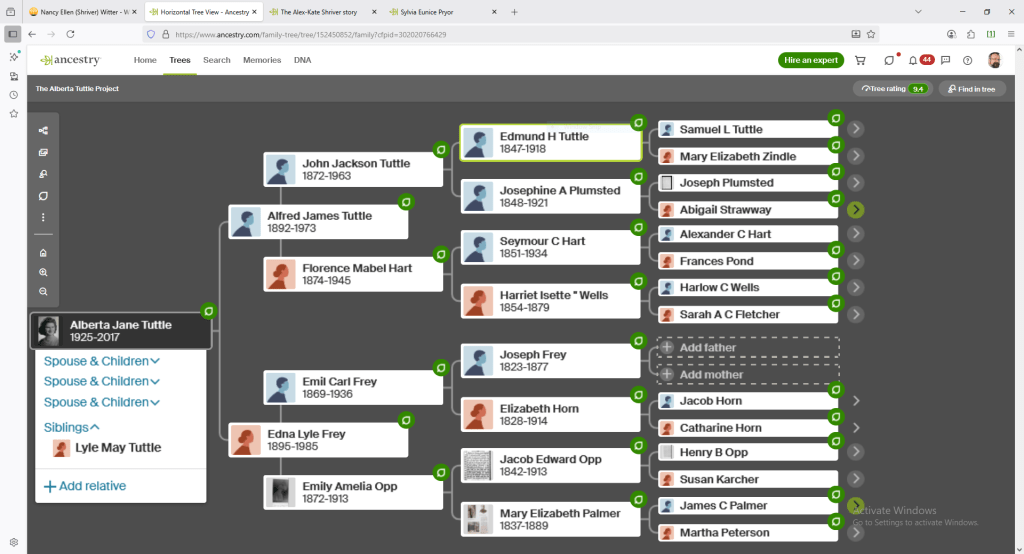
    Your first question is the right question

    What is a “bloomer”? And what does it have to do with Rev. Samuel L. Tuttle?

    The answer to the second question is “Nothing! And that’s how I knew to look for another Samuel Tuttle!” The answer to the first question depends on context1, but our context was the census record for the Tuttle family in 1850.

    1850 United States Federal Census, Rockaway, Morris, New Jersey; Roll: 459; Page: 326b

    Up until the point where I actually looked at the documents I had collected, I believed that my 4th-great-grandfather was Reverend Samuel L. Tuttle (1815-1866), who also lived in Morris County, New Jersey. But the 1850 Census listed my ancestor’s occupation as “Bloomer” and not “Minister” which made me start questioning all of those inherited trees I had been collecting up to that point.

    Who Was Samuel L Tuttle?

    Samuel L. Tuttle (1823-1881) was the grandfather of John Jackson Tuttle (1872-1963), one of My Sixteen. Samuel married Mary Zindle, the granddaughter of Leopold Zindle, who you might remember from two previous stories (Wavetops: Leopold Zindle and Leopold Zindle: The Story Behind the Story).

    Bloomery” refers to an old process of smelting iron ore. The use of blast furnaces to make iron was already replacing the outdated pit and chimney method in 1860, according to an answer on WikiTree.2 The 1860 Census reflects this, recording Samuel’s occupation as “Forgeman” – which Ancestry has transcribed as “Largeman.” (Another example of the need to review original documents.)

    1860 United States Federal Census, Rockaway, Morris, New Jersey; Roll: M653_704; Page: 486; Family History Library Film: 803704

    In 1870 and 1880, he is just listed as “laborer,” which doesn’t tell us a lot. But at least by studying the other household members, we can be reasonably sure this is the right family.

    If you look at that 1860 record, you can see Mary’s brother, Joseph Zindle, living with them; and the 1880 includes Mary’s sister, Abby (Zindle) Starr. The connection to Joseph is important because I don’t have any direct evidence showing Mary to be the daughter of Charles Zindle and Lydia Hall. She married Samuel in 1846, and so she doesn’t appear with her parents in the 1850 Census – but Joseph does!

    Finding Samuel’s Parents

    Samuel has a similar problem to Mary, in that he would have probably been in his father’s household in 1840, which did not name individual household members. So I needed to find another document somewhere that could tell me his parents’ names.

    Another descendant of John Jackson Tuttle, Rob Trautz, found that document in 2010 and sent me a transcript of it. Unfortunately, I haven’t been able to find a digitized version of the original:

    Samuel L. TUTTLE’s death certificate.

    Samuel Landon TUTTLE
    Age: 59 yr, 1 mos, 4 days
    Occupation: Laborer
    Birthplace: Horse Pond, Rockaway Twp.
    Last place of residence: Rockaway
    How long resident of this State: Life
    Place of death: Rockaway Morris Co.
    Father’s name: Squire TUTTLE, country of birth: NJ
    Mother’s name: Mary BURNETT, coutry of birth: NJ
    Date of death: 5-May-1882
    Cause of death: Bright’s disease of the kidneys
    Length of illness: 8 weeks
    Medical attendant: John W. Jackson, resided Rockaway
    Date of death certificate: 8-May-1882
    Undertaker: John Jones, Rockaway NJ
    Place of burial: First Presbyterian Church of Rockaway Cemetery, NJ

    The only problem I find with this piece of evidence is that the record I can see on Ancestry in the New Jersey, Deaths and Burials Index, 1798-1971 database gives his date of death as “8 May 1881” – which is close enough to be a transcription error. (I have also seen a pattern before where the index records and the actual death certificates were a year off, but I don’t know what causes that error.)

    If that date of death and his age at death are correct, then this document says that Samuel’s birthdate is Friday, April 4, 1823.

    Wavetops: Squire Tuttle and Mary Burnett

    As I suspected, there is very little direct evidence to confirm that these are Samuel’s parents. However, Squire Tuttle appears on the 1840 and 1850 Census, and there is a marriage record for Squire Tuttle and Mary Burnett in Morris County dated 28 Sep 1812. From there, I have leads to investigate for Samuel’s siblings (he seems to be the youngest of four, a brother, Zenas Tuttle, and sisters Esther (or Hester) and Jane).

    But I’m suspicious of the name “Squire” – usually that’s a title, and as a given name, it is unique enough that I should easily find more records for him. I wonder if the reason I haven’t been able to turn up more records might be because he had a middle name that transcribers or clerks mistook for his given name, and I need to find out what it was and search for that?

    Whatever the case may be, I have a lot of work to do before I can start adding Samuel’s family to WikiTree! (But his descendants are well-represented!)

    1. https://en.wikipedia.org/wiki/Bloomers ↩︎
    2. https://www.wikitree.com/g2g/1519315/whats-a-bloomer-a-job ↩︎
  • Two Steps Back

    Still Progress, But Not The Kind I Wanted

    Last time I wrote about the Livingston family, I said this:

    …I finally decided to take some time to put a WikiTree profile together for James. After spending about five hours combing through the records and drafting a new profile page, I discovered that he and his wife already had WikiTree pages!

    This was great because I was able to add my work to an existing page that (now) adds several generations to the Wavetops for my Livingston ancestors. I also learned that James Livingston’s origins were in Cleish, Kinross-shire, Scotland, which I did not know before!

    As it turns out, the reason I did not know that before is because it might not be true. To understand why, we have to zoom out and look at all of the available evidence.

    The Case for James Livingston

    If you read the whole post Shine a Light on the Livingstons, you know that James Livingston‘s life after his marriage Elizabeth Clemson in 1782 is well documented in the Quaker records. But where he came from before that is less clear.

    When I found the WikiTree profile for James, it cited three key pieces of evidence for information about James Livingston’s life before he married:

    • James Livingston and Elizabeth Clemson’s marriage record
    • A biographical sketch of his (possible) nephew in the History of Lancaster County, Pennsylvania1
    • A birth record in Cleish, Kinross-shire, Scotland

    The marriage of James and Elizabeth is recorded in a secondary source, “The Clemson family of Pennsylvania, 1701-1968”2 which gives us the date of the marriage and James Livingston’s name, but the county record3 that confirms the secondary source account also provides the name of James’s father: William Livingston. (From here out, I’ll refer to him as “William Sr.”) William Sr.’s name is given in this record as “Wilhelm Lewyton,” and James is “James Lewyton,” but considering that the marriage took place in a German church4, and there don’t appear to be any other records with that spelling, I will assume for now that this is the only time their name was rendered as anything besides “Livingston.”

    The family described in History of Lancaster County, Pennsylvania may be our Livingston family, but I have yet to find records that conclusively show that the James Livingston named in this sketch is the same as our James Livingston. (I am inclined to believe that this is the same Livingston family, but I can’t be certain, yet.)

    Here is the relevant paragraph from Isaac Livingston’s biographical sketch:

    …[Isaac’s] grandfather, William Livingston, emigrated with his family, consisting of wife and four sons, to wit: William, John, Isaiah, and James, from Ireland in 1766, and settled in Lancaster County. John lived with his brother William in Salisbury until his death, and was buried in the Salisbury burial ground. He was never married. Isaiah and James moved to the West.

    You will note that this passage doesn’t give us much detail. If this is James’s family, all we learn about him is that he had three brothers, their (very common) names, and the detail that they came “from Ireland in 1766” – which will be hard to refute or verify. We know from the Quaker records that James “moved to the West” and died in Warren County, Ohio, but I have not yet found any records that tell me where Isaiah Livingston lived (either in Pennsylvania or in “the West”).

    Later in Isaac’s sketch, we are told that his father, James’s brother William (who I will refer to as “William Jr.”), was twelve years old when he arrived in America, which would put his date of birth in about 1754. The sketch also tells us that William Jr. and his wife, Jane Allison, were Quakers – a detail that may or may not be important, since we know most of what we know about James Livingston from Quaker meeting records. (I have not found a record of William Jr.’s marriage to Jane Allison outside of this sketch.)

    So far, the only record containing evidence about James Livingston’s birth comes from his appearance in the 1800 Census, which counted him in the “45 and older” category – putting his birthdate before 1755. All we know for sure is that we are looking for a man born about 1755 to a father named William. He may have had three brothers (William, John, Isaiah), and they may have come “from Ireland,” but even if the book’s account is accurate, that doesn’t mean any of them were born in Ireland.

    I don’t have any way of knowing how the person who found the 1754 Scottish birth record decided that the James Livingston born in Cleish parish, Kinross-shire, Scotland, was a match for the James Livingston in the Lancaster book. The citation on WikiTree came from FamilySearch5, but I also found it on Scotland’s People.

    (Scotland’s People is operated by the UK government and is free to search, but copies of the original records must be purchased to be viewed. Ancestry and FamilySearch license parts of that digitized database, so most of what I have been able to review consists of index records, and not the originals. I can’t link to this evidence, but I’ve built profiles for these families in Ancestry, and I’ll link to those later if you want to inspect the evidence for yourself.)

    That birth record tells us that James Livingston’s father was William Livingston, and gives his mother’s name as “Isobel Alexander.” Scotland’s People allows several useful searches, so I looked for other children of those parents6, we do find several brothers and sister:

    • James (1754),
    • John (1755),
    • Peter (1758),
    • Peter (1760),
    • William (1764),
    • Alexander (1766), and
    • Isabel (1768).

    I also found death records in Cleish for several of these children – William died in 1766 at age 2, Isabel died at age 1 in 1770, and both Alexander and the second son called Peter (born in 1760) died in 1775. Since the boy named William died in Cleish in 1766, he can’t be William Jr., and there is no evidence that William Sr. and Isabel had another son called William.

    There is also no brother named “Isaiah” in this family, and the fact that the deaths in 1775 occurred in Cleish suggest this is not the family from the sketch of Isaac Livingston. (I searched extensively and found no records that anyone named Isaiah Livingston was born in Scotland between 1740 and 1780.)

    But all that tells us is that the family in History of Lancaster County is not the family from Cleish – we still don’t know which of those two families the James Livingston who married Elizabeth Clemson belonged to.

    So Where Was James Livingston Born?

    Based on what we know for sure, James Livingston’s father was named William, and James was born sometime before 1755. So, assuming he was born in Scotland, he could be the James Livingston in any one (but not all) of these families. These links go to my Ancestry tree “The Nancy Witter Project” if you’d like to review the evidence there:

    1. James Livingston – b. before 1755, no place of birth named in documents, son of William Livingston (mother’s name not given), lived in Lancaster County, PA. May have immigrated in 1766. Brothers William (abt. 1754), Isaiah, and John.
    2. James Livingstone – b. 17 March 1745 in Queensferry parish to William and Elizabeth (Moncrief) Livingstone. Siblings: Katharine (1733) and William (1741).
    3. James Livingston – b. 3 September 1750 in Fossoway and Tulliebole parish to William Livingstone (prob. mother – Margaret Kid) Brother: Andrew (1752), half-siblings (children of Isobel Graham): Mary (1755), John (b. 1756), Isabel (1758-1759), John (1759-1760), Isabel (b. 1763).
    4. James Livingston – b. 20 July 1753 in Duddingston parish to William and Sibylla/Isobell (Halyburton) Livingston. Siblings: Jean (1755), William (1758), Isabel (1761), Isobell (1763), Andrew (1765), Robert (1768), David (1770).
    5. James Livingston – b. 13 Jan 1754 in Cleish parish to William and Isobell (Alexander) Livingston. Siblings: listed above.
    6. James Livingston – b. 25 August 1756 in Pencaitland parish to William and Elizabeth (Case) Livingston; OR James Livingston – b. 4 September 1757 in Pencaitland parish to William and Elizabeth (Cass) Livingston. (If these two records are showing the same parents, then the first boy may have died in infancy.)

    If we accept that the first family on the list, the family described in History of Lancaster County…, is our Livingston family, then we have to rule out the Scottish candidates for not fitting that family’s description. We have also not looked for candidates in Ireland, yet. (Because I don’t know where to look – any suggestions for a good online resource?) While the book doesn’t necessarily state that the Livingstons lived in Ireland, we should at least look there for evidence.

    Unfortunately, that leaves us in limbo. I have suggested changes to the Profile Manger for James Livingston’s WikiTree page, but he removed what I put in the Research Notes section as “speculation” (which is what the Research Notes section is for), and since the evidence we have is inconclusive, I’m honestly not sure what changes would be appropriate to make.

    So for now, James Livingston remains a Wavetop/Brick Wall, until we can find better evidence of his birth.

    1. History of Lancaster County, Pennsylvania : with biographical sketches of many of its pioneers and prominent men. by Ellis, Franklin, 1828-1885; Evans, Samuel, 1823-1908, joint author. Publication date 1883. Part 2. Page 1059. https://archive.org/details/historyoflancast02elli/page/n1209/mode/2up?q=Livingston. ↩︎
    2. BELL, Raymond M., et al. “The Clemson Family of Pennsylvania, 1701-1968,” (FamilySearch link), page 3. The Historical Society of Pennsylvania by Raymond Martin Bell, Washington, Pa., Frank R. Baird, West Chester, Pa. and Margaret S. Ward, Oil City, Pa.. (Washington and Jefferson College Washington, Pennsylvania 1971) ↩︎
    3. “Pennsylvania, County Marriages, 1775-1991”, citing Digital film/folder number: 007718478; FHL microfilm: 000844565; Image number: 574 (FamilySearch link: accessed 7 September 2025), James Lewyton, son of Wilhelm Lewyton, marriage to Elisabeth Clemson, daughter of Thomas Clemson, in 1782 in Pennsylvania, United States. ↩︎
    4. “Pennsylvania, U.S., Compiled Marriage Records, 1700-1821”, Original data: Pennsylvania Marriage Records. Harrisburg, PA: Pennsylvania Archives Printed Series, 1876. Series 2, Series 6, (Ancestry link: accessed 7 September 2025): Elisabeth Clemson, child of Thomas Clemson, marriage to James Lewyton on 6 Dec 1782 in Lancaster, Pennsylvania. ↩︎
    5. “Scotland Births and Baptisms, 1564-1950”, database, FamilySearch (https://familysearch.org/ark:/61903/1:1:XYK8-MHQ : 11 February 2020), James Livingston, 1754. ↩︎
    6. If you search for “Isobel Alexander” on the SP site, be sure click on “Search tools” next to the “forename” field and set it to “Fuzzy matching” instead of “Exact names only” – her name is spelled in a variety of ways. ↩︎
  • 1888: The Thomsens Arrive in America

    On 17 April 1888, a Danish miller named Jens L. Thomsen, age 38, disembarked in New York City from the S/S Hekla, a ship of the Thingvalla line, with his wife, Mette (also 38) and son, Thomas, age 11.1 These are the folks we discussed in Danish Root: The Thompson Family in Iowa. They came from Gudumland, and on 29 March had sailed from Christiania2, Norway, bound for New York.

    On the following page, three more Thomsen children were recorded as passengers, but without any indication they were part of the Thomsen family: Maren (age 9), Christian (age 6), and Jens (11 months) – all with the surname Thomsen, originating in Gudumland.

    Jens may have made the decision to emigrate after seeing a Thingvalla Line promotional pamphlet, like this one published in 1887. The pamphlet (which you should read!) paints an enticing picture of spacious accommodations and good food, even in steerage (there’s a picture!) but they did leave out some details. The S/S Hekla (2) was the second Thingvalla ship of that name; the first S/S Hekla sank in February 1883. This second Hekla had “[l]ost her rudder during a storm 500 miles off the Irish coast” in 1886, after having suffered $5,000 worth of damage from a fire which “broke out in the hold and it was a case of spontaneous combustion” in October 1885.

    The S.S. Hekla (2) in Scandinavian America Line colors. Photographed by Anders Beere Wilse at Oslo. The image has been colorized by Borge Solem. License for the colorized work: CC BY-NC-ND 4.0)

    Fortunately, the Thomsens had an uneventful voyage. Jens, Mette, and their four children probably didn’t spend much time in New York City. The Thingvalla pamphlet recommended that immigrants should order train tickets to an inland destination when booking passage on a ship in order to avoid an expensive and lengthy stay in New York.

    But that raises the question: Where did they go? The Denmark Emigration index only has records for Jens and Maren, and the record for Jens gives his destination as New York City. But Maren’s says her destination is Lamberton, Minnesota.

    Kin in the American Midwest

    As we discussed in the last post about Tom and Lena Thompson, they married in Council Bluffs, Iowa, in 1899. In 1895, Jens L. Thomsen lived in Westbrook, Cottonwood County, Minnesota. Lamberton is in Redwood County, about twenty miles north and east of Westbrook, so I am comfortable assuming this is the same Jens L. Thomsen.

    In 1895, Jens lived in Westbrook with two young people:

    Minnesota, U.S., Territorial and State Censuses, 1849-1905, Line: 3, Roll: V290_54; Original data:Minnesota Historical Society. Minnesota State Population Census Schedules, 1865-1905. St. Paul, MN, USA: Minnesota Historical Society, 1977.

    I almost missed the fact that Jens was not alone in this household because the database didn’t link household members together, but here we have “Katrine,” age 17, and “Marinus,” age 10. It seems odd to record them by their middle names, but “Katrine” seems like a reasonable spelling for “Cathrine” given the way the name was most likely pronounced in Denmark. I assume Mette Marie died between 1888 and 1895, though this record does not explicitly state that Jens L. is widowed.

    Looking for them in 1900, I find a Census record for a widowed “Joseph Thomsen” (which is almost certainly mistranscribed – I think it says “Jens L.” under the enumeration note) and a son, Jens M. in Westbrook.

    1900 United States Federal Census Westbrook, Cottonwood, Minnesota; Roll: 761; Page: 5; Enumeration District: 0076; Lehi, UT, USA: Ancestry.com Operations Inc, 2004.

    What I have not told you, though, is that when I was first researching this family, I didn’t know about the two younger sons until I looked at this 1895 Census record. Remember how Maren, Christian, and Jens M. were listed on a different page in the ship’s passenger record? I didn’t find that information until after I found Jens Marinus in these two records and went back to answer the question, “When did the younger children come over, and where did they live?”

    And that led me to look at all of Jens Laurits and Mette Marie’s siblings!

    MORE Kin in the American Midwest

    This is the part of the research project that becomes grueling: building a biography for every one of Jens and Mette’s siblings. I’m a methodical person, so I started with the oldest of Jens’s four sisters.

    I only needed to determine whether they emigrated from Denmark, and if so, when. The three eldest sisters were Dorthe, Lovise, and Ida Marie: they all married in Denmark, and either died there or (in Ida Marie’s case) at least stayed in Hjorring Amt (county) until 1890. The youngest, Ane Marie, was born on 19 Feb 1852, and the latest record I could find showed her confirmation in 1866 – after that, I can’t find any records that conclusively belong to her.

    Mette Marie had two younger sisters: Ane Margrethe and Martine. Their parents were Thomas Christian Jespersen and Cathrine “Trine” Madsdatter. Before the 1856 naming act in Denmark changed how surnames were passed down, the three sisters appeared with the last name “Thomsdatter,” but after 1856, they became “Thomsen” and their mother appeared as “Madsen” in the Denmark Census and church records. That also means that if they came to the United States, Trine and her daughters could also appear under the surname “Jespersen.”

    And, Behold!

    Thomas Jespersen, his wife, Kathrine, and an 11-year-old girl “Christine” who is listed as “daughter,” departed from Copenhagen aboard the S/S Island, another Thingvalla ship, on 3 April 1884, arriving in New York on 21 Apr 1884. According to the Denmark, Emigration Index, 1868-1908, their destination was Council Bluffs, Iowa.

    The more I look, the more evidence I find that Mette Marie’s family preceded her and her husband to the United States. There are still many important gaps and inconsistencies in the records to figure out, but here is a rough timeline of events:

    • 1878: Ane Margrethe Thomsen (at about age 24) marries Jens Nelson in Racine, Wisconsin, and they settle in Westbrook, Cottonwood County, Minnesota.
    • 1882: Martine Thomsen (age 23) of Dronninglund, Hjørring, travels from Denmark to Omaha, Nebraska. I presume this is a visit to the family of her intended husband, Jens Pedersen, who had also emigrated from Hjørring a few years prior.
    • 1884: Thomas Jespersen, his wife Katherine Jespersen, and 11-year-old Christine Jespersen immigrate to the U.S. in April 1884 and settle in Council Bluffs, Iowa, where Martine marries Jens Peterson in May.
    • 1888: Jens Thomsen, Mette, and their four children arrive in the U.S., probably settling in Minnesota.

    This shows a pattern of immigration that unfolded over ten years, with neighbors from Aalborg and Hjørring crossing the ocean to join communities in Minnesota and Iowa, and Mette Marie’s entire family eventually joining them.

    Conclusion? Not Quite…

    I still have a lot of questions. When did Mette Marie die, and where was she buried? What happened to Christian Peter Thomsen after the family arrived in the U.S.? What happened to Maren and Jens Marinus after we see them in 1895 and 1900? Who was Christine Jespersen?

    But for now, I need to take some satisfaction in the progress we have made, and acknowledge that this story won’t be told all at once. I’ve been working on the text of the post as the picture evolved, adding children, revisiting siblings, moving between databases and adjusting assumptions as new evidence arises. For now, we can assert with more confidence:

    On 17 April 1888, a Danish miller named Jens L. Thomsen, age 38, disembarked in New York City from the S/S Hekla, a ship of the Thingvalla line, with his family…

    …and know that “with his family” means a lot more than we thought it did!

    1. New York, U.S., Arriving Passenger and Crew Lists (including Castle Garden and Ellis Island), 1820-1957; Microfilm Serial or NAID: M237; RG Title: Records of the U.S. Customs Service; RG: 36; Lehi, UT, USA: Ancestry.com Operations, Inc., 2010. ↩︎
    2. Christiania regained its original name, Oslo, in 1925. ↩︎

  • Hail, Hail! The Hale Hales!

    My 4th cousin, 3x removed, Robert Lewis Hale (1895-1977), was a fellow genealogist. He died when I was five years old, and he left behind a body of research similar to The Callin Family History. His book was privately printed after his death, probably by his daughter, Hester Ann Hale (1927-2008). “H.A. Hale” donated copies to at least a few genealogical societies, and I was able to find four physical copies held in four libraries on WorldCat.

    Secondary Source Conundrum: Is It Trustworthy?

    Finding a book like A History of the Family of Hugh and Mary Hales isn’t the end of my search for my Hale/Hales ancestors, but it is still an exciting landmark for me.

    The preface tells you a bit about the quality of the research that went into the book.

    “Many years ago I was furnished a copy of data contained in an old family Bible that belonged to my great great grand-father, Hugh Hales, Jr. About a dozen years ago /written in 1965, I decided to try to see if I could compile a list of all the descendants of this family.”

    That is Robert L. Hale’s own explanation of the purpose of this book. What follows is a copy of the family history аs he had compiled it (with minor additions and corrections) up to the time of his death, September 13, 1977.

    It represents many years of part-time research and, while it obviously is incomplete, it should be accurate for the most part – at least to the extent that public records and recollections of family members are accurate.

    Most of the information has derived from Census, court house, and cemetery data. Much was furnished by members of various Hale branches and from people acquainted with them.

    Because Mr. Hale enjoyed his hobby and appreciated the help he had received, it was his wish to share his findings with other family historians.

    Unfortunately, in the interest of presenting a concise Descendants Report for our progenitor, Hugh Hales (1737-1817), Mr. Hale left out specific citations for much of the research he did. There are places where he mentions whether a fact came from the Hales family Bible or from another family Bible, and he does include some information from the U.S. Census in places. But those are exceptions to the norm.

    Most of the book consists of names and biographical facts, organized using a modified de Villiers/Pama System in an outline structure. I was able to find my dad and Aunt Vicki in the then-most recent generation, and compared Mr. Hale’s information to what I have been able to document. There are a few minor errors (my great-grandfather’s name was recorded as “John I. Callin” instead of “his correct “John Q. Callin”) but the rest of the information tracks with what I have been able to prove with my own research.

    In a way, the “John I. Callin” error reinforces my faith in Mr. Hale’s work, because the 1920 U.S. Census record for John’s family was transcribed that way by Ancestry, and I have seen it “John I. Callin” show up in other trees. This suggests to me that Mr. Hale got the information about my great-grandparents from these census records.

    I will still need to track down original records to confirm what Mr. Hale produced, but unless I find original documents that refute his work, I think I can depend on this book as a framework going forward.

    Filling In the Blanks

    If you recall, I talked about piecing together clues about the Hales family from other secondary sources in The Ubiquity of Prominence. I was able to stitch together enough clues to guess that Baker Hales (1803-1880) was the son of William Hales (1767-1835), and the brother of Mary Elizabeth (Hales) Dailey (1815-1883). William’s family lived in Brooke County, Virginia (which is now West Virginia) long enough to be listed in at least three U.S. Census counts. And many of William’s relatives ended up in Hancock County, Ohio.

    Now, after finding A History of the Family of Hugh and Mary Hales, I can confirm William’s origins, and I now know his parents’ and sibling’s names, thanks to what Mr. Hale reported from the Hales family Bible.

    With that framework to guide me, I can begin to look for documentary evidence that will expand on what Mr. Hale has, possibly tracing Hugh and Mary Hales’s family back through their origins in Baltimore and Harford Counties in Maryland. The irony here is that I lived in Baltimore County for 15 years, so I could have been doing local research all this time, had I but known!

    Esoterica and Illustrations

    I remember my Grandpa Bob telling me that his grandmother’s maiden name was “Hale” – and that he supposed we must be related to Nathan Hale, a soldier and spy for the Continental Army during the American Revolutionary War. When Nathan was hanged by the British in 1776, he was only 21, and had not married or had children (that we know of). So far, I have not seen any evidence linking Hugh Hales to the Hale family that Nathan descended from.

    And yet… this idea persists that because we share a rather common surname, there must be a connection. When A History of the Family of Hugh and Mary Hales went to publication, it included a page featuring the Hales family Coat of Arms and a page of historical lore about the origin of the surname provided by Kenneth Glyn Hales, Secretary and Custodian of Records for the Hales Genealogical Society.

    According to the description on the WikiMedia page, this is the Coat of Arms reportedly used by Ensign Robert Hale of Charlestown, Massachusetts, 1630, a direct ancestor of Nathan Hale, based on the heraldic blazon recorded in Matthews’ American Armoury and Blue Book.

    Perhaps one day, we might find a family connection to the prominent Colonial Hale family, but for now, we don’t know what that connection is.

  • Grandma Merle’s Travelogue: Back to Arizona (1913)

    This is part three of a series of posts based on the 60-minute recording of my great-grandmother, Hannah Merle (Huff) Witter. Last time, Merle talked about her family’s life in Glendale, Arizona, between 1907 and 1911, when they moved back to Kansas. Tuberculosis impacted Merle’s family, especially her older half-brother, Perry; but after Perry’s death, Merle decided she liked living in Glendale and returned there.

    Merle finally meets my great-grandfather

    Daddy – Dick – came out here I would guess, in about …1910 or 11, I’m not sure. And he came out here partly because…well, I guess he’d have been about 19 years old or 20, I’m not sure. Never stopped to figure it out. 

    But he had an uncle and an aunt living out here. That was Charlie Gilbert and Mrs…. Dick’s mother’s sister. And he stayed at their place for a while, and worked with Uncle Charlie… did work with the beets, that is he managed the ranch and done the buying for them and things like that. Dick got interested in it, and he got some teams and did help with the farming work of the beets, and he had his own bachelor’s tent, then, when he got out in the beet fields.

    Dick’s mother was Nancy (Shriver) Witter, and her sister would have been Eunice Alma (Schriver) Gilbert (1868–1951).

    Later, after the beet market didn’t do so well, [Dick] had moved and bought a little place a mile south and about a quarter east of Glendale. And there in his camp, he had about, at first he bought five acres, then a little later he bought the other five back of it. And later still he bought another 10 beside it. So he had the 20 acres, there. 

    Sugar Beet Factory is pictured here in 1915. Smoke belches from the gigantic smokestack as sugar beets are processed into raw sugar near the end of its sugar-producing days. Empty and unused for years, the building still stands near Glendale and 52nd avenues.
    Photo from AZCentral1, provided by the Glendale Historical Society

    I met him, believe it of all things, at Sunday School. I think …That was at the First Christian Church. Not the church, the Sunday school. They didn’t have the church yet, but they had the Sunday school started and were getting ready to organize the church, but they met in the woman’s club house here in Glendale. And of course, the women’s club didn’t rent it to just us, the church; they rented to others and mostly it was a dance on Saturdays.

    There is a lot of history behind the First Christian Church in Glendale; they underwent a drastic change in 2018.2 The full name of the denomination is “Christian Church (Disciples of Christ)” if you’d like to dig deeper into Grandma Merle’s faith.

    I was living with Iva at that time, and she had, had.. and I, and Phil would walk from their house across through the desert and get the hall cleaned up so we could have our Sunday school and church Sunday morning., and we all of course, with the dances and programs that they’d had Saturday night before, the chairs were all around the wall, and a lot of other things we had to clean up on Sunday morning. The women’s club is right where it is now, the same one, the same building, except they have done a little remodeling and little renovation of it. 

    And we lived the other side of the tracks across from [Lateral] 18. And I met Daddy, he was coming, he came to Sunday school there, we had a …oh maybe 9, 10, 11, I’m not sure just how many of us there were, and I’d hate to have to name all of them. But we had a good time in Sunday school.

    I was already, through Iva and Bertha, we all of us belonged to the Christian church, and they were charter members, and I had already belonged to the Christian church back in Savonburg, so I was a charter member too, although I was working in Phoenix when they were organizing. But they managed for me to get my name put on the list, so I was a charter member too.

    But I didn’t meet Daddy until after that, and he was not a charter member, but he was one of the very first ones that did join the church.

    The Onset of World War One

    The First World War disrupted life early in Dick and Merle’s marriage. I wrote about his service in Twice Honored, but this is all new information to me about his time in the Army.

    At that time, I was working in Phoenix for the Valley lumber company, and I was a stenographer and bookkeeper. …but I would imagine that it was …March 15th 1917, and I imagine I met him somewhere along in 13 or 14, but I can’t be sure of that. Then he …he joined and enlisted in the … [this word was garbled on the recording] Depot in California, he went along in the summer after we were married and enlisted, then he came back to Arizona to be waited until they called him.

    And they called him in the fall. In the meantime, after we had married, he built us a little house on his acreage and we had a bunch of cows and some horses. His garden horses, he also had a team of work mules, at least one team. Of course all of that had to be sold off before he could… because I couldn’t very well manage it. 

    We bought a lot, about half a block from Iva’s. That was over in northern addition. It was just a one little room square building on it. So he put, built all around it the back part of it then was enclose for the kitchen, and the south side of it was enclosed for the bedroom. And the rest of it then, well part of it was screened in. I guess maybe all of it eventually was screened in the porch around it. And I was supposed to have lived there while he was gone.

    He did move me up there, and when his call came, he left. But I was kind of blue, I expect. So I had quit working sooner and put in full time for Sample More meat market. Before that for about six or eight months, anyway, no, it was longer than that, it was before we were married anyway. I had stared doing the bookkeeping for Sample and More just on an evening basis, after I finished working for the lumber company, I’d come out and do their book work and the posting, anyway and everything. I’d usually work about three evenings a week in there. 

    And after I quit in phoenix, the lumber company, I worked full time at their place. Then… after I’d decided to go to follow Dick over to California, he seemed to be establish there. I quit all of the jobs, I quit that one, too. And I’m not sure… I think it ws the first of January in… that I wnt over to California where he was. I was in San Diego in a little apartment, and he was at … Depot base.

    He could come in twice a week, he could come in Wednesday and he could stay just so he got back out to camp in time for breakfast to begin the day the nxt day. And on Saturdy, he could come in an noon and didn’t have to be back until Monday morning early.

    Most of the boys didn’t have it that nice; just the married ones was the only ones could stay in town overnight. The rest of em had to be back the same night, SAturday night, and Wednesday night, when they went in.

    In the summer, when Dick got a couple of weeks off, in the meantime to go back and forth from camp and to San Diego we had bought an old Ford. And the fact of the matter is I had to buy it. Because when we went in and he found the one he wanted, and he was getting started was gonna start it was gonna be a charge account and they wouldn’t sell it to him. I had to be the buyer; because they couldn’t collect it from the soldier, but I was a civilian so they insisted on selling it to me. But they had the surprise of their lives when we agreed to that, and I just wrote em a check for the thing, because our cattle and stuff had been sold off and he had put it all in my name anyway. So I just wrote em a check, but then they explained afterwards why they couldn’t sell it to him.

    But anyway, in the summer we got a furlough, we came back to Airzona in that old ford, and on the way back… of course we had to ferry across the Colorado River. There was no crossing at Parker, only the ferry. And it was uneventful except that it was a long, tiresome ride in that old Ford.

    Dick and Merle’s “Uneventful” Journey

    But we drove that first day to get …not on the first day, but the day we was gonna get to the ferry… because they ferry didn’t open until 9 o’clock the next morning, and Dick wanted to be across the ferry the night before because he didn’t want to fool around until 9 o clock, to cross and get started on our way again. 

    So I was pretty tired, but we did, we crossed the ferry. We camped just a mile or two beyond. And uh.. I was too tired, I didn’t want anything to eat at all, but Dick was hungry and he figured if he got supper, I would eat too, so he started a little camp fire. I think he was frying himself if I remember some potatoes or maybe some bacon, I don’t know what, but he started a little fire. And he finished his supper and crawled into bed, and the fire had kinda burned down a little bit.

    He hadn’t gotten to sleep yet, and he couldn’t tell for sure where it was, but it sounded like it was right at my head. And I had gotten to sleep. And he was afraid, he didn’t want to startle me, but he didn’t know which way I’d jump or which direction the snake was. But when he said “Snake” I did jump anyway, I come right awake and jumped. I went hand over hand, I don’t know how far, just rolling. I was clear out of reach of the snake, and it happened that I went in the direction the snake had been right at the foot of our bed!

    We didn’t have very much better luck sleeping the next night. We came to a nice little lake – I can’t remember the name of that lake – it was some shade trees along there, and people had camped along there, and a little road went along beside it. It looked nice because we didn’t get too much rest the night before with the rattlesnakes.

    So we made camp and got settled and was just ready to put down our beds and crawl in, when we happened to look down the road, it was just a dirt road by the lake, and here comes three big tarantulas. They looked like they was as big as your hand with your fingers down, just walking in file, one two three, right down the road in front of where we’d planned to camp. So we didn’t feel like getting up and going on. We didn’t much feel like sleeping there on the ground, either. So we slept in the car that night.

    And we got up early enough and made it on back to our little old apartment the next day, and we was very glad to get to a place where it was safe to sleep.

    Next time…

    We’ll get a taste of married life as Merle and Dick start a family in Glendale.

    1. AZCentral, “This is what Glendale used to look like: See the historical photos“, 7 May 2025. ↩︎
    2. Christian Church (Disciples of Christ), disciples.org: Arizona region helps congregation find ‘resurrection story’ in new ministry center, December 11, 2018. ↩︎
  • HAMP: Harmonizing with FamilySearch

    part of a series, “Harmonizing Across Multiple Platforms

    You want to ensure that your work as a family historian and your family’s history are well-represented online. To accomplish that you will need to pay attention to the information that appears on all of the websites that might include your family, and one of the largest and oldest databases has been hosting a “one world tree,” the FamilySearch FamilyTree (FSFT), in addition to their various indexing projects.

    As you consider the “footprint” you’re going to leave behind, you shouldn’t ignore the way your family is represented on FamilySearch.org. There are a few extra things to consider before you dive in and start “fixing” what you find on this resource.

    The Benefits of Longevity

    FamilySearch is a nonprofit organization operated by the Church of Jesus Christ of Latter-day Saints and is part of the Church’s Family History Department (FHD). As that Wikipedia article will tell you, “The Family History Department was originally established in 1894, as the Genealogical Society of Utah (GSU); it is the largest genealogy organization in the world.”

    So when you visit familysearch.org and create a free account, you’re benefiting from a 130-year-old nonprofit organization’s mission to help people learn more about their family history. While the records they offer for online use may lag behind other services that offer digitized, online, and indexed records, their collection is vast and worth exploring. And while the FSFT is prone to the same kinds of mistakes and shortcuts that plague other platforms hosting user-generated content, this user-generated tree may strike you as more user-friendly than WikiTree.

    But there is an added wrinkle to that history.

    Who is Behind FamilySearch?

    Usually, when you’re deciding on a company to trust with your family’s personal data and artifacts, your decision will revolve around how the company is making their money and whether they will use your work and your family’s photos and documents without your consent. As a nonprofit organization, FamilySearch isn’t likely to try to monetize your research…but there is another motive behind their 130-year project, and it is not easy to talk about objectively.

    The reason the Church of Latter-day Saints1 puts so much effort and financial support into this work has to do with their Temple ordinances – which are poorly understood by non-believers. As with most issues that revolve around what a large, diverse group of people believes, I can’t tell you what those beliefs are or how the rituals listed on that Wikipedia page work. You will have to explore that knowledge on your own.

    I know that members of my family (both living and dead) were and are horrified by the thought that their names could be used in a Temple ritual, and have expressed discomfort at having their information (and their ancestors’ information) included on FamilySearch for that reason. I have also been reassured by believers that the rituals are only done on behalf of the ancestors of believers. I can’t decide for you whether that is true or not, and if true, whether it is reassuring.

    I can tell you that I, as a nonbeliever, have asked my questions of believers, and based on what they have told me, I don’t think that their rituals have any real affect on my ancestors. The dead are dead, and unless someone comes back and tells me otherwise, they are beyond the reach of whatever we can do to them.

    So, in keeping with the part of the Serenity Prayer that deals with “things I cannot change,” I ignore as much of the controversy over rituals as I can, and I use FamilySearch as a sort of back-up to my Ancestry and WikiTree work.

    I recommend that before you create a FamilySearch account, you should learn as much as you feel is necessary about the rituals and history of the Church of Latter-Day Saints, and decide how you feel about this issue…taking into account how your relatives will feel about it if they learn you are contributing information about them to the FSFT.

    Practical Considerations

    Once you build your account and connect your profile to an existing ancestor already on the FSFT, you can quickly see “what is already there” in the database. From the “Family Tree” button in the top/left corner, you can find a pulldown menu with the “Tree” link – and once there, select your view. I chose the Fan Chart to get an idea where trouble spots might be:

    As you can see in the red circle, Seymour (not Teymons) Hart needs work. I’ve done quite a bit of work on the Hart family, which is documented on WikiTree, but I still need to improve what we have here on FSFT. I’ve done a bit of work on the family of Josephine Plumstead (green circle).

    Not to give away any spoilers for future posts, but I’ve also done a bit of work on the family of Samuel Tuttle:

    There are a lot of evolving features here, such as the Research helper (green circle) which opens a list of elements (green arrow) that can help you guide your research into Samuel.

    For the most part, I like the workflow that is built into the website. Clicking the “FamilySearch” link under “Search Records” takes you to a pre-filled query that you can use to find records. Adding records to your ancestor can get a little “fiddly” – notice I’m not offering a walkthrough here – but once you figure it out, you can build a robust list of Sources for each individual.

    You can also manually add outside sources, which you may need to do a lot if you decide to make FamilySearch your primary platform for housing your research. From the Sources tab for an individual, you should be able to see “+ADD SOURCE” at the top of the source list, which will bring up a form asking for basic citation information and a URL for the source you are linking.

    If you do invest any amount of time in your FSFT, you will need to get familiar with the processes for editing your tree and doing this like “Merging duplicate profiles” or using “Source Linker.” Fortnately, there is a pretty robust “Help” database at your fingerttips. Look for the “?” icon in the top right corner, a few spots to the left of your name (you can see it in the screenshot for Samuel Tuttle, above) and type what you need help with in the search bar pop-up. Typing “merge duplicates” can lead you to a short video “How Do I Merge Two Duplicate Records?

    Harmonizing Tips

    FamilySearch does offer a few ways to integrate itself with other platforms – such as the links to other sites we saw under “Search Records” – but on balance, I find that it is a rather self-contained ecosystem. By that I mean, if you make it your primary platform, you might not need to leave their site to do everything you need to do – and again, it is free.

    Their records overlap with other free services, because in most cases, they digitized and databased those records originally and have licensed them to other sites. I find that there are circumstances where there are U.S. marriage records in FS that I can’t find in other places, so even though I pay for Ancestry access, I still sometimes lean on FS for those.

    If you are searching for data outside of the U.S., select “Search” –> “Records” and look for the “Search by Place” search box to go to the databases for the country you’re interested in.

    If, like me, you do your research on one main site but document your work on another (like WikiTree, which we will talk about in more detail at a later date), there are several easy options for generating citations from FamilySearch that you can paste into your other site.

    Next Up…

    I plan to give you a “philosophy of WikiTree” – less of a how-to, and more of a “why-to”… but if you’d rather learn about another platform, let me know! I’m happy to flex a little bit.

    Even better, if you have a favorite platform, write and tell me about it – guest posts are always welcome!

    1. I am trying to respect the recent “rebranding” of the Church – see this 2018 CNN article “Mormons don’t want you calling them Mormons anymore” – however, it is confusing to people who are not familiar with the church or its history if I refer to them by their chosen names without mentioning the “Mormon” or “LDS” names. I am not a believer, so I hope this gesture of respect will be taken into account by believers when they inevitably accuse me of treating their faith disrespectfully. ↩︎
  • Danish Roots: The Thompson Family in Iowa

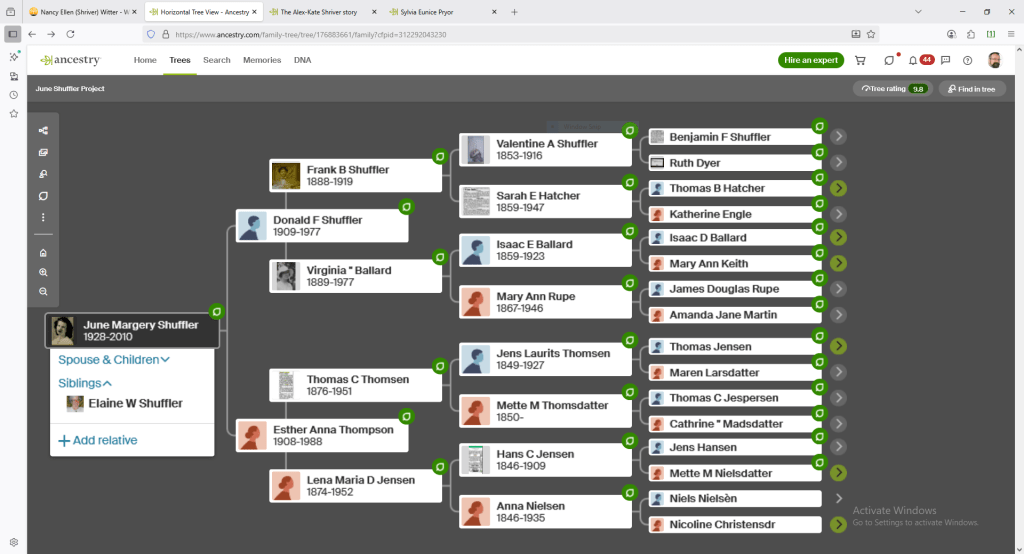
    My wife’s paternal grandmother was June Margery (Shuffler) McCullough (1928-2010), and June’s mother was Esther Anna (Thompson) Shuffler (1908-1988). Esther was born in Council Bluffs, Iowa, but her father was a Danish immigrant, and her mother was the daughter of Danish immigrants.

    Tom and Lena are two of Her Sixteen – two of my wife’s 16 great-great-grandparents. We touched on parts of their story in Family Reunion: Thompson/Thomsen and Family Reunion: Jensen.

    The Time Before Surnames

    As we discussed in the Family Reunion post for the Thomsen family:

    Thomas Christian (Thomsen) Thompson (1876 – 1951) was the son of Jens Laurits Thomsen (b. 1849) and Mette Marie Thomsdatter (b. 1849), born on 2 Oct 1876 in Gudum, a parish of Ålborg, Denmark.

    You may have noticed that Thomas was given the surname “Thomsen” when he was born, instead of the traditional patronym of “Jensen” even though his father, Jens, seems to have been named “Jens Thomsen” after his father, Thomas Jensen. This Wikipedia article suggests that the 1856 naming act in Denmark could be the reason for this switch. Jens was born in 1849, so he took the traditional patronym. His son, born long after the naming act required children to inherit their father’s surname, then took “Thomsen” instead of “Jensen”.

    If you’ve been accustomed to researching families that used surnames, you will need to be extra careful, because your eye will be conditioned to reject records with surnames that don’t match. I know I have to look carefully through Hints and Search results to make sure that I have “three matching points of data” before I consider accepting a record and adding it to my tree. With Tom Thomsen, I have been lucky enough to find records that consistently include both parents’ full names, full place names, and accurate (if not always precise1) dates.

    That challenge becomes less difficult with practice, especially if you are lucky enough to find your target family in church records. Likewise, learning how to recognize and navigate the place names in Denmark (or whatever country your ancestors hailed from) will become easier with familiarity. Don’t rush yourself. Take the time to make sure you have found the correct family, in the right place, at the right time before expanding to siblings and earlier generations.

    Finding Your Place

    I am no expert on European place names, and given the unpredictable number of variables that can affect what appears on a given record, you may struggle to interpret what you find. Not only can the names of various types of districts/counties/dioceses/parishes change over the lifetime of your ancestor, there may be two different and valid names for the same place (one municipal, one religious) for the same time period. And the person can move, of course.

    On top of those factors, the records that get to you might be in the original language (in this case, Danish) or may be transcribed into English. “Gudum, Ålborg, Danmark” would be the same place as “Gudum, Aalborg, Denmark,” for example. Records might omit the type of jurisdiction (as the previous example did, leaving out the “Amt” in “Ålborg Amt”) or might list multiple jurisdictions, like this: “Hellevad Sogn (Hjørring Amt), Ålborg Amt; Hjørring Amt, Danmark” showing that the church parish (Sogn) of Hellevad was partly in Aalborg county (Amt) and partly in Hjorring county.

    There are numerous resources online that can help you figure out where your ancestor’s records place them, but I recommend starting with the gazetteers2 linked from the FamilySearch.org wiki – Denmark Gazetteers has links to several sites. You can also start on their Denmark Genealogy page and drill down to the Counties or Parishes you are interested in. That’s how I found my way to the page for Jens Laurits Thomsen’s birthplace, Hallund Sogn, Hjørring Amt, Danmark.

    Again, take your time, learn how the gazetteers work, and make sure you are finding records for the right person before you add them to your tree. (And don’t be afraid to translate individual words – knowing that the “Relation to Head of House: Tjenestekarl” means “servant” can be key information!)

    Tom Thomsen’s Parents

    There were several online trees that confidently told me the names of Tom’s parents, but the sources that would usually confirm that information were not helpful. His Iowa death certificate from 1951 listed both parents as “Unknown” – meaning that the informant, his daughter Dagmar Ranum, did not know her grandparents. But, she did give a precise date of birth (2 October 1876) and multiple sources, including his obituary, gave Denmark as his birthplace.

    Denmark, Church Records, 1812-1924 show Thomas Christian Thomsen born 2 Okt. 1876 in Gudum, Aalborg, Denmark, to parents “Indsidder” Jens Laurits Thomsen and wise (Hustra) Mette Marie Thomsen. From there, we can find the family in the 1880 Denmark Census, where we learn the name of Tom’s sister, Maren Cathrine Thomsen.

    From there, the puzzle pieces begin to fall into place, but not without some difficulty. For example, you see that Mette Marie’s last name is give as “Thomsen,” which could simply mean that Tom’s birth record listed her married name. That would be unusual, though, and further digging to find Jens and Mette Marie’s marriage record shows her maiden name is “Thomsen” also.

    It turns out that her father’s name was Thomas Christian Jespersen. She was born before the Naming Act of 1856 went into effect, and thus she was listed with the patronymic “Mette Marie Thomsdatter” on the 1850 and 1855 Denmark Census – but from 1860 onward, she appeared under the surname “Mette Marie Thomsen.”

    Both Jens and Mette Marie grew up near what is now the Brønderslev Municipality, and their records show several of the placenames you can see on this map:

    As you can see, there is a lot of information to assemble before we can put together a biography for either of Tom Thomsen’s parents. Challenges can vary, from the number of people with similar names from neighboring districts and counties, the confusing transitions from using patronyms to surnames, the use of abbreviations (“Thomsdr” for “Thomsdatter”) or simply working around clerical errors (Mette Marie’s mother’s name should have been “Cathrine Madsdatter” but was recorded as “Inger Madsdr” on a key baptismal record).

    For now, our WikiTree entries stop with Tom Thompson of Iowa, but with some patience and care, the records that tell us the rest of the story about his parents and sister should come to light. And when they do, I’ll get to tell that story. We know Jens emigrated in 1888, but did Tom come with him? What about Mette Maria and Maren Cathrine?

    Until then, back we go to mining the databases!

    1. If you don’t remember, we talked about the difference between “accuracy” and “precision” in Good Enough. ↩︎
    2. A gazetteer is a dictionary of place-names. ↩︎