Tad Callin has been working on family history and genealogy since the late 1990s. He does most of his research on Ancestry and posts what he learns to WikiTree.
The revised Callin Family History is where I focused most of my efforts from 2015 to 2022. I started with James Callin, my 5x-great grandfather, and traced as many of his descendants as I could using Ancestry’s World Deluxe membership (which includes partial access to Newspapers.com and Fold3). If you click on his name, you will find yourself on his WikiTree profile – and the green “SHOW DESCENDANTS” button will display the top three or four generations.
Some other significant surnames:
Montgomery – two granddaughters of James Callin married brothers named Montgomery, and moved to Fulton County, Indiana.
Davidson – Sarah, one of the Montgomery daughters married Henry Davidson (28 May 1818 – 19 Feb 1894), and they moved their large family to Oregon in 1852. (That’s right – they took the Oregon Trail!)
Scott – Sarah Callin, another granddaughter of James married and moved to Winnebago County, Illinois, leaving a large number of Scott descendants there.
Campbell – Granddaughter Ann Callin married Henry Campbell, and their children settled in Missouri, Texas, and California.
Ferguson – Eliza Callin married James Ferguson and their family moved to Fort Wayne, Indiana. Dozens of their Ferguson and McNabb descendants remained in Fort Wayne and Auburn, and some moved to Michigan.
2022 – The Callin Family History
All of the families mentioned above are documented in my book, The Callin Family History – links to that book and others, including the republished 1911 version, can be found at this link.
Callen
I am convinced that James Callin is somehow related to Patrick Callen, whose family is documented in The Callen Chronicles, published in 1990 by Edna Callen MacNellis and her associated researchers. We have some compelling DNA connections and stories shared between the two families, as well as a tantalizing grave site in Muscatine County, Iowa (see below) that seems to prove that there is some kind of connection – but I haven’t found any documentary evidence. Yet.
Let me know if you think you have any clues – and if you want regular updates, be sure to subscribe.
Ohio and Kentucky
My grandfather, Robert T (Bob) Callin, was born in Ohio, and the four generations before him lived in either the Fostoria area, near Bowling Green, or in Ashland and Richland counties.
If you read James Callin’s WikiTree profile, you can see the evidence I’ve gathered suggesting that he did not die in Westmoreland County, Pennsylvania, but likely moved to Kentucky sometime after the conclusion of the Revolutionary War. There are dozens of people recorded with various spellings of the surname Callin or Callen in Mason, Campbell, and Kenton Counties in Kentucky.
I think I will need to start a One-Name Study if I’m ever going to figure out whether these Kentucky Callen families are related to my Pennsylvania/Ohio Callin family. [Update: I did! See The Callan Name Study]
Iowa
Two of James Callin’s grandsons, Hugh and Alec (or Alexander) settled in Iowa around 1840. I’ve traced two of Hugh’s daughters and their descendants, but I don’t know whether he had sons. Until someone descended from either Hugh or Alec does DNA testing, and comes looking for them, I am at a brick wall with their branches.
But I do know that their mother, Mary Callin, is buried in Muscatine County, Iowa, alongside Patrick Callen’s grandson, Callin Rayburn.
Russell Hudson Clark (1920-2002) was my maternal grandfather. Most of the Clark families I work with are related to Grandpa Russ – but the surname does show up in my Callin Family History, too.
Maternal side:
Grandpa Russ was the youngest of a large family. He was born in Clermont County, Ohio, but all of his older siblings were born in Ashland, Boyd County, Kentucky. His grandfather was Joel Clark (1828 – 1915), who was born in Lawrence County, Ohio, just across the river from Ashland. Joel Clark’s nine children were all born in either Ashland or neighboring Greenup County, Kentucky.
Those three generations of Clarks married people from the local area – so the same surnames keep popping up. As far as I can tell, it was rare that anyone closer than 3rd cousins married each other, but sometimes two siblings from one family would marry two siblings from another family, which can make the records harder to figure out.
The Big Four surnames that keep showing up are Clark, Reynolds, May, and West.
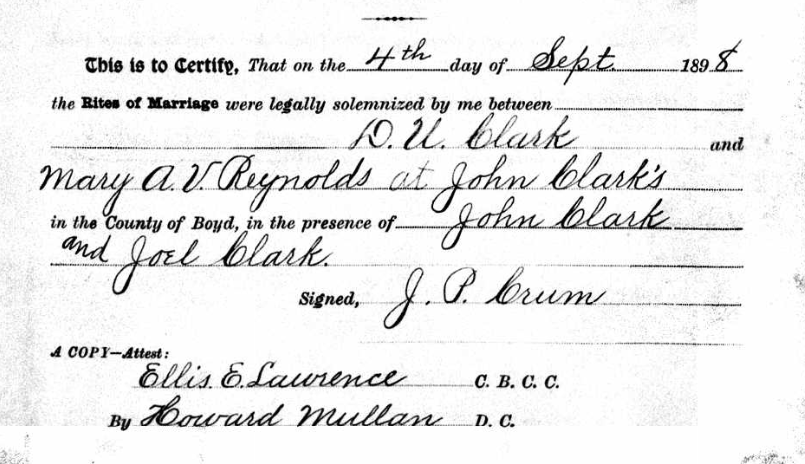
We also have several cousins living in the Ashland area who are descendants of Grandpa’s aunt, Jennie (Clark) Smith (1878 – 1975). If you’re a cousin of mine through David Ulysses Clark, you might be interested in the Facebook group Peggy’s Clippings, in which several of her great-grandchildren have shared the local newspaper clippings collected by Jennie’s granddaughter, Peggy Adams.
Grandpa Russ used to tell us stories about growing up in Arkansas, and a number of his aunts and uncles relocated there around the time of the Great Depression.
I have done my best to document everyone from Joel Clark down in WikiTree – and I am still looking for information about Joel’s father, Amos Clark. There were at least three men from that area called Amos Clark at the same time, which does present some challenges. Hopefully, as more folks get their DNA into the system, we’ll be able to figure out who’s who.
My paternal connections:
I wrote about these folks in 2015 in “Those Darned Clarks” – here’s a shorter version:
Charles and Howard do not appear to be related to each other. However, Howard was born in Ashland, Kentucky, so there is a solid chance I will find a connection between him and my maternal Clark family someday.
If you’re a descendant of any of these Clark families, drop a comment and say hello or ask questions. If you want me to write more about them, asking me questions is the best way to inspire me!
And be sure to invite your cousins to subscribe – so when I do get around to writing something new, they won’t miss out.
Most cultures contain within their most primal beliefs the idea that Names have Power.
You see this idea pop up in fantasy stories about magic, in mystical belief systems, and in most creation stories – for example, Adam’s first act in the Garden of Eden was to name the creatures being created. (The first taxonomist!) It is also true in modern society, where your username gains you access to the world and where your “personal brand” is often more important than the substance of what you sell under that brand.
In genealogy, the first thing most novice researchers focus on is their collection of names. It can be thrilling to find a name you recognize attached to your ancestors, especially if it’s a famous name. My paternal grandfather, for example, knew that his maternal grandmother’s name was “Hale,” and I grew up hearing that we were “probably related to Nathan Hale” based solely on the power of that name connection. As far as I have been able to discover, we have no family connection to the 21-year-old American spy, and he died unmarried and childless.
As important as names are, it can be brutally difficult for a researcher to figure out what a person’s name actually was, and how to find that person in historical records. Today I wanted to talk about one example of how someone’s name became a puzzle.
From Name to Record
We don’t often think about how names get attached to a person, or how those names get recorded, but when you do think about it, the process starts to resemble the old Telephone game. Before a name gets to you, the researcher, it can go through several layers:
the people who pick the name
the person who uses the name
the people who know the person
the people who record the name
transcribers and indexers
As with the Telephone game, errors can creep in at any point between any of these layers. I’ve seen countless examples where parents have used one name for their child only to have that child prefer to use a middle name or an alternate spelling later in life. My great-grandmother Hannah Merle was named “Hannah” after her grandmother but went by “Merle” or the diminutive “Merly” until her death in 1984. My great-uncle, Byron Herbert Callin, was called “Byron” in his youth but preferred to use the more distinguished-sounding (to his ears) “Herbert” in his career as an educator.
There are, of course, nicknames: Jack for John; Libby for Elizabeth; Sadie for Sarah; Polly for Mary; and Dick for Richard. These are pretty common even if they don’t always make sense to later generations, and some of them have taken on a life of their own. I’ve seen countless examples of people who were christened with a pet name or diminutive like “Billie,” or “Johnny.”
As these names get written down, there can be a mix of factors that lead to some wildly different recorded results. Let’s take a look at one person whose name looks different on almost every record: Eliza Alice “Lydia” Reed Donaldson (1866-1951).
Following the Records
The first record I had that named Eliza was The Callin Family History record of her mother, which identified her as “Eliza, married, five children living.” Great-Uncle George did not cite his sources for his information in the CFH, but we might assume from the newspaper reports of Callin Family Reunions that occurred in Ohio during the early 1900s that gatherings of distant cousins would share what they knew, and he probably collected the names of his cousin Elizabeth’s children at one of those gatherings.
The earliest public record I have is her family’s appearance in the 1870 U.S. Census, where her name is given simply as “Eliza” – here is how her name seems to have evolved each time she appears in the Census (as transcribed for Ancestry):
1870: Eliza (Reed)
1880: Eliza A. (Reed)
1900: Lisa A. (Donaldson)
1910: Leda A. (Donaldson)
1930: Eliza (Donaldson)
1940: Liza Alise (Donaldson)
The game of telephone becomes really apparent when you consider how the Census records get to us. First, of course, you have the family that knows the information; then you have the enumerator who writes down the information; and after 70 years or more, the records are scanned and transcribed by a human being to create the index we search against.
Since we don’t know who told the census enumerator the names of the Reed or Donaldson families in each of these records, we don’t know for sure what the family actually told them. The three records where our girl is listed as “Eliza” are pretty straightforward – the enumerators of those records wrote clearly, and the indexes were transcribed accurately. But the other three are harder to read, and make the name more ambiguous:
detail from the 1900 U.S. Census record on Ancestry.comdetail from the 1910 U.S. Census record on Ancestry.comdetail from the 1940 U.S. Census record on Ancestry.com
If we assume that Norman gave the enumerator his wife’s information, it’s possible that he said “Liza” each time, but the different enumerators heard it differently. Of the three, only 1910 is clearly written with a “d” in “Lida” or “Leda” – and while it’s not a common name today, “Lida” was a fairly familiar name in the Midwest at the turn of the 20th century. (Familiar enough for a song with that name to appear in the 1962 Broadway musical The Music Man!)
Taking all of these records together, I’m inclined to believe that her given name was actually “Eliza” and that everyone knew her by the nickname “Liza” – but there are more records to consider.
The Indiana, Marriages, 1810-2001 database on Ancestry is very useful, as it provides the names of the bride, groom, and both sets of parents, in addition to the marriage date and location. As with the Census, though, we don’t know who is providing the information on the record, and we don’t know which human being(s) were involved in digitizing and transcribing the records for the index. At the least, I think it’s safe to assume that the bride and groom gave their parents’ names to the county clerk. So, with that assumption in mind, here are the variations of Eliza’s maiden name as known to her children:
Note: I linked the names of the grooms to the original record images at FamilySearch.org so you can examine them for yourself. With one exception, they appear to have been transcribed accurately; Russel’s document clearly says “Lida,” though, and was incorrectly transcribed as “Lydia”:
detail from Indiana Marriages 1811-2007 on FamilySearch.org
This tells me that four of her five sons knew her maiden name as “Lida Reed” – and they probably all knew that was a nickname, but Gerald thought that “Lida” was short for “Elizabeth.”
Oh, Have You Met Lydia?
As I pointed out, one transcriber seems to have misread “Lida” as “Lydia” – possibly not knowing that Lida was a popular nickname, or thinking that it was a shortened version of Lydia. There are two other records that list Eliza’s name as “Lydia,” however, which could either mean she started using that name later in life for some reason, or that this is a very common mistake.
The first example, chronologically, is the Death Certificate of her husband, Norman Donaldson, who died on 3 December 1940. This is a typewritten document that can be found in the Indiana, Death Certificates, 1899-2011 database on Ancestry.com. Oddly, the transcriber entered the name in the index as “Ludia,” but the document quite clearly gives her name as the wife of the deceased: “Lydia D.”
The second example is another Death Certificate, this time for Eliza’s son, James, from 20 July 1951, again from the Indiana, Death Certificates, 1899-2011 database. This record is also clearly typewritten, and gives the mother’s maiden name as “Lydia Reed.”
In the first example, the informant is recorded as “Newton Donaldson,” which either refers to Norman’s brother, or to Norman and Eliza’s son, Newell Donaldson (1900-1962). If they were referring to the latter, then the clerk botched the name of the informant, and that makes me suspect that Newell probably gave her name as “Lyda” and the clerk got that wrong, too. In the second example, the wife of the deceased, Celestia Donaldson, is the informant. The clerk did a much better job spelling the name of the informant on this document, but given the patterns we’ve seen in other records, I’m inclined to think that either Celestia didn’t know her mother-in-law’s name was “Lyda” or (more likely) the clerk just corrupted it into Lydia, as we’ve seen done elsewhere. It’s possible, if the informant on Norman’s death certificate was Newton, that both clerks made the same error.
Conclusion
Based on the totality of the available evidence, I have recorded Eliza’s name as “Eliza A. ‘Lyda’ Reed” with alternate names included to highlight the one record that gives her middle name as “Alise.” And while I will refer to her as “Lyda,” since that seems to have been the name she was known by, I tend to give the final authoritative word on what someone’s name is to whatever the family is willing to set in stone.
Find a Grave Memorial 141478294
Taking the extra steps needed to figure out simple facts can be tough – do you have a puzzle like this that is making it hard for you to learn everything you can? Drop a comment or send me an email; I’m happy to take a look.
And don’t forget to subscribe if you haven’t already:
My wife’s maternal grandfather, Arvid Wesley “Bud” Holmquist (1920 – 1996), was the son and grandson of Swedish and Norwegian immigrants who arrived in the United States during the 1880s (in the case of his maternal grandparents) and in 1910 (in the case of his father).
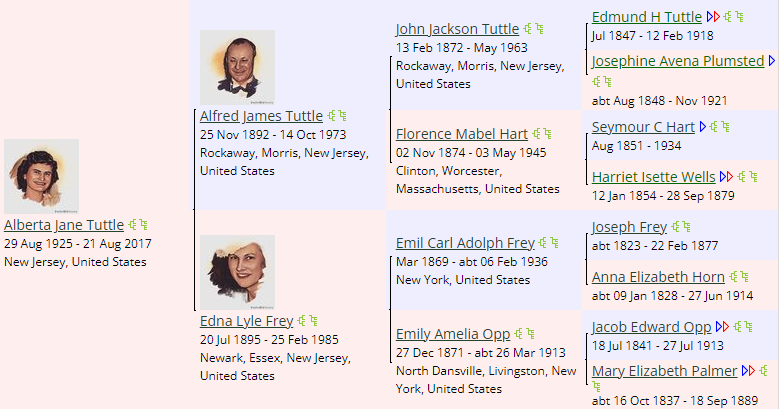
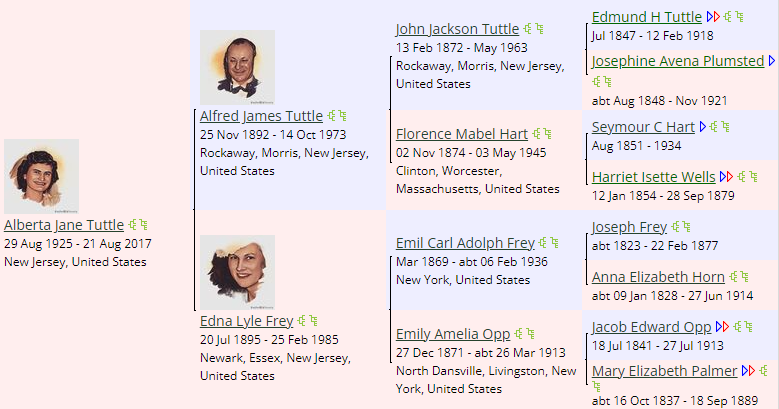
Eight of my wife’s sixteen great-grandparents are relatively recent immigrants from Denmark, Sweden, and Norway, or from Holland and Prussia. When I say “recent,” I mean that they arrived during the mid-to-late-1800s as opposed to arriving during or before the American Revolutionary War. In contrast, my own great-grandparents were all born in the U.S. and the most recent immigrants on my side of the tree were Joseph Frey and Elizabeth Horn, who arrived from southern German states in the 1840s.
Researching immigrant families is a lot of fun, but it does take extra time. The digitized records for the Scandinavian countries are particularly good, as they tend to be thorough – more details to compare means it is easier to learn new facts. However, the language barrier remains difficult. Not only did I find myself dealing with multiple countries with different languages, but they were going through periods of administrative changes that affected both family names and place names. You can see a lot of examples in Bud Holmquist’s ancestry.
The Scandinavian Surname Game
I have been able to trace the Holmquist family back to Bud’s grandfather, Anders Holmquist (1846-1916). If you recall our previous post about the Thompson/Thomsen family, we observed that my wife’s Danish ancestors seemed to begin using a family name for their surname instead of a patronymic after an 1856 law passed in Denmark. The Holmquist family name appears to have already been in use as their surname as far back as Anders, born in 1846, despite Sweden having no law regarding family names until after 1901.
We also see that Bud’s maternal line, the Leander family, was using their surname as early as his grandfather’s generation, Gustaf Hugo Leander (b. 1863). Gustaf’s father was known as Mårten (Persson) Lenander (1833 – 1896), suggesting that he was born under the patronymic name “Persson” and later switched to using Lenander as his surname.
Bud’s grandmother was Ingeborg Olesdatter (1858-1934), born in Byneset, Norway. She was given a patronymic at birth, but when her family came to the United States during the 1880s, they used Svedal or Swedahl as their surname. Her family’s farm name was Svedal, one of the farms near the village of Aunet.
To Minnesota from Sweden
Gust Leander probably married Ingeborg Swedahl in New York, in about 1884, according to their 1910 U.S. Census record. Their first two children, Augusta and Hildur, were born in Connecticut and Brooklyn, New York, respectively, and the family had moved to St. Paul, Minnesota, by 1888. By 1895, the family was in Chicago, and then in McHenry County, Illinois, but they had returned to Saint Paul by 1903.
William A. (he only seemed to use “Arvid” on certain records) Holmquist was 29 years old when he arrived in New York from Liverpool aboard the Arabic on 3 May 1910. His uncle, John Spence, was listed as the “Person in the US” to meet him in Stillwater, Washington County, Minnesota. William married Hildur on 26 Jun 1912 in St Paul, Ramsey, Minnesota. William was naturalized as a citizen on 12 Sep 1921 in Stillwater.
Slow and Steady
I expect to find a few cousins on this side of my wife’s family in the near future – it has been difficult to find all of the siblings who immigrated to the US at different times. But as I keep working and adding profiles to WikiTree, I hold out hope that things will start to come together.
As always, if these families look familiar, drop a comment or an email.
And if you haven’t already done so, go ahead and subscribe so you can get a free newsletter in your inbox.
Born in Germany, in the mid-1820s, he came to settle in New York, probably during the 1830s or early 1840s. His birthday is listed on various documents as ranging from 1823 to 1828, and his birthplace is usually listed as either “Baden” or “Wurttemberg“, but other sources say his parents may have been from a small French town near the Swiss border, or that he was born in Switzerland.
These were very difficult times for working-class people in Europe. Between successive revolutions in France, uneasy relations amongst the old Empires, and terrifying epidemics – particularly cholera – sweeping through the increasingly crowded and unsanitary cities, a young man looking across the ocean might have been strongly attracted to the relative prosperity and peacefulness of the United States.
Once settled in one of the German-speaking neighborhoods around New York, that young man would have become part of the story of that young, still experimental nation. He would have seen the growing stream of immigrants from Ireland pouring through New York Harbor during the so-called Potato Famine of the 1840s; he would have seen politicians arguing about Westward expansion; and he would have heard about threats of war from Britain, France, and Mexico. Without records or writing from Joseph’s point of view, I have to assume from the evidence available that he found his place in America, and decided to invest himself in it.
When President Polk maneuvered the U.S. into war with Mexico, Joseph enlisted as a private in Company A, 5th Regiment of Infantry, New York Volunteers. He signed up for a 5-year term on 3 December 1846 but was discharged honorably after 11 months and 24 days on 27 November 1847 after the relatively quick American victory at Mexico City.
On March 11, 1849, he married Elizabeth Horn in the Lutheran church in Williamsburg, New York, and they began raising their family; Frederick (1851), Maggie (1853), William (1856), Theodore (1858), and the twins, Edwin August and Edward (1859).
As a veteran soldier and a member of a close-knit community in a burgeoning New World city, I like to imagine that this would have been a happy and hopeful decade for Joseph and Elizabeth. Despite the growth of the anti-immigrant sentiment??in the 1840s and 1850s, people like the Freys were learning how to thrive in the “melting pot” of New York. Joseph was listed in the 1860 census – along with Elizabeth and the children listed above – and identified as a brush maker, which implies that he was literate and educated, and moderately well-off.
And then there came another war.
Enlisted in Captain Robinson’s Company of New York Volunteers on 6 September 1861, Joseph re-enlisted on 15 November 1863 and was discharged and mustered out with the Company on 21 June 1865. His pension records say he contracted seriously debilitating rheumatism during his time in service, and while he and Elizabeth had two more children – Augusta (“Gussie”, b. 1865) and my great-great-grandfather, Emil Adolph Carl (1869) – his health would never fully recover.
In 1870, Joseph had taken his brush-making profession back up, and his older sons and daughter seem to have been helping with the house and the business in the Flushing neighborhood of Queens, New York. But his condition seems to have deteriorated so that sometime around 1876, he had to move into the Soldier’s Home in Washington, DC – where he died in February 1877, barely 50 years of age.
By 1880, Elizabeth had moved the family to Newark, New Jersey, probably to be near her brother’s family, and the Freys lived at 103 Congress Street for many years. Young Emil met Miss Emily Amelia Opp, whose family split their time between a cottage in nearby Paterson (about 15 miles from Newark) and Dansville, in upstate New York.
Emil and Amelia were married around 1894 in Dansville and settled back in Newark. They had six daughters: my great-grandmother, Edna (1895), Elizabeth “Bessie” May (1897), Blanch (1899-1900), Marjorie (1900), Grace (1902), and Theresa “Tessie” Decker (1908).
Frey family, about 1903 from left: Edna, Emil, Bessie, Amelia (front) Grace, Marjorie
I have the impression that Emil found a second family in the Opps. Amelia’s father, Jacob, was a veteran of the late war, just like Emil’s father. He worked as a locomotive engineer, which might account for his family seeming to simultaneously live in two towns separated by nearly 300 miles. For example, in 1900, Emil and Amelia and their girls show up twice in the Census records – once in the home of Susan Opp (Jacob’s widowed mother) and once in their own home in Newark. Interestingly, the two records were enumerated only about a week apart – one on the 1st and one on the 9th of June – suggesting that they were recorded both while visiting Dansville AND after their return home to Newark.
Jacob Opp
These years seem to have been happy ones for Emil. He worked as a grocer and (according to a Frey family tradition) as a Borden’s milk delivery man. It isn’t clear what caused the tragic loss of little Blanch before her second birthday, but the other girls seem to have all been healthy and the family seems to have prospered. Sadly, Emil and Amelia would not see their twentieth wedding anniversary.
Frey daughters, about 1909 (clockwise from left) Edna, Theresa, Elizabeth, Marjorie, Grace
In 1910, Jacob was listed in the Census records as living in Emil’s household, where he apparently lived out his days. He succumbed to pneumonia in July 1913, only a few months after Amelia died, in March of that year. At this writing, I am just shy of my twentieth anniversary myself; I know how I would feel if I lost my lovely bride right now. If my impression of their relationship is correct, Emil then immediately lost someone who may have been like a surrogate father for an even longer time. Then, as if that weren’t enough, Emil’s mother, Elizabeth, died in 1914 of Bright’s disease at the age of 86.
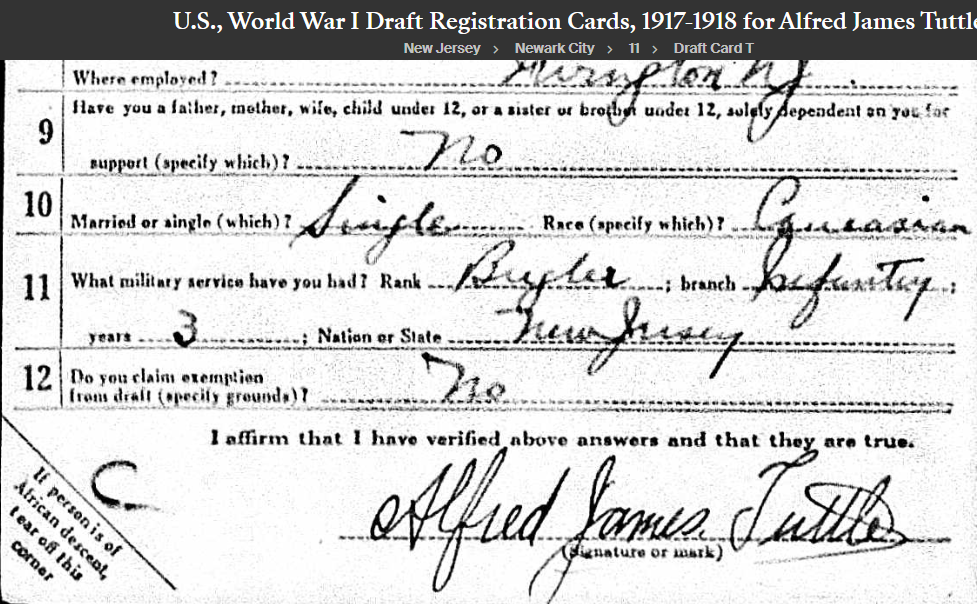
This all seems to have been too much for him. Emil’s older daughters, Edna and Bessie, began working to support the family, and they took care of the younger girls. By 1920, Edna was married to Alfred Tuttle; Bessie was working as a legal clerk, living with the other girls in a rented house on Fourth Street in Newark while they attended school; and Emil was an inmate in the Essex County Hospital Center (also called Overbrook hospital) in Cedar Grove.
My grandmother, Edna’s younger daughter, recalls visiting Emil in the hospital. She told me, “We used to visit him every Sunday, and take him fruit and treats. I was very young then of course.” She would have been 11 years old when he died of pneumonia in February 1936.
Today, approaching 2015, I have to wonder if it might have been possible to do more to treat Emil; if we could go back armed with a better understanding of the mind and brain, would we be better equipped to help him, and get him back home with people who loved him? It’s hard to know what his life was like those last 16 years; I haven’t found records that could describe his condition or diagnosis, and the hospital itself shut down in 2007. It is now a favorite haunt for so-called urban explorers and ghost hunters – thrill seekers more interested in playing up the “spookiness” of old buildings than understanding what life was like for the patients.
At least his life was bookended by heroic people. From his father, the devoted soldier, to his self-sufficient daughters, Emil Frey seems to have been surrounded by love, strength, hope, and joy for most of his life. I will leave it to you to decide whether that lessens or sharpens the tragedy of those last years.
It is difficult to be certain about much when looking for records for a family like this one. They lived in a crowded city full of other immigrants, and their names were fairly common. Spelling was inconsistent – some documents (including signatures in their own hand) spell the surname “Fry” while most appear to use “Frey.” Some of the documents are in German, which is complicated when they are handwritten.
But there are some certainties. I ordered Joseph’s pension file from the National Archives many years ago, and that helped me tell much of his story – which you can read on his WikiTree profile, linked above.
One of the facts I found to be most tantalizing in its uncertainty is the identity of one of the witnesses who signed the documents in that NARA file. The documents attesting to Elizabeth’s right to claim Joseph’s pension were her daughter, Augusta, and a man named John Horn who resided at 170 McWhorter Street in Newark, New Jersey. I suspect that John Horn was Elizabeth’s brother, so I am hoping that this information will lead me to some record that shows when Elizabeth’s family arrived in the United States.
Outside of the NARA files, I have found one immigration index record of a 17-year-old Joseph Frey arriving in New York from Germany in 1840. This could be our Joseph Frey – but I need to track down the original document to see if it contains any additional clues.
When Joseph died, the NARA files indicated that he had two children under 16 years of age: Augusta and my 2nd-great grandfather, Emil Frey. I will share his story on Friday – pun intended!
If you happen to be descended from a Frey family that lived in 19th Century New Jersey or Long Island, drop a comment and compare details!
And, as always, subscribe to get regular updates. It’s a free newsletter, and you never know when our common ancestors might surface.
I originally posted this essay on my old Mightier Acorns blog, and I’m reposting it today so you can see how much work can be involved in chasing down immigration information. Please note that the words “Ellis Island” don’t appear anywhere in this story. I have edited this version to update links and correct minor copy mistakes.
When I set out to trace all of the descendants of James Callin, I made the choice to delve more deeply into the families of spouses than I usually see done in the older family history books. In the case of George Wishart, I did my best to discover who his parents were, and where and when they were born and died. In the process, I think I stumbled into a possible controversy in the research.
I started with Edna H. Malson, my 4th cousin, 2x removed, and after I walk you through ten pieces of evidence about her husband, George, and his parents, I’ll explain the remaining mystery.
The Lebanon Express – 12 Feb 1919, page 1
1. Edna’s Obituary (see the Newspapers.com clipping here) establishes that we have the right person (Edna Hazel Wishart, brother’s name “C.W. Malson”) and some useful facts about George, which are confirmed by the first piece of evidence: a marriage record in the Multnomah County, Oregon Marriage Index, 1855-1919 database.
Name: George Wishart
Married: 1 June 1908 in Portland
2. 1910 Census: I don’t think it’s too wild a leap to assume this record showing George and Edna Wishart living in Portland is the same couple we see on that 1908 marriage record, and we learn a few more facts about George.
Birth Year: abt 1890
Birthplace: New York
Occupation: Baker
Father’s Birthplace: Scotland
Mother’s Birthplace: Canada
3. WWI Draft Registration:George’s record in the U.S., World War I Draft Registration Cards, 1917-1918 is a treasure trove. It confirms and expands upon what we already knew about George, so now we have:
Name: George Alexander Wishart
Occupation: Baker (the card gives the company he works for and its address)
Marital Status: Married (the card says “wife, 2 children” – which matches what we know about Edna and their daughters at that time)
Birth Date: 1 Oct 1890
Birth Place: “North Towndanda,” New York, USA
(The New York State, Birth Index, 1881-1942 confirms the date and place of birth, and tells us that the correct name of the birthplace is North Tonawanda, which is located in Niagara County.)
4. California, Death Index, 1940-1997: this record matches what we now know about George, and gives us some new information: Name: George Alexander Wishart Birth Date: 1 Oct 1890 Birth Place: New York Death Date: 4 Jun 1980 Death Place: Monterey Mother’s Maiden Name: Bailey
5. 1900 Census:conveniently, the Wishart family appears in North Tonawanda, Niagara County, New York in 1900. George is listed (age 8, born Oct 1891 – close enough for our purposes) and we see his family listed:
Father’s Name: John Wishert (I chalk the spelling up to transcriber error – again, it’s close enough for our purposes)
Father’s Birthplace: Scotland
Birthdate: Oct 1854 (note that the 1900 Census dates tend to be one year off – this will be important later)
Mother’s Name: Anna Wishert
Mother’s Birthplace: Canada, England
Birthdate: Nov 1868
Children:
Andrew Wishert, 12 George Wishert, 8 James Wishert, 7 Jessa Wishert, 1
The 1900 Census provides a few more useful details:
Older brother Andrew’s date/place of birth is listed as Dec 1887, Canada; George, James, and Jessa were born in New York.
John Wishart’s immigration year (1878) and marriage year (1886) are given, and it says his parents were both born in Scotland.
Anna’s entry says “Immigration Year: 1878” – but it also says “Years in US: 12,” which would be 1888.
Given these clues, I believe I should be looking for a marriage record for John Wishart and Anna Bailey (remember document #4) somewhere in Canada in 1886. I should also be looking for immigration records for John in 1878 and for both John and Anna in 1888.
6. Immigration/Arrival: two records show John Wishart arriving in the U.S.; one in the New York Port, Ship Images, 1851-1891 database, and the other in New York, Passenger Lists, 1820-1957. Both show that a John Wishart, born “abt 1853,” arrived in New York from Liverpool aboard the Baltic, a ship of the White Star Line, on 5 April 1878. They list his Ethnicity/ Nationality as English, but I’m reasonably certain this is still our guy.
7. Ontario, Canada, Marriages, 1801-1928: two records in this database tell us more about George’s parents. Taken together, here’s what we learn from them:
Name: John Wishart
Birth Year: abt 1854 (Age: 32)
Birth Place: Orkney Scotland
Marriage Date: 5 Aug 1886
Marriage Place: Woodhouse Township, Norfolk County, Ontario, Canada
Father: James Wishart
Mother: Helen Wishart
Spouse: Annie Bailey
Birth Year: abt 1867 (Age: 19)
Birth Place: Port Dover, Norfolk County, Ontario
Spouse father: William Bailey
Spouse mother: Mary Ann Bailey
8. Ontario, Canada Births, 1869-1913: this record provides one last piece of evidence that confirms what I said about the 1900 U.S. Census; in particular, I think Name: Andrew Wishard Wishart (this is an Index Record, so I couldn’t view the original to see which spelling is on the document) Birth Date: 11 Dec 1887 Birth Place: Norfolk, Ontario, Canada Father: John Thompson Wishart Mother: Annie Bailey
9. 1871 Scotland Census: at this point, I think we know enough about John’s origins to look for records in Scotland – and here’s what we find: Name: John Wishart Estimated Birth Year: abt 1854 (Age: 17) Mother’s Name: Helen Wishart Where born: So Ronaldshay, Orkney
10. Scotland, Select Births and Baptisms, 1564-1950: and here’s the crowning piece of evidence. Name: John Thomson Wishart Birth Date: 10 Oct 1853 Baptism Date: 20 Nov 1853 Baptism Place: South Ronaldsay, Orkney, Scotland Father: James Wishart Mother: Hellen Thomson
Now, after all of that work, I’m left with one remaining mystery: where and when did John Thompson Wishart die?
There is an Oregon, Death Index, 1898-2008 record that shows “John T Wishard” died on 29 March 1942 in Marion [County], Oregon, but there is a Find-A-Grave memorial for another John T Wishart which claims that date of death:
John Taylor Wishart
Birth: 19 Aug 1869, Letham, Angus, Scotland
The biography of John Taylor Wishart seems completely different from what our records show for John Thompson Wishart:
John was born in Letham, Dunnichen Parish, Angus and immigrated with his family to the United States in October 1871, arriving in Nebraska and settling in Nemaha Co., Kansas as a family unit. Many family members moved to Parkdale, Hood River Co., Oregon in 1885 and John along with them; he held a tract of land adjacent to his father and brothers in the Upper Valley Precinct, which he appears to have sold about 1895.
By the 1900 census John was located in Upper Trout Precinct, Crook Co., Oregon working as a laborer in a sawmill, and by 1910 he was in Ashwood, Crook Co., where he had his own farm and was a Stockman. Ashwood was redistricted into Jefferson Co., Oregon, and he is again located in the 1920 and 1930 census in Ashwood as a Stockman and farmer in stock grain. All census records record him as single, no children.
I do see a 1910 Census record for a widowed John Wishart, born about 1854 in Scotland, living in Portland; this could well be our John Wishart since the other fellow was supposedly in Ashwood at that time. Our John Wishart was a sailor who lived in Canada and New York (all while this other John Wishart was growing up in Nebraska. I don’t know how long our Wishart family stayed in New York before moving to Oregon, but our John and Annie had three sons and a daughter and the timing of the records we have would allow for Annie to move to Portland before dying in 1906.
The last record I have shows 77-year-old John Thomson Wishart arriving in New York from Glasgow aboard the Transylvania on 9 December 1930 after a trip to Scotland to visit relatives. I’d like to think he arrived home in Portland safely, and enjoyed many more years with his family.
I just don’t have the evidence to support that conclusion.
So, there you have a glimpse into my sources and methods. I’m not directly related to the Wishart family, but I hope I’ve helped clarify some things, and if anyone has an answer for my mystery, I’d love to tie up the loose end!
As always, if you’ve found one or more of your relatives mentioned in this blog, please get in touch. You can comment below or email “mightieracorns” at Gmail.com.
If you haven’t already subscribed to this newsletter, you can keep up with three weekly posts delivered straight to your inbox, if you like:
My wife’s paternal grandmother, June Margery Shuffler (1928-2010), was descended from several families of Scandinavian immigrants on her mother’s side. There are several challenges involved in trying to research these families and create accurate profiles on WikiTree. There are language issues, leading to inconsistency in the immigration records; there are cultural differences in the way Scandinavian surnames and middle names are used; and once you have followed an immigrant’s line back to their country of origin, there can be confusion about the geography – especially if they emigrated during a time of conflict when borders were changing.
All of that makes the work more interesting, but more time-consuming.
As of this writing, I have only managed to add profiles for Grandma June’s four grandparents to WikiTree. If you follow the link to her page (above, in the first paragraph) and click on the green “Show Ancestors” button, you will be able to see if I have added more people. Here is a preview of the research I have done on Ancestry, from my public tree:
Tree View from “The June Shuffler Project”
June’s mother, Esther Anna (Thompson) Shuffler (1908 – 1988), was the youngest daughter of Thomas Christian Thomsen (1876–1951) and Lena D Jensen (1874–1952), born on 16 Jun 1908 in Council Bluffs, Pottawattamie, Iowa.
Thomas Christian (Thomsen) Thompson (1876 – 1951) was the son of Jens Laurits Thomsen (b. 1849) and Mette Marie Thomsdatter (b. 1849), born on 2 Oct 1876 in Gudum, a parish of Ålborg, Denmark.
You may have noticed that Thomas was given the surname “Thomsen” when he was born, instead of the traditional patronym of “Jensen” even though his father, Jens, seems to have been named “Jens Thomsen” after his father, Thomas Jensen. This Wikipedia article suggests that the 1856 naming act in Denmark could be the reason for this switch. Jens was born in 1849, so he took the traditional patronym. His son, born long after the naming act required children to inherit their father’s surname, then took “Thomsen” instead of “Jensen”.
That’s not confusing enough, though, because after emigrating to the United States, Thomas spelled his name as “Thompson” in the English fashion.
Tom’s wife, Lena Marie Dagmar (Jensen) Thompson (1874 – 1952) was born on 10 Sep 1874 in Chicago, Cook County, Illinois, so she was not affected by that same 1856 naming act. Her parents, Hans Jensen (1846–1909) and Anna Nielsen (1846–1935), however, were both born in Denmark, but I have a lot of work to do before I will be ready to say more about them.
Before creating a WikiTree profile for people of Scandinavian descent, you need to know their Last Name At Birth (LNAB) – which may require extra research. There are pretty good digitized records for Scandinavian ancestors, but teasing out which records are documenting the people you are looking for is complicated. If you’re working on a family like this one, take your time and be open to changing your mind about any assumptions you may have had about their story.
If you have questions about a family like this one in your own research, there are a lot of helpful researchers out there doing similar work. If you leave a comment, I can help you find resources on WikiTree’s message boards, or elsewhere.
And if you think you’d like to get updates on research about these folks, subscribe to this newsletter!
I missed a Weekly Log last weekend – we were doing stuff around the house. This week was a bit longer for me, thanks to the Federal holiday.
Sadly, I learned this morning that one of my Callin cousins passed away unexpectedly yesterday. Out of respect for the family’s privacy, I will only offer my condolences at this time.
Friday –
Digging into cousin Pat Witter’s “Witter Tree” on Ancestry; – this is his direct, paternal line – Discovered there are two men called Abraham Witter:
I added that, and a few other sources, to not-our-Abraham’s profile, and hope to get a chance to keep digging to find our-actual-Abraham’s parents.
Saturday –
Drafted and scheduled the remaining posts for November.
This includes an analysis of the available evidence of John Witter, Abraham’s possible father, with records from Frederick County, MD, and Franklin County, PA.
Sunday –
Mostly spent enjoying the rain and crossing some minor DIY projects off the list.
As always, if you have questions or suggestions for future posts:
Be sure to subscribe for regular updates – “Family Reunion” posts on Wednesdays to talk about specific surnames or lineages, and Essays or Stories on Fridays.
Find of the Week – “Stories from the Tree” by Kirsi Dahl where you can find photos and memories that spark stories of her family.
When I was a kid, I had a plaque on my wall that my father had made. It was a dark piece of wood with the newspaper obituary of his grandfather, Dick Witter Sr., held in place by heavy layers of shellac. He had also mounted Grandpa Dick’s pocket watch and a silver dollar, along with a photograph.
I must have read this clipping a million times while I was supposed to be doing homework:
“Live and Let Live” by a Friend*
It is not entirely accidental that Dick Witter Jr. is one of the most respected citizens of Glendale. After serving as traffic cop, meter minder and in other capacities, he was promoted to City Magistrate, Judge no less, a position which he carries on with dignity and honesty. One of the main reasons, we believe, that he is what he is today, belongs to the upbringing by his mother and father. We have known them both for nearly 30 years. No finer, more industrious people ever lived.
His dad, Howard R., also called Dick, and known to many of the older residents of Glendale, died Sunday and what a pity. Not because he has gone to his last reward as all of us must but because such a fine image of a man has to disappear from the every day world as we know it.
Possessed of that rarest of human blessings, a sense of humor, he never laughed at others but always at himself. And we cannot think of an unkind word that he ever uttered against anyone. That, in itself, is a rare gift indeed. So many of us, myself included, often belittle and revile others, perhaps as a defense against our own foibles; who knows? But Dick Sr. never did. This world would be a better place in which to live if more of the people emulated the Witter family with their unsaid but sincere code: “live and let live.”
*Written by Tommy Anderson; appeared in the April 5, 1963 “Glendale Herald”, Glendale, AZ
When I used to read that plague as a boy, I didn’t attach the importance to it that I do today. I don’t think I realized it was an obituary for a long time, since the first paragraph is about my great-uncle Dick, who I actually knew and who, at the time, was still alive.
I did think a lot about “live and let live” and what it meant, though. When I would read about that sense of humor, that tendency to laugh at himself, I recognized the same trait in my dad and grandma. I saw how I learned it from them, and without realizing it, reading and re-reading that old plaque made me feel closer to the old dairy farmer in that photo who died nearly a decade before I was born.
Coming from Kansas to raise a family on a hot, dry dairy farm in Glendale, Arizona; building a life in a corner of the infant state; surviving World War I, the Great Depression, and seeing a son through World War II – these were the people in the background of history. He was the “Over There” of the song; they had the pot that Roosevelt promised to put a chicken in; and later, they were “back home” to their soldier in the Philippines.
People like these don’t expect high honors or recognition; maybe it is the humility passed down from the Witters who came from Germany with the other Pennsylvania Dutch. Maybe it is just a realistic outlook that says, “Don’t attach too much importance to yourself.” It could have something to do with that self-deprecating sense of humor Mr. Anderson described. I imagine my great-grandmother’s reaction when she received the condolences of friends and family after Dick Sr. passed away in March of 1963: the stoic widow’s pride at the honors and sympathies, and then the quiet packing away of the memories. No need to fuss, now. Tidy up, and move on.
When we visited Arizona for Christmas in 2005, Grandpa Bob took me to his garage and offered me several boxes of “old junk”. He knew I was interested in all this family history stuff, and I knew that he wasn’t able to bring himself to throw away everything that Grandma, a notorious pack rat, had held onto over the years. These boxes had been sitting for a couple of years in this garage, a storage unit for a few years before that, and their old house on Gardenia Avenue for some fifty years before that.
Digging through, I found that picture of Dick Sr. and that eulogy I recognized from the plague. I found a letter of condolence from their U.S. Congressman, and in a large manila envelope postmarked February 7, 1964, I found this certificate:
I suppose all the veterans’ widows were receiving these, but it was still a thrill for me to find something with my great-grandfather’s name on it, signed by President Johnson:
Looking at the postmark, I was struck by how strangely history folds around us. When Dick Sr. died in March 1963, President Kennedy was still alive. It’s petty of me, but my first thought was to curse the timing that put one man’s signature on a document instead of another’s. That moment passed, though, as I thought about how these things must work.
Who knows how long it took for someone from a protocol office to get these certificates printed for the heroes of a fifty-year-old war, how many there were in the stack, or how long it sat waiting for the pen stroke of the mighty. Assuming those letters were still being physically signed by the President himself, I imagine how a still-stunned and grieving Mr. Johnson might have felt, sending condolences to my great-grandmother. Considering he was certainly still grappling with the circumstances under which he had just come into office, I like to think that a duty like this, while sad, would be of some comfort to him.
And I can imagine how she, a farmer’s widow, reacted when she saw it arrive in the mail – nearly a year after she lost him. I can almost see her face when she opens it; the pang of being reminded of her loss followed by a wry smile of appreciation. That familiar combination of humor and humility helped her maintain her husband’s “live and let live” attitude over all those hard years.
I wonder, if I could go back in time and ask her what she felt, what she would say about that honor? Did it bring her any joy? Did she show it to anyone? She kept it, so it would seem she accepted it as the honor it was intended to be. Did she smile when she saw it, or cry, or simply nod as she slipped it back into its envelope and laid it in a drawer on top of the other one – the one that I found later, as I kept combing through Grandpa’s old boxes. The one with the 1963 postmark and that other certificate, identical to the first except for the signature: