Tad Callin has been working on family history and genealogy since the late 1990s. He does most of his research on Ancestry and posts what he learns to WikiTree.
When I was new to genealogy, I did what a lot of people do: I uncritically relied on the work of others. A lot of what I know about the Huff family came to me via the late Max Huff. Unfortunately for me, by the time I decided to get serious and disciplined about researching my ancestry, Max was in poor health and he died in 2018 while I was in the middle of my Callin Family History project.
Lesson: life moves fast, and you never know how long you have before the universe deprives you of a resource or mentor.
Kansas to Arizona
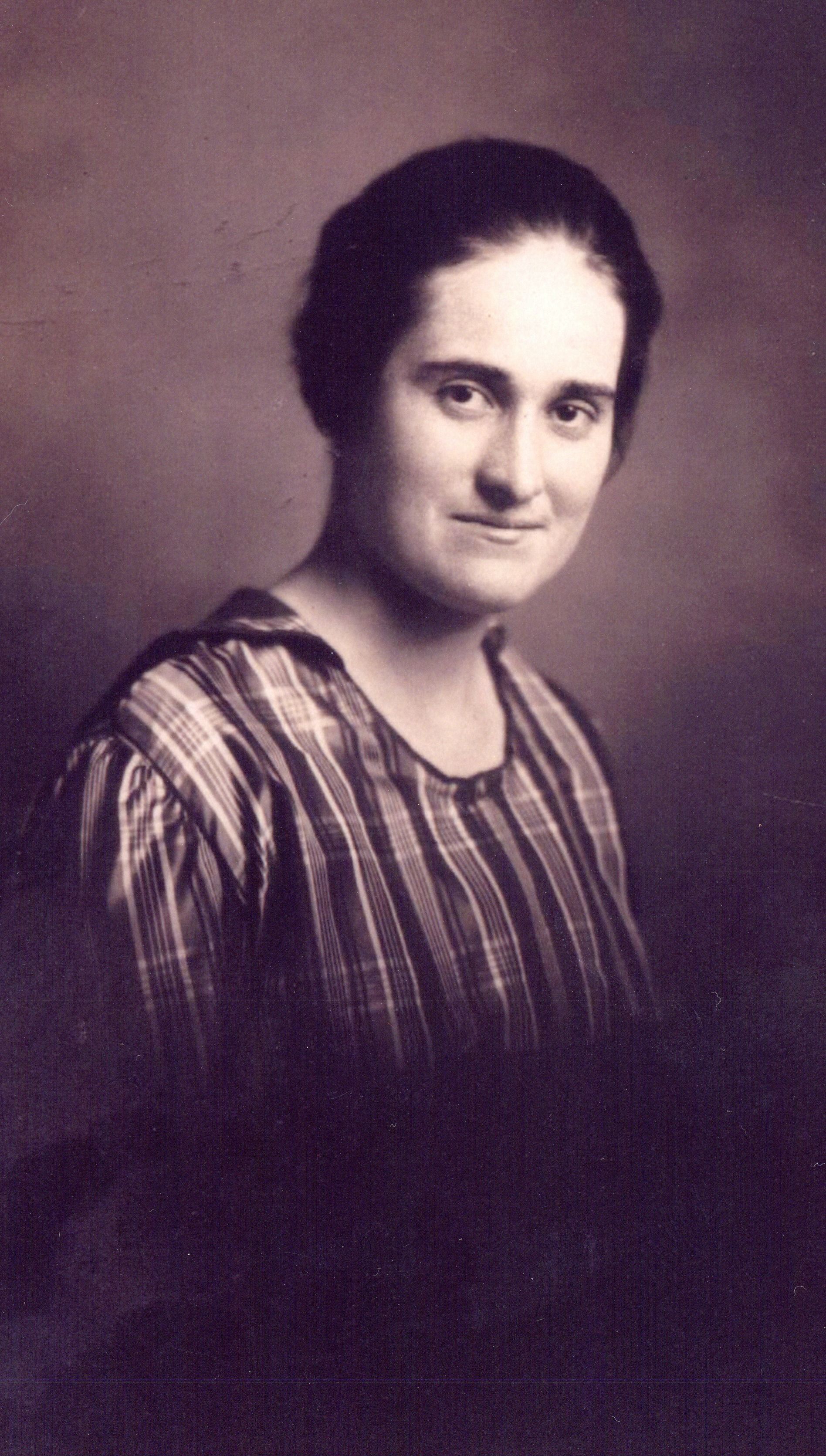
My great-grandma Merle Witter was born Hannah Merle Huff (1889-1984) in Allen County, Kansas. By 1910, Merle and her family had migrated to the Arizona Territory where they settled in a town called Glendale.
My grandma Nancy and aunt Vickie always said that the Huffs came to Arizona in a covered wagon – and if I hadn’t been so obsessed with Star Wars and Indiana Jones movies, I might have remembered the stories Great-Grandma Witter surely told me about traveling to the desert and staring a new life only a few years after the last of the wars with the indigenous tribes of the Southwest, and during a time when Pancho Villa threatened to bring the civil war in Mexico north into Arizona.
Hannah Merle (Huff) Witter
Virginia to Ohio
The most distant Huff ancestor I have been able to confirm is Lewis Huff who originated in Virginia and moved with his family to Ohio and then Kansas. There are a lot of people to investigate and document, so they will require a great deal of attention.
The Devil is in the details. Or, so I have heard. But that aphorism, according to Tally over on Medium, “derives from an earlier German proverb — “Der liebe Gott steckt im detail”, which translates as ‘God is in the detail’.”
Any genealogy researcher can tell you that both are true. If you read my earlier posts, The Corruption of Names, or Finding John Witter, you can see examples of the details playing games and hiding in the available evidence, sometimes enlightening me and sometimes taunting me. In the end, I often have to make a judgment call on which facts are “correct” so I can move on to other mysteries.
Sometimes, my judgment calls are spot on – and sometimes they aren’t. I try not to let the fact that I don’t know which ones are which bother me. Knowing that there are mistakes, errors, or inaccuracies in my work is something I have learned to live with and that is why I am constantly encouraging people to reach out and let me know when they see something “wrong” in my research.
But for a lot of people, those inevitable errors are hard to accept. I frequently see posts in the various genealogy forums I visit where people are complaining that “you can’t trust obituaries” or “online trees are unreliable” as if the fact that errors exist prevents a person from ever really knowing anything. I rarely comment on that sentiment, but sometimes I will respond and encourage them to include the offending information in their trees, along with the evidence demonstrating why it is wrong.
In my experience, there are different kinds of “wrong” that can creep into the work we do and alter the stories we tell. Sometimes the obituary is wrong because the person writing it didn’t know the person as well as other family members did; sometimes the rank that your great-great-grandpa held in the Civil War differs from what was handed down because his children and grandchildren didn’t know the difference between an artillery sergeant on the battlefield and a post colonel in the Grand Army of the Republic. And that’s okay. Sometimes mistakes are part of the story.
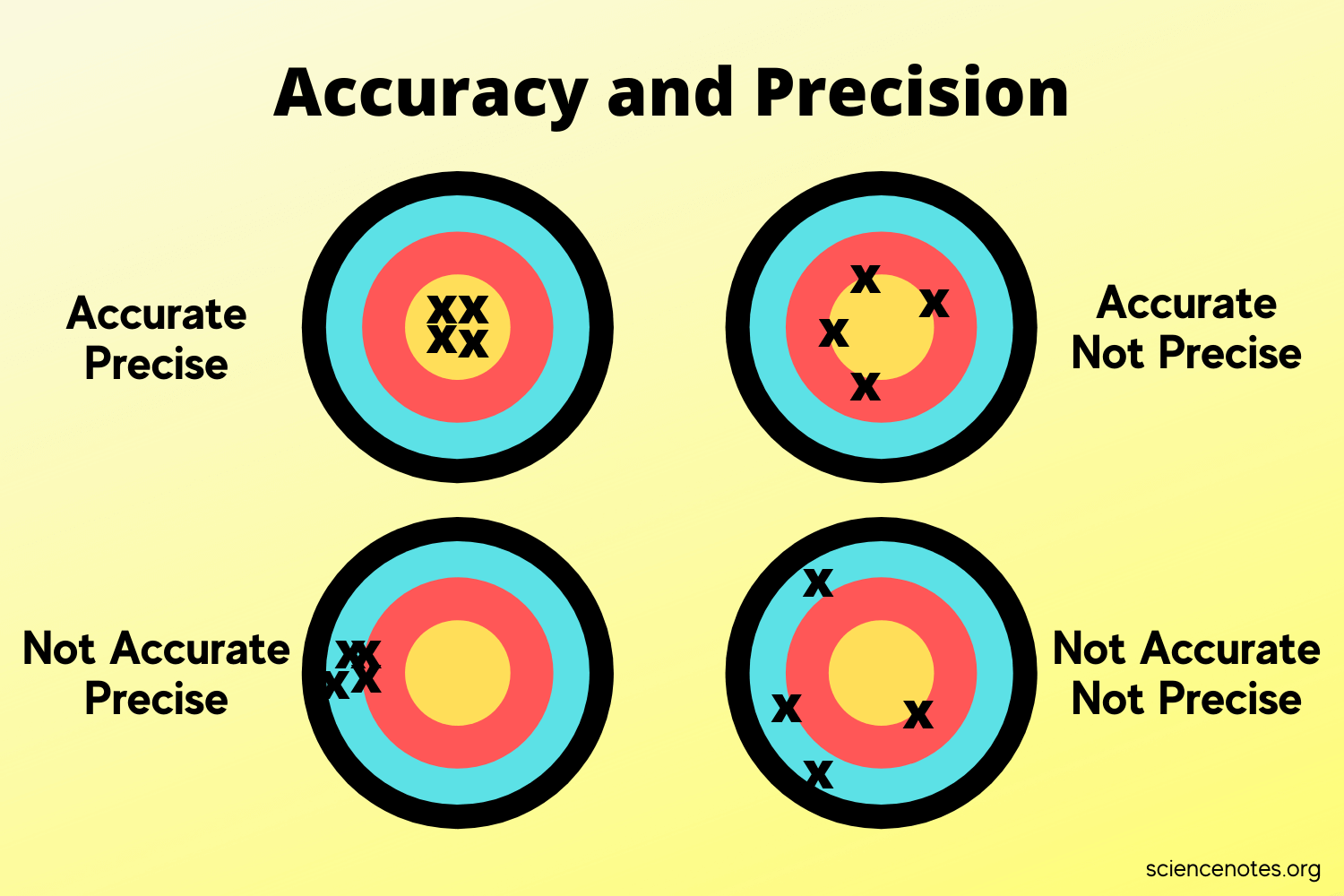
There is a tendency to want to throw out or hide mistakes, which is perfectly understandable. But in genealogy, the best practice is to document everything and try to make the most accurate and precise picture you can make from the information that is available to you.
from Sciencenotes.org – What is the Difference Between Accuracy and Precision?
Consider all of the different records you might find that tell you an ancestor’s birthdate. Census records usually ask for the person’s age as of their last birthday on the date the information was recorded, which means the estimate of their date of birth might be off by a year. It can be off by more than that if the enumerator collected the information from someone who didn’t know the exact ages of everyone in the household. I have also observed a pattern with U.S. World War I registration documents where the year of birth is off by one year even though the information was provided by the person being registered. U.S. Social Security files are generally pretty reliable, but if all of the other evidence is also reliable and their Social Security information is different, how do you tell which birthdate is “correct”?
In practice, if the records disagree with each other, I create alternate facts for the different sources and use my judgment to figure out which is the most likely “correct” fact. If I find the “correct” information later, I still keep the alternate facts and add an explanation for how I determined which one was correct. This can be interesting – “this person lied about their age on their World War I registration so they could enlist” – or mundane – “this person lived alone and nobody knew how old he was” – but either way, including the explanation and the evidence saves everyone time in the long run.
Getting comfortable with errors (or the possibility of errors) can be difficult. Sometimes the family legend you want debunked and forgotten is something painful or controversial. It is still important to address it for future generations of researchers because if there is one thing we have learned over the last few years, it is that misinformation and disinformation are persistent! For some reason, even basic facts have to be re-litigated and re-proven before some people will accept them.
The moral of the story is that as hard as we may work to leave a legacy of “perfect” information behind, we have to accept that there will always be questions, mistakes, and enduring mysteries.
Sometimes, we have to simply live with what is Good Enough.
Mary Blom’s parents were Bernard Blom (1861–1917) and Ida Slight (1863–1949), who were married in Ackley in 1886, about ten years after Bernard’s family immigrated from the Netherlands. Ida was born in Ackley, but her parents were immigrants from Prussia who had arrived in the U.S. about 1854 and had married in Ogle County, Illinois in 1856.
Bernard was the son of Bernard Blom (b. 1829) and Anna Maria Heijting (1832–1916), born on 30 Jun 1861 in Angerlo, Zevenaar, Gelderland, Netherlands. Both Bernards worked as carpenters or cabinetmakers – in fact, most of the Blom men seemed to follow that trade, both in the U.S. and in Holland. If you get a chance to dig up their Dutch records, you will see the occupation “Timmerman” on many of their documents! So far, I have only traced back as far as the elder Bernard’s parents, Jan Blom (1792–1859) and Aaltje Slotboom (1793–1860).
Angerlo, Gelderland, Netherlands
We don’t know when the elder Bernard died, but he appeared on the 1910 U.S. Federal Census and Maria was listed as “widowed” in the 1915 Iowa State Census. She lived alone in a house near that of her son, George, and she died in a fire that consumed her house in March 1916. George was grief-stricken by the loss of his mother and he took his own life in May 1916 because, according to the note he left behind, he couldn’t stand being confronted by the charred reminder of her ruined house every morning when he woke up.
The younger Bernard died a year later, in May 1917, when the limb from a tree he was trimming struck him in the abdomen. He was survived by four brothers and two sisters, as well as his wife and four daughters.
Be sure to hit that comment button if you think you are connected to this Blom family – especially if you’re looking to connect your WikiTree profiles!
When we talk about our “family tree,” we tend to focus on “lines” – which leads us to an over-simplification of what our “tree” looks like. For the sake of understanding who we’re talking about, we will skip over several generations to get to a particular family, and we can end up picturing that tree like this:
Palm Tree art from supercoloring.com
Sometimes your tree actually works out that way. In the case of my great-grandmother, Bertha (Greenlee) Callin, for example. If you just go up her paternal line:
Robert Greenlee (many siblings)
Allen Greenlee (only child)
Bertha (one half-sibling)
More often, you have a lot of siblings in each generation, and visualizing them all can feel a lot more complicated:
Fractal Tree Animation from “make a gif”
There is nothing wrong with simplifying things to make them easier to explain. But when you’re building your tree, it’s important to remember the Big Picture. You have to zoom in and focus on one family at a time to get anywhere, but you also need to figure out good maps for navigating both up and down your trees.
I have spent a lot of time adding profiles to WikiTree and connecting them so that I can take advantage of their visualization tools and figure out where I need to focus my attention for future research. Usually, I start with one of the eight grandparents (my four, and my wife’s four) and click the “Ancestors” button, follow the line back to where I am stuck, then click that person’s “Descendants” button and figure out which family has been most neglected.
That might sound like a daunting task – a fractal tree is always branching further, always growing, and never ….done. But that’s good news for me because I like to keep going.
If you want to have a say in which way I am going, drop a note.
If you just want to keep following along… Subscribe!
Normally, I would give you a brief overview on Wednesday followed by a story or essay on Friday – but this post sort of fits both descriptions, so I’ll think of something else to share on Friday.
This 2015 post buries the lede, but it is about the ancestry of my Grandpa Bob Callin’s maternal line.
The Unknown and the Unknowable
The book doesn’t say where in Scotland Robert Greenlee and his brother came from, but it could have been Lanarkshire as easily as anywhere else. The famous mobility of Lowland Scots was nothing new, and even though the coal industry was just taking off, there were bound to be good reasons for a pair of enterprising young men to follow the flood of people pouring through Ireland and on into the New World.
The settlement of Ulster in the northern counties of Ireland was also nothing new – that had been going on for two centuries by the time the Greenlee brothers came to Ireland around 1770; Robert settled in County Armagh, in the village of Tandragee, while his brother went on to America. The book says he was there in time for the Revolution, but we’ll have to take the book’s word for that. Robert, a manufacturer of goods, stayed in Tandragee, married, and raised a family of four boys and two girls.
Most of Robert’s children would end up in America, but not Robert. His eldest son, Samuel, born in 1795 would grow up to become a linen weaver and marry Nancy Jamphry in 1819. For nearly 20 years, Nancy and Samuel would bring another Greenlee into the world in each of the odd-numbered years, though Robert would only see the first six – he passed away in 1832. By 1837 they had six boys and three girls in their home. Their youngest son, born in 1835, was named Robert, after his grandfather.
We don’t know the cause, since the book and the records don’t say, but their third eldest, a daughter called Margaret, died in 1843 at 18 years of age. Nancy died the following year, in 1844. It’s possible that they were taken by disease, and it is certain that the year after that – 1845 – saw the beginning of what would be known as the Great Famine. It could be that chronic hunger, loss of income from the economic impact, and spreading disease associated with the famine made the family decide to move; it could be that their occupation as weavers kept them from feeling hunger, but their political and religious affiliations as Presbyterian Unionists made them targets of their starving Catholic neighbors frustration. Regardless of the source of the pressures that drove them, the Greenlees would soon leave Armagh.
Thus, as his uncle and some of his brothers and sisters had likely already done, Samuel decided to bring his family to the United States. On 14 November 1846, Samuel arrived in Philadelphia aboard the Ship Champlain accompanied by a 28-year-old Anne Greenlee. This was most likely his eldest daughter, Mary Ann, who would go on to marry Robert Willis. In 1850, the family was settled in the township of Aston in Delaware County, Pennsylvania. Samuel, along with his sons – Samuel, Jr., Matthew, Thomas, and Robert – worked as weavers; Samuel, Jr. had his wife, Ann Jane Sinton, and their baby daughter, Ann, in the household, and it must have been very… close and cozy.
The Greenlee children began to disperse themselves across the country. John and Mary Ann each married, and ended up in Wineland, Ohio, with their new spouses. James moved to Michigan, and Robert also moved to Ohio, settling in Hancock County, where he married Sarah Bollman in 1857. Thomas married and may have been in New York, as he joined the 67th Regiment of the New York Infantry in 1861 on the outbreak of war.
Robert and Sarah had their son, Allen, in April of 1861, the month that the Civil War began. Robert enlisted in the 21st Regiment, Ohio Infantry, and he served for 3 months, mustering out in August of 1861. His unit was sent on a reconnaissance expedition down the Kanawha River in West Virginia, but they do not appear to have seen any action or suffered any casualties. His brother, Thomas, was not as fortunate, as the 67th NYI was involved in the Battle at Fair Oaks outside Henrico, Virginia, where he was killed at the end of May 1862.
Here, the story becomes darker and harder to see. As little detail as the book gives us – the book being Ralph Stebbins Greenlee’s Genealogy of the Greenlee Families, to be specific – it got us this far. It tells us enough to connect everything we just read to what happened next…but what did happen next?
Sarah Catherine Bollman was born in 1838 in Ohio. In 1850, she lived with her mother, Eleanor, and a younger sister and brother (Elizabeth Ann and Solomon, respectively). They lived in Cass Township in Hancock County, which is where Sarah’s marriage to Robert Greenlee was recorded in 1857. In 1860, she and Robert showed up in the census, still in Cass Township. We have records of Robert’s enlistment, and they give us no reason to believe that he did not survive the war, and yet in 1870, Sarah and a 9-year-old Allen are back living with Eleanor.
It’s impossible to guess from the information available, but the lack of information itself (and the fact that Sarah is listed in 1870 by her maiden name) suggests that something unheroic befell Robert Greenlee. We only know he died because the Greenlee book says so – “died at Vanburen, Ohio.” It doesn’t say how or when.
(Update: Sarah died in January 1875 and was buried in the Bechtel Cemetery, in Allen township, Hancock county. Robert was buried there after he died in 1879, and Allen in 1887. Sarah’s marker lists her as “Sarah C. Greenlee,” but the obituary index gives her name as Bollman.)
Allen Greenlee’s life was similarly mysterious, in that very little solid information about him exists. We see him in the 1870 and 1880 census records, living with his grandmother (though the 1870 lists his name as “Ellen”), and we do see him listed on his daughter’s birth record, so we are at least not guessing at the relationship. But aside from a single appearance in the Cincinnati Enquirer in 1882, when he was raising sheep in Findlay, Ohio, he only left one other trace behind.
[Update: thanks to the digitization of the Weekly Jeffersonian on Newspapers.com, we know that Allen was a teacher and that he died after contracting typhus. Details are on his WikiTree page.]
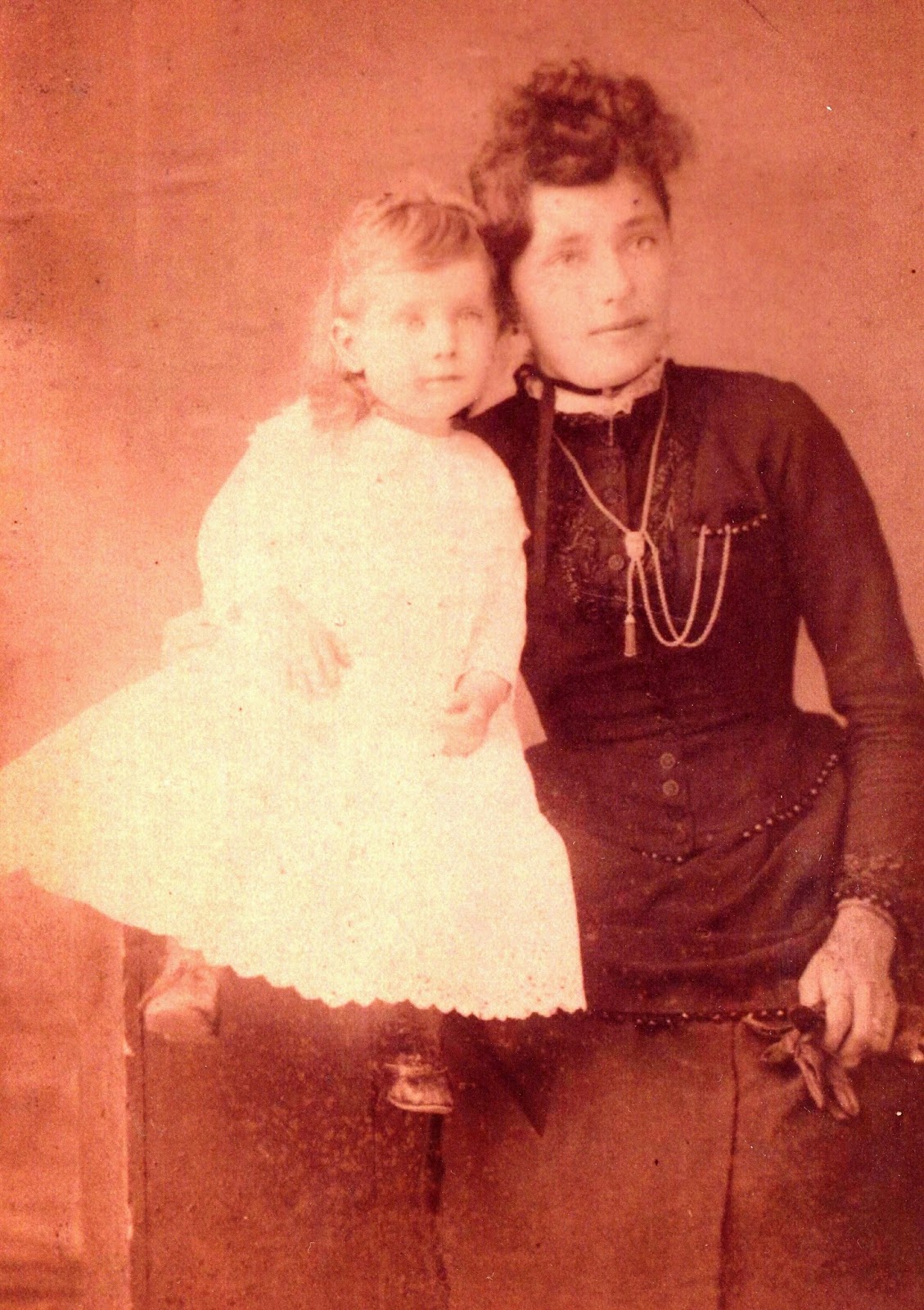
Bertha May Greenlee and Alice Ava Hales – c. 1889
Bertha May Greenlee, my great-grandmother, was born December 5, 1885, in Arcadia, Ohio, to Allen Greenlee and Alice Ava Hales. By the time she was four years old, her father was gone, and her mother remarried George McClellan Cramer on November 28, 1889. George adopted her, and Bertha Cramer grew up with her half-sister, Mamie Cramer, her mother, and her adopted father in turn-of-the-century Fostoria, Ohio.
If Bertha knew what happened to her father, or her grandfather, it did not get passed down to us. She did name her youngest son Robert, but that’s not necessarily a clue. Her grandchildren and great-grandchildren can only imagine how dangerous life was in those days and be grateful that we’re here to marvel at it! And we are here because Bertha married John Quincy Callin, of the 20th Century Callin Clan, on June 6, 1906 – but that is a whole other story.
There is a lot we still don’t know – about Allen and Robert, at least – and it’s not likely we’ll ever find out what happened to them. We’ll keep looking, of course, because that is how you find out what is unknowable, and what is merely unknown. If we don’t search, we certainly won’t find any answers.
If you spend any time interacting with me, you will come to realize that “Critical Thinking” is my answer to almost any question. But not everyone understands what the term “Critical Thinking” means, and that sometimes causes trouble.
The Three Meanings Of “Critical”
Wikipedia’s article on “Critical Thinking” gives us a good starting point. Critical Thinking “is the analysis of available facts, evidence, observations, and arguments in order to form a judgement by the application of rational, skeptical, and unbiased analyses and evaluation.” But that’s not what everyone immediately thinks of when they hear the word “critical”.
If you put “define critical” in your search bar, here are the top three definitions you should get:
expressing adverse or disapproving comments or judgments.
“he was critical of many U.S. welfare programs”
expressing or involving an analysis of the merits and faults of a work of literature, music, or art.
“she never won the critical acclaim she sought”
(of a situation or problem) having the potential to become disastrous; at a point of crisis.
“the flood waters had not receded, and the situation was still critical“
Synonyms for that first definition include “condemnatory,” “disparaging,” “disapproving,” “fault-finding,” “judgmental,” and “pedantic.” The opposite of this definition of critical is “complimentary.” If someone gets angry at you for suggesting that they apply critical thinking to a problem, they probably think this is what you meant by “critical.” The third definition, with synonyms like “grave,” “dangerous,” and “hazardous” may also lead to misunderstanding.
That second definition is the one that relates to the desired kind of “critical thinking” with synonyms like “analytical,” and “explanatory.”
How Thinking Is Critical
When you are researching your family history, it is critical (definition 3) that you think critically (definition 2) even if that means criticizing (definition 1) the existing stories that you think you know about your family. As I said in my Mastodon “toot” critical thinking means:
Always asking “how do you know that?”
Always being open to the idea that something you think you know could be interpreted a different way if new information came to light.
Documenting incorrect information and providing evidence that puts it in context so it doesn’t misinform future researchers.
These three statements work together and should be the foundation for all of your research. Every document, every public tree, and every fact you uncover should provoke that first question: “How do you know that?” If you’re lucky, the answer will be some reliable source – though you still have to ask that reliable source “How do you know that?” What makes a source reliable will depend on a lot of factors. Is it an official record? Is it an original copy (or a digital scan of an original)? Does the information match what other sources say about the same facts or events?
And if there isn’t a source citation supporting a story or fact, that isn’t the end of the inquiry. Perhaps you have an eyewitness account from a long-dead relative providing information about events that you can’t verify or disprove with records. Perhaps you have stories handed down about the same event through different generations that don’t match each other. Those stories can give insight into what your ancestors thought about events even if the stories themselves prove to be inaccurate or false. Just be sure to mark them as such – so that the next person asking “How do you know that?” doesn’t have to re-do the work you have done.
The Other Three Words
Throughout your process of finding and critically evaluating evidence, be mindful that you are staying rational, skeptical, and unbiased.
“Rational” means “based on or in accordance with reason or logic” – and that means keeping your emotional investment in the subject from making you ignore facts and evidence that contradict what you may want to believe. It does NOT mean that you aren’t allowed to feel excited or relate to the joys and tragedies of the family stories you tell. And you also can’t forget the emotional investments of others; discovering that something is (or isn’t) true may be shocking to relatives who have a different perspective from yours. If you find someone is behaving irrationally towards you or your research, be as kind and patient with them as you can be.
“Skeptical” is another word that has some negative baggage. Like “critical,” a lot of people associate “skepticism” with negativity and they often confuse it with “cynicism.” But a healthy skeptical outlook means that you are willing to ask questions that might imply that there are uncomfortable answers. Asking those potentially uncomfortable questions is how you figure out…
“Bias” – which is a prickly problem no matter who you are. Everyone has some built-in assumptions and shortcuts in their thinking that help them make sense of the world. Being “unbiased” is probably impossible, but constantly examining what your biases are and making sure you are behaving rationally despite them is the goal.
The Journey Is The Goal
Like a lot of things in life, this is about practice. You’re not going to instantly Be In Shape if you start doing modest daily exercise. You’re not going to become a scholar overnight. There are no easy tricks to get meaningful results.
But if you are always thinking critically about the things you read, and asking questions about your assumptions (and the assumptions of others), those habits will get you where you want to go.
Have you got an example of something you learned from asking “How do you know that?” Have you got a story that is important to your family whether it is exactly “true” or not? Share a comment – and subscribe to see updates.
Merilyn (Martin) Rossiter (1923 – 1997) was the daughter of Howard William Martin (1897–1970) and Aletha Frederick Putnam (1899–1981), born on 17 Aug 1923 in Council Bluffs, Pottawattamie, Iowa. She married Arvid Wesley “Bud” Holmquist (1920–1996) in 1943 in Douglas County, Nebraska.
Merilyn was my wife’s maternal grandmother, and from her, I showed her matrilineal line as far back as I have been able to go. On Merilyn’s paternal line, I have only been able to trace a couple of generations, so there is work to be done in that direction!
Here-We-Go Howie
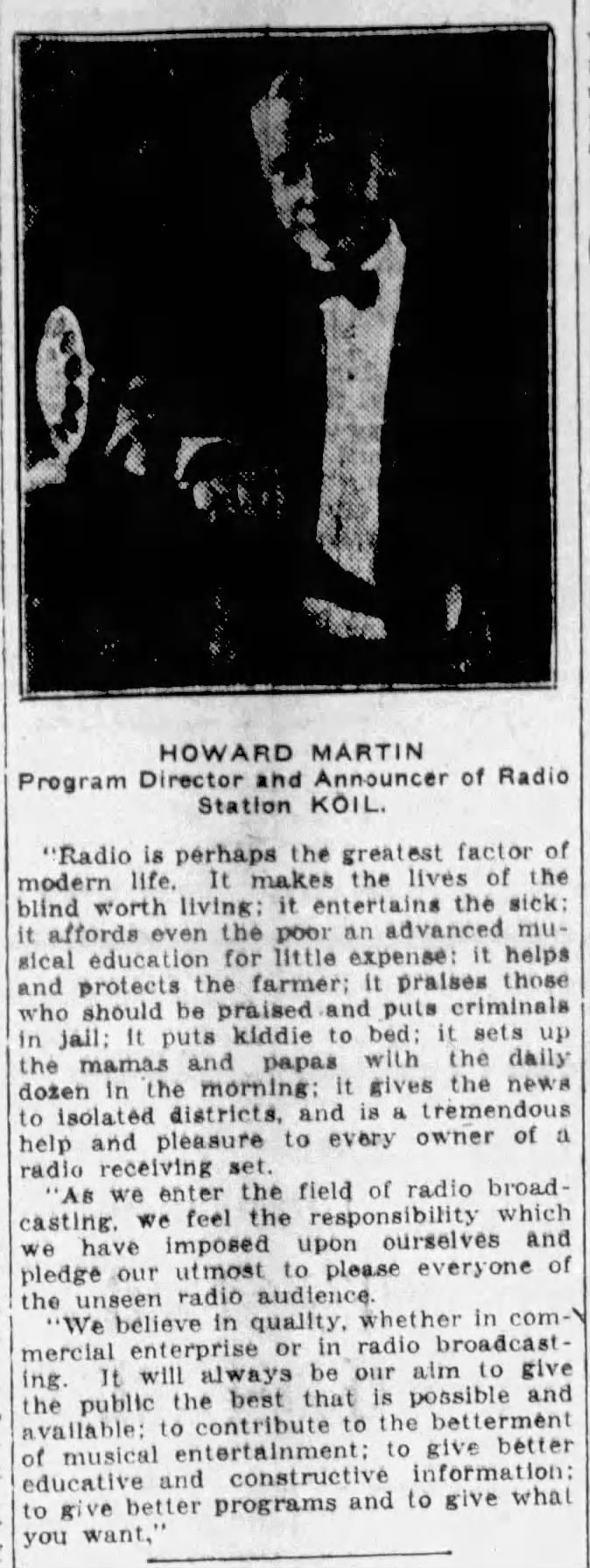
Merilyn’s father was Howard Martin, a World War I army veteran and businessman in 1920s Iowa. He ran his own Texaco filling station and held positions at several successful companies. He even had his own radio program on the local Omaha radio station, KOIL, where he was known as “Here-We-Go Howie”. You can see from this 1925 opinion piece that he thought very highly of the radio:
The Stockman’s Journal Omaha, Nebraska • Thu, Nov 5, 1925
Howard was the only child of William Findley Martin (1874–1943) and Harriet Jenevereth “Hattie” Shepard (1874–1923). I have been able to establish that William Findley Martin’s parents were Charles R Martin (1847–1916) and Elizabeth L Caughey (1844–1926) and that he had a brother, Oscar J Martin (1870–1934), but I have a lot of work to do if I hope to find out more about this family.
As always, I’d love to hear from descendants of these folks, and if you have questions about them, that will help me plan my future research. Drop a comment to connect:
And be sure to subscribe – it’s free and you will get something in your mailbox twice a week for as long as I can keep digging!
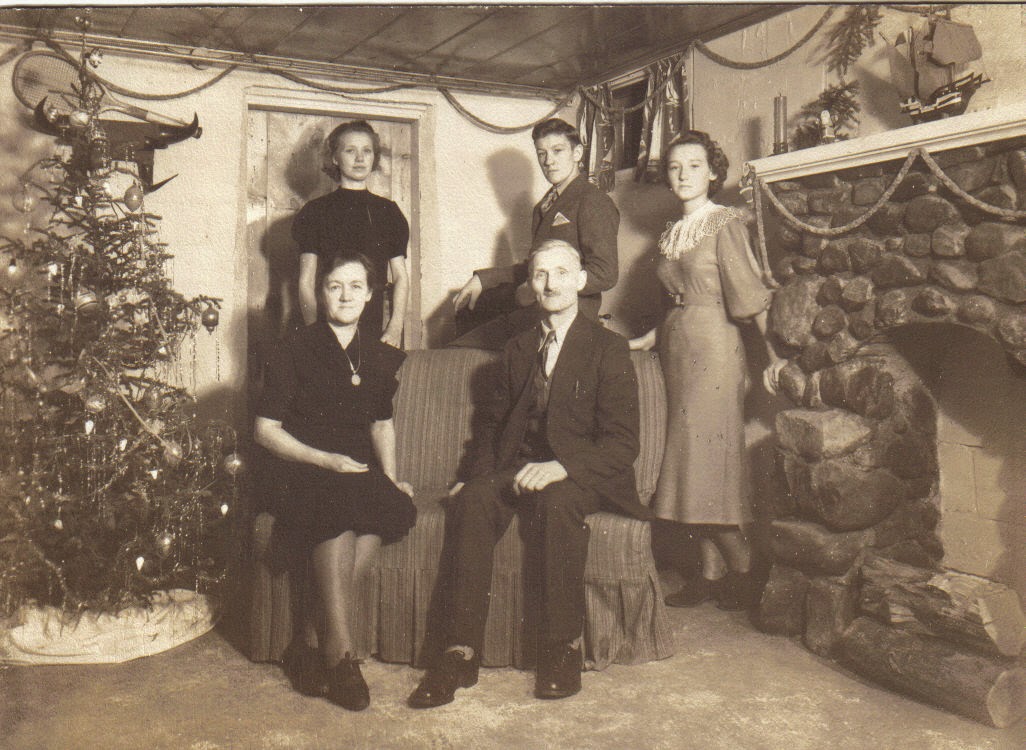
This is the Holmquist family in the festive living room of their home in Mahtomedi, Minnesota. William Arvid is seated, with his wife, Hilder; their three children – Ruth, Arvid Wesley (“Bud”), and Lillian (“Lil”) behind them.
William Arvid was born in Sweden in the 1880s, arrived in the U.S. around 1910, and married Hilder in St. Paul. Hilder was born in New York in 1888, her parents having immigrated from Sweden around that time. Bud was the grandfather of my lovely bride.
Here’s hoping your holidays are warm and cheerful!
This piece was adapted for this blog from a longer two-part piece on my Tad’s Happy Funtime blog. That version spends more time on me than is proper for a biographical sketch of my grandfather, Russell Hudson Clark, Sr. (1920-2002), but if you’d like to see that longer version, part one is here: A Fire in the Desert
The preacher roamed the wilderness of the desert Southwest for 50 years in a series of new and used recreational vehicles, his wife by his side, always seeking receptive souls to bring to the Lord. He raised a son who went to Vietnam and two daughters – all three raised sons of their own. He built houses, sank wells, raised chickens and rabbits, saved souls, started churches – and moved on, always moved on.
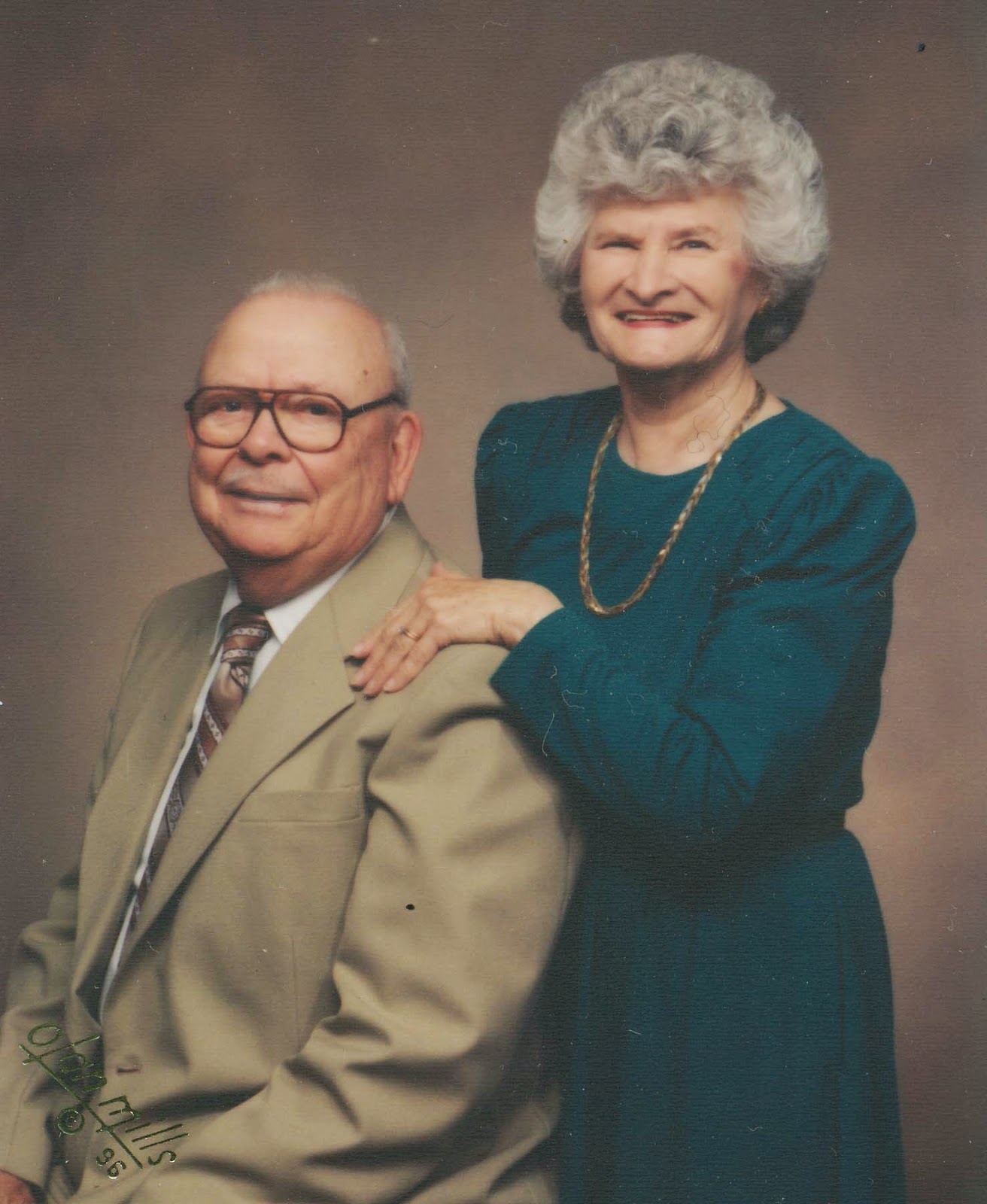
Russ and Alberta Clark, 1996
His name was Russ Clark, and he was a big man with a big voice, a broad smile, a ready laugh, and a proverbial fire in his belly. He once joked that this was why he ate so much when he visited us, but that was more likely a side effect of being the youngest of 12 children raised in the South during the Great Depression.
His hair, what was left of it by the time I knew him, was usually a close-cropped white stubble that seemed to grow wild and wispy overnight. I thought of him as a bald man, but he always claimed to need a haircut.
“Grandpa,” I would exclaim, “You’re bald! Why do you need a haircut?”
And his laugh would boom, and he would start to relate to me a tale about Jesus telling all men to keep their hair off their collar, not like those… but Grandma would usually swoop in with the clippers and a towel, and hurry him off to our patio for a trim before he could get much further.
He traded camper vans up for RVs, traded the RVs up for pickups with fifth-wheels, and traded the trailers up for mobile homes on an acre of property before deciding he had tied himself down with too many possessions and scaled back down again. No matter where he lived, you would find Grandma with her box of mementos, her organ, their dog, and her quiet hope that someday they would find the right home.
One thing about desert life is its innate mobility. Plants’ roots never run deep – they run shallow and broad. Animals may dig in and hide during the heat of the day, but they know to stay on the move if they want to find shade and water. One place Grandpa could always find some shade and water was under the tree in our driveway.
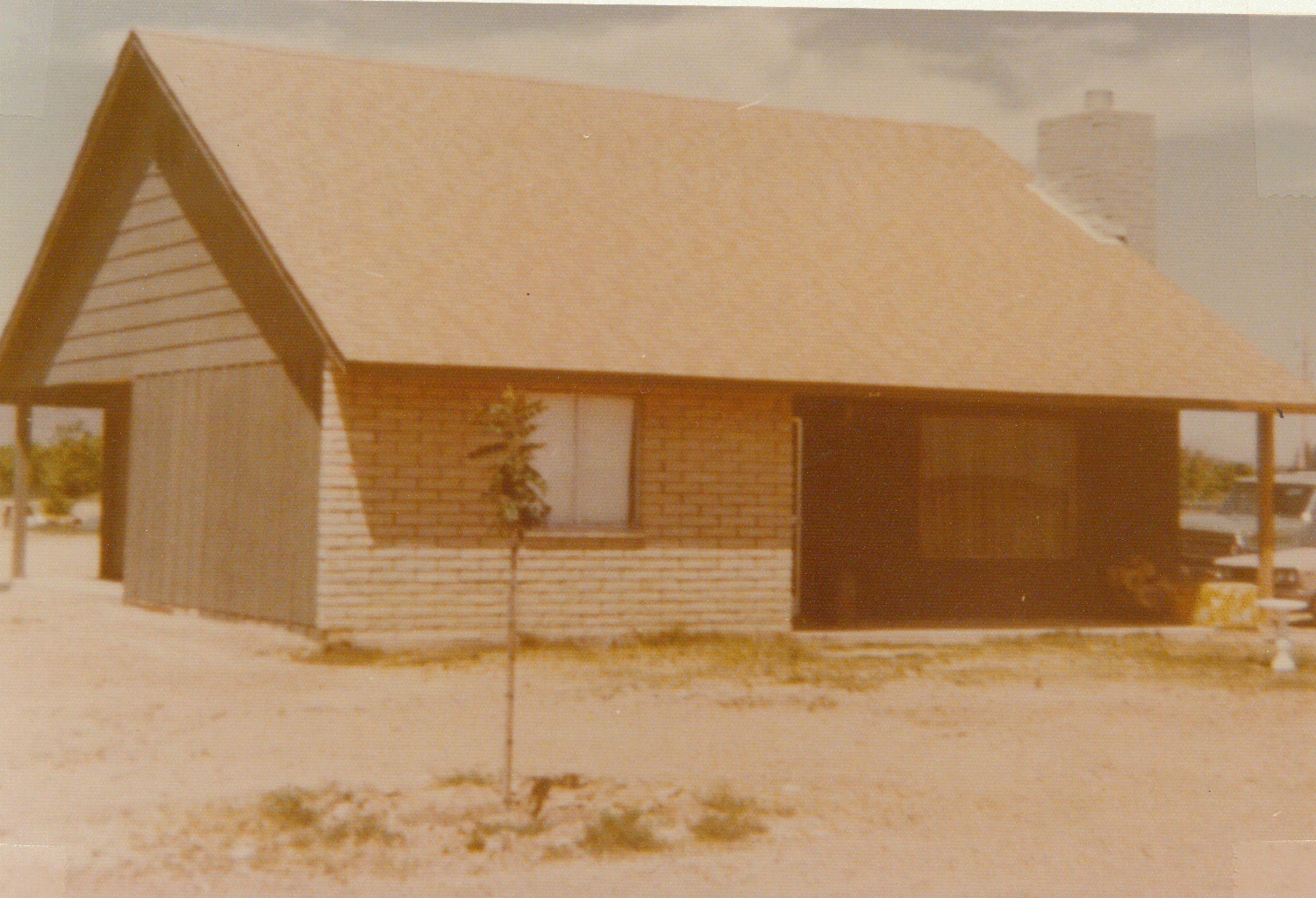
When Grandma and Grandpa showed up, it was almost always a surprise to us kids. Mom learned not to give us any warning that they were coming to visit, or we would stake out the couch by the big picture window and drive each other crazy with anticipation, shrieking “They’re here! They’re here!” at every puff of dust on the washboard that was 89th Avenue.
The house on 89th Ave., 1973
And they would finally roll in, pulling up under the skinny poplar tree where Grandpa would jack, level, and brace whatever mobile domicile they were currently living in, and hook up water and electricity. He’d run a hose from the sewer line to the poplar tree, and remind us kids that if we used their toilet, only to “run water” in it. When we were little, he’d explicitly tell us, “Only pee-pee and wee-wee in there! No poop-poop!” and we would giggle at the naughty nonsense words and repeat them daringly until we remembered that Grandma was waiting inside.
Most of the time, we could take turns sleeping over in the Camper; no matter what the actual vehicle was, it was always “the Camper” to us. Our favorites were the cab-over motorhomes with their inevitable forward and side windows. I’d fill every spare inch with Star Wars men, posting guards at the corners and locking imprisoned rebels in the cup holders. My sister would pasture her My Little Ponies on and around the dining table. Meanwhile, the grown-ups would stay inside with sweating glasses of sweet sun tea, talking about trade-in values, equity, and whatever else grown-ups discuss when the kids are out of earshot.
None of these visits ever lasted long enough for my sister or me, but Mom and Dad seemed to uncoil a little bit whenever the clouds of dust would follow the caravan du jour down the road toward their next stop – usually my cousin’s house a few miles away. Looking back, I can see how my dad, who was always happiest building and tinkering with his handy projects around the property, might have looked forward to not having his father-in-law offering advice on how to build and tinker better. And since they were mom’s parents, I could see how maybe there were lingering childhood issues that every family has that made her feel progressively less in control of her own home until the visits were over.
They never said anything to us about it, because they would never say an unkind word about anyone to us. But I think now that maybe the mornings after Grandma and Grandpa drove off after each visit might have been the mornings that Mom’s old Beatles, Monkees, and Lovin’ Spoonful records came out for a spin – replacing Kate Smith’s “How Great Thou Art” and Barry Sadler’s “Ballad of the Green Berets” which had seen more prominence the previous few days.
Whatever the adults’ issues may have been, I remember treasuring the stories Grandpa told us. If Grandma left him alone with us for any length of time, we would prod and pester him to tell us stories about growing up in Kentucky and Arkansas, and when he did, we would sit around him, raptly hanging on every word. This happened most often on Sunday afternoons, after church and the big chicken dinner that Mom and Grandma would prepare. I remember sitting close to him, despite the inescapable odors of dust and sweat that plague a big man who spends long days driving Arizona back roads. I remember feeling full of chicken and listening to him tell adventurous stories about the things that his brothers got up to or cautionary tales of drinkers and smokers who ended up badly.
My personal favorite was a memorable tale about the time a young Grandpa had found a perfectly good hat floating on a vat of sheep dip when he took a shortcut through the stockyards. He wore it proudly down the main street, only to have a woman run screaming out of her house, calling the police and demanding that he show her where he found it. When the police dragged a pole through the vat of sheep dip, they found the woman’s husband – dead and drowned. He had evidently wandered through the stockyards after a night of heavy drinking and fallen in. Sometimes, when he ended the story, Grandpa would tell us that the woman let him keep the hat – and he would point at his sun-bleached ball cap with the enormous grin of a champion spinner of tall tales.
Grandma was never comfortable with Grandpa’s insistence on filling our heads with nonsense, so he would frequently placate her by telling us Bible stories. I always figured the Bible stories came naturally to him because Grandpa was a preacher.
At least, he would talk about being a preacher; and once or twice, he was invited to give a sermon at our church. In school, when our religion class covered the revival movements of the 1800s, I knew exactly what they were talking about when they described the hellfire and brimstone of the tent revivals, largely because of the impression that my Grandfather made on me from the pulpit. He lit up in front of a congregation of any size or composition, and his oratory would grow olive branches and wind its way along the corners of our plain, unadorned sanctuary turning our little Southern Baptist church into a cathedral or a great tent.
It was something of a mystery to me why he didn’t have a church of his own, but I figured out that there is a big difference between being a “preacher” and being a “pastor”; it’s rather the same difference between being a revolutionary and running a government after the revolution is over.
That revolutionary Grandpa would sometimes run out for a gallon of milk, and come back hours later relating how he had spied a young man “with an earring” who had clearly needed to hear the Word of Jesus. Or he would leave Grandma with us while he went “visiting” – coming home late in the evening, bursting with energy, and planning to move back to Phoenix and start a revival that would sweep the city!
Even when he did “find a church home,” it never seemed to last. There would be excitement; property would be purchased or rented, and funds raised. Ground would be broken, and promises would be made. But eventually, almost never longer than six weeks along, the enterprise would evaporate and Grandma and Grandpa would pack up and drive off disconsolately, shaking their heads, and sadly bemoaning a general lack of faith and unwillingness of people to hear the Word of the Lord.
Not that there wasn’t something to Grandpa’s side of the story, but it’s fair to say that there were several notions harbored in his heart along with his extensive knowledge of Bible stories and personal morality tales. When I got older and read about the John Birch Society and Barry Goldwater, and started seeing “conservative” radio and TV hosts gaining popularity in the early 1990s, I recognized many of the ideas that Grandpa had tried to teach me over the years when Grandma and Mom were out of earshot. Like the time when I was 9 and deeply into dinosaurs, he waited until we were alone in the living room to tell me that Satan had placed their bones in the ground to confuse scientists and to test our faith. Or when the space shuttle Challenger exploded and he ruefully reminded me that the space program was just man’s foolish attempt to build another Tower of Babel and that the explosion was God’s way of reminding us to stay focused on Jesus.
At the time, I hadn’t explored any of this very deeply. To me, Grandpa was simply one of the most colorful and admirable people I knew. On balance, he made me feel loved more than judged, and he was clearly proud of me. Maybe his stories exaggerated some details, and maybe some of his beliefs about science were on the questionable side, but he instilled an appreciation for narrative and a love of words in me that I still cherish. I was enthralled by the power of his storytelling, and I learned that his engaging tall tales about growing up in the South and his ever-evolving stories about his exploits serving in the Navy during World War II were, if not factually precise, intended as morality plays. I doubt it was his intent, but he taught me the beautiful and awkward relationship between fiction and truth.
Sometime in the dim, early reaches of my memory, Grandpa had a nasty fall. He was working as a building inspector in downtown Phoenix and fell off of a building he had been climbing. His knees were destroyed, and he spent a great deal of the rest of his life in and out of the VA hospital for various surgeries to repair or replace his joints. It happened that one of his visits occurred during my junior year of high school and coincided with a new knee replacement at the hospital where my girlfriend’s neighbor worked as a nurse.
As was expected, when Grandpa came home from the hospital he began to regale us excitedly about what a blessing it had been for him to be the instrument of the Lord in that place; how he had prayed with all of the nurses and Saved them all – reinforcing his perception that there was a Higher Purpose to his suffering, and that Jesus was using his pain to win souls.
He saw himself as a light in the desert at night, trying to show people the way.
But when I asked my girlfriend’s neighbor, the nurse, about Grandpa’s story, she told a slightly different version. “Oh, yeah,” she said, “I remember Mr. Clark. He wouldn’t let us change his bedpan or give him any meds until we prayed with him. I accepted Jesus eight times, just so I could finish my rounds.”
Perception differed from reality in the harsh light of day.
Russell Hudson Clark, USN
When he found out I was joining the military, he was proud, and he pulled me aside to tell me about his experiences. Not the stuff he told me when I was just a kid, mind you – he wanted to warn me of the “traps” he had fallen into as a serviceman in the U.S. merchant marines; his cocaine and heroin habits (which I had never heard him mention before) on top of his drinking and smoking (which I had). He told me how he had been singing in a night club on shore leave in Italy, and had been approached by a U.S. Army Major who wanted to recruit him to sing in his USO band – but that Major, one Glenn Miller, had disappeared in Africa before the transfer papers went through. Needless to say, the details he told me didn’t add up with official accounts, but I understood by then that they were true enough for stories and that he was really telling me he loved me.
Grandpa passed away in 2002, about a year after I returned to Arizona from serving overseas in the Air Force with my young family. I had known his health was declining for a while, so as soon as we returned to the States, we arranged to visit Grandma and Grandpa in their RV, which was hooked up on the San Carlos Apache Reservation outside of Peridot, AZ.
I had told my wife many of my stories about him, and she was almost terrified to meet him. She knew he had strong opinions about tattoos and how a wife should behave, and while she’s pretty tough and uncompromising herself, she didn’t want to be resented by anyone in my family. But her fears dissipated when they finally met. Grandpa was overwhelmingly sweet, complimented her tattoo, and dandled the baby on his knee (which had recently been replaced again) while recounting his adventures on a Liberty ship taking lend-lease materiel to Murmansk through a German submarine convoy in 1941.
We had a wonderful (if short and hot) visit. Kate was relieved that Grandpa hadn’t criticized her or tried to Save her – but she wondered why he kept calling her “Karen.” The explanation for the name slips and the apparent change of character was horrible and simple: Alzheimer’s.
It is a horrific thing that a disease like this can alter your perceptions without you knowing it. The more we learn about the human brain, the more we understand that it is a delicate marvel and how easily it can be deceived. We learn more all the time about how memory works (or doesn’t) and how unreliable we are as eyewitnesses. I had long known that, in the harsh light of day, I had to take Grandpa’s stories with a grain of salt, but Alzheimer’s magnified the problem.
Finding out years after the fact that things he said to me, and things he believed were true, could have been due to changes in his brain forced me to reevaluate everything I thought I knew about him. It was hard to sort out, but in the end, while it’s impossible to know how much the disease had to do with altering his basic character, I choose to see the sweet man we said goodbye to as the “real” Grandpa. It doesn’t matter what made him do and say things – what matters is that he did his best with what he had.
He chose to roam the desert doing what he thought was right. I choose to perceive him in the best possible light – warts and all, flaws proudly on display. After all, a fire in the desert may cast shadows at night that disappear in the harsh light of day; but without it, the night can get very cold.
Looking for the father of Abraham Witter (1786 – 1882)
A few weeks ago, I published Family Reunion: Witter, which prompted a conversation about Abraham Witter (1786-1882) with my dad’s first cousin, Pat Witter. Pat had sources connecting Abraham to the family of Joseph Witter and Hannah Washburn; however, those sources proved that a different Abraham Witter belonged to that family. This leaves our family without a known father for Abraham.
Reviewing the available evidence leads to a theory: Abraham’s father may have been John Witter – but we still don’t know for sure, yet. Here’s what I’ve got to work with:
Elizabeth Shown Mills’s analysis
Elizabeth Shown Mills, “Samuel Witter (1787–1876) & Wife Rachel “Lizzie” Smith (ca. 1802–1854: Research Notes,” A Working File Updated 5 December 2013, p. ____; archived online at E. S. Mills, HistoricPathways (www.HistoricPathways.com: accessed 08/26/2023).
Mills collected evidence to consider whether the Samuel Witter she was researching was a brother to the Abraham Witter we are interested in. She considered four men who were possible fathers of Samuel and Abraham. Of those, I believe her evidence best supports the theory that John Witter is the father of Abraham Witter. According to her file, she collected the following documents:
1782 – court reference to “John Witer’s Lane” in Tom’s Creek Hundred, Frederick County, Maryland.
1785-86 – “John Witter” sued a debtor
1796 – John Witter received patents for two tracts
1800 – bought a tract in Metal Township, Franklin County, Pennsylvania, saying he was of “Tom’s Creek Hundred…”
1800 – Census (not sure whether she meant Federal or Pennsylvania Census)
1820 – U.S. Census (see below)
Searching in Ancestry, I have been able to find the following documents:
1790 U.S. Census: Frederick County, MD
Columns indicate “Males – 16 and over” (2), “Males – Under 16” (4), and “Females” (5)
Note that the transcription has his name as “John Withero” but it looks to me more like “John Withers”. None of the other names on this page appear to be any variation of “Witter”. There is a “Witherow” family in Metal Township but I think they are distinct from the Witter family (and various spellings) in those records.
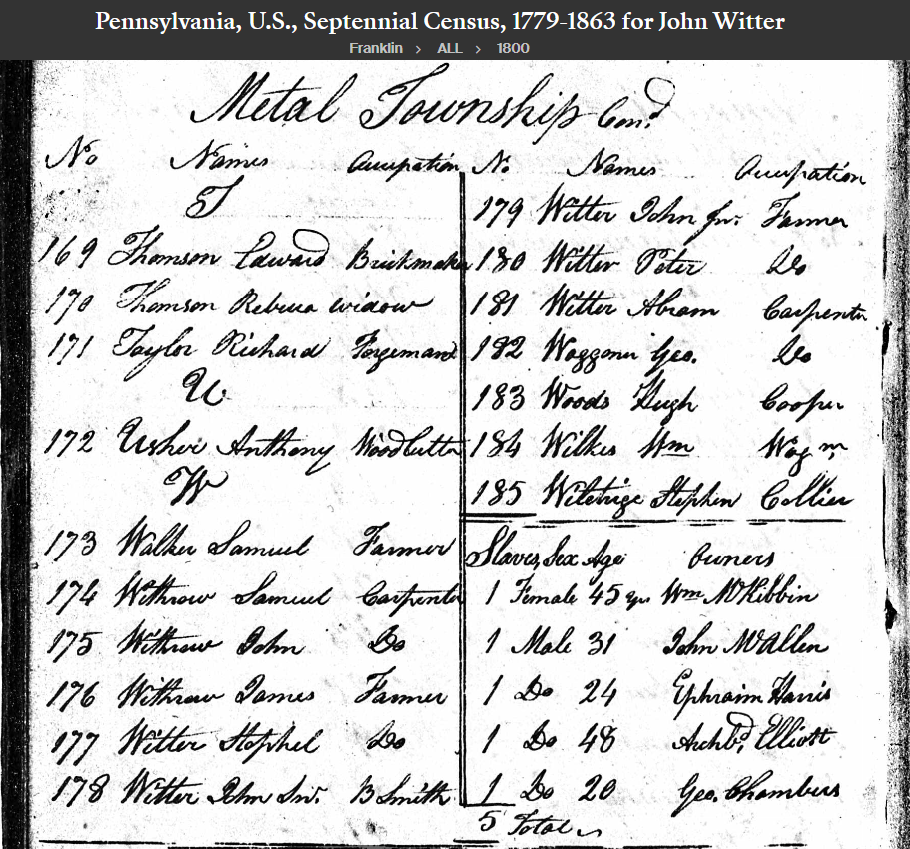
1800 Pennsylvania, U.S. Septennial Census: Metal Township, Franklin County, PA
177 Witter Stophel [farmer]
178 Witter John Sr. blacksmith
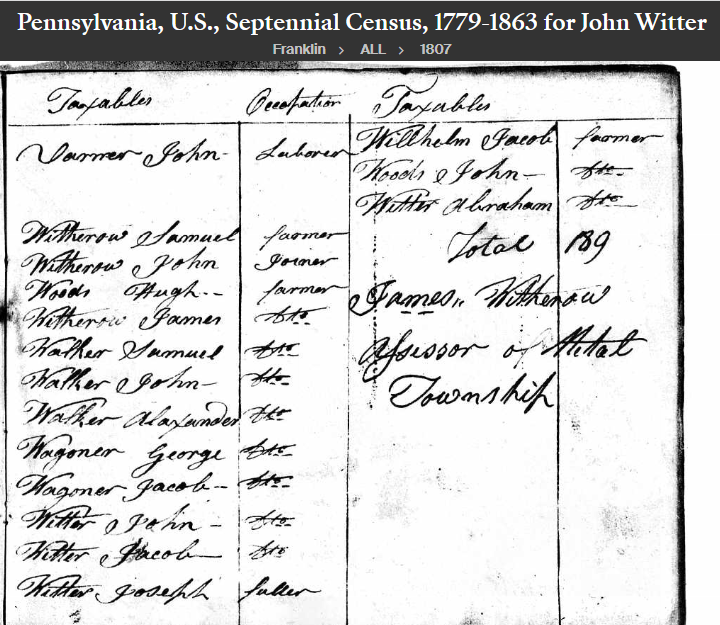
1807 Pennsylvania, U.S. Septennial Census: Metal Township, Franklin County, PA
Witter, John – [farmer]
Witter, Jacob – [farmer]
Witter, Joseph – fuller
1810 U.S. Census: Hamilton Township, Franklin County, PA
Males – 16 thru 25: 3
Males – 45 and over: 1
Females – 16 thru 25: 1
Females – 45 and over: 1
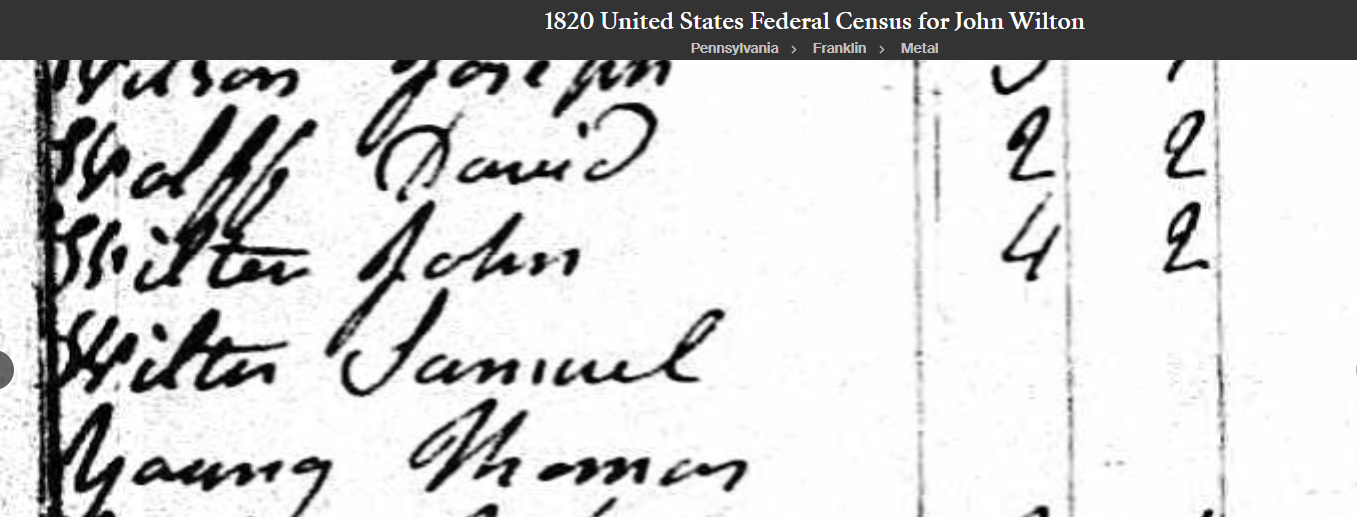
1820 U.S. Census: Metal Township, Franklin County, Pennsylvania
“Wilter John” followed by “Wilter Samuel”
Data columns:
Males Under 10: 4
Males 10-15: 2
Males 16-25: 1
Males 26-44: 1
Males 45 and over: 1
Females Under 10: 3
Females 10-15: 1
Females 26-44: 1
Samuel’s household:
Males 16-25: 1
Males 26-44: 1
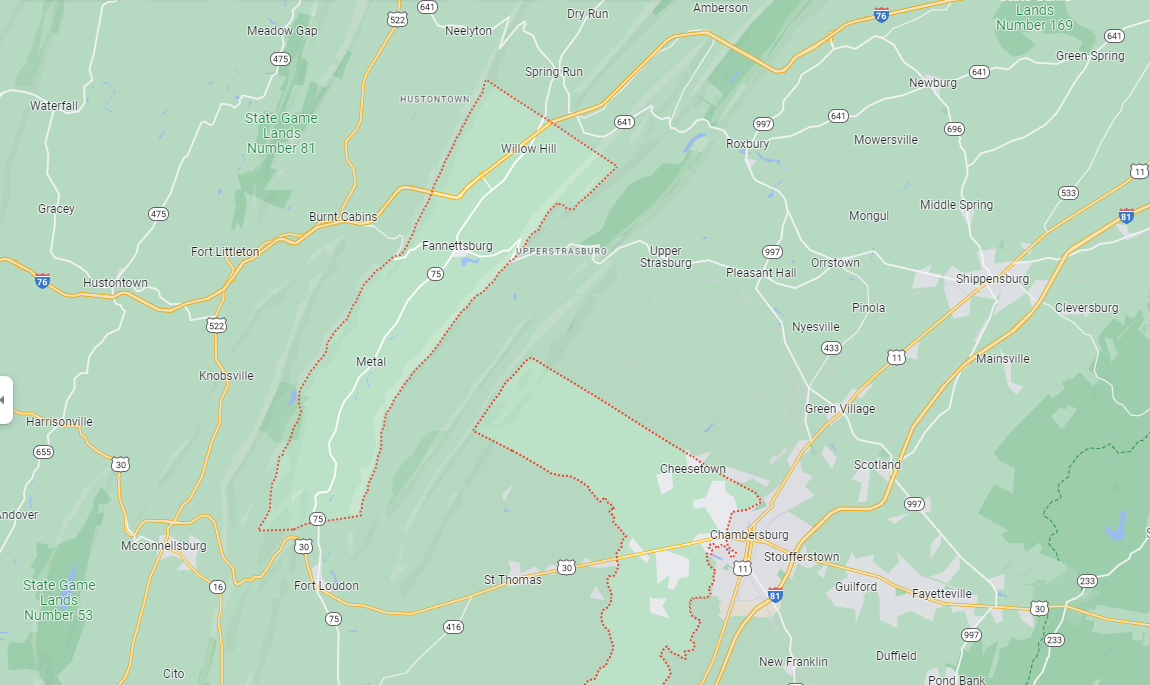
Metal Township (left) and Hamilton Township in relation to each other; for scale, Chambersburg to Shippensburg is about 11.6 miles
Conclusions:
These records seem to confirm that someone named John Witter, and men who shared his surname, lived in Franklin County, Pennsylvania, from at least 1800 to 1820.
His occupation was given as “blacksmith” in one record, and “farmer” in another. We may assert that he had at least three sons (John, Jr., 1800; Abram/Abraham, 1800/1807; Samuel, 1820) but we don’t have evidence to support the assertion.
We can guess that John Witter was born before 1765 – presuming that the 1810 and 1820 Census both put him in the “45 and over” category.
That said, there are a couple of very tenuous clues in biographical sketches for members of the Piper family in Franklin County – so perhaps we might learn more by looking more closely at the family of Catherine Piper, Abraham’s wife.
Stay tuned!
And let me know if you recognize these families – I’d love to compare notes.







 Mightier Acorns