Mightier Acorns

Journeys through Genealogy and Family History

A parody of a family coat of arms designed with acorns as elements, with the motto "ex gladnis potentioribus" Latin for "from Mighty Acorns"
From Mighty Acorns
  • Teasing meaning from the absence of evidence (part 1)

    I owe a ton of thanks to two cousins for their part in getting my Callin Family History published: and John K. Callin. Joan is my 3rd cousin, 1x removed; John is my 2nd cousin, 1x removed. Our nearest common ancestors are William Callin and Elizabeth Berlin. John and I are descended from their son, John H. Callin; Joan is descended from John’s younger brother, James M. Callin.

    John K. was the one who had a copy of the original 1911 Callin Family History and gave it to my grandfather, Bob Callin. That book was compiled by a third brother of John H. and James M., named George W. Callin. The cover photo I chose for my 2022 Callin Family History shows George’s family in recognition that I was carrying forward the work of a lot of people who came before me.

    If you’re descended from the man at the center of today’s post, you should subscribe for future updates, and say hello in the comments!

    James “1st” – but not THAT one

    The ancestor at the very beginning of the Callin Family History was named James Callin – this was William Callin’s grandfather. George referred to this James Callin as “James 1st” in order to keep his readers from confusing him with all of the other men in the book who would carry the name “James” – and there are a lot of them. But George’s choice has confused some readers who thought that George meant his great-grandfather was James I, the Scottish and English King who united the crown in 1567 and sponsored the King James translation (or “KJV”) of the Bible.

    He was not.

    We know precious little for certain about James “1st” Callin – George set out his knowledge on the opening page of his manuscript:

    As far as we know the Callins in this country all descended from one man, James Callin, who with his brother John (who never married), emigrated from Ireland to America about the commencement of the Revolutionary War.

    Our fathers tell us that these two brothers enlisted in the Continental Army and fought under Lafayette at the battle of Brandywine and remained in this army till the close of the war. These brothers settled on government land in Westmoreland Co. in Western Penn., where they remained the remainder of their lives, John sharing the home of James, who married about the year 1778.

    Despite more than twenty years of effort to find documents to support George’s claims, we have found very little proof. There are no documents that support the assertion that James came from Ireland, or when he arrived in the colonies. However, we have found evidence that supports other details in George’s version of events.

    In 2016, Cousin Joan shared her analysis of muster and pay rolls that record James Callin as a private in the 4th Virginia Regiment of Foot. We have been assuming this is the same man as “James 1st” – but until we learn more, it is only an assumption. In the years since, I have gone over the same ground several times, hoping that new records will be digitized and released on Ancestry or Fold3. Here is a distillation of what we know:

    The Facts

    James Callin1 and a man named Edward Callin both enlisted for 3-year terms in the Virginia 4th on 19 September 1777 – eight days after the Battle of Brandywine, which took place on 11 September. Edward enlisted in the company commanded by Capt. John Stith in September and October, and then both men appeared in Capt. James Lucas’s company after that. Edward could be the brother “John” referred to above, or a different person from John.

    The muster rolls put James and Edward in the 4th VA Regt. until May 1778, when Edward is “Claimed by another company” – and there are a couple of records in the US, Pennsylvania Veterans Card Files, 1775-1916 that show Edward Callin served in the 6th Pennsylvania Regiment in 1781.

    That timeline puts both men in the Battle of Germantown on 4 October 1777 – and you can see the order of battle that shows their unit, commanded by Col. Robert Lawson, under the 4th Virginia Brigade, commanded by Brigadier General Charles Scott. The Virginia Regiments were in the left wing of the attack; the 6th Pennsylvania Regiment under Lt. Colonel Josiah Harmar was in the right wing. Both Regiments spent the winter of 1777-1778 in Camp Valley Forge, and James and Edward were both recorded in the muster rolls as being present with the 4th VA there in Mar 1778.

    After Edward left the 4th Virginia, James was recorded as “sick Prest.” in June 1778, but otherwise present through November. He was almost certainly involved in the Battle of Monmouth on 28 June 1778 – which gives me an excuse to post this clip from Hamilton:

    In December 1778, James was listed as “On furlough” – a formal leave from military service granted by a commanding officer. What I find interesting is that he is just “On furlough” from December through March 1779. Staring in April he is listed as “On furlough in Virginia” followed by two months that say “on furlough 15 April” and finally, in July, “on furlough Virga; supposed to be on commd to the southward.”

    From August 1779 through the last record I have, dated 9 December 1779, James is listed as being “with Genl. Scott” or “supposed to be with Genl. Scott.”

    Interpretations

    We may be assuming that James Callin, private in the 4th Virginia, is the same person as James “1st” Callin in the 1911 Callin Family History, but there are many clues that can be drawn from these records to support that assumption. They are also clues that suggest where I can look for more facts and records, and they can help me put my ancestor’s service into context with the history of more notable figures. However, until I find conclusive records, everything I am about to say is pure speculation.

    Let’s compare what we know from the records to what George gives us in his history:

    Fact Check: Lafayette at the Battle of Brandywine

    Lafayette was not in a command role at the Battle of Brandywine, and the brothers did not enlist until a week after that battle. This contradicts George’s statement that the brothers “fought under Lafayette at the battle of Brandywine,” but the records do place James and Edward in Camp Valley Forge in 1778 – and by that time, General Washington had given the impressive Frenchman a command that included their unit.

    The old Valley Forge Legacy website shows that Major General Lafayette’s Division included General Scott’s 4th VA Brigade (which included the 4th VA Regiment) and this map from that website shows their proximity to Lafayette’s quarters in the lower left corner:

    An Encampment map from the old Valley Forge Legacy website

    Fact Check: The Marriage of James Callin

    The other major fact that George asserts in his paragraph about James 1st is that James married “about the year 1778.” Coincidentally, James began a three-month furlough in December 1778. Did he get married during those three months? It’s hard to say without a marriage record, but it seems likely. I just need to find a marriage record. (There was nothing in Westmoreland County, PA.)

    Fact Check: Westmoreland County, PA

    George stated: “These brothers settled on government land in Westmoreland Co. in Western Penn., where they remained the remainder of their lives, John sharing the home of James…” I have learned over the years that this is less informative than it appears at first glance. Joan and I have reached out separately to the National Archives, local genealogical societies, and county records repositories requesting records to support this without finding anything conclusive. There are no land grants for men named Callin in Westmoreland County – at least not the Westmoreland County that exists today.

    Much of the territory of what was called Westmoreland County, Pennsylvania, before the Revolutionary War was also claimed by Virginia. I believe James may have lived in the “lost county” of Yohogania. There is a tax record from 1773 that lists James Callin in Hempfield Township, Bedford County, PA, and that territory was within the boundaries claimed by Yohogania County in 1776. Since James enlisted in a Virginia regiment, he may have considered himself a Virginian rather than a Pennsylvanian and registered any major life events at the Yohogania County courthouse near modern-day Jefferson Hills, Pennsylvania.

    Virginia and Pennsylvania resolved their dispute in 1779. Their agreement was ratified by the legislatures of both states in 1780. It stands to reason that the records I need might have been filed in one of the counties that no longer exist – and until we find them, we are stuck drawing conclusions from the outlines of missing information.

    What Next?

    Since I try to keep these posts focused and under 1,500 words, this topic has turned into a series. Next week, I’ll talk about Edward and the evidence that hints at his likely career, and then we’ll come back to James the week after and sketch out a few of my theories on where to look next.

    1

    The names are spelled in various ways from month to month – Callan, Callen, and Callin are all used at least a few times each, for both men.

  • Going four generations back to find another line

    This surname can be found among my Sixteen great-great-grandparents. We have to go that far back to find the first Shriver –

    Nancy Ellen “Ella” Shriver (1864 – 1936)

    Ella was my Grandma Nancy’s Grandma Nancy – put another way, Nancy (Shriver) Witter was my paternal grandmother’s paternal grandmother. Nancy (Witter) Callin was about 11 years old when her grandmother died in Kansas, so it’s possible they met at some point, but if they did, the younger Nancy’s memories did not make it to us.

    500px-Shriver-740.jpg
    Nancy holding her son, Howard Ray “Dick” Witter – North Topeka, Kansas, abt 1891

    Nancy Shriver – who was referred to as “Ella” – was the daughter of Alexander Mitchell Shriver and Mary E (Cline) Shriver, born in Ohio and raised in Caldwell County, Missouri. She was the middle child of nine children. The family lived in Caldwell County until 1882, when they moved to Vienna, Pottawatomie County, Kansas. That is where Ella met Abraham Howard Witter (1859 – 1918) and they married on 11 Feb 1885. They lived in Belvue Township, raising seven children in Wamego and in St Marys.

    Alexander Shriver was born on 28 Sep 1837 in Salem, Columbiana County, Ohio. He was the son of George Shriver (b. 1798) and Catherine Harmon (b. 1813) and his family lived in Washington, Monroe County, Ohio, in 1850. Mary E Cline was born on 11 Sep 1831 to John C. Cline Jr (1799–1868) and Elvira Mcvay (1803–1892) and grew up in Monroe County, Ohio. The Mcvay family is documented on WikiTree back to the 1560s, but I have not done any research in that direction, yet. (If you’re interested in seeing what I can learn about that line, you know what to do!)

    I have a lot to learn about Ella Shriver – the records I have found only give me a bare-bones account of her life, but with so many siblings and cousins to investigate, we are bound to find something that will let us tell her story in more detail. This is one of the families that settled in the Midwest during that difficult time just before the Civil War, and we have yet to discover what their part in those events might have been.

    Again, if you want to learn more, drop a note in the comments, and: Subscribe!

  • originally posted on Friday, February 6, 2015

    The U.S. Memorial Day holiday falls on Monday, so I thought it appropriate to re-post this look at one of the sadder stories from the Callin Family History. If you think of yourself as someone who “supports the troops,” I would ask you to channel some of that support into writing to your Congressfolks and asking them to provide better funding to the Veteran’s Administration so that they can do more to take care of service members and their families.

    Remembering the Maine

    I remember this story from history class.

    An American ship in a foreign harbor, supposedly on a mission to defend democracy and freedom, is destroyed. Emotions run high, and questions abound – the official investigation inevitably leaves some unanswered. Lives were lost, honor sullied. The press, eager to sell papers and to push their owners’ political agendas, created a battle cry, and political pressures overwhelmed pacifist preventative measures, leading the President to reluctantly go to war.

    It is all a familiar pattern to us by now – or should be. The harbor could have been the Gulf of Tonkin; the yellow press could have been Fox News; the incident could have been Pearl Harbor. But this time – in 1898 – the harbor was Cuban, the ship was the USS Maine, the President was McKinley, and two months after the incident, the Congress declared war on Spain.

    Among America’s military adventures abroad, this one stood out for being less noble than others – at least, with the benefit of a century of hindsight. It wasn’t a war for freedom and democracy, but it was clearly a war for the expansion of our territory – and it was touted in the press of the day as a fight against aggression. It was a war that disrupted the already dwindling Spanish Empire, setting them on a self-destructive course that contributed to later wars. It brought a number of Caribbean and Pacific islands into American possession and set the U.S. on its uncomfortable historical course with Cuba.

    There’s a decent overview of the Maine event on Newpapers.com’s FishWrap blog, and of course, there’s a more thorough background on Wikipedia.

    Sinking of the USS Maine
    from Newpapers.com’s FishWrap blog

    Whatever else may be true about the circumstances surrounding the war, Americans who fought in it were a lot like my generation. They were too young to have been involved in either side of the Civil War, but they had grown up hearing about the glorious battles and heroics, and they were looking for a mission. The shock and horror of the war between states had subsided somewhat, and among the many unresolved internal issues, there was a growing appetite for using the military to show the rest of the world what the U.S. was capable of.

    This was the war that made a hero out of Teddy Roosevelt, and he wasn’t the only adventurer of his age with something to prove. This is my family’s connection to that war.

    Zimri Callin was the youngest son of William and Elizabeth Callin, with one small exception. Zimri was born in December of 1850, and when he was two years old, his little brother, Milton, died at only 5 months of age. In a way, even though he was still the youngest member of the family, Zimri was no longer “the baby” after that.

    Young Zimri had a lot to live up to. His father was the quintessential frontiersman – a big, strong man who had cleared land for at least three farms by the time Zimri came along, and who was involved in the Underground Railroad, helping escaped slaves on their journey through Ohio to wherever they thought they could be free. When Zimri was nine, his sister married into the Sly family, and started bringing little Sly cousins into his world – and when he was 11, the Confederacy turned the always-divisive slavery issue from a political battlefield into the more literal kind.

    His older brothers each went off to join the Union – first his oldest brother, John, then James and George. At least Hugh, who was only two years older than Zimri, was also too young to go, otherwise, being left behind might have been too much to bear. But then they returned – John the celebrated teacher, and a local hero for his part in arresting Morgan’s Raid; James, a wounded veteran; and George, another respected teacher. That’s a lot for a kid to live up to. And then Hugh went to school and studied to become a doctor, leaving young Zimri working as a saddler in a blacksmith shop.

    All of this is speculation, of course; Zimri didn’t leave behind any known writings expressing his feelings, and he may have been at his happiest working with leather and horses while his brothers pursued their studies. And his brothers didn’t put anything unkind about him in writing. If anything, there is an undercurrent evident in the way the others write about the War and their place in it, and the way they mention each others’ accomplishments without mentioning Zimri. The family clearly put a high value on their experiences in the war, and on education, and it couldn’t have been easy for Zimri to feel like he was measuring up – the youngest, but not the youngest, robbed of even the distinction of being the “baby” of the family.

    Zimri’s name even suggests something about his place in the family.  “Zimri” was a Biblical name. It was the name of an Israelite tribe leader killed for, let’s call it “less than exemplary judgment“, and also of a later Jewish king known for betraying and murdering his predecessor. His parents were devout members of the Methodist Episcopal church, and even if they were not well educated themselves, surely his brothers, with their various studies, were aware of the origin of the name.

    But whatever actual pressures life in this family may have exerted on him, Zimri married Ella Franklin in 1874, at 24 years of age, and tried to begin his own family. Sadly, Ella died the day of the birth of their son, Edward Milton, on July 10, 1875. Zimri must have been heartbroken, and if he chose that middle name for his son – the name of his own, long-dead brother – it could be a sign that his sadness ran deeper than our evidence can show.

    Young Eddie’s life, marked by this sad beginning, wasn’t necessarily a sad one. As a little boy, he and his father lived with his grandparents in Plain Township, Ohio. When his father remarried in 1881, Eddie was about seven years old – and his new stepmother was only about ten years older than he was! Minnie Parker was young, and had what would be described as a delightful personality; it’s a safe guess that she brought much-needed sunshine into Zimri and Eddie’s lives. Zimri’s brother Hugh died in October at only 32 years of age, and the boys’ father, William, died that December.

    It was good that Zimri and Eddie still had reasons to be happy. The family moved to a place just west of Bowling Green, and Minnie and Zimri had three daughters during the 1880s.  When Eddie’s little brother Harry came along in 1892, Eddie was almost 18, and probably already working for a printer in Bowling Green. He reportedly worked in various printing offices over the next several years, and when the U.S. Congress declared war on Spain, he was 23 years old. It’s a fair bet that Eddie, a boy who grew up hearing his uncles swap stories from a war that his father had had to watch from the sidelines, must have seen a new opportunity. He was bound to have been eager to impress the men in his family, so he went to Bloomdale, Ohio, and was enlisted by a Capt. Fasig as a private in Company H of the 2nd Ohio Infantry on April 26, 1898.

    3rd Ohio Volunteer Infantry, Co. G
    A photo of 3rd Ohio Volunteer Infantry, Co. G.

    His unit was sent to the site of the Chickamauga battlefield in Georgia, where the Army mustered them into the federal service as part of the 3rd Brigade, 2nd Division, of the 1st Army Corps. By late August, the conditions there at Camp Thomas had severely deteriorated because of overcrowding, poor sanitation, and inadequate supplies. (Eddie is listed as having been transferred to the hospital unit at some point.) The army determined that it would be best to relocate the men in the camp to other locations. The 2nd Ohio was relocated to Knoxville, Tennessee, where it remained until the unit was mustered out of service between February 10 and 15, 1899 at Macon, Georgia.

    Eddie went back home, briefly, then on 16 May 1899, enlisted with Capt. Ames in Toledo, Ohio, in the 5th U.S. Cavalry Regiment. Troop A of the 5th Cav had seen action in Puerto Rico in 1898 but spent 1899 and 1900 in San Antonio. It isn’t clear what happened to Eddie, but the records seem to indicate that he was dishonorably discharged from the Jefferson Barracks in Missouri in July 1900 – several months before the unit shipped out to the Philippines.

    Having served during a period of relative peacetime, myself, I can appreciate what Pvt. Eddie Callin might have been going through. Coming from a family tradition of Civil War honors, trying to live up to their legacy while being kept out of the action is a real source of pressure. Joining the military under a passionate slogan like “Remember the Maine” and re-enlisting despite the horrible conditions – his ambitions as a Cavalry private, whatever they may have been, stopped by a dishonorable discharge; it must have been mortifying.

    In 1900, President McKinley was re-elected. He may have been reluctant to go to war with Spain in 1898 but he ran with a vigorous young Vice President named Theodore Roosevelt who had recently garnered a great deal of national attention leading his 1st Cavalry’s “Rough Riders” into battle in Cuba. Then in September of the following year, an anarchist assassinated the President. The young Rough Rider became President, and a month later, Eddie Callin made the papers, too.

    According to two accounts in the Butler County Democrat of October 17, 1901, “Printer and Veteran of Spanish War – Ed M. Callin The Insane Man” was taken into custody after appearing on the street in Bowling Green saying “Anarchy Will Be Suppressed By Me.” Eddie had been working in Cincinnati when, apparently, the grisly news of the McKinley assassination broke. His family was contacted by the hospital there, and his father sent money to help him out and bring him home. Once back home in Bowling Green, though, there were incidents of Eddie shooting weapons in the street and ranting at people.

    The last straw came when he entered the probate court and struck up a disturbing conversation with the court librarian. He seemed to be drinking “medicine” which he said he got from a “Montana Charley” (perhaps a local snake-oil concoction?), and he confided a great deal of disappointment in the differences between what he was taught, particularly by his parents, and what he observed in the world – telling the librarian of his plans to publish his theories and suppress anarchism.

    He spoke for a long time and reportedly had quite a large crowd listening to him when he was finally arrested. He protested that he was not crazy, but Deputy Sheriff Fred Bisdorf of Hamilton County took him to the state hospital in Dayton that afternoon.

    By July of 1902, at 27 years of age, Edward Milton Callin was dead.

    We don’t know the official cause of death, but given the circumstances, it’s safe to say that whatever actually killed him, the cause of death was indirect.

    I may be reading too much into Eddie’s story. It’s true that until I started writing this post, I didn’t know the details of his service, and had not seen the newspaper accounts hinting at his end. I’m relating it here because his story sounds so much like the story of other veterans that I know today. Even though he died 70 years before I was born, Eddie could have been any of a number of people I served with – he could be any of a number of people who have worked for me.

    I still have questions, and as I said before, there is a great deal of speculation here about what Zimri, Eddie, or anyone may have felt about the events described here. I’ll update this post as evidence is uncovered.

    But the facts are the facts; and people are still people. If you recognize patterns from Eddie’s life in your own, or in the life of a veteran, emergency worker, or really anyone you know, take a moment to check in with a sympathetic ear.

    If you or someone you know needs help, visit the VA National Center for PTSD homepage.

  • Going four generations back to find another line

    This surname can be found among my wife’s Sixteen great-great-grandparents. We have to go that far back to find the first Jensen – the maternal grandmother of my wife’s maternal grandmother.

    Lena Marie Dagmar Jensen – 10 Sep 1874 – 04 Jan 1952

    Lena was born in Chicago to Danish immigrants, Hans Jensen (1846–1909) and Anna Nielsen (1846–1935). Lena’s generation was the first to use “Jensen” as a surname; Hans was named using the traditional patronymic, so his father was Jens Hansen, son of Hans Pedersen… and so on.

    It is interesting to note that Lena’s mother, Anna, was recorded as “Anna Neilsen” – and that her father was Niels Nielsen, born in 1814. This suggests that her father had decided to use “Nielsen” as a surname, rather than continue the traditional use of a patronymic; otherwise, Anna would have been recorded as “Anna Neilsdotter”.

    Map of Denmark, showing Uggerslev village near Odense
    Uggerslev village, in Nordfyn municipality

    Lena’s parents were born in two villages on the island of Funen, about 15 miles north of the city of Odense. Anna was from Uggerslev (shown on the map) and Hans was from Nørup, about a mile east of Uggerslev. They were married about 1870, and emigrated to the United States at about the same time – I don’t have the marriage or immigration records to clarify whether they were married in Denmark or the U.S.

    Hans and Anna both left family behind in Denmark, though I have not been able to determine how many Danish cousins Lena might have known. Anna’s brother, Niels Christian Nielsen, died in Odense in 1915; he was married, and had at least five children, all born after Anna and Hans emigrated. Hans had a sister and two brothers, also.

    Lena was born in Chicago, but it’s not clear whether her parents lived there or if they had already settled in Council Bluffs, Iowa. Either way, Lena’s brother, August, was born in Council Bluffs on 18 Aug 1876 – and her sisters were all born there, as well. Hans supported his family by working as a sign painter. He and Anna had four more daughters and raised them in Council Bluffs.

    As you may recall from our earlier post, Family Reunion: Thompson/Thomsen, Lena married another Danish immigrant, Thomas Christian (Thomsen) Thompson (1876 – 1951). Their three daughters only had one male cousin with the surname Jensen – the son of Lena’s brother, Folmer August Jensen (1909–1994). Folmer had three daughters and one son, and he took his family to Missouri at some point.

    Two of Lena’s sisters – Julia and Constance – never married or had children. Another sister, Monica, married Morris (or Maurice) Peterson and had two sons and five daughters. Their sister Laura married a man named Henry Jessen – which looks a lot like Jensen if you’re not careful – and they had two sons.

    This means that while there are a fair number of people who belong to Lena’s family, very few of them used the surname “Jensen.” That means that if you want to track down cousins related through Lena, you can’t search by surname – and if you’re looking for DNA results, you will have to do a lot of paper research to figure out who is who.

    This family needs a lot of attention on WikiTree, so hopefully by the time you read this, I will have had a chance to add some of the research I have done to Lena’s profile and to her immediate family. As always, if you recognize any of these folks, drop a note or leave a comment.

    And if I find out any more interesting stories about them, you’ll get them in your inbox if you subscribe – which you can do for free.

  • Going four generations back to find another line

    This surname can be found among my Sixteen great-great-grandparents. We have to go that far back to find the first Hale:

    Alice A Hale (16 Apr 1865 – 24 May 1942)

    Alice was the maternal grandmother of my grandpa Bob Callin.

    4 Generations: Alice Cramer holding her granddaughter, Yvonne Callin (born 9 May 1907), seated next to her father, Thomas B Hale, and her daughter, Bertha Callin – in Fostoria, Ohio.

    Alice’s first husband, Allen Greenlee, was my great-grandmother Bertha’s father. He died of typhoid fever in 1887 when Bertha was only two years old. Alice remarried George Cramer, who adopted Bertha and raised her as his own.

    Alice’s father was Thomas B (for “Baker”?) Hale – the missing “s” on his headstone suggests he spelled his name without it, though records indicate that his ancestors used “Hales.” Thomas was born on 1 Apr 1836 in Washington Township, Hancock County, Ohio. His records are easily confused with Thomas Jefferson Hale, who was born 25 Sep 1836-died 24 Mar 1919 and was buried in Arcadia Cemetery, Hancock County, Ohio.

    Thomas and his first wife, Mary Bowman (1835-1862), had two daughters and a son. Alice was the oldest daughter of Thomas and his second wife, Elmira Spitler (1843-1904) – they had three daughters and three sons.

    Thomas was the son of Baker Hales (1803–1880) and Ann Bailey (1813–1902), the oldest of their six children. Baker Hales came to Hancock County from Brooke County, Virginia, (present-day West Virginia) with his elderly father, William, and a sister. I’m pretty sure his mother’s name was Elizabeth Baker, thus his given name. Baker was named as executor of the will of Grafton Baker – who might be his uncle – in 1849.

    I have a lot of work to do to sort out all of the conflicting evidence before I can say which Hales and Bakers are related to Baker Hales, but both sets of families appear to have lived in Baltimore and Harford counties in Maryland before moving west. If you think you’re related to either family, please let me know!

    (Boy, I sure hope there’s a reliable book out there that will do the heavy lifting for me.)

    Thanks for reading Mightier Acorns! Subscribe for free to receive new posts and support my work.

  • Taking a moment for a little shameless self-promotion

    I first encountered the term “hoardings” in England, where I took it to mean the same thing as a billboard. But “advertising hoardings” refers to the large boards erected around a construction site, which can prominently feature printed graphics and designs. And that seems an appropriate description for today’s post.

    Last month I talked about writing consistently and I mentioned that I like to keep several weeks’ worth of posts scheduled so I don’t feel like I’m butting up against a deadline to say something. But as of this writing, I’m only scheduled for the next two weeks … and while I do have several things in draft, it feels a little bit like a construction site in my draft folder.

    So why not use this dusty space to advertise? And what should I advertise? How about me?


    Around my 45th birthday, I realized there were several things I wanted to accomplish before turning 50 – first on the list was to take my favorite stories from the blogs I posted in the early 2000s and publish them as a book. My friend Johanna offered to be my editor and in 2016, we published “Tad’s Happy Funtime” – named for my early blog.


    My first (and so far, only) fiction sale was a story called “Silver,” published on the Dunesteef Audio Fiction Magazine podcast in 2008.

    At the time, I was inspired to write by Escape Pod, the weekly science fiction podcast, which launched in 2005. The company has expanded to five podcasts – science fiction, fantasy, horror, Young Adult speculative fiction, and Castscast…which is cat-based speculative fiction. As you would expect.

    Escape Artists, Inc. became the Escape Artists Foundation in 2023, a non-profit organization dedicated to producing free, listener-supported stories every week and paying the creators who make it all possible. If you like fiction, it will cost you nothing to visit their company website, EscapeArtists.net, and look around!

    Since 2016, I’ve been an associate editor for their Pseudopod Horror Fiction podcast, where, in addition to reading submissions (an adventure in itself), I’ve hosted and narrated several episodes. You can find links to the episodes I’ve been on at this link.

    In September 2021, I narrated Escape Pod 802: Sentient Being Blues, a story about a Russian mining robot that gains sentience and starts singing the blues. I had a ball doing it, and now I get to claim (factually) that I’ve worked on the same podcasts as Anson Mount and Linda Hamilton!


    Long-time readers will know that in March 2022, I published my updated Callin Family History on Lulu.com:

    This is the one I worked on for seven years – it has a BLUE cover with a portrait of the family of George W. Callin (restored and colorized by Claudia D’Souza, the Photo Alchemist). 

    I was inspired to start that project by the original 1911 Callin Family History:

    This is a replica of the original Callin Family History published by George W. Callin in 1911. It has a RED cover and is much smaller than my Big Blue update. If you’d like a copy of this one, you can get it in either paperback or hardcover:

    And then we have:

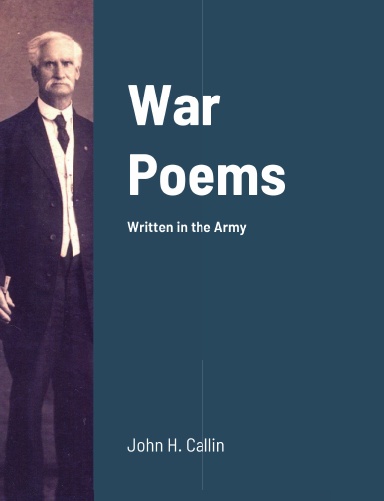
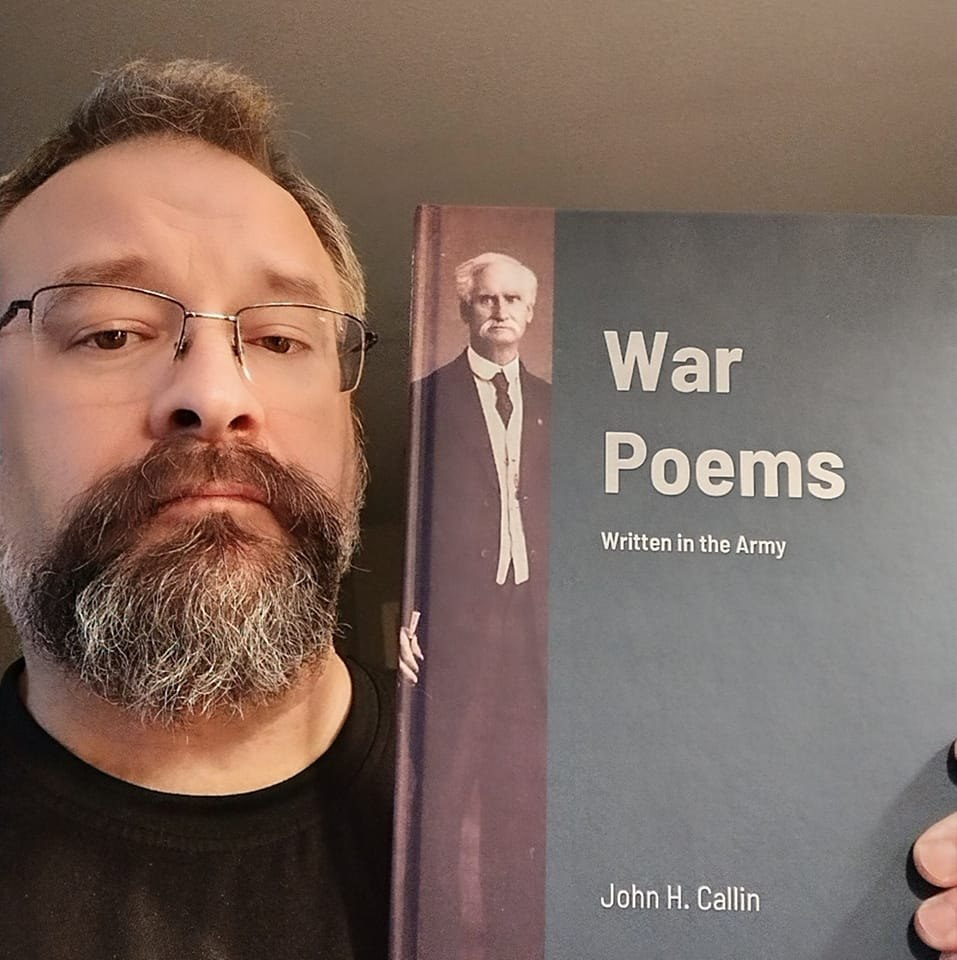
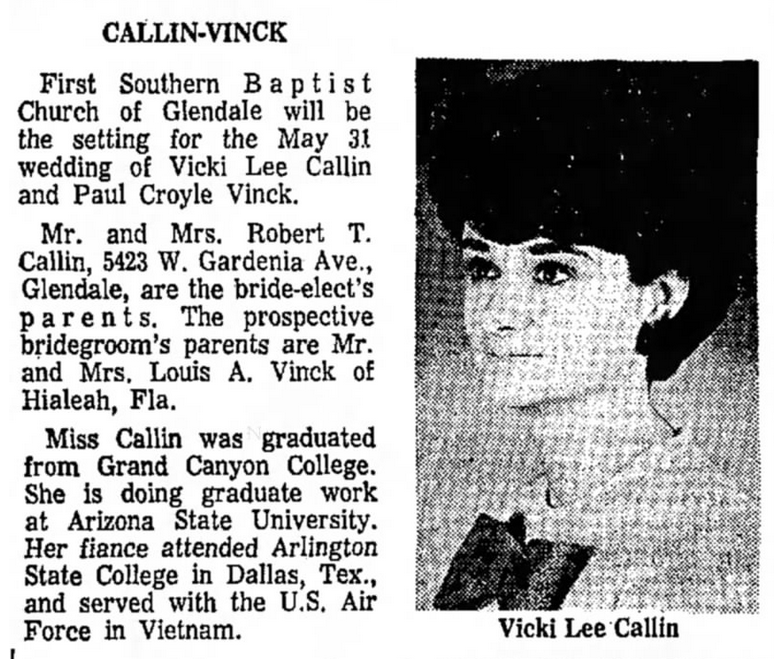
    This was my secret side-project for much of 2021. My aunt Vicki inherited a book of poetry written by her great-grandfather, John Henry Callin, and she and I collaborated on transcribing it and editing it for publication.

    (The link to War Poems will ask you to verify your age due to “explicit content”; that’s because there are grisly descriptions of John’s wartime experiences in some of the poems.)


    Are you still with me? That’s very kind. I guess the only thing left to promote is my SoundCloud… which I recently learned still exists!

    I only posted a few recordings to try out the service, but I was pretty proud of these two.

    “Birthday Disco” is a song I wrote for my girlfriend in 1991 and recorded in the then-new electronic music studio at Glendale (Arizona) Community College.

    “Beyond Belief” is probably still my favorite Elvis Costello song, recorded at home in Maryland around 2010.


    Got any projects you’re proud of? This seems like a good place to mention them!

    Next time, we can go back to talking about family history.

    Thanks for reading Mightier Acorns! Subscribe for free to receive new posts and support my work.

  • Going four generations back to find another line

    This surname can be found among my wife’s Sixteen great-great-grandparents. We have to go that far back to find the first Mårtensson – but with a Swedish twist!

    Elna Mårtensson – 04 Nov 1846 – 07 Dec 1915

    As you’re probably aware, laws for Scandinavian surnames were adopted at different times, depending on the country of origin. Elna was born in a village called Annelöv in Skåne County, Sweden. Her father’s name was Mårten Esbjörnson, and his father’s name was Esbjörn Mårtensson.

    Annelöv, Sweden, and surrounding villages (Malmo is several miles to the south)

    Evidence suggests that when it came time to baptize his daughters, Mårten decided that instead of using the traditional patronymic, his daughters would carry “Mårtensson” as their surname. So in 1846, 1848, 1853, and 1860, you can find baptism records for Elna, Anna, Hanna, and Emelie (respectively) that list their surname as “Martensson”. Sweden abolished patronymics in 1901 and required everyone to adopt a surname, so Mårten was quite the trendsetter.

    If you decide to dig into the very detailed records from the Sweden, Selected Indexed Household Clerical Surveys, 1880-1893 database, you can find records placing the family in several of the places named on the map above:

    • Billeberga (where Mårten Esbjörnson married Pernilla Åkesdotter on 4 Nov 1845);
    • Östra Karaby, where they farmed from 1855-1863; and
    • Reslöv, where Mårten died on 1 Dec 1876.

    Mårten’s mother, Else Andersdotter, was born on 7 Nov 1778 in Annelöv; his father, Esbjörn Mårtensson, on 3 Sept 1773 in Västra Karaby.

    Odds are that the family were members of the Lutheran Church of Sweden – though, considering that membership in the State church was legally enforced until 1860, it’s hard to know how they actually felt about their membership. Not only did the enforced religious membership end in 1860 but rules regulating emigration were also eased. The country’s population had doubled from 1750 to 1850 and was still growing, meaning that tillable land was increasingly scarce. This was hard on farm laborers like Mårten. All of these factors led 100,000 Swedes to travel to America between 1868 and 1873 alone!1

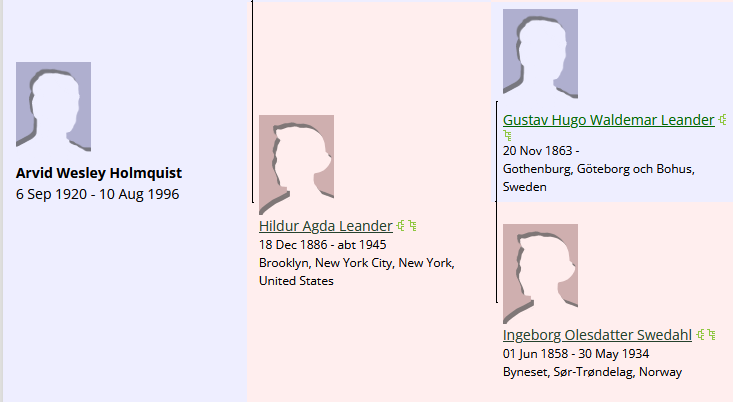
    Elna’s brother, Anders Mårtensson, was among them. He left his home in the village of Reslöv, boarded a ship called the Spain, and arrived in New York on 5 Nov 1872. I don’t know where Anders ended up, but his nephew, Arvid Holmquist, came about 40 years later and settled near Minneapolis, Minnesota.


    As always, I’d love to hear from you if any of these folks are in your family tree. I know the odds are slim, but it doesn’t hurt to invite you!

    I’m working my way through the second set of Sixteens – my 2nd-great grandparents and my wife’s – in these Family Reunion posts. If you’d like a simplified list of the first set of Sixteen (the 16 great-great-grandparents of my children), you can find that here. And if you’re curious about who is in this second half of the series, be sure to subscribe!

  • originally posted Friday, November 7, 2014

    Note for fellow researchers: I’m still trying to find evidence that will confirm the parents of Elizabeth (Berlin) Callin – that WikiTree link presents the few documents we have. Here is the fullest version I have of the memoir written by her granddaughter, Rosemary Callin.

    (I am working on more about this part of the family – so be sure to subscribe for updates when they are ready!)

    Silk or Satin

    Transcribed from a letter dated 1973:

    Things I Have Been Told About My Grandmother, Elizabeth Berlien (Barline) Callin.

    The Revolutionary War soldiers were given land in the Northwest Territory — Pennsylvania, Ohio — to settle their wages for service, I believe. But this was a generation before Elizabeth’s time. I am under the impression that my grandfather William Callin fought in the War of 1812. I don’t know how or where he met up with Elizabeth Berlien. My father’s Callin family history says they settled first in around Ashland, Ohio, later moving to Wood County.

    Anyhow they lived in a Lincoln-like log cabin in Wood County. My father, George Callin, born in 1846 said they would waken in the morning and find a light layer of snow over their bed. William paid his taxes by cutting wood and hauling it into town, 50 cents a load.

    William and Elizabeth had six children, five boys and a girl. I believe the girl was the oldest — Harriet (Sly), John, Zimri, George, Hugh and Jim. Father said they were warned not to say nothing at school about it, but their cabin was a station on the Underground Railway. I don’t know whether it was William or Elizabeth, probably the latter, who awakened them softly in the middle of the night and led them to the window. The moon flashed out and they saw a white man, maybe William, leading a string of blacks through the clearing around their cabin and into the woods. They were on their way to Great Uncle George’s barn. From there he would take them onto the next stop.

    William was a powerful man, six feet tall. The boys had to be in the fields around sunup. He had a big, black whip. I don’t know whether it was Elizabeth or her mother-in-law who would say pleadingly, “Now, William, don’t whup ’em.” It was a brutal age.

    The first thing the children heard in the morning was the sound of her spinning wheel and the last thing at night. Papa said that one time she didn’t get the buttons sewed on their shirts or maybe she didn’t have any buttons so she sewed their shirts together with thread and so off they went to school or wherever.

    When the Civil War came all five enlisted. I have a strong feeling that probably Elizabeth always had a Bible and encouraged visiting preachers and friends who could read it to her. She possibly taught the children verses and stories from it. I have known among my Appalachian friends people who couldn’t read and write at all who knew their Bible by heart, sometimes more strongly and sincerely perhaps than literate people because to them it is the one book. They think about it and discuss it constantly.

    The five boys went to war and for the first time Elizabeth learned to read and write so that she could communicate with them. This was probably not too hard for her as those “Dotsch” are good at everything anyway.

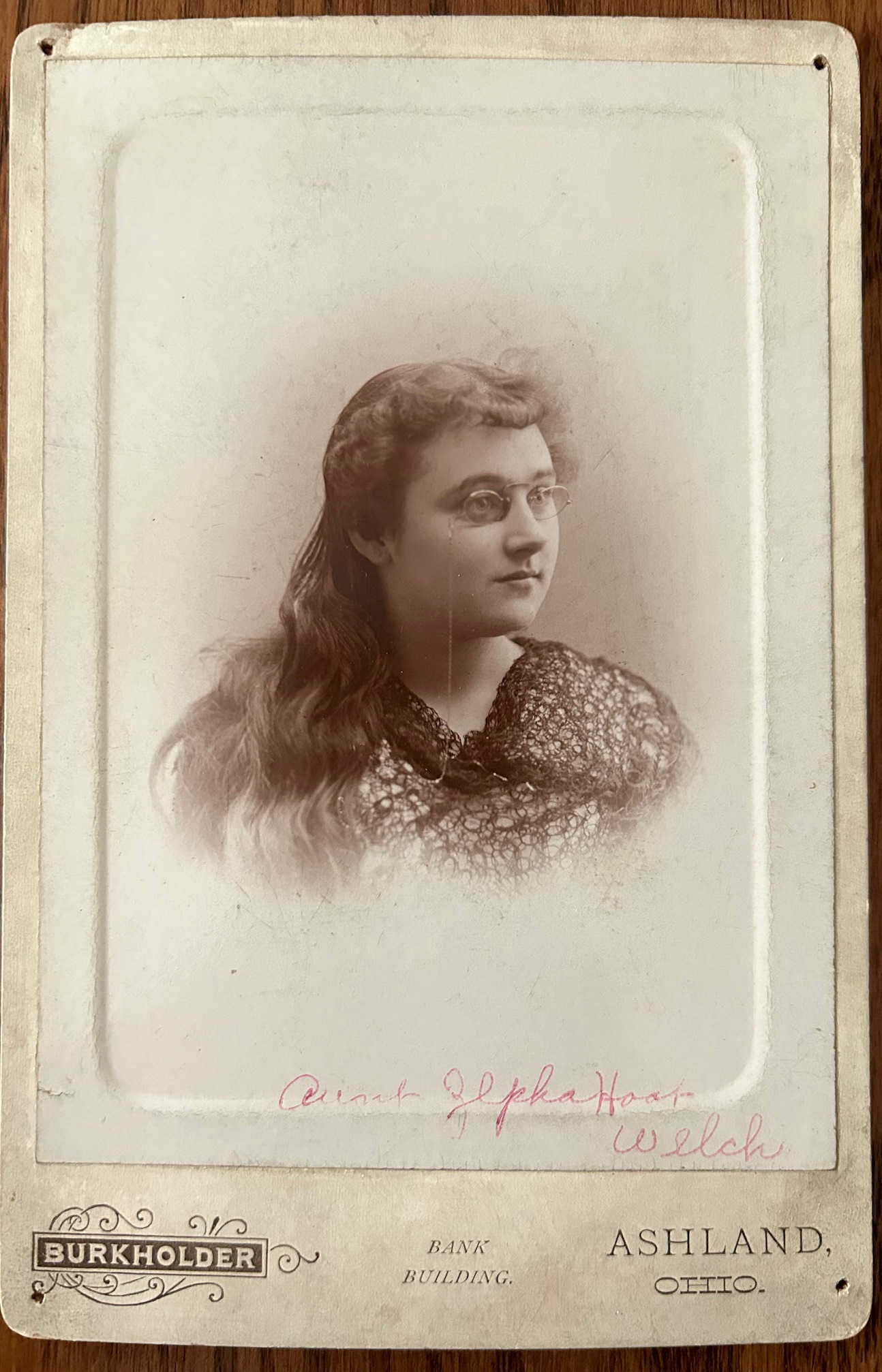
    William died at maybe around 62 and I don’t know what Elizabeth did then. I believe she lived to be about 84. In her very last years she came to live with us at 331 Pearl Street in Bowling Green. And this is where this picture1 must have been taken, probably by my mother who had a camera. Later I inherited my half-sister’s (Mabel Callin’s) dress-up picture of my father. I was handling it when it fell apart and here was this picture that I didn’t know existed of Grandmother Callin.

    I don’t remember her but she knew me. She sat by the window mostly in the east bedroom. Papa loved to go in for a chat and he delighted in her witty answers. Mother was going to make her a dress and Papa asked — he knew well enough that it would be calico or gingham, but he said playfully, “What’ll it be, Mother, silk or satin?”

    “It’ll be sat in, all right.”

    “George, sometimes I wish I had gone over the hills to the poor house.” (In those days considered a great disgrace.) “There would be old people there and they would know the things I want to talk about.”

    Another day she said to him.
    “The woman next door (mother) is going to have a baby (me).”
    After I came she said;
    “I guess you better call her “Melia”. (Sure glad they didn’t.)

    Mother went in one time and laid me on the bed for a moment. When she came back, Grandmother had grabbed me by the skirts and was pulling me toward her. I was almost off the bed. Mother probably let her hold me. She liked old ladies and was kind to them. When I was a young girl I used Elizabeth for my middle name but later I decided that Rosemary was enough.

    Elizabeth passed away in 1903 and was probably buried from our house. I don’t know where. There is a George Callin lot in Oak Grove Cemetery at Bowling Green and, by-the-way, there are still two places on it if any one in the family should need them. She and William might be buried on Uncle John Callin’s lot also in Oak Grove, but I don’t think so. I don’t remember ever seeing them there.

    If any of you know any more about Grandmother Callin I would certainly appreciate hearing about it.  I see from the Callin family history that I have the order of the children wrong. It was John, Zimri, Jim, George and Hugh. Jim was possibly the flower of the flock. Papa said he once accused Elizabeth of liking Jim best. She answered that he needed her the most.

    Rosemary Callin
    September, 1973

    Some notes [from Tad Callin]:

    George W. Callin, Everett (standing), Clem, Mary Ann, and Mabel – c. 1890

    I have a photocopy of this 1973 letter, though I don’t know if the original was typed or handwritten. I would love to get copies of any of the photographs mentioned in this letter, so if you have them, please comment below or email me (mightieracorns at gmail dot com).

    The writer of this memoir is Rosemary Callin (1902-1978), daughter of George W. Callin (1846-1921), the man who compiled the “Callin Family History” in 1911. Rosemary was born to George and his second wife, Lura Warner, in 1903. She never married, and she made a career as a journalist for her local newspapers. It’s not clear who was her intended audience for this memoir.

    As far as Rosemary’s facts:

    I haven’t found any proof of William (who would have been about 3 years old) fighting in the War of 1812. His father and uncle migrated from Westmoreland County, PA, around 1816, though, so either or both of them may have been involved in the fighting around the Great Lakes. As of the date of this post, I’m still looking for evidence to show where they came from and where they might have served.

    I believe the “Great Uncle George” referred to would be William’s brother, George Callin (1804-1879), who shows up in Huron County on the 1850, 1860, and 1870 census records.

    When the Civil War began, I don’t believe “all five” Callin brothers enlisted – I have found pension records for John, Jim, and George, but Hugh would have been 13 when the war began, and Zimri would have been 15 at its close. (In an interesting twist, Zimri’s son, Edward, is the only relative of mine that I have found to date who served in the Spanish-American War.)

    According to the Find-a-Grave database (thanks to cousin Joan!), Elizabeth is indeed buried in Oak Grove Cemetery.

    1

    I have yet to locate a copy of the picture Rosemary refers to.

  • How our immigrant ancestors got here

    We are all descended from immigrants.

    If you are like me and you live in the Americas, you are bound to have ancestors from somewhere else. Even if one of your ancestors was among the earliest known people to arrive on a pristine, post-glacial continent from Asia1 (and assuming you don’t count that as “immigrating”) you also have approximately 1,024 8x-great grandparents who lived around 200 years ago, so your odds of not being descended from someone who came from elsewhere are pretty slim.

    I’ve been having a lot of fun researching my wife’s family tree because she has a lot of relatively recent immigrants for me to study. Her Swedish great-grandfather, Arvid Holmquist, arrived in 1910. Other branches arrived from the Netherlands, Denmark, Norway, and Germany during the mid-19th century. My family’s earliest arrivals were probably Joseph Frey who came to New York from Germany, or the Greenlees who came from Ireland during the infamous famine – both in the 1840s.

    Is this a good time to share one of my favorite songs?

    Thousands are sailing
    Across the western ocean
    Where the hand of opportunity
    Draws tickets in a lottery
    Where e’er we go, we celebrate
    The land that makes us refugees
    From fear of priests with empty plates
    From guilt and weeping effigies
    Still we dance to the music
    And we dance

    Most of my ancestors have been in North America for longer than there have been immigration laws. It wasn’t until 1882 that the first general immigration law was enacted. The Immigration Act of 1891 established a Bureau of Immigration in the Treasury Department. The Immigration Act of 1924 (the Johnson-Reed Act) finally set up the first “consular control system,” which required that visas be obtained abroad from a U.S. consulate before admission.2

    The earliest European folks who came here were (most likely/most often) religious dissidents or non-conformists fleeing Europe, or they were “transported” – meaning their emigration from England was involuntary and they became someone’s property for a period of service when they arrived. My earliest known Bellamy ancestor started his time in North America as an indentured servant. We also have to acknowledge that many, many people were stolen from their homelands and brought to the Americas to spend their entire lives performing the labor that made the country viable.

    The point is that if any of my ancestors had been required to follow our current immigration laws, I wouldn’t be here. I wouldn’t be. And neither would most of you.

    That’s why I find the common insistence that immigrants who want to come here should come in “the right way, the way my family did!” to be so odd. When people say that, they seem unaware that their ancestors most likely did come in the way modern migrants come in – they showed up unannounced and did their best to find land or work to feed their families. That’s what my ancestors did!

    The sad thing about this insistence that there is a “right way” to immigrate is the cruelty this inflicts on people who are fleeing here for many of the same reasons my ancestors came. Most Americans don’t even know who their immigrant ancestors were – they might know they were “German” or “Irish” and they might even know some of their names – but I have learned over the years that they are rarely interested in the details. (Details like, “What did ‘German’ mean before 1870?” or “Which kind of Irish were they?”)

    Coming to America used to require a dangerous ocean voyage with no guarantee of work or prospects upon arrival. There were risks from diseases or being exploited upon arrival, and little chance of a welcome from the people already living here. Modern Americans seem to believe that our immigration laws have changed those factors when the truth is we have only made it harder on the poor, the vulnerable, and the desperate while doing nothing to bar the people the laws are intended to keep out.

    When I look at the people trying to make America their home today, I see my ancestors. They’re from countries torn apart by war, they speak dozens of languages, and they just want the same breathing room to raise their children that my ancestors wanted. And if you judge today’s immigrants by the yardstick of my ancestors, they are coming in “the right way” – making a long and dangerous journey and showing up, hoping for their chance to be one of us.

    Maybe the problem isn’t them, or how they get here, as much as it is how we treat them – and how we contribute to the causes that drove them to leave their home countries in the first place.

    1

    Archaeological and genetic evidence suggests the first humans arrived in North America between approximately 25,000 and 16,000 years ago. (University of Oregon, “New data suggests a timeline for arrival of the first Americans” by Becky Raines, Museum of Natural and Cultural History, 24 Feb 2023.)

    2

    American Immigration Council, Did My Family Really Come “Legally”? 10 Aug 2016.

  • A Quick Overview of my work under this surname

    This surname can be found among my Sixteen great-great-grandparents. We have to go that far back to find my first Murray – Rosa Edith Murray (23 Apr 1861 – 19 Nov 1943)

    My great-great-grandmother was a Murray, and her grandfather was a Scottish immigrant who came to the newly established United States around 1800. He may or may not have looked exactly like this:

    “Murray”. A plate illustrated by R. R. McIan, from James Logan’s The Clans of the Scottish Highlands, published in 1845. (from “Clan Murray” on Wikipedia)

    I don’t know much about Thomas Henderson Murray. In truth, I have a single piece of evidence to hang my hat on:

    Many unsourced online trees insist that Thomas’s parents were James Murray and Isabel Carmichael, who married in Aberlour, Banffshire (now Moray), Scotland. James and Isabel contracted to marry on 21 Nov 1778 and were married on 10 Dec 1778. This would only give them eight months or so for a 12 Jul 1779 birthdate to fit – but the real reason I am skeptical that these are Thomas’s parents is that there are baptism records for seven children born to James and Isabel in either Aberlour or Mortlach from 1779 to 1800, and none of them are named “Thomas.” The oldest of these children, John, was baptized in Mortlach on 18 Aug 1779, which suggests strongly that Thomas’s parentage lies elsewhere.

    I would love to learn more about Thomas’s origins so that if I make another journey to Scotland, I can visit places of more specific interest. If you are a Murray descendant who recognizes this American family, please do get in touch!

    That said, I do know a fair bit about Thomas’s youngest son, Aaron Murray.

    Aaron and Hannah

    Aaron was born in Ohio, probably near Springboro in Warren County. Aaron’s maternal grandparents (Thomas’s mother- and father-in-law) were members of the Hicksite sect of the Quaker faith that had moved west from Pennsylvania to form a community in Springboro. Thomas’s family appeared in nearby Clear Creek Township on the 1820 Census.

    Aaron married his first wife, Maria P. Harris, and they had two sons in Wabash County, Indiana, before Maria’s untimely death in 1854 – probably from one of the many outbreaks of cholera, typhoid, yellow fever, or other diseases that decimated prairie towns in those days. Aaron soon remarried the widowed Hannah (Bender) Eby, who had two sons from her first marriage. They had five more children together, the third being Rosa.

    Rosa was born within days of the outbreak of the Civil War. The family lived in Liberty Mills, Wabash County, Indiana, just west of Fort Wayne. By the following year, Aaron had moved his family about 300 miles south and west, to Illinois. He enlisted in Company F of the 113th Illinois Infantry at Belmont, Iroquois County, Illinois, on 12 Aug 1862 – the same unit as Hannah’s brother, Lyman Bender. Lyman was captured and died in Andersonville prison on 10 Oct 1864; Aaron was discharged at Camp Butler for disability on 27 Oct 1864.

    Two years later, Aaron and Hannah named their youngest son Lyman in his honor.

    Rosa (Murray) Huff – seated; Nancy (Witter) Callin and Nancy’s best friend, Bobbe Harris (striped shirt) standing behind her; Glendale, AZ, abt. 1941

    After the Civil War, Aaron and Hannah moved their family to Big Creek in Grant Township, Neosho County, Kansas. Rosa grew to adulthood in Kansas and married Albert Huff in 1883. They farmed in Elsmore, Allen County, Kansas, and had five Huff children. In 1908, they sold their farm equipment, rented the land, and moved to Glendale, Arizona. You may recall an earlier post about that move:

    As always, I post twice a week, so if you want regular updates: Subscribe!