Tad Callin has been working on family history and genealogy since the late 1990s. He does most of his research on Ancestry and posts what he learns to WikiTree.
The surname “Jones” dates back to Wales in about the 1270s, when it probably evolved from the patronymic meaning “John’s son” – making it very common in Wales after the Laws in Wales Acts, passed in the mid-1500s, led to the Anglicisation of Welsh names. This makes “keeping up with the Joneses” significantly harder when you’re tracing your genealogy.
David E Jones1 first appears in the 1850 Census as a 19-year-old furniture maker in the household of Augustus Bradley in Meadville, Crawford County, Pennsylvania. Given that Mr. Bradley was also a “Chairmaker & Painter” in the Furniture and Fixtures industry, it seems likely that David was his apprentice. If so, he probably completed his apprenticeship two years later upon turning 21.
In about 1854, David married Susanna Brookhouser (1836–1924), and they lived in French Creek, Mercer County, Pennsylvania, with their daughter, Frances, age 4, in 1860. A 9-year-old Albert Jones also appears in their household on that census, but we don’t see him again in later records – it seems likely Albert might have been a nephew. David and Susanna had two more daughters during the 1860s.
[Update: I don’t think this enlistment refers to our David Jones.] On 21 August 1865, someone named David Jones enlisted at Utica, New York. He was about the right age – 35 – to be our David and gave his birthplace as Philadelphia, Pennsylvania. His recorded description: blue eyes, brown hair, a medium, and standing 5 feet, 9 inches. He was recorded with the 15th Infantry and the following day, 22 August, was his discharge date.
By 1870, the Jones family had moved west, settling in Missouri Valley, a small community in Saint John Township, Harrison County, Iowa, which sits just east of Council Bluffs and across the river from Omaha, Nebraska. That is where Alice met John Riley McCullough (1848–1918) and married him on 4 Nov 1877.
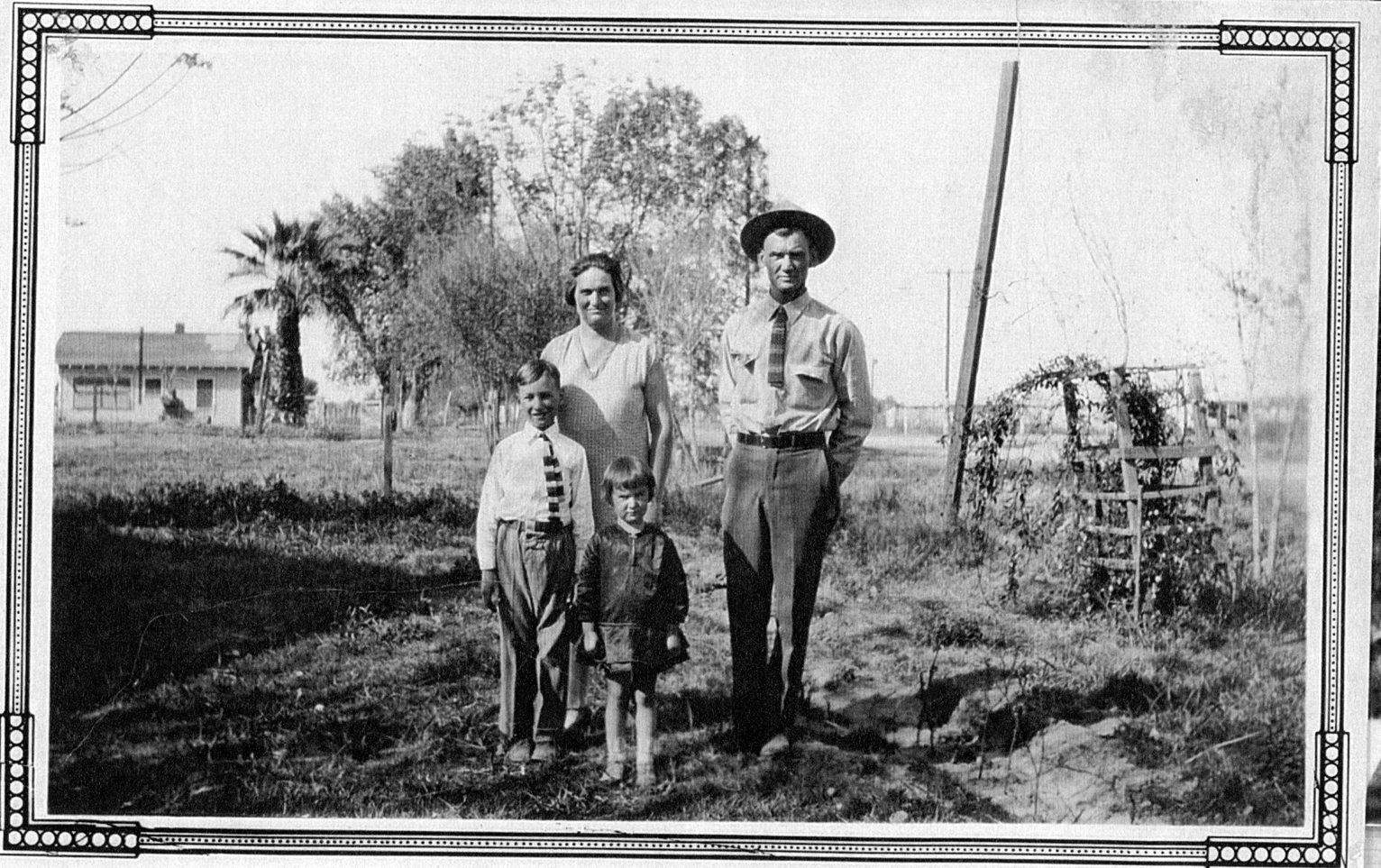
Alice’s family: from the left: John Riley, William Edgar, Elsie Ann (center), Earl Randolph, and Alice Frances (Jones) McCullough c.1890 – from James McCullough and Descendants, page 90
Alice had several siblings who raised families of their own in Iowa. Her sister, Martha (Jones) Fickel (who died Martha Sublet), and her brothers, William and Bert Mac Jones, all had large families and stayed in or near Harrison County all their lives. William Jones lived until 1958 and had five sons to carry on the Jones family name.
I’ll keep looking for David’s ancestors – for now, I don’t have a lot to go on. If you’ve researched this Jones family, say hello!
Thanks for reading Mightier Acorns! Subscribe for free to receive new posts and support my work.
David’s name is frequently given as “David Eligh Jones” but I haven’t found any documents referring to his middle name. The closest I’ve seen use his middle initial.
This is one of my favorite finds – thanks to my cousin, Chad, for sending it my way all those years ago! I’d love to hear about your famous connections if you’d like to share.
For those who may not be familiar with him, here is a little YouTube introduction to Marty Robbins, performing two of his songs about El Paso in 1965 and 1978:
I remember hearing about grandma’s famous neighbor from time to time when I was growing up, but aside from being an interesting thing to mention whenever Big Iron came on the radio, it wasn’t something that seemed to have much to do with family history – until my cousin Chad acquired a copy of Means’s book, signed by the author, and sent it to me a few years ago.
Dick Jr. and Nancy Witter, 1930s Glendale
Mamie and Martin Robinson – “Marty Robbins” was his stage name – were twins, born five minutes apart in September 1925 in a two-room house near Glendale, Arizona. The family moved around quite a bit, from that house (which was about 8 miles north of Glendale along what is now 59th Avenue) to Prescott, to Phoenix, north to Cactus (which no longer exists, being absorbed by Phoenix suburbs around the intersection of Thunderbird and Cave Creek Roads) and eventually, back to Glendale.
Dick Witter Sr., my great-grandfather, ran a dairy farm there, and Hannah Merle raised their two kids, Dick Jr. and Nancy. Nancy was born in March 1925, and Richard in February 1921. (Read more about the Huff and Witter families settling in Glendale here: The Huffs Move West. Twice.)
Around 1932 or 1933, Mamie recalls moving from Cactus, where they attended Sunnyside Elementary (which later became Greenway Middle School), to Glendale, where they enrolled in the Peoria School District. “We walked about half a mile to catch the bus,” she says, “and it seemed we rode a long way to Peoria.”
I attended Peoria Schools myself, though 50 years later. In high school, I had to ride the bus about 15 miles from my house at 89th Avenue & Deer Valley Road to Cactus High, so I have a pretty good idea of what that bus ride might have felt like to Mamie and Martin. And this is where my grandmother comes into the story!
“A little girl named Nancy came over to me and asked me my name. I told her it was Mamie and she laughed, saying it was the funniest name she had ever heard. I happened to agree with her, but nevertheless I started to cry. Later she became my best friend during the years we went to Peoria School.”
Richard and Nancy, c. 1930
That does sound like my grandma, I have to admit. I’ve inherited a bit of that trait myself – the tendency to notice the odd and call it out without picking up on the social cues that would alert a normal person that they had offended somebody. Nancy probably had no idea that she had caused Mamie any distress! Despite the initial hurt feelings, though, when Nancy invited Mamie to play with her at recess, all was forgiven.
Mamie had a lot to say about her twin brother’s antics. He liked to challenge other boys to wrestle, torment her and her friends with taunting nicknames, and he even indulged in the occasional bit of petty shoplifting from the local store – much to Mamie’s horror.
She also had some interesting things to say about her friend’s family – giving me a view of my grandmother’s life I wouldn’t have otherwise had:
“These were depression years for everyone, although at the time it seemed as if some were far richer than others in this farming community. It wasn’t until years later that we found out that other families were just as doubtful about making it financially as we were. “Besides, riches are all a matter of how you see things. I thought my friend Nancy was really rich when I visited her and saw that she lived in a house that wasn’t falling down, and that she had her own bedroom with pretty blankets and bedspreads. “Years later she told me she liked to visit me as a child because I had so much more to play with than she did. By that she meant spaces to roam, trees to climb, and the endless thickets that served us as imaginary rooms and houses in which to play. “Nancy was from a small family. She had one brother. I thought he was cruel and scary because he was a bully. On the school bus, he would take my nickel away from me. Not even Martin could help me get it back. “When we had no school, Nancy would often visit with me all day. She would arrive early in the morning and stay until her father came after her. “When she came to play, there would be a certain amount of jealous rivalry between my cousin Lois – another frequent playmate – and me. But in an effort to outfox Martin, the three of us would usually end up banding together and the visit would turn out well. “We had to watch continually for Martin and his tricks. Once I thought I had lost Nancy’s friendship because of him. We were playing around a haystack. It seemed awfully high to me at the time, but in reality was probably only a few feet. Martin sneaked up on one side of it and jumped down on us, taking us completely by surprise and scaring us badly in the bargain. “Nancy began crying and wanted to go home right then. She had no way of getting to her house, so instead she went with Lois to her home. I was sure I had lost my best friend, and was really upset with Martin. I began crying and chasing after him. He tried to say he was sorry for scaring us, but at that point it was too late for apologies.” (“Some Memories”, pg. 80-81)
Nancy and Richard, c. 1930
It would seem that the girls were close enough friends to survive these setbacks. As they got older, some of the problems they faced were a little more serious. Martin and Mamie’s father had long had a drinking problem, and it either got worse as they grew older, or they simply noticed it more. Either way, after a few years, the family moved out of their house and into two big tents they set up near what is now 59th Avenue and Thunderbird Road.
Life there was busy, and Mamie, her brothers, and their parents seemed to have an increasingly fractious relationship.
“Sometimes I would go to my friend Nancy’s house, about five miles away, and play with her in peace. I would be given a ride over there, and we would play house or paddle in an irrigation ditch. “Even at these times, we did not escape entirely. Often Martin would show up and throw rocks at us. It seemed as if he came from nowhere. When we went after him, he ran away laughing like crazy. “Needless to say, Nancy didn’t like him at all. Telling on him did no good, so we had to suffer. Mom definitely had a blind side when it came to Martin’s tricks. The ditch, by the way, is still there. I think of us playing there every time I drive by it.” (“Some Memories”, pg. 94)
In 1937, Emma Robinson took Mamie, Martin, and the other siblings still living at home, moved into Glendale, and divorced their father. It would seem that Mamie and Nancy saw less of each other after that. A few years later, when things got serious, Martin joined the Navy and went to War. Life moved on for everyone as he returned and eventually became an internationally famous country singer.
As a kid, my dad would always get excited when he heard a Marty Robbins tune on the local country station, KNIX. Sometimes he would allude to grandma’s acquaintance with the singer, but it wasn’t something the family talked about in great detail – just an interesting fact. For us, it was the beautiful voice, the cowboy tales, and the sense of a local boy making it big that made the songs important to us. But the older I get, the more I appreciate the small ways we are tied to our history and our culture.
Grandma died in 2004, the same year Mamie Robinson died. Without Mamie’s recollections, I would only have a vague family legend about their relationship – but thanks to her (and to Mr. Means for making sure those recollections got published!), I have something small and precious to remember about the woman who painted this sunset, and a reason to hum a certain cowboy’s tune while looking at it.
What to expect when you’re expecting collaboration
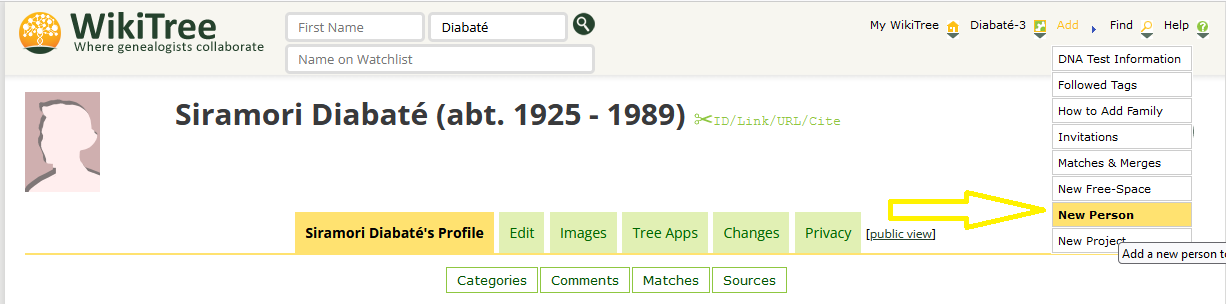
By now, you may have noticed that I love using WikiTree. I do my original research primarily using my Ancestry membership (which is expensive and not an option for everyone), and then take what I learn about each family/relative and craft it into a biographical profile on WikiTree so that it is easier for me to share my research with others.
If you see me mention a relative in a Substack post, odds are that I’ve linked their name to their WikiTree profile – for example, Thomas Henderson Murray (about 1779 – about 1837), who I am hoping to trace back to Scotland.
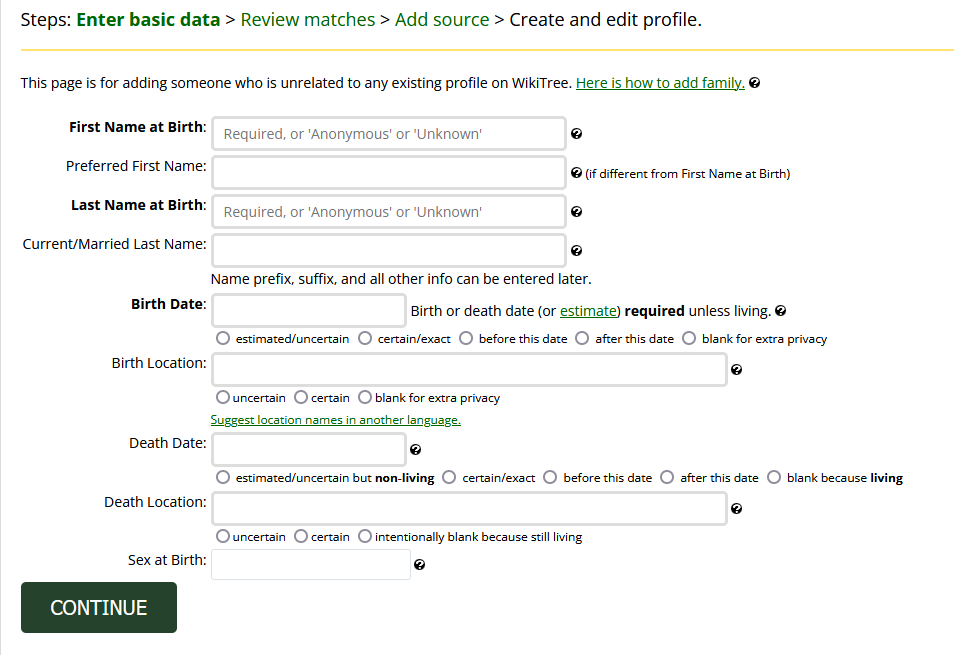
Another practice I enjoy is creating “Free Space” pages for the unique local histories and published family histories that I run across in my research. Here are three WikiTree pages that explain what these are and how to make them:
And if you visit my profile, Callin-50, I have a “Local Histories” section linking to the various Free Space pages I’ve made or contributed to. Like this one:
Screenshot of the “Callin Family History” Free Space Page
So What?
When America’s first Centennial approached (1876, for those who need a number) it became a trend for towns and counties, especially across the more recently settled MidWest, to publish large histories of their town or county, and they often included biographical sketches of the most prominent citizens. Despite hiring historians and scholars to edit these massive projects, they rarely met any kind of academic standard – they cited no sources or primary records and often relied on close relatives or (in some cases) the subjects of the biographies to submit the sketches to the editors.
At best, these biographies give us a sense of what these “prominent citizens” thought about themselves, or how their families saw themselves in local society. They are often useful for tracking down primary sources, and they often provide a detailed list of ancestors and siblings for the person featured in the sketch.
At their worst… these biographies can be full of errors, bias, and a near-constant elevation of white men with property over the rest of the residents of a given area. The erasure of the contributions of women and ethnic minorities to these towns and counties, combined with the almost universal reinforcement of the myth of “rugged individualism” that “built our country from nothing,” puts the racism and casual superiority of the men of that time on full display.
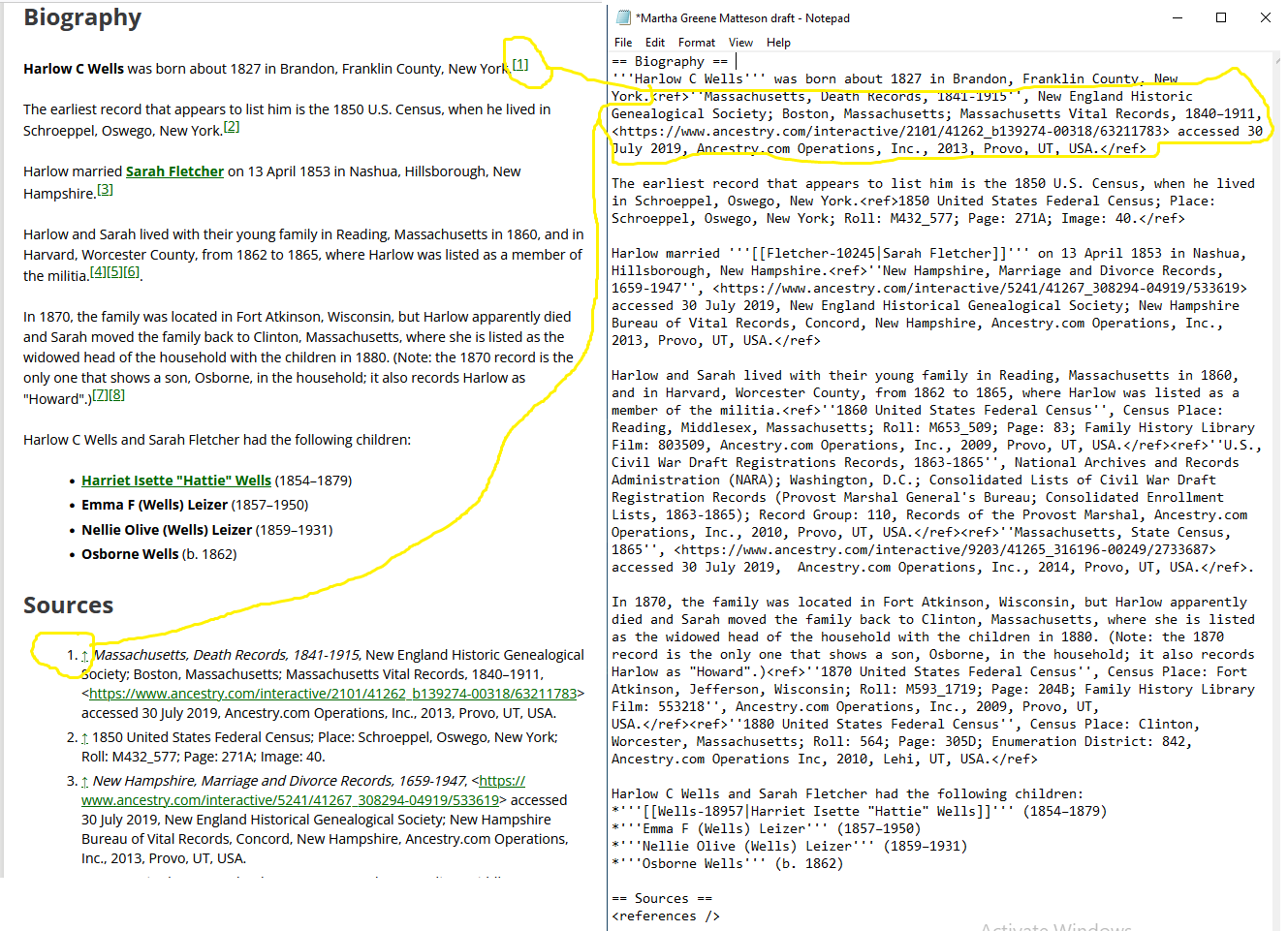
There are a lot of places where you can find local histories – Internet Archive, Hathi Trust, Google Books, FamilySearch.org, and Ancestry collect a lot of them. The benefit of a Space on WikiTree is that researchers can create links to all of those repositories and include information about the reliability of the information, as well as provide source citation text that can easily be pasted into any WikiTree profiles you might be making. Example:
<!– wp:image {"caption":"copy the \u201c\u2026everything\u2026\u201d and paste into a profile citing this source”,”sizeSlug”:”large”,”linkDestination”:”none”} –>
copy the “<ref>…everything…</ref>” and paste into a profile citing this source
The Wiki platform also has a few neat features that make it easier to see, at a glance, how many individual profiles cite or link to a source. If the source citation text includes a link to the Free Space page for that source, any profile that cites that source using that text will appear at the “What Links Here” link for that Free Space page. Users can also use Categories that can build an index of related pages, so you can see profiles based on their family groups or local areas, or even Categories for “People named in this source,” if that is useful.
The Down Side
You might be leery of “trusting” what is on WikiTree – or you may be one of the people I see complaining online that you had an unpleasant interaction with another contributor or a profile manager. These are valid concerns – and your experience may vary wildly from the experiences of others. But there are a lot of us out here who want to help – never be afraid to ask for help.
Using any collaborative platform – any user-editable web page – will inevitably lead you to cross paths with people who don’t behave the way you expect or desire. You mustn’t let common human behaviors (including, perhaps, your own) discourage you from learning how to use a potentially helpful tool. But the behavior of other people is often a mask for the real problem, which can be boiled down to a fear of the loss of control over your work.
The real downside for many people is that posting on a collaborative platform means putting work into something that you don’t have absolute control over. That’s the trade-off you have to make if you want other people to benefit from your work – they have to be able to access it. In my experience, though, whether I’m editing Wikipedia, WikiTree, or any of the other work- and hobby-related wikis I’ve used over the years, it is far more common for the work I do to be ignored than it is for it to be vandalized or altered by another user.
This is why I’m so grateful to see you reading my work here – sometimes it can get lonely doing this kind of work, and seeing you regular subscribers enjoying my efforts is more rewarding than you might think!
Three railroads converged in Mills County, about 25 miles south of Omaha, Nebraska. The western terminus of the Burlington and Missouri River Railroad and the eastern terminus of the Nebraska Burlington & Missouri Railroad met at a station on the Kansas City, Council Bluffs, & Saint Joseph Railroad – and that spot was given the name Pacific Junction in 1871.
Burlington Depot, Pacific Junction, Iowa (from the Mills County, Iowa IAGenWeb Project)
That was a magical year in American history – in many ways, it marked the beginning of a dramatic industrial transformation of the country from a rural landscape of disconnected farms and frontiers to an inter-connected economic and technological world power. Between 1870 and 1890, the amount of railroad track in the United States tripled1. Total trackage increased from 35,000 miles in 1865 to 254,000 miles in 19162. Railroad magnates took advantage of generous federal subsidies (usually in the form of land grants) and of the lower costs of using steel tracks instead of iron, and they made fortune after fortune from building this new infrastructure – often on the backs of workers who had to fight for fair treatment and reasonable wages. This sometimes led to violence, as it did in Pacific Junction in 1888, during the Burlington Railroad Strike of 1888.
Pacific Junction was also a farm town.
Stock and produce bound for Chicago and Boston, or the West coast, or points South, converged on a place like Pacific Junction, where auctioneers with silver tongues and lightning lips spoke for the Invisible Hand of the market. One of those auctioneers was a man named Frank Shuffler.
Frank was a dashing young man, born in Hubbell, Thayer County, Nebraska, on March 29, 1888. His father was Valentine Shuffler, a farmer who moved his family to Pacific Junction when Frank was 10 so Valentine could work for the railroad. The violent years of the labor battles were ten years in the past, and the steady work of the railroad probably insulated the Shufflers from the notorious boom-and-bust cycle of farming in what we now call the Gilded Age.
In 1907, at age 18, Frank married a local girl from a Pacific Junction farming family. Virginia Ballard was also 18, the second of five daughters of Isaac and Mary Ann Ballard. Her father was a former drayman who later became a railroad man, working as a brakeman on the trains that passed through Pacific Junction. Sometime after 1900, though, Virgie’s parents divorced, and in 1904, Isaac married a girl from Saint Joseph who was nearly half his age and moved with her to Oakland, California. It seems likely that Isaac was not at Frank and Virgie’s wedding in 1907.
But Frank was handsome and popular in town and ran a barbershop with his partner, Thomas Martin. As mentioned above, he was also an auctioneer – and at some point, Frank even served as mayor of Pacific Junction. So we have an Iowa railroad town in 1912 with a thriving young community centered on a barber shop – the only thing missing from this scenario is a charismatic flim-flam man hoping to sell the school board marching band uniforms!
(If you’re not familiar with the 1962 film production of The Music Man, a show set in 1912 in the fictional town of River City, Iowa, please allow me to correct that, now.)
Frank and Virgie had four sons between 1909 and 1915: Don, Darrell, Dale, and Duane. You could almost pick them out of the crowd of children in the park; you could almost see Virgie in one of those magnificent hats, standing with the other young mothers. This family must have enjoyed a wonderful decade after their 1907 wedding.
Sadly, Frank’s dad, Valentine, died on February 1, 1916. And while America had tried to stay out of the growing war in Europe, events conspired to draw the country into it. The U.S. Congress declared war on Germany on April 6, 1917, and on Austria-Hungary on December 7. Some 5 million young Americans – out of a total population of just over 103 million – would enlist over the next year.
Frank and his partner, Thomas, were too old to enlist and had dependent families. However, such a massive disruption to the labor pool created a shortage of workers to operate the railroads the country depended on. Both men quit the barber shop and went to work as switchmen for the railroad “in order to help the government win the war.”
On the night of January 9, 1919, Frank slipped on the tracks and was run over by a moving train, killing him instantly.
Lincoln Journal Star, Lincoln, Nebraska; Sat, Jan 11, 1919, Page 2
Virgie and her four small boys, ranging in age from 10 to 4, were not left entirely alone. Her mother, Mary Ann Ballard, moved in with them to help care for the boys and Virgie found work as a cook in a hotel.
The Arrival of Mr. Steele
Orin Durant Steele was born in Newbury, Massachusetts, on 3 Sep 1882. As a young man, he worked as a weaver in the woolen mill in Newbury. Orin married Estella W Winct in 1903 and they had two sons. After Orin’s mother died in 1912, his father, Horace, came to live with Orin and Stella until he died in 1920.
A lot had happened to Orin in that decade. About 1915, he took a job as a state fish and game warden, and about 1917, the family moved to Quincy, Norfolk County, Massachusetts. Then the war came, and Orin enlisted in the U.S. Army on July 2, 1918, He served as a sergeant in the 316th Company Tank Corps (Salvage And Repair). His unit sailed from Hoboken, New Jersey aboard the Kroonland on 30 Aug 1918, and may have participated in the Meuse-Argonne Offensive. He returned from the war and was discharged on 10 Apr 1919.
After the war, things went back to normal, mostly. Around 1925, Orin was hired to be a U.S. Game Warden. His job was the enforcement of the Migratory-bird Treaty and the Lacey Acts for the U.S. Department of Agriculture. He was posted to Council Bluffs, Iowa, from 1925 to 1927. Rather than go west with Orin, Stella went to California, where she married Samuel Willis in 1926. His sons were grown by this point, his older son, Arthur, having married in 1924, and his younger son, Marcus, entered the U.S. Naval Academy as a midshipman.
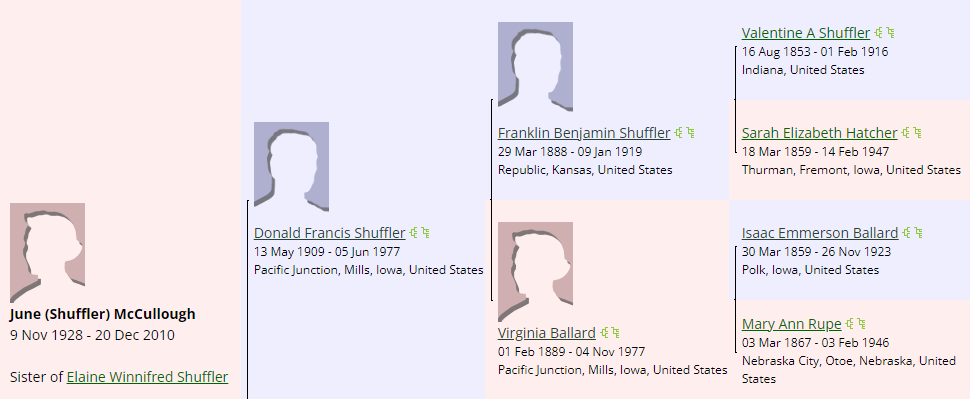
I don’t know the details, but it is easy to imagine that a game warden based in Council Bluffs would have occasion to stay in a hotel in nearby Pacific Junction. And if Virgie Shuffler was anything like her granddaughter, June (Shuffler) McCullough – or like June’s granddaughter, who I married – then it is even easier to imagine that he would fall in love with her.
When his posting to Iowa ended, Orin spent 1928 based in Kansas City, Missouri. But by 1930, he was assigned to the region based around Cambridge, Maryland, and he took his new wife and her three younger sons with him. Virgie’s oldest son, Don, was married by then and had two daughters, Elaine and June. They remained in Council Bluffs.
Orin and Virgie lived in Cambridge for about ten years, until his career took them to Long Island, and then back to Massachusetts. But Cambridge was home for them and for Virgie’s younger sons. After Orin died in 1950, Virgie returned to Cambridge, where she lived until her death on November 4, 1977, at age 88.
Pacific Junction had already begun to decline, too, by that point. The Pacific Junction Public School, in a building built in 1914, graduated its last high school class in 1961 and closed for good in 1986. The town population, which peaked at just over 700 people during Frank Shuffler’s time had dwindled to 96 by the 2020 census. And those remaining families would have been devastated when the Mills County levees failed on March 17, 2019, flooding the city.
Of course, the moral of the story is that good times and bad times will come – and overcoming the bad times may require some steel.
This surname can be found among my Sixteen great-great-grandparents. We have to go that far back to find the first Bellamy – my maternal grandfather’s paternal grandmother:
Sarah is named in The Bellamys of Early Virginia, by Joe David Bellamy. We know she married Joel Clark (of Family Reunion: Clark fame), but Mr. Bellamy’s book didn’t give us a lot of detail about her family. There is a skeletal genealogy for Sarah’s parents, with names and birthdates for her siblings, but not a lot of additional information.
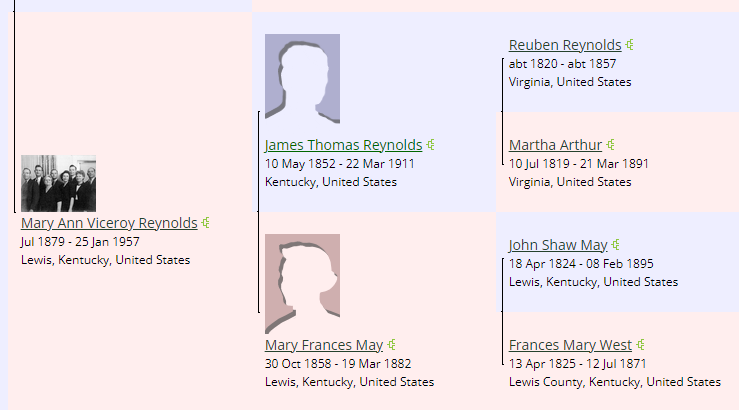
Several generations of Bellamy men married women from the West family. Sarah’s parents were Bennett Bellamy and Jane West; Bennett’s parents were Matthew H. Bellamy and Nancy West. Sarah’s son, David Ulysses Clark, married the granddaughter of Frances (West) May, whose father was murdered by secessionists in 1862. I have no idea how or whether these West families are related to each other, yet, but I am working on finding out!
The Bellamy book covers a lot of territory. It is not a straightforward descendency report, but it does trace descendants of a John Bellamy who was “imported” to be an indentured servant of Dorothy Pleasants in Henrico County, Virginia. Based on the available records and what is generally known about the terms of indentured servitude, John most likely arrived from England around 1710 or 1711, purchased 120 acres of land in 1717, and died in 1729. By the time he died, the land he had purchased in Henrico County in 1717 was in Goochland County.
Joe David Bellamy offers a great deal of analysis, rather than simply drawing conclusions and presenting them as facts. I appreciate this approach. Being able to see the journey he took and the facts that led to his conclusions about John’s origins makes the factual claims that are here more reliable and shows me where further research needs to be done. Along the way, he includes photographs and personal stories where he finds them.
As I said, Sarah Bellamy was the paternal grandmother of my maternal grandfather, Russ Clark. I have been working my way through these branches of his tree slowly, and adding profiles to WikiTree – but I have been slowed down by the fact that several generations in a row had as many as a dozen children each. Their large families intermarried with the same handful of families, making it hard to document exactly how the cousins are interrelated.
Be sure to subscribe so that you can see when I post updates about these families.
And drop a note so I know you’re interested – if I know there is an eager audience waiting, I can schedule updates accordingly.
Postscript: Joe David Bellamy died in August 2014, not long before I discovered his book. He was an award-winning author and professor at several colleges. You can learn more about him at that link, and let me know if you read any of his work.
The Bellamy name is often seen spelled “Bellomy” but I can’t tell if that is a preference used by actual Bellamys or if it is just a transcription error; I apologize if I misspell somebody’s name, but I will usually default to using “Bellamy”.
The short, tragic life of Paul Olin “Pretty” Callin
Paul Olin Callin (1902 – 1930) was the youngest of three siblings: he had an older sister, Ruth, and a brother, Martin. They grew up in Ashland, Ohio, where their father worked as a blacksmith. Delbert Dean Callin (1863-1934) was a descendant of my 5th-great grandfather, James Callin, making Paul and his siblings my 4th cousins, twice removed.
Delbert had married Hettie Stull in June 1890, only to lose her in death that August to unknown causes. Widowed Delbert married his second wife, Mary E Coleman (1872–1962) on 31 December 1891, and Ruby was born the following October. Martin was born in 1894 and was probably named for Del’s older brother, who had been a prominent businessman in Crawford County, Ohio, until his tragic death in a train accident in 1889.1
Life as a blacksmith in Ohio at the beginning of the twentieth century was probably not easy. “By the end of the 19th century, most blacksmiths found themselves out of their typical line of work, and needed to diversify to get by. Shoeing horses became a major source of income for displaced blacksmiths, but the development of the automobile industry quickly reduced the need for this work in the early 20th century.”2
Dell seems to have found work in the shops and factories around Ashland, but his household struggled as his kids got older. In December 1914, Mary filed for divorce, charging “habitual drunkenness and failure to provide.” According to Mary, “her oldest daughter has worked to help support the family since she was 15 years old and the son since he was 10 years old.”3 The judge granted the divorce in Jan 1915 and gave Mary custody of the children.
We can only speculate as to how the children felt about this. Paul, for one, put on a brave – and handsome – face, according to his senior yearbook entry in 1918. His big brother enlisted in a medical unit in the National Army in May 1918 and returned the following year.
It’s not clear whether that portrait is Paul or Gerald – but if it’s Paul, his High School Senior quote says a lot! (found on Ancestry)
Paul lived in Ashland at least until 1921, when he was listed in the city directory, working as a druggist clerk. He and his family moved to Akron where they lived at 184 Eureka Terrace together. On 16 Jul 1924, 23-year-old Paul married Ruth Claudine Warren (1903–1980) of Columbus.
Akron, Ohio, had a lot going on in the mid-1920s. The Prohibition Era was in full swing, coinciding with the rise of “flapper culture” – when young women were out to have fun. “They bobbed their hair, applied colorful makeup, wore short dresses, rolled down their stockings, chewed gum, swigged gin and even smoked cigarettes. Worst of all, they listened to jazz and danced. Oh, how they danced.”4
We don’t know what Paul or Ruth thought about all of this, but it seems likely that Paul, at least, liked to live a little. We know he was proud of his looks, and if he suffered from an unhappy childhood, he may have found himself enjoying the Roaring ‘20’s – and the criminal elements of it that came along with the party atmosphere.
If I had to guess, I would say that Ruth was not happy about Paul’s life choices. She divorced him in October 1928 and moved back to Columbus. She supported herself as a stenographer and telephone operator, and as far as I can tell, remained single until she died in 1980.
On December 1, 1928, The Akron Beacon Journal reported that detectives “swooped down upon the headquarters of a holdup gang … and captured four men and one woman, who is alleged to be the ring-leader.” Members of the gang included Paul Callin, 28. All were charged with highway robbery.
Paul Callin in The Akron Beacon Journal, Tuesday, April 22, 1930, Page 35
Paul and his compatriots confessed to several holdups, and Paul was convicted and sentenced to 10 to 25 years. Mrs. Leona Steele, the woman arrested as the ringleader, tried to deny her involvement, but Paul and another man, Frank Butler, testified that they had plotted the robberies at her home.
The 1930 U.S. Federal Census for Columbus, Ohio, was enumerated on April 16, 1930. Paul Callin, 29 and divorced, is listed as an inmate in the Ohio State Penitentiary. Interestingly, he is listed as a veteran of the World War – though I have not found any records to support that.
A mere few days after that census was taken, Paul was killed in a terrible fire at the penitentiary that claimed a total of 317 people on 21 April 1930.
Wilmington News-Journal, 22 Apr 1930, Tue, Page 1
This was the deadliest prison fire in the history of the United States. An investigation, hampered by the unwillingness of the convicts to talk about what they knew, turned up evidence of arson as part of a failed escape attempt. The prison had been built for 1,500 and at the time of the fire it held 4,300.
Paul’s family had stayed in Akron. His brother, Martin, married and had a daughter, Vivian, in 1926, but sadly, his wife, Irene, died in 1931. Martin and Vivian went to live with Martin and Paul’s sister, Ruby, and their mother, Mary. Vivian married in 1949 and lived with her husband in Albuquerque, New Mexico. After Mary died in 1962, Martin and Ruby eventually moved to New Mexico, where they died – he in 1976, she in 1984.
This story unfolded in a very roundabout way for me. For a long time, all I knew about Paul came from the Census and a few city directories, and I hadn’t looked very closely at the 1930 Census. In my defense, I was in the middle of the massive project that would turn into the Callin Family History, and even though I saw he was included in the population of the Ohio State Penitentiary, I didn’t realize he was an inmate initially – since several of my family members have appeared on the census in institutions like this as employees. It wasn’t until I noticed that he was listed as divorced that it occurred to me to look harder and I noticed he was a prisoner.
Once I found the newspaper articles reporting his death, along with so many others, I began searching for other details: the trial of “Bandit Queen” Leona Steele, details of his marriage and his ex-wife’s life, and the timeline of events.
There is a technique to this kind of story recovery – check out Kate’s list of prompts on Motley Stories:
As always, it’s hard to fill in the gaps and the context accurately. I don’t know whether his arrest and conviction showed Paul the error of his ways, or if it hardened him and made him determined to be a smarter, more dangerous criminal when he got out of prison. I don’t know whether his wife was a wild flapper and partner in his criminal life, or if she wanted a quiet family life and simply wouldn’t follow him down the path he chose. I think the latter is more likely, but we don’t know.
If you are telling a factual story, like I’m trying to do, that’s where you have to stop. If you’re looking to expand the narration and capture a possible version that gives your reader insight into the times and places… you can do that. (Just make sure your reader knows what is fact and what is speculation!)
Let me know what you think in the comments – especially if you know you’re related to that branch of the family.
In which we arrive in a world full of Johns Green(e)
For nearly ten years, I have held onto the notion that I was descended from one of the founders of Rhode Island – a surgeon named John Greene. I was very excited about the idea, and the research I did on his biography became one of my more detailed essays, Foundation Found, Providence Provided, on the original Mightier Acorns blog.
But, now I have finally done the legwork. And boy, there were a lot of men named “John Greene” in colonial Rhode Island.
I am also not related to this John Green.
The journey to get here has been tricky. We have looked at more than 10 generations of my ancestry, beginning with my great-grandfather, Alfred Tuttle. Along the way, we saw families that struggled to carve out lives in cold and remote parts of what was then the frontier of America. They lived next to significant places from American history, and they might not have left a lot of records behind, but what they did leave behind brought us this far.
And now, we have reached a point where I can go no further. Martha Greene married Joseph Matteson, and the record says her father’s name was John (Greene):
“Rhode Island, Town Clerk, Vital and Town Records, 1630-1945,” database with images, FamilySearch; various city archives, Rhode Island.
Further digging through the Rhode Island vital records reveals the birthdates of what are most likely Martha’s siblings, as well as her mother’s name:
Arnold, James N. “Record of Rhode Island, 1636-1850; 1st Series, Births, Marriages & Deaths” Providence, R.I., USA: Narragansett Historical Publishing Co., 1894.
Note that these children’s births were recorded in Bristol County, while the other Greene and Matteson families we’ve been looking at were in East and West Greenwich, Kent County. In my original essay, I accepted the flawed evidence that showed my John Greene was the son of James Greene (c. 1626-1698), who in turn was the son of John Greene, surgeon. That particular James Greene had two sons called John – one of whom likely died young, and the other who married Mary Increase Allen (not Elizabeth) and whose children do not match the list of children belonging to our John Greene.
Here is a look at the area where we have found records for all of these Greene and Matteson families:
Providence, RI, and the pertinent towns to the south
It is possible, but not likely, that we will be able to find the answers we’re looking for – but not without digging through primary sources and finding more clues. Other researchers who have looked for this family have settled on this conclusion for John Greene (abt. 1679-1747):
His origins are unknown at this time. He doesn’t fit into any of the Puritan Great Migration Rhode Island arrivals, those John Greene’s are ‘all spoken for’. Ship passenger lists, land and probate records after 1641 need to be researched to see if he can be further identified. Because this is a Pre-1700 profile, and because of his common name, primary source vital records are needed to establish a credible ancestry.
For now, we have arrived at the top of our ladder to Providence. We did not prove what I set out to prove, but we at least arrived in the right town. Along the way, we learned a lot and improved a lot of WikiTree profiles.
There is a certain amount of frustration involved in having to let go of a misimagined story that you have shared and invested in for a decade. But I don’t think it’s a mistake to imagine a goal or a story when you’re at the bottom rung of your ladder. The story can motivate you to find more information. Imagination can help you make sense of the clues, and when you are stuck with potential gaps – as we were when we needed to connect Harlow Wells to his grandfather, Greene Whitford – imagining his story helped us bridge those gaps.
Just be ready to let go of your story when the evidence reveals the gap between facts and imagination.
At the risk of sounding pleased with myself, I wanted to share some of the habits and organization that go into this newsletter. Folks new to writing often start a project like this only to tire of the constant deadlines. They may feel like they’ve run out of things to say after only a few posts. Making certain strategic choices early on will help avoid that kind of exhaustion.
This Substack newsletter is only about half a year old at this writing, but I have been doing some sort of weekly writing since the early 2000s – much of it related to family history. This is how I tackle the big project:
Set the Tone
The hardest part of any creative activity is facing the blank page.
If you hope to produce something with any regularity, you need to figure out how to inspire yourself to fill that page on a schedule. I am writing about two things: Genealogy and Family History. They are related1, of course, but they are different disciplines, and most of my posts draw their narrative from fusing the two.
Either of my chosen topics can get super-dry if I approach them academically. Simply writing out lists of ancestors or reciting names, dates, and places isn’t fun for the writer or the reader. (Besides that, WikiTree or FamilySearch are better platforms for building an online tree.) But whether you are new to this or have been doing it for years, something grabbed you about the research and excites you enough to keep digging. Whatever that something is, use that as your starting point for generating story ideas.
Any time you hear yourself muttering, “Well that’s interesting!” you’ve got a story idea. Write it down.
Map Your Route
Once you have ideas, they need a framework and a schedule.
I decided when I started that I wanted this newsletter to be primarily a genealogy project. Everyone I write about is related to me in some way, and the individual posts are organized around that – talking about how we are related, discussing the evidence that shows the relationships, my research and analysis methods, and the resulting family histories that come out of that research are all up for discussion.
I also decided that I could handle publishing two posts a week and that the individual posts should aim for a 500 to 1,000-word limit. (For me, it is hard to stay under 1,000 words in any context. Ask my former supervisors.)
Those decisions gave me some “rules” for structuring my calendar.
Try to balance my subjects by not writing about the same “side” of the family twice in a row.
Serialize big ideas – this will help with “giving myself space” and spreading out the amount of work necessary in a given week.
Try to balance between “biographical” stories and “research drama” stories – sometimes they blend well, but when they are distinct, spread them out.
Give Yourself Space
For Mightier Acorns, I use my drafts as my “idea list” – currently, there are 24 “drafts” in various stages of composition sitting in my queue. I also have the next 7 posts scheduled – which gives the anxiety monster and the procrastinator inside me enough space to work on the 24 drafts and begin putting them on the schedule.
When I launched this newsletter, I took advantage of some of the better pieces from my “back catalog” at my previous blogs, cleaned them up a little bit, and put them into that drafts folder. If you don’t have a back catalog, consider holding off on launching your project until you have 3 to 6 weeks’ worth of posts polished and ready to schedule.
As of Christmas, I had finished posts scheduled through the beginning of March. Nine of my 50 posts have been recycled favorites, and the first 16 Family Reunion posts were easy to pull together. Serializing what began as an idea for a very large single essay, “Climbing the Ladder to Providence,” gave me 11 posts in total, which bought me more than 13 weeks in which to research, compose, and edit – while maintaining my two-post-a-week pace. (If you subscribe now, you’ll get the 11th and final post in your inbox on Friday!)
The point is to avoid having nothing for your readers to read while also not stressing yourself out or scrambling to put something/anything together at the last minute. A healthy buffer will keep this labor of love from becoming a burden.
Editors Are Your Friends
If you have a partner you trust who wants to read your drafts and help with copy-editing, let them help.
If you don’t have an editor, take some time each week to read the posts you have scheduled with a critical eye. Regular readers may cock an eyebrow and say, “But, your posts are riddled with errors and awkward wording.” And that’s because I do my best, but mistakes are inevitable. I use Grammarly’s free service to catch big errors, and I spend an hour or so each Sunday going over the two posts in the queue for that week – but I’m only human.
But if you have someone else to review your work, be open to their feedback. They will tell you to change things you might not want to change – and it is up to you to find the balance between having enough humility to see things their way and enough confidence to fight for what is important to you.
No matter what, strive to be gracious when someone is kind enough to offer help.
Yeah, So…
In yoga practice, you are told, “Set your intention for your practice.” I like the explanation “…intention is usually recognised as the practice of bringing awareness to a quality or virtue you’d like to cultivate for yourself.”
During yoga, you stretch muscles and connective tissue to release tension and improve your flexibility. In your writing, you stretch your mind and seek to connect with your readers – hopefully expanding what they know. Both take effort and discipline but also require patience and forgiveness.
If you set reasonable limits, give yourself room to let artificial deadlines slip, and establish a loose plan with the freedom to generate new ideas, you should be able to look back after a few months and realize, “Wow – I did a lot of work, a little at a time.”
They can be tricky – leading to a really long post today
Alice Matteson married Thomas Whitford on 9 Jan 1752 in West Greenwich, Kent County, Rhode Island. We know this from the marriage record which was documented in the 21-volume Rhode Island, U.S., Vital Extracts, 1636-1899, compiled by James Newell Arnold and published from 1891–1912.1
One of many book covers published by James N. Arnold
Arnold organized the original vital records for Rhode Island by town and condensed each record into one or two lines, depending on how much information was recorded on the original record. He sorted the marriage records within each town by the bride’s surname and the groom’s, so those appear twice. In the West Greenwich section, in the W’s, among the other Whitfords, you find:
1-83 [Whitford] Thomas, of Pasco, and Alice Matteson, of Joseph; m. by Jeremiah Ellis, Justice, Jan. 9, 1752.
And in the M’s, with the Mattesons, you find:
1-83 [Matteson] Alice, and Thomas Whitford, Jan. 9, 1752.
Arnold does warn in his introduction that “nothing beyond the book and page of the original Town Record, the names and the date are given when the bride is placed first. That under the groom the notes are so extended as to include all the items of the record from whence it is taken. The reader will therefore consider the bride being placed first as merely an index for him to consult the other entry.”
Arnold’s work is a good example of a reliable secondary source – these aren’t the original records. Still, if you don’t have access to them (and if you pay attention to Arnold’s introduction) this should be a useful tool for documenting these family connections.
Now what?
Finding Joseph Matteson
Considering how many Whitford and Matteson families are in West Greenwich, it stands to reason that we should look for Alice’s parents in nearby Rhode Island locations. A search did turn up another secondary source: The Genealogical Dictionary of Rhode Island compiled by John Osborne Austin in 1887. Page 132 gives us a picture of three generations of Mattesons.2
Henry Matteson (1646-~1690) and Hannah Parsons appear in a column on the left, their children are listed in a large central section, and their grandchildren (where known) are in a column to the right, lined up with their parents’ entries. I’ve pulled out the information you need in this outline:
I. Henry Matteson (d. 13 Apr 1752) and Judith Weaver (d. 1751) – dau. of Clement Weaver
10 named children
II. Thomas Matteson (d. 19 Jan 1740) and Martha Shippee – dau. of David and Margaret (Scranton) Shippee
6 named children, including:
4. Joseph Matteson (b. 1 Jul 1705)
III. Joseph Matteson (d. 1758) and Rachel (no further info)
1. Joseph Matteson (b. 22 Mar 1707)
(III.) Joseph and 2nd wife, Martha (died after 1757; no further info)
5. Alice
Take note: there are three men named Joseph Matteson in this chart:
Jospeph “III.” – son of Henry (no birthdate reported).
Joseph “1.” – son of Joseph, born on 22 Mar 1707.
Joseph “4.” – son of Thomas, born on 1 Jul 1705.
Austin’s 1887 “Genealogical Dictionary” predates Arnold’s register of vital records by at least four years, so Austin’s information probably comes from the primary sources. We see Alice Matteson listed, and now we have the names of her father and mother – Joseph “son of Henry” Matteson and Martha.
Looking for more information, I came across two more interesting sources that add to what we know about Joseph “son of Henry”:
History and genealogy of a branch of the Weaver family3 tentatively claims that Judith Weaver is the daughter of Clement Weaver (1647-1691) and wife of Henry Matteson, above (“I. Henry Matteson (1646-~1690)”). It then includes this brief mention:
“VII. Rachel, b. Dec. 24, 1684; m. Joseph Matteson (Henry). He was a brother of her sister Judith’s husband. CHILD (Matteson): I. Joseph, b. March 22, 1707.
Rachel’s birth in 1684 suggests that her husband and his brother were probably born close to that same year (within reason). Then, more helpfully, Ancestry and descendants of William Curtis of Marcellus, N.Y.4 named Joseph as the third child of Henry and Hannah Matteson:
“iii. JOSEPH, d. 1758, m. Ist, Rachel –, 2nd., Martha Greene.
Now that we have Martha’s surname, we can look for sources that mention her, and what a find that uncovers! According to The Greene family and its branches from 861 to 1904 by Lora La Mance (emphasis mine):5
“MARTHA GREENE-MATTESON. She was married 10 days before her brother, James Greene, being married to Joseph Matteson May 8, 1727. He was her mother’s first cousin, and had at that time a grown son by his first marriage. Had nine children. Of Obediah, Elizabeth, Thomas and Eunice I have no records. Martha’s line is a most extensive one, and cannot be given as fully as I would wish, from lack of space.”
(excertped from the biographies of Martha’s children:) –ALICE MATTESON-WHITFORD, wife of Thomas Whitford, her cousin. Line inter-married with the Tarbox branch later.
Based on this book, the work to connect Alice (Matteson) Whitford to the surgeon John Greene is already done. All we need to do is look for primary source records to confirm that. Except…
Not So Fast, Cousin
“Wait a second, Tad,” you might be saying. “Some of this information doesn’t add up. If Joseph’s first wife was born in 1684, and her sister married his older brother, wouldn’t he be too old to marry Martha and father eleven children…?” Probably. It’s good that you’re being skeptical. Let’s take a look at that 1727 marriage record.
Back in Arnold’s “Vital record…” this time in East Greenwich, we find bride and groom records for:
1-8 [Matteson] Joseph, of Thomas, and Martha Greene, of John; m. by Thomas Spencer, Justice, May 8, 1727.
That simple statement of fact contradicts those earlier secondary sources and calls their other facts into question. Further digging reveals that genealogist H. Porter Matteson addressed the discrepancy between the Rhode Island vital record identifying Joseph’s father as “Thomas” and these other family histories confusing him with his uncle, as shown above, in his 1938 manuscript, Mattesons in America.6
Simply Stated
Matteson’s work in 1938 points out many flaws in earlier works that focus on the Greene and Matteson families in Rhode Island. My own research seems to suggest that several of these family histories referred to the Austin Genealogical Dictionary of Rhode Island (some cite him specifically) and either did not refer to Arnold’s later, more authoritative Vital Record or simply did not notice the “of Thomas” in Joseph Matteson’s marriage record.
But take some notice of the fact that I wouldn’t have found my way to the 1938 Matteson book without those flawed sources to follow. It would be irresponsible and unhelpful to throw out works that have these kinds of errors and hide them from view. But now our job as researchers is to document what the errors are, and leave our work correcting them for others – the way Matteson did.
Unfortunately, The Greene family and its branches from 861 to 1904 is a widely available, frequently re-published work. It is engagingly written, includes a lot of colorful commentary about the relationships between the families, and some poetry from the author. Matteson’s work is a typewritten manuscript, hard to read, written with cryptic abbreviations, and not available in any kind of attractive hard copy options.
You can see how I addressed this problem if you look through the Research Notes section of Alice (Matteson) Whitford’s WikiTree profile. I also linked the WikiTree source page for The Greene family… back to the Matteson work and updated the Errata section.
To Sum Up:
We only have one solid primary source that connects Alice to her mother, Martha Greene – but we have a lot of context from secondary sources, including her father’s will (which was misattributed to an uncle of the same name).
And we have a clue connecting Martha Greene to her father, who bore the incredibly unique name, “John.”
Austin, John Osborne, 1849-1918, The genealogical dictionary of Rhode Island: comprising three generations of settlers who came before 1690: with many families carried to the fourth generation, J. Munsell’s sons, Albany, 1887, page 132.
Weaver, Lucius E.; History and genealogy of a branch of the Weaver family, Rochester, N.Y.: DuBois Press, 1928; Provo, UT: Ancestry.com Operations Inc, 2005; page 69 – accessed 12/31/2023.
La Mance, Lora Sarah Nichols (1857-), Stowe, Attie A. Nichols (1843-); The Greene family and its branches from 861 to 1904; Mayflower publishing company, Floral Park, N.Y., 1904; Collection: The Library of Congress, pp. 120-121.
Ida was born in Ackley, Iowa, and married a Dutch immigrant named Bernard Blom on 21 Nov 1885. You may recall reading about Bernard’s family in an earlier post if you need a refresher:
Ida Slight’s story begins with her grandfather, Jan Harms Sligt, who was born about 1798, in what was then known as the County of East Frisia (or “Ostfriesland”) within the Kingdom of Prussia. We know from their children’s records that Jan married Antje Martens, and we can guess they were married about 1823. They had three children: Hilke (b. 18 Sep 1824), Marten (b. 17 Jan 1828), and Johann (b. 28 Nov 1834).
The political climate at that time was turbulent. The records we have say the Sligt family lived in the village of Tergast, which is located a few miles east of the city of Emden. Emden had been annexed by Prussia in 1744, some 54 years before Jan was born. It was then captured by French forces in 1757, during the Seven Years’ War, and by Anglo-German forces in 1758. In 1807, when Jan was about 9 years old, East Frisia was added to the Kingdom of Holland, which had been created by Napoleon Bonaparte a year before to control the Netherlands. After Napoleon’s downfall in 1815, East Frisia was transferred to the Kingdom of Hanover, which was officially ruled by George III, the king of England.
Tergast (center) in relation to Emden. inset: Tergast within modern Germany
I suspect that there might be more records to find – from Prussia or the short-lived Kingdom of Holland – but the records I do have appear to have come from Lutheran church records in the Kingdom of Hanover. From Jan’s death record, we know that he was a carpenter (“Zimmerkunsst”) who died on 5 November 1834, just a few weeks before the birth of his youngest son, Johann.
Jan Harms Sligt record from Germany, Lutheran Baptisms, Marriages, and Burials, 1500-1971, Lehi, UT, USA: Ancestry.com Operations, Inc., 2016.
(If you can read old German script, please feel free to flex your superior skills and drop a translation of this record in the comments. The first contributor to do so wins a free subscription to this newsletter and the title to the Kingdom of Holland1!)
Jan’s death left his widow, Antje, to raise ten-year-old Hilke, six-year-old Marten, and infant Johann on her own. This probably meant that they relied on the support of their church, which would most likely have been the General Diocese of Aurich, part of the state church, the Evangelical-Lutheran Church of Hanover.
On 11 May 1851, Hilke married Christian Berends Freese (1816–1890), becoming his second wife and stepmother to his two daughters. Christ’s first wife was Hilke Emmen Garrelts, who died in 1848. They lived in Needermoor, a few miles southeast of Tergast.
On 24 May 1854, Antje, Marten, and Johann Sligt arrived in Baltimore, Maryland, aboard a bark (a sailing ship) called the Blücher. Hilke and her family appear to have come over the same year, though I have not found immigration records to confirm that, yet. After living in Illinois for several years, they all settled in Iowa during the 1860s – some in Grundy County, and some in Hardin County.
With a slight change in spelling,2 “Johann Sligt” became “John Slight” – and he married another recent immigrant from the former East Frisia. Frauke Margrette Swidden (or Sweeden) and John Slight were married in Ogle County, Illinois, on 23 March 1856. They lived in Grand Detour in 1860, and their daughter, Anna, was born in Illinois on 28 March 1862. They moved to Iowa soon after that, as their second daughter, Ida, was born in Ackley, Hardin County, Iowa, on 24 July 1863. Their youngest daughter was born in Hardin County on 22 Jun 1866, and they named her Hilke.
All three of John and Margrette’s daughters were named in honor of a relative: Anna was named for John’s mother, “Antje,” which was probably pronounced like “Anya” to our American ears. “Ida” was named after Margrette’s mother, who was born “Itje” and began spelling it “Ida” when she immigrated to America. Obviously, “Hilke” was named for John’s sister.
Ida Slight had no brothers, but she did have five male cousins, the sons of her uncle Marten. So if your family traces back to the Slights who lived in Grundy and Hardin Counties in Iowa, Ida’s descendants might just be your cousins.
If you would like to learn more about what the trip over might have been like for the Sligt family, check out Rainey Mitchell’s piece describing another German immigrant’s journey from Emden in 1848: