Tad Callin has been working on family history and genealogy since the late 1990s. He does most of his research on Ancestry and posts what he learns to WikiTree.
A recap of favorites from my first year on Substack
I might miss posting next week due to traveling last week – if so, don’t panic! I will come back once I recover. But I think I’m allowed some time off. After all…
I launched Mightier Acorns on Substack on 4 Oct 2023, with A New Leaf for an Old Genealogy Nut. And if I did my math right, this post is the 114th on this platform – but there is no guarantee that I took time zones into account, so I could be off one way or another.
My original plan included a “Weekly Log” feature which I managed to maintain for all of 5 weeks before dropping that format in favor of a two-posts-per-week, Wed/Fri, rotation. I also did some simple math and realized that my “Family Reunion” posts were relatively easy to assemble, would give me at least half a year’s worth of content, and would inspire deeper, more interesting stories and essays. I have enjoyed watching my friends on Substack take that idea and run with it!
Some of my favorite stories from the original Mightier Acorns blog found a new audience here. I was particularly proud of the four snapshots of my four grandparents:
I am extremely pleased with the body of work I’ve put up on this platform. I’ve done several multi-part explorations, including a deep dive into Rhode Island founder John Green (who turned out to probably not be my ancestor). I’ve sketched out the path for researching my wife’s ancestry and learned a ton about Sweden and Norway. And I have had fun along the way – hopefully, if you’re reading this, you are having fun, too!
…and if you haven’t already, subscribe for free!
They say the friends you make along the way are the point of the journey, and I’ve been thrilled to become part of the community of genealogists here. Barbara Tien at Projectkin Community Forum and Robin Stewart of CuZens Genealogy Matters, both separately and under their joint effort at Mission: Genealogy, have been encouraging and supportive at every step.
And to each of you who clicks the “like” button, shares a note, or links to something I wrote – you are seen and appreciated!
In the coming year, I hope to keep doing what I’ve been doing. I’ve found that just writing about what interests me, keeping each post under 1,000 words, and making sure there are at least 6 scheduled posts in the queue at all times is a successful formula.
I don’t plan on turning on the paywall, because I want future cousins to be able to find old posts, but as of this writing, one person has pledged at the annual rate, and I am flattered by the gesture. If you feel strongly about supporting Mightier Acorns financially, I recommend that you pick up a few copies of great-grandpa John’s War Poems as gifts for the Civil War buffs in your life, or to donate to your local library.
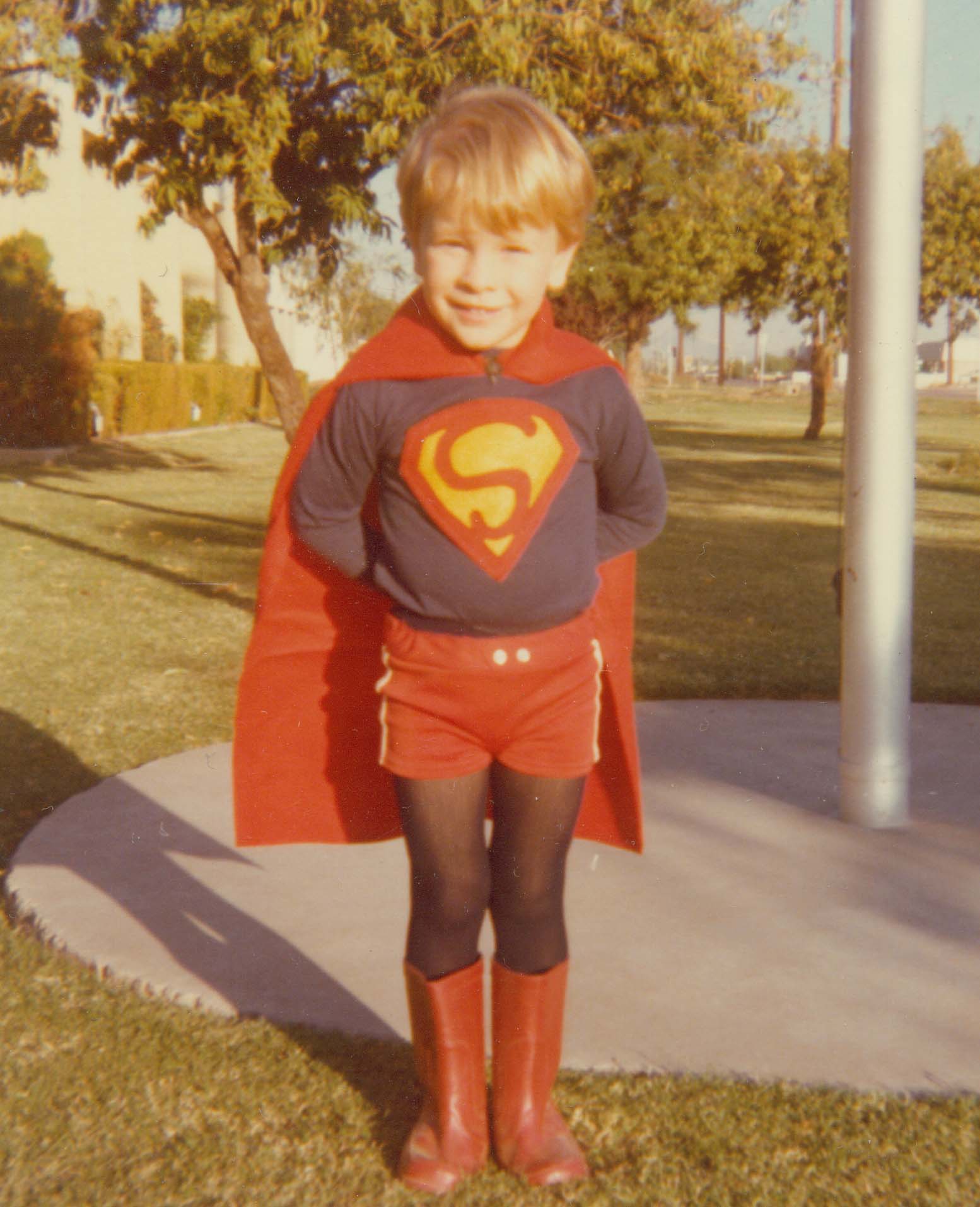
And lastly, if you happen to be my sister – Happy Birthday! (She’s who I was waiting for outside the hospital in this photo – which you might recognize as the cover of my book, Tad’s Happy Funtime.1)
Tad, age 4, waiting for Sara’s arrival outside the hospital
I’m at a special wedding this week – so I’m re-purposing an old post about weddings in my family.
Here are three couples with a few things in common:
They all married young
The grooms (and one bride) were all in the service
Not only did all six of these people share a surname (after their respective weddings), but the grooms shared their given names, as well!
How young were they? Well, that’s the basis for our trivia question – “Which of these brides was the youngest at her wedding?”
You’ll need some dates to make an educated guess, but with this being the open internet, you’ll excuse me for being coy about just posting them here without making you work for them!
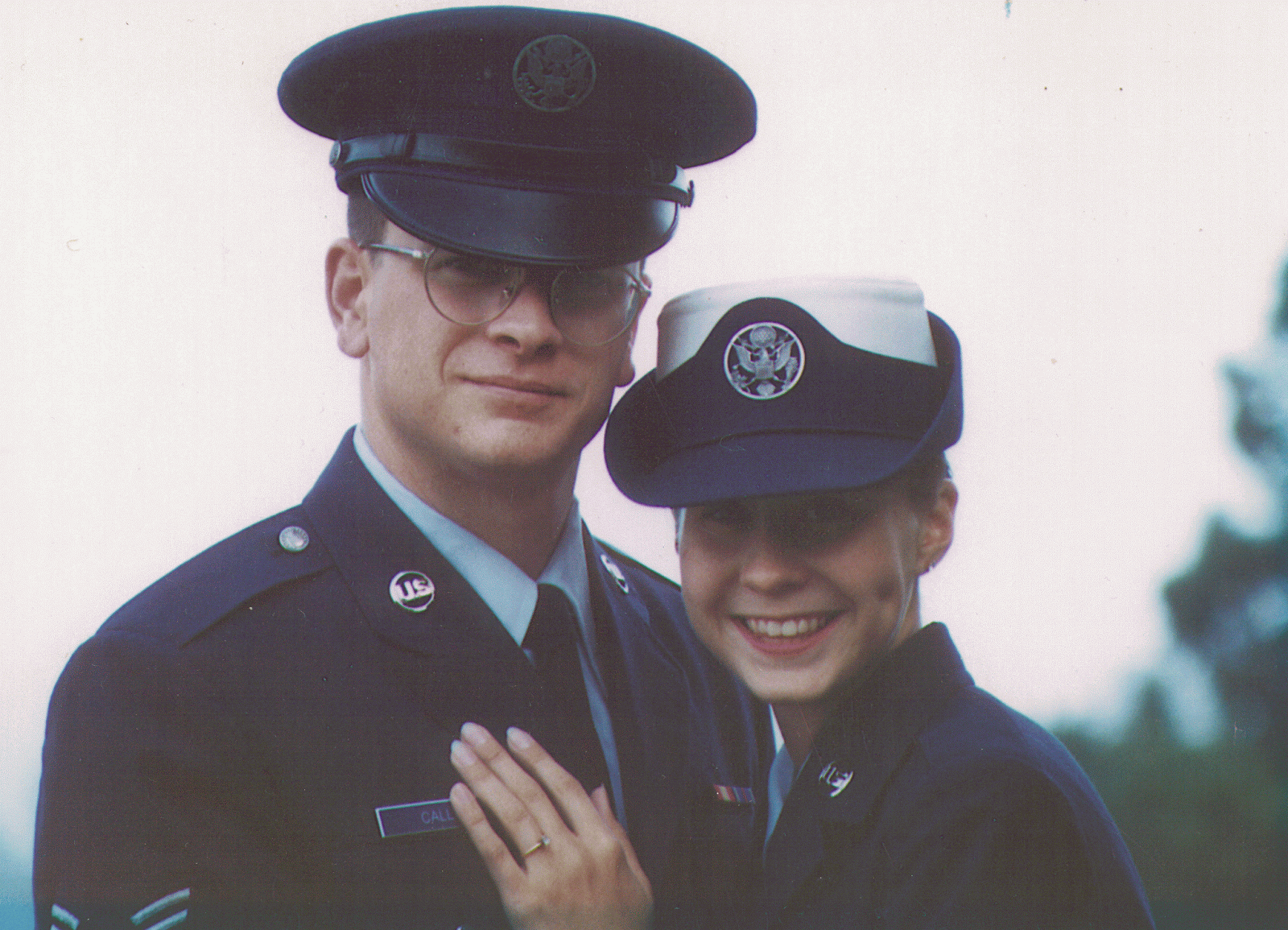
First up, you can see a happy young pair of airmen getting their engagement picture taken. Tad was a mature (ahem) 22 years, and Kate was a Bicentennial Baby. They took a lot of ribbing over their age difference, but when they married after a brief, six-week romance, she was 18 – and only a few months shy of 19.
Tad and Kate, February 1995, Monterey, California
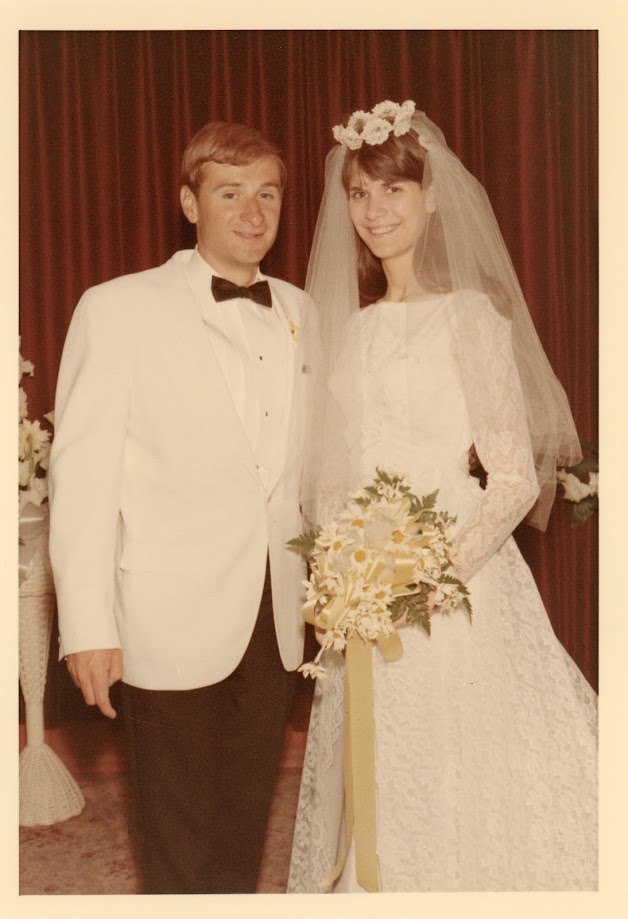
Our next couple could hardly wait for high school graduation to set their wedding date, but wait they did. Teddy was a mature (I am certain) 22 years old, and Barbie was a true child of the 1950s. They married in 1968, just one month after her 18th birthday.
Ted went on to join the National Guard and trained to be a medical technician, then tried his hand at teaching before settling on his career as a firefighter.
Ted and Barb, April 1968
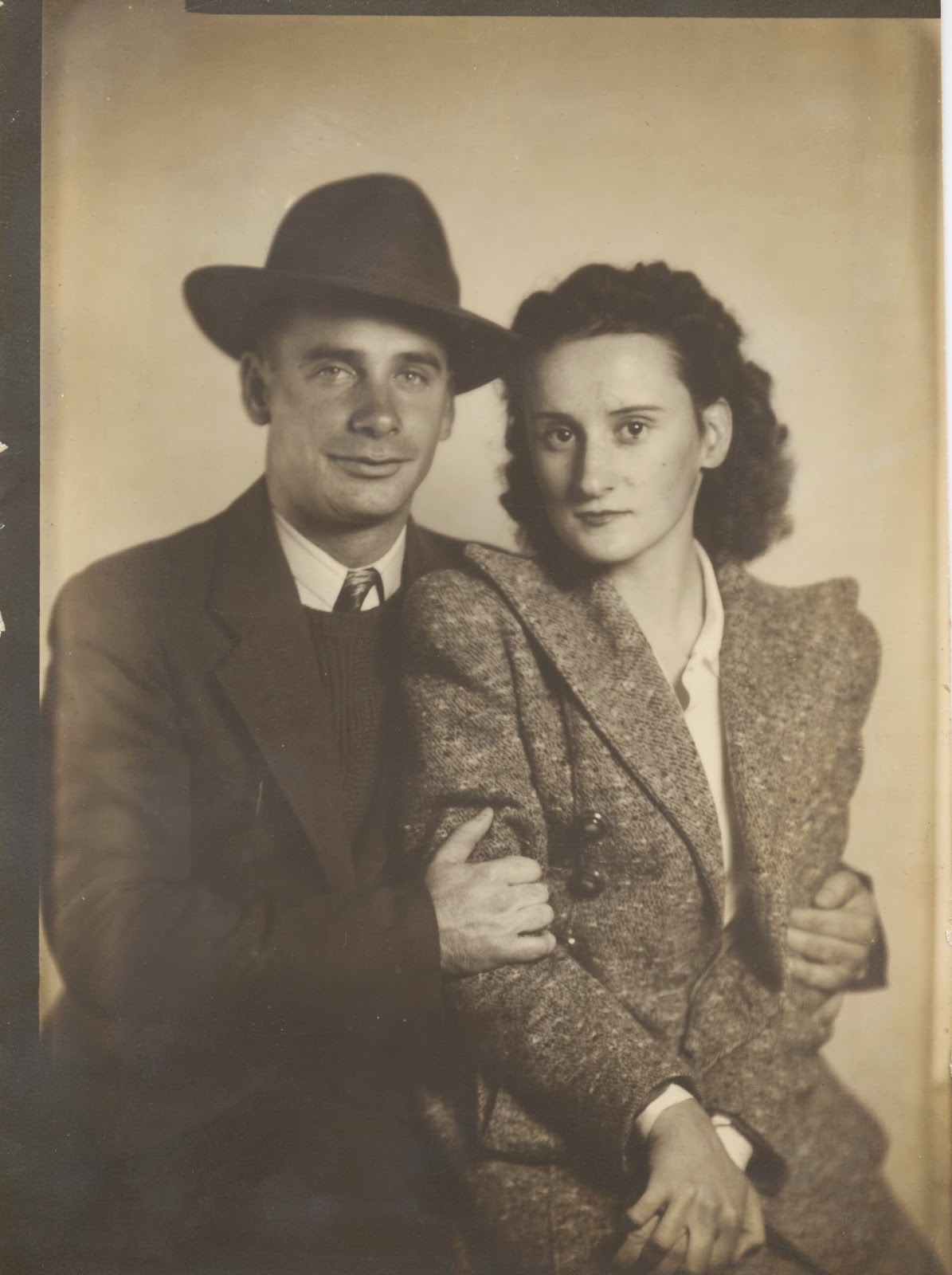
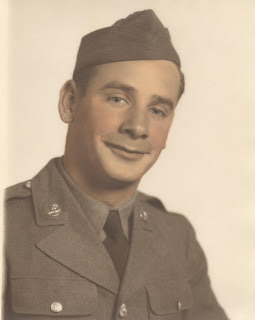
And finally, we have the dashing couple straight out of Casablanca, the heroine and hero of When Things Got Serious. Bobby was a 21-year-old Army airplane mechanic, and Nancy was in high school when they met – and the outbreak of the Second World War lent some urgency to their decision. And so they married in 1942 – about 8 months before her 18th birthday.
Bob and Nancy, c.1942, Phoenix, Arizona
So there you have it – I come from a long, well-established line of young men who married young brides and survived to tell the tale. I think I can safely claim that none of us has regretted it for a moment. And this week, continuing a three-generation tradition of having older and older brides… my youngest, Mileidy (22) is marrying Elliot at a fairy castle in Maryland!
Elliot (left) and Mileidy, Baltimore, Maryland, 2023
However old or young your sweetheart is, here’s hoping you’re as happy as we were – and are.
A woman who saw the changing rights of women in Ohio
A story can seem straightforward once the facts are lined up and neatly documented. The life story of one of my 4th great-grandmothers, for example, could be summed up like this:
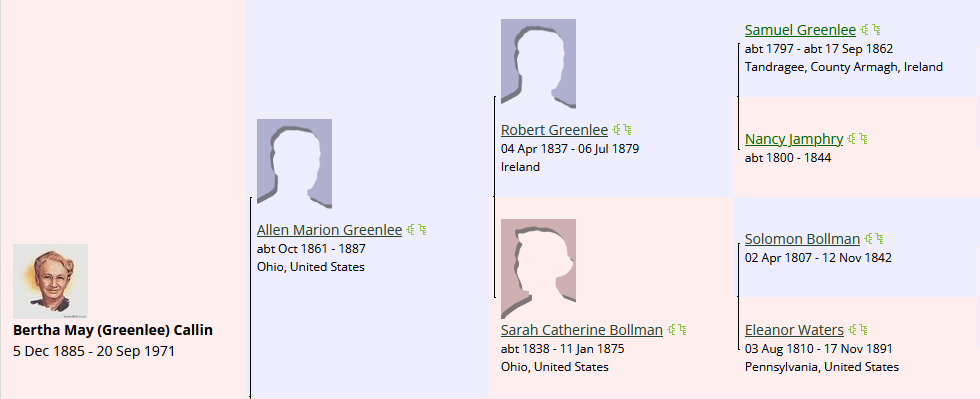
Eleanor Waters was born on 3 August 1810 in Pennsylvania. Her family moved west to Ohio, where she married Solomon Bollman (1807-1842) in Wayne County on 13 November 1836. They lived in Hancock County, Ohio, where they had three children. When Solomon died in 1842, Eleanor was left with two small daughters and was pregnant with their son. The three children were:
Sarah Catharine Bollman Greenlee (1838–1875)
Elisabeth Ann Bollman McComb (1840–1933)
Solomon W Bollman (1843–1864)
Eleanor raised these children on her own in Cass Township, Hancock County. After her eldest daughter, Sarah, separated from her husband, Robert Greenlee, Sarah and her son, Allen, went to live with Eleanor, who continued to raise Allen after Sarah died in 1875.
Eleanor died on 17 November 1891, survived by her daughter Elisabeth McComb, her grandson, Lewis Henry McComb, and her great-granddaughter, Bertha Greenlee. In her will, she specified that some of her lands should be sold to pay off her mortgage (1st) and then to provide burial markers for Allen, Eleanor herself, her husband Solomon, and Sarah Watters – presumably her mother.
Laid out like that, her story seems straightforward. But the journey to get there was rough. I started with Allen Greenlee’s name, and not much else – I didn’t have dates or places associated with him. Every record I found gave me unexpected clues that led me further from his biography and down more rabbit holes. And while I’m happy with what I’ve learned about Eleanor, her biography and that of her daughter Sarah (my 3rd great-grandmother) point to a bigger story about the growing independence of women in the late 1800s.
When Solomon Bollman died unexpectedly in 1842, it isn’t clear whether his wife, Eleanor, would have been allowed to inherit his property. Ohio’s earliest laws were based on English common law, under which women could not “own” anything. Their personal property – clothes, bedding, etc. – belonged to their husband. If the husband died without a will, a wife would automatically receive one-third of her personal property, with the other two-thirds being distributed to the husband’s other descendants. The first Married Women’s Property Act in Ohio was not passed until 1845. But laws passed in 1809 did allow “a woman, as well as a man, the right to devise his or her estate by will.”1
I have looked for Solomon’s will without success – I assume he did not leave one. Since Eleanor remained unmarried, but in control of her household, I suspect that she probably remained in control of her property through the inheritance of her then-unborn son, Solomon. There are newspaper notices showing transfers of real estate from Eleanor to her daughters in 1869 and 1883, and of course, Eleanor’s will from 1891 – all of which show that she took advantage of the new laws. I can only imagine that Eleanor was one of the many women who wrote to legislators to press them to change those laws.
There is another story that I haven’t been able to tease out of the available facts. Sarah Catherine Bollman married Robert Greenlee in 1857. Their son, Allen, was born in 1861 – and by 1870, Sarah and Allen were living with Eleanor. Sarah appears in the 1870 Census under her maiden name, Sarah Bollman, but her grave marker gives her name as Sarah Greenlee.
It seems pretty clear that Sarah and Robert divorced, but I have not found any information that could tell me why, or what happened to Robert between his enlistment as a private in the 21st Ohio Infantry Regiment in 1861 and his death in 1879. What I do know is that Eleanor raised her grandson after Sarah died in 1875 and that her will provided a burial marker for him, as well.
Her will – a testament to the drastic changes in women’s rights that took place during her lifetime.
Thinking about the moral baggage we attach to the idea of “work”
A quick Google question “How many Americans are there” gives me an estimated population of America in 2022 of 333,271,411. In 2022, it was estimated that over 158 million Americans were in some form of employment, while 3.64 percent of the total workforce was unemployed. 3.64% of 333 million is 12,131,079 “unemployed” – there were 72.5 million children in the United States in 2022, and 58 million in the 65-and-older category, which assumes they are retired. By my admittedly crude accounting methods, of the 333 million Americans who are NOT children, retirees, employed, or “unemployed”, there are still 32,640,321 who are not working.
So I wonder – what are they up to? (Clearly, they are not all doing genealogy…)
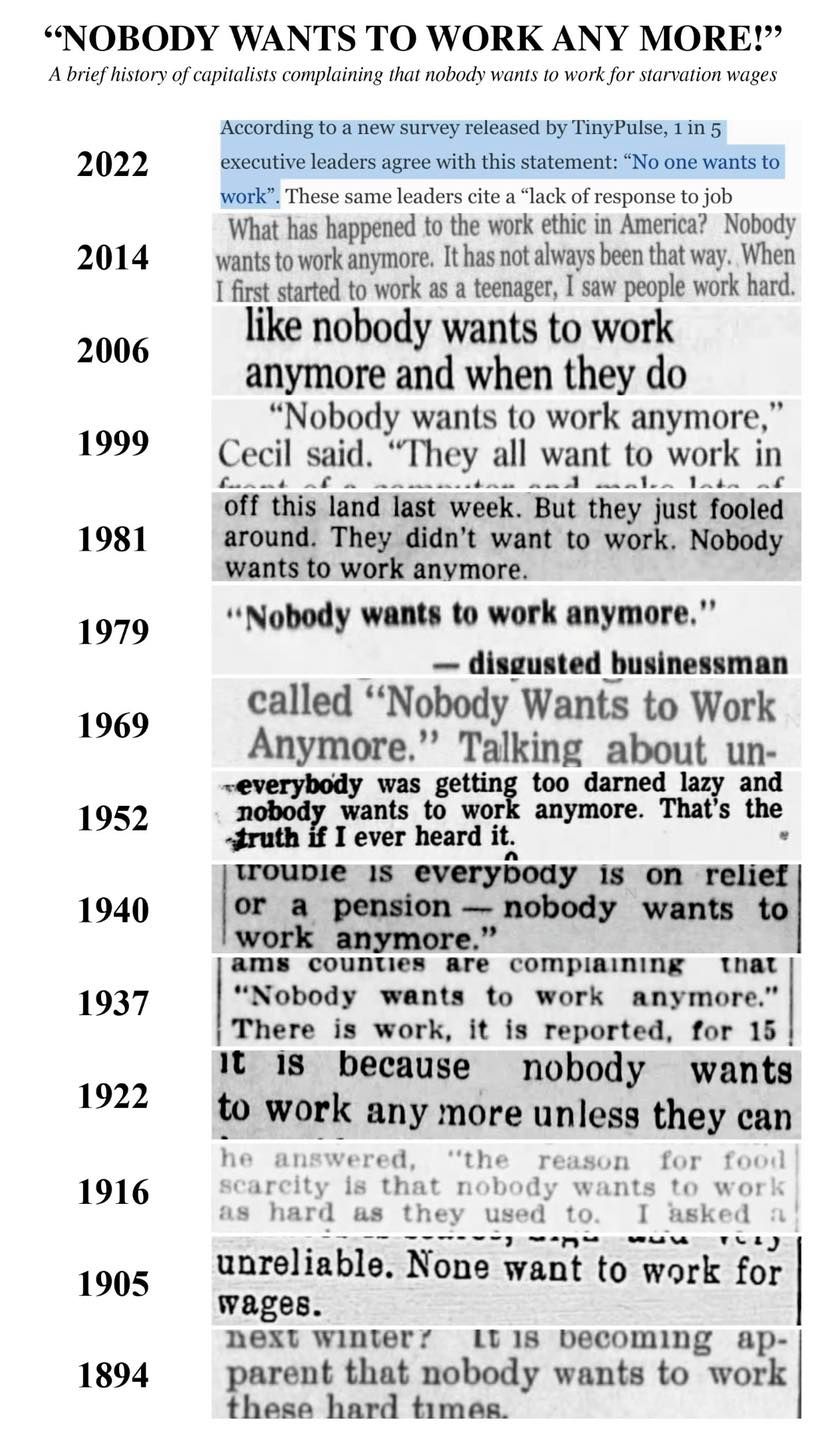
When you talk to people about “work” you find that we all have a lot of notions about what counts as “work” – and it is interesting to look at how those notions have changed over time.
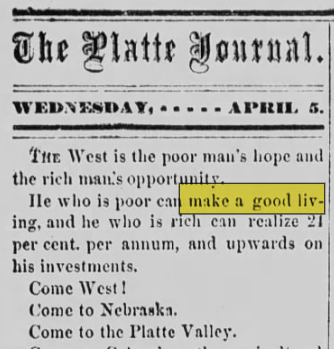
Once upon a time, ads like this one drew people who had known scarcity and poverty in Europe to claim land in the American West. They surely knew that this land had been stolen from previous occupants, but many of them convinced themselves that those previous occupants had not been “good stewards” of that land. They justified their possession of the prairies of the MidWest by asserting that their efforts to farm and develop industries on that land gave them a right to it that the indigenous tribes did not have – in other words, they made a moral judgment that the nomadic hunters who had lived off the land for centuries before had not worked for a living.
There were two components of history and culture behind this idea. One was the Protestant work ethic described by Max Weber in 1905. Weber’s theory traces this attitude towards work to Martin Luther, who “conceptualized worldly work as a duty which benefits both the individual and society as a whole” – in other words, Protestants tied their salvation to work1, and the idea that equated “hard work” with “good morals” still permeates our society in subtle ways.
The other component was the struggle seen for millennia in Europe between the “civilized man” and the “barbarian.” Modern Americans have a few popular notions about who the Celts or the Gauls were, and may have a vague notion that somehow, those people were displaced by “the Romans.” But the story of European civilization is one in which newer models of living that depend on exploiting agriculture and raw materials for wealth and influence – almost always at the expense of those doing the hard labor – slowly displaced older models of living off the land, hunting, and following migratory game.
Somehow, along the way, being a citizen, working hard, and letting your betters (aka, shareholders) profit from your labor became your moral duty as a person.
Daveed Diggs, as Thomas Jefferson, to Lin-Manuel Miranda, as Alexander Hamilton
When I look at the documentation of my ancestors in census records, it is easy to see the trend away from farming and farm-related work as the most common occupation. After about 1871, more recent ancestors experienced the Industrial Revolution, which is evident in the number of people employed by the railroads or in factories. A century later, with the rise of computers, we entered the information age – and I have spent my entire adult life doing what could be classified as “knowledge work”.
I doubt that my 3x-great grandfather, William Callin, who cleared acres and acres of Ohio forest with his five sons and turned his land into prosperous farms, would recognize anything I do as “work.” He probably would have been appalled that his grandchildren were leaving the farms he worked so hard to establish so they could earn wages in factories. Industrialization was, to men like William, something to be resisted, and they made compelling moral arguments against it. In 1869, The New York Times described the system of wage labor as “a system of slavery as absolute if not as degrading as that which lately prevailed at the South”.2
If you look at things from William’s point of view, or at least from the point of view of Midwestern American Protestants like him, the only thing more morally outrageous than not working would be to have someone else steal your labor. This would explain why people like William and his brother George were willing to defy the law and help enslaved people escape from the South.
I know I don’t want to spend any more time than I have to spend being “employed” – but I don’t plan to ever “stop working.” I have found this to be true of many people, especially those who work at creating art or those in the field of education. Most of them keep their “day job” to pay for the basics, but their drive is focused on making their art, supporting their community, and doing things that corporations have not figured out how to exploit for coin.
On the flip side, though, I don’t think anyone wants to go back to working their ancestral farms; even with modern time- and labor-saving technology! I suspect that whether we stay employed or find a better way to support ourselves and our work, there is one ever-green meme that will never go out of date:
When you put your work into WikiTree, the goal is to make your contributions as solid as possible. You want your ancestors’ profiles to be as thoroughly documented with evidence as possible, with source citations pointing other researchers to your sources.
At some point, an ancestor you’ve put a lot of time and attention into will connect to an existing profile that ties your work into what the folks at WikiTree describe as the “World Tree” – and if everyone has brought their best work to their profiles, you should be able to rely on that connection.
But often, your ancestor was not the focus of the other person’s full attention, and you get a connection to a profile that needs work.
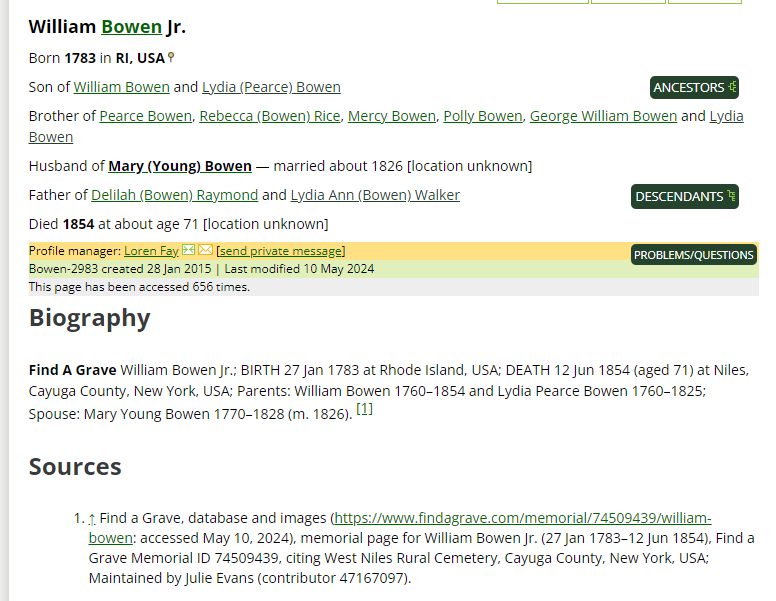
Screenshot from William Bowen Jr. on WikiTree, as of 1 Sep 2024
The point here is not to criticize the Profile manager or anyone else who updated the profile – I assume they did the best they could with the information they had on hand. (I include myself in that assessment.) I only point out that when I make that connection to the World Tree, my work is not done.
I still need to examine each profile and look for evidence to support the facts before I can say with any certainty that what is there on the page is correct. So, if you follow the link to William Bowen’s Wikitree profile, and click that green “Ancestors” button, you can see that William is far from the “top” of my tree. Yet, because the evidence I have to support his connection to these other ancestors is so insubstantial, I consider him to be the “Wavetop” of this branch.
Despite digging into this branch of the family many times over the years, I still have precious little information about who Amanda’s mother, Lydia Bowen was. Sometimes she is referred to as “Lydia Anti Bowen” in other peoples’ trees and notes, but I don’t know if that’s a middle name, a misspelling of “Ann” or some other artifact of having information handed down through multiple generations.
What I do have is an 1850 U.S. Census Record from before Lydia’s marriage to William “Yankee” Walker that lists Lydia in a Huron County household with her father, stepmother, and a couple of siblings. That seems sufficient to tie her to her father – and there is existing research on him that seems convincing. You can follow the link on his WikiTree page to his Find-A-Grave profile where someone has copied information about William from the New England Historical and Genealogical Register (which is databases here: NEHGR, Jan. 2011, Vol. 165, p. 58-59).
There are some missing facts in that NEHGR summary and some estimates that probably need to be revised. For example, the article estimates the date of William’s first marriage as 1821 – however, subsequent research suggests that his oldest daughter was Delilah (Bowen) Bodine Raymond, born in 1810. Also, the Census records for the William Bowen household put that family in Sempronius, Cayuga County, New York, as early as 1810, when William and his wife already had three daughters (one over 10 years of age – I think she might actually be a sister of William or Mary).
I started writing this post on the first of September 2024, and as I’ve been drafting, I have been updating William’s WikiTree profile so it tells more of his story and cites the sources I have. If you visit that link now, it should look a lot different from the screenshot I included above.
Perhaps next time the tide comes in, my Bowen family wavetop will reach further into the past. If you find yourself connected to William’s family, say hello!
This October is the first anniversary of Mightier Acorns on Substack, so I thought it would be appropriate to republish some older posts from the days on Blogger. We also talked a lot about “Granpa No-Bob” at my Aunt Vicki’s memorial service, so some of these stories feel fresh to me.
SGT Bobby Callin, U.S. Army Air Corps
When I first took an interest in “Family Trees”, I was young and innocent of sense, common or otherwise. I had the idea that if I looked hard enough I would find lurking in the branches of my ancestry kings, astronauts, baseball players… or maybe someone wealthy who had left behind a healthy fortune just for me.
So far, the closest my DNA comes to fame and fortune is “7th cousin to Richard Nixon and Dwight D. Eisenhower’s grandchildren”. But as cool as it is to be able to say that, I’ve discovered a much deeper fondness for my less “glamorous” ancestors than my younger self would have thought possible.
One of those regular people was Bob Callin. His great-grandfather, William Callin, was a true pioneer, clearing at least two farms in Ohio. Before the Civil War, one of those farms was a “stop” on the Underground Railroad. Bob’s grandfather, John Henry Callin, fought for the Union, alongside brothers and cousins, and became a teacher after the war. His father, John Quincy Callin, was another groundbreaker, moving the family to Florida long before it became the Enchanted Kingdom. Bob himself enlisted in the Army when the rumbling approach of the Second World War could still be mistaken for a thunderstorm, and by the end of it, he had found his best friend and greatest partner, Nancy. They eventually settled in Glendale, the desert city where her father had carved out a farm back when Pancho Villa was still a real threat.
But, as impressive and manly as these deeds may sound in the history books, the real men behind them were not John Wayne archetypes. These were Real Men, who got by with love and a strange sense of humor. They would have needed a lot of both to survive. Great-grandpa William discovered an oil well on his farm and sold it for what he thought was a great profit — just a few years before Mr. Ford’s very popular automobile took off. Grandpa John’s Civil War service was spent largely in hospitals, recovering from diseases picked up in Civil War hospitals.1 And Bob’s father, John, would write ruefully humorous letters to his son chronicling “that old Callin luck” that kept him from becoming a real estate tycoon. (It had less to do with luck, and more to do with a man who was too generous to succeed in such a cutthroat market.)
The notorious Fang, around 1974
The man I knew as Grandpa Bob was every bit as lucky as his forefathers; blessed with happiness and a healthy family, yet plagued by minor tragedies. Prone to accidents around open cupboard doors and his beloved Volkswagen, Fang, he met every challenge with a long-suffering grin and a ready joke.
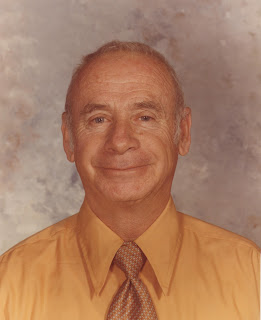
After the war, Bob decided to leave the service and tried a few different professions and locations before joining the first class at Grand Canyon College with the intention of becoming a pastor. He took his Bachelor of Arts in 1951 and a Master of Arts in Education from Arizona State in 1960 before embarking on a career as a math teacher with the Glendale Union School District. He and grandma enjoyed traveling around the Western U.S. and camping with friends, and they kept a series of small, but comfortable recreational vehicles for just that purpose.
One memorable summer, they invited me and my cousin Jeff to visit Yellowstone National Park with them. They showed us Bryce Canyon and the Four Corners along the way and took us to one of their favorite places in Colorado – Ouray, and the Silverton narrow gauge railroad. It was a great trip, and even though Grandma worried almost constantly that one of the three of us boys would fall off a cliff or into a geyser, all survived intact!
My most lasting impression of them as a couple came from that trip. Grandma would hover behind him on treacherous switch-backed roads, occasionally bursting out with a cautionary, “Slow down, Bob! You’ll get us all killed!” I felt kind of bad for him, thinking that would stress me out as a driver – but I swear when she turned her attention to other things going on inside the motorhome, he would get a perverse twinkle in his eye, his lip would twitch slightly, and he would step on the gas and swerve (not a lot, just enough) until she came back and started in again.
The moral of the story: Callin men can be a little bit evil.
One summer, a couple of weeks before we expected them back in town, we got a frantic call that Grandpa had been hurt pretty badly in a fall. Their RV had overheated in Colorado, and when he opened the hood to investigate, the radiator hose burst causing him to hit his head on the latch and then fall out into the road. He did recover, and they continued camping for a few more years after that, but he was hurt badly enough to lose his sense of taste! One day after he was back on his feet, I saw him go into his kitchen to make a cup of coffee (General Foods International) and sigh. I asked him what was wrong, and he explained that while he still needed the caffeine, he couldn’t taste sweetness anymore, which took some of the pleasure out of the coffee.
“But,” he said, always looking at the bright side, “I guess I’ll save money on sugar!”
On my last visit with him, during our 2005 Christmas trip to Arizona, he had just come out of the hospital. He had required another procedure to clean up his circulatory system, and the doctors had left him with livid bruises on both his arms. I asked him if it hurt him, if he was alright; he said he was.
Mr. Callin, Mathematics teacher
“It’s not as bad as it looks,” he told me, looking somewhat glum. But then his eye twinkled, and he perked up as he said, “But you shoulda seen the OTHER guy!”
So, while I may not have found any kings or powerful magnates in our past, I have found something of much greater value to me. Our stories are the treasures that we spend at family gatherings. They collect in our memories, and the interest compounds with time. They are fortunes built on love, and Grandpa Bob always had a great storehouse of that treasure.
He will be missed, but our sadness is overwhelmed by the joy of having known him. We will mourn, but we are grateful for his life and his love: the greatest inheritance.
Because they were married in 1864, Elmira appears in two Census records under her maiden name, presumably with her family. Those records from 1860 and 1850 establish that Elmira’s father was Samuel Spitler, born in Ohio in either 1809 or 1810.
We can derive a few facts from these two records:
In 1850, Samuel’s wife was Jane, who was most likely the mother of the six children listed.
In 1860, Samuel’s wife was Margaret, who had children from a previous marriage. We know from her marriage records that her maiden name was “Kalen” and her first marriage was to Philip Pifer in 1845.
Samuel’s family lived in Perry Township, Wood County, Ohio.
But from there, things get a little dicey. These are just a few factors that have made it difficult to flesh out Samuel Spitler’s biography:
Lack of records; I haven’t found key records (like Samuel and Jane’s marriage record) supporting some of my guesses.
I haven’t found a record of Samuel’s death or obituary.
Multiple Spitler families were in the area, complicating searches for his children.
Spelling variations I have seen include “Spittler” and “Spitter,” but who knows how else the name could have been rendered.
Samuel’s household in 1850 included two people (“Sylvia” Spitler, age 23, and John Spitler, age 31) who might have been his siblings. I found an 1840 Census for “Saml. Spitter” in Vermillion Township, Richland County, Ohio, that seems to account for Samuel, Jane, their two older children (John and Catherine), and possibly a sister the same age as Sylvia.
In 1860 and 1870 his household included people who could be relatives of either Samuel or Margaret: an 82-year-old Catherine Taylor who could be an aunt or a mother-in-law of either of them (or just a boarder, of course); and children who could be from either of their previous marriages. (Census enumerators were not careful about recording which children were “Spitler” and which were “Pifer”.) And while Margaret appears in 1880 as a servant in another household where she is listed as “married” there doesn’t appear to be a matching record for Samuel in 1880 – which only suggests that he was alive in 1880 without proving anything.
When it comes to putting together Samuel’s biography, there are only four records you can hang your hat on: three Census records (1850, 1860, and 1870), and the marriage record between Samuel Spitler and Margaret Pifer (1857). We have a possible death date of 1893, based on a Find-A-Grave memorial for a Samuel Spitler in the Bechtel Cemetery in Van Buren Township, Hancock County, Ohio. That cemetery does hold several of Samuel’s relatives (of various surnames), so that’s plausible, but the headstone photo is unreadable, and the person who transcribed it recorded his age as “age 10/3/7” – which would rule this out as Samuel’s memorial.
We can assume Samuel married Jane about 1835, as their oldest child in the 1850 census was born about 1836. Jane appears to have died about 1855, and with an infant daughter and five other children between the ages of 7 and 20, Samuel probably depended on those older children to run the house until he remarried.
Normally, I would research each of those children and look for clues about their parents in their biographies – but each of Samuel’s children presented a different set of problems. His two sons, John and Levi, left no obituaries and none of their other records mention their parents. There are marriage records for more than one Catherine Spitler – any of them could be Samuel’s oldest daughter, and none of the records mention parents. Except for Elmira, I was unable to find evidence for the other daughters beyond 1860. Most of them would have been of marriageable age, but I found no marriage or death records that could explain where they went.
Samuel’s second wife was born Margaret Kalen, probably around 1821 in Pennsylvania. According to Ohio County Marriage records, she married Philp Pifer on 23 Mar 1845 in Columbiana County, Ohio. The couple had three children before Philip’s death, probably around 1855. After Margaret Pifer married Samuel in 1857, she bore a son and at least three daughters – though, again, the records contradict each other and I have had to make several guesses about what they mean. Some guesses are easier – “George W. Spitler” is clearly supposed to be “George W. Pifer” – but others are murky without other supporting evidence.
All of this adds up to something but not to the kind of story I usually enjoy telling. There are too many questions and too many possible threads that could either spin into a nice tale or tangle into a confused mess. Maybe if I keep chipping away at the edges and filling in the gaps, a real story will emerge.
The good news is that Samuel is not a “brick wall” – he’s more of a chain link fence. Or, if we want to stick with a Wavetops metaphor, he’s a bit of foam floating above the more readily supported biography of his daughter.
The year 2001 was already a difficult one for my family. I separated from the U.S. Air Force that May, after returning from three years stationed in the UK. Those three years had taken a toll on us, so we were eager to return to America. And our family had grown: when we arrived in England in 1998, it was just me, my wife, and two-year-old Cam; when we returned, we had added two-year-old Seamus and newborn infant Lars to the family.
None of our kids remember any of these events. The two older kids were too little to understand any of it, and the memories they do have come from hearing Kate and I share our stories with friends and family.
My last year in the service had been frustrating. There are supposed to be benefits for helping airmen like me with job assistance and placement, but we wanted to live in Arizona, and no one could figure out how to find me a job there. Instead of helping me, most of the people I dealt with lectured me about what a fool I was to be leaving the military with a family of five. “There’s no way you’ll be able to survive without the military supporting you!” one MPF1 master sergeant laughed.
All that summer, I struggled to find work in my hometown of Phoenix. My parents had just built the house they are in now, and if they hadn’t been so generous and let us live in the house they had just moved out of, we would have been homeless.
I got into a truck driving school program and I was almost ready to graduate in September. I was taking our oldest to school and listening to the local rock station in the car. The morning show, The Morning Sickness, was known for its “edgy” comedy so as the song I was listening to ended, I was ready to change channels anyway when they broke in with a news report about airliners crashing into buildings in New York. I thought it must be another tasteless joke meant to wind up a gullible audience – but changing channels just brought up another news report, and another, and another.
I called Kate, and she was already watching the news, stuck on the couch breastfeeding an infant while the horror played out in real time. We knew that her brother was stationed at the Air Force Base in New Jersey, but we only found out later that his unit had been called up to the city to help, and that he was on the ground assisting with evacuation and relief efforts when the second tower fell that morning. He was alright, but for a few days, we didn’t know that.
Those weeks of confusion, anger, outrage, and the bizarre sense of coming together as a nation – but also not having the same understanding of what was happening – were awful to experience. I knew right away from hearing the Secretary of Defense, Donald Rumsfeld, talking about the U.S. response that we were going to start a misguided war in Iraq, even though the attack had been planned and launched from Afghanistan by a known terrorist organization led by a Saudi national. But you couldn’t tell anyone at the time that they were being irrational or misled, not without being accused of “helping the terrorists win.”
Even years later, when the evidence showed pretty conclusively that Secretary of State Colin Powell had lied to the United Nations about Iraq’s involvement in the 9/11 attacks, and that the intention of those who planned and carried out those attacks was to draw the U.S. into the same nightmarish quagmire that dragged down the Soviet Army in the 1980s, pointing out that Rumsfeld and Cheney had been the ones who “helped the terrorists win” was not a strategy for maintaining friendships.
But in October 2001, before I knew what the U.S. reaction would be, I went back to a recruiter and asked if I could re-enlist, so I could do my part in whatever came next. He laughed at me and said, “You are a fool if you think you’d be able to support a family of five on Senior Airman pay?”
That frustrated sense of irony and vindication has stayed with me over the years.
Amid all of the pivotal historic events unfolding around us, we also had the bittersweet experience of watching our new home team, the Arizona Diamondbacks, win their way into the 2001 World Series. Unfortunately, their rivals were the New York Yankees, and the excitement of watching our team win the championship was tempered by a sense of shame at kicking New York while it was down.
Fortunately for us, the U.S. military’s response to 9/11 opened up opportunities for work – unfortunately, those opportunities were in Maryland. So we left our chosen home, thinking that one day, we would be back. That day hasn’t come, yet, but we keep hoping and working.
One day, the country might recover, and one day, we might go home. Twin hopes that loom on our skyline, only visible in their absence.
Why we keep doing research after we think we found all the answers
Last week, we revisited a story about my 6th-great grandfather, a Hessian soldier who was captured by General Washington’s troops and sent to work in Mount Hope, New Jersey, for John Jacob Faesch, who needed laborers to continue making ammunition for the Continental Army.
In 2014, I posted a compelling and dramatic story to my old Mightier Acorns blog: “Me No Go; Me Die First”. The source attributed that story to a neighbor, Mr. William F. Wiggins, who claimed to know Leopold after he died in 1820, but I needed more information to prove the connections between Leopold and his children, and to try to trace Leopold’s origins in Germany.
While digging for this information, I found evidence that the story attributed to Mr. Wiggins in the History of Morris County, New Jersey1might not reflect events as exactly as they played out.
So what did happen to Leopold Zindle, exactly?
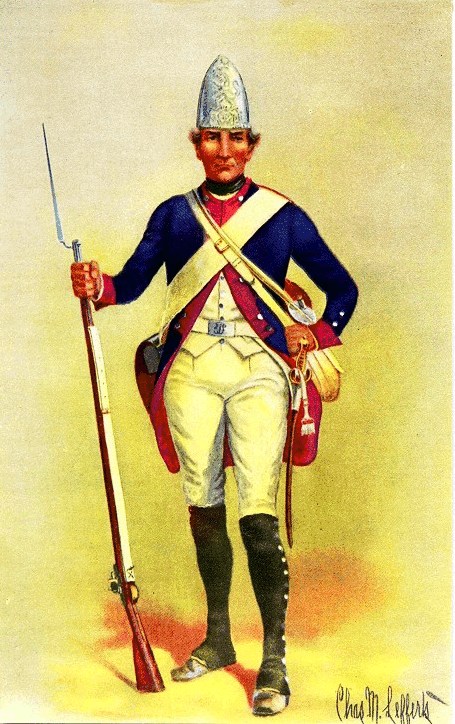
Uniform of a Fusileer from the Regiment Erb Prinz of Hesse-Cassel, 1776 (from the Sons of the Revolution in the State of California website)
Leopold enlisted in the Hesse-Kassel Regt. Erbprinz, 1. Comp., and was reported on the unit’s muster roll in August 1779. The prisoner lists I referenced last week show a Leopold Zuendel (Zindell) from the Kassel Regt. Erbprinz, including a remark saying “Captured at Paulus Hook 8-20-79.” Then, after John Jacob Faesch from Mount Hope, New Jersey, requested German prisoners of war as laborers he received thirty-five men (not 250) from the Commissary of Prisoners in Philadelphia on April 29, 1782, and put his furnace into blast. Among the soldiers sent to work for Faesch were two men from the Hesse-Cassel Erbprinz (“Prince Hereditary”) Regiment captured at Paulus Hook in 1779: Adolph Assmann and Leopold Zuendel.
The rest of the story comes from two sources: an article published by Daniel Krebs2, and Peter Lubrecht’s book, “New Jersey Hessians”3, both of which I will try to summarize:
The month after Faesch received his 35 laborers, several Continental leaders decided that German prisoners of war could either be recruited for the Continental Army, ransomed for 80 Spanish dollars, or sold into indentured servitude. Brigadier General Moses Hazen, whose regiment already guarded the prisoners of war, was sent to tell the prisoners of their new options. Accounts of what happened next differ between the American authorities and the correspondence of the German soldiers.
Both sides agreed that officers from Hazen’s regiment arrived in Mount Hope in November 1782 to announce the new policies. One of the American officers, Captain Selin, a German immigrant, told the prisoner laborers that they could choose between enlistment, ransom payment, or a return to the New Gaol in Philadelphia. The men refused to serve as soldiers but asked for more time to consider the other proposals.
In February 1783, some of the German prisoners in Mount Hope attempted to escape to British-occupied New York. They made it as far as Newark, New Jersey before they were caught. At the beginning of March 1783, officers from Hazen’s regiment returned to Mount Hope. When the prisoners refused to enlist in the army and refused to ”redeem” themselves, Selin began to march them back to Philadelphia. After one day’s march, the German soldiers demanded to talk to Faesch and supposedly “entered into a voluntary agreement with him” to become indentured servants, with the intention to pay their ransom of 80 Spanish dollars (or 30 pounds of Pennsylvania currency) and then become citizens of New Jersey. Not all thirty-five prisoners signed their indentures with Faesch for three years, and on March 11, 1783, Faesch returned two prisoners of war to Hazen.
In a letter dated March 20, 1783, to General von Lossberg, commander of the Hessian troops in America, the remaining German soldiers told a different story.
“The Captain told them they were at his disposal, because they were Continental Servants, to which they replied, that they were no Servants, but the King’s Soldiers. Upon which the Captain drew his sword, put it to their breasts threatening to kill them, and struck them, till he broke it upon the head of one of them. He then carried them off, and that night put them into a house surrounded with sentries, and allowed them neither bread not water.”
(Krebs, pg. 134)
Jacob Peter, a prisoner of war in Mount Hope, who was able to pay the ransom with his wages on June 23, 1783, added in his account that Captain Selin was the officer who struck the soldiers. According to Peter, the two were Leopold Zindel and Valentin Landau. Peter stressed that the German soldiers gave up and agreed to the contracts with Faesch only because of American pressure and lack of provisions. Peter also claimed that he and his comrades did not know that they signed an oath of allegiance and an indenture for three years because nobody explained the English documents or translated them into German.
But the prisoners of war at Mount Hope almost certainly talked to Captain Selin in German. To later claim that they did not understand what they heard and signed is unconvincing, even when you consider the fact that some sources say that Captain Selin spoke Swiss German (or “Schweizerdeutsch”). It is also worth considering that while the newspapers and local histories often refer to him as a “Dutchman,” Jacob Faesch appears to have been born in Hesse himself4, so he would have been able to speak to Hessian soldiers in their mutual native language.
Not all of Faesch’s German prisoners of war returned from Mount Hope when Lossberg bought their freedom from Faesch in the summer of 1783. Leopold Zindel and Adolph Assmann (both of the Erbprinz Regt.), and Georg Schmidt (of the Knyphausen Regt.) are the only settlers known to have remained in New Jersey and to have left records behind.5 All of this suggests that these prisoners knew what they wanted after the end of the war – to remain in America and build a new life – and played the German, British, and American officers off of each other to get it.
What Does This All Mean?
Now that we know more facts from contemporary witnesses, and can compare differences between somewhat official accounts, a few things become clear about the story I found in 2014:
The officer who abused Leopold was American, not British.
The townspeople of Mount Hope may not have been present, and if they were, their interference did not make it into the formal report.
William F. Wiggins got those details wrong when he repeated his story to Halsey for the History of Morris County.
Wiggins’s version of the story is still important evidence because we can compare the stories and learn something from the differences. Krebs relates several examples in his article where German prisoners of war told their German commanders an altered version of the truth to avoid the consequences of desertion. On page 135, Krebs describes one group that agreed to enlist as marines aboard an American frigate, the South Carolina. When captured, they were interrogated and claimed they had enlisted on the American ship only because they had heard from Loyalists that the South Carolina would be captured and sent back to New York. They all left out the fact that they had fought hard to resist being captured by the British.
The story Wiggins tells suggests an element left out of the reports: the reaction of the local population. Eyewitnesses, especially younger ones, probably wouldn’t have known the difference between an American officer (who, if it was Selin, was probably speaking German to his prisoners) and a British or Hessian officer. Townspeople would probably be unaware of the details of the policies being explained to the prisoners, and it seems reasonable that they would have misunderstood the dynamics of the situation.
That could explain why, in Wiggins’s story, it was a British officer beating Leopold, and why he thought the officer’s anger was due to the cost involved in Leopold remaining behind. It was due to the cost – but that cost was to the Continental Congress, and not the British Crown.
To my mind, the most important part of Wiggins’s tale is that he captured the sentiment that Leopold was welcomed into the community despite being an “enemy soldier” – and that was probably because many of the inhabitants of Mount Hope were German immigrants themselves, and knew Leopold from his years as an indentured man at Faesch’s iron works.
So, whether or not Leopold ever said, “Me no go; me die first!” to the abusive Captain Selin, he did stay in Mount Hope, and in 1820, after raising a family of seven children, he did die there.
I hope that you find a story in your family history that you love as much as I loved Leopold’s story. And I hope that just because you love a story, you are open to accepting new evidence and changing what you thought you knew – because the “story” part of “history” is always fluid and elusive.
If you’ve been following my new music newsletter, All Kinds Musick, you may have noticed my recent post about the Los Lobos album, La Pistola y El Corazon. In it, I said:
I credit [David Higaldo’s] work on this album as the final puzzle piece that made me accept the accordion as a favorite instrument instead of seeing it as just an oddity. This journey took me from Weird Al’s parody polkas through the Pogues and into Zydeco records. The instrument also features so prominently in these Latino traditions, that I began to wonder how it got there.
There is a good answer to that.
The accordion was first developed in the 1820s by Viennese and German instrument makers.1 It was inspired by a centuries-old Chinese instrument called the “cheng” or “sheng” introduced to Europe in the 1770s by a Jesuit explorer. The addition of bellows and Western-style keyboards allowed players to make chords with one hand while playing a melody with the other, and various designs spread quickly throughout Europe and the rest of the world. German immigrants brought the instrument with them when they settled in Texas in the 1840s along with styles like polka, waltzes, the “schottische” and mazurkas.2
The Tejanos who lived in Texas incorporated this music into their own culture, sometimes replacing guitars with accordions and setting the corridos they wrote to tunes that were built around these new European styles. After only a couple of generations, the music that came out of this fusion was strongly associated with Tejanos and Mexican musicians to the point where the descendants of the German immigrants forgot their own cultural ties to it.
My own German immigrant heritage is a small part of my family tree. The only German immigrants I have traced back to Germany were Joseph Frey and his wife, Elizabeth Horn, who probably arrived in New York in the 1840s from their birthplaces in the Duchies of Baden and Hesse. I do have German heritage in older lines who arrived in North America much earlier.
The Witter and Piper (or Pfeiffer) families appear to have been in Pennsylvania by the mid-1700s, and their descendants married into the Tice (or Theiss) family that arrived slightly before them.
The Shriver and Cline families that ended up in Kansas probably came from Germany before 1800 and also lived in Pennsylvania for a few generations.
Elizabeth Berlin’s family almost certainly arrived before the Revolution and lived on the Pennsylvania/Maryland state line.
And we just finished reading about Hessian soldier Leopold Zindle!
German ancestry can be tricky, because the nation of Germany didn’t exist until 1870, and the fiercely independent states that formed it had been part of the Holy Roman Empire for a thousand years before the Napoleonic Wars put an end to that in 1806. Cultural identity as “German” did exist, but people tended to define themselves by their religion or by their language before “nations” became common, and it can be difficult for us to look back now and sort out who “belonged” to the numerous shifting populations that lived in Europe.
The United States struggled to figure out how to integrate its English-speaking and German-speaking populations in its early years. Benjamin Franklin wrote of the German-speaking settlers in Pennsylvania after he began serving in the Pennsylvania legislative assembly:
“Few of their children in the country learn English; they import many books from Germany… The signs in our streets have inscriptions in both languages, and in some places only German. They begin of late to make all their bonds and other legal writings in their own language, which (though I think it ought not to be) are allowed good in our courts, where the German business so increases that there is continual need of interpreters; and I suppose in a few years they will also be necessary in the Assembly, to tell one half of our legislators what the other half say.”
In other places, he wrote about the impossibility of mixing the two cultures. He contrasted the German standards of beauty for their wives against that of the English in terms which, if he were saying them about Latinos today, would have likely scuttled his political career.
He also turned out to be wrong about the permanence of the divide between the two cultures. Today, the German language barrier is all but forgotten, except that many Americans have very long surnames that are hard for people to spell. The anti-German sentiment that rose during the two World Wars seemed to drive many families to ignore or deny German heritage. One unfortunate facet of this assimilation process seems to be that people descended from German immigrants forgot so much about what was good, and adopted some bad habits from their English neighbors – like Mr. Franklin.
The good news is that despite the blinkered view that one group is somehow “superior” to another, the wild diversity of musical traditions – or of one’s ancestry – is never entirely out of reach. People will make the bonds and connections that are important to them, and then later generations can sort out and promote what they value. For my part, I’ve learned that I value this instrument more than I thought I did – and I can thank my buried German heritage for its existence!







 Mightier Acorns