Tad Callin has been working on family history and genealogy since the late 1990s. He does most of his research on Ancestry and posts what he learns to WikiTree.
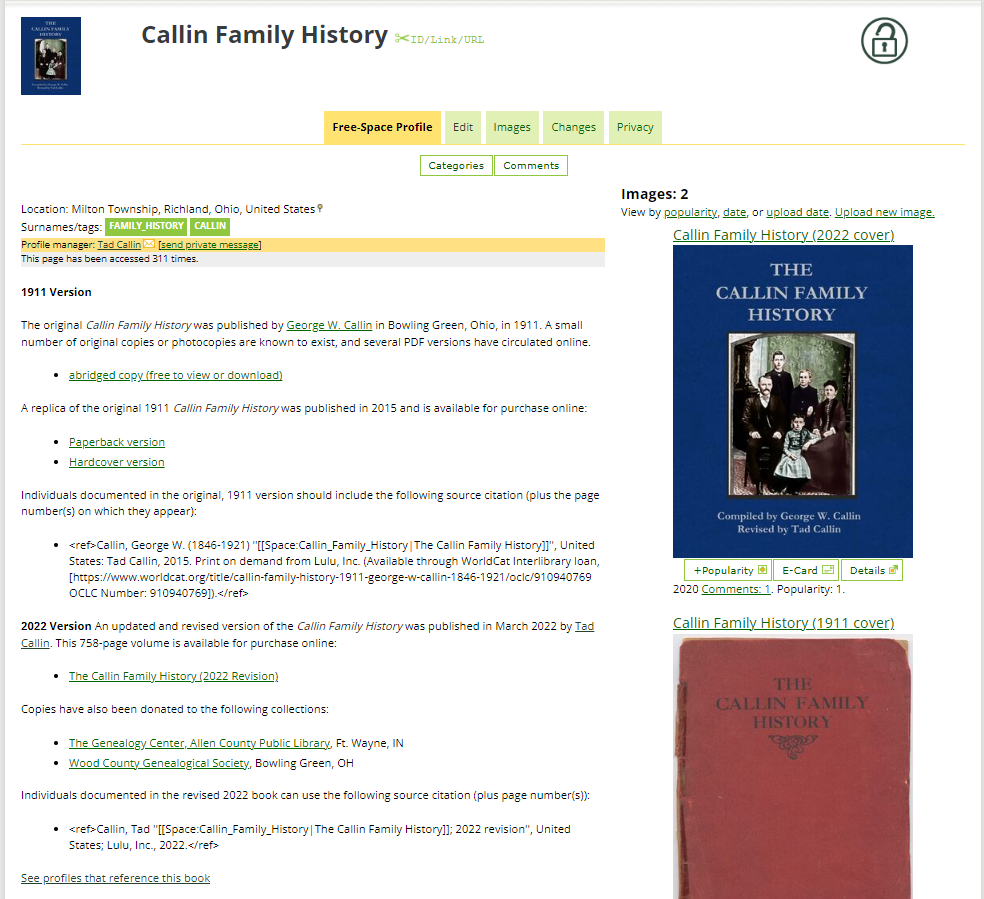
A couple of weeks ago, I had some unexpected time off (thanks, persistent pandemic!) and since my brain was still functional, I decided to use that time to launch a One-Name Study for my surname on WikiTree. (This post is short because I want you to follow that link.)
I did this because I’m selfish. My research into the life of my 5th-great grandfather, James Callin (c. 1750-c. 1816) suggests that he and his brother moved from Westmoreland County, Pennsylvania, to somewhere in Kentucky. As I cast about for evidence of James living in Kentucky, I keep finding Callin families who are clearly not James – in the general area around Mason, Campbell, Kenton, and Pendleton counties. Unfortunately, online records from before 1810 are sketchy.
Keeping track of these unrelated families is difficult in Ancestry, and many of them may not end up being biologically connected to my family – so the logical choice is to put the research on a collaborative platform where others can contribute to or benefit from the work I’m trying to do.
Now the trick is to figure out how to let the diaspora of Callan descendants know that the project is there.
If you have any advice for managing something like this, I’d love to hear from you!
And if you’ve found your way to this blog from WikiTree, be sure to subscribe so you can keep tabs on my progress!
Last week, we examined the evidence supporting rung #2 in our ladder to Providence: Florence Mabel (Hart) Tuttle. This week, we take another step up
.
Harriet Isette “Hattie” Wells was born on 12 Jan 1854 in Reading, Middlesex County, Massachusetts, to Harlow C Wells (1827-c.1880) and Sarah Ann Fletcher (1835-1920). She grew up in Reading and Harvard, Worcester County, except for a brief period around 1870, when her father moved the family to Fort Atkinson, Jefferson County, Wisconsin. Harlow disappears from the record after that, so he may have died sometime in that decade, prompting the widowed Sarah to return to Massachusetts.
There is strong documentary evidence for Hattie’s connection to her parents. Massachusetts Birth Records and the Massachusetts State Census for 1855 and 1865 show her living with her parents and give us a precise date of birth.
The 1870 Federal Census was unusual in that the family was in Fort Atkinson, Wisconsin. Her father worked as a cabinet maker there. It is the last record I have found that shows her father at all, and it is the only record that indicates that Hattie had a younger brother, Osborne Wells.
Hattie’s mother, Sarah, was back in Massachusetts by 1880, listed as “widowed” – and living with Hattie’s two younger sisters. Hattie married Seymour C Hart (1851–1934) on 25 Jul 1874 in Clinton, Worcester County, Massachusetts. Florence was their only child, born on 2 Nov 1874. She was five years old when Hattie died on 28 Sep 1879 in Clinton, Worcester, Massachusetts, after suffering from “Ulceration of uterus” – most likely a form of cervical cancer.
We have Hattie’s death record, and as we mentioned last week, Florence went to live with Hattie’s mother. Sarah Ann (Fletcher) Wells has a well-documented life, as well. She married again after Florence was grown, and was known as Sarah McGown in her later years. She died in New Hampshire, where she lived with her daughter, Emma Leizer.
There are still some mysteries to solve – I haven’t been able to trace the children of Hattie’s two sisters, both of whom married men named Leizer and moved to New Hampshire. And I’ve yet to prove whether her brother Osborne or her father survived Fort Atkinson. If you happen to be descended from any of these folks, I’d be thrilled to hear from you.
Next week, we ascend one more rung and look at what we know about Hattie’s father, Harlow Wells. Subscribe to get updates as soon as they are published!
My mother-in-law’s paternal grandmother was Hildur Agda Leander (1886-1945). She wished you “Merry Christmas, from 1938” a few weeks ago – she’s seated between the Christmas tree and her husband, Arvid William Holmquist:
The Holmquist Family, abt. 1938, Mahtomedi, Minnesota
Hildur was the daughter of Gustav Leander and Ingeborg Swedahl, born on 18 Dec 1886, probably in Brooklyn, New York, and was baptized on 19 Feb 1893 in the Christ Lutheran Church in St Paul, Minnesota.
Gustav and Ingeborg were immigrants who married in New York about 1884, not long after arriving from Sweden and Norway. Gustav was born in Gothenburg, Sweden, and Ingeborg in a village called Byneset, Norway. Their first two children were born in Connecticut and Brooklyn, New York, respectively, and the family had moved to St. Paul, Minnesota, by 1888. We don’t know what happened to Gust; the 1913 City Directory for Saint Paul lists everyone in his family living at 1019 White Bear Ave, except for “Gust M”, who it says “moved to Tacoma Wash”. Ingeborg is listed as “divorced” and living with Hildur and William Holmquist in Lincoln Township on the 1920 Census, but the rest of Gust’s biography is a mystery.
Fortunately for us, there are good records in Sweden that tell us about Gust’s origins. His parents were Mårten Persson Lenander (1833–1896) and Augusta Charlotta Gustafsson (b. 1833), and he had three siblings: Arthur, Norma, and Agda (who died at one year of age). Swedish “Household Clerical Surveys” from the late 1800s give us some insight into where the family lived – but after Gust emigrated, and Mårten died, it isn’t clear what happened to Augusta.
There are a lot of unanswered questions to look into for each of these individuals. I’m pretty sure Arthur emigrated to the U.S., but if he did, he used a middle name (William) and the surname “Lenander” instead of “Leander.” Norma appears to have emigrated to Chicago, but she died back in Gothenburg. There are small disagreements between the records that might be nothing – Mårten’s birthdate is sometimes recorded as “20 May” and sometimes as “29 May” – or might indicate that I am mixing up records from multiple families.
I always hope to hear from potential distant cousins who might recognize the family I am researching – be sure Contact Mightier Acorns.
Last week we took a close look at the records that provide supporting evidence for what we know about my maternal great-grandfather. This week, we will review the evidence for his mother:
Florence Mabel Hartmarried John Jackson Tuttle on 28 May 1891 in Succasunna, Morris, New Jersey. She was the daughter of Seymour C Hart (1851–1934) and Hattie Isette Wells (1854–1879), born on 2 Nov 1874 in Clinton, Worcester County, Massachusetts. Her mother died when Florence was 5 years old, and she went to live with her grandmother: Hattie’s mother, Sarah (Fletcher) Wells, also in Clinton, Massachusetts.
My grandmother, Albert (Tuttle) Clark, seemed to think that her grandmother, Florence, was called “Lovey” by her family; and that’s possible. John and Florence also named one of their 12 children Florence, and the nickname may have been passed down to her.
We have pretty solid evidence for all of Florence’s major life events. We can see her with her family in all of the expected Census records, beginning with the 1880 Census when 5-year-old Florence lived with her grandmother and two 20-something aunts, Emma and Nellie. The available Massachusetts Town and Vital Records give us her parents’ names and her birthdate.
Florence was an only child, and she doesn’t seem to have grown up around other children. Her father did remarry, but not until 1890; Florence married the following year, and the older of her two half-siblings, Charles, was born the year after that.
Records are scarce for the period between the 1880 and 1900 Census, so Florence might have moved back in with her father at some point; if he moved to New Jersey for business and took his young daughter with him, that would account for them being in New Jersey in the late 1880s.
But other than some of these gaps, I feel confident asserting that Florence takes us up one more solid rung on the ladder we are building. If you’re descended from any of her 12 Tuttle children, or her half-siblings, Charles Hart or Harriet (Hart) Schaub, drop a note!
Vicie Clark was something of a mystery to me for a long time. I only recently found records that tied her to her parents – but from there, I’ve been able to assemble a lot of information about her siblings, cousins, aunts, and uncles.
Mary Ann Viceroy “Vicie” Reynolds was the third child, and only daughter, of Rev. James Thomas Reynolds and Mary Francis May, born on 27 Jul 1879 in Lewis County, Kentucky. Her father and both her oldest and youngest brother were all Baptist preachers. Vicie married David Ulysses Clark on 4 Sep 1898 “at the home of John Clark in Oakview” in Boyd County, Kentucky.
Clark-Reynolds marriage certificate, 4 Sep 1898 (Ancestry link)
One reason that I found it so difficult to break through and make progress with Vicie’s family is the fact that she came from a couple of large families in a three-county area which intermarried and preferred very common names. Her grandparents’ surnames were: Reynolds, Arthur, May, and West. The May families and the West families, in particular, turn up a lot in each others’ family trees. For example, Her father and his brother, John Harold Reynolds, married May sisters. Vicie’s oldest daughter (my grandpa Russ’s sister) Opal married an Arthur, as did Vicie’s brother-in-law, James Sylvester Clark. Two of David Clark’s other siblings married Mays, and their mother’s mother was Jane West.
If you found that paragraph to be confusing, I sympathize.
I’ve only been able to take the Reynolds line back to Vicie’s grandfather. Reuben Reynolds was born about 1820 in either Virginia or North Carolina. He married Martha Arthur (add her to the list) about 1850, and they farmed and had two sons in Greenup County, Kentucky.
One day, I hope to trace them back beyond the United States, but for now, there are plenty of cousins in Kentucky to sort out. If you’re one of them, say hello!
And be sure to subscribe so you see all of the updates.
Nearly nine years ago, I spent a small amount of time exploring my maternal grandmother’s side of the family, and I fell into a rabbit hole. What I found led to an ancestor1 who settled in Providence, Rhode Island, and founded the First Baptist Church there along with Roger Williams and 11 other charter members.
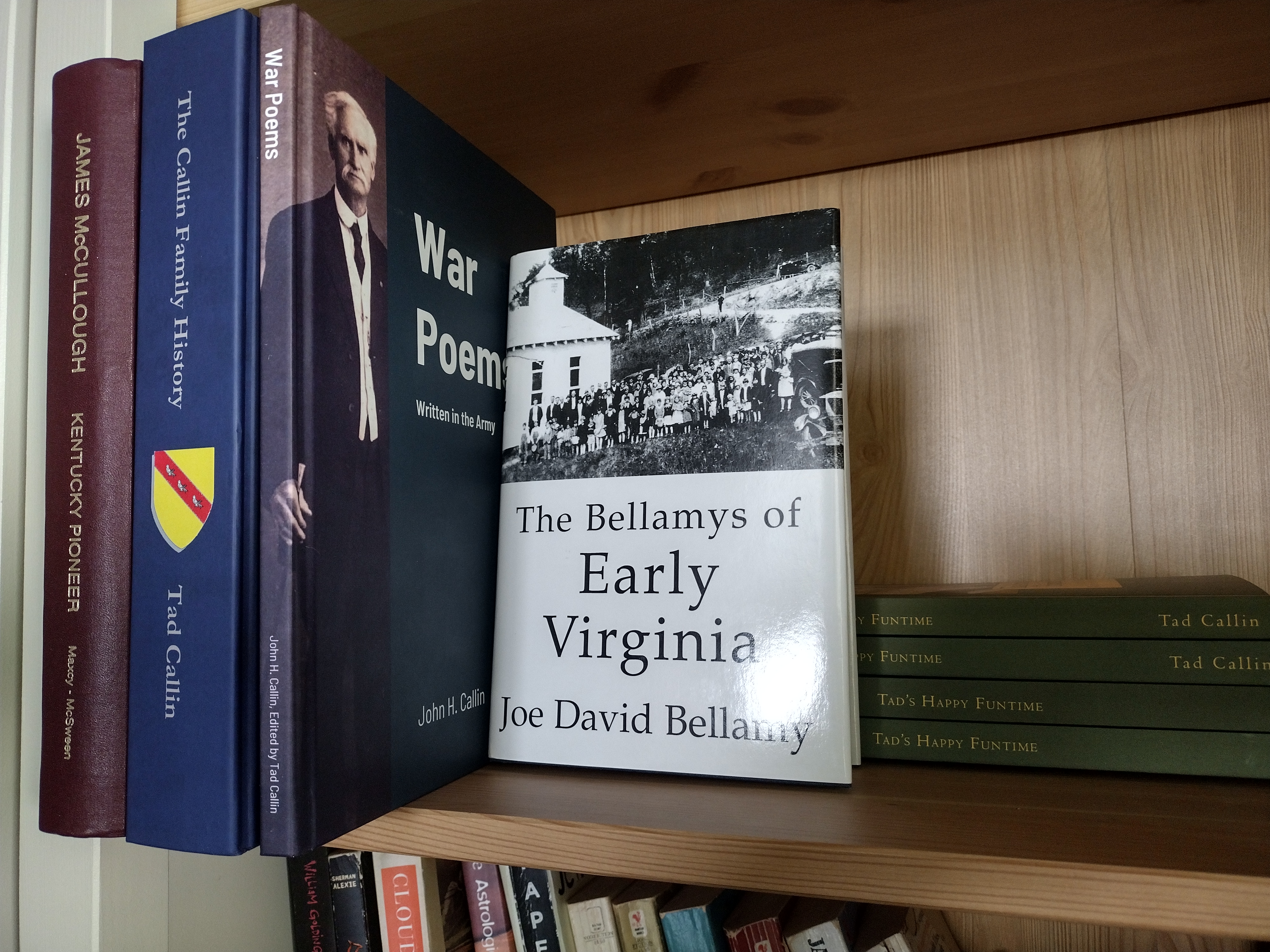
I was very excited by this, and I spent some time learning about that 11th-great grandfather and drafting a post for my blog. The trouble is that this particular palm tree did not have a lot of substantial evidence supporting each connection – but at that time (2015) I was just beginning the major project that would become my Callin Family History (available for purchase at that link if you are inclined to own 800 pages of my work), so I did not take the time to investigate.
We’re going to take the time to investigate now. Week by week, we will build a ladder up the side of that proverbial palm tree, and inspect each family for evidence and records as we work our way back to the mid-1600s and the Providence Plantations.
The caveat here is that someone likely took a shortcut or made a mistake when they built the unsupported online tree that I found in 2015. At some point, I expect to discover that I’m not related to this ancestor at all – or that I am through some more obscure relationship than “direct ancestry” – and when that happens, I’ll show you the mistake, and we’ll figure out what the real story is together.
But, we’ll burn that bridge when we come to it.
Today, we begin with the lowest rung on the ladder: my maternal great-grandfather, Alfred Tuttle.
Alfred James Tuttle was the son of John Jackson Tuttle and Florence Mabel Hart, born on 25 Nov 1892 in Rockaway, Morris County, New Jersey. Alfred was the oldest of 12 children, and John supported his large family by working as a machinist and mechanic. During World War I, John worked as a tool-maker for the International Arms and Fuze Company in Bloomfield, New Jersey. Alfred registered for the draft on 5 June 1917 and indicated that he had already served 3 years as a bugler in the New Jersey Infantry.
Alfred’s WWI Draft Registration on Ancestry
Less than two weeks later, on 27 Jun 1917, Alfred married my great-grandmother, Edna Lyle Frey (1895-1985).
The records that we have do a pretty good job of “proving” all of this, and they are the sort of records that most people should have easy access to. U.S. Census records show young Alfred and his siblings living with his parents; Social Security and World War records document full names and birth dates; and they were members of the First Reformed Church (a Dutch Reformed Church) in New Jersey, which has records of most of their major life events.
Alfred died in New Jersey when I was less than a year and a half old, and I wouldn’t expect to have any memory of him, but my mom and grandma told me about him when I was growing up.
Conclusion: this is a pretty solid connection – and a very good place to start our climb.
As always, I encourage you to take a look at the WikiTree profiles I’ve made for the folks in this post. Let me know if you’re a cousin – I’m pretty sure I know all of my 1st and 2nd cousins (everyone descended from Alfred and Edna) but say hello just so I know you’re reading!
And if you want to follow along as we ascend this particular ladder: Subscribe!
Spoiler: what I found only suggested he was an ancestor. This series intends to investigate that possibility! ↩︎
Aletha Frederick Putnam was the daughter of Charles Walter Putnam (1859–1922) and Daisy Deane Frederick (1871–1964), born on 16 Nov 1899 in New Albany, Floyd County, Indiana. Her family moved to Council Bluffs, Pottawattamie County, Iowa, between 1904 (when her younger brother was born in New Albany) and 1910. Aletha attended Council Bluffs High School in 1916.[1][2][3]
Aletha married Howard William Martin (1897–1970) on 3 Jul 1919 in Pottawattamie County, Iowa. They resided with Aletha’s family in 1920.
We looked at Howard’s line in Family Reunion: Martin, so today we’re looking up Aletha’s tree.
Her father, Charles Walter Putnam, was the son of George C Putnam (1835–1873) and Elizabeth Ann Force (1836–1918), born in Oct 1859 and raised in Rochester, Monroe County, New York. After the close of the Civil War, the Putnam family lived in Brownstown, Wayne County, Michigan. After the death of George Putnam in 1873, Elizabeth took Charles and his sister, Carrie, back to Rochester. In 1880, Charles moved from Rochester to New Albany, Floyd County, Indiana, where he lived with his maternal grandparents.
George C Putnam was the son of John Putnam (1802–1854) and his wife, Elmira, born about 1835 in Greece, Monroe County, New York. George appears to have served as an officer in the New York National Guard from 1858 to 1860, and he served in the 13th New York Infantry during the Civil War, rising to the rank of captain.
George had at least one brother named John and two sisters – but there are a lot of folks named “Putnam” out there to investigate. If any of these folks are interesting to you, I’d love to hear from you!
And don’t forget to subscribe so you can keep up with the latest developments!
Re-posting Note: this post covers the family of my paternal grandmother’s maternal grandfather, Albert C. Huff (1854 – 1936). I think I tested all of the links to make sure they worked, but let me know if you find one that doesn’t.
Sample-More Meats – a Businesswoman’s Story
Note: I’m making some assumptions to turn all of these disparate facts I have into a story. If you find mistakes, comment or email me, and I’ll update it!
Albert C. Huff was born in Ohio just 6 years before the beginning of the Civil War. His father moved the family to Savonburg, Kansas, not long after it was founded in 1879. There, Albert met and married Rosa Edith Murray. They raised seven children in Savonburg, but somewhere around 1905 or so, the family felt the pull to move to the Arizona territory. Based on the postcards and letters between Glendale, Arizona, and Savonburg, they didn’t all move at once, but by 1910, most of the clan appeared on the federal census records in Glendale.
Perry Huff was the eldest of Albert and Rosa’s seven children. He and his wife, Pearl, along with two of his three sisters, Bertha and Iva, and their husbands, were probably the first to relocate. Perry started a meat market on Glendale Avenue in partnership with his brother-in-law, Bertha’s husband, Roy Sample. It was one of the first businesses in the young town: the Huff/Sample Meat Market.
This postcard addressed to “Miss Merl Huff” (my great-grandmother!) appears to have been written by Perry – based on the greeting “Hello Sis” – it shows the meat market, and possibly its owners. The “R.S.” at the bottom may refer to Roy Sample, on the left; Perry ought to be the other man in white to the right of the slicer; and “Bill” might refer to the other man to the far right. [1]
Sadly, Perry’s young wife, Pearl, did not survive to see his success. She died in 1907, possibly in Las Vegas, New Mexico, during the move from Kansas. Perry and his infant daughter, Doris, were living in his parents’ new Arizona home by the time of the 1910 Census, but the family’s correspondence indicates that his health was giving out, too. When Perry died in 1911, Doris was sent back to Kansas where she was raised by Pearl’s mother, Lucy Enos.
Harry More and Iva Huff possibly a wedding photo
After Perry’s death, Perry’s other brother-in-law, Harry More, took over the business. The Sample & More Meat Market thrived, and so did all of the young Huff families living there in the young state of Arizona.
Harry and Iva had a son, Phil, who was born in 1909. Roy and Bertha had Thelma in 1909 and a boy named J.L. in 1914. By this period, Albert Burton Huff (everyone called him Burt) had moved to Glendale, and he and his wife Mary had four little girls: Maurine (1908), Maxine (1910), Bruce (1917), and Ezell (1919) – who would grow up to have quite a few adventures of her own!
After President Taft signed the bill establishing Arizona’s statehood, Phoenix became the new state capital, which spurred growth in the surrounding towns, as well. Glendale grew, along with the Huff families, and they were all part of what changed the area from a wild frontier into something more like a city.
Scan of original “meat tray” – order form for Sample & More meat market [3]
It might not seem that wild when you’re looking at some old photos of a butcher shop and reading a list of babies’ birthdays, but it’s worth remembering that between the births of young J.L. Sample and Bruce Huff, General Pershing spent a year trying to catch the Mexican outlaw, Pancho Villa – and there was every chance that chase could have turned north into Arizona. The migrating Huffs also had to pass by the famous Fort Apache on their 1,200-mile journey from Kansas. Located not quite 200 miles to the east of Glendale, it operated until 1924, when the native Americans were granted U.S. citizenship – even after that, the possibility of unrest and some kind of “Indian attack” of Old West lore was a real, potential threat in the back of their minds.
In spite of the risks of frontier life, Arizona was also a place that was looking ahead. After having removed parts of their original constitution – containing things like direct election of senators, women’s suffrage, and other reforms – things which were delaying the passage of their statehood bill, Arizonans turned around and put those parts right back in a referendum election, effectively making the Huff sisters voters earlier than many of their contemporaries in the rest of the country.
Parade down Glendale Ave. c. 1915
And so it goes – a simple photo of a parade of old cars down an empty street under a big desert sky turns out to be a story about brave, ordinary people, carving a home out of the dirt, setting up shop, and trying out the wonders of a new age while living in the setting of the old one. Knowing that these people came to the area in covered wagons barely a decade before, and built all of this in the heat and the dust, with the possibility of death from outlaws, displaced indigenous people, or unnamed diseases around every corner makes this a triumph.
Bertha, Thelma, and J.L. at Roy’s gravesite
Life being what it is, though, Bertha and her two youngsters lost Roy just before Christmas in 1918. [2] This seems to be when Bertha began to take charge of more of the business, and by the time she re-married in October of 1920, she was described in the local newspaper article about the event as, “a well-known business woman and property owner in Glendale.”
The man she married, Earnest Kinman, was a well-liked and outgoing friend of the family. His best friend was my great-grandfather, Dick Witter, who had only married Bertha’s little sister, Merle, a couple of years before – before getting himself drafted and going off to join the Army, of course.
Harry More would pass away in 1925, and after that, his widow Iva moved on to California with Phil, leaving the meat market to Earn and Bertha to run. By the time Bertha died in 1965, the Wild West was 100 years in the past, the pioneer families were all but gone, and meat markets were being replaced by supermarkets. But along the way, the family had grown, loved, lost, fought, and eventually became a small background part of history.
As we all do, if we’re lucky enough.
Aunt Bertha and Uncle Earn
1. My identifications of the men in the postcard of the Meat Market are pure speculation. I am guessing based on what is on the back of the postcard. The Glendale Arizona Historical Society has a photo of Roy outside the market with an Albert Huff, but they identify Albert as Roy’s father-in-law. I think the man in the photo is actually his brother-in-law, Albert Burton (who went by “Burt”); Burt’s father was Albert C Huff, and this is what he looked like:
Albert C. Huff
2. Despite the timing of Roy’s death and his eligibility for the draft, I don’t have any indication that he served in the war. Of course, his brother-in-law, Dick Witter, did – but that’s a different post!
3. The scanned “meat tray” above is of an original sheet saved by my great-grandmother, which was photocopied by her daughter, Nancy Witter Callin, and annotated with the historical notes you see in this picture. I used her notes as a sort of timeline for putting this essay together and filled in other facts based on official records, postcards, and letters.
As always, I love to hear from fellow descendants. If you’ve got any of these folks in your family tree, say hello!
I’m always open for suggestions – subscribe to get updates or corrections.
When I was new to genealogy, I did what a lot of people do: I uncritically relied on the work of others. A lot of what I know about the Huff family came to me via the late Max Huff. Unfortunately for me, by the time I decided to get serious and disciplined about researching my ancestry, Max was in poor health and he died in 2018 while I was in the middle of my Callin Family History project.
Lesson: life moves fast, and you never know how long you have before the universe deprives you of a resource or mentor.
Kansas to Arizona
My great-grandma Merle Witter was born Hannah Merle Huff (1889-1984) in Allen County, Kansas. By 1910, Merle and her family had migrated to the Arizona Territory where they settled in a town called Glendale.
My grandma Nancy and aunt Vickie always said that the Huffs came to Arizona in a covered wagon – and if I hadn’t been so obsessed with Star Wars and Indiana Jones movies, I might have remembered the stories Great-Grandma Witter surely told me about traveling to the desert and staring a new life only a few years after the last of the wars with the indigenous tribes of the Southwest, and during a time when Pancho Villa threatened to bring the civil war in Mexico north into Arizona.
Hannah Merle (Huff) Witter
Virginia to Ohio
The most distant Huff ancestor I have been able to confirm is Lewis Huff who originated in Virginia and moved with his family to Ohio and then Kansas. There are a lot of people to investigate and document, so they will require a great deal of attention.
The Devil is in the details. Or, so I have heard. But that aphorism, according to Tally over on Medium, “derives from an earlier German proverb — “Der liebe Gott steckt im detail”, which translates as ‘God is in the detail’.”
Any genealogy researcher can tell you that both are true. If you read my earlier posts, The Corruption of Names, or Finding John Witter, you can see examples of the details playing games and hiding in the available evidence, sometimes enlightening me and sometimes taunting me. In the end, I often have to make a judgment call on which facts are “correct” so I can move on to other mysteries.
Sometimes, my judgment calls are spot on – and sometimes they aren’t. I try not to let the fact that I don’t know which ones are which bother me. Knowing that there are mistakes, errors, or inaccuracies in my work is something I have learned to live with and that is why I am constantly encouraging people to reach out and let me know when they see something “wrong” in my research.
But for a lot of people, those inevitable errors are hard to accept. I frequently see posts in the various genealogy forums I visit where people are complaining that “you can’t trust obituaries” or “online trees are unreliable” as if the fact that errors exist prevents a person from ever really knowing anything. I rarely comment on that sentiment, but sometimes I will respond and encourage them to include the offending information in their trees, along with the evidence demonstrating why it is wrong.
In my experience, there are different kinds of “wrong” that can creep into the work we do and alter the stories we tell. Sometimes the obituary is wrong because the person writing it didn’t know the person as well as other family members did; sometimes the rank that your great-great-grandpa held in the Civil War differs from what was handed down because his children and grandchildren didn’t know the difference between an artillery sergeant on the battlefield and a post colonel in the Grand Army of the Republic. And that’s okay. Sometimes mistakes are part of the story.
There is a tendency to want to throw out or hide mistakes, which is perfectly understandable. But in genealogy, the best practice is to document everything and try to make the most accurate and precise picture you can make from the information that is available to you.
from Sciencenotes.org – What is the Difference Between Accuracy and Precision?
Consider all of the different records you might find that tell you an ancestor’s birthdate. Census records usually ask for the person’s age as of their last birthday on the date the information was recorded, which means the estimate of their date of birth might be off by a year. It can be off by more than that if the enumerator collected the information from someone who didn’t know the exact ages of everyone in the household. I have also observed a pattern with U.S. World War I registration documents where the year of birth is off by one year even though the information was provided by the person being registered. U.S. Social Security files are generally pretty reliable, but if all of the other evidence is also reliable and their Social Security information is different, how do you tell which birthdate is “correct”?
In practice, if the records disagree with each other, I create alternate facts for the different sources and use my judgment to figure out which is the most likely “correct” fact. If I find the “correct” information later, I still keep the alternate facts and add an explanation for how I determined which one was correct. This can be interesting – “this person lied about their age on their World War I registration so they could enlist” – or mundane – “this person lived alone and nobody knew how old he was” – but either way, including the explanation and the evidence saves everyone time in the long run.
Getting comfortable with errors (or the possibility of errors) can be difficult. Sometimes the family legend you want debunked and forgotten is something painful or controversial. It is still important to address it for future generations of researchers because if there is one thing we have learned over the last few years, it is that misinformation and disinformation are persistent! For some reason, even basic facts have to be re-litigated and re-proven before some people will accept them.
The moral of the story is that as hard as we may work to leave a legacy of “perfect” information behind, we have to accept that there will always be questions, mistakes, and enduring mysteries.
Sometimes, we have to simply live with what is Good Enough.