Tad Callin has been working on family history and genealogy since the late 1990s. He does most of his research on Ancestry and posts what he learns to WikiTree.
This is NOT the official re-launch… you and I will have to wait a couple of weeks for that.
BUT…
FTDNA and WikiTree have announced THIS EXCITING NEWS and since I kind of “live” on WikiTree, I couldn’t wait to talk about it.
Of course, I’ll have to wait, because I’m not quite ready to re-launch, yet. But when I do, you can bet there will be a very breathless post about all the fun I’m having matching DNA matches to a collaborative tree that more cousins can see for FREE!
Welcome to the third incarnation of “Mightier Acorns.”
My name is Tad Callin, and I started blogging in 2003. In 2007, I started a genealogy blog just for a specific group of cousins called “Mighty Acorns” (more about that on the About page), and in 2009, I started an open-to-anyone genealogy blog I called “Mightier Acorns.” That incarnation lived on Blogger for about ten years.
Two years ago, I moved to Substack, mainly so I could take advantage of the community-building features. I like the other genealogy ‘Stacks and found some kind and encouraging friends there. Unfortunately, Substack’s founders have decided that are okay running “a Nazi bar.” After two years of thinking they might change their minds when they see the damage done by welcoming and profiting from the worst of humanity…they have not.
I can’t do much to influence a corporation that does not care about my concerns, so, here I am, on WordPress. Starting over… sort of.
If you’re just stumbling across Mightier Acorns for the first time, Welcome, cousin! (We’re all cousins if you go back far enough.)
I like to post twice a week, and I try to keep my posts between 500 and 1500 words. My hope is that by rotating through the different branches of my children’s extended family tree (writing about my ancestors and my wife’s ancestors) there will be something interesting for a broad spectrum of genealogists of all skill levels no matter how distantly related we might be.
Since Substack doesn’t do Tags or Categories in the same way WordPress does, I’ll be going back through my imported archive to add them to older posts. Meanwhile, I find the “Sixteen” pages are a good staring point if you just want to look around:
In that time period Genealogy was quite a fad, consequently many are badly written and poorly sourced. Their resources at the time included interviews with oldsters in the family and connecting through genealogy want ads in newspapers. So much of it is backed by the collective memories of the oldest memories of the family. The purpose of those books was not facts and truth, it was the creation of the families’ origin story.
As we learn more about our collective family history, we inevitably learn more about the mythology America’s European colonizers built around their experiences. And it is important to keep in mind what mythology means, because “myths” are not simply “true or false.” When they are the stories we tell about ourselves, they can incorporate facts, capture elements of our self-image and of our aspirations, and they can shape the way we interpret which parts of the stories are factual.
A Callin/Callen Family Myth
For example, the 1911 Callin Family History and The Callen Chronicles, published in 1990, both include what appear to be different versions of the same story. I discussed both stories on the old Mightier Acorns blog in “The Perils of Polly (or Margaret),” where you can read them side-by-side.
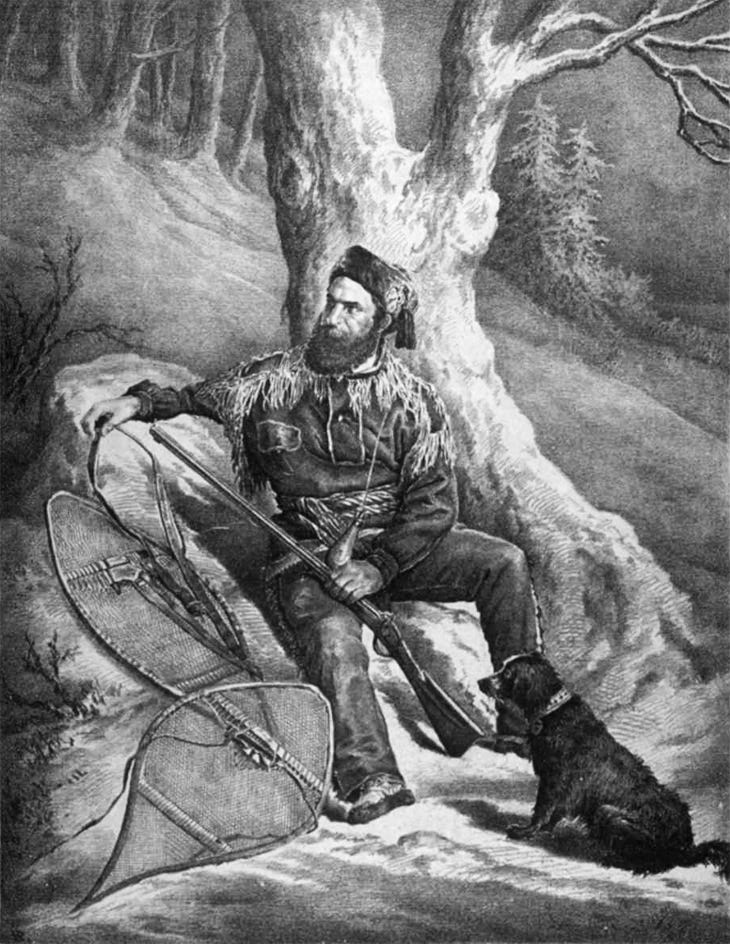
In The Callen Chronicles, the story is that the twin daughters of Patrick Callen, about six years of age, were taken from his home in Westmoreland County, Pennsylvania, during a raid by hostile Native Americans. One of them returned to her family after a white trader (one of those mythical frontiersmen) came to the village where she and her sister had been living for about 12 years.
The story George Callin recorded tells of Polly, a daughter of James Callin, who was taken in a raid, presumably from his home in Westmoreland County. In that story, James summoned a posse, which chased down the raiding party and recovered Polly, who was permanently injured in the ensuing fight.
Determining which parts of these twin stories are “true” is challenging. The account in The Callen Chronicles contains more details, including a mention of the relationship between Margaret (the twin who was recovered) and Patrick Callen’s grandson, Watson. It is also a less dramatic story, told in a way that sounds more factual, although neither story has any facts that are likely to be verifiable by research. My theory is that the Patrick Callen version of the story is probably “true” and that the version told about “Polly Callin” was altered and adapted as George’s grandfather and great-uncle retold the story to their children in Ohio, and was further adapted by those children when they told the story to their children.
Framing this story as part of a larger American Mythology has nothing to do with whether or not it is “true” and everything to do with how the people telling the story felt about it. And in the story of the stolen daughters, the people telling the story felt threatened by an outside invader…even though, strictly speaking, they were the outside invaders.
James Callin, Indian Fighter
I still don’t have enough evidence to make a proof argument connecting my Ohio ancestors to the Revolutionary War veteran named James Callin, whose military career I have written about before:
So far, my research amounts to speculation about who my 5th-great-grandfather might have been, and if he was this person, I further speculate that the story told about Patrick Callen’s daughters was turned into a story about James Callin’s daughter as James’s descendants created the family’s origin story.
I have to acknowledge that I am continuing to create that origin story. Even if I can find evidence to prove that the brothers who settled in Milton Township, Ohio, in the early 1810s, James and John Callin, were the sons of the Revolutionary War soldier named James Callin, all of this is still part of the mythology recorded by George and the Callen researchers.
As I learn more about our history and try to trace my ancestors’ place in it, I can see why the story of these girls was necessary to the mythology built up around our family. Because without this dramatic tale of being attacked in our homes and having our vulnerable children snatched away by “invaders,” James Callin would have no honorable reason to join General Scott’s Kentucky cavalry and be a part of the war to push Native Americans out of the Ohio Territory.
Whether James claimed the story of Polly as his own, or (more likely) he repeated the story of what happened to Patrick’s family to his children and grandchildren, it became a part of the family’s mythology: a self-image of ourselves as victims fighting back against a terrifying threat. And our fear of that threat was used as part of a broader campaign to make us part of the United States’ plan to expand westward.
Our Family Origin Story
Whatever the specific facts may prove to be, my version of that family origin myth currently says:
“Our Callan ancestors came to North America from Ireland. In Ireland, they suffered from increasing oppression from their British neighbors and the violence and economic hardship brought on by centuries of religious conflicts. In America, they were caught between hostile factions of English and French colonizers who allied with warring groups of indigenous Americans at different times for different reasons.”
The Callans seem to have justified the part they played in displacing Native Americans from their homes by pointing to a specific raid that harmed and terrified them, and they have passed that story down for generations.
James Callin probably chafed under the Quaker government of Pennsylvania, as the pacifist Quakers and the British government were unwilling to provide soldiers or arms to defend the people living along the front lines of the French and Indian Wars. That could explain why he enlisted with a Virginia Regiment when Virginia sent recruiters through Westmoreland County, PA (which, at the time, Virginia claimed as Yohogania County), and that would explain how he ended up serving under General Scott.
Later, in 1794, when James likely joined the Kentucky cavalry to fight under Gen. Scott again, Gen. Scott had personal reasons for wanting revenge on the Shawnee people from Ohio who had killed his son. The need to see himself as defending his family, rather than framing himself as a genocidal aggressor, could explain how James’s descendants transformed a story about the raid on Patrick’s family into a raid on their own.
And that is how, despite whatever the facts might be, a myth is born.
The Power of the Modern Myth
Here in America in 2025, we tell ourselves similar stories to justify our actions. Americans whose ancestors came from around the globe to live here have become the native population that fears outsiders. I can’t help noticing that our fear of them probably has more to do with what we did to the indigenous people of North America when we were the outsiders than it does with any supposed actions by modern immigrants. Most of the stories we tell ourselves capture how we feel rather than reflecting the facts.
Too many Americans seem willing to accept lies about being “invaded” by people from other countries, and listen to men calling for an end to what they call “open borders”—a myth that ignores how the open borders between our states drove our unity and economic growth after the completion of the railroads in the 1880s and after World War II.
Too many Americans feel the economic disparity caused by decades of income inequality and buy into the idea that, because resources are scarce, we must accept further economic austerity and cruel policies towards our most vulnerable neighbors—a mythical argument that doesn’t hold up under the weight of historical evidence.
Our record of learning from our past and seeing through misleading myths is not great. Few of our average citizens are willing to do the hard work of figuring out what is and isn’t true, and prefer to embrace a version of their story that justifies their part in whatever they have already decided to do. If we’re lucky, we will still be here to recover after the consequences of their choices play out, and we’ll get to tell a more accurate version of their story.
When James Callin and his children told themselves their origin myth, they couldn’t have known the scale of the atrocity they were committing. To them, the continent was vast, and they were the underdogs. But by 1910, when George wrote his history, the brutal treatment of the Native Americans was mostly complete, and the establishment of America as a rising world power included a “cowboys and Indians” myth as part of our national image.
When George recorded his version of the family origin story more than a century after his grandfather’s time, he didn’t have many facts and accepted the version of the story that justified the family’s place in America. Now, more than a century after George, I still don’t have many facts and must do the best I can to tell our story.
I can only hope that in another century, researchers will find my work and that it will help them understand why we told that story.
You might recall that I talked about my wife’s ancestry in February—particularly the difficulty in tracing the Jones family of her 2nd great-grandmother, Alice Frances (Jones) McCullough. I had intended to follow up on the Jones family sooner than this, but today is the day:
Introducing the Brookhousers
Alice’s mother was Susanna (Brookhouser) Jones (1836–1924). After I wrote about the Jones family, another descendant of David Jones and Susanna Brookhouser reached out on Ancestry, and we have been corresponding periodically since then. I have to confess, she has been doing the heavy lifting, so right now, I’m building off of her work.
There is a lot we still don’t know about David and Susanna’s lives. If you look at Susanna’s WikiTree, I have Albert Jones (b. 1851) listed as their eldest son, but I haven’t been able to prove whether Albert was their child or not. If he was, he most likely died at an early age. And I am still trying to determine when they were married. The only evidence I have is the 1900 Census stating they were married in 1854. And I estimate that they moved to Iowa between 1864 and 1870, probably after the end of the Civil War.
Susanna was the daughter of Adam Brookhouser, Jr. (1803–1865) and Mary Stokes (1808–1881), born in 1836 in Pennsylvania. Her family lived in Hayfield Township, Crawford County, Pennsylvania. When Adam was born, his parents lived in Crawford County. They appeared in Meadville on the 1800 Census. Mary Stokes was the daughter of John Stokes and Margaret Elizabeth Peters (1780-1876), and was also born and raised in Crawford County.
Adam and Mary had ten known children, including Susanna. My goal is to flesh out their biographies on Ancestry and then add them to WikiTree in the next couple of weeks. Once that is done, I’ll be able to connect Adam Jr.’s profile to the existing family that currently ends at his father’s profile.
Ascending the Brookhouser Tree
As you work your way through your family tree, you probably have one or two generations of ancestors who don’t get the attention they deserve. For whatever reason, one person’s biography will get less focus than their children and their parents. In this family, that person is:
Adam Brookhouser, Sr. (1776-1863) will eventually get more attention, but for now, I need to finish documenting his grandchildren. And while I’m doing that, cousin Jodie keeps finding interesting sources to tell us about the rest of the family. For example, here is the biography she found for Adam Sr.’s father:
JOHANN ADAM BROOKHOUSER
JOHANN ADAM BRUCHHAUSER later BROOKHOUSER, tailor {9,27}, born Obernhof in Rheinland-Pfalz, near Koblenz, Germany, 2 March 1734, son of Johann Jacob Bruchhauser and his wife Margaretha Elisabetha Klumb {1}; emigrated to Philadelphia in 1764 {3}, and later lived in Berks {5}, Northampton {6,7}, and Westmoreland counties {8} before moving to Crawford County, Pennsylvania, by 1800 {9,10,19}; died 2 February 1818 {17}; married Swedes Church, Philadelphia, 6 June 1768 {4} ANNA MARIA HAUCK or Houch, born Germany in 1743 or later, died Hayfield Township 22 December 1839 {17,19-21}; both buried there in Brookhouser Cemetery.
Each of those {digits} is a source that needs to be examined and verified before I can incorporate it into the existing profile for Johannes Adam Brookhauser (1734-1818)!
I will have to take special care since I have three generations of men named “Adam Brookhouser” with records in the same county.
Meanwhile…
Though it takes time and effort to properly care for a family tree, it can help to see the work laid out ahead of you. And I find the prospect of turning names and dates in a list from data points into people to be a fine motivator.
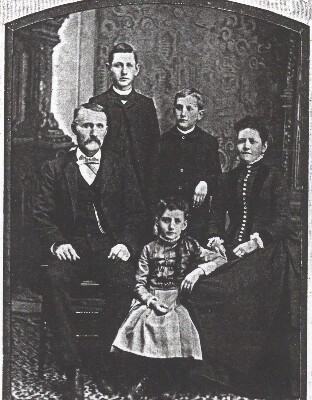
They may be beyond caring about what I do, but I like to think that someday soon, there will be a well-sourced story behind each of these faces.
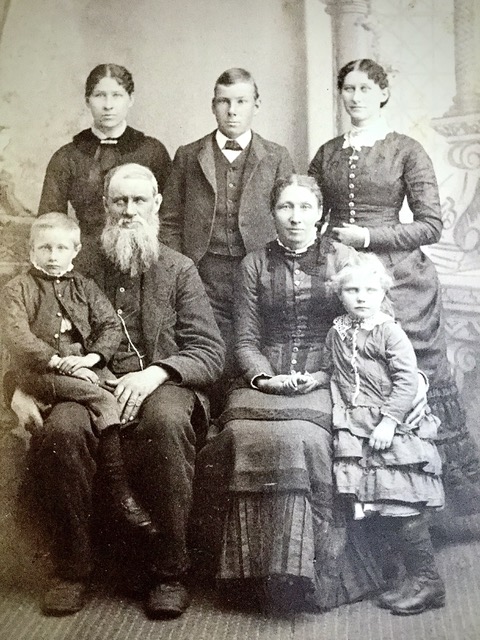
David E. Jones (bearded) and Susanna (seated to his left); William (b. 1870, center) flanked by Alice (b. 1857, to his right) and Martha (b. 1864, to his left); Bert (1878) on David’s lap, and Bessie (1881) left of Susanna; about 1887, 13792 Haugh Road, Waterford, Erie, PA
As I’ve been writing about the branches of my children’s ancestry this year, I’ve had to consider many points of view that are very different from my own. Most of those differences are due to the religions practiced by those ancestors.
The history of America was driven by the choices people made, often in the name of their religious traditions. The founding of the British and Dutch colonies was as much about people fleeing from the violence and political upheaval caused by the mixture of religion and government in post-Reformation Europe as it was about conquest by those European powers. Westward Expansion of white American colonists had as much to do with the four major revivalist periods known as the Great Awakening as it did with the desire to exploit resources and crush the people already living in the West.
My recent posts about the families who took the Oregon Trail happened to be about people who belonged to the mainline Protestant denomination called the Christian Church (Disciples of Christ), but there were dozens of groups moving westward together, hoping to find “new land” where they could build a community free of the “outside world” — and we often shy away from talking about the specifics of what that meant.
Sometimes, those specifics involved uncomfortable positions on sexuality.
A Core Belief
Determining the core beliefs of individuals and separating those from the teachings of a larger group is always complicated, at best.
Consider the Oneida Community that existed in upstate New York from the mid-to late-1800s. They formed at the end of the Second Great Awakening, which gave rise to many new religious movements in the United States, such as Adventism, Dispensationalism, and the Latter Day Saint movement. The Oneida famously practiced group marriage, lived communally (in the sense of communal property and possessions), and practiced “male sexual continence” – a concept I won’t go into here, but which is not typically associated with “Christian mores.”
The Oneida community waned, but The Latter Day Saints also have a history involving the practice of polygamy, and they have long struggled with separating the positions of the church as a whole from the individual practices of its members or of groups that broke off from the main church. The struggle has always stemmed from the tension between “orthodoxy” (the official rules of the main group) and “heterodoxy” (the individual freedom of members to be guided by their conscience).
The common thread that seems to bind all religious organizations throughout history is this: how do you convince individuals to accept limitations on their behavior while allowing those same individuals to believe their free will is not at odds with the church?
It’s about power: the balance of power between an organization that can only be as strong as its members allow, and individuals who agree to overlook and tolerate behavior they don’t condone for the sake of maintaining whatever benefits the organization gives them.
Or, to be more concise: it’s about the power to decide who gets to decide.
Conscience versus Conformity
Which brings me to Pride Month, my children, and where the Queer Spectrum fits into our research.
Yes, I buried the lede, and I apologize, but—if you’re someone who isn’t comfortable talking or thinking about this subject, I wanted you to consider the vast diversity of religious thought our ancestors represent. Because at the end of the day, embracing our Queer cousins is not about sex, but about accepting that someone else has fundamental beliefs about themselves that you don’t have.
And those fundamental differences don’t have to keep us apart.
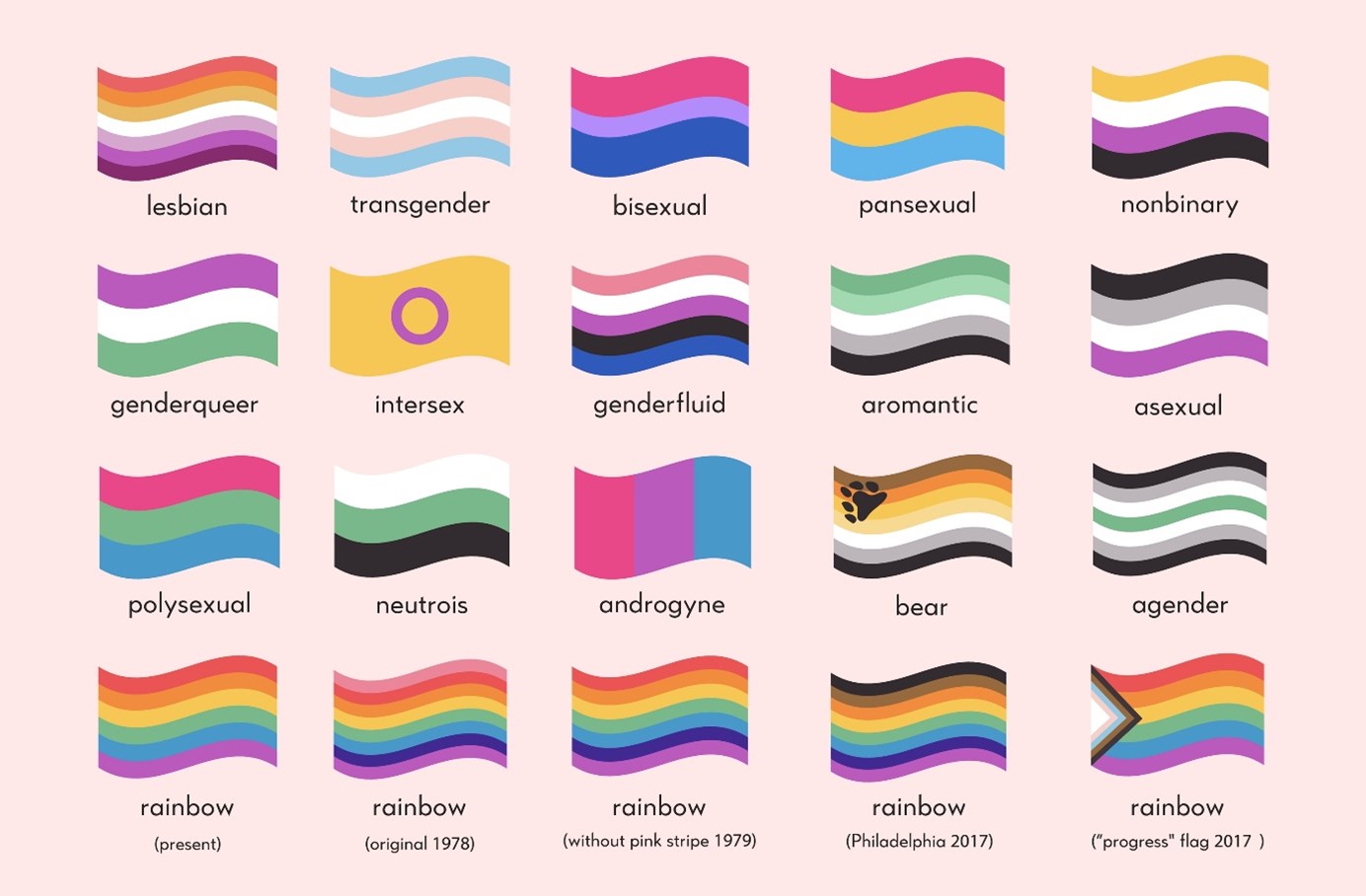
A Brief History of Our LGBTQIA2-S Pride Flag from the LA County Dept. of Mental Health
In middle school, my eldest (top row, second from the left) brought home a homework assignment to “write a 350-word essay about a topic in the news” and turned in a passionate and articulate defense of the then-recent legalization of same-sex marriages. The argument turned on the fact that some people who argued against such marriages based their objection on their personal religious beliefs. My brilliant child recognized early on that whether you believe someone is “born that way” or is “making a choice,” the Constitution is supposed to protect people in either case from being forced to practice someone else’s beliefs.
Even at that time (around 2012), most of us didn’t know nearly as much about the variety of human gender and sexuality as we probably do now. I know I’ve learned a ton in the last decade and a half – and I would urge anyone to at least take a few moments to Learn About the Queer Spectrum. But what I remember is how impressed I was that my middle schooler arrived at such a concise legal defense of human rights, before they even understood that fundamental thing about themselves.
My eldest is nearly 30 and engaged to a delightful music teacher. And last October, my youngest (top row, second from the right) was married to someone who could claim several of those flags. I told you about their literal fairy-tale wedding:
More recently, we talked about Richard Zimmerman, whose WWII U.S. Navy discharge raises questions that still make people uncomfortable to discuss.
And, of course, there are dozens of relatives like Dr. Caroline Putnam, who remained single all their lives, and may or may not have considered themselves to be what we would now call LGBTQ—we simply don’t know how many of them may have belonged on that spectrum, or would have known it if they did.
Point being: there is a lot that we don’t know about the people living in the past. There have always been queer and transgender people, but if their society and their family forced them to conceal who they were, we may never know which ones they were.
So, if you’re still not comfortable thinking about it, take your time, and then come back and follow up with some homework later.
Further Reading
Thomas MacEntee is a professional genealogist who writes and speaks about family tree software. He has also written about the subject of finding and documenting LGBT ancestors at MyHeritage and on his platforms:
Taking a moment for a little shameless self-promotion
I posted this list of my other projects last May, so I thought it was time for an update. These are all ways to support what I’m doing, if you would like to do so. And, of course, you can become a paid subscriber here:
I first encountered the term “hoardings” in England, where I took it to mean the same thing as a billboard. But “advertising hoardings” refers to the large boards erected around a construction site, which can prominently feature printed graphics and designs. And that seems an appropriate description for today’s post.
Last year, I discussed the importance of writing consistently, mentioning that I like to schedule several weeks’ worth of posts in advance so I don’t feel like I’m rushing to meet a deadline. But as of this post, I’m only scheduled for the next two weeks … and while I do have several things in draft, it feels a little bit like a construction site in my draft folder.
So why not use this dusty space to advertise? And what should I advertise? How about me?
Around my 45th birthday, I realized there were several things I wanted to accomplish before turning 50 – first on the list was to take my favorite stories from the blogs I posted in the early 2000s and publish them as a book. My friend Johanna offered to be my editor, and in 2016, we published “Tad’s Happy Funtime” – named for my early blog.
Tad’s Happy Funtime – available in paperback and Kindle editions
My first (and so far, only) fiction sale was a story called “Silver,” published on the Dunesteef Audio Fiction Magazine podcast in 2008.
At the time, I was inspired to write by Escape Pod, the weekly science fiction podcast, which launched in 2005. The company has expanded to five podcasts – science fiction, fantasy, horror, Young Adult speculative fiction, and Catscast…which is cat-based speculative fiction. As you would expect.
Escape Artists, Inc. became the Escape Artists Foundation in 2023, a non-profit organization dedicated to producing free, listener-supported stories every week and paying the creators who make it all possible. If you like fiction, it will cost you nothing to visit their company website, EscapeArtists.net, and look around!
Since 2016, I’ve been an associate editor for their Pseudopod Horror Fiction podcast, where, in addition to reading submissions (an adventure in itself), I’ve hosted and narrated several episodes. You can find links to the episodes I’ve been on at this link.
In September 2021, I narrated Escape Pod 802: Sentient Being Blues, a story about a Russian mining robot that gains sentience and starts singing the blues. I had a ball doing it, and now I get to claim (factually) that I’ve appeared on the same podcasts as Anson Mount and Linda Hamilton!
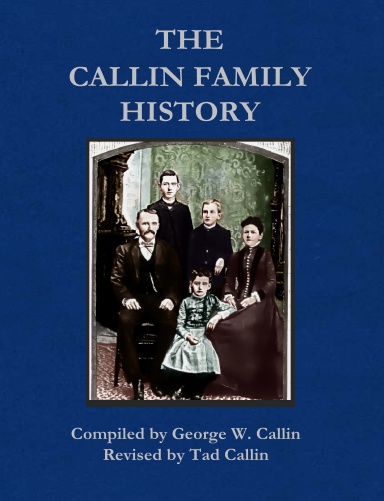
Long-time readers will know that in March 2022, I published my updated Callin Family History on Lulu.com:
We hadn’t unpacked the books yet when this arrived in the mail!
This is the one I worked on for seven years – it has a BLUE cover with a portrait of the family of George W. Callin (restored and colorized by Claudia D’Souza, the Photo Alchemist).
I was inspired to start that project by the original 1911 Callin Family History:
This is a replica of the original Callin Family History published by George W. Callin in 1911. It has a RED cover and is much smaller than my Big Blue update. If you’d like a copy of this one, you can get it in either paperback or hardcover:
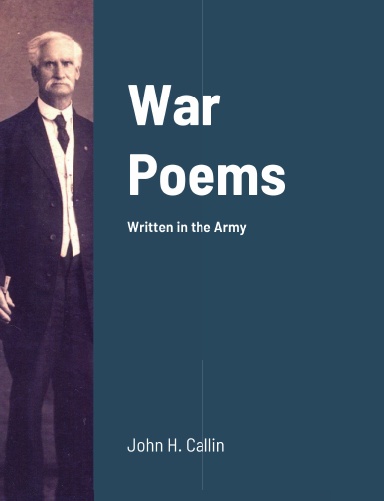
This was my secret side-project for much of 2021. My aunt Vicki inherited a book of poetry written by her great-grandfather, John Henry Callin, and she and I collaborated on transcribing it and editing it for publication.
(The link to War Poems will ask you to verify your age due to “explicit content”; that’s because there are grisly descriptions of John’s wartime experiences in some of the poems.)
Last year, I launched another Substack, All Kinds Musick, where I try to connect with the “why” of the broad range of musicks that I love. Occasionally, I manage to write something there that has to do with family stories, so you might have seen a couple of cross-posts.
Are you still with me? That’s very kind. I guess the only thing left to promote is my SoundCloud… which I recently learned still exists!
I only posted a few recordings to try out the service, but I was pretty proud of these two.
“Birthday Disco” is a song I wrote for my girlfriend in 1991 and recorded in the then-new electronic music studio at Glendale (Arizona) Community College.
“Beyond Belief” is probably still my favorite Elvis Costello song, recorded at home in Maryland around 2010.
Got any projects you’re proud of? This seems like a good place to mention them!
Next time, we can go back to talking about family history.
Thanks for reading Mightier Acorns! Subscribe for free to receive new posts and support my work.
He was active during a time when Americans enjoyed a newfound sense of optimism and possibility about their place in the world and when average men, like those in his family, were documenting their own lives as if they were the Great Men of history.
He published his research in a book called “The Callin Family History” in 1911, paying for the printing of an unknown number of copies bound in red leather. My grandfather received one of those copies, which found its way to me. In 2015, I published a replica of it on Lulu.com so any interested researchers could inspect it for themselves:
Learning From His Efforts
I have written before about some of the flaws in this book. George did not cite any of his sources, and he framed several claims about the origins of the Callin family as received wisdom from “our fathers,” who may or may not have had first- or even secondhand knowledge of the “facts” they passed on.
My early research grew out of George’s book. I used the facts he documented to hunt for census records using free Ancestry and FamilySearch records, and eventually expanded to a full Ancestry subscription that allowed me to fill in a lot of gaps using Newspapers.com and Fold3.
I re-published George’s book in 2015 as part of my project to update his work and provide source citations to support (or refute) his claims. Seven years later, I published my own imperfect document: an 800-page behemoth capturing up to seven generations of descendants of the man George referred to as “James 1st,” a Revolutionary War soldier who may or may not have been born in Ireland.
Who Did George Meet?
As I built my Callin Family History, it became clear that George didn’t use many official records. More likely, he got his information by speaking to his older relatives and relying on their memories. The closest he comes to referring to records is this statement early on:
Making deductions from the earliest known marriage record, that of Thomas
Callin, grandson of James 1 st , the order of descent would be like this…
Some hints suggest George corresponded with relatives who lived outside of Ohio, but I think he gathered most of the information for his book from relatives who returned to Ohio for annual family reunions, the first of which he hosted in 1906 at his home on “the corner of Pearl and Buttonwood avenue, Bowling Green, Ohio.”1 That article, and those documenting later reunions held in Akron in 19102 and in Bowling Green (again) in 1914, list the attendees, which I can compare with the contents of George’s book to see if I can tell who he met, and who got left out of his book.
(I was going to try to talk about that in this post, but it is turning out to be a deep, time-consuming rabbit hole involving a spreadsheet and multiple lists of 50-75 attendees… some of whom I also missed!)
The upshot is that George was acquainted with many of his cousins and their children who lived in Ohio.
An Elusive Irish Source
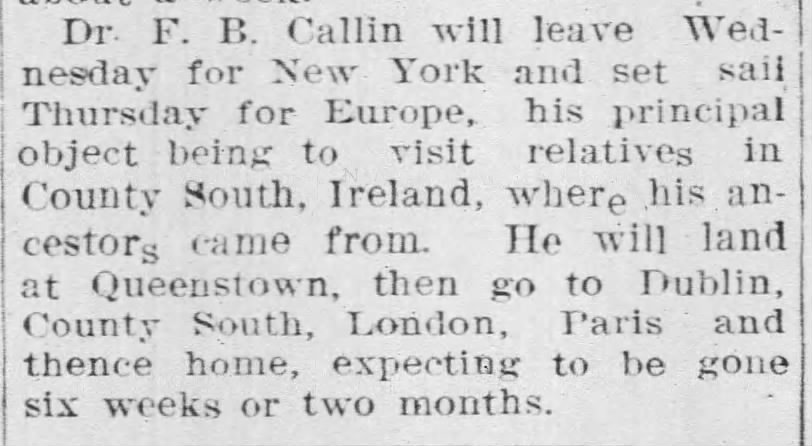
You might recall that I wrote about Dr. Fred Callin a while back, in The Angry Doctor. Dr. Fred was another family historian, and he was listed among the attendees of the 1906 Callin Family reunion, where, according to The Daily Sentinel Tribune:
Away off in Ireland one of the members of the Callin family and written and sent an interesting letter which was read aloud.
I speculate that the writer of this letter might be the person Dr. Fred visited the following year:
I have been skeptical over the years of the family’s claims to Irish heritage, but these tantalizing clues suggest that they had something more solid than a vague legend of the Old Country. I just wish they had recorded their relationship.
Who George Did/Didn’t Know
While I can puzzle out who George met during his later years, I have to make some educated guesses about who he knew as a child. George knew his parents, William Callin and the former Elizabeth Berlin. He probably only received oral history from them. I know from the essay written by George’s daughter, Rosemary, in 1973, that Elizabeth was illiterate until her sons enlisted to fight in the Civil War. I assume that William was also illiterate, based on this description, which may have been written by his grandson, Byron H. Callin, in 18953:
“He was an industrious, hardy, persevering man, possessing great physical strength, but had only a limited knowledge of books. He had a mind of keen perception and sound judgment, and was well fitted for pioneer life.”
George did not know his grandfather, John Callin, who died of tuberculosis in 1835. He might not have met his grandmother, John’s widow, the former Elizabeth Simon. She lived with her daughter, Eliza (Callin) Ferguson, in Auburn, Indiana, in 1860, and may have moved to Auburn when the Ferguson family moved between 1840 and 1850. George was born in 1846, so depending on how long Elizabeth remained in Ohio, he may have known her at a time when he was old enough to have memories about her. George’s book is the only source I have found that tells us Elizabeth Simon’s maiden name.
George did include descendants of his aunt Eliza Ferguson in his book, so it is possible he met some of them at a reunion, or perhaps traveled to Auburn to visit them. He also included some limited information about his aunt Ann (Callin) Campbell and her surviving children.
His father’s oldest sister, Sarah (Callin) Scott (1801-1872), married and moved to Illinois with her husband before George was born, and no one in Ohio seems to have maintained contact with them. Finding them in Rockford, Winnebago County, Illinois, was one of my proudest accomplishments for the revised Callin Family History.
William had six cousins, some of whom are documented in George’s book. Only Thomas Callin remained in Milton Township, and he died three years before George was born. Thomas and his wife, Nancy (Burget) Callin, had ten children, but five of them survived childhood. Most died before George was born, and only the family of Thomas Jefferson (Jeff) Callinwas well documented in George’s book. Jeff’s brother, Marquis, was believed to be dead by the time George compiled the book.
Three of Thomas’s siblings married Montgomerys, and we have been discussing them in our “Milton Township Diaspora” posts recently. But George did not seem to know about them at all. George only documented Thomas, Alec, and James; he did not mention Elizabeth, Sarah, or Hugh.
And that makes sense when you think about who would have still been around central Ohio after the Civil War. The Montgomery families (Elizabeth’s and Sarah’s children) were long gone by the time George began researching. And when we talk about the Iowa group (Alec, Hugh, James, and William’s sister, Margaret), they all moved in the decade before George’s birth and probably (mostly) died off.
To Be Continued…
I breezed past a ton of material in the last five paragraphs, and I do plan on giving more time to each of the families I mentioned. I learn more each time I revisit them, and it has been a while since I re-investigated the folks who moved to Iowa and then (mostly) died out. I have yet to find Alec’s descendants, and I know they ought to exist!
So, with all due gratitude to George for leaving his record in print, we will continue seeking to fill in the gaps.







 Mightier Acorns