Mightier Acorns

Journeys through Genealogy and Family History

A parody of a family coat of arms designed with acorns as elements, with the motto "ex gladnis potentioribus" Latin for "from Mighty Acorns"
From Mighty Acorns
  • Seeking unknown children can be a roundabout task

    Last time I talked about this family, I pointed out that Adam Smith (1792-1847) and Experience Garretson (1800-1897) probably had more children than were named in the 1850 Census, based on the 1840 count of their household:

    Today, I want to build the case that I found one of them: Harriet Zerelda (Smith) Compton. Like the rest of her siblings, she lived in Floyd County, Indiana.

    A Recap

    The Smith family lived in Greenville Township, Floyd County, Indiana, a few miles from Louisville, Kentucky. The document that forms the foundation for our argument is the 1850 Census1, which names Experience and four children (Philip, Jacob, Mary, and Jane). The 1840 Census2 (which only named the head of the household, Adam Smith) counted the family members, and I have filled in the names that we know, along with birth/death dates that I’ve been able to dig up:

    1840 Smith household:

    1. Male, born between 1811 and 18203

    2. Male, born between 1826 and 1830

    3. Female, born between 1826 and 1830

    4. A second female, born between 1826 and 1830

    5. Female, born between 1831 and 1835

    6. Philip William Smith (1831–1901)

    7. Jacob Smith (b. 1833)

    8. Mary M (Smith) Brown (1836–1929)

    (Remember, the youngest daughter, Jane (Smith) Frederick (1840-1916), was born just after the 1840 census was enumerated.)

    Isabella (Smith) Miller (1823-1909)

    We talked about Isabella last time; her death record named her parents as Adam and Experience, but there is a question about the timing of her birth. (If her death record and headstone have the correct date, then Experience might not be her mother.) For now, we may assume she is #3 on the list above, since she was married in December 1841 and ought to be in this household.

    (Since drafting this post, I recorded my thoughts about Isabella’s birth date and the possible implications on Adam’s WikiTree profile. More words at that link!)

    Harriet Z. (Smith) Compton (1826-1865)

    The journey to find Harriet began by poring over the documentary evidence for the biography of Mary M (Smith) Brown. Mary Smith married George W Brown (1833–1907) in 1856, and they had a daughter, Olie Brown (1857-1901), who lived with her parents all her life and worked as a music teacher. They moved a few times, ending up in Fremont, Colorado, where both George and Olie died.

    As you can see from those dates, George and Olie died long before Mary did, so I was curious who provided the information on Mary’s 1929 death certificate:

    detail from Mary (Smith) Brown's 1929 death certificate showing the informant's name: Hattie Devol of New Albany, IN
    Indiana death certificate for Mary (Smith) Brown – 5 Nov 1929

    I had no idea who “Hattie Devol” was, or where to begin looking for her, but I kept digging and ran across her name again, in a newspaper snippet that mentioned Olie Brown:

    MISS HATTIE DEVOL, Miss Olie Brown, Miss Daisy and Mr. Merrill Frederick, of New Albany, who have been spending several days in the city [Louisville], have returned to their homes.

    ~The Courier-Journal, Louisville, Kentucky, Sun, Jun 13, 1886, Page 6

    I assumed that since Olie (Mary’s daughter), Daisy, and Merrill (Jane’s children) were cousins, Hattie might be the daughter of one of the other missing Smith children. I created a new person profile for her on Ancestry and started collecting evidence to show who her family members were, hoping to find a thread that led back to the Smiths.

    Harriet Compton “Hattie” Devol (1868–1944) was the daughter of George Henry Devol (1839–1918) and Eliza L Compton (1845–1919). That made her 11 years younger than Olie Brown, and about the same age as Merrill Frederick. A little more digging revealed that Eliza Compton’s parents were Banister Compton (1819–1872) and Harriet Z Smith (1826–1865).

    I have yet to discover any direct documentary evidence that Harriet was the daughter of Adam Smith and Experience, but I can’t imagine why Hattie Devol would be completing Mary (Smith) Brown’s death certificate if they weren’t related.

    That would probably make Harriet Z. (Smith) Compton #4 on that 1840 Census above.

    The Search Continues

    Another lead or two should help us find out more. There are at least two more names to find, plus Jacob Smith (b. 1833) only appears in the 1850 Census, so we need to track him down.

    Time to go double-check for informants and newspaper clippings.

    1

    1850 United States Federal Census, Place: Greenville, Floyd, Indiana; Roll: 145; Page: 464a.

    2

    1840 United States Federal Census, Place: Greenville, Floyd, Indiana; Roll: 79; Page: 153; Family History Library Film: 0007724.

    3

    This oldest male might not be a child of Adam and Experience—he was born before their marriage in 1825. He could be a younger brother of either Adam or Experience, a servant or farmhand, or another relative taken in by the Smiths. We don’t have enough information to speculate, yet.

  • Most of her story remains underground

    The Opp family is my mother’s maternal grandmother’s maternal side—and if that doesn’t emphasize “maternal” enough, I think of them as being on the Opp-osite side of the tree from my Callin family.

    (Opening with a Dad joke of that magnitude should rebalance things, don’t you think?)

    I’ve tried to write about this family before, but I kept getting stuck, as you’ll see, so I decided to start with the people who presented the biggest mysteries and roadblocks. Perhaps if we talk through it together, I will find it easier to work my way back through the rest of the family.

    Welcome to all of our new subscribers! Mightier Acorns doesn’t have a paywall, but appreciates free or paid subscribers.

    Emily Amelia (Opp) Frey was my 2nd-great-grandmother—one of “My Sixteen”—and her brother’s family poses several research challenges. We’ll get to him, but first:

    Finding Jessica

    Jessica Viola Owens was the third of four daughters of Walter William Owens (1850–1933) and Charlotte E Clarke (b. 1868), born on 1 August 1896 in Manhattan, New York City. Charlotte was born in England and arrived in New York on 17 October 1888 aboard the SS Ludgate Hill. Charlotte and Walter married the day after her arrival, on 18 October 1888.

    Just over a year later, Janet Emily Owens was born on 9 November 1889. Florence Clark Owens was born on 12 January 1891, followed five years later by Jessie, who remained the baby of the family until she was nine years old. Then she was supplanted when Gladys Charlotte was born on 11 November 1905.

    The Owens family lived in The Bronx, and they probably benefited from the newly opened subway system, the world-famous IRT.

    By Epicgenius – Own work, CC BY-SA 4.0, https://commons.wikimedia.org/w/index.php?curid=99337648

    Jessie’s First Marriage

    This is where things became difficult, because the evidence tells me things that make me question whether the facts are correct, because the situations they imply are unusual.

    Marriage license index records tell me that Jessica Owens married Stanley Slaker (1891–1972) on 9 May 1911 in Manhattan. She was 14 years old, and Stanley was 19. That seems young to me, but it’s consistent with the later records.

    Stanley was a puzzle, because it turns out he also appears under the name Stanley Slicinski in some of his military records. It’s not that odd for people to use an Anglicized name; it just seemed odd that he could be found under both names. After comparing details across several military enlistment and draft registration records to be sure, records showing his different names but with a matching, precise birth date (27 October 1981) and his World War I enlistment date (11 October 1917) led me to believe they are showing me the same person.

    On 5 Jun 1917, Stanley Slicinski signed his WWI Draft Registration card. He listed his residence at 742 East 217th St., Bronx, New York City, and his marital status: Married with 2 children. New York birth index records tell me that Stanley W Slaker was born on 18 Oct 1912 in Manhattan, and Dorothy Slaker was born on 21 Aug 1914 in Bronx, New York City.

    Normally, I think men were exempted from the draft if they were married with dependents, but as I said, Stanley enlisted in the U.S. Army on 11 October, just over 4 months after registering. I suspect this is when Stanley and Jessica separated, because by the time the 1920 Census was taken, Jessica, Stanley Jr., and Dorothy were living in the household of James Henry Opp… and all three of them were listed with Opp as their surname.

    What makes things difficult for me is that Stanley Sr. doesn’t show up in census records after his marriage. I only get his military records—the most recent of which was his 1942 World War II Draft registration, which said he was living at 711 East 231 St., Bronx, with someone named Jesse Slaker at that same address. I considered the possibility that our Stanley died in the war, leaving Jessica widowed to marry James Opp, but as I said, the later military records have precisely matching dates, and it’s pretty clear Stanley lived until 1972.

    So something happened to his marriage between 1917 and 1920.

    James Opp’s Third marriage

    James Henry Opp found himself a 45-year-old widower in October 1915. He had been married to his second wife, Lillian Jones (1871–1915), for 19 years, and their youngest child was a ten-year-old daughter, Emily Amelia Opp. Emily was named after her aunt, my 2nd-great-grandmother.

    The Opp family lived in Newark, and James ran an export business in New York. I don’t know what circumstances put a middle-aged widower in the orbit of a 20-year-old mother of two who was living in the Bronx, married to a machinist, but these are the facts I have. In chronological order:

    • 18 Oct 1912: Stanley W Slaker was born.

    • 21 Aug 1915: Dorothy Slaker was born.

    • 6 Oct 1915: Lillian (Jones) Opp died.

    • 13 Jan 1917: Emily A Opp died at age 13.

    • 11 Oct 1917: Stanley Slaker (Sr.) enlisted in the Army.

    • 13 Oct 1917: James Henry Opp, Jr. was born.

    • 1920: The Opp family appears in the census, living in Elmira, Chemung County, New York.

    • 10 Apr 1926: Jessica Viola Opp was born.

    • 1930: The Opp family appears in the census, living in Elizabeth, Union County, New Jersey.

    That 1920 Opp household tells me a lot. It includes: James and Jessie Opp (49 and 24, respectively) and Julian Opp (21, James and Lillian’s son), Walter and Charlotte Owens (69 and 51, Jessie’s parents), Gladys Owens (14, Jessie’s sister), and three children under 10: Stanley Opp (7), Dorothy Opp (5), and James Opp (2).

    I found no marriage record for James and Jessie, but I think the unavoidable conclusion is that they combined their families in 1917. The 1930 household is not much different from the 1920 household. Charlotte Owens is not there, though Walter is listed as “married” and not “widowed.” I haven’t figured out what happened to Charlotte yet. The other major addition is 3-year-old Jessica. And in 1940, James (70), Jessica (43), and Jessica (13) lived in Newark.

    If you look at the timeline and assume that James adopted Stanley Jr. and Dorothy, the facts all make sense. That timeline raises a lot of questions. It’s clear that James Opp Jr. was conceived soon after Emily Amelia died, and the timing of Stanley Sr.’s enlistment suggests that he may have learned that his wife’s third child was not his, probably during that summer. I always say I don’t like to judge people without knowing the facts, but somebody in this equation made some cruel choices.

    Whatever the situation, I doubt Stanley Sr. was happy about these events.

    An Opp-ilogue

    James Henry Opp died on 1 Aug 1941 and was buried in Sleepy Hollow Cemetery in Westchester County, New York. Jessica stayed in New Jersey until around 1962, when Mrs. Jessica V Opp appears in Los Angeles County, California. She lived in Thousand Oaks for 20 years and moved to Lompoc in 1986.

    Jessica was 90 years old when she died, survived by sons James Opp of Camarillo, CA; Stanley Opp of New Jersey; Dorothy Campbell of New Jersey; and Jessica Whitesell of Solvang, CA.

    I still have a lot of questions, and there are several more stories to tell about James Henry Opp’s life. But at least the story of the Girl from New York City seems to have had a happy ending.

  • Reflections upon reaching 5,000 edits

    I knew the big round number was creeping up on me, but I didn’t expect to see it when it happened. I tend to go for several weeks without editing, then add a flurry of full biographies for a whole family group.

    But…

    screenshot of my 5001st WikiTree contribution
    Tad’s Contributions page

    Major v Minor

    Everyone’s approach to editing a wiki is different. Some people are more comfortable adding one fact at a time. Save, read, edit; view, save, read, edit—building one page might mean a few dozen edits until they get it “right” and move on.

    I prefer to gather all the facts and evidence, draft as complete a biography as I can, and put my source citations in order before I even begin to create a page. I still end up finding minor edits to fix, but for me, one page usually means 3 to 5 edits.

    Neither approach is “right” or “wrong,” and I am just grateful when other people add even a small edit to a page I’m interested in.

    A Little Preview

    You will notice that edit #5,000 was on a new page (created as edit #4,999) for the first wife of James Henry Opp. I worked on my Opp family extensively about a decade ago, before getting on WikiTree, and I keep trying to work my way back in their direction. They need to be added to the wiki, but there have been some challenges.

    James H. Opp was an interesting character and his biography took several twists and turns: an early divorce, a bankruptcy, allegations of embezzlement (not by that name, because they were unproven allegations and that would have been libel), and a total of three marriages with 2, 3, and 3 children (plus one adoption) with each wife, respectively. My standard is to try to develop as complete a biography as possible for each wife and child, and since the family spent time in New Jersey, New York City, and Upstate New York, the records are scattered and hard to find.

    But once I get all of that done, I will start climbing those Opp Wavetops, and there are some interesting folks up there!

    To the Next Milestone!

  • Spoiler: it was also called “Smith”

    I can’t help myself.

    The focus of today’s post is the Smith family, so my brain immediately and urgently goes to Mary Poppins:

    Since Adam Smith died in 1847, I don’t think he’ll be coming after me anytime soon.

    I’ve spent some time lately updating the WikiTree profiles for my wife’s family, starting from her great-grandmother, Aletha Frederick (Putnam) Martin (1899-1981). And Aletha’s maternal grandmother was born, Jane Eliza Smith (1840-1916), so that’s how my brain got to Mary Poppins. Q.E.D.

    You can find Jane in the bottom-right corner of Aletha’s chart:

    screenshot of the ancestry chart for Aletha (Putnam) Martin
    ancestry chart for Aletha Frederick (Putnam) Martin

    “Trust but verify” – with less “trust”

    Whenever I show you a profile on WikiTree, you can assume that I have at least some information about that person’s parents. Jane’s profile opens with this paragraph:

    Jane Eliza “Jennie” Smith was the youngest child of Adam Smith (1792–1847)1 and Experience Garretson (1800–1897), born on 26 Jun 1840 in Galena, Floyd, Indiana. Her father died when she was seven years old, and she grew up in a household run by her mother in Greenville Township.

    As sources, I cited the 1850 and 1860 census records showing Jane and her siblings living in a household headed by Experience Smith. But in my Ancestry profile for Jane (Smith) Frederick, I have several sources telling me who her parents and other ancestors were. I did not include them because I have not had a chance to verify these sources. (As it is, I feel bad for putting the names and vital dates for Adam and Experience in Jane’s profile without a source, but I rationalize that eventually I will get around to doing that when I build their profiles.)

    In this case, the sources I haven’t verified yet are from the Daughters of the American Revolution Lineage books. They do not include original source citations, so I don’t know how accurate the information is, and therefore, I should not “trust” it. However, the information required to complete a DAR application is supposed to be supported by evidence, so I treat the information as a lead to finding the original documents.

    For this Smith family, that means accepting the Ancestry hints (so I have leads and know where they came from) and looking for corroborating evidence. Once I have confirmed what I need to build a new biography, I’ll create a profile for Jane’s parents.2

    Defined By Absence

    Jane (Smith) Frederick’s father died in 1847. Since the U.S. Census didn’t start listing everyone in a household by name until 1850, this means that we will have to find less direct ways to confirm whether the records we find are for the right family.

    Not only is the name “Adam Smith” very common, but the family lived in Floyd County, Indiana, which is not a distant, rural outpost where we can assume everyone with the same name is related. Floyd County is just across the Indiana-Kentucky state line, on the North and West side of the Ohio River. You should be able to spot New Albany and Greenville on this map:

    That means we should be looking for records in both states and in newspapers based in Louisville. (There are a surprising number of references to the author of The Wealth of Nations in Louisville during the three decades our Adam Smith ought to have been living in the area.)

    Since the 1850 Census puts his family in Greenville, it is reasonable to assume that the 1840 Census for an Adam Smith in Greenville Township is probably the correct family. Here’s how the known family members from 1850 would fit into the 1840 household3:

    Adam Smith (1792-1847)

    Experience Garretson (1800–1897)

    unknown – possible son or servant, or other relative

    unknown – possible son

    Isabella (Smith) Miller (1823-1909) – m. 28 Dec 1841

    unknown – possible daughter

    unknown – possible daughter

    Philip William Smith (1831–1901)

    Jacob Smith (b. 1833)

    Mary M (Smith) Brown (1836–1929)

    If you compared this to the 1850 household4, you may have noticed that the document names Experience and four children (Philip, Jacob, Mary, and Jane)—but not Isabella. Isabella Miller’s 1909 death certificate gave us her maiden name and named her parents. The informant was her daughter, Anna (Miller) Wheeler.

    The discovery of Isabella presents a couple of problems. First, the birth date given on her death record and her headstone (3 Sep 1823) makes her about three years older than the oldest girl counted in the 1840 Census. Second, depending on which birthdate is correct, she might or might not be the daughter of Experience (Garretson) Smith.

    An Either/Or Puzzle

    Either Isabella (and her family) got her birth date wrong, or someone else was her mother.

    Floyd County marriage records show a man named Adam Smith marrying Elizabeth Kallahan/Hallahan on 9 June 1821. An undated grave marker exists for an “Elizabeth Smith” (inscribed “Mother” on the top) in West Haven Cemetery in New Albany, Floyd County, Indiana5. This evidence doesn’t “prove” that Elizabeth (Kallahan) Smith was Isabella’s mother. It doesn’t even prove that Elizabeth (Kallahan) Smith existed, but I have been unable to rule that possibility out.

    If the family misremembered the year Isabella was born, then she could have been born (as the 1840 census indicates) in 1826, after Adam married Experience.

    There is another possibility, since the 1830 Census has an Adam Smith family in New Albany. That record counts one Female born between 1816-1820, one Female born between 1821-1825, and two children, one Male and one Female, born between 1825-1830. If Isabella was born in 1823, she could have appeared on the 1830, and not been recorded on the 1840 census. (She married Jacob Miller in 1841 in Floyd County.)

    Either way, the family has several unknown children for us to find, and we need better evidence to tell Adam’s story.

    To Be Continued…

    At this point, I will need to go digging for more information about Jane (Smith) Frederick’s siblings, especially the ones who were in the household in 1830 and 1840. This will require chasing down obituaries for everyone, hoping to catch a name that isn’t already known, or hoping to find a marriage or death record that names the parents. (Which will probably be horribly misspelled, since Ancestry’s hints haven’t already suggested them.)

    But that’s what keeps us going, right? Always another mystery, just out of reach.

    1

    This is NOT Adam Smith (1723-1790), the Scottish economist who sired capitalism.

    2

    Update: I did end up building a profile for Adam, and found “orphaned” profiles for him and his parents, so I “adopted” and updated them: Adam Smith (1792-1847)

    3

    1840 United States Federal Census, Place: Greenville, Floyd, Indiana; Roll: 79; Page: 153; Family History Library Film: 0007724.

    4

    1850 United States Federal Census, Place: Greenville, Floyd, Indiana; Roll: 145; Page: 464a.

    5

    Elizabeth Smith” Memorial on Find-A-Grave.

  • Thinking about Hermeneutics in genealogy

    Stop and think before you read on:

    Did you answer the title question based on what you think “godly” means, or did you answer based on what your ancestors thought “godly” meant? Once you’ve fixed your answer in your mind, read on!

    The question in the title isn’t really about your ancestors. It’s about you and how you (inevitably, like a human being) project your understanding of the world onto them.

    Branching Fields of Study

    Genealogy is a field of study that sometimes demands that you become an expert in unexpected, additional areas. You may not be mechanically inclined, but learning about your great-grandfather’s career on the railroad may require studying a bit about running trains. Understanding your great-aunt’s medical career may lead you to digging up turn-of-the-century medical texts. And it never hurts to learn more about farming.

    But religion raises the difficulty. A while ago, I talked about how knowing about your ancestors’ faiths can be both useful and difficult:

    Learning about the faith of your ancestors can be tricky because you not only have to find out what religion your ancestors (most likely) practiced, but you have to figure out what that religion taught, what the disagreements and divisions within it were, and where your ancestors aligned with those divisions. This will never be obvious.

    How someone practiced their religion can either explain or be explained by their choices, so you sometimes have to dig a little deeper to understand what choices they were facing. There is a name for this kind of academic inquiry.

    What does “Hermeneutics” mean?

    Well, here’s the definition:

    Hermeneutics: noun - the branch of knowledge that deals with interpretation, especially of the Bible or literary texts.

    That might require some unpacking.

    I am an atheist/secular humanist now, but I was raised in a Southern Baptist family in suburban Arizona. Most people who learn I am an atheist now don’t realize that I read the Bible extensively in my youth and still read and study religion and religious history today. Their assumption that “atheist” means “ignorant of the scriptures” is a common mistake and is an example of one way we project our assumptions onto others.

    Growing up, my evangelical Christian community was “us,” and everyone else was “the world.” I remember attending week-long seminars in the summer explaining the flaws of the other religions that “claimed to be Christian” and why (in our view) they weren’t. One year, we spent one night each week on a different sect. We covered Catholicism, Jehovah’s Witnesses, “The Occult” (because it was the 1980s and we were in the middle of the Satanic Panic), and two nights discussing the Church of Latter Day Saints.1

    When I learned the word “hermeneutics,” I was horrified by the thought that my faith might be treated as just another point of view, the same as these other faiths that I had been taught to avoid and fear. It was offensive to imply that they were all equally valid, academically. I’ve outgrown that impulse, but I remember it, and I recognize it when other people are confronted with thinking about religion (especially their own) in a neutral, academic way for the first time.

    Common Southern Baptist hermeneutics for interpreting scriptures might sound familiar to American Christians. We called ourselves a “Bible-believing faith” and emphasized that the Bible was the literal Word of God. We talked a lot about interpreting the Bible “literally,” but we downplayed the fact that none of us were reading the original text in the original languages.

    Not being “orthodox” was very important to us, as well; we made a point of putting our conscience above any “earthly authority” such as a priest. Our pastors were sometimes more educated than we were, but were expected not to hold that against us. “Orthodoxy” vs “Heterodoxy” is just one fault line that can divide believers even within the same faith or sect.

    Two hundred years ago, whether members were “abolitionist” or not could be so divisive that groups might separate violently—one such conflict led to the establishment of the Southern Baptist Convention in 1845.

    These days, “progressive” vs “conservative” may be a more prevalent divider. One of my favorite writers on the subject, Fred Clark (known as The Slacktivist), has a handy post, “Shellfish Hermeneutics,” that illustrates some of the problems that even people of the same faith can have in understanding their hermeneutics.

    The Faith of Our Fathers

    Both of my grandfathers were ordained Southern Baptist ministers, but they were very different in their outlook. Grandpa Bob was a public school teacher who retired in the mid-1980s and went on to perform weddings at my Aunt Vickie’s bed and breakfast in his later years. In contrast, I wrote extensively about Grandpa Russ’s fiery iconoclastic approach to faith about ten years ago:

    The fact that everyone in the family and both grandfathers were Southern Baptists led me to take for granted that “we have always been Southern Baptists.” Only later did I learn that neither Bob nor Russ was raised in a church like mine. When my mom read an earlier version of “A Fire in the Desert,” she pointed out that she and her mother had urged Grandpa Russ to ‘get saved’ – and before she died, Grandma implied to me that she threatened to leave him in the 1950s if he didn’t stop drinking and join a church.2

    Grandpa Bob talked warmly about his family. In his view, they had been respected and well-to-do for several generations: teachers, businessmen, and “godly,” meaning that whatever church they were associated with, grandpa saw them as reverent believers. Grandpa Russ, in contrast, talked about his large family, then living mostly in Kentucky and Arkansas, as “not very good people” – meaning that they had problems with drinking and smoking3 and (when no other adults were around) infidelity. And yet, of all the ancestors I’ve studied, Grandpa Russ’s people had more people with “Reverend” prefixed to their names than any other branch.

    As I began to build my genealogical knowledge, I found references to the different faiths that my forefathers practiced. Their names didn’t tell me much about their beliefs: United Brethren, Presbyterian, Disciples of Christ, Quakers, German Reformed Church, and later, Methodist. But as I studied the Protestant Reformation and the waves of revivalist movements that swept the early United States, I learned about some of the deep divisions that plagued these different groups.

    Some of these were critical, opposing philosophical differences involving the nature of free will. Some were more symbolic, like how and when people should be baptized. “Infant baptism with confirmation later in life” v. “a commitment to raise a child to be baptized at some later time when their conscience moved them” seems like a cosmetic difference to some people, but it meant the world to Granpa Russ.

    Tips For Parsing Your Religious History

    You don’t need to attend a seminary to figure out what your grandparents believed. That might not help, anyway, since even a very orthodox religion will have differences of opinion and interpretation, and your folks could be on either side of any controversy. You might be lucky enough to find writings that give you an insight into what they believed.

    More often, you will get the name of their pastor and/or their congregation in an obituary. If you have the pastor’s name and a date range, you can search in newspaper databases or look for them in Google Books/Internet Archive-like sources, and see if they left writings that describe their teachings.

    You probably noticed my Wikipedia links to the different denominations above—I find Wikipedia is a great starting point for getting a neutral overview of the general history of a church. The bibliography on those articles can lead you to more sources; I like to look there for books with deeper information, or for collected writings by clergy of that denomination.

    If you are new to the study of religion in general, you could do worse than reviewing the Crash Course series on Religion:

    On Open Mindedness

    In my last post, about the career of Dr. Carolyn Putnam, I talked about the conundrum of honoring her as an independent professional woman at the turn of the 20th Century while also not lending credence to the field she worked in. Evidence-based medicine has discredited much of homeopathic medicine since Dr. Putnam’s time, but a lot of people still practice homeopathic medicine. Since you don’t know how your audience may react to having you call it “discredited,” you want to avoid bringing that up unless it is necessary to understand Dr. Putnam’s story.

    It is vital not to let your personal beliefs shape the research that you do. Your job is to follow the evidence where it leads and document your findings. Thinking critically may require you to ask “What does that mean?” and “How do I know that?” several times before you begin to make sense of the information. Take your time to question your assumptions.

    When you write about what you learn, stick to what you can prove. If you can’t prove a point or you have to make an educated guess, make it clear in your writing which parts of the story you are speculating about.

    There will be times when you must record thoughts and feelings attributed to your ancestors that you would rather erase or condemn. You might uncover something painful, and someone may be hurt or offended by what you have learned. Stick to what you can prove, and make it clear when you are expressing an opinion (either yours or your ancestors).

    The best advice I can offer is to avoid putting judgments into your writing unless necessary. Stick to the facts, and be open to learning more about the nuances of the human experience.

    Be patient with each other—even with the dead.

    1

    I am aware that since 2018, they have officially preferred to be called “The Church of Jesus Christ of Latter-day Saints,” or “the Church” for short. They also prefer their members to be referred to as “Latter-day Saints” or “members of The Church of Jesus Christ of Latter-day Saints,” rather than “Mormons” or “LDS”. I try to respect that preference in my writing, and I encourage “the Church” to show that same respect to others.

    2

    I don’t know whether she did—that’s just something she told me once.

    3

    Smoking was considered an offensive practice and a grave sin in my family. Calling someone a “smoker” was almost always shorthand for saying they had no class, no impulse control, and no moral compass.

  • Dr. Carolyn Elizabeth Putnam (1857-1917)

    Carolyn Elizabeth “Carrie” Putnam was the daughter of George C Putnam (1835-1873) and Elizabeth Ann Force (1836-1918), born in Jan 1857. She grew up in Rochester, Monroe County, New York, until her father moved the family to Brownstown, Wayne County, Michigan, to start a new business around 1870. George died in 1873, and by 1875, Elizabeth had returned with Carrie and her brother, Charles, to Rochester.1

    If this family sounds familiar at all, it might be because I wrote about George and Elizabeth’s families not long ago:

    There seems to be an endless supply of these Mightier Acorns, but that’s up to our free and paid subscribers.

    A Biography

    Carrie was the sister of my wife’s 2nd-great-grandfather, Charles W. Putnam. (I guess that makes her “Sixteen-adjacent”?) She received her early education at Rochester Free Academy, where she was admitted in 1878, at 21 years of age. She most likely attended classes in the Academy Building, which was built in 1872-73 and is still used as office space today.

    photograph of the Academy Building in Rochester, N.Y.
    Academy Building, Rochester, N.Y.

    Carrie and her mother lived in the home of her uncle, I.F. Force, in Rochester. She taught school in Rochester in 1880 and 1882. In 1887, she was hired to teach at the Karnes school (which was located at Fourth and Troost) in Kansas City, Missouri.

    After working as a teacher for several years, Carolyn returned to school to become a doctor practicing homeopathic medicine. She graduated from the New York Homoeopathic Medical College and Hospital in 1886, before moving to Kansas City to teach. She later graduated from the Kansas City Homeopathic Medical College in 1897. The Kansas City Homeopathic Medical College merged with Hahnemann Medical College of the Kansas City University to form Kansas City Hahnemann Medical College in 1902. Dr. Putnam was on the Kansas City Hahnemann Medical College faculty in 1904-1905, listed as one of five lecturers on materia medica. The school became the Southwest School of Medicine and Hospital in 1915 and closed in 1916.

    Carolyn died on 2 Apr 1917 in Kansas City, Jackson County, Missouri, due to complications from an inner ear infection. She was buried in Mount Hope Cemetery in Rochester, Monroe County, New York. In her will, she left $10 to her mother and the rest of her estate to her brother, requesting that Charles attend to their mother’s needs. Her obituary appeared in The Kansas City Times on 10 Apr 1917.

    A Career and a Conundrum

    The field of homeopathic medicine was established in 1796 by a German physician, Samuel Hahnemann. If you click through to that Wikipedia article, you should be able to learn some of the history of the field. If no one has altered the text, it should tell you that the founding beliefs behind homeopathy have been discredited since the mid-19th century. The practice of evidence-based medicine—called “Allopathic medicine” by Dr. Hahnemann—was relatively new in the 1800s, and there was a fierce competition between homeopaths (like Carolyn Putnam) and allopaths.

    Throughout her career, Carolyn was involved with the International Hahnemannian Association. She was active in organizing committees and submitted at least one paper discussing the group’s opposition to President Taft’s intent to create a national board of health at the annual conference in Kansas City in 1910.2 In 1911, she attended the conference held in London, traveling with several of her colleagues aboard the White Star ship, Megantic.3

    The conundrum lies in finding the best way to celebrate this ancestor. I find it admirable that she broke with the norms of the times, never settled for a husband, and spent two decades as a professional trying to help people. There is no evidence she was an activist or a suffragette, but the life she chose was an act of defiance in her society. Remember, the 19th Amendment, giving Carolyn the right to vote, did not pass until two years after her death.

    But at the same time, her field and her professional efforts put her at odds with reality. Evidence-based medicine would prove to be a better, more effective way of approaching the treatment of disease. Carolyn’s part in opposing that progress was harmful, whether she knew it or not.

    Telling the Stories

    In the end, our job is to tell the story of a person’s life. What they believed was important to them, and if we have evidence that tells us what they believed, we have to honor their memory by engaging with that belief.

    I don’t know what the correct approach would be in every case. In drafting Carolyn’s biography, you’ll notice that I left out any commentary about the validity of homeopathic medicine. I did link to the Wikipedia page, though, knowing that people I respect and trust have had a hand in keeping that page fact- and evidence-based over the years. I have to trust my audience to understand that we can honor her life and her accomplishments without lending credence to ideas she held in error.

    This is a common problem in genealogy. Sometimes, a researcher can ignore things, like discovering ancestors who believed in a drastically different religion from their own. Sometimes, it can be hard to process that an ancestor may have owned slaves, committed some horrific crime, or was a fervent supporter of a cause we find appalling today.

    But we aren’t here to judge. We are here to document. We are here to tell their story as best we can.

    What the audience thinks of that story is up to them.

    1

    If you’re looking for my sources, I cited them on Carrie’s WikiTree profile.

    2

    Newspapers.com, The Kansas City Times, Kansas City, Missouri; Tuesday, June 28, 1910, “They Oppose Health Board”.

    3

    Mastin, James William, M.D.. The Critique, Volume XVIII, January to December 1911; Denver Journal Publishing Company, Denver, Colorado, “A LETTER FROM DR. C. E. FISHER, MAILED IN MID-OCEAN” page 279 and “Americans Present” page 346.

  • Finding family in the military

    Charles Walter Putnam (1859–1922) was one of my wife’s sixteen great-great-grandparents. We talked about his family last year:

    Some families pass down maternal surnames as first or middle names in their children. In the Putnam family, Charles named his youngest son George Force Putnam (1904–1978), not only giving young George the name of Charles’s father, but also bestowing his maternal grandmother’s maiden name as a middle name. This practice is common enough that I didn’t think to comment on it before, but as I dug deeper and found more information about the Putnam and Force families, I learned that the name “George Force Putnam” meant a bit more to the Putnam family.

    Rochester Roots

    According to his gravestone, John Putnam (1800-1854) was born in Dracut, Middlesex County, Massachusetts. By 1840, his family lived in Greece, a suburb of the city of Rochester in Monroe County, New York. We know from the 1850 census that he and his wife, Elmira, had at least three children, but since the 1840 census doesn’t list individual names, and I haven’t found a marriage record, we can only assume that Elmira was the mother of all of the children. We also can’t be sure whether the three older (unnamed) young people on the 1840 were his children, too.

    John Putnam was a businessman who engaged in several enterprises. He died while visiting Richmond, Virginia, in 1853 at only 53 years of age. His youngest son, George C. Putnam (1835-1873), was 19 years old, but soon made a name for himself in Rochester and was even elected to the city Board of Supervisors in 1860. Among his activities, George was a member of the Rochester Light Guard, a militia that was organized under the New York National Guard as Regiment 54, Brigade 25.

    The Force Family

    Again, according to his gravestone, John Force (1809-1887) was born on 13 Aug 1809, but he was born in New Jersey. He married his first wife, Altha Farley (or “Alpha”—sources disagree, but “Altha” is on her headstone), and they had their first two children in New Jersey (George B. Force in 1831) and Easton, PA (Isaiah Farley Force in 1833) before settling in Monroe County, New York. There, they had two daughters, Elizabeth and Catherine, and a son, John Jr., before Altha died in 1849.

    As young men, George B. and Isaiah Force were part of the Rochester Light Guard, where they became friends with George Putnam. They were coming of age in the late 1850s, and they found wives and married within those 5 years. George Putnam married Elizabeth Ann Force, the sister of George and Isaiah, probably in early 1856.

    George Force probably married his wife, Ellen Whitney, in 1855 or early 1856, and they had a son, George Whitney Force1, who died in Rochester in 1857. Soon after this, George and Ellen moved to Michigan and had another son, Charles, in 1861.

    When the War Came

    When the Civil War began, George Putnam was the first of the three friends to join up.

    Confederate forces fired on Fort Sumter on 12 April 1861, and two weeks later, on 25 April, 1st Lt. George C Putnam enlisted in the 13th New York Infantry, Company A. During the war, he was promoted to the rank of captain. He mustered out and resigned his commission after a year, on 27 May 1862. After George left the battlefield and went to Washington, DC, where he worked as a clerk for the War Department, appearing in the city directory in 1864, residing at 110 Second.

    George B. Force joined the 13th Michigan Infantry on 3 Oct 1861 as a captain. He gave his residence as Plainwell, Michigan, in Allegan county. He served at the siege of Corinth, Mississippi, as a member of the 13th Michigan before being discharged due to ill health on 31 May 1862. Not satisfied with such a brief military career, George moved back to Rochester and re-enlisted with the new 108th New York Volunteer Infantry as a camp instructor, where he was promoted to Major on 6 September 1862.

    Major Force provided what little training the 108th received at camp, and was the only field officer in the 108th with previous military experience. He died almost immediately when the 108th entered the Battle of Antietam on 17 September 1862. His body was brought back to Rochester by George C. Putnam on the evening of October 3rd, 1862.

    MAJ George B. Force, Mount Hope Cemetery (FindAGrave)

    Isaiah Force was commissioned in the 140th New York Infantry Regiment on 10 September 1862, and he served during battles at Fredericksburg, Chancellorsville, and Gettysburg. He was discharged on a surgeon’s certificate of disability on 14 November 1863 and returned to Rochester. Soon after his discharge, he was given a brevet promotion to lieutenant colonel for gallantry on the battlefield.

    All From One Name

    Isaiah Force and George Putnam remained business partners, and their families remained close, sometimes residing together, either in Rochester or in Michigan, where George moved to establish one of their businesses. When George died from an unspecified fever in 1873, his widow and two small children lived with her brother in Rochester for a time. And one of those two children, Charles Walter Putnam, passed the name “George Force Putnam” to his youngest, honoring several people at once.

    As you can see, there is a lot of history behind the name of one boy. With the guilty knowledge that almost every child in each of these families inherited maiden names of mothers or grandmothers, you can see how their names remember those who came before—but you wouldn’t be able to know that without doing the due diligence of finding records and proving the relationships, first.

    1

    The records I found don’t actually give us the middle name “Whitney,” but his headstone says “George W,” and his mother used her maiden name as a middle name, too.

  • And other anniversaries

    Today’s date, April 23rd, turns up a lot in my research.

    I mean, sure, it happens every year, but sometimes I am overwhelmed by how often a specific date intrudes itself into whatever I happen to be reading on a given day. For example, I don’t know why I remember this, but these two people happened to have been born on the same day:

    John Oliver (left) and John Cena (right), clearly separated at birth?
    Twin Johns? Oliver (left) and Cena (right) – born 23 April 1977

    One of my least-favorite U.S. Presidents, James Buchanan, was born on this date in 1791, and considering his role in advocating for “states’ rights” leading to the Civil War, I have to confront his legacy regularly in my research.

    James Buchanan – 2nd worst President? From Brady daguerreotype (Mathew Brady) (1822-1896) – This image is available from the United States Library of Congress’s Prints and Photographs division under the digital ID ppmsc.00051.

    Great-Grandma Rosa

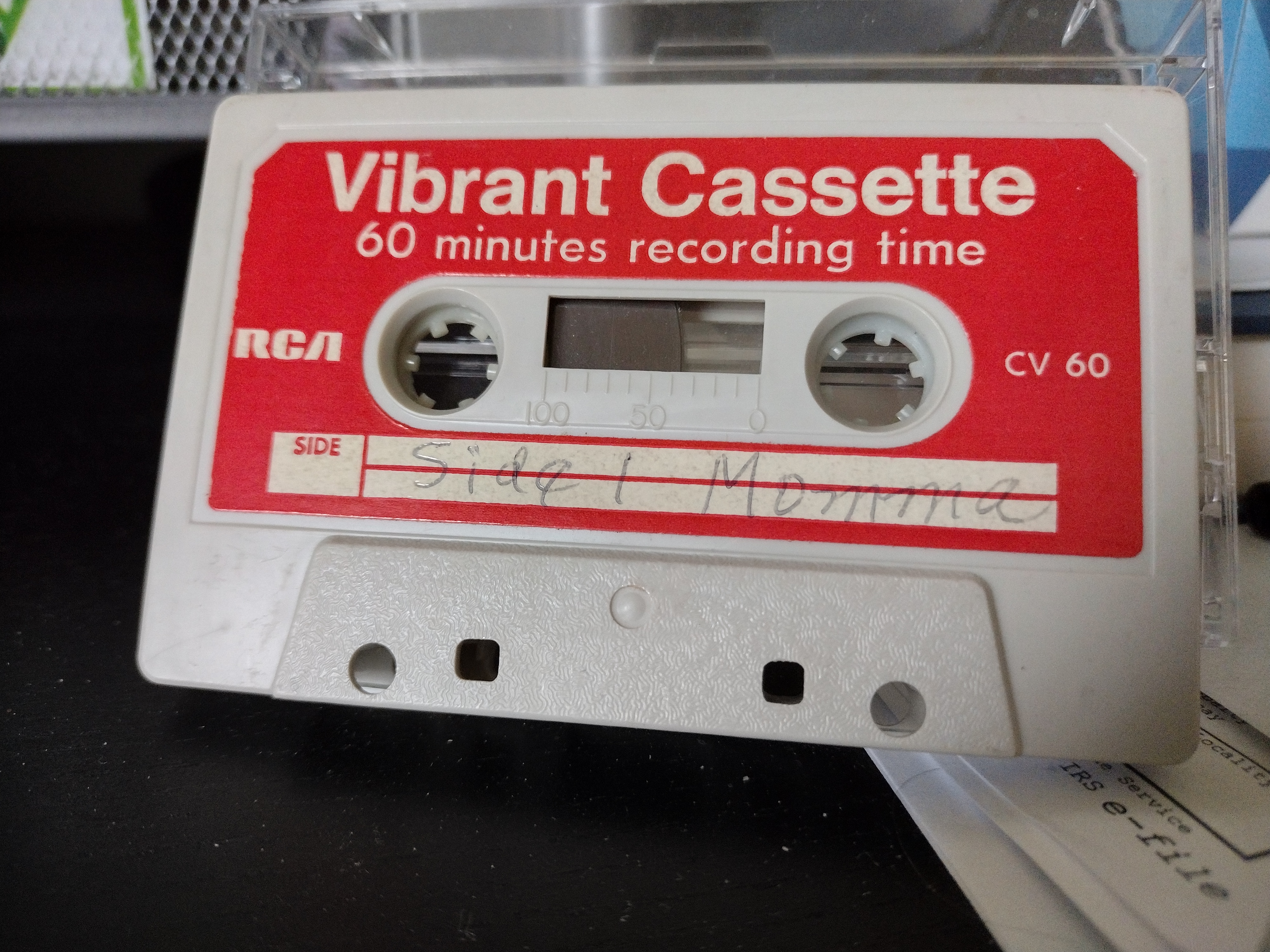
    On a far more pleasant topic, my 2nd Great-grandmother, Rosa Edith (Murray) Huff (1861-1943) was born on April 23rd. I heard from my cousin, Pat Witter, recently that he found a cassette tape from a time when my grandmother (his aunt Nancy Callin) recorded her mother (Rosa’s daughter, Hannah Merle Witter) talking about their family’s journey to Arizona from Kansas in 1907. I’m looking forward to making digital copies and a transcript of that tape. I suspect it will give me a lot of interesting things to share with you all in the coming year.

    photograph of Rosa Huff, c. 1942
    Rosa Huff, about 1942

    Historical Rhymes

    I’m not a person who puts a lot of stock in the mystical, but sometimes the way history “rhymes” leads one to think about things less linearly. The recurrence of dates shouldn’t feel so mysterious, since, as I mentioned, they happen every year. But our brains also evolved to make connections between seemingly unrelated data points to arrive at conclusions that we can’t easily explain.

    For example, William Shakespeare died on 23 April 1616 at age 52. By tradition, he is supposed to have died on his birthday. Maybe he did, maybe he didn’t—but Roy Orbison was also born on 23 April (1936) and died at age 52 in December 1988. I happened to be writing about Orbison as part of an upcoming post over at All Kinds Musick, and I realized that I am 52 years old this year, too. That doesn’t mean anything, but it is unsettling—either it is a portent of doom, or the universe is pointing out that since I haven’t accomplished anything nearly as enduring as either artist, I should be safe.

    The universe is kind of a jerk.

    Mightier Acorns is reader-supported, so I appreciate you sticking with me on a day when I’m feeling silly!

    One More Thought

    If I have prompted you to think about the dates that keep intruding into your research, WikiTree has a handy link (for those with active accounts) that can pull together Family Anniversaries based on the profiles you are connected to through WikiTree.

    You can also get there from the “My WikiTree” pulldown menu by clicking “Anniversaries.”

    If you poke around, your favorite tree software may have something similar.

  • Stephen Hart and Stephen Hart lived 30 miles and 4 years apart

    I told you about Martin Hart (1792-1879) and his life story several weeks ago. I told you about his connection to his father, Stephen Hart (1767-1857), and shared some facts about Stephen…but then I started to write today’s post about Stephen and realized I made a mistake. I included this paragraph:

    The Hart family moved to Stillwater, New York, and from there to a newly settled town called Pinckney in Lewis County, New York, around 1805. Stephen Hart figured in the early history of Pinckney. The first town meeting was held at his house, and he served as town supervisor in 1815. He served additional terms in 1817, 1821, 1827-28, and 1830-31.

    (Hough, Franklin Benjamin, (1822-1885), History of Lewis County, New York; with…biographical sketches of some of its prominent men and pioneers; page 497-499.)

    That paragraph refers to facts about a second Stephen Hart who lived in Lewis County, NY. The Stephen Hart I’m interested in settled in Turin in about 1799, and the Hough book talks about both men without indicating that Mr. Hough knew they were two different people.

    Parallel Lives

    Complicating matters, the two Stephens have very similar biographies. They were born about 4 years apart (one in 1767, one in 1771) and died about 4 years apart (1857 and 1861). They moved from their respective homes to Lewis County about 7 years apart (older Stephen in 1799, younger in 1806) – one from Torrington, CT, and the other from Stillwater in Saratoga County, NY:

    map of upstate New York, showing the respective journeys of both Stephens
    The elder Stephen came from Torrington to Turin; the younger came from Saratoga County to Pinckney

    To keep them straight and to illustrate which Stephen is the “correct” Stephen, I added a Table of Evidence to his WikiTree profile page. Then, I added the “Easily confused” template to differentiate the two WikiTree profiles and ensured the Table of Evidence was on both pages.

    Whew.

    Seeing Double

    Stephen Hart is not the only person in this family who has a doppelganger to watch out for. Eunice Seymour came from a prominent and prolific family, too, and there are marriage records for more than one “Eunice Seymour” in Connecticut from around the same time. As I go hunting for Eunice’s ancestry, I need to keep a sharp eye out to make sure that I have the correct person before adding information to my tree.

    (One of these days, I might put together enough reliable information to post about Eunice. If I’m lucky.)

    The Lesson?

    As reminded us (Twice!) recently: Trust Nobody!

    Tales & Trees Genealogy
    Trust Nobody
    Hi- I’m Sadie of Tales & Trees Family History Services, and I have a confession. I had a line in my tree wrong for ~years~ because I fell victim to a classic Ancestry user error. I even told people I was distantly related to a Salem Witch Trial victim and president because of it. (Now I know I’m not…
    Read more

    Tales & Trees Genealogy
    Trust Nobody: Part II
    Read Part I here…
    Read more

    And when we say “don’t trust anybody,” we mean “don’t blindly accept facts without testing them.” We are all fallible, and we can all make mistakes. Telling you not to “trust” means that you should always be questioning the facts. Examine the original sources, and if somebody isn’t citing sources, don’t accept their work until you can verify it yourself.

    Because you see how easy it is for any of us, even if we are trying our best, to make a mistake, miss a clue, or perpetuate a mistaken assumption. Sometimes you can get away with that, but eventually, you will find yourself with two Harts, wondering how you got into this mess.

    And having two hearts is only good if you’re this guy. (IYKYK.)

    Doctor Who's future in doubt as Ncuti Gatwa 'heads for exit'

  • The Milton Township Diaspora (part 2)

    Sarah Montgomery was born in Milton Township, Richland County, Ohio, on 27 December 1824 and married Henry Davidson (1818–1894) in Fulton County, Indiana, on 22 Apr 1841. They took their family—including their adopted niece, Sarah Ferrell—on the Oregon Trail in 1853. In my last post about this family, I told you, “…but we will have to talk about that adventure another time.”

    Now is another time!

    Born In Ohio

    Sarah Montgomery was about 10 years old when her mother, Elizabeth (Callen) Montgomery, died. She would have been about 14 when her father moved the family to Fulton County, Indiana, in 1838, and she was 17 when she married Henry Davidson there on 22 Apr 1841.

    It’s hard to say whether Sarah or her siblings were able to keep in touch with their cousins in Milton Township after they left. Many of those families left Milton Township soon after the Montgomerys did. Her grandmother, Mary Callen, moved with Sarah’s uncles, Alec and Hugh, to Iowa, and we know the Callins who stayed in Ohio lost touch with the Iowa relatives after 1845. Sarah’s uncle, Thomas Callin, died in 1843, leaving his widow, Nancy (Burget) Callin, to care for their ten children.

    By 1846, Sarah had two small children, Lucretia and William. When her sister, Mary Ferrell, died, Sarah and Henry took in Mary’s orphaned daughter, Sarah Ferrell, and raised her with their own. They had two more children soon after: a son in 1848, Theodore Bruce Davidson, named after Sarah’s adventurous brother, who had gone off to join the U.S. Army in Mexico, and a daughter, Frances Mary, in 1850.

    Setting Out for Oregon

    In 1852, the Davidsons set out for Oregon as part of the Murphy Train. Captained by John Ecles Murphy, the group consisted of family and friends, all members of the Christian Church known as Campbellites or Disciples of Christ.

    In the early 1830s, the followers of Alexander Campbell, founder of the Disciples of Christ, moved from their homes in Warren County, Kentucky, to Warren County, Illinois, and established the town of Monmouth, named after their home in Monmouth, Wales. As the word of the virtues of the Oregon Territory reached Illinois, the group began planning another move. An advanced migration of church members went west in 1850, which included Elijah and Margaret Davidson (of unknown relation to William Henry Davidson).

    In April 1852, the second migration of church members began the journey. This second group was made up of the families of Burford, Butler, Davidson, Lucas, Mason, Murphy, Roundtree, and included Henry and Sarah Davidson and their children, as well as their adopted niece, Sarah Ferrell.

    Coincidentally, they probably traveled in a Murphy Wagon—no relation to Captain Murphy—like this replica at Scotts Bluff National Monument.

    NPS.gov: Murphy Wagon Replica

    The Journey of Sarah Ferrell

    Sarah Ferrell would have been 6 years old in 1852, when her family joined Captain Murphy’s wagon train. Before they could begin the journey, they had to travel more than 500 miles from Fulton County, Indiana, to join the group on the Missouri River, probably near Omaha, Nebraska. From the Missouri River, the group had to travel more than 1,500 miles to the Willamette Valley in the Oregon Territory.

    CC BY-SA 3.0, https://commons.wikimedia.org/w/index.php?curid=117243

    Sarah, along with her two older and two younger cousins (Lucretia was 10, baby Frances was 2), would have probably ridden in the wagon, pulled by oxen traveling an estimated 12 to 15 miles per day. The National Park Service website has a pretty good description of A Typical Day on this trip, which could last from 4 to 6 months.

    As far as I can tell, the Davidson family arrived safely in Oregon and settled in Linn County, in what is now Harrisburg.

    Modern Harrisburg, in relation to Eugene, OR

    At 18, Sarah was married to Josiah S Powell (1839–1865), son of Noah Powell (1808–1875) and Mary E. “Polly” Smith (1812–1893). He was born on 19 Nov 1839 in Menard County, Illinois. The Powell family wagon train, led by Noah and his two brothers, was one of the largest groups to migrate along the Oregon Trail, departing Illinois in 1851. Josiah and Sarah probably married in 1864, and their son, Glenn O Farrell Powell, was born in Mar 1865. Josiah died at 26 years of age on 21 Nov 1865. He was buried in Hunsaker Cemetery in Marion, Marion County, Oregon.

    A widow at 21, Sarah married E J S Page on 4 Aug 1867 in Marion County, Oregon. We know nothing about Mr. Page beyond his name; we do not even know what his initials stood for. A child and a marriage record are all he left behind. Their daughter was Sarah Olive Page, born on 14 May 1868.

    Now 24 years old, widowed twice, and caring for two small children, Sarah married for a third time.

    A Final Match

    James Addison Bushnell was a 44 year old widower, originally from Cattaraugus County, New York. According to his Wikipedia article (because he would go on to be notable enough for this!):

    “He crossed the plains in the spring of 1852 to Oregon and then on to California. He departed for home in July 1853 via ship from San Francisco and across Nicaragua to New York to Missouri to get his family, only to discover they had already left for Oregon. He then returned to Oregon via ship from New York across Panama, back to Portland where he joined them in Springfield in Oct 1853. Thus, he covered over 10,000 miles in less than 120 days. His first wife, Elizabeth C. Adkins, whom he married in Sep 1849 in Missouri and who died in Jan 1868 in Junction City, was part of the ‘Lost Wagon Train of 1853’ that came over the Cascades via the Elliott Cutoff. He married his second wife, Sarah E. Page in Apr 1870.”

    There is a lot of adventure packed into that paragraph—not only for James, but also for poor Elizabeth. She would have had their son, Charles, with her when she crossed the plains in 1853, and Charles would have been about 2 years old. I can’t imagine the fortitude it took to care for a 2 year old during the “Lost Wagon Train of 1853;” the Elliott Cutoff was not a picnic.

    James and Elizabeth had seven children, including Charles. When James married Sarah (Ferrell) Powell Page in 1870, four of his seven children were still alive. James was a successful farmer, and he and Sarah had another five children, three of whom were lost to a diphtheria epidemic in the winter of 1881-82, along with one of James’s older sons, George Addison “Addie” Bushnell.

    Despite these hardships, James operated a grain warehouse near Junction City for 35 years. He and C.W. Washburne established the Farmers & Merchants Bank in 1893, and served as its president until his death in 1912 at age 85.

    The first library at Eugene Divinity School was named the Bushnell Library, as James and his wife Sarah provided $1,000 for the purchase of rare bibles. The Sarah E. Bushnell Bible and Rare Book Collection, established in 1913, is now housed in the Kellenberger Library at Northwest Christian University, successor to Eugene Divinity School.

    Sarah died on 29 Jan 1916 at age 70 in Junction City, Lane County, Oregon. She and James are buried in the Luper Cemetery. Her obituary appeared in The Oregon Daily Journal in Portland, Oregon, on 2 Feb 1916.

    “Pioneer of Lane Dies.
    “Junction City, Or., Feb. 2–Mrs. Sarah Elizabeth Bushnell, aged 70 years, died here at the home of her daughter, January 29, after a brief illness. The funeral was held from the Christian church Tuesday. Mrs. Bushnell had lived in Lane county since 1869. Her husband, Addison Bushnell, died about three years ago. She leaves four children: Mrs. Ollie Beebe, Ashland, Oregon; Glen O. Powell of Portland, Or.; H.C. Bushnell and Mrs. Gertrude Movius of Junction City, Oregon.”

    And we haven’t even discussed the Davidson family, yet!

    Mightier Acorns is reader-supported. To receive new posts and support my work, consider becoming a free or paid subscriber.