Mightier Acorns

Journeys through Genealogy and Family History

A parody of a family coat of arms designed with acorns as elements, with the motto "ex gladnis potentioribus" Latin for "from Mighty Acorns"
From Mighty Acorns
  • When our identity is taboo, it is too easy to be erased from history

    Note: much of this post is adapted from “You Just Can’t Matcham,” posted on my old Mightier Acorns blog on November 11, 2016. If you are interested in this family, I included a lot more information about George and Emma’s children in that original post.

    George Delorain Matcham (1844–1923) was born in Pittsfield, Lorain County, Ohio, to Edward and Abigail (Tinker) Matcham, both of whom had come to Ohio from Massachusetts. Edward was born in Pittsfield, Berkshire County, Massachusetts, in 1812, and he arrived in what would be called Pittsfield, Ohio, in 1830. He and Abigail were school teachers in neighboring townships.

    According to a 1951 article in Elyria’s “The Chronicle-Telegram” on the history of schools in Lorain County:

    “Pittsfield’s first school was taught by Miss Minerva Loveland in a small cabin erected for educational purposes. In 1831 or 1832 Edward Matcham began his period of teaching which lasted 10 years. Miss Abagail Tinker was the first teacher in Rochester Township. She conducted her school in a log cabin during the Winter of 1833-1834.”

    Edward and Abigail were married on 8 April 1835. They had a daughter, Mary, in 1841; their only son, George, followed in 1844. George was never a very healthy boy, and he had to drop out of his studies at the college at Oberlin because of his health problems. Still, he was a bright young man, and after he managed to complete a course at the business school at Oberlin, he took out patents on improvements he made in farm equipment, which helped establish him as a businessman.

    In 1871, George married his first wife, Marion Worcester (1840–1906). George served on the school board for a time and kept up his patents for income. The couple continued to live in Pittsfield until 1895 when they moved to Oberlin. Soon after coming to Oberlin Mr. Matcham invested in land at Linwood Park on Lake Erie and helped to develop the resort. He built several cottages there and had spent his summers there for several years. Marion helped run the 19-room inn they built there until she died in 1906.

    portrait of George Matcham and Emma B. Callin, about 1907
    George and Emma; 1907

    Emma Beatrice Callin (1885–1951) married George the following year. Emma was the fourth child of John H and Amanda (Walker) Callin. She grew up in a house with a Civil War hero father, a pioneer mother, five brothers, and her grandmother, who died in 1903. She married when she was 22 years old and George was 63 – just two years younger than Emma’s father. I suspect the two men were at least friends if not business partners.

    In the decade and a half they were married, George and Emma had five children. They continued to live off of their inn, and Emma hosted social life in the resort on Lake Erie. Sadly, George died in 1923, when their youngest daughter was only four years old. Emma’s mother, Amanda, had been living with the family for several years by then and probably helped with the children.

    Five years after George died, Emma married Gustav Heimsath (1888–1963) on 10 December 1928. Gus was an engineer whose family hailed from Germantown, Pennsylvania, near Philadelphia. After Amanda died in 1933, and the children began to leave home, Gus and Emma moved to the Cleveland area, where Emma died in 1951.

    Ruth Ellen Matcham Heimsath (1919–2009) was the youngest of George and Emma’s five children. She was so small when her father died, that she only really knew her step-father, Gus Heimsath. She grew up and married Richard R. “Zimmy” Zimmerman (1924–2009) in February 1946, and they had two children, both of whom are still living. Ruth began using her stepfather’s surname and was known as Ruth Heimsath until she died in 2009.

    The Truth About Zimmy

    Richard Roland Zimmerman was the son of Roland H Zimmerman (1899–1980) and Helen J Smith (1899–1980), born on 11 Feb 1924 in Salem, Columbiana County, Ohio. He grew up in Perry, Columbiana County, and enlisted in the U.S. Navy on 12 Jan 1942. He served aboard submarines during 1942 and early 1943, when he was discharged on 3 Mar 1943 under the Navy’s policy against homosexuality. He returned to Salem, and after a run-in with the law, he was able to find work.

    Richard married Ruth Ellen Heimsath in Feb 1946 in Salem, Columbiana County, Ohio. Ruth and Richard had a son and a daughter together, but soon after Ruth’s mother died, Richard left her and she found she was pregnant with a third baby. She gave her two children to the family across the street to raise because she could not work and care for them at the same time. When her third child was born, Ruth put her up for adoption. (I don’t have records for these events; a surviving relative gave me this information.)
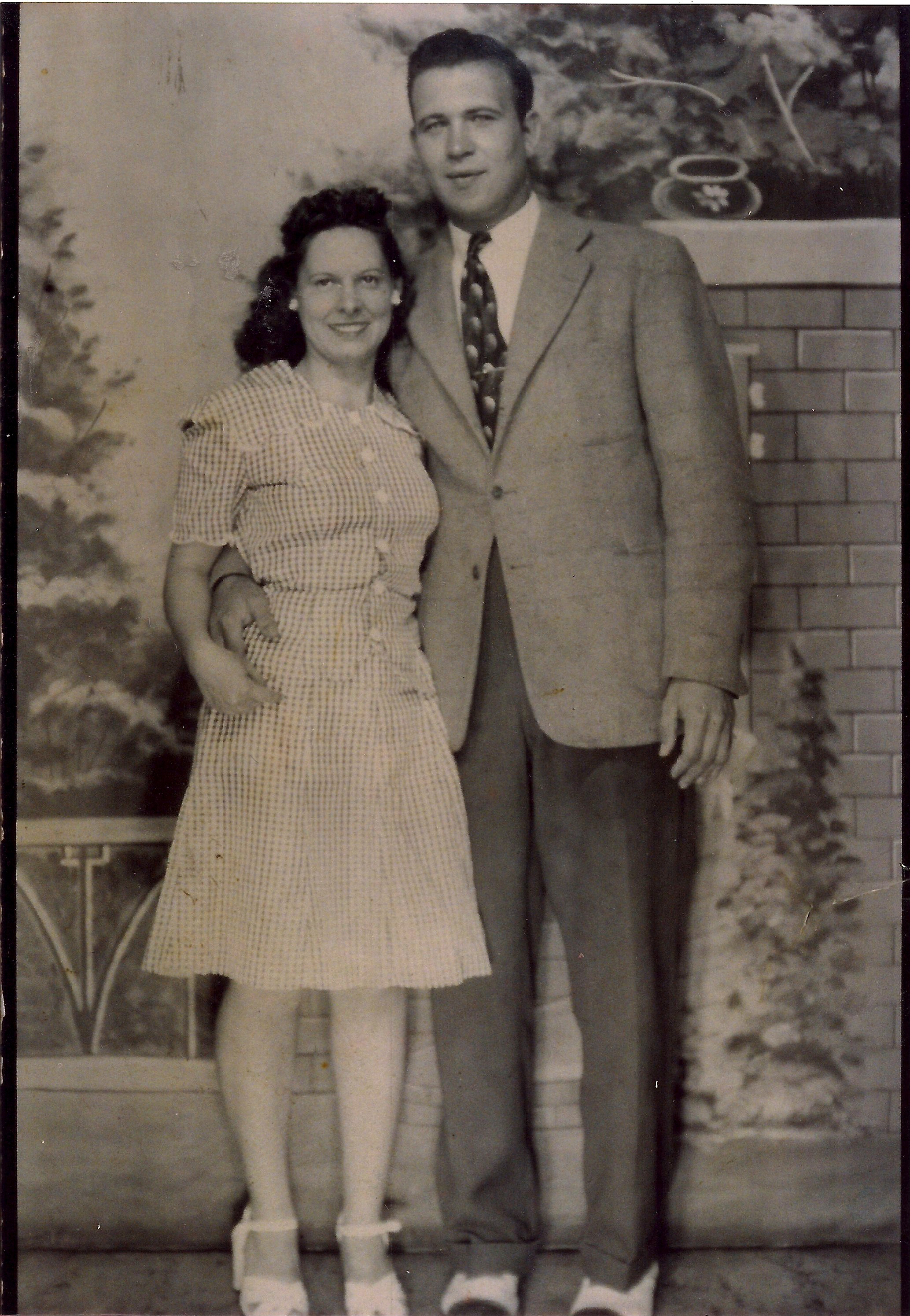
    Ruth and Richard, abt 1946

    After his divorce from Ruth in the 1950s, Richard does not appear in available records until 1968. He married Nancye Bernice (Easely) Spicher (1940–2011) on 18 Jul 1969 in Clark County, Nevada, and they lived in Downey, Los Angeles County, California. They also had a daughter, Tracye G. (Zimmerman) Smith (1968-2018), whom they raised in Salem, Columbiana County, Ohio. Richard and Nancye divorced in 1997.

    Things We Know

    Records can tell us a lot while also leaving a lot out. I’ve got a pretty good timeline of Richard Zimmerman’s World War II service thanks to the U.S., World War II Navy Muster Rolls, 1938-1949 records on Ancestry.

    He enlisted in the U.S. Navy on 12 Jan 1942 at Cleveland, Ohio. His service number (283-68-76) helped distinguish his records from those of other men with similar names. His rating was “A.S.” for Aviation Support Equipment Technician.

    After he finished training, Richard traveled aboard the USS President Adams (AP-38) in Feb 1942 from Tampa, Florida, to the Panama Canal Zone. He transferred on 19 Feb to the Submarine Base at Coco Solo. A month later, on 19 Mar 1942, he boarded the USS Bonita (SS-165). From 5 Apr 1942, he was temporarily transferred to USS Antaeus (AS-21), returning to the Bonita on 24 May 1942, having advanced in rating to F3c (Fireman 3rd class).

    On 28 Nov 1942, F3c Zimmerman was transferred to the submarine base at New London, Connecticut. He shipped out on 1 Dec 1942 aboard the USS R-9 for a brief trip down to the U.S. Naval Station at Key West, Florida, then transferred to the USS R-14 on 16 Dec 1942.

    Finally, on 3 Mar 1943, his record shows that he was discharged “from U.S. Navy with undesirable disch. in accordance with SecNav. conf. ltr. 83443 dated 1/1/43.”1

    If you read SecNav letter 83443, it appears evident that Richard was investigated by his commander, and confronted with a choice. The language “with undesirable discharge” suggests that as an enlisted man, Richard was asked to accept the discharge with no further charges being pressed.

    Things We Don’t Know

    Given the gaps in Richard’s biography and the sensitivities of discussing homosexuality in the 1940s, we could read a lot into his story. That incident leading to his discharge may have been an isolated event, or it could indicate that he led a life in which he hid part of himself from those closest to him. I imagine he was embarrassed and angry—angry enough to attempt a crime.

    One night in January 1944, while working as a cab driver, Richard broke into the Ohio Restaurant on E. State St. in Salem. Police making their rounds at 2 a.m. startled him, and he ran through the glass front door, cutting his wrist. He got away, but when he found his way back to where he had left his car, it was gone. He was captured when he phoned the police to report it stolen. They had taken the car to the station after Richard fled the scene of the burglary. To add insult to injury, Richard had initially only found $30 and two cartons of cigarettes, which he had stashed in the car before the police arrived. He had gone back into the restaurant to look for more when the patrol showed up.

    This incident seems to have discouraged future malfeasance, at least while he was married to Ruth. Considering the abruptness of his divorce from Ruth, and the fact that we don’t know where he was for nearly twenty years afterward leaves a lot of open questions.2 That he married again and had another child tells us something about his journey—but what it tells us depends on other unknowns.

    From this point, all we can do is keep an open mind and respect who Richard was—whether we ever find out the facts or not. What we cannot do is erase him, or those like him, from our history.

    Perhaps one day—hopefully sooner than later—it will be safe for everyone to be who they truly are. Until then, all we can do is use the strength that empathy gives us to take care of each other.

    2

    According to his obituary, “He had resided in California for 23 years before returning to Salem. Before his retirement he had worked as a tool and die maker at Warren Molded Plastics for eight years and had previously worked at Paxson Machine.”

  • Another gap in 1850 and another tenuous connection

    Last time I talked about this family, I told you the life story of Seymour C Hart (1851-1934), my 3rd-great grandfather.

    Seymour was the youngest of four children born to Alexander C Hart (1817–1871) and Frances Pond (1822–1866).1 We know a bit about the family from records dating as far back as 1855. The little details in those records give us enough evidence to make the connection between Alexander and his parents – but only barely.

    Bedeviling Details

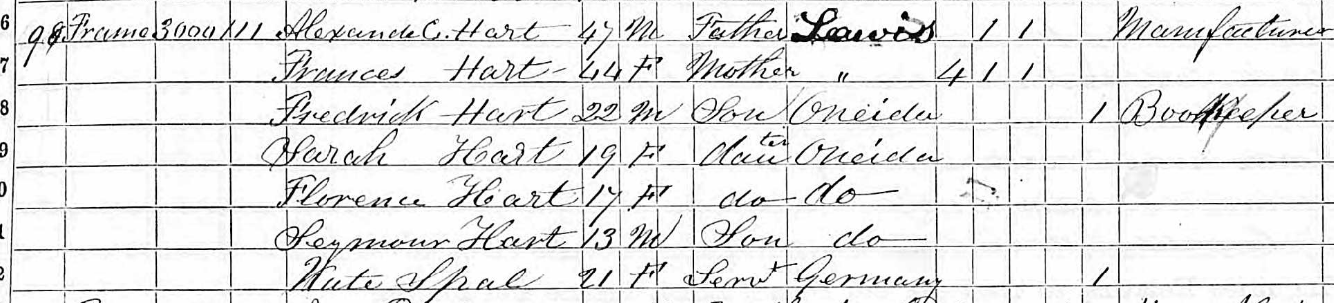
    Seymour was born in 1851, so we wouldn’t have seen him in 1850, but for some unknown reason, the rest of Alexander and Frances’s family was also missing from the U.S. Census that year. Fortunately, the New York State Census takes us back to 1855:

    Detail image of the New York State Census from 1855
    New York, U.S., State Census, 1855: Alexander C Hart and family

    Key clues we’ll need later: this census records the county where each person was born. In Alexander’s case, that would be Lewis County; Frances and the children list Oneida. Also, notice Alexander’s occupation is given as “Burr Stone Manufacturer.”

    We get similar information in 1865:

    Detail image of the New York State Census from 1865
    New York, U.S., State Census, 1865: Alexander C Hart and family

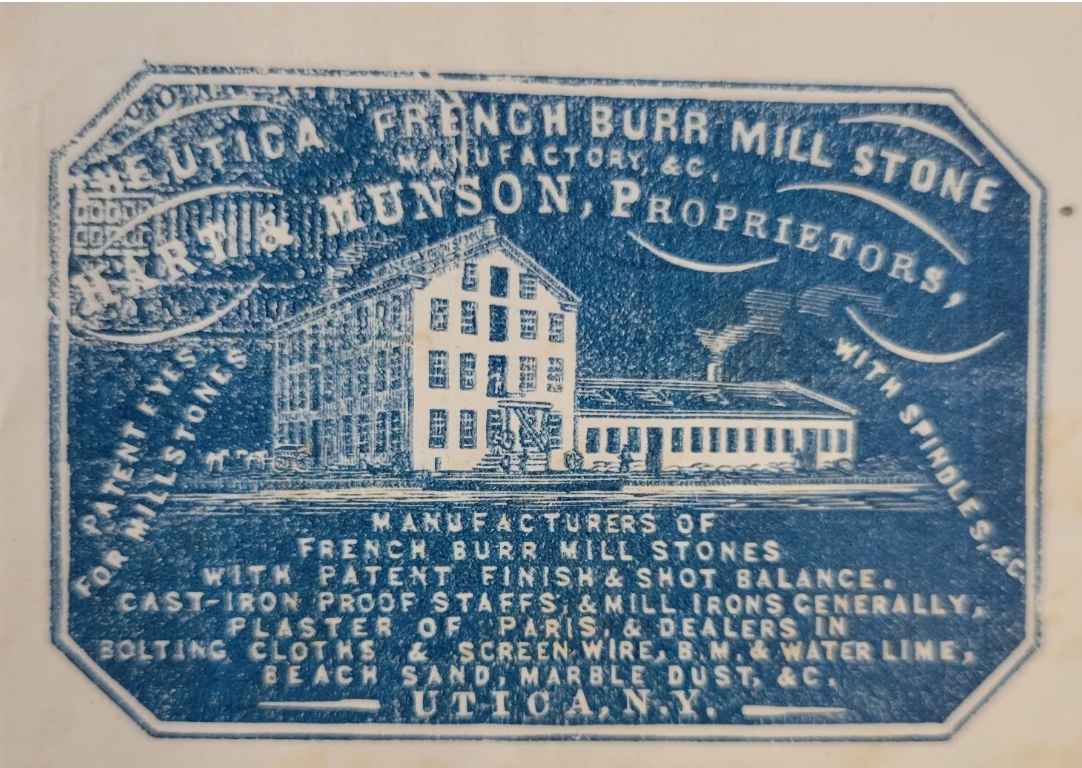
    In addition to the state census, there are some Utica City Directories that tell us Alexander is associated with “Hart & Munson” – which manufactured burr stones and milling equipment.

    Detail from a letterhead for the Hart & Munson company

    Armed with that knowledge, let’s look at what we can learn from the History of Oneida County, New York (emphases mine):2

    “About 1823 Alfred Munson commenced the manufacturing of lubricators, Martin Hart became associated with him in 1830, and the firm name was Munson & Hart. This partnership continued for several years, when the firm dissolved, and Alexander B. Hart, a son of Martin, and Edmund Munson, a nephew of Alfred, became associated under the name of Hart & Munson. This firm did an extensive business, but it was dissolved in 1868, and a new one formed under the title of Munson Brothers.”

    There is a similar passage in another source, the History of Oneida County, New York, 1667-1878 (again, emphases mine):3

    “The manufacture of buhr-millstones was commenced by Alfred Munson about 1823-25, on the corner of Hotel and Liberty Streets. … Alfred Munson continued the business in his own name until about 1830, when Martin Hart became associated with him, under the firm-name of Munson & Hart. This continued for a number of years, when the firm dissolved, and Mr. Alexander B. Hart (a son of Martin) and Mr. Edmund Munson (a brother of Alfred) became associated under the firm-name of Hart & Munson, and carried on the business until about 1868, when the firm dissolved…”

    Alone, I wouldn’t accept these secondary sources as proof that Martin is Alexander’s father, but when you factor in the tiny corroborating details we see in Alexander’s other records, the theory becomes more compelling.

    Still, to make a more solid claim, I need at least one more piece of evidence to tie Alexander to Martin. It’s too bad there are no records earlier than 1855 naming Alexander…

    One More Record

    Frances died in 1866, and Alexander’s children were grown and independent. But Alexander survived until 1871, so there should be one more U.S. Census record that includes him. Sure enough:

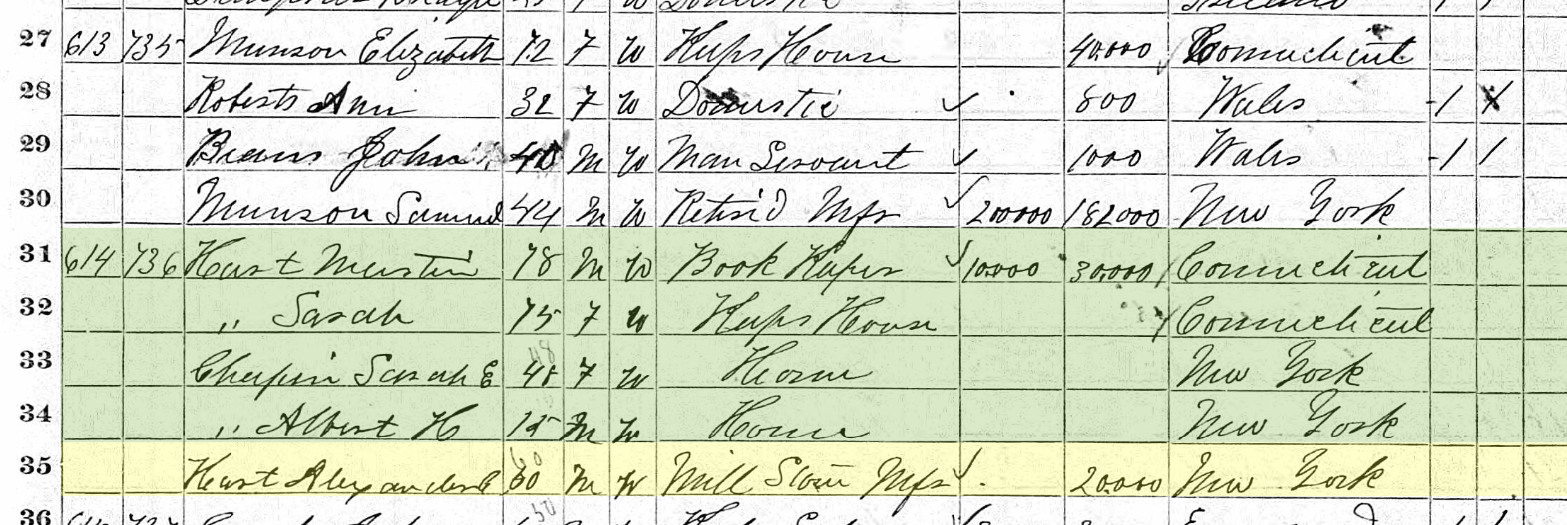
    Detail from the 1870 U.S. Census showing the Munson and Hart families
    1870 United States Federal Census: Munson and Hart families in Utica

    Here we see not only that Alexander Hart, Mill Stone Mfs., was living in the home of Martin and Sarah Hart, but the family immediately above them in the enumeration were the Munsons—notably Edmund, “Retir’d Mfs.” (Remember, the books said the business was dissolved in 1868.)

    There’s no substitute for vital records, but since I don’t have Alexander’s birth or marriage records, this is about as conclusive as I’m likely to get. Perhaps when I dig more into Martin’s records, I may learn more.

    1

    Grandparents to Florence Mabel (Hart) Tuttle, one of My Sixteen.

    2

    Cookinham, Henry J.. History of Oneida County, New York (S.J. Clarke Publishing Company, Chicago, Ill., 1912), pg. 450.

    3

    History of Oneida County, New York, 1667-1878, published by Everts & Fariss, Philadelphia, 1878, pg. 310.


  • Are we noticing the history we are living?

    The way we were taught history in school did not prepare me for this moment.

    We studied the usual significant milestones in (mostly) American history, learning the dates of events and some of the connective tissue of cause and effect. However, few of my classmates retained any of that information, and fewer still learned how to think critically about what we were being taught.

    And it shows.

    I shared this article in a Note already, but it is super important:

    Civil War Memory
    The Damage to our Shared History Has Been Done and It Will Take Years to Repair
    We are witnessing a wholesale erasure of history across federal agencies and programs that have worked tirelessly over the years to interpret our shared past in an inclusive and balanced manner. Whether we are talking about the National Park Service, the…
    Read more

    I am a federal employee, and there are a million or more of us waiting to learn each week whether we will still be employed next week. There is no rhyme or reason for the “cuts” going on, as the lies about fraud keep mounting up. If there was a real effort to curb fraud underway, that would be one thing—but this is not about taking account or finding facts.

    None of what is happening right now is right—little of it is legal. And Congress could stop it if the Senate Republicans would support Rep. Al Green (D-TX) or Rep. Raskin (D-MD) on articles of impeachment.

    Jamie Raskin, Democrat and representative for Maryland’s 8th congressional district, has also spoken about a possible impeachment of Donald Trump. On Tuesday (Feb. 4), Raskin was asked whether he would consider impeaching the newly-elected president over “illegal executive overreach,” to which Raskins replied, “Find me two Republicans, and I’ll go to work tomorrow.”

    Vibe.com, “Donald Trump Faces First Articles Of Impeachment In Second Term

    That is unlikely to happen, but it should be clear by now that the Executive Orders and contradictory actions of the DOGE (which may or may not exist, legally) are infringing on Congress’s powers. Any principled conservative would not stand for that.

    Meanwhile, I will continue to try to conduct my family history research and understand the historic moments that my ancestors faced. It can’t have been easy for them to decide how to act when the Continental Army was assembled. I know what kinds of strife existed between family members, church members, and civic leaders in the lead-up to the Civil War.

    Those personal conflicts that existed underneath the larger historical moments feel more real to me than before.

    I hope my descendants have the ability to research this moment, and I hope they never have to feel this way about it.

  • Seeking the Wavetop for my Hart family

    A year ago, I wrote about my maternal grandmother’s paternal grandmother (one of My Sixteen), Florence Mabel (Hart) Tuttle (1874-1945):

    I followed Florence’s ancestry from there through her mother, Harriet Isette (Wells) Hart. Today, I am looking at her paternal ancestry.

    Seymour C Hart (1851–1934) was the youngest of four children born to Alexander Hart (1817-1871) and Frances Pond (1822-1866) in Utica, Oneida County, New York. His big brother, Frederick, was nine years older than Seymour, and there is evidence that Frederick worked as a clerk for his father’s company, Hart & Munson’s, which made milling equipment. It stands to reason that Seymour also worked for his father.

    C1864 Utica New York UTICA FRENCH BURR MILL STONE MANF. adv. billhead - Picture 2 of 4
    detail from the letterhead of a document found on eBay

    Their two sisters were Sarah and Florence. After Frances and Alexander died, they lived together in Utica. They were school teachers. Sarah married a surgeon named Edward Mattoon in about 1878; she lived in the home of Edward’s parents while he worked to establish a practice in Denver, Colorado. They had a daughter they named after Sarah’s sister in 1879, and eventually Sarah and little Florence moved to Colorado.

    Aunt Florence moved to Milwaukee where she did clerical work until she died in 1888. Her estate amounted to just under $2,000 (about $66,443.16 today) and was divided between her surviving siblings since she never married.

    Seymour married his first wife, Hattie Isette Wells (1854–1879), on 25 July 1874 in Clinton, Worcester, Massachusetts. They had their only child, also named Florence, in November of that year (I don’t do the math) but Hattie died in 1879 after suffering from “Ulceration of uterus”. Little Florence went to live with her grandmother: Hattie’s mother, Sarah (Fletcher) Wells, in Clinton. (Sarah was the wife of Harlow Wells.)

    There is a bit of a gap in the records, but in 1880, “S.c. Hart” was listed in Orange, Franklin County, Massachusetts, running a sewing machine shop. I like to think that he stayed close to his daughter as she grew up.

    By the Numbers

    I don’t like to sound judgmental about the choices people made, but there are some numbers in this story that will raise some eyebrows, and it would be irresponsible to ignore them.

    First, as I mentioned, Florence Mabel was born only about four months after Seymour and Hattie were married. Considering how little time Seymour and Hattie would have together, it feels cruel to imply they should have waited to begin their life together.

    Seymour remarried when Florence was 15. He married Zella Jane Bastedo (1872–1951) on 28 Mar 1890 in Bloomingdale, Passaic, New Jersey. Exactly one year later, Florence married my 2nd-great grandfather, John Jackson Tuttle, on 28 May 1891 in Succasunna, Morris, New Jersey.

    Sixteen does seem to me to be a bit young for marriage, but at least her husband was 18. In contrast, Zella, Florence’s new mother-in-law, was only 18 herself. That means that Seymour’s second wife was only two years old when he married his first wife.

    But this fun fact is a little less cringeworthy: Seymour and Zella’s son, Charles Seymour Hart, was born on 12 Dec 1892, seventeen days after his nephew (my great-grandfather Alfred Tuttle) was born. Both boys were born in Rockaway Township, Morris County, New Jersey, which suggests that Zella and Florence must have gone through their first pregnancies together. I’d like to think that they might have been close and supported each other.

    Seymour and Zella also had a daughter, Harriet, born 16 Nov 1906. That was eleven months after Florence had her seventh child, John Samuel Tuttle. Florence would go on to have twelve children, her youngest being Ethel May, born in 1915.

    A Kind of Epilogue

    The Hart and Tuttle families had moved to Newark by 1910. I like to think Seymour enjoyed plenty of time with his two children and their dozen nieces and nephews. He was the only one of his siblings alive by then.

    His brother, Frederick, had two children: Charles B. Hart, born in 1869; and Louisa B (Hart) Trembley (1875–1951). I don’t know what happened to Charles after 1875, when his family lived in Utica with Frederick’s in-laws, Dan and Harriet Buckingham. Frederick died in Saranac Lake, New York, in 1909, where the Trembleys lived.

    Their sister, Sarah Mattoon, had died in 1900. Her daughter, Florence Mattoon, stayed with her father until his death in Oklahoma in 1939. As of 1950, she was living in the Central State Hospital in Cleveland County, Oklahoma. She was listed as “unable to work” and had never married.

    Seymour died in 1934 at 83 years of age.

  • Using lessons learned from a different family

    In January I talked about finding some of my wife’s ancestors in the records of the Society of Friends (also called “Quakers”) in Indiana.

    As it happens, the skills I picked up as I learned about the Dyer family may help me learn more about my Scottish immigrant ancestor, Thomas Henderson Murray. He would have been the grandfather of Rosa (Murray) Huff (second wife of Albert Huff, from “The Huffs Move West. Twice.”)

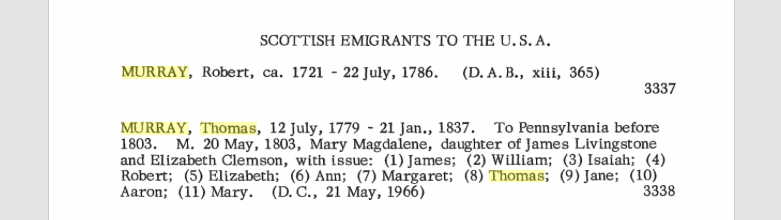
    I still have very little information about Thomas, but here’s the connective evidence between him and his in-laws (Rosa’s father is (10) Aaron):

    Detail from "A Dictionary of Scottish Emigrants to the U. S. A."
    Whyte, Donald. A Dictionary of Scottish Emigrants to the U. S. A. United States, Genealogical.com, 2009. – page 240

    Searching for clues, I came across a few newspaper items written by William D. Murray, publisher of the Lawrenceburg (Indiana) Press and a great-grandson of Isaiah Henderson Murray. He sent these questions to The Indianapolis Star in the 1960s, looking for help with his research:

    The Indianapolis Star, Sun, 4 Aug 19631

    The Indianapolis Star, Sunday, 12 Dec 19652

    Look again at the citation from Donald Whyte’s book: “D.C., 21 May, 1966”—checking the bibliography tells me that “D.C.” refers to the “Dictionary Correspondence. Letters to the editor regarding Scottish immigrants. Scottish Genealogical Society Library.” Since William Murray was actively researching and corresponding in the mid-1960s, I suspect one of his letters to the Scottish Genealogical Society might be the source of the information recorded in Whyte’s book.

    And THAT tells me that William Murray probably had access to records that told him about the Livingstone family but left him with the same questions I have about Thomas Henderson Murray.

    A Brief History of the Miami Monthly Meeting

    I wanted to see what I could find based on William Murray’s information. We start with a few clues:

    • About 1830, James belonged to the Hicksite church in Springboro, Warren County, Ohio.

    • His wife was Elizabeth, and their daughter (Thomas’s wife) was Mary Magdalene.

    • Thomas and Mary Magdalene married in 1803, probably in Pennsylvania.

    A fuzzy Ancestry search for James Livingston living in Warren County, Ohio, in 1830 gave me many results. Focusing just on those from Warren County, I saw several results from volumes of the Encyclopedia of American Quaker Genealogy. These records included a lot of cryptic abbreviations, which are explained in the front matter of the book—along with some explanations of the functions and history of the Monthly Meetings.

    “The genealogical records of all members of Meetings of all types are kept by Monthly (Business) Meetings, which are attended by delegates sent by their sub-ordinate meetings:-Meetings for Worship and their Preparative Meetings. The Monthly Meeting is the executive body of the Quaker Organization. …

    The Monthly Meeting, as stated, keeps all records, such as births, deaths, burials, marriages, disownments, certificates of removal, members received and released, etc., for all Meeetings for Worship which it controls.”

    William Wade Hinshaw, writing in the Encyclopedia of American Quaker Genealogy Vol· V, 1946.

    In the Introduction to that same volume, Thomas Worth Marshall writes,

    “When the Quakers began settlements in Ohio and Indiana, their meetings were established by and attacked to Redstone, (Pa.) Quarterly Meeting in Baltimore Yearly Meeting. This condition continued until 1813, when Ohio Yearly Meeting was established by Baltimore Yearly Meeting and took jurisdiction over all meetings in Ohio, western Pennsylvania and Indiana. Indiana Yearly Meeting was established in 1821 and took jurisdiction over western Ohio and all of Indiana. With the Hicksite separation, separate Yearly Meetings were established to serve the Hicksite Monthly Meetings in the territory of Ohio Yearly Meeting and those in the territory of Indiana Yearly Meeting.”

    Miami Monthly Meeting (MM) was the first established in southwestern Ohio and opened on 13 October 1803 by permission of Redstone QM. The Friends met in private houses until a log structure was built in 1805. A brick meeting house was built in 1811, and in 1828, the followers of Elias Hicks (Hicksites) separated from the Orthodox group (the minority) with the Hicksites taking the larger brick meeting house and the Orthodox group withdrawing to the old log meeting house.

    The White Brick Meeting House is still in use and is the oldest regularly attended religious building west of the Allegheny Mountains.

    169 South Fourth – White Brick Meeting House

    The Search for James Livingston

    With all of that background knowledge, I can piece together some facts from the records:

    • 1797 – James Livingston requested admission to the Muncy MM (Lycoming County, PA) on 16 February for himself and six children: Madgaline, Ann, Elizabeth, Aaron, Isaiah, and James (all minors). (recorded at the Byberry MM)

    • 1801 – 17 June, Elizabeth Livingston produced a certificate from Salisbury MM dated 28 Jan. 1800 and was accepted into the Muncy MM.

    • 1811 – 18 Dec, James Levingston and wife Elizabeth and five children (Aaron, Isaiah, James, Thomas, and Tamer) recommended by Muncy MM to Centre MM

    • 1812 – 13 Feb, James Livingston and his wife Elizabeth and their minor children (Aaron, Josiah (sic), Thomas, James, and Thamer) were admitted to Centre MM from Muncy MM (certificate dated 18 Dec 1811)

    • 1820 – 26 July, James received on certificate (rocf) from Center MM (PA) to Miami MM (Warren County, OH)

    • 1822 – James rocf from the Miami MM to the New Garden MM (IN)

    • 1823 – Tamar rocf Center MM to Miami MM (dated 18 Dec 1819)

    • 1824 – Tamar gct New Garden MM (IN)

    • 1825 – Aaron rocf from Centre MM (PA) to New Garden MM

    Best of all, the Hinshaw Index to Selected Quaker Records, 1680-1940 lists the children, giving birthdates for all but Tamar, and identifying “Magdalen b 6.28.1783… m. 1804 ____ Morry”—almost certainly identifying Mary Magdalene (Livingston) Murray.

    There is a lot more work to do, looking for records for each of these siblings and tracking the Livingstons through their moves from Pennsylvania to Ohio, and on to Indiana. I need to figure out which records go with James Sr. and which with James Jr., and see if I can find sources cited in some of the Index records.

    But now I have some solid footing for basing the next round of searches!

    1

    Newspapers.com, The Indianapolis Star, Indianapolis, Indiana, Sun, 4 Aug 1963, Page 74 Q-51.

    2

    Newspapers.com, The Indianapolis Star, Indianapolis, Indiana, Sun, 12 Dec 1965, Page 99, Q-2839.

  • Tips and Tricks for stirring up clues

    Even if you’re new to genealogy, you have probably already run across somebody posting a warning not to trust information from various common sources:

    And yet, people who are just starting on their family history journey are also bombarded with advice to look for clues in all of those places—which can leave the new researcher feeling as helpless and paralyzed as the old timer in this bank robbery:

    I suspect that the vast majority of potential new researchers are turned off by this conundrum, especially if they paid for a DNA test, only to find that DNA doesn’t tell you any of the stories they came looking for. Finding out that it will take work to tease out answers that you expected to have handed to you is always discouraging.

    Hopefully, you are willing to put in some effort, but if you feel paralyzed, the best thing to do is ignore all of these generalized warnings and focus on specific questions that you can learn how to answer.

    1. Map Out the Rabbit Holes—Then Look for the Rabbits

    All of the best advice tells you to start with what you know. Build a free private tree in several of the major platforms. If you did your DNA test through Ancestry or FTDNA, start there—and then try FamilySearch, too. Keep your information about living people private, but when you get to your first generation of deceased ancestors, learn how to find and attach source records to their profiles. Once you have a favorite site, begin following the evidence you find, pushing out (siblings and cousins) and back (great- and multiple-great grandparents) to expand your tree.

    I tend to gravitate toward a systematic approach. If I get stuck on finding a person’s biographical records, I will go through what I know about their parents and then (usually) their siblings, from oldest to youngest.

    But the point is to build a framework around what you already know, and in the process of doing that, develop a list of questions you intend to answer.

    Make sure that for each piece of evidence you add, you ask, “How do I know that this is correct?” Compare the facts from an obituary with what you know from the Census or from death records. Pay attention to who the informant was on the vital records.

    If something doesn’t add up, DON’T THROW AWAY THE SOURCE—instead, make a note for yourself in a comment or note section that points out the discrepancy and explain why you think the “correct” information is correct and the “incorrect” information is wrong.

    1. Don’t Fear the Hints—Just Don’t Trust Them

    I’m most familiar with Ancestry’s hints system, and while I’m uneasy with most uses of AI, their ever-evolving fuzzy search algorithms have been more right than wrong over the years. Keep in mind that I’m not implying that hints can be accepted without review; I just mean that 10% of the time, their hints pan out quickly, 5% of the time they can be easily rejected out of hand… and 85% of the time, they raise questions and present useful leads.

    As you review your hints, you should have specific questions you are trying to answer (see the previous section). If a hint raises more questions, add those new questions to your list—only dismiss hints if they:

    • clearly do not apply to your ancestor

    • duplicate information from a more reliable source (i.e., if another user uploaded an image of a record you already have)

    • come from unsourced or unreliable records (for ex., I ignore all Geneanet hints in Ancestry because they come from unsourced trees ingested into Ancestry)

    If you find that your list of questions is growing longer than your list of answers, that might be a good thing, because:

    1. Old Family Mysteries Are No Match for Search Engines

    Once you have enough records to build a basic biography for someone, you should know when and where they were born, when and where they died, and basic facts (marriages, children, etc.) in between. You should be constantly asking “How do you know that?” about those facts—and be prepared to change what you thought you knew in the face of new evidence.

    But what you don’t know should also start to take shape. Did your ancestor move in their lifetime? What kinds of searches might tell you more about how and when they moved? Did your ancestor have non-relatives listed in their household? What can you learn about those people—are they more distant relatives, or just boarders/lodgers?

    Answering these types of peripheral questions might give you unexpected answers to some of your other mysteries. Even if they don’t give you answers, they may pose questions that will help you find more sources.

    Don’t take my word for it! If Mightier Acorns passes your scrutiny, consider becoming a free or paid subscriber.

    When They Say “Don’t Trust”…

    Being skeptical is the key—you never simply accept a fact without testing it against what you already know. And you never reject a fact just because it doesn’t fit with what you know on the surface.

    Asking “How do I know that” until you have enough evidence to support (or refute) your biography is the task. You never “trust” your biography—you test it. Constantly.

    But you will never learn anything if you hear “don’t trust” as “don’t look.” Sometimes, the biggest obstacle is not knowing to go look!

    Well, okay then!

  • Chapter 10 from “Tad’s Happy Funtime”

    Thirty years ago, I was a Korean student at the Defense Language Institute in Monterey, California. I met the love of my life, proposed to her (on Valentine’s Day!) and married her (on St. Patrick’s Day!), and started our family.

    Ten years ago, I published my book, “Tad’s Happy Funtime” which includes stories about growing up in suburban Phoenix, experiencing DLI, and raising our family. This story is from that middle section.

    Mightier Acorns is a reader-supported publication. Consider becoming a free or paid subscriber, or you may have to throw the Pig.

    Piggies

    Upon her arrival in California, Lieutenant Colonel Harriet J. Gallegos set out to make things better in her new command. She met with her staff, and received orders from the wing commander, and contemplated all of the things that needed to change. Her predecessor had been a friend to the airmen in his squadron, but that clearly was not a good approach, as discipline and good order were needed to stamp out the rampant smoking, drinking, and sexual escapades of her student body. Everywhere she looked there examples of lax standards, loose morals, and evidence that these Generation X slackers needed her guiding hand in their lives.

    But before getting down to the business of implementing her program, she took a trip with her family to Santa Cruz and spent the day on their famous boardwalk. They rode rides and played carnival games, and she won a great, spherical, pink plush pig—which gave her a wonderful, horrible, awful idea.

    My lovely bride, Kate, and I had already come to the attention of “Aunt Harry,” and not in the best way. There had been a number of people lined up outside the commander’s door for punishment after my infamous bachelor party, for one. And then, on the very day of our wedding, a Friday afternoon normally reserved for a 30-minute commander’s call between the wings, our 700-member squadron was split into male and female groups and led to separate showings of a 20-minute abstinence training video. We sat quietly through the program, and when it was over, TSgt Knight asked if we had any questions.

    “Yeah, sir,” I said, “will you be sending a student leader to enforce this while I’m on my honeymoon?”

    No. The answer was no.

    The commander had a number of bad ideas. One of my favorites lasted fewer than three weeks: the Student Chaplain program. There are a lot of things about an airman’s daily life that are up to commander’s discretion in the rule book. Lt Col Gallegos used her discretion to ban smoking on the Presidio, but quickly learned that the post commandant, a grouchy Army colonel, happened to be a prolific smoker, and she was reminded (with several full-throated vodka- and Marlboro-scented obscenities) that it was not within her power to ban smoking on his post. So it became part of the student leaders’ duties to enforce a no-smoking rule among the airmen. They were also the enforcers of tighter rules about drinking (no alcohol from Sunday night through Friday afternoons), monitors of travel (no leaving a 50-mile radius of DLI without approved leave forms), and local area activities (no one was allowed to rent a hotel room within 50 miles of DLI).

    After a very brief time under this new regime, tempers became frayed and incidents of bad behavior began popping up with alarming frequency. The Student Chaplain program was something the commander thought of while reading (what else) Chicken Soup for the Soul. She laid out her vision of “students helping each other with their spiritual needs,” and asked for volunteers at one of her Friday commander’s calls. These spiritual leaders would wear a white rope and be considered student leaders.

    By the next Friday, she had five volunteers: a Muslim Arabic student, two Mormons, a Wiccan, and a Buddhist. She reminded everyone that morale was low and improving each other’s spiritual fitness was a good way to help raise it. By the Friday after that, the commander, who was a Roman Catholic, canceled the program, saying tersely that no one had taken her idea seriously.

    Kate was horribly allergic to cigarette smoke, and was under 21, so my drinking and smoking were naturally being curbed anyway; and as a married couple, we applied to be moved onto F Flight. We received a modest three-bedroom house on Fort Ord. This eliminated our need to find accommodations that subverted the commander’s de facto abstinence encouragement plan. Besides, setting up house together was such a blast, we didn’t have much time for partying.

    One thing we had done for a while was volunteer as PT monitors. Every day after school, we would change into running gear and meet up with A Flight—remember, they were the Phase One airmen, and they were required to run for their mandatory PT. We were on Phase Four, which meant we could manage our own exercise program, but we decided that it would be easier to maintain our practice if we ran on the same schedule as the newer folks.

    The downside of being a PT monitor was that when we had new people fresh from Basic Training in the formation, they weren’t used to running on Monterey’s steep hills, and whenever those people fell out of formation with cramps or other issues, it was the job of a PT monitor to stay with them and make sure they made it back to the squadron safely. Unfortunately for me, this usually meant that instead of running the two miles, I was walking next to someone who didn’t know what shin splints felt like, telling them to keep breathing and stop crying.

    This, combined with my sedentary days in the classroom, meant that I was putting on a little weight. Strangely, Kate was too, even though she had an incredibly high metabolism and had been eating less since moving out to Fort Ord, probably due to the stress of getting to school on time upsetting her stomach in the morning.

    “I don’t like this,” she would say, dressing in the morning. “My boobs are getting squashy.” I never complained about that.

    But, as I was contemplating other PT options I realized that Fort Ord was an easy bike ride from the Presidio, and with a convenient bike path leading from the bottom of Private Bolio Road where it intersected with Lighthouse Avenue all the way through Seaside, I decided to resign as a PT monitor, buy a bicycle, and make that 40-minute journey twice a day.

    That’s when the commander announced her pig idea.

    “Good morning, squadron!” she crowed at us, holding the ridiculous pink toy under her arm. It clashed horribly with the Air Force blue of her uniform. “I’ve been noticing that morale is low, and some of you airmen are starting to look like little piggies!”

    We braced ourselves for the worst. Last time she had mentioned low morale, one of our less popular airmen had pointed out that there were plaques in Commander’s Hallway celebrating past Drill Competitions, and we had subsequently been required to show up for marching practice at 0700 on Saturday mornings. The airman in question had, naturally, washed out of her Vietnamese course and departed for another training school, so I’m sure the early drill practice improved her morale immensely.

    “Since not enough of you are doing your own PT, I’m going to institute a weekly squadron run,” the commander continued, as our peers from the other branches of service casually slowed their pace to hear every word. “Each Monday, you will all gather by flights, and we’ll run the circuit around the whole post. That’s just under two miles, all the way down the hill and all the way back up! As you run, we’ll sing cadence, and throw this pig!” She brandished the pig over her head triumphantly as the horde of giggling Navy, Army, and Marine eavesdroppers scattered to tell their comrades what the Air Force was up to this week.

    “If anyone drops the pig, we’ll have to go around again, so look sharp, everyone!”

    Kate and I went that weekend and bought bikes. On Monday, I let the flight commander running the PT monitor program know that I wouldn’t be joining them the rest of the week. I had to assure her that I wasn’t quitting because of the pig, and since we were all required to be there that afternoon, I would help out with my normal duties on these Monday runs.

    It was a brilliant, rare sunny day, but the 700 faces assembled in their drab running gear looked miserable. We were spread out, doing stretches and some calisthenics while watching the double doors leading from Commander’s Hallway. And then she appeared, the pig tucked under her arm, striding with her odd smile to the front of the formation.

    We formed up. We snapped to when called to attention. We marked time, then began double time. The enormous, shuffling mass lurched around the corner and onto the road.

    And the pig soared high into the air.

    The first few people held onto the pig before launching it into the sky again, but then others began flinging it straight back, and it practically rolled across several hundred hands to the end of the line, like Eddie Vedder crowd-surfing at a Pearl Jam concert. Once at the back, someone was tapped to sprint to the front again with the pink monstrosity and begin the process anew.

    As we ran, all of the other services turned out along the road to watch us go by. The commander acted as though they were cheering us, as if our squadron had returned from the front after licking Hitler, instead of jeering at a bunch of losers whose commander thought they were too fat to deserve dignity.

    There was one close moment when someone fumbled, and we thought the pig was going to touch the ground. It may have, actually, but everyone denied that the black foot-shaped smudge was the result of an angry stomp, and the commander didn’t press the issue. So, humiliated and sweaty, we returned to our starting point, and dispersed to our quarters to wash, change, and prepare to face the rest of the U.S. military at dinner. Hopefully there wouldn’t be pork on the menu.

    That week, I began my regimen of biking to school. The ride was amazing. I had the perfect riding mix (Dave Matthews Band, Spin Doctors, and Blues Traveler) on the Walkman, and whether I was going to school or back home, the trip started with a thrilling downhill half mile, followed by a peaceful beach cruise, and a half mile uphill workout.

    Poor Kate seemed to be having a harder time with her stomach, and it was hard to say whether the stress of her Arabic class was affecting her, or whether the nausea and occasional dizziness was affecting her work. Either way, her grades were slipping, and she was not happy. When she hadn’t improved over the weekend, she finally agreed to visit the clinic—conveniently for her on Monday afternoon.

    The Squadron Run started out about the same as the first one had, except the overcast sky did a better job of reflecting the mood of the squadron. There seemed to be a lot more spectators lined up on the road this week, and the commander beamed proudly as she strutted to the head of the column.

    But this time, just as we got to the road, a small squad of Marines, carrying their platoon’s guidon (the pole that every military unit uses to display ribbons and honors), charged from between the Marine and Navy buildings and plunged into the middle of our formation. They speared the pig, which was in mid-fling, on the chrome spear-point of their guidon, grunted a bellowing shout of “HOO-AH!” and barreled out of sight down the hill before any of the airmen thought to stop running.

    “Get them!” shrieked the commander. “Get that pig back, now!”

    The crowd had shuffled to a halt and was milling about in a mix of mirth and befuddlement. A couple of people trotted off to follow the Marines half-heartedly, but by now it was apparent that no one was sad to see the pig go.

    Well, one person was. Lt Col Gallegos stood weeping in the road and staring around at our blank, unhelpful faces, as it dawned on her that we would have been happy to let the Marines carry her off, speared on their guidon. She stalked back to her office without another word.

    Kate met up with us as we returned, and in retrospect, I shouldn’t have been surprised by what she had to say. It made me forget about pigs, unhappy commanders, and intrusive student leader programs. All of the symptoms were there, and the timing was right, but it took a trip to the clinic for the truth to occur to either of us.

    “Tad,” she said, “I’m gonna be a momma!”

    If you enjoyed this story, there are several more available in paperback or on Kindle. Just click that button!

    Tad's Happy Funtime: A Collection of Misremembered Events: Callin, Tad,  Bell, Joanna Franklin: 9781530734382: Amazon.com: Books
  • The family of Albert Crydler Huff (1854-1936)

    Albert C Huff1 (1854-1936) was the son of Lewis Huff and Catherine Stroud, born on 11 Apr 1854 in Findlay, Hancock County, Ohio. He grew up in Hancock County, but by 1875, his rather large family had moved nearly 800 miles southwest to Elsmore Township, Allen County, Kansas.

    Albert had four older brothers (plus an older half-brother), two younger brothers, and two sisters. All of them – some with spouses and children of their own – pulled up stakes and moved to the same area around either Elsmore in Allen County or Grant Township in Neosho County.

    Not long after settling in Kansas, Albert married Catherine Elizabeth Butterfield (1859–1912), whose family had also moved from Ohio. Their wedding was on 1 January 1877, and a little over a year later, their son was born: Perry L Huff (1878–1911).

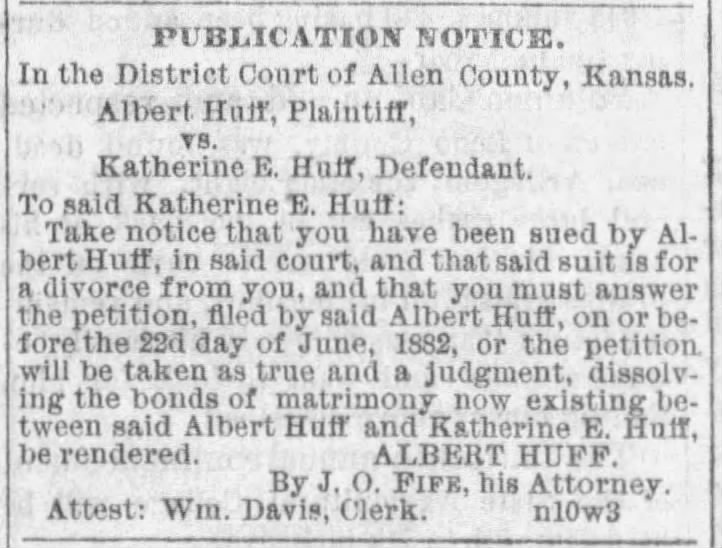
    The marriage did not last long. By 1880, Albert and Perry were living back in Van Buren, Ohio, and Kate was listed as living in her parent’s household in Elsmore as “Kate Huff, 22, widowed.” Albert sued her for divorce in the summer of 1882.

    The Independent Press, Humboldt, Kansas, Wed, May 24, 1882, Page 1

    After their divorce, Kate married James H Gipple (1863–1899) on 8 Jul 1895 in Bourbon County, Kansas, and she died in Wichita on 28 Feb 1912.

    A Second Family

    Albert and Perry’s stay in Ohio was brief. Albert returned to Kansas and married Rosa Edith Murray (1861–1943) on 8 February 1883. By 1885, they lived in Elsmore Township, Allen County, Kansas, on a farm just south of the little town of Savonburg.

    Rosa gave Albert five children before 1890: Albert Burton (1883), Bertha May (1885), Iva Edith (1886), Chester (1887), and Hannah Merle (1889). Albert’s younger brother, Martin, lived nearby with his five children. Their father, Lewis Senior, lived in Martin’s household until he died in 1901.

    In time, the farms and the farmers grew and prospered.

    After twenty years of life in farm country, Albert and Rosa had succeeded at rearing a family and they faced the prospect of an empty nest. Their children were growing up and marrying the children of friends and neighbors – specifically the Samples and the Mores. But the downside of having large families prosper in a small, rural town is that there isn’t much for the younger folks to do.

    Perry and his wife, Pearl, along with two of his three sisters, Bertha and Iva, and their husbands, were probably the first to relocate to Glendale, a growing town founded in the Arizona Territory. Perry started a meat market on Glendale Avenue in partnership with his brother-in-law, Bertha’s husband, Roy Sample. Perry’s health soon gave out, and Roy Sample’s new partner in the business was the husband of Perry and Bertha’s sister, Iva: Harry More.

    I told the rest of their stories a few years ago: Sample More Meats: A Businesswoman’s Story

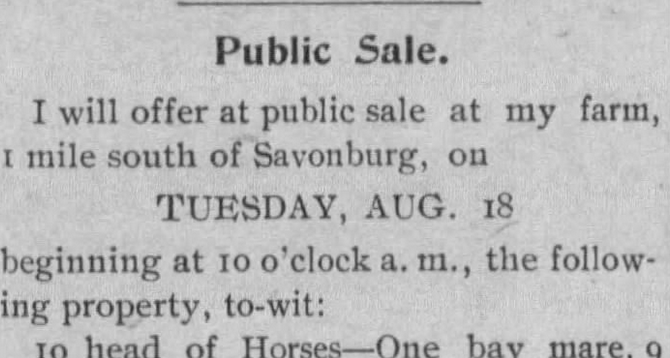
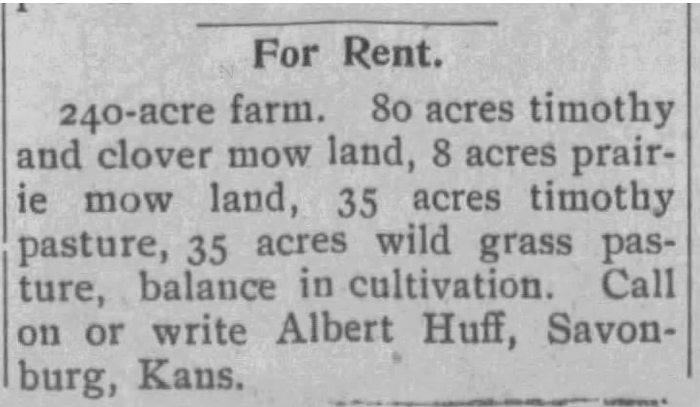
    Albert must have decided to follow the bulk of his family. His youngest son, Chet, left Kansas to work as a lumberman in Colorado, and the only child remaining at home was my 19-year-old great-grandmother, Hannah Merle. So Albert auctioned off his farm equipment and animals, rented out his land, and moved Rosa, Merle, and himself to Arizona.

    image of newspaper announcement of Albert Huff's Public Sale on 18 August 1908
    The Savonburg Record, Savonburg, Kansas; Fri, Aug 14, 1908, Page 3
    newspaper clipping announcing the Huff farm for rent
    The Savonburg Record, Savonburg, Kansas; Fri, Aug 21, 1908, Page 4

    A Second Move

    Growing up, I frequently heard my Aunt Vickie refer to the Huff family’s move to Arizona, saying, “My grandmother came here as a young girl, a pioneer in a covered wagon.”

    There is a romance to that image—and there is a solid chance it is an accurate statement. But it’s probably worth pointing out that making that journey in 1908 was probably a very different thing from making the journey to Kansas in 1875.2

    My guess is that Albert, Rosa, and Merle probably traveled in a Murphy wagon—like the one described on the National Park Service website. Coincidentally, 1908 was the year the first Model T Ford automobiles went on sale in Kansas City.3 I have a strong hunch that Albert might have chosen one of those contraptions over a wagon if they had made their move just a year or two later. There were available railroad routes by that time, running from Kansas City, through Santa Fe, and on to Phoenix, but the fares for three people, plus freight charges, mattress rentals, and buying food probably made the covered wagon a more economical choice.

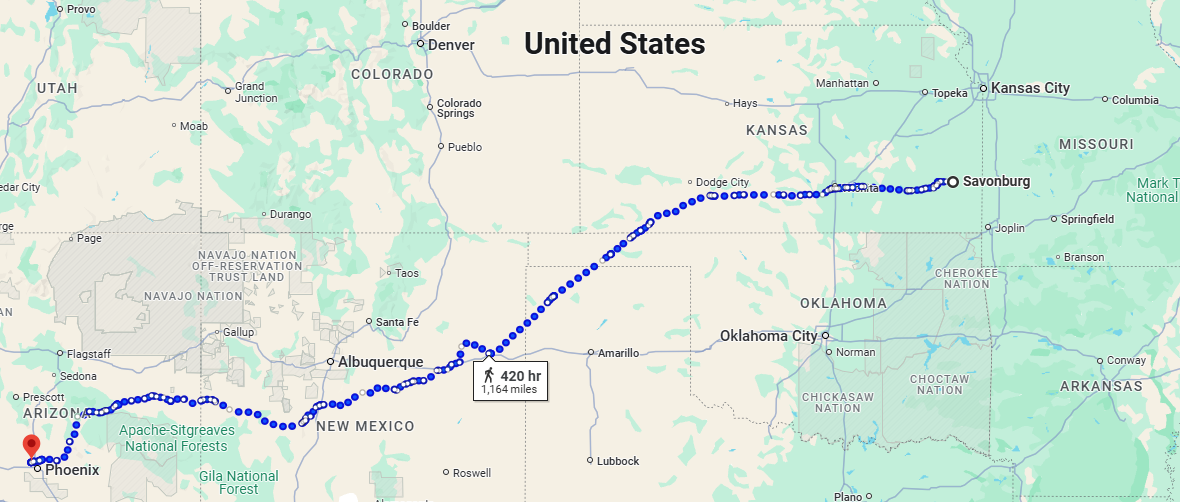
    image of map showing approximate foot route from Savonburg, Kansas to Glendale, Arizona on a modern map
    Approximate overland route from Savonburg to Glendale, on a modern map.

    I don’t know exactly what overland routes would have been available in 1908, but I imagine the family may have followed the railways between Kansas and New Mexico. The last leg, from Albuquerque to Phoenix would have taken them through lands contested by the Apache tribes, which occasionally clashed with the U.S. Army through 1924.

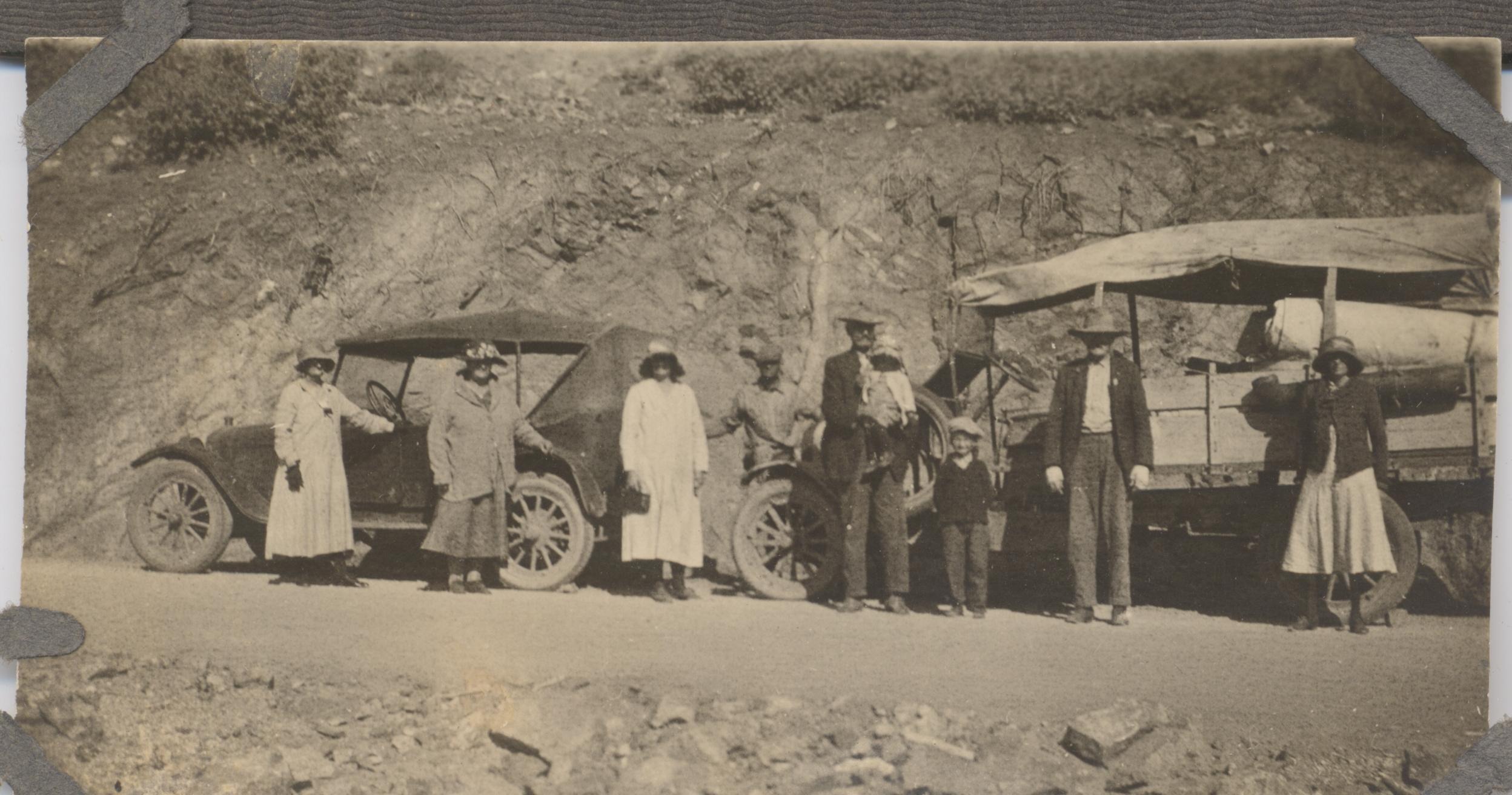
    scanned photograph from collection of Hannah Merle (Huff) Witter
    The Huff family touring Arizona – probably mid-1920s

    I do have a bit of evidence that Albert and his family toured Arizona in automobiles. The photographs came to me when my Grandpa Bob died in 2007, and I’ve managed to scan a few. This one was taken at the roadside, probably between Glendale and Prescott. It’s hard to see faces, but Albert, holding a child, is unmistakable.

    He and Rosa lived out their lives in Glendale, watching their grandchildren grow. He died in 1936, and she remained in their Glendale home until she died in 1943. They are buried in Glendale Memorial Park.

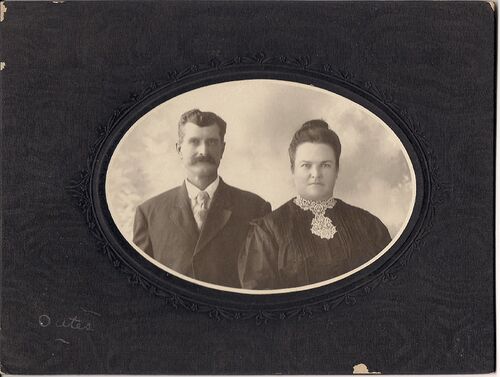
    Albert and Rosa, probably about 1900.
    1

    Albert Huff was my 2nd-great-grandfather – one of “My Sixteen” – and his second wife, Rosa, was my 2nd-great-grandmother.

    2

    National Park Service, “Wagons on the Emigrant Trails

    3

    Wells, Michael, Kansas City Public Library, “Western Auto: A Sign of the Times,” Thursday, July 23, 2020.

  • The search for David E. Jones (1830-1902)

    Depending on your sources and time frame, the surname “Jones” is about the 5th most common surname in the United States. The same can be said for “David” when you look at first names for males.1

    Our work is cut out for us today, since we are looking for the origins of David E. (possibly “Eligh”) Jones, who was born about December 1830 in Pennsylvania and died in Harrison County, Iowa, on 8 August 1902.

    How Do We Know What We Know?

    We’re beginning our search with the facts we know about David based on research I did on his daughter, Alice Frances (Jones) McCullough – my wife’s 3rd-great-grandmother. There are a lot of records from 1870 forward that give us clues that we can use to narrow our search results down as we dig backward. This is how we know his approximate birthdate and that he was born in Pennsylvania. His obituary puts his family’s arrival in Iowa about 1867 (which is supported by the birth place/date information for his children) and the marriage records for his children recorded his wife’s maiden name as “Brookhouser,” which is useful information.

    I talked about a few additional finds in April:

    Mightier Acorns is all about documenting the journey. Subscribe to keep up—I will circle back to your favorite family eventually!

    Two key pieces of evidence are Census records that appear to show our David Jones living in Meadville, Crawford County, PA (1850) and in French Creek, Mercer County, PA (1860). The 1860 shows David already married to Susanna, and Alice is listed as “Frances” on the following page. I don’t have a marriage record for the couple, but Susanna Brookhouser appears within her parents’ household in 1850 in Hayfield, Crawford County, PA.

    At the end of that piece, I put out my usual plea for anyone else researching this family to say hello, and recently heard from Jodie, who is descended from Alice’s brother, Will.

    Jodie has found a lot of information.

    New Leads and Old Reports

    This last document appears to have been originally published by the Crawford County Genealogical Society in 2005 and it looks like a hard copy is housed in the Oswego Public Library in Illinois.2

    There are three sections shown for the “Jones Family” listed in the record, and Jodie’s document appears to have the first two. The first section is a transcript of three pages from a family bible provided by a descendant named Helen Osterberg, Erie, Pa, listing birthdates of William’s family, and his son Robert’s. The second is “THE DESCENDANTS OF WILLIAM & MARGARET (FITZ RANDOLPH) JONES OF WOODCOCK TOWNSHIP” by William B. Moore. It provides a well-sourced descendant report for William Jones, who appears to be the same man named in “Our county and its people…

    William Jones had a son, Robert, born June 23, 1789. According to Mr. Moore, Robert’s eighth child was “David E. Jones, b. Dec. 19, 1830.” This fits with the transcript of birth dates. Mr. Moore’s genealogy cites only one piece of evidence for David E. Jones: his 1880 Census record in St. John, Harrison County, Iowa.

    This is a good lead, but Mr. Moore also lists the children of Robert’s younger brother, John Mounts Jones, which includes a son—“David Jones, b. ca. 1830, crossing the plains in 1862, never heard from again”—which could also describe our David Jones.

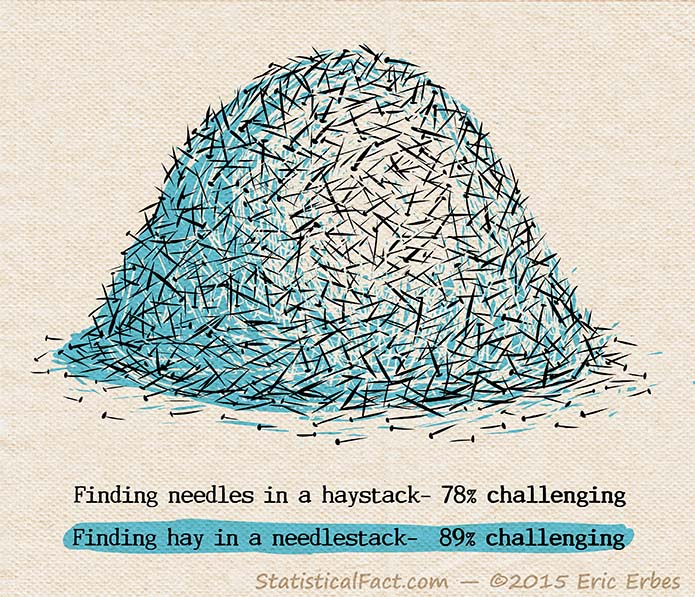
    a huge pile of needles
    “Needle Nightmare” – from StatisticalFact.com by Eric Erbes

    The Way Ahead

    I’m pretty sure that I agree with Jodie and Mr. Moore. David E. Jones is probably the son of Robert and Letitia (Roberts) Jones. The best strategy I can think of is to create profiles in my Ancestry tree for both Robert Jones and John Mounts Jones, using the leads and source information provided by Mr. Moore, and then work my way “down” to see if I can find more direct evidence connecting our David to either of them.

    Along the way, I have a ton of Brookhouser leads to explore, and friends and neighbors (FAN) to look for who might provide more clues.

    The goal is to push my Wavetop for the Jones family back at least one or two generations.

    Let the hunt begin!

    1

    Social Security Administration, “Top Names Over the Last 100 Years

  • William “Zardie” Sly (1882–1954) – a.k.a. Jack St. Clair

    William Zardie Sly (1882–1954) took his middle name from his maternal grandfather, Gilbert Zardius Avery; most of the references I have found refer to him as “Zardy,” or by his initials “W.Z.” which probably served to distinguish him from the generations of William Slys related to each other and living in Wood county, Ohio.

    He is the grandson of William Sly (1838–1894) and Harriet E. Callin (1838–1907), so he is named in the 1911 Callin Family History. We knew from that brief entry that he was married and had a daughter, and his wife, the former Jessie June Stockstill (1882-1966) appears as “divorced” in the 1910 census with their daughter.

    For a long time, I didn’t know what happened to “Zardy” after about 1907. Then cousin Leanna contacted me with the rest of the story, which I ran as a guest post on the old Mightier Acorns blog on Friday, June 14, 2019:

    Guest Post: William Zardie Sly AKA John St. Clair

    Oh my, Uncle Jack, where to begin.

    Actually, he was my great-uncle, the eldest brother of my paternal grandmother, Fanny Fern Sly Elder. (I’m sure retribution will hit me eventually for revealing her correct given name, Fanny Fern Sly. She hated ‘Fanny’. I’ve often wondered if she realized she’d probably been named for her great-grandmother, Francis/Fanny Cooper Meeker, or maybe for her mother’s sister, Fanny. She changed it to Fern F. early on.) But I digress. This is about Zardy, or to me, Uncle Jack.

    Since I only heard first names of relatives as a kid, I didn’t know about this name change for a long time. Uncle Jack & Auntie Margaret would come from Chicago and visit Fern and her husband Cash almost every summer in the 1940s & early 1950s. They both loved to cook. They would work away in Fern’s kitchen during the day, making batches of food for us, or extra portions, which were put in the freezer. Auntie Margaret was from Virginia and her light Southern drawl was a joy to me. They always tolerated this little kid watching in the kitchen, since mom, dad and I lived next door. We lived in the old village of Eagleville, about 2 miles North of Bloomdale in southeastern Wood County; about 18 miles southeast of Bowling Green. Eagleville was an old village from the 1860s and 1870s and had been plotted. There were actually 2 or 3 lots between our houses, but Fern & Cash owned it all, so it was a great big yard for me to play in.

    I use the birth date of 20 Sept. 1882 for William Zadius / Zardy Sly. That’s the one in the Callin Family History book, the one on his Masonic records with the Grand Secretary. Grand Lodge of A. F. & A. M. of Illinois, and the one on his World War II Draft Registration, filled out in 1942. (Isn’t it nice that those 3 agree?) This shows that the birthday of 20 Sept. 1882 for Zardy in the Callin History is the same as the birth dates of Uncle Jack who was a Mason and the Uncle Jack who filled out a World War II Draft registration.

    This also means I have discounted his Dec. 1882 birth date in the 1900 Federal Census, Wood Co., OH, Washington Twp., Tontogany village, p. 234A, the 20 Sep 1880 date he gave on his World War I draft registration card, and the year 1881 in his obituary in the Oak Leaves. (newspaper) Oak Park, Illinois, 17 June 1954, p. 59. (quoted below)

    Eventually, I found out that Uncle Jack had been married to someone before Auntie Margaret, and they even had a child, a daughter. My parents told me that for some reason, Uncle Jack divorced his wife and changed his name to get away from his first wife and daughter. Since they were always tolerant of this little kid, I found it a bit hard to think of Uncle Jack not wanting his child.

    My parents told me that in the beginning, Uncle Jack and Auntie Margaret so enjoyed their cooking they spent summers at resorts in Wisconsin and places in the North, then went to Florida resorts for the winter. Not sure when they did this since they apparently were settled in Chicago by 1918. It seems that Zardy had a bit of a wanderlust and I wonder if he felt marriage & a child would tie him down.

    I have not been able to determine exactly when Uncle Jack changed his name. He was William Zardy Sly in 1902 when he married Jessie Stockstill and in 1903 when his daughter Lulu was born. I haven’t been able to locate him in the 1910 Census under either name. When his daughter got married in 1924, naturally she knew the name of her father but I doubt that he was at the wedding.

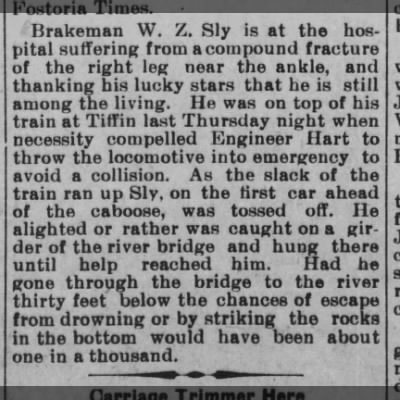
    Brakeman W.Z. Sly
    Garrett Clipper, Garrett, Indiana • Thu, Apr 26, 1906, Page 4

    I was not aware of his career with the railroad so was surprised to read about those activities in 1906 and 1907 that Tad mentions in Mightier Acorns: William James Sly. He also mentions he lived in Detroit & Toledo. I’m eager to see those newspaper clippings. Actually, I have been able to find some newspaper reports from that time & place, since I was motivated to look, so I evidently found a few of them.

    The first instance I can find of him using his new name, John St. Clair, is when he joined the Masonic Lodge in Illinois – Home Lodge # 508 in 1917 in either Chicago or Oak Park. His occupation was a cook. Interestingly enough, they had no mention of his other Masonic activities such as the Shriners and Knights Templar. Dad was positive he was & since dad was also a Mason, I would expect him to know, and we have photos of Uncle Jack in regalia.

    He was definitely going by John St. Clair by the fall of 1918. He had met Margaret Rebecca Walters and they got married in Lake County, Indiana on 3 October 1918. Lake County is the northwesternmost county in Indiana and borders Cook County, Illinois. Interestingly, on 12 Sept. 1918, two weeks before they were married, when he filled out his World War I draft registration card, he listed his nearest relative as his wife, Margaret, living at 640 Barry Ave., which is the permanent address he gives initially on the card for himself. At that time he was working as a chef at the Ontario Hotel, where his employer was William Hogan. And they were still living on Barry in January 1920, when the 1920 Census was taken. They rented rooms at that location from the homeowner. At the time of the Census, he was a hotel chef, possibly still at the Ontario Hotel, and she was not working.

    On the other hand, since the Census is taken every 10 years, and they are only renting, it’s plausible that they were spending summers cooking at resorts in the North and Florida in the South off and on over these years.

    They were living in Chicago for the 1930 Federal Census. She was not working and Uncle Jack was a chef in a wholesale grocery. They were still renting rooms from a homeowner, but had moved to 1758 N. Linder Ave. Oddly, they had a boarder with them. Her name was Esther Gahagan. I don’t recognize her name as anyone in the family. I wonder how often renters, in a home, have a boarder with them.

    By the 1940 Federal Census, they were living in the Chicago suburb of Oak Park, at 1138 Erie, in their own home. Uncle Jack is a chef at a café and Margaret is a Pantry Girl at a Country Club.

    On 27 April 1942, Uncle Jack, at age 59, dutifully filled out his World War II Draft Registration Card in Oak Park. This registration card was interesting as it finally gave an indication that the St. Clairs did move around for work from time to time. While it gives his residence as the same Erie St. address as in the 1940 Census, it does not ask for an occupation, just an employer. And that employer was Eagle Waters Corp., Eagle River, in Vilas County, Wisconsin. Now there’s a resort, and I found it’s in the way-North of Wisconsin, on the Wisconsin – Michigan U.P. border. Now I’m wondering if this is where Uncle Jack worked in summers – one of those Northern resorts in Wisconsin my Mom talked about, and Chicago was just sort of a home base.

    Since I was born about 6 weeks before Pearl Harbor, I don’t really remember much until the mid to late 1940s. By then, Uncle Jack was the chief chef at the Cook County jail in Chicago. He prepared food for the warden and bailiffs. Auntie Margaret was the head salad maker at the fabulous Marshall Field store restaurant. According to Wikipedia, that downtown Marshall Field store was the first to provide ‘in-store’ dining facilities. That was their life – working with food. I remember going to Oak Park to visit a couple of times, with side trips to places like the Natural History Museum being included.

    On 11 June 1954, Uncle Jack had a heart attack at work and died. I secured an obituary from the Oak Park Public Library:

    Oak Leaves. (newspaper) Oak Park, Illinois.

    Copy of obituary obtained from the Oak Park (IL) Public Library, Oct. 1996.

    p. 59, June 17, 1954, (page and date from accompanying letter):

    “St. Clair – John St. Clair, 72, of 1138 Erie, died suddenly Friday of a heart attack at work, at 26th and California. He was long the chief chef for the warden and bailiffs there. He was born September 20, 1881, in Bowling Green, Ohio and had lived in the village a number of years. He was a member of Chevalier Bayard commandery, No. 52, K.T., of Chicago chapter, No. 127 R.A.M., and of Medinah Shrine. His widow, Margaret survives him, a brother, Sanford, and two sisters, Fern Elder and Fay Baumgardner. Masonic rites were accorded Monday at Drechsler’s chapel, under the auspices of Home lodge, 508. Burial followed at Mt. Emblem cemetery.”

    June 17, 1954 was a Thursday so he died on Friday, 11 June 1954.

    I thought it was interesting that an address was given as to the place he died, so I wrote back to the Library, inquiring about the address and the Cemetery and was told:

    “Dear Mrs. Shaberly:

    The central court building for criminal cases in Cook county is located at 26th and California. This building is at the edge of a whole campus, of county buildings, including Cook county jail, offices for the county states attorney, sheriff’s police, social services etc. The phrase 26th and California is used to refer to the court building and to refer to the whole complex.

    I don’t believe I had heard of Mt. Emblem cemetery before but there are many, many cemeteries in the Chicago area. Mt. Emblem, I find, is in Elmhurst, a suburb about fourteen miles further west than Oak Park. Oak Park is on Chicago’s western border.

    Mount Emblem Cemetery Assn

    510 W. Grand Ave.

    Elmhurst, IL 60126 Telephone 830 834-6080

    …”

    The Cemetery is in DuPage County, just West of Cook County. I created Memorial #196924112 for John St. Clair on Find-A-Grave and requested a photo. Then I recently saw that there was a Memorial for him under his birth name with the correct dates, but the note: burial unknown. I’m mulling this over in my mind about whether to try and merge the 2 records. Since the burials are 3 states apart, I might just leave them as they are. I did submit a note to Find-A-Grave for Zardy with the AKA information and burial place. It is currently under consideration.

    And in his obituary, the deception of his name was kept right to the very end. His brother Sanford is mentioned, but not his last name. And with the 2 surviving sisters married, their names don’t point to anyone named Sly. I’ve included the obituary here, to help tie the threads together.

    Auntie Margaret stayed in Chicago for several years before moving back ‘home’ to Virginia. She died on 27 May 1977, in Staunton, Augusta Co., VA. She is buried in Oak Lawn Cemetery, in Bridgewater, Rockingham Co., Virginia, with her father, Joseph Wesley Walters, and one of her sisters, Jessie Walters Hamilton. I cannot find where her mother is buried, and not really sure when or where she died, just that it was before the 1910 Census.

    And that’s pretty much what I know about William Zadius Sly AKA John St. Clair, my Uncle Jack!

    Leanna Elder Shaberly
    11 April 2019
    Bowling Green, Ohio

    Thanks for reading Mightier Acorns! If we’re cousins, and you have a story to share, let me know!