Mightier Acorns

Journeys through Genealogy and Family History

A parody of a family coat of arms designed with acorns as elements, with the motto "ex gladnis potentioribus" Latin for "from Mighty Acorns"
From Mighty Acorns
  • posted Friday, November 21, 2014

    This piece was adapted for this blog from a longer two-part piece on my Tad’s Happy Funtime blog. That version spends more time on me than is proper for a biographical sketch of my grandfather, Russell Hudson Clark, Sr. (1920-2002), but if you’d like to see that longer version, part one is here: A Fire in the Desert 

    The preacher roamed the wilderness of the desert Southwest for 50 years in a series of new and used recreational vehicles, his wife by his side, always seeking receptive souls to bring to the Lord. He raised a son who went to Vietnam and two daughters – all three raised sons of their own. He built houses, sank wells, raised chickens and rabbits, saved souls, started churches – and moved on, always moved on.
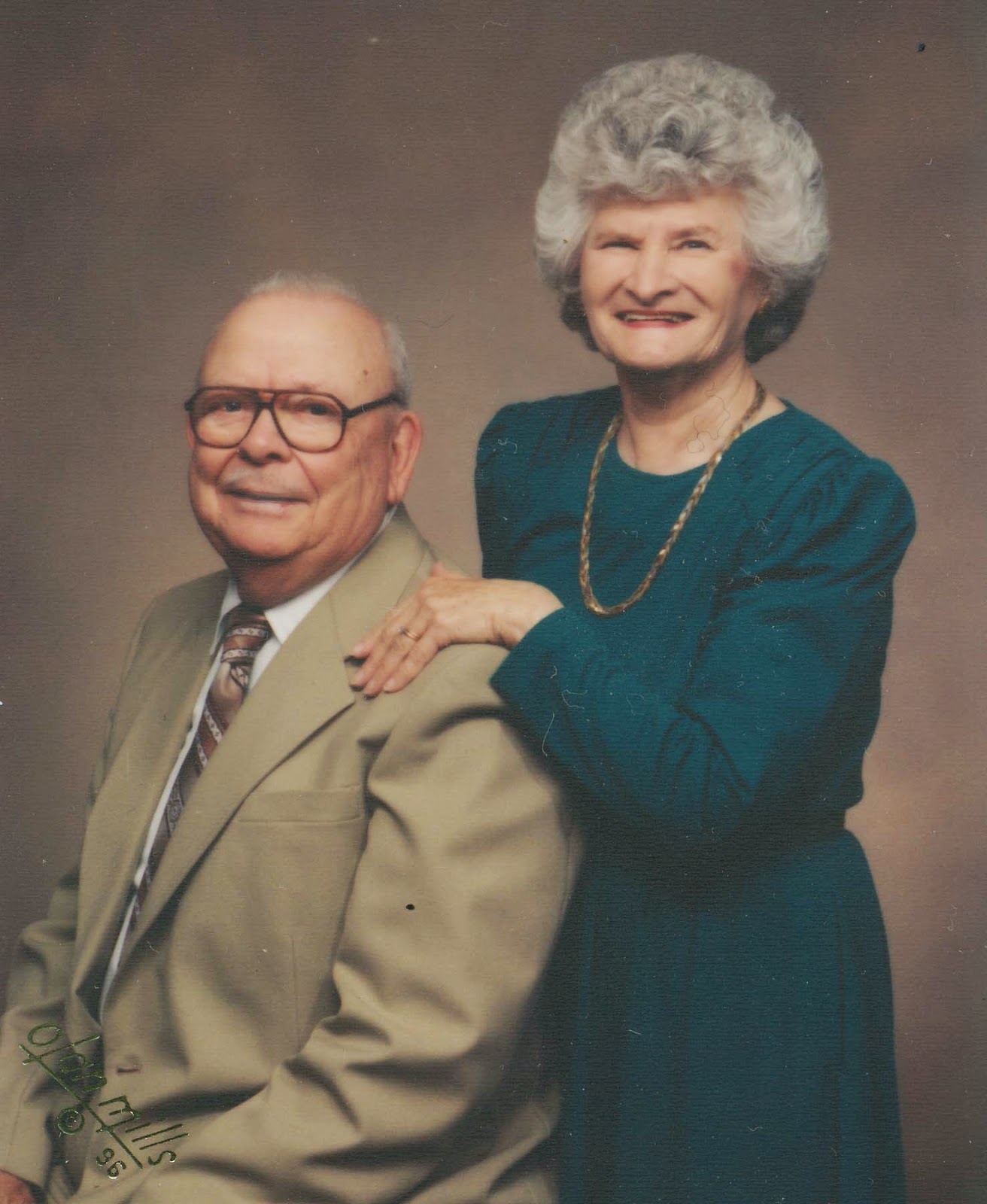
    Russ and Alberta Clark, 1996

    His name was Russ Clark, and he was a big man with a big voice, a broad smile, a ready laugh, and a proverbial fire in his belly. He once joked that this was why he ate so much when he visited us, but that was more likely a side effect of being the youngest of 12 children raised in the South during the Great Depression.

    His hair, what was left of it by the time I knew him, was usually a close-cropped white stubble that seemed to grow wild and wispy overnight. I thought of him as a bald man, but he always claimed to need a haircut.

    “Grandpa,” I would exclaim, “You’re bald! Why do you need a haircut?”

    And his laugh would boom, and he would start to relate to me a tale about Jesus telling all men to keep their hair off their collar, not like those… but Grandma would usually swoop in with the clippers and a towel, and hurry him off to our patio for a trim before he could get much further.

    He traded camper vans up for RVs, traded the RVs up for pickups with fifth-wheels, and traded the trailers up for mobile homes on an acre of property before deciding he had tied himself down with too many possessions and scaled back down again. No matter where he lived, you would find Grandma with her box of mementos, her organ, their dog, and her quiet hope that someday they would find the right home.

    One thing about desert life is its innate mobility. Plants’ roots never run deep – they run shallow and broad. Animals may dig in and hide during the heat of the day, but they know to stay on the move if they want to find shade and water. One place Grandpa could always find some shade and water was under the tree in our driveway.

    When Grandma and Grandpa showed up, it was almost always a surprise to us kids. Mom learned not to give us any warning that they were coming to visit, or we would stake out the couch by the big picture window and drive each other crazy with anticipation, shrieking “They’re here! They’re here!” at every puff of dust on the washboard that was 89th Avenue.
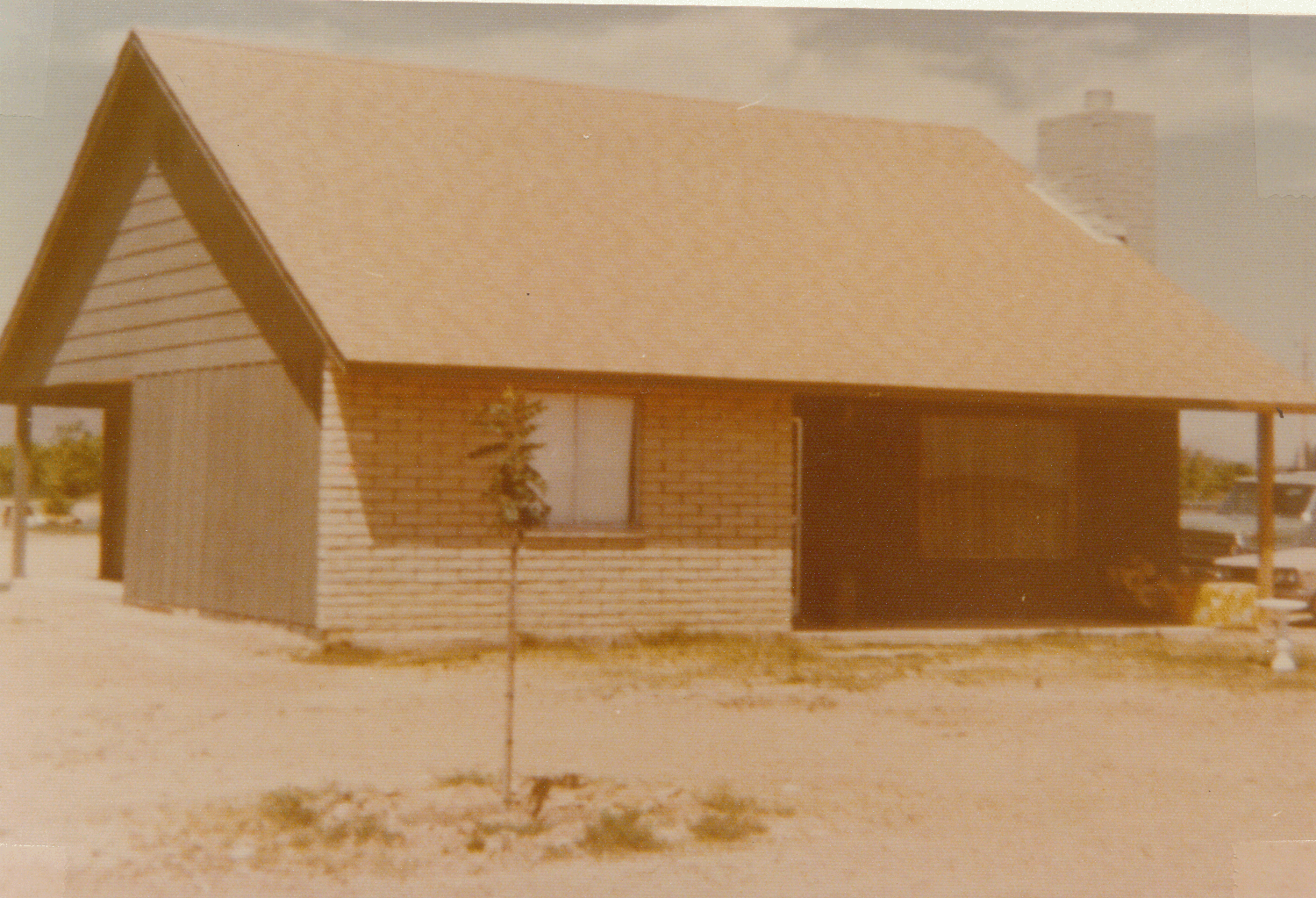
    The house on 89th Ave., 1973

    And they would finally roll in, pulling up under the skinny poplar tree where Grandpa would jack, level, and brace whatever mobile domicile they were currently living in, and hook up water and electricity. He’d run a hose from the sewer line to the poplar tree, and remind us kids that if we used their toilet, only to “run water” in it. When we were little, he’d explicitly tell us, “Only pee-pee and wee-wee in there! No poop-poop!” and we would giggle at the naughty nonsense words and repeat them daringly until we remembered that Grandma was waiting inside.

    Most of the time, we could take turns sleeping over in the Camper; no matter what the actual vehicle was, it was always “the Camper” to us. Our favorites were the cab-over motorhomes with their inevitable forward and side windows. I’d fill every spare inch with Star Wars men, posting guards at the corners and locking imprisoned rebels in the cup holders. My sister would pasture her My Little Ponies on and around the dining table. Meanwhile, the grown-ups would stay inside with sweating glasses of sweet sun tea, talking about trade-in values, equity, and whatever else grown-ups discuss when the kids are out of earshot.

    None of these visits ever lasted long enough for my sister or me, but Mom and Dad seemed to uncoil a little bit whenever the clouds of dust would follow the caravan du jour down the road toward their next stop – usually my cousin’s house a few miles away. Looking back, I can see how my dad, who was always happiest building and tinkering with his handy projects around the property, might have looked forward to not having his father-in-law offering advice on how to build and tinker better. And since they were mom’s parents, I could see how maybe there were lingering childhood issues that every family has that made her feel progressively less in control of her own home until the visits were over.

    They never said anything to us about it, because they would never say an unkind word about anyone to us. But I think now that maybe the mornings after Grandma and Grandpa drove off after each visit might have been the mornings that Mom’s old Beatles, Monkees, and Lovin’ Spoonful records came out for a spin – replacing Kate Smith’s “How Great Thou Art” and Barry Sadler’s “Ballad of the Green Berets” which had seen more prominence the previous few days.

    Whatever the adults’ issues may have been, I remember treasuring the stories Grandpa told us. If Grandma left him alone with us for any length of time, we would prod and pester him to tell us stories about growing up in Kentucky and Arkansas, and when he did, we would sit around him, raptly hanging on every word. This happened most often on Sunday afternoons, after church and the big chicken dinner that Mom and Grandma would prepare. I remember sitting close to him, despite the inescapable odors of dust and sweat that plague a big man who spends long days driving Arizona back roads. I remember feeling full of chicken and listening to him tell adventurous stories about the things that his brothers got up to or cautionary tales of drinkers and smokers who ended up badly.

    My personal favorite was a memorable tale about the time a young Grandpa had found a perfectly good hat floating on a vat of sheep dip when he took a shortcut through the stockyards. He wore it proudly down the main street, only to have a woman run screaming out of her house, calling the police and demanding that he show her where he found it. When the police dragged a pole through the vat of sheep dip, they found the woman’s husband – dead and drowned. He had evidently wandered through the stockyards after a night of heavy drinking and fallen in. Sometimes, when he ended the story, Grandpa would tell us that the woman let him keep the hat – and he would point at his sun-bleached ball cap with the enormous grin of a champion spinner of tall tales.

    Grandma was never comfortable with Grandpa’s insistence on filling our heads with nonsense, so he would frequently placate her by telling us Bible stories. I always figured the Bible stories came naturally to him because Grandpa was a preacher.

    At least, he would talk about being a preacher; and once or twice, he was invited to give a sermon at our church. In school, when our religion class covered the revival movements of the 1800s, I knew exactly what they were talking about when they described the hellfire and brimstone of the tent revivals, largely because of the impression that my Grandfather made on me from the pulpit. He lit up in front of a congregation of any size or composition, and his oratory would grow olive branches and wind its way along the corners of our plain, unadorned sanctuary turning our little Southern Baptist church into a cathedral or a great tent.

    It was something of a mystery to me why he didn’t have a church of his own, but I figured out that there is a big difference between being a “preacher” and being a “pastor”; it’s rather the same difference between being a revolutionary and running a government after the revolution is over.

    That revolutionary Grandpa would sometimes run out for a gallon of milk, and come back hours later relating how he had spied a young man “with an earring” who had clearly needed to hear the Word of Jesus. Or he would leave Grandma with us while he went “visiting” – coming home late in the evening, bursting with energy, and planning to move back to Phoenix and start a revival that would sweep the city!

    Even when he did “find a church home,” it never seemed to last. There would be excitement; property would be purchased or rented, and funds raised. Ground would be broken, and promises would be made. But eventually, almost never longer than six weeks along, the enterprise would evaporate and Grandma and Grandpa would pack up and drive off disconsolately, shaking their heads, and sadly bemoaning a general lack of faith and unwillingness of people to hear the Word of the Lord.

    Not that there wasn’t something to Grandpa’s side of the story, but it’s fair to say that there were several notions harbored in his heart along with his extensive knowledge of Bible stories and personal morality tales. When I got older and read about the John Birch Society and Barry Goldwater, and started seeing “conservative” radio and TV hosts gaining popularity in the early 1990s, I recognized many of the ideas that Grandpa had tried to teach me over the years when Grandma and Mom were out of earshot. Like the time when I was 9 and deeply into dinosaurs, he waited until we were alone in the living room to tell me that Satan had placed their bones in the ground to confuse scientists and to test our faith. Or when the space shuttle Challenger exploded and he ruefully reminded me that the space program was just man’s foolish attempt to build another Tower of Babel and that the explosion was God’s way of reminding us to stay focused on Jesus.

    At the time, I hadn’t explored any of this very deeply. To me, Grandpa was simply one of the most colorful and admirable people I knew. On balance, he made me feel loved more than judged, and he was clearly proud of me. Maybe his stories exaggerated some details, and maybe some of his beliefs about science were on the questionable side, but he instilled an appreciation for narrative and a love of words in me that I still cherish. I was enthralled by the power of his storytelling, and I learned that his engaging tall tales about growing up in the South and his ever-evolving stories about his exploits serving in the Navy during World War II were, if not factually precise, intended as morality plays. I doubt it was his intent, but he taught me the beautiful and awkward relationship between fiction and truth.

    Sometime in the dim, early reaches of my memory, Grandpa had a nasty fall. He was working as a building inspector in downtown Phoenix and fell off of a building he had been climbing. His knees were destroyed, and he spent a great deal of the rest of his life in and out of the VA hospital for various surgeries to repair or replace his joints. It happened that one of his visits occurred during my junior year of high school and coincided with a new knee replacement at the hospital where my girlfriend’s neighbor worked as a nurse.

    As was expected, when Grandpa came home from the hospital he began to regale us excitedly about what a blessing it had been for him to be the instrument of the Lord in that place; how he had prayed with all of the nurses and Saved them all – reinforcing his perception that there was a Higher Purpose to his suffering, and that Jesus was using his pain to win souls.

    He saw himself as a light in the desert at night, trying to show people the way.

    But when I asked my girlfriend’s neighbor, the nurse, about Grandpa’s story, she told a slightly different version. “Oh, yeah,” she said, “I remember Mr. Clark. He wouldn’t let us change his bedpan or give him any meds until we prayed with him. I accepted Jesus eight times, just so I could finish my rounds.”

    Perception differed from reality in the harsh light of day.

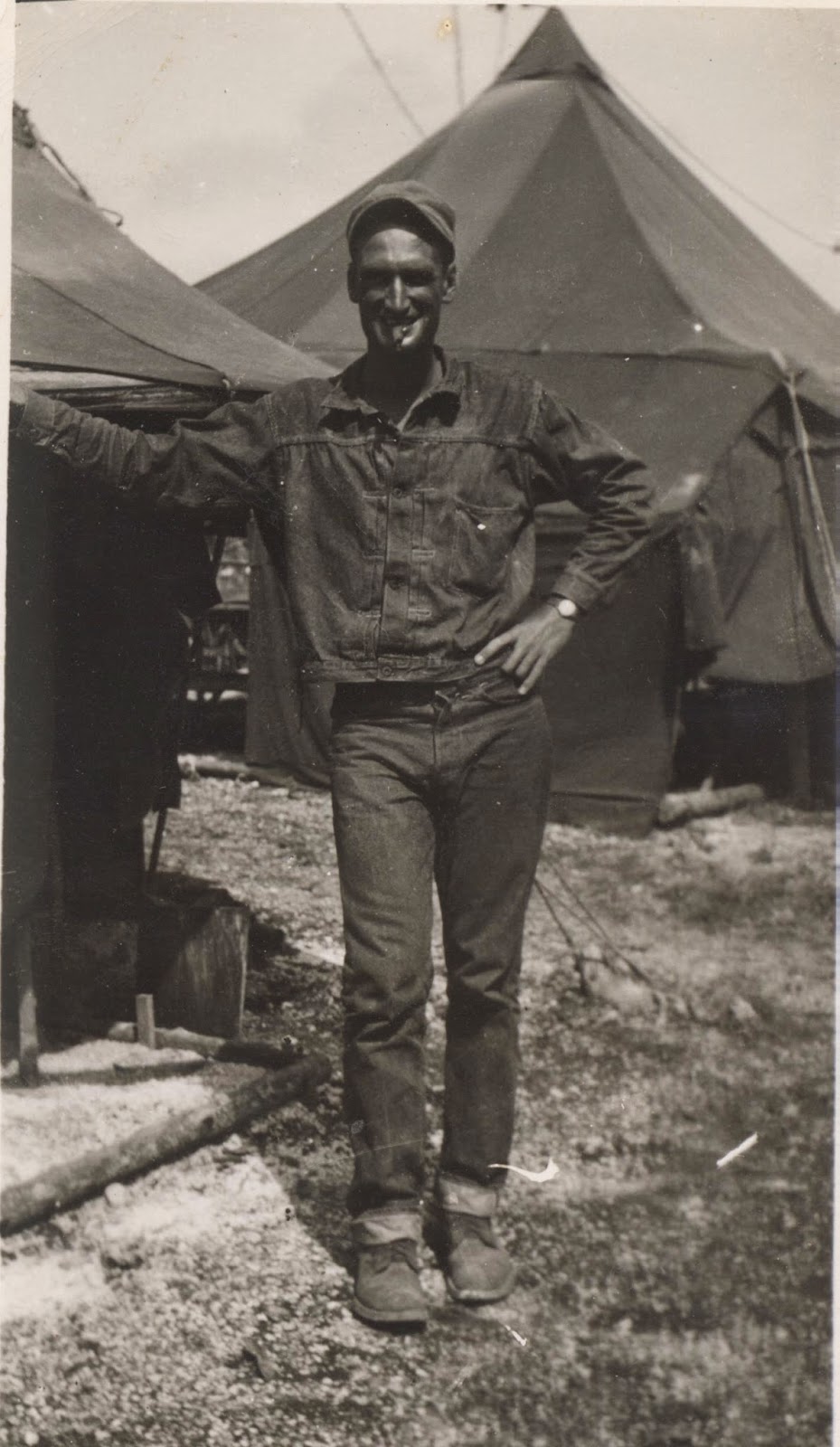
    Russell Hudson Clark, USN

    When he found out I was joining the military, he was proud, and he pulled me aside to tell me about his experiences. Not the stuff he told me when I was just a kid, mind you – he wanted to warn me of the “traps” he had fallen into as a serviceman in the U.S. merchant marines; his cocaine and heroin habits (which I had never heard him mention before) on top of his drinking and smoking (which I had). He told me how he had been singing in a night club on shore leave in Italy, and had been approached by a U.S. Army Major who wanted to recruit him to sing in his USO band – but that Major, one Glenn Miller, had disappeared in Africa before the transfer papers went through. Needless to say, the details he told me didn’t add up with official accounts, but I understood by then that they were true enough for stories and that he was really telling me he loved me.

    Grandpa passed away in 2002, about a year after I returned to Arizona from serving overseas in the Air Force with my young family. I had known his health was declining for a while, so as soon as we returned to the States, we arranged to visit Grandma and Grandpa in their RV, which was hooked up on the San Carlos Apache Reservation outside of Peridot, AZ.

    I had told my wife many of my stories about him, and she was almost terrified to meet him. She knew he had strong opinions about tattoos and how a wife should behave, and while she’s pretty tough and uncompromising herself, she didn’t want to be resented by anyone in my family. But her fears dissipated when they finally met. Grandpa was overwhelmingly sweet, complimented her tattoo, and dandled the baby on his knee (which had recently been replaced again) while recounting his adventures on a Liberty ship taking lend-lease materiel to Murmansk through a German submarine convoy in 1941.

    We had a wonderful (if short and hot) visit. Kate was relieved that Grandpa hadn’t criticized her or tried to Save her – but she wondered why he kept calling her “Karen.” The explanation for the name slips and the apparent change of character was horrible and simple: Alzheimer’s.

    It is a horrific thing that a disease like this can alter your perceptions without you knowing it. The more we learn about the human brain, the more we understand that it is a delicate marvel and how easily it can be deceived. We learn more all the time about how memory works (or doesn’t) and how unreliable we are as eyewitnesses. I had long known that, in the harsh light of day, I had to take Grandpa’s stories with a grain of salt, but Alzheimer’s magnified the problem.

    Finding out years after the fact that things he said to me, and things he believed were true, could have been due to changes in his brain forced me to reevaluate everything I thought I knew about him. It was hard to sort out, but in the end, while it’s impossible to know how much the disease had to do with altering his basic character, I choose to see the sweet man we said goodbye to as the “real” Grandpa. It doesn’t matter what made him do and say things – what matters is that he did his best with what he had.

    He chose to roam the desert doing what he thought was right. I choose to perceive him in the best possible light – warts and all, flaws proudly on display. After all, a fire in the desert may cast shadows at night that disappear in the harsh light of day; but without it, the night can get very cold.

  • Looking for the father of Abraham Witter (1786 – 1882)

    A few weeks ago, I published Family Reunion: Witter, which prompted a conversation about Abraham Witter (1786-1882) with my dad’s first cousin, Pat Witter. Pat had sources connecting Abraham to the family of Joseph Witter and Hannah Washburn; however, those sources proved that a different Abraham Witter belonged to that family. This leaves our family without a known father for Abraham.

    Reviewing the available evidence leads to a theory: Abraham’s father may have been John Witter – but we still don’t know for sure, yet. Here’s what I’ve got to work with:

    Elizabeth Shown Mills’s analysis

    • Elizabeth Shown Mills, “Samuel Witter (1787–1876) & Wife Rachel “Lizzie” Smith (ca. 1802–1854: Research Notes,” A Working File Updated 5 December 2013, p. ____; archived online at E. S. Mills, HistoricPathways (www.HistoricPathways.com: accessed 08/26/2023).

    Mills collected evidence to consider whether the Samuel Witter she was researching was a brother to the Abraham Witter we are interested in. She considered four men who were possible fathers of Samuel and Abraham. Of those, I believe her evidence best supports the theory that John Witter is the father of Abraham Witter. According to her file, she collected the following documents:

    • 1782 – court reference to “John Witer’s Lane” in Tom’s Creek Hundred, Frederick County, Maryland.

    • 1785-86 – “John Witter” sued a debtor

    • 1796 – John Witter received patents for two tracts

    • 1800 – bought a tract in Metal Township, Franklin County, Pennsylvania, saying he was of “Tom’s Creek Hundred…”

    • 1800 – Census (not sure whether she meant Federal or Pennsylvania Census)

    • 1820 – U.S. Census (see below)

    Searching in Ancestry, I have been able to find the following documents:

    1790 U.S. Census: Frederick County, MD

    Columns indicate “Males – 16 and over” (2), “Males – Under 16” (4), and “Females” (5)

    Note that the transcription has his name as “John Withero” but it looks to me more like “John Withers”. None of the other names on this page appear to be any variation of “Witter”. There is a “Witherow” family in Metal Township but I think they are distinct from the Witter family (and various spellings) in those records.

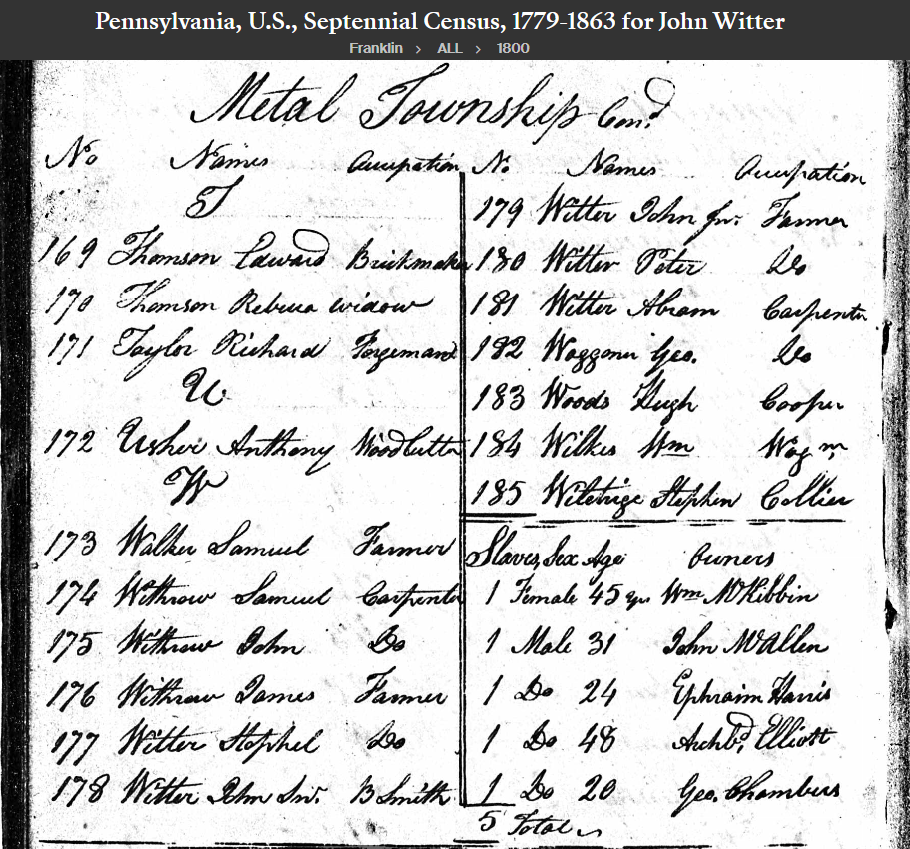
    1800 Pennsylvania, U.S. Septennial Census: Metal Township, Franklin County, PA

    • 177 Witter Stophel [farmer]

    • 178 Witter John Sr. blacksmith

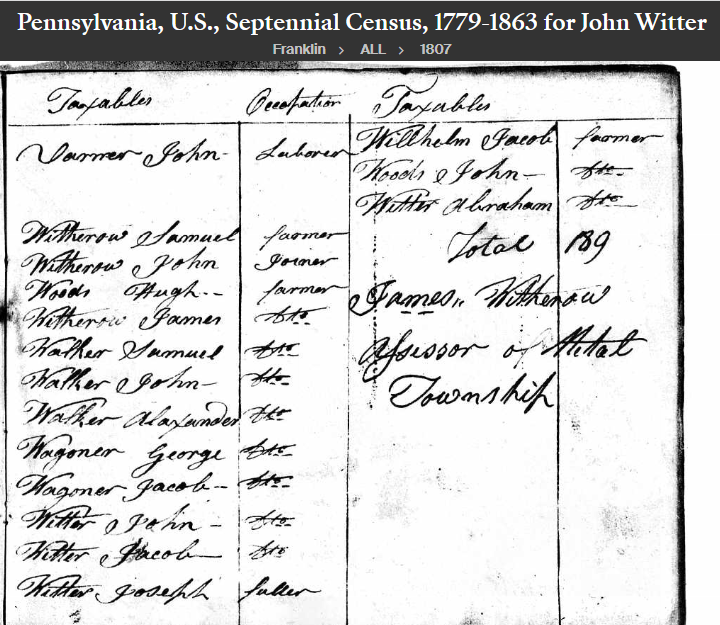
    1807 Pennsylvania, U.S. Septennial Census: Metal Township, Franklin County, PA

    • Witter, John – [farmer]

    • Witter, Jacob – [farmer]

    • Witter, Joseph – fuller

    1810 U.S. Census: Hamilton Township, Franklin County, PA

    • Males – 16 thru 25: 3

    • Males – 45 and over: 1

    • Females – 16 thru 25: 1

    • Females – 45 and over: 1

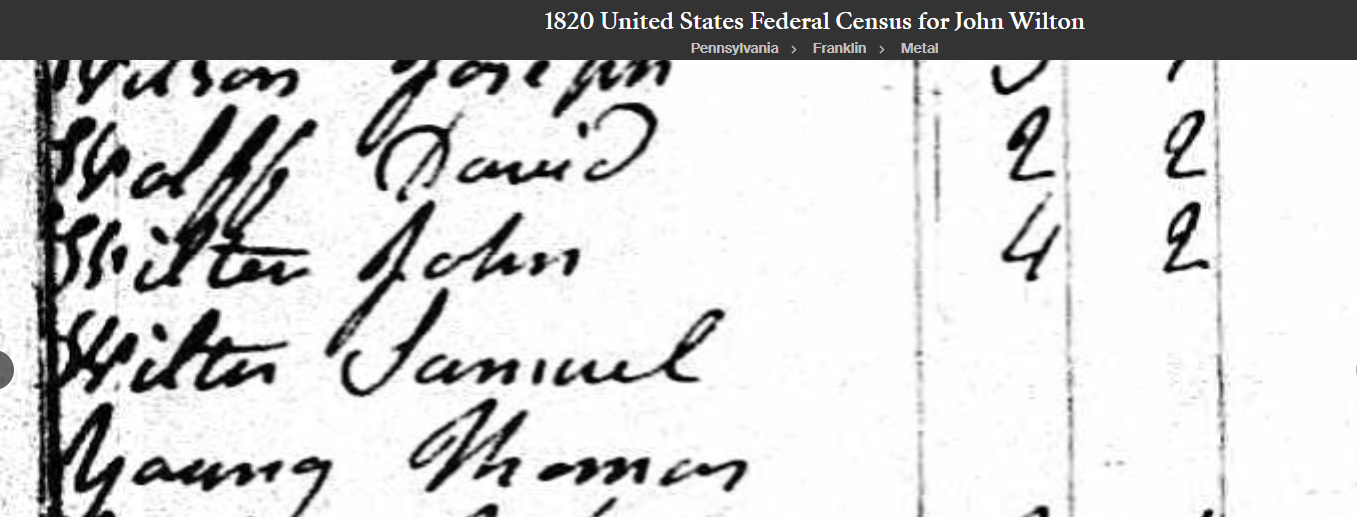
    1820 U.S. Census: Metal Township, Franklin County, Pennsylvania

    “Wilter John” followed by “Wilter Samuel”

    Data columns:

    • Males Under 10: 4

    • Males 10-15: 2

    • Males 16-25: 1

    • Males 26-44: 1

    • Males 45 and over: 1

    • Females Under 10: 3

    • Females 10-15: 1

    • Females 26-44: 1

    Samuel’s household:

    • Males 16-25: 1

    • Males 26-44: 1

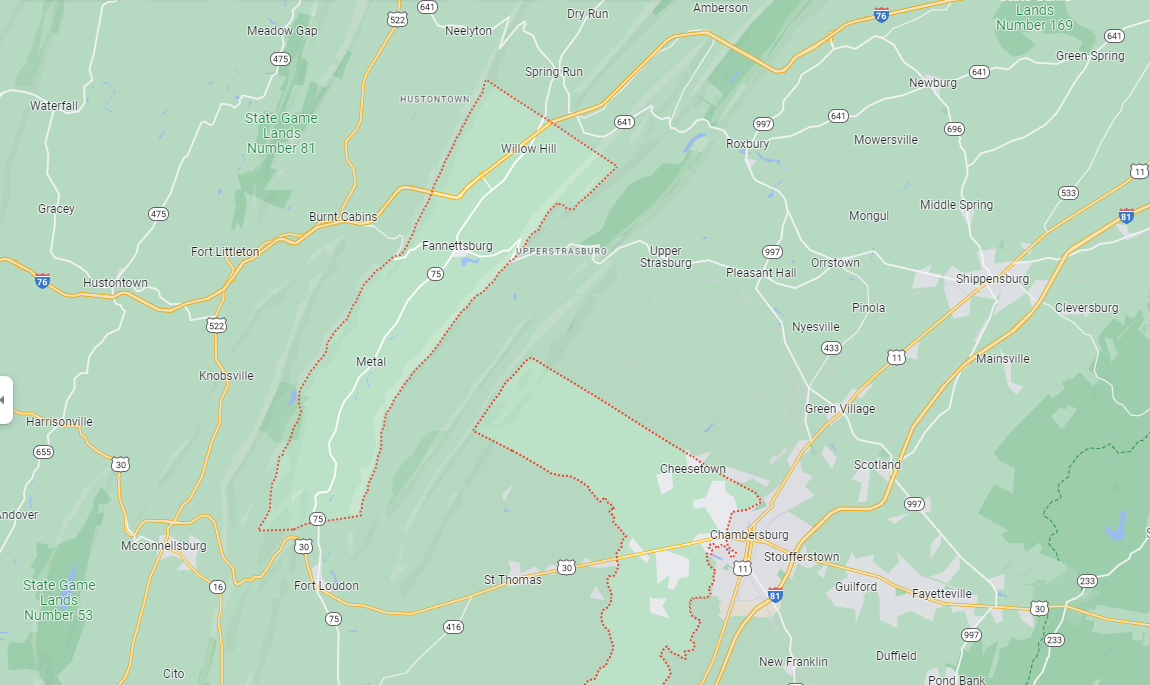
    Metal Township (left) and Hamilton Township in relation to each other; for scale, Chambersburg to Shippensburg is about 11.6 miles

    Conclusions:

    These records seem to confirm that someone named John Witter, and men who shared his surname, lived in Franklin County, Pennsylvania, from at least 1800 to 1820.

    His occupation was given as “blacksmith” in one record, and “farmer” in another. We may assert that he had at least three sons (John, Jr., 1800; Abram/Abraham, 1800/1807; Samuel, 1820) but we don’t have evidence to support the assertion.

    We can guess that John Witter was born before 1765 – presuming that the 1810 and 1820 Census both put him in the “45 and over” category.

    That said, there are a couple of very tenuous clues in biographical sketches for members of the Piper family in Franklin County – so perhaps we might learn more by looking more closely at the family of Catherine Piper, Abraham’s wife.

    Stay tuned!

    And let me know if you recognize these families – I’d love to compare notes.

  • A Quick Overview of my work under this surname

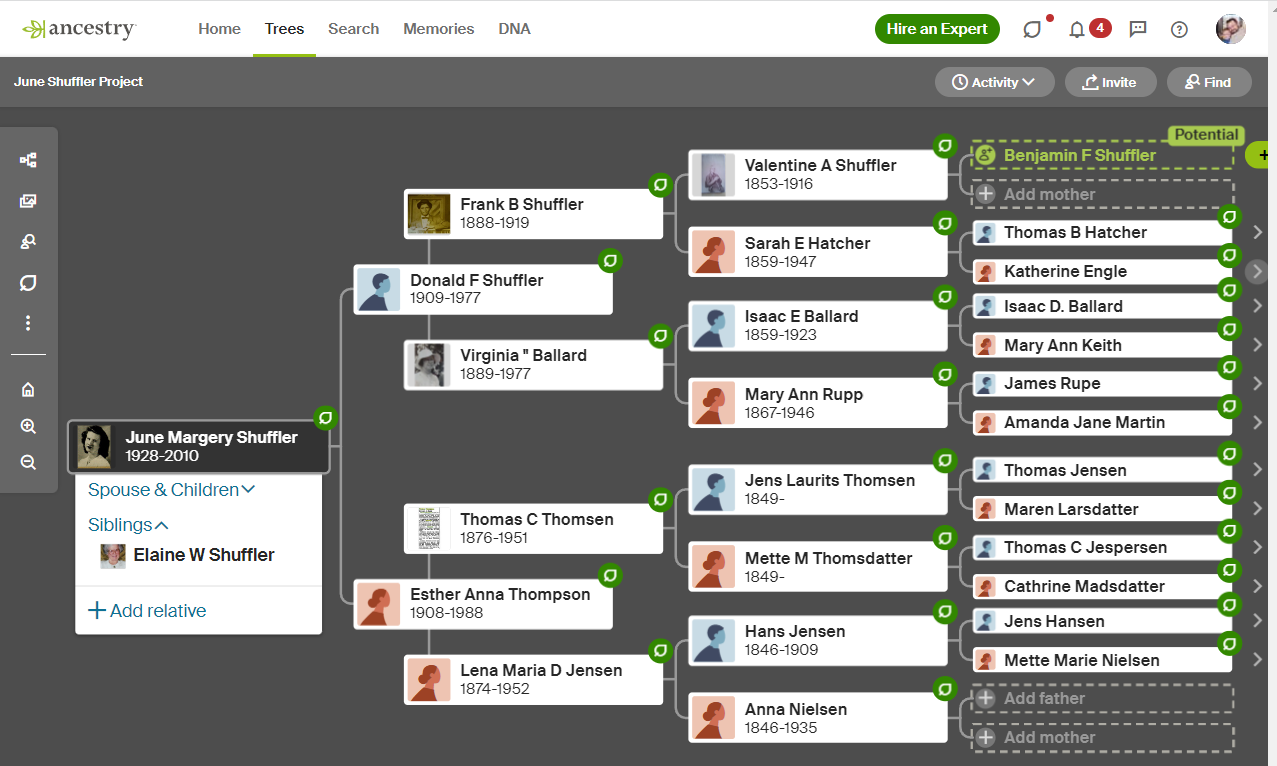
    Grandma June (Shuffler) McCullough was my wife’s paternal grandmother – her mother was Esther Thompson, whose lineage of Scandinavian immigrants is sketched out in our 15 November post. June’s paternal line, the Shufflers, were a part of the American Midwest. I owe them a lot more attention, but for today, here’s a snapshot of where we are with our research:

    June (Shuffler) McCullough’s Tree on Ancestry

    While I have been able to build back to June’s “Great Eight” (her 8 great-grandparents) I have yet to add everyone to WikiTree. Her grandfather, Frank, was a barber who quit his job and went to work in the Pacific Junction (Iowa) switchyards in 1918 “in order to help the government win the war.” He was run over and killed by a train in January 1919. He left four sons for his widow to raise. Frank’s widow, Virginia (Ballard) Shuffler, eventually re-married and took her younger sons to live with their stepfather in Maryland. [Update: read more about them in The Ballad of Mrs. Steele]

    Both sides of June’s paternal lineage descended from early Ohio settlers – and I hope to learn more about them over the coming months.

    Please do drop a note if you recognize any names from your own tree!

    And if you want updates on my progress, be sure to subscribe.

  • posted Sunday, December 7, 2014

    Reposting to mark Pearl Harbor Day.

    When Things Got Serious

    Bobby enlisted in the Army 26 July 1941 at Camp Blanding, near his hometown of Winter Park, Florida.

    Sgt. Bob Callin, c.1944

    He did well in training, and ended up applying for a special school, hoping to become a pilot. The Army being the Army, he had to agree to take a bunch of tests and special classes to qualify, and there was a pretty good chance he wouldn’t be selected for pilot school… but he decided to go for it.

    The specialty training included aircraft engine mechanic courses at Luke Field, located southwest of Phoenix, Arizona. The class was difficult, but Bobby was smart, and he didn’t spend a lot of time and energy getting wasted after hours and on weekends like some of his friends did. He preferred spending time at a church he had found. A church that hosted “mixers” on Friday and Saturday nights. Church mixers that had girls at them.

    That is where he met Nancy.

    Bobby and Nancy went out a few times, usually with Nancy’s best friend — whose name was Bobbe! — and one of her boyfriends. Nancy was only 17, but Bob (it was too confusing having two “Bobbies”) had also met her parents at the church, and they trusted him. Bob had even been to their house for Sunday dinner a few times.

    Things were going just swell (his words, not mine). Bob and Nancy liked each other quite a lot, but she was still in high school. And being in training for the Army, he didn’t know for sure where he would end up next. It was technically peacetime, but the Army was building up. There was talk of the trouble across the Atlantic, even though most Americans thought it was best to stay out of it.

    They decided not to worry about it, and to take their time. It was a mature decision. And then Bob was selected for a special class in California. He would be back after a few weeks, but maybe this meant he would get to learn to fly! So, he said goodbye to Nancy and promised to write to her often.

    Not long after that, America was attacked, and everything changed.

    Nancy’s brother, Richard Witter – a TSgt in the Philippines

    There was confusion; there was fear. There were a lot of things happening all at once. Nancy’s letters to Bob were frantic; she didn’t know where he was, or if the rumors were true that California was next. She hadn’t heard from her brother, a Technical Sergeant stationed in the Philippines. All she knew was that she loved Bob, missed him fiercely, and wanted him to be back safe with her.

    By the time Bob managed to get a letter through, things had calmed somewhat. People at least knew the basics: the Japanese had attacked Pearl Harbor; the U.S. had declared war. The West Coast was not under attack. Nancy’s brother, Richard, was safe for the time being, though he would be wounded in a sniper attack and end up the war as a guard at the POW camp in Papago, AZ.

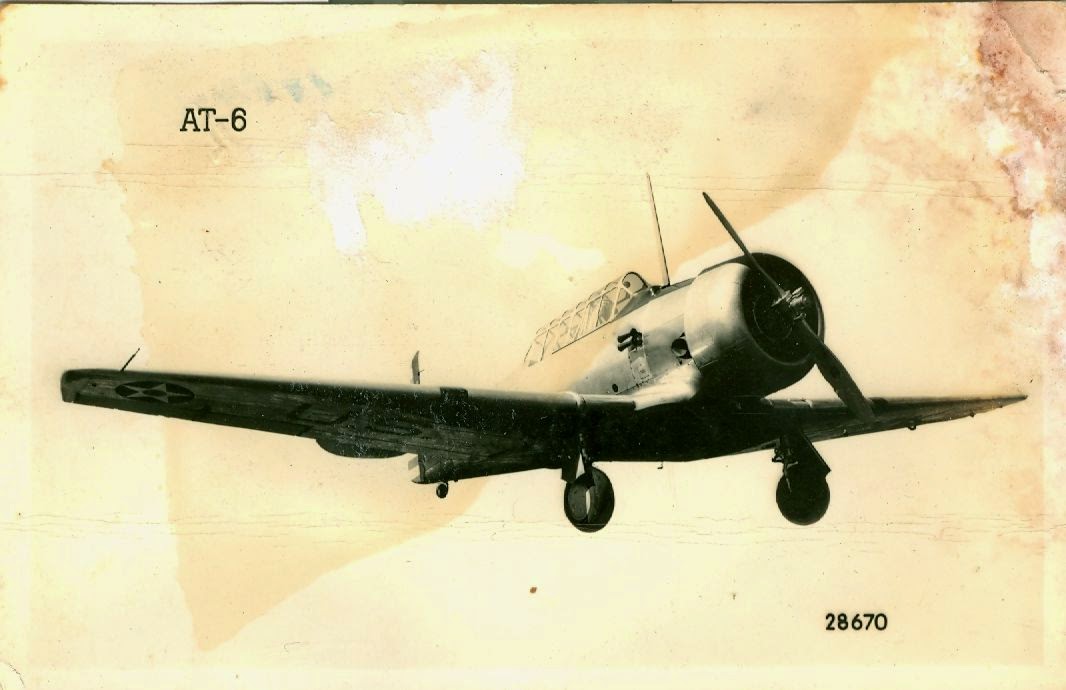
    Bob had also been turned down for officer training and pilot school. But this would turn out to be good news, because, as a high-scoring mechanic, Bob would spend the rest of the war at Luke Field, maintaining the trainers for the pilots of the P-38’s.

    The AT-6 – training aircraft like those Bob worked on at Luke Field.

    And so, on the 28th of June, 1942, Bob and Nancy were married.

    You could argue that without December 7, 1941, they might not have decided to wed. It’s possible that without the shock of war, and the fear of losing each other, they might have drifted away and only been pen pals. But some things are meant to happen. After all, Bob did eventually learn to fly.

    But that’s another story altogether…

  • A Quick Overview of my work under this surname

    The revised Callin Family History is where I focused most of my efforts from 2015 to 2022. I started with James Callin, my 5x-great grandfather, and traced as many of his descendants as I could using Ancestry’s World Deluxe membership (which includes partial access to Newspapers.com and Fold3). If you click on his name, you will find yourself on his WikiTree profile – and the green “SHOW DESCENDANTS” button will display the top three or four generations.

    Some other significant surnames:

    • Montgomery – two granddaughters of James Callin married brothers named Montgomery, and moved to Fulton County, Indiana.

    • DavidsonSarah, one of the Montgomery daughters married Henry Davidson (28 May 1818 – 19 Feb 1894), and they moved their large family to Oregon in 1852. (That’s right – they took the Oregon Trail!)

    • ScottSarah Callin, another granddaughter of James married and moved to Winnebago County, Illinois, leaving a large number of Scott descendants there.

    • Campbell – Granddaughter Ann Callin married Henry Campbell, and their children settled in Missouri, Texas, and California.

    • Ferguson Eliza Callin married James Ferguson and their family moved to Fort Wayne, Indiana. Dozens of their Ferguson and McNabb descendants remained in Fort Wayne and Auburn, and some moved to Michigan.
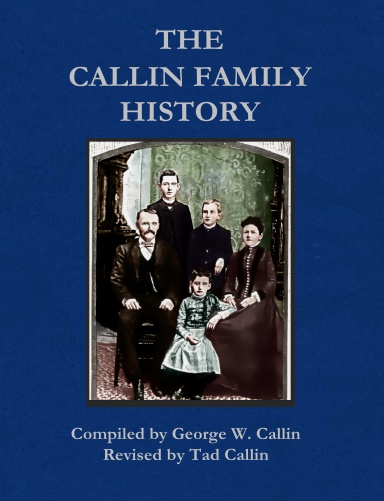
    2022 – The Callin Family History

    All of the families mentioned above are documented in my book, The Callin Family History – links to that book and others, including the republished 1911 version, can be found at this link.

    Callen

    I am convinced that James Callin is somehow related to Patrick Callen, whose family is documented in The Callen Chronicles, published in 1990 by Edna Callen MacNellis and her associated researchers. We have some compelling DNA connections and stories shared between the two families, as well as a tantalizing grave site in Muscatine County, Iowa (see below) that seems to prove that there is some kind of connection – but I haven’t found any documentary evidence. Yet.

    Let me know if you think you have any clues – and if you want regular updates, be sure to subscribe.

    Ohio and Kentucky

    My grandfather, Robert T (Bob) Callin, was born in Ohio, and the four generations before him lived in either the Fostoria area, near Bowling Green, or in Ashland and Richland counties.

    If you read James Callin’s WikiTree profile, you can see the evidence I’ve gathered suggesting that he did not die in Westmoreland County, Pennsylvania, but likely moved to Kentucky sometime after the conclusion of the Revolutionary War. There are dozens of people recorded with various spellings of the surname Callin or Callen in Mason, Campbell, and Kenton Counties in Kentucky.

    I think I will need to start a One-Name Study if I’m ever going to figure out whether these Kentucky Callen families are related to my Pennsylvania/Ohio Callin family. [Update: I did! See The Callan Name Study]

    Iowa

    Two of James Callin’s grandsons, Hugh and Alec (or Alexander) settled in Iowa around 1840. I’ve traced two of Hugh’s daughters and their descendants, but I don’t know whether he had sons. Until someone descended from either Hugh or Alec does DNA testing, and comes looking for them, I am at a brick wall with their branches.

    But I do know that their mother, Mary Callin, is buried in Muscatine County, Iowa, alongside Patrick Callen’s grandson, Callin Rayburn.

  • A Quick Overview of my work under this surname

    Russell Hudson Clark (1920-2002) was my maternal grandfather. Most of the Clark families I work with are related to Grandpa Russ – but the surname does show up in my Callin Family History, too.

    Maternal side:

    Grandpa Russ was the youngest of a large family. He was born in Clermont County, Ohio, but all of his older siblings were born in Ashland, Boyd County, Kentucky. His grandfather was Joel Clark (1828 – 1915), who was born in Lawrence County, Ohio, just across the river from Ashland. Joel Clark’s nine children were all born in either Ashland or neighboring Greenup County, Kentucky.

    Those three generations of Clarks married people from the local area – so the same surnames keep popping up. As far as I can tell, it was rare that anyone closer than 3rd cousins married each other, but sometimes two siblings from one family would marry two siblings from another family, which can make the records harder to figure out.

    The Big Four surnames that keep showing up are Clark, Reynolds, May, and West.

    We also have several cousins living in the Ashland area who are descendants of Grandpa’s aunt, Jennie (Clark) Smith (1878 – 1975). If you’re a cousin of mine through David Ulysses Clark, you might be interested in the Facebook group Peggy’s Clippings, in which several of her great-grandchildren have shared the local newspaper clippings collected by Jennie’s granddaughter, Peggy Adams.

    Grandpa Russ used to tell us stories about growing up in Arkansas, and a number of his aunts and uncles relocated there around the time of the Great Depression.

    I have done my best to document everyone from Joel Clark down in WikiTree – and I am still looking for information about Joel’s father, Amos Clark. There were at least three men from that area called Amos Clark at the same time, which does present some challenges. Hopefully, as more folks get their DNA into the system, we’ll be able to figure out who’s who.

    My paternal connections:

    I wrote about these folks in 2015 in “Those Darned Clarks” – here’s a shorter version:

    Charles Lincoln Clark (1866 – 1937) married my 2nd cousin, 3x removed, Lydia Minerva (Callin) Clark (1869 – 1943). Howard George Clark (1888 – 1923) married my 4th cousin, 2x removed, Madeline L (Callin) Clark (1896 – 1942). Lydia and Madeline were 3rd cousins, once removed, and were separated by a 27-year age gap. It’s possible they did not know each other.

    Charles and Howard do not appear to be related to each other. However, Howard was born in Ashland, Kentucky, so there is a solid chance I will find a connection between him and my maternal Clark family someday.

    If you’re a descendant of any of these Clark families, drop a comment and say hello or ask questions. If you want me to write more about them, asking me questions is the best way to inspire me!

    And be sure to invite your cousins to subscribe – so when I do get around to writing something new, they won’t miss out.

  • posted Wednesday, July 24, 2019

    Essay: The Corruption of Names

    Most cultures contain within their most primal beliefs the idea that Names have Power.

    You see this idea pop up in fantasy stories about magic, in mystical belief systems, and in most creation stories – for example, Adam’s first act in the Garden of Eden was to name the creatures being created. (The first taxonomist!) It is also true in modern society, where your username gains you access to the world and where your “personal brand” is often more important than the substance of what you sell under that brand.

    In genealogy, the first thing most novice researchers focus on is their collection of names. It can be thrilling to find a name you recognize attached to your ancestors, especially if it’s a famous name. My paternal grandfather, for example, knew that his maternal grandmother’s name was “Hale,” and I grew up hearing that we were “probably related to Nathan Hale” based solely on the power of that name connection. As far as I have been able to discover, we have no family connection to the 21-year-old American spy, and he died unmarried and childless.

    As important as names are, it can be brutally difficult for a researcher to figure out what a person’s name actually was, and how to find that person in historical records. Today I wanted to talk about one example of how someone’s name became a puzzle.

    From Name to Record

    We don’t often think about how names get attached to a person, or how those names get recorded, but when you do think about it, the process starts to resemble the old Telephone game. Before a name gets to you, the researcher, it can go through several layers:

    • the people who pick the name

    • the person who uses the name

    • the people who know the person

    • the people who record the name

    • transcribers and indexers

    As with the Telephone game, errors can creep in at any point between any of these layers. I’ve seen countless examples where parents have used one name for their child only to have that child prefer to use a middle name or an alternate spelling later in life. My great-grandmother Hannah Merle was named “Hannah” after her grandmother but went by “Merle” or the diminutive “Merly” until her death in 1984. My great-uncle, Byron Herbert Callin, was called “Byron” in his youth but preferred to use the more distinguished-sounding (to his ears) “Herbert” in his career as an educator.

    There are, of course, nicknames: Jack for John; Libby for Elizabeth; Sadie for Sarah; Polly for Mary; and Dick for Richard. These are pretty common even if they don’t always make sense to later generations, and some of them have taken on a life of their own. I’ve seen countless examples of people who were christened with a pet name or diminutive like “Billie,” or “Johnny.”

    As these names get written down, there can be a mix of factors that lead to some wildly different recorded results. Let’s take a look at one person whose name looks different on almost every record: Eliza Alice “Lydia” Reed Donaldson (1866-1951).

    Following the Records

    The first record I had that named Eliza was The Callin Family History record of her mother, which identified her as “Eliza, married, five children living.” Great-Uncle George did not cite his sources for his information in the CFH, but we might assume from the newspaper reports of Callin Family Reunions that occurred in Ohio during the early 1900s that gatherings of distant cousins would share what they knew, and he probably collected the names of his cousin Elizabeth’s children at one of those gatherings.

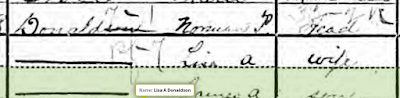
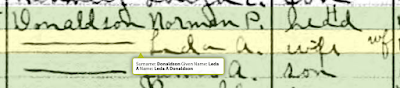
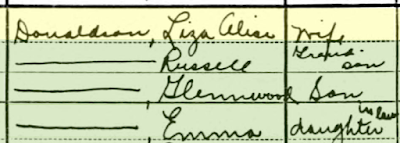
    The earliest public record I have is her family’s appearance in the 1870 U.S. Census, where her name is given simply as “Eliza” – here is how her name seems to have evolved each time she appears in the Census (as transcribed for Ancestry):

    • 1870: Eliza (Reed)

    • 1880: Eliza A. (Reed)

    • 1900: Lisa A. (Donaldson)

    • 1910: Leda A. (Donaldson)

    • 1930: Eliza (Donaldson)

    • 1940: Liza Alise (Donaldson)

    The game of telephone becomes really apparent when you consider how the Census records get to us. First, of course, you have the family that knows the information; then you have the enumerator who writes down the information; and after 70 years or more, the records are scanned and transcribed by a human being to create the index we search against.

    Since we don’t know who told the census enumerator the names of the Reed or Donaldson families in each of these records, we don’t know for sure what the family actually told them. The three records where our girl is listed as “Eliza” are pretty straightforward – the enumerators of those records wrote clearly, and the indexes were transcribed accurately. But the other three are harder to read, and make the name more ambiguous:

    detail from the 1900 U.S. Census record on Ancestry.com
    detail from the 1910 U.S. Census record on Ancestry.com
    detail from the 1940 U.S. Census record on Ancestry.com

    If we assume that Norman gave the enumerator his wife’s information, it’s possible that he said “Liza” each time, but the different enumerators heard it differently. Of the three, only 1910 is clearly written with a “d” in “Lida” or “Leda” – and while it’s not a common name today, “Lida” was a fairly familiar name in the Midwest at the turn of the 20th century. (Familiar enough for a song with that name to appear in the 1962 Broadway musical The Music Man!)

    Taking all of these records together, I’m inclined to believe that her given name was actually “Eliza” and that everyone knew her by the nickname “Liza” – but there are more records to consider.

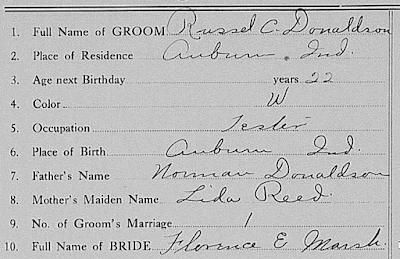
    The Indiana, Marriages, 1810-2001 database on Ancestry is very useful, as it provides the names of the bride, groom, and both sets of parents, in addition to the marriage date and location. As with the Census, though, we don’t know who is providing the information on the record, and we don’t know which human being(s) were involved in digitizing and transcribing the records for the index. At the least, I think it’s safe to assume that the bride and groom gave their parents’ names to the county clerk. So, with that assumption in mind, here are the variations of Eliza’s maiden name as known to her children:

    Year / Groom / name given for mother:
    1916 / Russel Donaldson / Lydia Reed
    1917 / James A Donaldson / Lida Reed
    1926 / Gerald Donaldson / Elizabeth Reed
    1927 / Glenn L. Donaldson / Lyda Reed
    1927 / Newell Donaldson / Lida Reed

    Note: I linked the names of the grooms to the original record images at FamilySearch.org so you can examine them for yourself. With one exception, they appear to have been transcribed accurately; Russel’s document clearly says “Lida,” though, and was incorrectly transcribed as “Lydia”:

    detail from Indiana Marriages 1811-2007 on FamilySearch.org

    This tells me that four of her five sons knew her maiden name as “Lida Reed” – and they probably all knew that was a nickname, but Gerald thought that “Lida” was short for “Elizabeth.”

    Oh, Have You Met Lydia?

    As I pointed out, one transcriber seems to have misread “Lida” as “Lydia” – possibly not knowing that Lida was a popular nickname, or thinking that it was a shortened version of Lydia. There are two other records that list Eliza’s name as “Lydia,” however, which could either mean she started using that name later in life for some reason, or that this is a very common mistake.

    The first example, chronologically, is the Death Certificate of her husband, Norman Donaldson, who died on 3 December 1940. This is a typewritten document that can be found in the Indiana, Death Certificates, 1899-2011 database on Ancestry.com. Oddly, the transcriber entered the name in the index as “Ludia,” but the document quite clearly gives her name as the wife of the deceased: “Lydia D.”

    The second example is another Death Certificate, this time for Eliza’s son, James, from 20 July 1951, again from the Indiana, Death Certificates, 1899-2011 database. This record is also clearly typewritten, and gives the mother’s maiden name as “Lydia Reed.”

    In the first example, the informant is recorded as “Newton Donaldson,” which either refers to Norman’s brother, or to Norman and Eliza’s son, Newell Donaldson (1900-1962). If they were referring to the latter, then the clerk botched the name of the informant, and that makes me suspect that Newell probably gave her name as “Lyda” and the clerk got that wrong, too. In the second example, the wife of the deceased, Celestia Donaldson, is the informant. The clerk did a much better job spelling the name of the informant on this document, but given the patterns we’ve seen in other records, I’m inclined to think that either Celestia didn’t know her mother-in-law’s name was “Lyda” or (more likely) the clerk just corrupted it into Lydia, as we’ve seen done elsewhere. It’s possible, if the informant on Norman’s death certificate was Newton, that both clerks made the same error.

    Conclusion

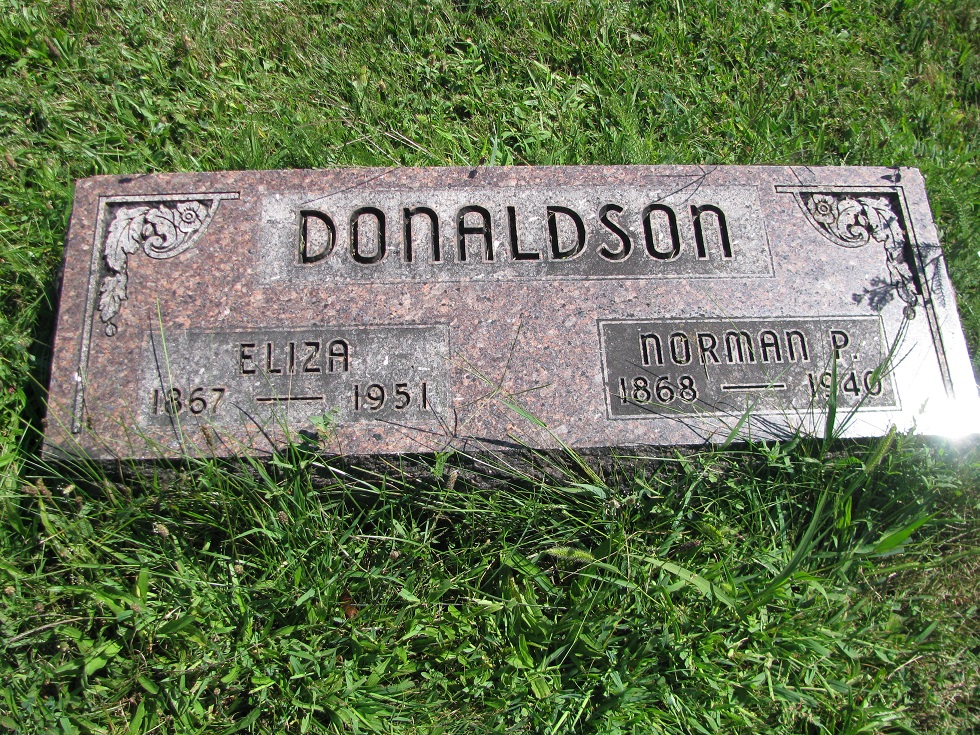
    Based on the totality of the available evidence, I have recorded Eliza’s name as “Eliza A. ‘Lyda’ Reed” with alternate names included to highlight the one record that gives her middle name as “Alise.” And while I will refer to her as “Lyda,” since that seems to have been the name she was known by, I tend to give the final authoritative word on what someone’s name is to whatever the family is willing to set in stone.

    Find a Grave Memorial 141478294

    Taking the extra steps needed to figure out simple facts can be tough – do you have a puzzle like this that is making it hard for you to learn everything you can? Drop a comment or send me an email; I’m happy to take a look.

    And don’t forget to subscribe if you haven’t already:

  • A Quick Overview of my work under this surname

    My wife’s maternal grandfather, Arvid Wesley “Bud” Holmquist (1920 – 1996), was the son and grandson of Swedish and Norwegian immigrants who arrived in the United States during the 1880s (in the case of his maternal grandparents) and in 1910 (in the case of his father).

    Eight of my wife’s sixteen great-grandparents are relatively recent immigrants from Denmark, Sweden, and Norway, or from Holland and Prussia. When I say “recent,” I mean that they arrived during the mid-to-late-1800s as opposed to arriving during or before the American Revolutionary War. In contrast, my own great-grandparents were all born in the U.S. and the most recent immigrants on my side of the tree were Joseph Frey and Elizabeth Horn, who arrived from southern German states in the 1840s.

    Researching immigrant families is a lot of fun, but it does take extra time. The digitized records for the Scandinavian countries are particularly good, as they tend to be thorough – more details to compare means it is easier to learn new facts. However, the language barrier remains difficult. Not only did I find myself dealing with multiple countries with different languages, but they were going through periods of administrative changes that affected both family names and place names. You can see a lot of examples in Bud Holmquist’s ancestry.

    The Scandinavian Surname Game

    I have been able to trace the Holmquist family back to Bud’s grandfather, Anders Holmquist (1846-1916). If you recall our previous post about the Thompson/Thomsen family, we observed that my wife’s Danish ancestors seemed to begin using a family name for their surname instead of a patronymic after an 1856 law passed in Denmark. The Holmquist family name appears to have already been in use as their surname as far back as Anders, born in 1846, despite Sweden having no law regarding family names until after 1901.

    We also see that Bud’s maternal line, the Leander family, was using their surname as early as his grandfather’s generation, Gustaf Hugo Leander (b. 1863). Gustaf’s father was known as Mårten (Persson) Lenander (1833 – 1896), suggesting that he was born under the patronymic name “Persson” and later switched to using Lenander as his surname.

    Bud’s grandmother was Ingeborg Olesdatter (1858-1934), born in Byneset, Norway. She was given a patronymic at birth, but when her family came to the United States during the 1880s, they used Svedal or Swedahl as their surname. Her family’s farm name was Svedal, one of the farms near the village of Aunet.

    To Minnesota from Sweden

    Gust Leander probably married Ingeborg Swedahl in New York, in about 1884, according to their 1910 U.S. Census record. Their first two children, Augusta and Hildur, were born in Connecticut and Brooklyn, New York, respectively, and the family had moved to St. Paul, Minnesota, by 1888. By 1895, the family was in Chicago, and then in McHenry County, Illinois, but they had returned to Saint Paul by 1903.

    William A. (he only seemed to use “Arvid” on certain records) Holmquist was 29 years old when he arrived in New York from Liverpool aboard the Arabic on 3 May 1910. His uncle, John Spence, was listed as the “Person in the US” to meet him in Stillwater, Washington County, Minnesota. William married Hildur on 26 Jun 1912 in St Paul, Ramsey, Minnesota. William was naturalized as a citizen on 12 Sep 1921 in Stillwater.

    Slow and Steady

    I expect to find a few cousins on this side of my wife’s family in the near future – it has been difficult to find all of the siblings who immigrated to the US at different times. But as I keep working and adding profiles to WikiTree, I hold out hope that things will start to come together.

    As always, if these families look familiar, drop a comment or an email.

    And if you haven’t already done so, go ahead and subscribe so you can get a free newsletter in your inbox.

  • posted on Friday, December 12, 2014

    Love and Loss in Old New York (and New Jersey)

    Joseph Frey (abt. 1823 – 1877) led a short but interesting life.

    Born in Germany, in the mid-1820s, he came to settle in New York, probably during the 1830s or early 1840s. His birthday is listed on various documents as ranging from 1823 to 1828, and his birthplace is usually listed as either “Baden” or “Wurttemberg“, but other sources say his parents may have been from a small French town near the Swiss border, or that he was born in Switzerland.

    These were very difficult times for working-class people in Europe. Between successive revolutions in France, uneasy relations amongst the old Empires, and terrifying epidemics – particularly cholera – sweeping through the increasingly crowded and unsanitary cities, a young man looking across the ocean might have been strongly attracted to the relative prosperity and peacefulness of the United States.

    Once settled in one of the German-speaking neighborhoods around New York, that young man would have become part of the story of that young, still experimental nation. He would have seen the growing stream of immigrants from Ireland pouring through New York Harbor during the so-called Potato Famine of the 1840s; he would have seen politicians arguing about Westward expansion; and he would have heard about threats of war from Britain, France, and Mexico. Without records or writing from Joseph’s point of view, I have to assume from the evidence available that he found his place in America, and decided to invest himself in it.

    When President Polk maneuvered the U.S. into war with Mexico, Joseph enlisted as a private in Company A, 5th Regiment of Infantry, New York Volunteers. He signed up for a 5-year term on 3 December 1846 but was discharged honorably after 11 months and 24 days on 27 November 1847 after the relatively quick American victory at Mexico City.

    On March 11, 1849, he married Elizabeth Horn in the Lutheran church in Williamsburg, New York, and they began raising their family; Frederick (1851), Maggie (1853), William (1856), Theodore (1858), and the twins, Edwin August and Edward (1859).

    As a veteran soldier and a member of a close-knit community in a burgeoning New World city, I like to imagine that this would have been a happy and hopeful decade for Joseph and Elizabeth. Despite the growth of the anti-immigrant sentiment??in the 1840s and 1850s, people like the Freys were learning how to thrive in the “melting pot” of New York. Joseph was listed in the 1860 census – along with Elizabeth and the children listed above – and identified as a brush maker, which implies that he was literate and educated, and moderately well-off.

    And then there came another war.

    Enlisted in Captain Robinson’s Company of New York Volunteers on 6 September 1861, Joseph re-enlisted on 15 November 1863 and was discharged and mustered out with the Company on 21 June 1865. His pension records say he contracted seriously debilitating rheumatism during his time in service, and while he and Elizabeth had two more children – Augusta (“Gussie”, b. 1865) and my great-great-grandfather, Emil Adolph Carl (1869) – his health would never fully recover.

    In 1870, Joseph had taken his brush-making profession back up, and his older sons and daughter seem to have been helping with the house and the business in the Flushing neighborhood of Queens, New York. But his condition seems to have deteriorated so that sometime around 1876, he had to move into the Soldier’s Home in Washington, DC – where he died in February 1877, barely 50 years of age.

    By 1880, Elizabeth had moved the family to Newark, New Jersey, probably to be near her brother’s family, and the Freys lived at 103 Congress Street for many years. Young Emil met Miss Emily Amelia Opp, whose family split their time between a cottage in nearby Paterson (about 15 miles from Newark) and Dansville, in upstate New York.

    Emil and Amelia were married around 1894 in Dansville and settled back in Newark. They had six daughters: my great-grandmother, Edna (1895), Elizabeth “Bessie” May (1897), Blanch (1899-1900), Marjorie (1900), Grace (1902), and Theresa “Tessie” Decker (1908).

    Frey family, about 1903 from left: Edna, Emil, Bessie, Amelia (front) Grace, Marjorie


    I have the impression that Emil found a second family in the Opps. Amelia’s father, Jacob, was a veteran of the late war, just like Emil’s father. He worked as a locomotive engineer, which might account for his family seeming to simultaneously live in two towns separated by nearly 300 miles. For example, in 1900, Emil and Amelia and their girls show up twice in the Census records – once in the home of Susan Opp (Jacob’s widowed mother) and once in their own home in Newark. Interestingly, the two records were enumerated only about a week apart – one on the 1st and one on the 9th of June – suggesting that they were recorded both while visiting Dansville AND after their return home to Newark.

    Jacob Opp

    These years seem to have been happy ones for Emil. He worked as a grocer and (according to a Frey family tradition) as a Borden’s milk delivery man. It isn’t clear what caused the tragic loss of little Blanch before her second birthday, but the other girls seem to have all been healthy and the family seems to have prospered. Sadly, Emil and Amelia would not see their twentieth wedding anniversary.

    Frey daughters, about 1909 (clockwise from left) Edna, Theresa, Elizabeth, Marjorie, Grace

    In 1910, Jacob was listed in the Census records as living in Emil’s household, where he apparently lived out his days. He succumbed to pneumonia in July 1913, only a few months after Amelia died, in March of that year. At this writing, I am just shy of my twentieth anniversary myself; I know how I would feel if I lost my lovely bride right now. If my impression of their relationship is correct, Emil then immediately lost someone who may have been like a surrogate father for an even longer time. Then, as if that weren’t enough, Emil’s mother, Elizabeth, died in 1914 of Bright’s disease at the age of 86.

    This all seems to have been too much for him. Emil’s older daughters, Edna and Bessie, began working to support the family, and they took care of the younger girls. By 1920, Edna was married to Alfred Tuttle; Bessie was working as a legal clerk, living with the other girls in a rented house on Fourth Street in Newark while they attended school; and Emil was an inmate in the Essex County Hospital Center (also called Overbrook hospital) in Cedar Grove.

    My grandmother, Edna’s younger daughter, recalls visiting Emil in the hospital. She told me, “We used to visit him every Sunday, and take him fruit and treats. I was very young then of course.” She would have been 11 years old when he died of pneumonia in February 1936.

    Today, approaching 2015, I have to wonder if it might have been possible to do more to treat Emil; if we could go back armed with a better understanding of the mind and brain, would we be better equipped to help him, and get him back home with people who loved him? It’s hard to know what his life was like those last 16 years; I haven’t found records that could describe his condition or diagnosis, and the hospital itself shut down in 2007. It is now a favorite haunt for so-called urban explorers and ghost hunters – thrill seekers more interested in playing up the “spookiness” of old buildings than understanding what life was like for the patients.

    At least his life was bookended by heroic people. From his father, the devoted soldier, to his self-sufficient daughters, Emil Frey seems to have been surrounded by love, strength, hope, and joy for most of his life. I will leave it to you to decide whether that lessens or sharpens the tragedy of those last years.

  • A Quick Overview of my work under this surname

    My most recent German immigrants were Joseph Frey (abt. 1823 – 1877) and Anna Elizabeth Horn (abt. 1828 – 1914).

    It is difficult to be certain about much when looking for records for a family like this one. They lived in a crowded city full of other immigrants, and their names were fairly common. Spelling was inconsistent – some documents (including signatures in their own hand) spell the surname “Fry” while most appear to use “Frey.” Some of the documents are in German, which is complicated when they are handwritten.

    But there are some certainties. I ordered Joseph’s pension file from the National Archives many years ago, and that helped me tell much of his story – which you can read on his WikiTree profile, linked above.

    One of the facts I found to be most tantalizing in its uncertainty is the identity of one of the witnesses who signed the documents in that NARA file. The documents attesting to Elizabeth’s right to claim Joseph’s pension were her daughter, Augusta, and a man named John Horn who resided at 170 McWhorter Street in Newark, New Jersey. I suspect that John Horn was Elizabeth’s brother, so I am hoping that this information will lead me to some record that shows when Elizabeth’s family arrived in the United States.

    Outside of the NARA files, I have found one immigration index record of a 17-year-old Joseph Frey arriving in New York from Germany in 1840. This could be our Joseph Frey – but I need to track down the original document to see if it contains any additional clues.

    When Joseph died, the NARA files indicated that he had two children under 16 years of age: Augusta and my 2nd-great grandfather, Emil Frey. I will share his story on Friday – pun intended!

    If you happen to be descended from a Frey family that lived in 19th Century New Jersey or Long Island, drop a comment and compare details!

    And, as always, subscribe to get regular updates. It’s a free newsletter, and you never know when our common ancestors might surface.