Mightier Acorns

Journeys through Genealogy and Family History

A parody of a family coat of arms designed with acorns as elements, with the motto "ex gladnis potentioribus" Latin for "from Mighty Acorns"
From Mighty Acorns
  • One of the challenges of genealogy can be sorting through the biographies of people with similar names. The two girls at the heart of today’s story shared a name that stands out for its uniqueness among a parade of Elizabeths, Marys, and Catherines. As it happens, the girls were 1st cousins, born within a few years of each other.

    But telling you who they were depends on sorting out who their relatives were, and that might be a challenge.

    So Many Namesakes

    My 3rd-great grandfather was William H Callin (1813-1881), the sixth of nine children born to John and Elizabeth Callin in Milton Township, Ohio. The farm these nine children grew up on was established by their uncle, James Callin.

    According to the Callin Family History, those brothers, James and John, were the sons of James Callin, who we believe was a soldier in the American Revolution. Both brothers named sons James and John, of course, and William named two of his sons James and John.

    But we don’t have to keep track of all of them; we only need to know that among all of these namesakes, William had two brothers: George Callin (1804-1879) and James Callin (1817-1873).

    Older brother George had two sons, who he named after his father and his brother. (John C. Callin (1830-1905) and William H Callin (1834-1919), if you need to keep score.) George also had four daughters:

    Younger brother James only had two children, Mary Ann (born 1838) and Sabra Ann (born 1841).

    Remembering through Mothers

    George married Mary Ann “Polly” Lewis about 1829, and from what their descendants were told, George and Polly were both stern Presbyterians. This sternness was accompanied by strict discipline and sobriety, and the names they chose for their daughters suggests some familiarity with Greek legends (Minerva) as well as a departure from the usual names favored by other branches of the family.

    Records don’t tell us much about Polly at all, and nothing about her personality. But we have an interesting echo that was handed down to us through William’s granddaughter, Rosemary. William married Elizabeth Berlin, and they named one of their sons (can you guess?) George. He was the George Callin who published the Callin Family History, and had a daughter (Rosemary) later in life, with his second wife. Rosemary related several memories about her grandmother Elizabeth. In one section, Rosemary was sharing amusing things that Elizabeth had said to her son George over the years, including this:

    Another day she said to him. “The woman next door (mother) is going to have a baby (me).” After I came she said; “I guess you better call her “Melia”. (Sure glad they didn’t.)

    I noticed that George and Polly Callin had their daughter, Amelia, in 1849, when George and William lived on neighboring farms in Huron County, so Elizabeth would have known Polly at that time, and seems to have had the notion that Amelia would be a good name for her new granddaughter.

    Sabra Ann and Sabra Ann

    So George and Polly named their second daughter “Sabra Ann” – and again, we don’t know a lot about her.

    But George’s younger brother, James, married Susannah Stout in 1839, and they also lived in Huron County, not far from George and William. I suspect their families were close, since they named their first daughter “Mary Ann,” apparently in honor of Polly. And they named their second daughter “Sabra Ann,” apparently in honor of their niece, who would have been about four years old at the time.

    I have to stress again that we don’t know very much about these people. We can speculate, but that only gets you so far. My speculation is that the older Sabra Ann may not have been very healthy. She died in 1849 at age 12, and is buried next to George and Mary A. Callin in Riverside Cemetery, Monroeville, Huron County, Ohio. Her headstone reads “Sabry A.”

    Sabry died just a month before Amelia was born.

    Her cousin Sabra survived, but records show that she was blind. She was a pupil at Ohio Institute for the Blind in Columbus, Franklin, Ohio in 1870. She lived with her widowed mother in Rochester in 1880, and after Susannah died, Sabra went to live with her sister in New London.

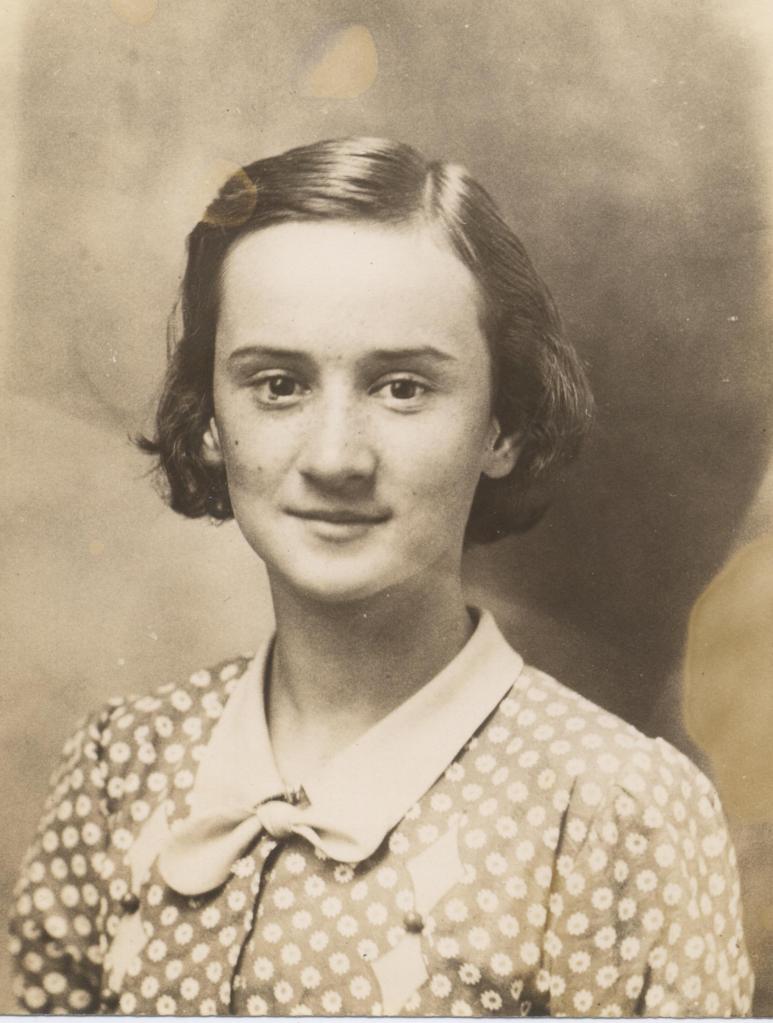
    Sabra died on 1 Dec 1902 at the age of 61. While we don’t have much information to tell us what her life was like, I see glimmers and suggestions in between the cold facts that make it possible to believe that the family cared deeply for each other. They certainly tried to take care of each other. And we have one grainy photo that is simply labeled “Sabra Callin,” suggesting there is more to her story than what we have.

    Perhaps one day, we might find something that tells us more. Until then, we’ll have to be satisfied with glimmers and speculate on the inner workings of the minds that gave us such whimsical names.

  • The Giving Season

    From the incessant ringing of Salvation Army donation buckets to the prolific inundation of end-of-year fundraisers, you may feel overwhelmed by all of the good causes that need financial support this year.

    You might be wondering if it is your imagination that the pleas for funding are more desperate than usual: it is not your imagination. Across the board, the content creators we love and the research resources we rely on are being squeezed between a worsening economy, increased reliance on extractive corporate-owned infrastructure, and competition from AI.

    Of course, if you’ve been hit hard this year, too, you may be struggling to support the providers and creators you value most. So I thought I would share some suggestions for making your donation budget more impactful, helping both you and those you wish to support.

    Use Your Library, Boost Your Budget

    When you consider your budget for donations, take the time to review where your money has been going.

    For one example, if you pay the $140/yr. fee for an Amazon Prime membership, you may feel like you’re getting a high value for that money, with the availability of “free shipping” or streaming services. However, the things that are “free” for you, the consumer, do cost money, and the story of how Amazon operated at a loss for 20 years as it undersold and bankrupted its competition goes a long way to explain how (like WalMart) they have become the only option for many people to receive services they used to get through a free market. (I’ll leave it to your conscience to research how these corporations spend their money to influence campaigns and public policy.)

    Your local public library actually offers many of the services you get through your Prime Membership, including eBook access, streaming services, podcasts, in addition to interlibrary loans and genealogy resources – all of which are free to you, with your library card. (Not to mention personal help from a human when you need it.) The big difference between public libraries and corporate memberships like Amazon is that while Amazon starves creators while extracting profits, libraries boost sales and support those creators. You are paying for the library, anyway, whether you use them or not.

    So you could be saving your money and still get the services by going through your library. The real cost to you might be convenience – having to wait for a reservation on a high-demand movie or book, having to drive a couple of miles to pick up your materials.

    If you’re paying membership fees or subscriptions to online services, you need to decide if that convenience is worth the price:

    • Amazon: $15/mo. or $140/yr.
    • NetFlix (no ads): $18/mo. or $215/yr.
    • Hulu (no ads): $19/mo. or $228/yr.
    • YouTube: $14/mo. or $140/yr.
    • Spotify: $12/mo. or $145/yr. (with a $99 annual option)

    What to Do With Your Bigger Budget

    If you cancel some or all of the examples above, your budget is now bigger by between $100 and $870 per year. These are just a few places I would recommend putting that money, instead:

    Support a local public broadcasting outlet. If you’re already supporting your local public station, and want to do more, that link takes you to an Axios article showing which stations need help most after federal funding cuts.

    Nebula – if you once found yourself addicted to educational or independent creators on YouTube, you may already know about Nebula, where many of them fled when YouTube began to eat into their revenue streams and block their content. Wikipedia article: Nebula (streaming service)

    Escape Artists Foundation – starting in 2005 with Escape Pod, one of the very first audio fiction podcasts, EA has grown into a US registered nonprofit producing five weekly genre-fiction shows for science fiction, horror, fantasy, young adult, and … cats. (Full disclosure, I am an editor for Pseudopod, the horror podcast, and have narrated for Pseudopod and Escape Pod.)

    Internet Archive – when I talk about old local histories, as I did in The Publication Puzzle, I’m most likely talking about resources I found on Archive.org. Starting as the Wayback Machine some 30 years ago, the Archive was also recently designated a federal depository library by Sen. Alex Padilla (D-Calif.), who proclaimed the organization a “perfect fit” to expand “access to federal government publications amid an increasingly digital landscape.”1

    Wikipedia – in my opinion, the best example of true, decentralized, evidence-based democracy in action. Because so many editors are doing so much more than I can find time to do, I began supporting them years ago with monthly contributions, and you may notice that I link to them all the time.

    Support Your Local Genealogical Society and/or Library

    Not all Genealogical Societies are created equal – some are independent of the public library system, some have partnerships with them. If you find that your local society has a genealogical library, and you’re already paying your dues, you can also scour estate sales, secondhand stores, and even online re-sellers like HalfPriceBooks, AbeBooks, or Alibris for materials they might be able to preserve in their collection.

    You can also help them and independent publishers by purchasing self-published works (like my own, for one example) that libraries often can’t order (depending on their purchasing policies), and donating them. If you’re going to donate a book for their collection, you may want to contact them first and make sure they know it’s coming, and that it’s an appropriate addition to their collection.

    1. Belanger, Ashley, Ars Technica, “Internet Archive’s legal fights are over, but its founder mourns what was lost”, 3 Nov 2025. ↩︎
  • A Slight (or Sligt, or Sleight) Diversion

    Note: Today’s featured image comes from the Baltimore Immigration Museum’s collection. Today’s family arrived in Baltimore aboard a bark named Blucher in 1854. Learn more about their experience at that link.

    Nobody likes to feel ignorant. This is why we are driven to learn. But no one ever truly knows what they don’t know, and sometimes the sense of remaining ignorant no matter how much one learns might compel someone to simply stop learning.

    When you go digging into your family history, the things that you don’t know can take on unexpected dimensions and layers due to changes in language, geography, or governments over time. Sometimes, evidence that suggests an ancestor moved a lot may prove later to show that they lived in a place that changed names or was claimed by more than one government. Records we need may not materialize until after learning about someone’s origins, or figuring out how their name might have been misspelled. And we may never find a clear record of where they came from if the name of the place they came from changed between their birth and their emigration.

    In other words, researching ancestors who came to America from Europe in the middle of the 19th Century can reveal our ignorance in ways that might seem designed to give us only wrong answers.

    So we need to learn to be flexible in our thinking, be willing to review our assumptions, and be prepared to forgive those who came before us for being ignorant of the things we’re trying to learn.

    Who Was John Slight?

    It would be easy enough to simply say, “John Slight was a German immigrant who arrived in Baltimore in 1854 and anglicized his name to assimilate,” but that leaves out a lot of interesting details that make his ancestry harder to trace.

    If you go by his headstone, found in the Oak Wood Cemetery in Ackley, Iowa, John Slight was born (Geb.) in December 1834 and died (Gest.) in June 1879. Of course, the records that tell us his story rarely render his name the same way twice. He could appear as “John,” “Jan,” or “Johann,” and as “Sligt,” “Slahet,” or “Sleight,” depending on how the clerk recording his information perceived his name.

    We learned a bit about the Slight family in “Family Reunion: Slight” and we looked at some of those documents and learned a bit about the history of John’s place of origin in the village of Tergast.

    The records we have say the Sligt family lived in the village of Tergast, which is located a few miles east of the city of Emden. Emden had been annexed by Prussia in 1744, some 54 years before Jan [John’s father] was born. It was then captured by French forces in 1757, during the Seven Years’ War, and by Anglo-German forces in 1758. In 1807, when Jan was about 9 years old, East Frisia was added to the Kingdom of Holland, which had been created by Napoleon Bonaparte a year before to control the Netherlands. After Napoleon’s downfall in 1815, East Frisia was transferred to the Kingdom of Hanover, which was officially ruled by George III, the king of England.

    All of this is to say that while John Slight seems to have been a speaker of the German language, and came from a place that we now identify as being in Germany, the Sligt family might not have been German, and may have even spoken one of the Frisian languages recognized in that part of Germany.

    The original Frisian people were descended from tribes of Angles and Saxons (you may equate the term “Anglo-Saxon” with England, but those were Germanic tribes) and they lived in a boggy, marshy territory around Emden that resembled the Netherlands more than other parts of Germany. It might be fair to say that some of the patterns we see in the way John Slight’s parents, grandparents, and aunts and uncles were named more closely resemble the patronymic system used by our Scandinavian ancestors, than you might expect from more traditionally German families.

    The point here is that Germany itself has only been Germany since 1870, and when people came from places that were Germany later, they could be labeled with a variety of names that might or might not be helpful. We were lucky to see “Tergast” on the Sligt family’s immigration documents, because when we see documents that say they were from Germany, Prussia, or Hanover, we know that Tergast was, technically, part of each of those larger places during John Slight’s childhood.

    The Slight Sweden Diversion

    On March 23, 1856, Ogle County, Illinois, John Sligt married Margaret Sweden, according to the Ogle County marriage records.

    Margaret’s full name was “Frauke Margrette Swidden” or “Sweeden” (depending on your source) and unless you know to look for a variety of spelling permutations for each of her three names, you will miss her in the records. Many county clerks or newspapers that rendered her name would drop “Frauke” and list her as “Margaret” (as that marriage record did). But many documents, and her headstone (shared with her husband, seen above) indicate that she was called Frauke, which is a German diminutive for “frau” that means something like “little princess” or “little wife”.

    Unfortunately, that name is frequently mis-recorded or mistranscribed as “Franke” or some similar variation.

    Fortunately, once you know what to look for, it is relatively easy to connect Frauke to her parents and siblings with a variety of documents. There are immigration records and German-language newspaper accounts of the Swidden family leaving Emden aboard the Antje Brons, and from there you can begin to piece together Frauke’s ancestry.

    But once again, the “Americanization” of names complicates our search. For example, Frauke’s father was Marten Gerjets Swidden, born in 1805 and residing in Osterhusen, in Ostfriesland, when he and his wife’s family, the Boyengers, decided to migrate to the New World. His grave marker renders his name as “M.G. Sweeden” but he often appears in records as “Martin George Swidden” or similar.

    But that middle name, Gerjets, is not a German version of “George.” The German name for
    George is “Georg,” though that can also be rendered as Jörg, Jürgen, or Jörgen; all derived from the Greek name Georgios, meaning “farmer.” Gerjets, though, is an old East Frisian surname that means “son of Gerjet,” and is usually a surname. That name is derived from the German word, ger, meaning “spear” or “dart.”

    So the question is, did Marten choose to change “Gerjets” to “George,” or was that choice made by a clerk somewhere down the line because the two names sounded similar to him? It’s hard to say.

    What Did We Learn From All of This?

    There are a lot of specifics in the records of the Slight and Sweeden families that might not directly apply to your “German” families, but there are a few broadly applicable tips that will at least help you learn about your ancestors’ specific difficulties.

    1. Pay attention to how their birthplace is recorded. If the record is from before 1870 and it just says “Germany,” that could refer to any number of places throughout Europe – including modern Poland, Austria, Czechia, or really anywhere German was spoken widely, like France or Switzerland. If the record indicates more specific principalities (Prussia, Hanover, Hesse) take note of that, and look for more local towns or districts that fall into those areas when you find other records.
    2. Don’t commit to one “correct” spelling for names. It might be tempting to dismiss the different spellings you find as mistakes, either on the part of the immigrant (who might or might not be literate in English), the clerk (who might have assumed the immigrant was illiterate), or transcribers (who might see the “u” in “Frauke” as an “n”). Do your best to document the various spellings and pay attention to where they turn up; they may help you figure out that a “German” family actually spoke another language or belonged to another ethnic group, which could help you trace further back.
    3. Use the variations to find more records. This is tricky, because if you have to use fuzzier spellings or leave off a unique name (like “Frauke”) in favor of a more common name (like “Margaret”) you will get a lot of false positives. If you are able to identify her family members, you can use those relationships to help sift through those false positives and find what you’re looking for. (This is also where using the FAN Club techniques can help you.)

    And this last tip isn’t as much about genealogy as it is about current events: studying these immigrant communities has compelled me to be more gracious about how I view modern immigrants.

    The super-heated partisan discussions over immigration policy that have driven the dialogue over the last several decades often assumes that our European ancestors came here “the right way” and assimilated into “our” culture – but the reality is that they frequently came over with nothing, just showed up and brought whole villages of relatives with them, and took several generations to “assimilate,” which sometimes meant losing their native language and changing their names to fit in.

    But we can also see from the language on their headstones and their persistent use of “family names” that the towns and counties they inhabited had to learn to accept them and their “foreignness,” too.

    And that is a lesson in grace that more Americans need to embrace.

  • The Publication Puzzle

    In history and genealogy, a secondary source is a record or document created by someone who was not an eyewitness to the event, often created later using primary sources. A primary source is an original record created during the time period being researched, providing a first-hand account of an event or person.

    The quality of secondary sources can vary wildly. They often do not cite their sources, but if you can find primary sources that support their claims, the biographical sketches and local histories they document can help you enhance your ancestors’ stories.

    So when you find a book that seems to mention your ancestors, what do you do with it? How do you evaluate it, and what do you do with books that are out of print or hard to find?

    Finding Secondary Sources

    Most secondary sources that genealogy researchers might find useful fall into one of two broad categories: 1) genealogies or family histories, usually compiled by a descendant of the family in question, or 2) local histories, like those popular during the late 19th and early 20th centuries.

    Ancestry and FamilySearch have extensive databases of digitized books that fall into both categories. In the U.S., you can also access books through HeritageQuest online through your local public library.

    Many of the books you are likely to find this way were published during the period between the Civil War and the First World War, particularly around the time of America’s first Centennial in 1876. There were several booms in publishing these types of books, driven by the economic prosperity that came after the completion of the cross-continental railroad. More people had the means to spend time and energy researching their family history, and more Americans began to take an interest in establishing their family connections back to the American Revolution or to events like the arrival of the Mayflower.

    Some of this interest was spiritual, coinciding with the incorporation of genealogy into rituals of the The Church of Jesus Christ of Latter-day Saints. Some people were also motivated by nativist and anti-immigrant sentiments, and desired to establish themselves as part of the mythology of the rugged individualist and the Pioneer. When you consider the various motivations of the people creating these books, you can’t help but see a bias towards telling the stories of the “prominent men” in the communities being researched, excluding the stories of women, freed slaves, Native American communities, or more recent arrivals who did not speak English as their native language.

    Understanding that bias will help you understand what you can expect to find in these databases.

    Genealogies and Surname-based Family Histories

    Before the advent of the Internet, books like these served the role that many online trees serve today; and when you find them, you should approach them with the same skepticism you would apply to an online tree.

    One very flawed book, The Greene family and its branches from 861 to 1904 by Lora La Mance, proved to be untrustworthy when I was trying to confirm my connection to John Greene of Rhode Island. In a post from 2024, Simple Statements of Fact, I talked about how I used that book, despite its errors, to find more trustworthy sources, such as the 1938 manuscript published by H. Porter Matteson1 that addressed some of La Mance’s errors.

    Still, with a few notable exceptions, like the La Mance book, most of these family histories were created in good faith by people who wanted to be accurate. Even if they made mistakes, it can still be useful to see what they saw. You have more resources readily available to you than they did, and you have the ability to correct those mistakes, and and even going through that process is probably faster than doing the research they had to do in the last century.

    One good place to start looking for these types of books is WikiTree’s page for “Sources-Family Genealogies.” You can search through that page for your surname(s) and get an idea of what might be readily available.

    Local Histories

    For a long time, there was a market for “Commemorative” histories of counties throughout the American MidWest, particularly as these counties reached their local centennials. They suffer from the selection biases mentioned above, but they can still be interesting and informative. The editors of the books often got the biographies they included from surviving relatives of the subjects, which can give you some insight into the family’s opinion of itself.

    For example, I strongly suspect that the biography of my 2nd-great-grandfather, John H. Callin, that appeared in the Commemorative Historical and Biographical Record of Wood County, Ohio (J. H. Beers & Co., Chicago, Illinois,1897), was written by his son, Herbert Byron Callin. He definitely exaggerated some parts of his father’s biography, and either repeated a family legend or created one when he said of John’s ancestry:

    “His father, William H. Callin, was born at Callinsburg, Clarion Co., Penn., September 10, 1813…”

    In fact, Callensburg, PA, was not established until 1825, and we don’t have any primary source evidence that tells us where William’s family were living when he was born. But most of the other facts Herbert recorded are supported by evidence, such as the details of John H.’s Civil War record.

    Herding the Cat(egorie)s

    Finding these books is an art. So is figuring out what to do with them after you find them.

    In addition to the databases mentioned above, copies may be lurking in local libraries, the Library of Congress, Google Books, the Internet Archive (my favorite), the Hathi Trust… which means that the dream of finding all of these books in one place will probably never come true. (WorldCat comes close, though it is the catalog and doesn’t give direct access to the books.)

    Whenever I find one of these books, I look for it on WikiTree’s page for “Sources-Family Genealogies” or (for local histories) dig down from Category:Sources. I make a point of creating a page for each book if one doesn’t already exist. (You can find a sample list of the pages I’ve built on my WikiTree profile.)

    There are two main reasons I do that.

    • A WikiTree page allows me to provide links to the digitized copies of that book that can exist in all of the places I just mentioned. Over time, as people add and update links, and use the page in their source citations, the usefulness of the page improves.
    • A WikiTree page allows me to document problems with the reliability of a book, and help caution future readers against including its errors in their work. And, of course, adding categories and links helps search engines find the book and its associated pages, which helps future researchers.

    Re-Printing and the Public Domain

    Occasionally, you will find out about the existence of one of these old, out of print family history books, but it won’t be available online at all. I found this to be the case with The Berlin Family, as I mentioned in my last update, A Surfeit of Berlins. (Fortunately, I was able to make contact with the man behind that book, and we’ll be discussing our options after the holidays.)

    When copies of a book are hard to come by, and the text is in the public domain, I sometimes wonder whether it would be worth re-publishing a particular book, either with a print-on-demand service like Lulu.com, or as an e-book. Most of the time, if that option is easy to do, someone has already done it. A search for the “Commemorative Historical and Biographical Record of Wood County, Ohio” through Abe Books or Alibris will give you some examples, ranging from vintage copies to re-prints.

    Considering the limitations I learned about when preparing The Callin Family History for publication, I am leery of trusting re-prints that don’t give me a page count or explain why their edition is half as thick as the original.

    The first challenge of re-publishing a rare book is acquiring the text in the first place, but if you are able to get it in a PDF format, the real question is, how much effort are you willing or able to put into editing? Are you going to reprint it “as is,” errors and all? Or are you going to try to fix things… and how long will that take you?

    If you can find or create a digital copy of a public domain book, you’re probably better off working with one of the archive sites or a genealogical society’s library to upload it for general use.

    As much as I love the idea of assembling a physical family history library of my own, the reality is that my energy is probably better served by making those WikiTree pages as good a guide to the digital copies as I can make them!

    1. Matteson, H. Porter, “Mattesons in America”, Columbus, Ohio, 1938; pages 10 and 11 – accessed 12/31/2023; Provo, UT: Ancestry.com Operations Inc, 2004. ↩︎
  • Re-Finding Focus

    Family history research often serves as a metaphor for life – there is so much to learn, so much to do, and so little time to do it all. If you’re familiar with “spoon theory,” this is the season when you are most likely to run out of spoons. And that’s okay.

    During the holiday season, we’re all going to experience that stretching sensation of having too much to do all at once. We will try to set healthy priorities, and ideally, that will mean putting our focus on the living. If you’re lucky, you may get to spend some of your time with family talking about your research. Hopefully, you’ve got a few entertaining stories about your common ancestors to share, and you might learn a few in return!1

    But after the visitors have all returned to their homes and the decorations have been packed away, and your time becomes your own again, you may find yourself overwhelmed when you turn back to your research. Where do you begin? What are your goals?

    What will your focus be in the coming year?

    Making Choices

    It is not lost on me when I write one of these “genealogy advice” posts that the advice I’m offering is advice that I’m struggling with myself. And one of my greatest recurring struggles is deciding which part of my tree needs the most immediate attention.

    Which tree can I grow this year?

    If you’ve been following my journey from Blogger, through Substack, and onto WordPress, you’ve seen the results of the choices I made during previous holiday seasons play out in weekly posts.

    For the first eleven weeks of 2024, I was “Climbing the Ladder to Providence,” taking the time to scrutinize the chain of evidence connecting me back to John Greene of Providence, Rhode Island. That choice led me to discover that I was probably not related to the John Greene who helped found the First Baptist Church of Providence along with Roger Williams and 10 others. That wasn’t the outcome I wanted, but that choice was a good one, because I learned a lot on the journey.

    In between those posts, I spent time each week looking at the families belonging to the 32 surnames of my 2nd-great-grandparents and those of my wife – My Sixteen and Her Sixteen – and then looking for the “Wavetop” ancestors: the most distant ancestors I could find along those lines.

    The lesson I have taken from doing things this way is this: Choosing where to put your focus is not a Zero-sum game. You aren’t choosing which research you’re going to do – you’re just choosing which research you’re going to do next.

    Personally, I forget that sometimes, and I need to remind myself that if I tried to do everything all at once, I wouldn’t get anything done! But breaking the task down into reasonable weekly goals means that eventually, I can devote some attention to everybody.

    Selection Bias: Telling You Where to Look

    If, like me, you are limited to doing the bulk of your research online, you may find that your choices are limited by what is available via the internet. (The missing 1890 U.S. Federal Census comes to mind as a big gap for many people.) When that happens, you may find it necessary to skip a branch or three until you can plan a trip to do local research, or until the records you need are digitized.

    Letting the gaps in available data guide your resource decisions is a form of selection bias – and it is something you need to factor in when you’re deciding where to spend your precious time. One way I have tried to overcome my own selection bias is to use this blog platform to document where my gaps are. While you aren’t wrong to move on and do the research that is available to you right now, you need to remember to circle back to those ancestors who seem out of reach. For me, that exercise in pursuing topics based on where the gaps are is an ongoing thing.

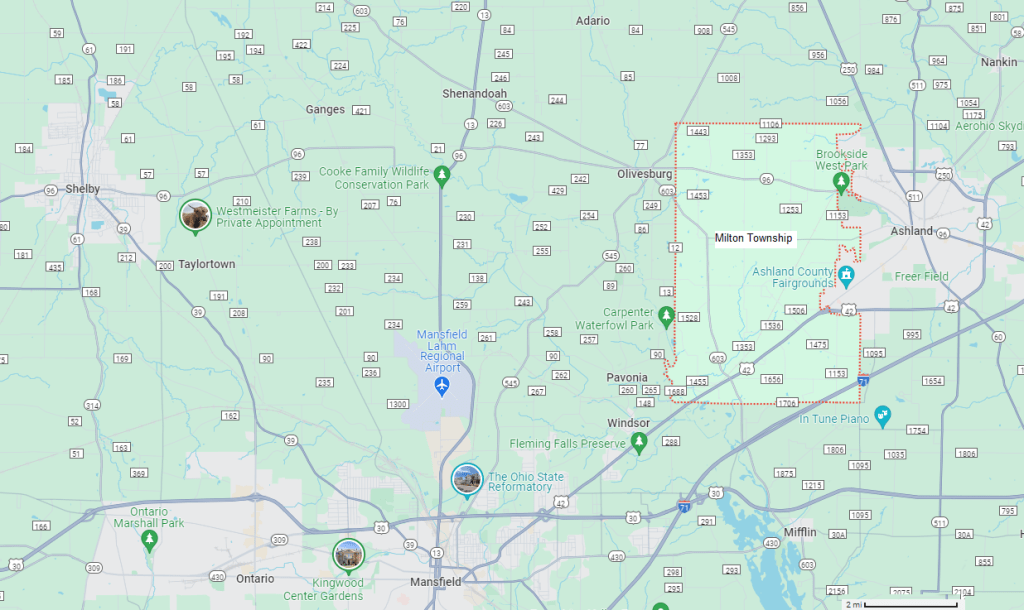
    This year, whenever I wrote about my most distant Callin ancestor, James Callin, I emphasized how much of what I know about him is theoretical. In James’s case, we haven’t found the records we would expect to find where earlier researchers suggested we should find them. And so, when I come back around to the Callin line, I need to think about filling in what we might not know about his wife’s family, or look for patterns, like the Milton Township diaspora, which might open up a new line of evidence.

    While James Callin might be a “brick wall” ancestor, there are avenues of inquiry that might get me around that wall someday. Sometimes, this can feel futile – like the old joke about the guy who dropped his keys in the road, but is looking for them on the sidewalk where the streetlight is, because he can see better there.

    The Callan Name Study is one of those avenues; researching the surname as it appears in places like Ireland or Kentucky may be a longshot, but even if I never find what I’m looking for, I can at least leave a map of where I have searched for those who come after me. Maybe I can build a path to get someone else to the goal.

    If you’ve been tracking my posts on the Milton Township diaspora, they are an example of what can happen when someone follows up on your research later on. George Callin didn’t actually know who all of his cousins and second-cousins were when he published the 1911 Callin Family History. But he included the names of those he did know about, and told us where they were last seen. When I came along in 2015 and started hunting for James Callin’s descendants, I was able to add the Montgomery families and the descendants of Sarah (Callin) Scott and to my 2020 Callin Family History.

    All of which is a long way of saying, “It’s okay to search where the light is, but also do what you can to move the light.”

    Taking My Own Advice

    As we muddle through December, I may need to prioritize the living over my twice-a-week blog schedule. I’m okay with that if you are.

    And as we head into 2026, and whatever awaits us there, I intend to keep working on the family history because it brings me joy.

    I feel fortunate to be spoiled for choice when it comes to the directions I could follow. No matter what direction I choose, I will have interesting things to tell you, and since I’ve done as much as I can with the “Sixteens” for now, I’ve decided on a new approach to coming up with topics on a weekly basis. (More on that later in December!)

    Hopefully, working through my choices will help you clarify yours. If so, I’d love to hear about it! Don’t be shy – drop a note in the comment section.

    1. I hope you’re taking good notes and/or recording these stories for your archives! ↩︎
  • A Sister for Abraham Witter

    The family trees we find online are rickety things, unreliable and often unsupported by evidence. You climb them at your peril, and you should never blindly accept what they say without applying some basic critical thinking skills to evaluating what they claim. (If someone tells you they have evidence for a claim but just aren’t sharing it, that’s the same thing as not having any evidence, as far as your research should be concerned.)

    You know this, but sometimes even your most careful research can lead you to a family that has been researched… let’s say “less carefully” than you might like. Whether you are curating a private tree on Ancestry or trying to help clean up a world tree at FamilySearch or WikiTree, everyone gets to a point where the only information you can find is missing sources and contradicts itself.

    For me, the Piper family from Amberson Valley, Pennsylvania, is one such family. My 4th-great-grandfather and his (probable) sister both married Pipers, and I’ve had a struggle sorting out who was related to whom, and how.

    Our Firm Foundation

    I laid out the chain of evidence I have for my Witter ancestry on WikiTree:

    My 4th-great-grandfather, Abraham Witter (1786-1882) married Catharine, “a daughter of Daniel Pipers, of Amberson’s Valley,” but even that evidence, taken from Abraham’s obituary, is unreliable. In 1968, Harry E. Foreman published “Conococheague Headwaters of Amberson Valley…” essentially a one-place study of Amberson Valley in Franklin County, PA.1 According to Foreman (pg. 151, in the WITTER section):

    Abraham Witter was married to Catharine Piper daughter of Adam Piper, Sr., and Mary Witter (1784-1865) was married to Daniel Piper (1777-1837), son of Adam Piper and brother of Catharine Piper Witter.

    Abraham and Mary were children of John Witter.

    If you want to review the evidence I have that Abraham is most likely the son of John Witter, you can take a look at the WikiTree profile for Johannis Witter. (If you’d like to revisit the process I went through to find and test that evidence, I talked about that process in Finding John Witter and Measuring Up to a Master.)

    With all of that background in mind, I’m pretty sure that it would be appropriate to attach the WikiTree profile for Mary (Witter) Piper to Johannis (John), and the fact that Foreman arrived at that conclusion seems to corroborate that finding. However: we’re still not in territory where we have “proven” the relationships between Abraham and the people we think are probably his siblings (Mary Piper and Samuel Witter).

    And I’m about to add another uncomfirmed name…

    A Clue! A Clue!

    Several weeks ago, Brad reached out to tell me he found something interesting in “Measuring Up to a Master;” I shared a newspaper item from The Franklin Repository (Chambersburg, PA) dated 16 October 1804, advertising John and Joseph Witter’s cloth processing business. In it, they advised customers to drop off the cloth they wanted to have processed at locations around Metal Township, including “Mr. Cridler’s tavern at the Burnt Cabbins.”

    As it happens, Brad is descended from Mr. Cridler, Frederick Kridler (b. 16 Feb 1770), and the Kridler family has passed down an artifact labeled “Family Register” that lists Frederick’s wife and 12 children, and their birthdates. According to Brad’s evidence, Frederick was born in 1770 in Frederick County, married in 1795, and re-located to Franklin County, PA, in 1799, where he was a tavern keeper.

    The family register provides the date of his marriage (April 4, 1795), and his wife’s name and DOB: “Elizabeth Weter born May 15, 1776.”

    What Consitutes “Proof”?

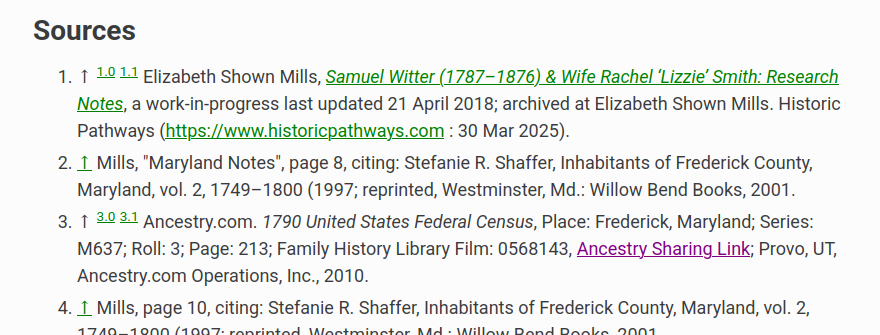
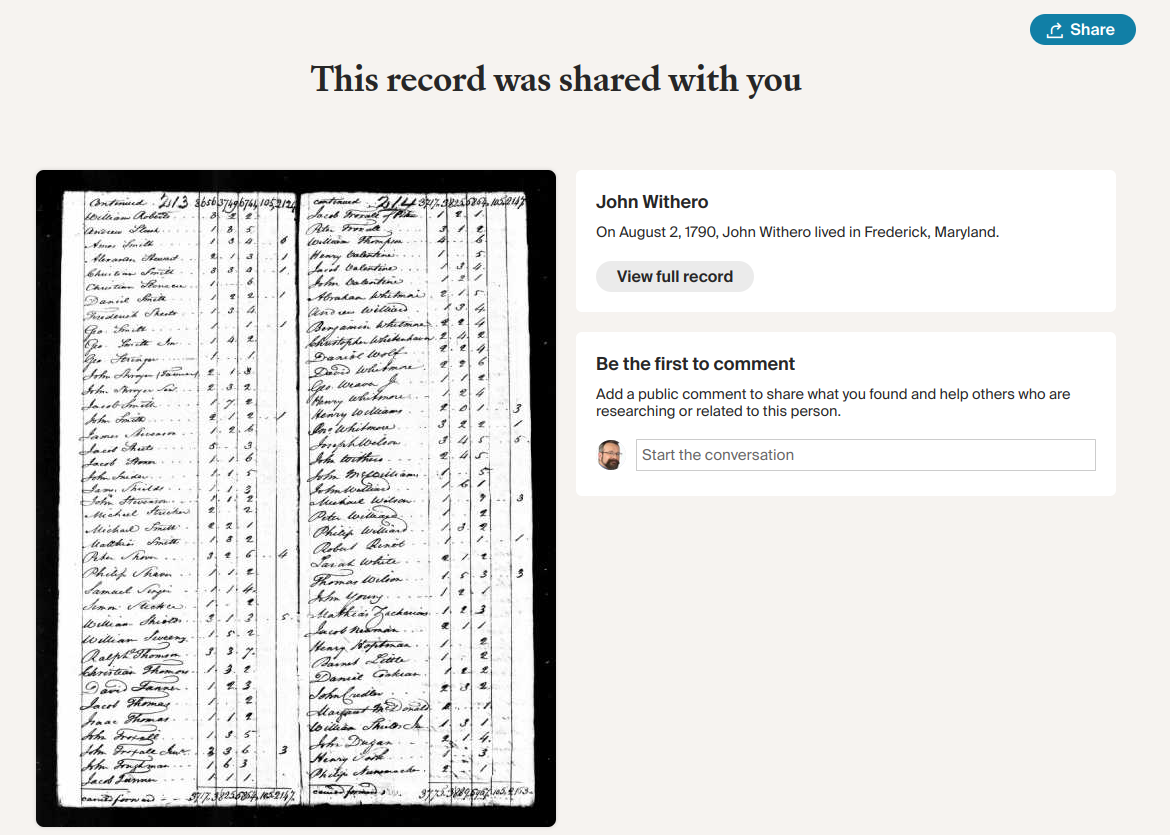
    This chain of evidence is thin; that spelling of Witter is phonetically closer than the name on some of John Witter’s documents (Wetter, Witters, Withers, etc.). And there are three unidentified females in the household of “John Withero [or “Withers”]” in Frederick, Maryland, on the 1790 U.S. Census – Elizabeth could be one of them. That puts the two families in the same county before Elizabeth and Frederick’s wedding date.

    But nobody has been able to find any documents that state that the Elizabeth Weter in the Kridler Family Registry is the daughter of John Witter, and until we find something like that, this relationship should be treated like the hypothesis that it is. (n., “a supposition or proposed explanation made on the basis of limited evidence as a starting point for further investigation.”)

    The thing that I find maddening about all of this is that I lived in Frederick, Maryland, from 2003 to 2005, and had I known any of this information about the Witters then, I might have been able to pop in at The Maryland Room in the C. Burr Artz Public Library, and get some hands-on help! (I also lived in Baltimore County for 15 years, so that would have been an easy trip to make.)

    For now, I’ve added Elizabeth to my Ancestry tree (The Nancy Witter Project), and I hope to find some clues that will either support or refute our hypothesis that she is the sister of Abraham, Samuel, and Mary Witter. If I find enough, and if it fits in the “support” column of the ledger, maybe we’ll build her a WikiTree page one of these days.

    There may be some useful documents out there; I know of at least one Kridler will with some names that seem to match our folks. However, the Kridler family was large and there were several people in it with similar names, so until I’m more familiar with who was who, I am not ready to use that will as proof of anything.

    Until we have proof, all of this is speculation and fantasy – and I hope that including her in my Ancestry tree doesn’t just add to the noise while I’m doing my homework!

    1. Foreman, Harry E., Conococheague Headwaters of Amberson Valley, Volume 5 of Harry Foreman collection; Length: 155 pages, Publisher: Harry E. Foreman, 1968. ↩︎
  • The Scott Family: Milton Township Diaspora

    According to George W. Callin’s 1911 book, The Callin Family History, Sarah Callin (1801-1872) was born when her family still lived in Westmoreland County, Pennsylvania. Her father was “John Callin, 2nd son of James 1st, [who] emigrated with his family from Westmoreland Co., Penn., to Ashland County in 1816 and settled on 60 acres of his brother James’ farm who gave him a life lease of it.”

    Sources disagree on her date of birth, but if it was in 1801, she would have been 15 when her family moved west to Ohio, and 22 when she married John Scott. All George knew about their family was summed up in one line:

    “Sarah, born 1808, married John Scott, moved to Ills. About 1840.”

    Like we saw with the Callin families who moved to Iowa, George Callin did not know what happened to his aunt Sarah after 1840, and he was born 6 years after the Scotts left Ohio. But that is just the beginning of their story.

    The Scott Family in Illinois

    Joseph Scott was born in Pennsylvania in 1765. He may be the Joseph Scott who appeared in Washington, Pennsylvania, on the 1790 U.S. Census, but according to other researchers, he moved with his wife, Elizabeth Mary (1778-1848), to Ohio where all of his children were born. His oldest child, John Scott, was born in Richland County, Ohio, on 6 October 1798.

    John Scott married Sarah Callen in Richland County on 18 January 1823. John and Sarah had their first three children there in Richland county before they left Milton Township about 1836. John and Sarah’s fourth child, Rebecca, was born while they were in Michigan, putting them in that state in 1837. And soon after that, they settled in an unincorporated area called Harrison, near Rockford, Illinois, in Winnebago County.

    Sarah and John lived out their lives in Harrison, and died just a few weeks apart from each other; he died on 20 January 1872, and she died on 6 February 1872. They are buried in North Burritt Cemetery.

    Scott Descendants

    John and Sarah had five children who survived to adulthood: George Scott, James Scott, Rebecca (Scott) Sharp, Cyrus H Scott and Lucina (Scott) Dobson.

    George Scott (1827-1905) was about ten years old when his family left Richland County, Ohio, so he likely had childhood memories of his Callin cousins from Milton Township. He and his wife, Lucetta Beach, had two sons and three daughters. Their grandchildren mostly remained in Winnebago County, though their sons both moved away later in their lives (to North Dakota and to San Diego, California). Their daughters married men named Knight, Johnson, and Wicks,

    James Scott (1832-1916) married Charlotte Brown about 1856, and raised a son and two daughters in Winnebago County. Their son, Christopher Columbus Scott, left no children behind, but their daughters did. Their older daughter, Mary (Scott) Taylor had one child; a granddaughter, Charlotte “Lottie” Taylor, who married Walter Scott Wicks, a grandson of George Scott and Lucetta Beach. Their younger daughter, Ina Belle, had seven children with her first husband, Bert Deuel.

    Rebecca Scott (1837-1928) was probably born in Michigan, before the Scotts settled in Winnebago County. She married Edward Robert Sharp (1835-1887) in 1856, and they gave Sarah and John six Sharp grandchildren. Of their two daughters, only the younger one, Donna A (Sharp) Randerson (1865-1940), had children: three sons.

    Cyrus H Scott (1843-1931) had four children with his first wife, Mary Wishop (1844-1902). Their daughter never had children, and their youngest son died at age 20, having never married. Cyrus had a daughter with his second wife, Ida May (West) McDonald (1864-1928). That daughter, Laura, married a man named Malcolm Ferns, but their daughter died in infancy in 1929, and Laura divorced Malcolm in 1932, and doesn’t appear in the records after that.

    Lucina Scott (1847-1910) married Joseph Dobson (1838-1928) and also had six children. Their grandchildren included 25 Dobsons, 10 Riels, and 5 Homans.

    Dozens of Cousins

    I did my best to document the Scott descendants in The Callin Family History, and if any of their hundreds of living descendants are interested in representing that family on WikiTree, I would be delighted to help. If the price tag on that 800-page tome is too hefty, there is a lot of information on my old Blogger site. (That link should give you a good start!)

    I’m still amazed that it was possible to find this branch of the family based on the very thin clues George W. offered in the original Callin Family History — a feat made possible because someone added John and Sarah’s grave markers to Find A Grave:

    From there, armed with their Richland County, Ohio, marriage record, I was able to pull together census records and kept digging until I found the 1916 death record for James Scott that gave his mother’s maiden name as “Sarah Callion” – which is probably as conclusive as things are going to get for this connection!

    So the lesson is, run down every lead. You never know how far you’ll have to go to find what you’re looking for.

  • Lives and Fortunes: Three Revolutionary War Americans

    Note: this is a fictional representation based on my research (follow links and footnotes if you want to know more). To tell this story, I made assumptions about how these men might have thought and felt, and even about how the cousins might have been related. These assumptions are based on the available facts, but they might not prove to be true as further evidence comes to light.

    James: September 1777

    When Patrick, James, and Edward Callin met in Hanna’s Town that late summer morning in 1777, the cousins had different goals in mind.

    They were young men in their twenties who lived in the surrounding Hempfield Township, but the eldest, Patrick, already had a family of small children, while young Jim and Edward had arrived from Ireland more recently and had not yet settled down with wives. Patrick intended only to bring home what he could find at market, but his cousins did not plan to return home that day at all.

    The Callin men had come to town to make a commitment.

    It had been two years since the Hanna’s Town Resolves were adopted on May 16, 1775, and since then, King George had sent military troops – both English regulars and German mercenaries – against his own people. Thomas Jefferson had written a Declaration of Independence that was adopted in Philadelphia and voiced some of the same complaints as the Hanna’s Town Resolves. Then New York had been occupied, and even the pacifist Quakers governing Pennsylvania realized they needed to authorize a militia.

    “There is your recruiting officer,” Patrick said, pointing towards a man in a prominent corner of the square. His uniform stood out in the crowded market, and he had posted the Militia Act, passed in March of that year, on a board behind him.

    “No,” said Jim, “I cannot bring myself to serve in an Army for the Friends. Cousin Edward has alerted me to another option.”

    “What other option? You don’t mean to enlist with the Virginians, do you?” Patrick knew that as of 1776, Virginia had claimed the land of Westmoreland County, including Patrick’s own farm. Patrick himself felt torn between loyalty to his adopted country and his frustration with their government, but he hadn’t realized his cousins’ distaste for the way the Quakers and their German neighbors governed Pennsylvania ran so deep1.

    Knowing where to placed one’s loyalty had become a difficult thing.

    “Cousin, you know better than I do how our people have been used by these two-faced Friends!” Jim said. “They claim to want peace with French & Indian savages, then they put us out on land they aren’t willing to let us defend! You know well they regard us all the same as the Paxton Boys – but now that they feel caught between the frontier and the Crown, they deign to let us fight for them?”

    He turned to scan the square, and spotted another man in uniform, standing with a group of young farmers and townsmen in a less well-trafficked corner. “If I must fight either way,” Jim said, “I will fight with real fighters.”

    Leopold: August 1779

    ­“He is at this time transporting large armies of foreign mercenaries to complete the works of death, desolation and tyranny,” Thomas Jefferson said of King George III in the Declaration of Independence.

    As early as August 1775, when the news of the Battle at Bunker Hill reached the European continent, Prince Friedrich Wilhelm II of Hesse-Cassel offered his ranks of well-trained soldiers to the British king, knowing that Britain did not have enough troops to overtake the massive American colonies. At that time, Hesse-Cassel was one of seven principalities that made up what is now Germany.

    Friedrich’s officers, coming from either the ranks of the aristocracy or the middle class, were well-educated, receiving advanced instruction at the Collegium Carolinium in Cassel, where they studied foreign languages, mathematics, and engineering. The men in the ranks were culled from the peasant class, frequently stolen off the streets by gangs of recruiters, and were segregated into units of Jägers (light infantry) or artillerists. The former group was made up of the sons of gameskeepers and foresters, and the latter tended to be the sons of industrial workers from the cities. At the bottom of the hierarchy were the “expendable people” (entbehrliche Leute): school dropouts, servants, unemployed tradesmen, or wandering homeless youths who were seized off the streets by recruiting gangs. All were indoctrinated with the German concept of Dienst, or sense of service, and swore a personal oath to Prince Friedrich2.

    Twenty-one-year-old Leopold Zindle found himself stepping off a cramped English ship after several uncomfortable weeks at sea, wearing the uniform of a private in the Hesse-Kassel Erbprinz Regiment. Whatever he had experienced as a boy from Essingen, and however invisible or expendable he may have been on the streets of Germany, he now found himself provided with an impressive uniform, weapons, and freedom from having to think about what to do next.

    “Do as you are told,” shouted the officer waiting for them to disembark, “and you will not be beaten. Fail, and you will run the gauntlet.” Leopold could see two lines of 150 soldiers each, facing each other, as another solider ran between them, stripped to the waist. He watched 300 soldiers, laughing as they beat the running man with whatever clubs or weapons they had on hand, and he resolved never to be so undisciplined as to receive such treatment.

    With his attention on his duties at camp, keeping watch, and endless marching, Leopold did not have much time to devote to keeping track of where his unit was, or puzzling out what their strategy was. But he couldn’t help notice that the “American savages” they had been sent to subdue did not live up to the image of the dirty, drunken heathens described by their officers. Instead of finding rude huts and seedy fields, the regiment often marched past well-tended fields, and tidy towns full of well-built houses, many of which were occupied by people who spoke German!

    Leopold’s fellow soldiers shared this opinion of the American populace, but took a dimmer view of the American soldiers. More experienced men described the poorly equipped and poorly drilled Continental soldiers they had seen during their time in Rhode Island and New York. Leopold’s sergeant frequently raised his canteen in mock salute to the Americans who had suffered through the famously brutal winter at Valley Forge, but had kept fighting throughout 1778 anyway.

    “But of course,” he would say, “They owe it all to Von Steuben!” then spit on the ground.

    On the morning of August 19th, 1779, while camped at the Fort at Paulus Hook in New Jersey, Leopold was awakened by shouting just before dawn. He and his fellow soldiers scrambled to dress and prepare their weapons, but in the early morning darkness, it was impossible to know friend from foe, let alone how many foes there were. By sunup, Leopold and 157 other prisoners were being led away by the 300 or so men under the command of Major “Light Horse” Harry Lee.

    The prisoners were marched inland for several days, joining a larger body of the Continental Army long enough for General Washington to work out what to do with them. Leopold was among those sent to work for Jacob Faesch of Mount Hope, where barracks were built for 200 men. Their work produced cannonballs, which Faesch sold to the Continental Army. Faesch and many of the other towsnpeople Leopold encountered spoke German dialects, which made the coming years of manual labor in this foreign land easier to face.

    For four years, Leopold was fed and sheltered in exchange for his labor, and he slowly learned about the people he was sent to subjugate for the British crown. Four years during which his homesickness would burn away in the coaling job and be replaced by something else.

    Edward: New Year’s Day, 1781

    Edward and Jim joined the 4th Virginia Regiment of Foot in 1777 a week after the Battle of Brandywine. A week after that, Philadelphia was captured by the British. It was a difficult time to be a new recruit, but they soon faced the British on the battlefield at the Battle of Germantown.

    Their regiment was assigned to the 4th Virginia Brigade, commanded by Brigadier General Charles Scott. The young soldiers were impressed by General Scott. They learned from their new comrades how well their unit had been handled under General Sullivan’s Wing at Brandywine, where their actions bought time for Gen. Washington and the charismatic young Marquis de Lafayette to retreat without greater losses.

    The first few months in the Army were grim, but at least they were together in the same regiment. They marched together into Valley Forge on 19 December 1777, and marched out again on 19 June 1778. Of the 12,000 men who established the camp, between 1,700 and 2,000 men died from outbreaks of typhoid, dysentery, influenza, pneumonia, and typhus, all made worse by the cold, wet weather and the inconsistent availability of food.

    Those who survived that winter came out better trained, because Baron Friedrich von Steuben, a Prussian military officer, stepped in as drillmaster. He taught the soldiers how to use the bayonet, and most importantly, how to re-form lines quickly in the midst of battle. Sadly, a month before leaving camp, Edward was claimed by the 6th Pennsylvania Regiment, and would no longer be so close to Jim.

    Their first major engagement after leaving Valley Forge was fought near the Monmouth Court House in modern day Freehold Borough, New Jersey. Jim and Edward were both once again technically under command of Gen. Charles Scott. Jim and the 4th Virginia were led by Col. William Grayson after Maj. Gen. Charles Lee shuffled his troops before the battle began. Edward was under command of Lt. Col. Josiah Harmar in Scott’s detachment in the forward screen. The results of the battle were inconclusive, but the majority of losses on both sides were due to heat-related illness and the Continental Army retained possession of the battlefield. For the first time, Edward thought, victory seemed within reach.

    Now that they were in different units, it was harder for Edward to keep track of Jim. He got word that Jim was sick during July and August, recovering at Camp White Plains. He also heard when Jim took furlough that winter and went home to marry.

    In June of 1779, Edward’s unit was deployed under Maj. Gen. Sullivan on his expedition to respond to attacks on American settlements made by Haudenosaunee (Iroquois) and Loyalists during the previous year. The Haudenosaunee had supported the British during the 1777 Battles of Saratoga, as well, and Sullivan’s army carried out a scorched-earth campaign that destroyed 40 villages throughout the Finger Lakes region of western New York. The campaign drove just over 5,000 Haudenosaunee to Fort Niagara seeking British protection, where many of them starved and froze the following winter, as the British were unable to supply them. This had the desired effect of stopping the attacks. It also depopulated the area for post-war settlement.

    Edward’s regiment spent the rest of the year in garrison at West Point and probably wintered at Morristown. Jim had returned from furlough and camped with his unit near Morristown in November 1779. The next year, Edward’s regiment took part in a number of small engagements in New Jersey and again wintered at Morristown; but Jim was supposed to have been sent to serve with General Scott again. Edward knew the Virginians had marched nearly 800 miles from Morristown to Charleston, South Carolina, only for Continental General Benjamin Lincoln to surrender, but he didn’t know if his cousin had marched with them. As far as he knew, Jim was being held prisoner.

    By this point, at the end of 1780, Edward was tired. He had served his three-year enlistment as of September, but the end of the war was nowhere in sight, harsh conditions persisted, and the army had not released him. On 1 January 1781, 1,500 soldiers from the Pennsylvania Line, the 11 regiments under General Anthony Wayne’s command, protested that their three-year enlistments had expired and complained that they had not been paid.

    For a week, the mutiny could have ended violently, but General Anthony Wayne and Congressional President Joseph Reed knew that how they treated these men now – men who had served more than a full enlistment already – would affect their ability to recruit. Since the men brought complaints that officers had tricked or punished soldiers to extend their enlistments, Reed concluded it would be better to meet their demands.

    Edward took a $20 bounty, and clothing, and went home.

    Apres la Guerre

    To simply say that “war changes men” is not enough. How it changes them depends on their character, and on the things that circumstances force them to endure.

    Jim Callen had a difficult enough time abiding by the authority of the Pennsylvania Quakers before he went to war and he came home with an even deeper mistrust of government. He never talked to his family about what happened to him when the Virginian regiments marched South, but he complained bitterly and often about the “decisions by committee” in Congress that kept Washington from acquiring needed supplies. He wouldn’t speak at all of his experiences after the surrender at Charleston, except to say that General Scott had been betrayed, and all Virginians with him. He would follow Gen. Scott again, fighting with the Kentucky Mounted Volunteers at the Battle of Fallen Timbers near what is now Toledo, Ohio, in 1794.

    Edward also had trouble talking about his experiences. While the expedition against the Haudenonsaunee had been framed as justice in response to their attacks, the sight of highly trained soldiers razing a village full of freezing and starving families never sat well in his heart. When he married and looked for land to raise his own family, he wouldn’t consider the towns in the Finger Lakes region.

    Leopold’s change was probably the most dramatic. He began his journey as an aggressor, seeing himself as the civilized warrior sent to bring order to a wilderness. Four years working for Mr. Faesch had convinced him that there was already a new kind of order in this New World, and he wanted to stay there to build his life. Despite the attempts of three armies – German, British, and American – to compel his allegiance during those four years of war, he decided to stay in Morris County as his own man. An American man.

    Jim and Edward never met Leopold, despite spending the New Jersey winter of 1778 within 17 miles of each other. Who knows how many of Leopold’s cannonballs the other two men saw fired on the British. Who knows how many of Jim’s and Edward’s defensive engagements kept the British from putting a torch to Leopold’s barracks. After the war, they would never know that they made each other’s lives possible.

    Just as they could never know that the great-great-granddaughter of Leopold’s great-great-grandson would marry the great-great-grandson of Jim’s great-great-grandson – or that a great-great grandchild of that marriage would write this story in 250 years.


    This story is part of the celebration of America’s 250th birthday at Projectkin – Stories250.

    1. JSTOR: Journal of the Presbyterian Historical Society (1901-1930), Vol. 3, No. 5 (MARCH, 1906) pp. 201-252 ↩︎
    2. Salamida, Joseph C. “The Hessians Are Coming!” Warfare History, April 2007 ↩︎
  • Grandma Bert’s Travelogue

    A treasured digital artifact

    My maternal grandparents were Alberta Tuttle and Russell H. Clark, Sr. I recently acquired a digital copy of the video tape they made in 1990 for their 44th wedding anniversary, which starts with the two of them sharing the story of how the met, and then consists largely of Grandma reading a list of the places they lived. Here is just a text-based sample of their humor and personality.

    Russ: Bert and I met on a blind date. A fellow sailor brought me to New Jersey to meet Bert, and we had a terrific time. We just did the town. We did everything that money or love can possibly do. We spent about 6 hours with this other couple, and then at the end of the evening, we separated. And at the time, the next morning, I was supposed to be shipping out, and we knew that we wouldn’t see each other any more. Undoubtedly, we thought that maybe we weren’t ever going to ever see each other again, because it was wartime.

    I went away and spent about nearly two years in the military, got injured, went into the hospital, they brought me back to the United States on a hospital ship. And I kept quiet and didn’t get in touch with her until I was able to get around again. And then we got together, we set a date, and we had a terrific time at that meeting. Everyone was so friendly. Her mother and dad were exceptional people. We got acquainted, they took us…her mother and father took us out to a dance that evening at a nightclub in New Jersey, and we really enjoyed ourselves.

    Of course, then I had to keep going back and forth to the hospital until I got my discharge. Then, when I was discharged from the military, I took up my abode in Maplewood, New Jersey, to be near Bert. And we, by the time we were really getting serious, we had gotten to know each other real well, and we knew that we were in love with each other, and we became engaged. This went on for a year because her father did not want us to get married right away.

    And it was hard on us, but we were up to it. We did a good job of waiting, and then that wonderful day came when we got married. We were married on March the 2nd 1946. We went to the church and there we were joined together.

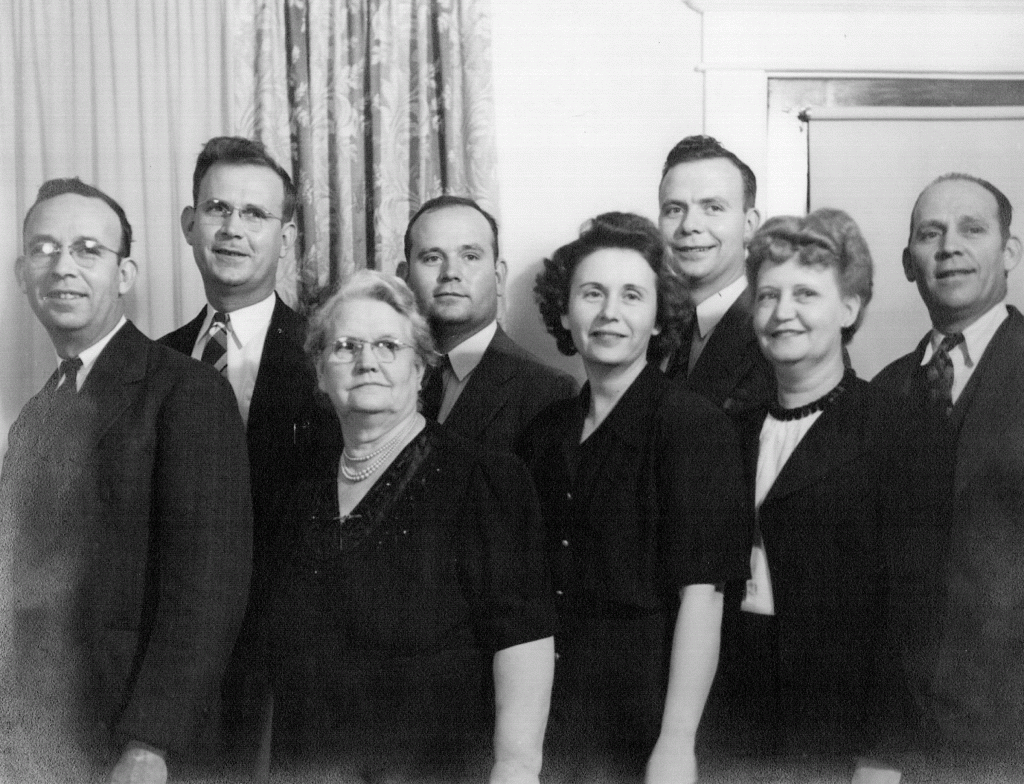
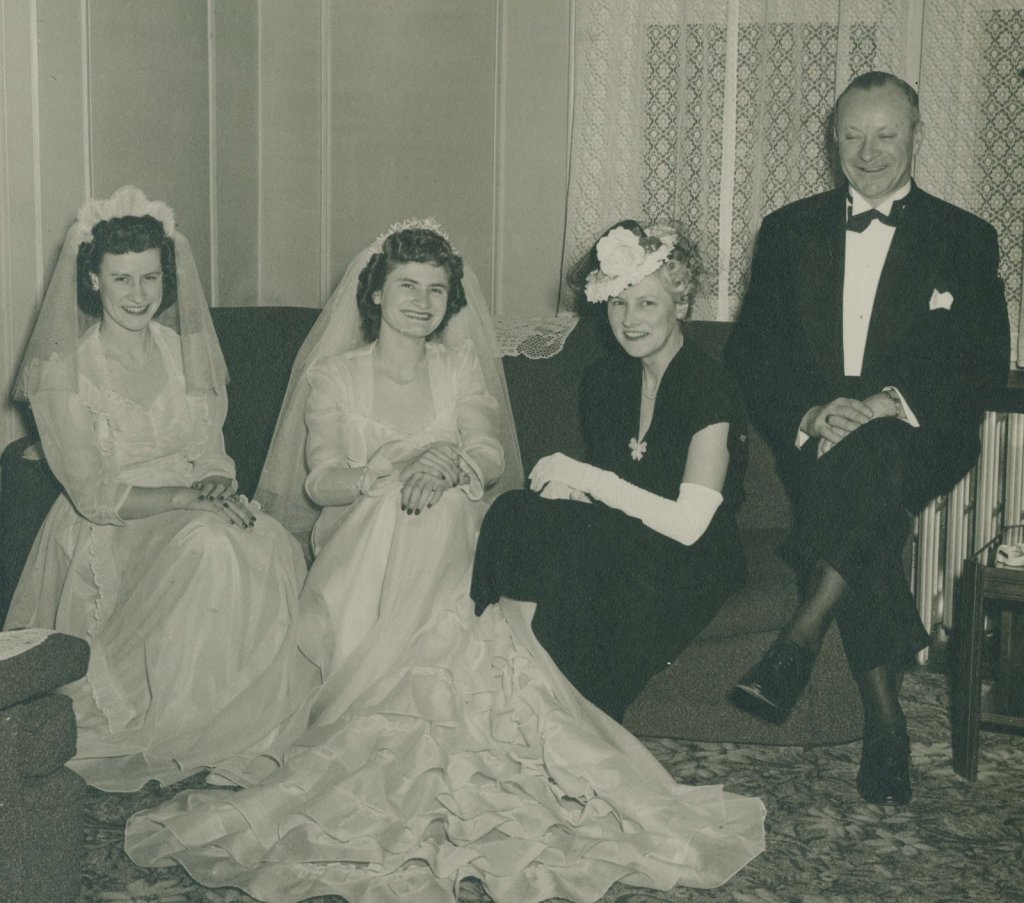
    The Tuttle family on 2 March 1946: Lyle (left), Bert, Edna, and Alfred

    Bert: When he came to the house, everybody just stood all together – my girlfriend, this fellow that brought him. And they just all stood there like a bunch of dummies. My father was sitting down waiting for an introduction and nobody would do it so Russ stuck out his hand and said “I’m Russ Clark, sir.” Well, that made points with my dad, believe me!

    So, we talked a while and also I remember before Russ came, I asked Eddie – Eddie Hadley was the name of the sailor – I asked him, I said, “What kind of a fellow are you gonna bring me?” 

    He says, “Oh, he has no teeth and he’s bald and he’s short and dumpy.” and I said, “I wouldn’t put it past you a bit, Eddie. That’s just about the way you’d do it. I’m not sure whether I really want to go or not.” 

    So they finally convinced me to go ahead. I’d never been on a blind date before. But when I saw him at the door, I knew this was going to be okay.

    I told my mother I said, “This is the first time I’ve ever been out with a man!” I’d been going out with boys, say about 17 or 18, but then when Russ decided he wanted to marry me, he went to my dad, and he said, “She’s still wet behind the ears, she’s too young.” Of course, I was 20, and I was too young? So, I said, “Okay, dad, I’ll wait til I’m 21.” … But anyway, I finally convinced my dad I was old enough to get married.

    So he accepted it, and we set the date, and we got together on the anniversary an engagement dinner with my grandmother and grandfather. And we had a big dinner to celebrate our engagement on March the 28th 1945.

    And then we talked over when we were going to get married, and we chose March the 2nd 1946. And then we went on our honeymoon to Washington D.C.

    Russ and Bert, bound for DC!

    Well Seasoned Travelers

    From that point, Grandma went straight into a 17-minute recitation of all of the places they could remember living. Even if you leave out a few brief stays in this town or that, it is an impressive list. When Grandma passed in 2017, I celebrated her in “When Grandma Played the Organ,” where I said:

    “All I knew when I was a kid was that seeing Grandma and Grandpa Clark was an adventure. They always had a new house in a new place, or if they were between houses, they would have a different motorhome or trailer to live in. As we got older, we learned what they meant by “disability” and “fixed income” when they talked with the other adults at dinner.

    “She wouldn’t complain, but sometimes we could tell that all of the moving around was hard on her. She would talk about finding a church home, putting down roots, and having a house she could call her own. Sometimes they even stayed on a piece of property long enough to build a house, and she could get her organ out of storage and set it up in her living room. I particularly loved the visits when she had room for her organ because she would play and sing those old revival hymns that made such a grand first impression on the churches they visited.”

    People don’t really comprehend just how much my maternal grandparents moved around in their lifetime. I know they don’t because I see their reaction when I mention even an abbreviated list of their homes. And after I transcribed their anniversary video, I have been struggling to find ways to express their seemingly constant mobility.

    When she listed off the places they lived, Grandma would sometimes have to give an inexact place (if they were living in their mobile home) or list several places they lived within one town in one year. Still, even leaving out a few details, I count 36 moves between their wedding and their 44th anniversary. Here is a map I made to try to wrap my head around it all:

    A Larger Project for the Future

    Someday, I’d like to re-edit the anniversary video and share it here. But while it is a precious thing for the family, it wasn’t meant for a wide audience, and I intend to respect that. There is a lot of information about my living aunts, uncles, and cousins that doesn’t need to be shared online, and the 1990 technology it was recorded on doesn’t do a good job of showing the photos and documents Grandma and Grandpa held up to the camera as they spoke. I suspect some modern editing (and a lot of time!) will make their story more presentable for future generations.

    So, for now, I have this map, a lot of photos to hunt down, and some goals!

  • Among the other disruptions in October, Microsoft alerted me that my computer’s operating system would no longer be supported. Rather than try to upgrade to Windows 11 (not really an option for a system as old as mine) or buy a new PC during America’s economic collapse and government shutdown, I decided to install an Ubuntu operating system.

    Long story short, I am now using “Noble Numbat” after several days of transferring/backing up files and trial and error. (What is a “numbat” you ask?)

    Behold, a noble Numbat

    In addition to unearthing some files I had forgotten about (which I am already drafting into future posts!) the installation process required me to sit and wait for things to happen, which got me thinking about how some of the technological changes in our recent history have changed the way we live.

    The Humble Inventor

    My great grandaunt, Emma Beatrice Callin, married George Delorain Matcham in 1907 in Fostoria, Hancock County, Ohio. George was the kind of person you might picture when you read about America’s Progressive Era.

    George D. Matcham with his second wife, Emma B. Callin – photo dated 1907.

    George was not a healthy boy, suffering from unspecified conditions that kept him from making a living in more physically demanding professions, and forcing him to delay his studies at Oberlin College. But after completing his business studies, he took out several patents on farm equipment, which provided him and his first wife, Marion, with an income and the means to invest in the resort they developed later in Linwood Park, on Lake Erie.

    Just for fun, if you have any ancestors who were inventors, you can look up their patents on the U.S. Patents and Trademark Office website. I found George by looking for “Matcham” in the “Everything” field:

    From Farm to Railroad

    When Emma’s great-grandfather, John Callin, died of tuberculosis in 1835, his probate documents included “A true and accurate inventory of the goods & chattels of the Estate of John Callen” that was appraised at a value of $231.50. That amount in 1835 is equivalent in purchasing power to about $8,522.78 today.

    That inventory doesn’t have a lot of things listed; if you leave off the livestock, there are a few key pieces of farm equipment, like the “patent plough Double & Single Trees” ($2), an “Iron pinned Harrow” ($4), and a wagon ($40, now a $1,478 value). At the top of the list, you can see John’s $12 “Rifle Gun,” which is the rough equivalent of $442 today – about the same price as a low-end rifle in 2025. (If only you could still get a car for under $1500!)

    Nineteenth century Ploughs – from the Plough article on Wikipedia

    That generation that included George and Emma saw several historical trends in the development that would have astounded a man like John Callin. John’s entire world was built around working the land with his sturdy, but simple, tools. Feeding his family, selling crops and his labor; those were his priorities. The innovations that went into building the railroads and improving crop yields using less human labor transformed the United States from an agricultural backwater into an industrial powerhouse, capable of not only feeding the world, but transporting its goods globally.

    But the world that George and Emma faced was one in which the population of the world was outgrowing the ability of even the most productive farmers to feed it.

    A German scientist named Fritz Haber changed all of that when he developed a process for making nitrogen-based fertilizer. Of course, Haber’s story is complicated; he’s the same scientist who created the gas used to exterminate people in the Nazi concentration camps in World War II. And the innovation that allowed farmers to increase their production so dramatically also cost them something that modern Americans still pretend we have.

    How We Innovated Away Our Independence

    John Callin’s son, William, was known as a physically strong man who cleared more than 160 acres of land to establish the farms where he raised his family. He was the sort of man that later generations thought of as a “rugged individualist,” even though he depended heavily on his neighbors and his community for his survival; especially when he was later afflicted with “rheumatism,” the reward for all of his hard, physical labor.

    One of his descendants described him by saying he “was an industrious, hardy, persevering man, possessing great physical strength, but had only a limited knowledge of books. He had a mind of keen perception and sound judgment, and was well fitted for pioneer life.” But William wanted something better for his sons. He knew better than most how hard it was to make a life the way he had, and he probably knew that the American model of raising large families on a few hundred acres of farmland was not sustainable. He made sure his children were educated, so that they could thrive in the world of business and industry that was growing around them.

    His son, John Henry Callin, became a teacher, and after surviving the Civil War, he became a businessman and local leader. He did not work a farm, and neither did any of his children. His sons followed his example, working as teachers and professors, investing in property and building houses, or working on the railroads.

    Like so many other Americans who left farm life behind to find work in cities, they made a trade. They increasingly depended on others for their food and sustenance. Growing your own food has always been hard, time-consuming work, and after World War I, Fritz Haber’s marvelous fertilizer innovation made it easier for those who still farmed to support those who didn’t.

    And since then, we have all lived with the trend of small, independent farmers being bought up by international corporations – Cargill, Archer Daniels Midland (ADM), Bunge, BASF, and Wilmar International, just to name a handful. The average American has no idea how they might feed themselves without products from these companies arriving at their local grocers.

    What Would They Think Of Us?

    As I wrote last year in The Meaning of Work:

    I doubt that my 3x-great grandfather, William Callin, who cleared acres and acres of Ohio forest with his five sons and turned his land into prosperous farms, would recognize anything I do as “work.” He probably would have been appalled that his grandchildren were leaving the farms he worked so hard to establish so they could earn wages in factories. Industrialization was, to men like William, something to be resisted, and they made compelling moral arguments against it. In 1869, The New York Times described the system of wage labor as “a system of slavery as absolute if not as degrading as that which lately prevailed at the South”.

    If you look at things from William’s point of view, or at least from the point of view of Midwestern American Protestants like him, the only thing more morally outrageous than not working would be to have someone else steal your labor. This would explain why people like William and his brother George were willing to defy the law and help enslaved people escape from the South.

    You may notice the contradiction there – that William wanted something better for his sons, and would have been appalled by the way the industrialized world steals labor and exploits every resource in the pursuit of maximizing sharehold benefit.

    We all live with that contradiction today. Our current disruptions are driven by it. People may not think deeply about the roots of their problems, but they instinctively know that they are being ripped off. They blame all the wrong people for it, of course. They allow themselves to buy into any number of false binaries to explain the trap we are all in, boiling everything down to battles between “civilizations,” races, cultures – everything but the actual conflict that has always plagued humans.

    Who holds the power over everyone else?

    Our technologies are at a point where we could feed everyone, house everyone, and focus on curing more of the diseases that threaten everyone. But we allow those who control our access to food, housing, water, and health care to tell us that our neighbor is a drain on resources. We let them use our fear of each other to cheat us out of our future.

    Americans, especially those who consider themselves to be “white,” carry a lot of fear inherited from previous generations – fear of the Native people we displaced, fear of the people we enslaved, fear of the immigrants we needed for labor, fear of those who believe differently. That fear works both ways; the surviving Native people have a reasonable fear of exploitation, the descendants of enslaved people have suffered through hundreds of years of being “othered,” and anyone coming here to find a better life lives under constant fear that they will be rejected.

    The question you have to ask is this: do we have to continue to accept those fears? Or can we look past our fear and find a way to take advantage of those technologies that promise to make our lives better? Can we stop blaming our neighbors for being as dependent on our corporate masters as we are, and turn our attention to convincing those corporate masters that they are better off continuing to feed all of us? They have the means to do so.

    Without all of us out here to consume their products, they don’t have any of their wealth or power. And they tell us every day that’s what they fear.

    And that’s why they keep developing newer, more disruptive technology.