Mightier Acorns

Journeys through Genealogy and Family History

A parody of a family coat of arms designed with acorns as elements, with the motto "ex gladnis potentioribus" Latin for "from Mighty Acorns"
From Mighty Acorns
  • We have some shaky footing on this ladder

    Last week, we considered the evidence that ties Thomas Wells and Cyrena Whitford to Harlow C. Wells. I decided to accept that Harlow was probably their son, based on the few facts we have been able to find in the available records. I also spent some time looking through the local histories published about Franklin County and searched for other Wells families who might have been in the area, but those sources did not offer any other alternatives to explore.

    This week, we are considering the next rung on the ladder, and looking for Cyrena Whitford’s origins. Once again, we don’t have a lot of information to work with. Other than this record of their marriage, there don’t seem to be any official documents that name Cyrena:

    a screenshot from Cyrena and Thomas's Vermont marriage record
    Whitford-Wells in “Vermont, U.S. Vital Records 1720-1908”

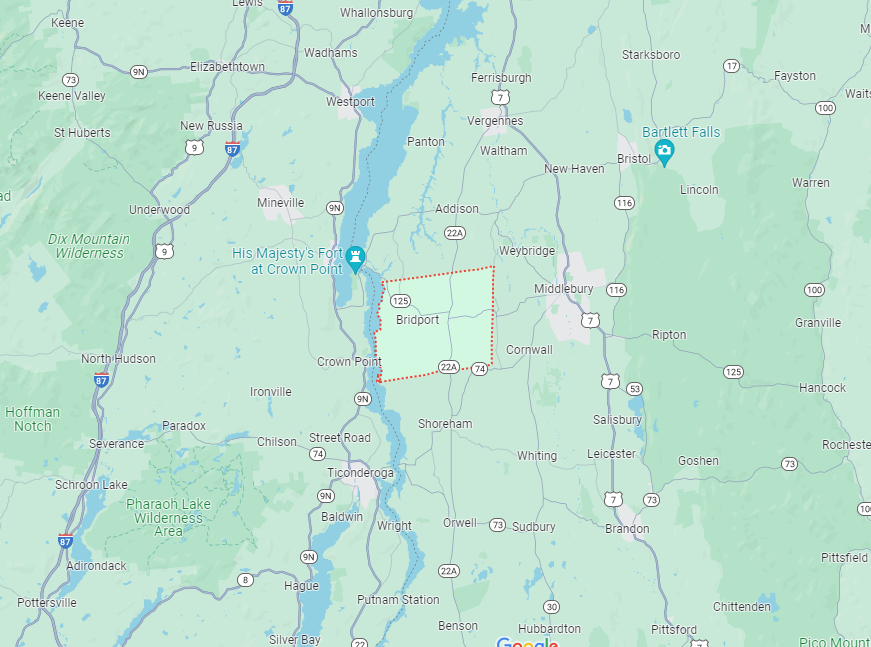
    The only other source that names Cyrena gets her name wrong. The death record for their daughter, Melissa (Wells) Whitman, who died in Haverhill, Massachusetts, in 1886, gives her parents names and their place of birth. It names Thomas Wells and “Irene”, born in “Bridgeport, VT” and “Crown P….”, respectively:

    detail from Melissa Whitman death record
    detail of Melissa Whitman’s entry in “Massachusetts, U.S., Death Records, 1841-1915”

    Once again, we have a very limited amount of information to work with if we want to figure out who Cyrena Whitford’s parents were. The two records that name her disagree on her name; there is no record of her date of birth; and the scan of the page that names her birthplace cuts off the placename. That said, I’m inclined to think that Cyrena/Irene was born in Crown Point, Essex County, New York, which is located directly across Lake Champlain from Bridport, Vermont.
    .

    But… once again, we have some leads thanks to the online trees shared on Ancestry, FamilySearch, and WikiTree. According to those researchers, Cyrena Whitford is believed to be the daughter of Greene Whitford (1759–1816) and Anna Clothier Pierce (1760–1808). As we did with Harlow, we need to look at the available records for that couple to see if we can support this theory.


    As always, I’d love to hear from any fellow descendants of these folks, especially if you have scans of the “family records” cited in their online trees.

    And if you are interested in seeing how far up this ladder we can get, be sure you are subscribed!
  • Sometimes it’s okay to fantasize

    I spend a lot of time on this blog emphasizing the importance of evidence and critical thinking in assembling a factual family history. But as some of my Substack friends will tell you, context and the construction of a narrative are also important elements for telling your family’s story.

    CuZens Genealogy Matters
    Your Ancestor’s Historical World: Family History Narrative Series
    When your ancestor’s narrative is grounded in the location and era they lived in, it provides your reader with much-needed context. Without the setting as a context for their experiences, a hole is left in terms of understanding them. Context gives meaning to your ancestor’s narrative by placing them within the circumstances of their historical world…
    Read more

    Motley Stories
    What is the context?
    We live in an ever-changing world. Which means that the context of how we view events in our lives may be viewed differently in the future. For instance, this is a beautiful painting of Madame Pierre Gautreau, painted by John Singer Sargent. This is the second version of the painting. The original painting, the one exhibited at the Paris Salon of 1884, …
    Read more

    I have a whole separate life in fiction that I don’t get to talk about here very often. Since about 2006, I’ve subscribed to the Escape Pod science fiction podcast, and since 2016 I have been an associate editor at Pseudopod, the horror fiction podcast. In addition to behind-the-scenes editorial duties, I’ve had the privilege of hosting and narrating a few episodes – full list here – most recently narrating the Veteran’s Day/Remembrance Day story, The Body Remembers, in 2023.

    If you do go check out that story, pay attention to the Content Warnings; and take note that this, and stories like it, serve a purpose that purely factual history can’t serve. The fictional world gives us a glimpse of the kinds of pain and suffering that most of us never experience – and enough distance to avoid experiencing it. The goal is understanding.

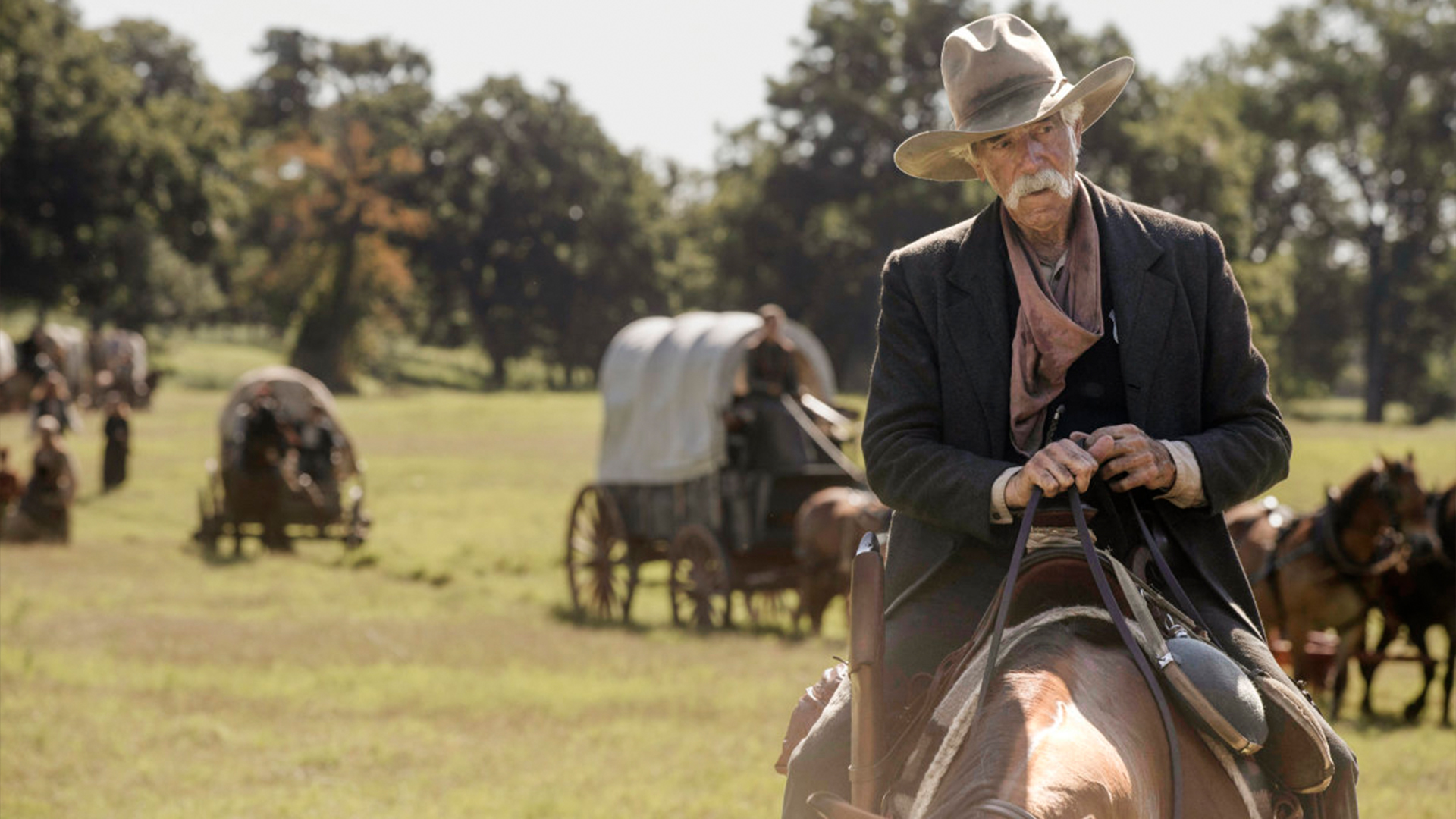
    Some amazing shows are being made that are based on historical events. Taylor Sheridan’s Yellowstone prequels, 1883 gave my imagination a backdrop for learning about my Huff and Witter ancestors – even though they settled in Kansas, not in any of the locations depicted in the show. The outlandishly fantastic Outlander – which takes a time-traveling erotic romance and grounds it in a visually stunning production – brought the Scottish Highlands to life in a way that I could never have accessed just by visiting. And Outlander’s recent seasons have (probably implausibly) woven the characters into events from the American Revolution – including places like Ticonderoga, New York, not far from where some of my ancestors lived, or in pre-Revolution North Carolina, where my wife’s ancestors settled.

    While none of these would ever pass for historical works, the settings, costumes, and otherwise brilliant production work can give someone like me a sense of place for the stories I want to write about my ancestors.

    Might your ancestors have remembered the feeling of riding in those wagons? (Sam Elliott in 1883.)

    Of course, admitting an affection for historical fiction makes me feel a little bit guilty as if I’m betraying all of the serious historians out there trying to Tell the Truth. But I also can’t help observing how historical fiction drew me into the study of history. I remember discovering Larry McMurtry’s Lonesome Dove novels in my teens, and the compelling story full of relatable characters helped me grasp the outlines of American history in a way that a simple recitation of names/dates/places never could.

    We do have to be careful about maintaining the line between history and fiction. Alex Haley’s groundbreaking and influential work, Roots: The Saga of an American Family, was a phenomenon when I was a kid, and undeniably influenced my interest in family history. But because it wasn’t presented as a novel, and because Haley did not acknowledge that he borrowed parts of it from a 1967 novel, it suffers as a work of history and draws criticism from those who want to deny the underlying realism of the events it portrays.1

    I personally still value Haley’s work, and the work of many others who could be described as “pioneers of ‘creative non-fiction” or the ‘non-fiction novel’” – my memoir/novel, Tad’s Happy Funtime, tells you outright that I don’t trust my memory and that I have probably altered my own stories over the years simply in retelling them. That is, after all, how the brain works.

    The key is to give value to both fact and fantasy and to understand that your ancestors did the same thing. Any writings you have inherited from them have tremendous value as artifacts of their time and their internal lives – but always remember to be skeptical of what is factual until you have evidence.

    And, of course, document your evidence – ideally on my WikiTree profiles – for posterity.

  • Looking for the link from Harlow Wells to Thomas Wells

    Our story thus far:

    I have been examining the evidence I have connecting my grandmother, Alberta (Tuttle) Clark back to our possible ancestor, one of the founding families of the Providence Plantations in what is now Rhode Island. We started with her father, Alfred Tuttle, and I feel confident that we have solid documentary evidence connecting him to his mother, Florence (Hart) Tuttle, her mother, Hattie (Wells) Hart, and Hattie’s father, Harlow Wells.

    Image of Hattie Wells Hart's WikiTree
    Harriet Isette Wells’s WikiTree

    Unlike everyone else we’ve looked at to this point, none of Harlow’s records name his parents, and only one record gives us a precise place of birth: Brandon, NY.

    Detail from Hattie's death record
    detail from Massachusetts Death record for Hattie (Wells) Hart, 28 Sep 1879

    Normally, I avoid looking to online trees for clues. They are almost always unsourced and rarely include enough information to help you get around a brick wall. But I’m out of options, so as long as I take a critical approach, maybe I can learn something useful.

    I found three member trees on Ancestry that named Harlow, all supported by the source records we already looked at; his FamilySearch profile lists 22 sources, but none we have not already seen; and he had an existing profile on WikiTree which cited “Family records” and a couple of the sources we have already seen. All of these trees name his parents as Thomas Wells and Cyrena Whitford, but none of the sources tie them to Harlow, specifically. Lastly, Thomas and Cyrena each have memorials on FindAGrave, which include (unsourced) names of their children. (There are no photos of their markers, either, which I would be curious to see.)

    Next, we’ll take a look at the evidence we have for Thomas and Cyrena, and see if we can rule out or confirm that Harlow is one of their children. We have Vermont Vital Records for Thomas’s birth (which names his parents) and for the 1819 marriage of Thomas and Cyrena Whitford in Bridport, Addison County, Vermont. Thomas and Cyrena moved to Brandon, Franklin County, New York, around 1824 – as is supported by U.S. Census Records and an entry in A history of St. Lawrence and Franklin counties, New York: from the earliest period to the present time by Franklin Benjamin Hough (page 484).

    I hope to someday learn what “family records” the information came from, but for now, I’m going to take the list of children named in their FindAGrave memorials as a starting point. Those children are:

    • Melissa

    • Alonzo

    • Harlow

    • Julia

    • Olive

    • Eunice

    Thomas’s will and probate documents aren’t as informative as I would have hoped, but they do name his son, Alonzo, and a grandson, Arthur Horrigan, as the heir of his late daughter, Eunice. Melissa’s 1886 Massachusetts death certificate also names her birthplace as “Brandon, NY” and her parents as “Thomas Wells” born in “Bridgeport, VT” and “Irene” born in “Crown…” (probably Crown Point, NY… but we’ll get to that in next week’s post).

    Thomas’s family appears in Brandon in the 1830 and 1840 Census, as well, and while those records don’t name anyone other than the head of the household, what we do know about this family maps well onto the household enumerated in the census:

    Thomas Wells in 1830: Brandon, Franklin, New York

    Thomas Wells in 1840: Brandon, Franklin, New York

    Conclusion:

    This evidence isn’t 100% convincing and still doesn’t confirm a direct relationship between Harlow, Thomas, and Cyrena. I was unable to find obituaries (except for Alonzo’s, which did not mention his family by name), records, or other books like local histories or genealogies that named them. But the information that we do have seems to fit together. If Harlow was born in Brandon, New York, then it seems likely that Thomas and Cyrena were his parents.

    If we learn any new facts or find any new sources, we will have to re-evaluate, but for now, I’m going to accept this connection and take one more step up the ladder.

    I’d love to hear from you, especially if you’re one of the folks who put your work into one of the online trees I looked at this week, or if you’re descended from any of Harlow’s siblings. You should also subscribe so you can continue the climb with me:

  • Step 4 on our ladder is a very shaky rung

    Last week, we reviewed the evidence supporting the facts of Hattie (Wells) Hart’s life story. She was my 3rd-great-grandmother.

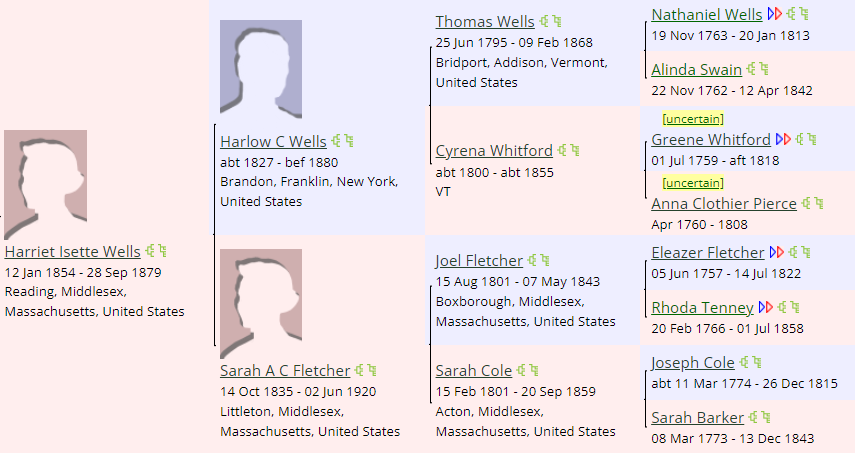
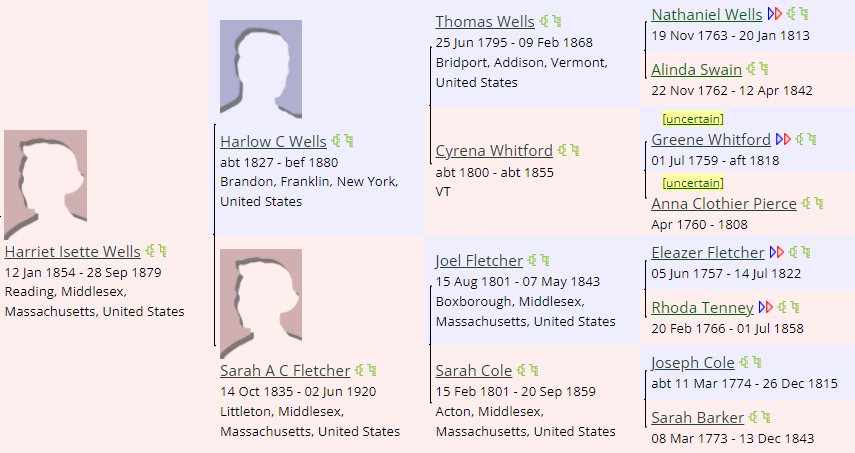
    An image of Hattie Wells's ancestor tree from her WikiTree profile
    Hattie Wells Hart’s WikiTree

    Hattie’s parents were documented well enough to assert that Harlow C Wells (1827–about 1880) was her father, but the documents we have tell us precious little about his life. Here’s what we know for sure:

    • His name – birth records for two of his daughters (Hattie and Nettie) give his name; he is recorded in the same household as them in two U.S. Census appearances.

    • His birth – all of the records that give Harlow’s birth date center on 1827 as the year, and list New York as the place. One record – Hattie’s Massachusetts death record – lists his place of birth in Brandon, New York.

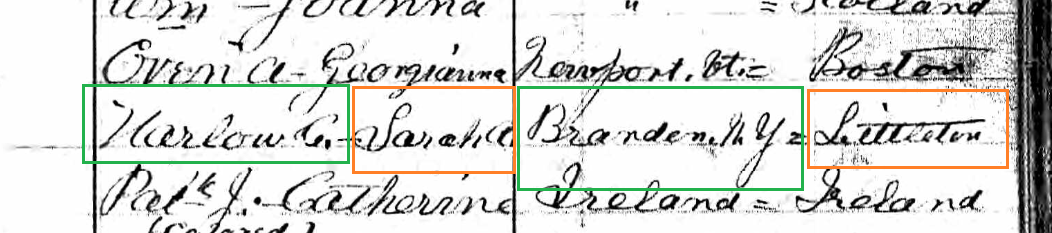
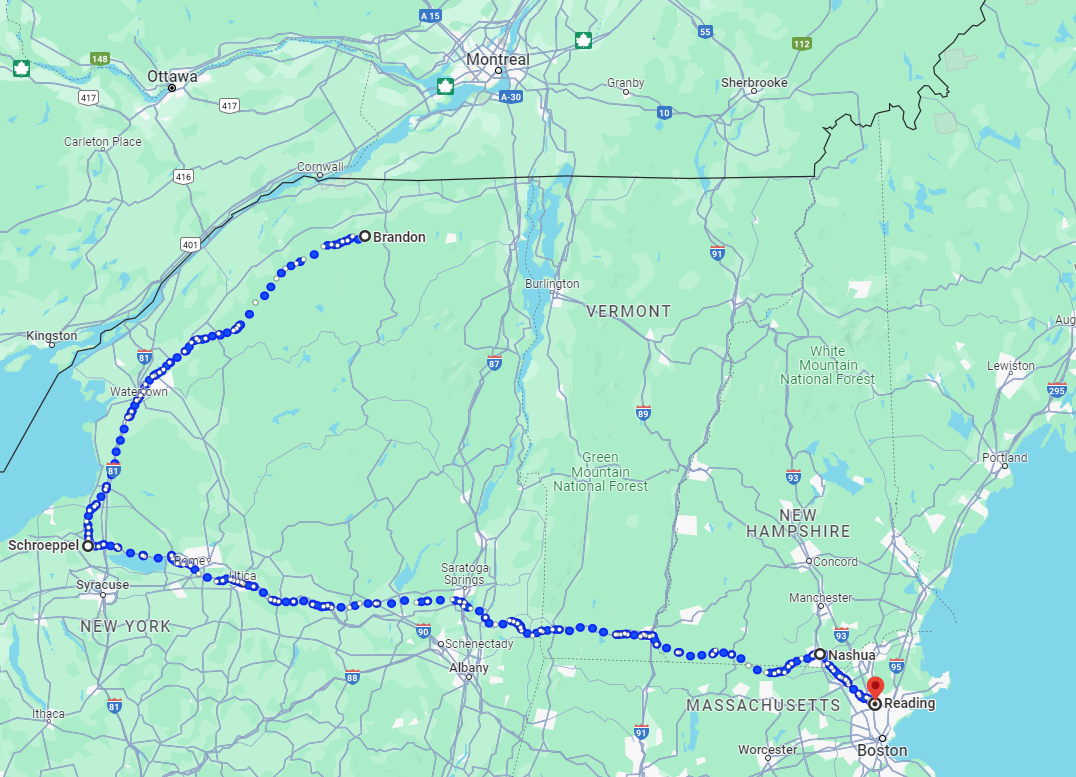
    Harlow’s earliest known record is the 1850 U.S. Census, which places him in Shroeppel, New York. He then married Sarah in Nashua, New Hampshire, in 1853 and settled down with her in Reading, Massachusetts, until at least 1865.

    Map of Harlow Wells life before 1870

    We are missing a big part of Harlow’s story by not knowing when or where he died. He clearly took his family to Fort Atkinson, Wisconsin – 1500 miles to the west, about halfway between Milwaukee and Madison – but even if you assume the family returned to Massachusetts by the time of Hattie’s 1873 wedding, that is a large gap for Harlow and his son Osborne (age 8 in 1870) to disappear into.

    But this particular brick wall isn’t completely blocking our path. Because Harlow’s name is attached to a Wells family that lived in Brandon, Franklin County, New York, beginning in 1824. Their profiles on WikiTree and FindAGrave didn’t lead directly to any documents that named Harlow – but we’re going to take a look at the evidence that is there and see what we can prove.


    This is the first shaky step we’ve taken in our journey – and I’m not 100% sure where it will lead. If you think you know, I’d love to hear from you!

    And don’t forget to subscribe to see where we go next.

  • A valentine for my surname

    A couple of weeks ago, I had some unexpected time off (thanks, persistent pandemic!) and since my brain was still functional, I decided to use that time to launch a One-Name Study for my surname on WikiTree. (This post is short because I want you to follow that link.)

    I did this because I’m selfish. My research into the life of my 5th-great grandfather, James Callin (c. 1750-c. 1816) suggests that he and his brother moved from Westmoreland County, Pennsylvania, to somewhere in Kentucky. As I cast about for evidence of James living in Kentucky, I keep finding Callin families who are clearly not James – in the general area around Mason, Campbell, Kenton, and Pendleton counties. Unfortunately, online records from before 1810 are sketchy.

    Keeping track of these unrelated families is difficult in Ancestry, and many of them may not end up being biologically connected to my family – so the logical choice is to put the research on a collaborative platform where others can contribute to or benefit from the work I’m trying to do.

    Now the trick is to figure out how to let the diaspora of Callan descendants know that the project is there.

    If you have any advice for managing something like this, I’d love to hear from you!

    And if you’ve found your way to this blog from WikiTree, be sure to subscribe so you can keep tabs on my progress!

  • Step 3 on our climb to Providence

    Last week, we examined the evidence supporting rung #2 in our ladder to Providence: Florence Mabel (Hart) Tuttle. This week, we take another step up

    .

    Harriet Isette “Hattie” Wells was born on 12 Jan 1854 in Reading, Middlesex County, Massachusetts, to Harlow C Wells (1827-c.1880) and Sarah Ann Fletcher (1835-1920). She grew up in Reading and Harvard, Worcester County, except for a brief period around 1870, when her father moved the family to Fort Atkinson, Jefferson County, Wisconsin. Harlow disappears from the record after that, so he may have died sometime in that decade, prompting the widowed Sarah to return to Massachusetts.

    There is strong documentary evidence for Hattie’s connection to her parents. Massachusetts Birth Records and the Massachusetts State Census for 1855 and 1865 show her living with her parents and give us a precise date of birth.

    The 1870 Federal Census was unusual in that the family was in Fort Atkinson, Wisconsin. Her father worked as a cabinet maker there. It is the last record I have found that shows her father at all, and it is the only record that indicates that Hattie had a younger brother, Osborne Wells.

    Hattie’s mother, Sarah, was back in Massachusetts by 1880, listed as “widowed” – and living with Hattie’s two younger sisters. Hattie married Seymour C Hart (1851–1934) on 25 Jul 1874 in Clinton, Worcester County, Massachusetts. Florence was their only child, born on 2 Nov 1874. She was five years old when Hattie died on 28 Sep 1879 in Clinton, Worcester, Massachusetts, after suffering from “Ulceration of uterus” – most likely a form of cervical cancer.

    We have Hattie’s death record, and as we mentioned last week, Florence went to live with Hattie’s mother. Sarah Ann (Fletcher) Wells has a well-documented life, as well. She married again after Florence was grown, and was known as Sarah McGown in her later years. She died in New Hampshire, where she lived with her daughter, Emma Leizer.

    There are still some mysteries to solve – I haven’t been able to trace the children of Hattie’s two sisters, both of whom married men named Leizer and moved to New Hampshire. And I’ve yet to prove whether her brother Osborne or her father survived Fort Atkinson. If you happen to be descended from any of these folks, I’d be thrilled to hear from you.

    Next week, we ascend one more rung and look at what we know about Hattie’s father, Harlow Wells. Subscribe to get updates as soon as they are published!

  • a quick overview of my work on this surname

    My mother-in-law’s paternal grandmother was Hildur Agda Leander (1886-1945). She wished you “Merry Christmas, from 1938” a few weeks ago – she’s seated between the Christmas tree and her husband, Arvid William Holmquist:

    The Holmquist Family, abt. 1938, Mahtomedi, Minnesota

    Hildur was the daughter of Gustav Leander and Ingeborg Swedahl, born on 18 Dec 1886, probably in Brooklyn, New York, and was baptized on 19 Feb 1893 in the Christ Lutheran Church in St Paul, Minnesota.

    Gustav and Ingeborg were immigrants who married in New York about 1884, not long after arriving from Sweden and Norway. Gustav was born in Gothenburg, Sweden, and Ingeborg in a village called Byneset, Norway. Their first two children were born in Connecticut and Brooklyn, New York, respectively, and the family had moved to St. Paul, Minnesota, by 1888. We don’t know what happened to Gust; the 1913 City Directory for Saint Paul lists everyone in his family living at 1019 White Bear Ave, except for “Gust M”, who it says “moved to Tacoma Wash”. Ingeborg is listed as “divorced” and living with Hildur and William Holmquist in Lincoln Township on the 1920 Census, but the rest of Gust’s biography is a mystery.

    Fortunately for us, there are good records in Sweden that tell us about Gust’s origins. His parents were Mårten Persson Lenander (1833–1896) and Augusta Charlotta Gustafsson (b. 1833), and he had three siblings: Arthur, Norma, and Agda (who died at one year of age). Swedish “Household Clerical Surveys” from the late 1800s give us some insight into where the family lived – but after Gust emigrated, and Mårten died, it isn’t clear what happened to Augusta.

    There are a lot of unanswered questions to look into for each of these individuals. I’m pretty sure Arthur emigrated to the U.S., but if he did, he used a middle name (William) and the surname “Lenander” instead of “Leander.” Norma appears to have emigrated to Chicago, but she died back in Gothenburg. There are small disagreements between the records that might be nothing – Mårten’s birthdate is sometimes recorded as “20 May” and sometimes as “29 May” – or might indicate that I am mixing up records from multiple families.

    I always hope to hear from potential distant cousins who might recognize the family I am researching – be sure Contact Mightier Acorns.

  • Step Two on the Ladder to Providence

    Last week we took a close look at the records that provide supporting evidence for what we know about my maternal great-grandfather. This week, we will review the evidence for his mother:

    Florence Mabel Hart married John Jackson Tuttle on 28 May 1891 in Succasunna, Morris, New Jersey. She was the daughter of Seymour C Hart (1851–1934) and Hattie Isette Wells (1854–1879), born on 2 Nov 1874 in Clinton, Worcester County, Massachusetts. Her mother died when Florence was 5 years old, and she went to live with her grandmother: Hattie’s mother, Sarah (Fletcher) Wells, also in Clinton, Massachusetts.

    My grandmother, Albert (Tuttle) Clark, seemed to think that her grandmother, Florence, was called “Lovey” by her family; and that’s possible. John and Florence also named one of their 12 children Florence, and the nickname may have been passed down to her.

    We have pretty solid evidence for all of Florence’s major life events. We can see her with her family in all of the expected Census records, beginning with the 1880 Census when 5-year-old Florence lived with her grandmother and two 20-something aunts, Emma and Nellie. The available Massachusetts Town and Vital Records give us her parents’ names and her birthdate.

    Florence was an only child, and she doesn’t seem to have grown up around other children. Her father did remarry, but not until 1890; Florence married the following year, and the older of her two half-siblings, Charles, was born the year after that.

    Records are scarce for the period between the 1880 and 1900 Census, so Florence might have moved back in with her father at some point; if he moved to New Jersey for business and took his young daughter with him, that would account for them being in New Jersey in the late 1880s.

    But other than some of these gaps, I feel confident asserting that Florence takes us up one more solid rung on the ladder we are building. If you’re descended from any of her 12 Tuttle children, or her half-siblings, Charles Hart or Harriet (Hart) Schaub, drop a note!

  • a quick overview of my work on this surname

    Vicie Clark was something of a mystery to me for a long time. I only recently found records that tied her to her parents – but from there, I’ve been able to assemble a lot of information about her siblings, cousins, aunts, and uncles.

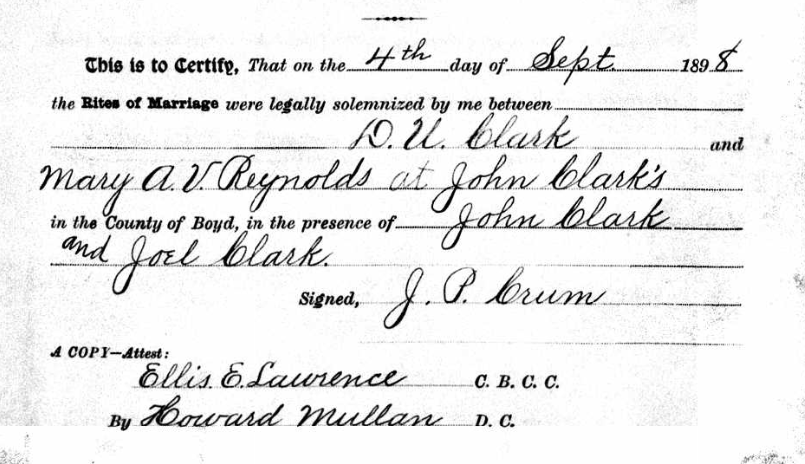
    Mary Ann Viceroy “Vicie” Reynolds was the third child, and only daughter, of Rev. James Thomas Reynolds and Mary Francis May, born on 27 Jul 1879 in Lewis County, Kentucky. Her father and both her oldest and youngest brother were all Baptist preachers. Vicie married David Ulysses Clark on 4 Sep 1898 “at the home of John Clark in Oakview” in Boyd County, Kentucky.

    Clark-Reynolds marriage certificate, 4 Sep 1898 (Ancestry link)

    One reason that I found it so difficult to break through and make progress with Vicie’s family is the fact that she came from a couple of large families in a three-county area which intermarried and preferred very common names. Her grandparents’ surnames were: Reynolds, Arthur, May, and West. The May families and the West families, in particular, turn up a lot in each others’ family trees. For example, Her father and his brother, John Harold Reynolds, married May sisters. Vicie’s oldest daughter (my grandpa Russ’s sister) Opal married an Arthur, as did Vicie’s brother-in-law, James Sylvester Clark. Two of David Clark’s other siblings married Mays, and their mother’s mother was Jane West.

    If you found that paragraph to be confusing, I sympathize.

    I’ve only been able to take the Reynolds line back to Vicie’s grandfather. Reuben Reynolds was born about 1820 in either Virginia or North Carolina. He married Martha Arthur (add her to the list) about 1850, and they farmed and had two sons in Greenup County, Kentucky.

    One day, I hope to trace them back beyond the United States, but for now, there are plenty of cousins in Kentucky to sort out. If you’re one of them, say hello!

    And be sure to subscribe so you see all of the updates.

  • Step One, in which our heroes begin their journey

    Nearly nine years ago, I spent a small amount of time exploring my maternal grandmother’s side of the family, and I fell into a rabbit hole. What I found led to an ancestor1 who settled in Providence, Rhode Island, and founded the First Baptist Church there along with Roger Williams and 11 other charter members.

    I was very excited by this, and I spent some time learning about that 11th-great grandfather and drafting a post for my blog. The trouble is that this particular palm tree did not have a lot of substantial evidence supporting each connection – but at that time (2015) I was just beginning the major project that would become my Callin Family History (available for purchase at that link if you are inclined to own 800 pages of my work), so I did not take the time to investigate.

    We’re going to take the time to investigate now. Week by week, we will build a ladder up the side of that proverbial palm tree, and inspect each family for evidence and records as we work our way back to the mid-1600s and the Providence Plantations.

    The caveat here is that someone likely took a shortcut or made a mistake when they built the unsupported online tree that I found in 2015. At some point, I expect to discover that I’m not related to this ancestor at all – or that I am through some more obscure relationship than “direct ancestry” – and when that happens, I’ll show you the mistake, and we’ll figure out what the real story is together.

    But, we’ll burn that bridge when we come to it.

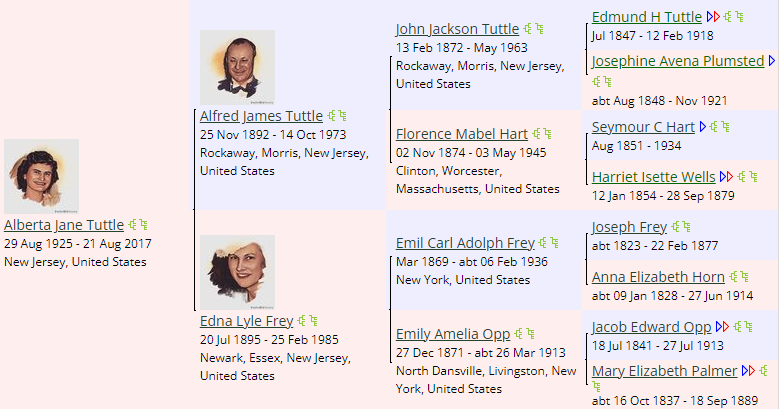
    Today, we begin with the lowest rung on the ladder: my maternal great-grandfather, Alfred Tuttle.


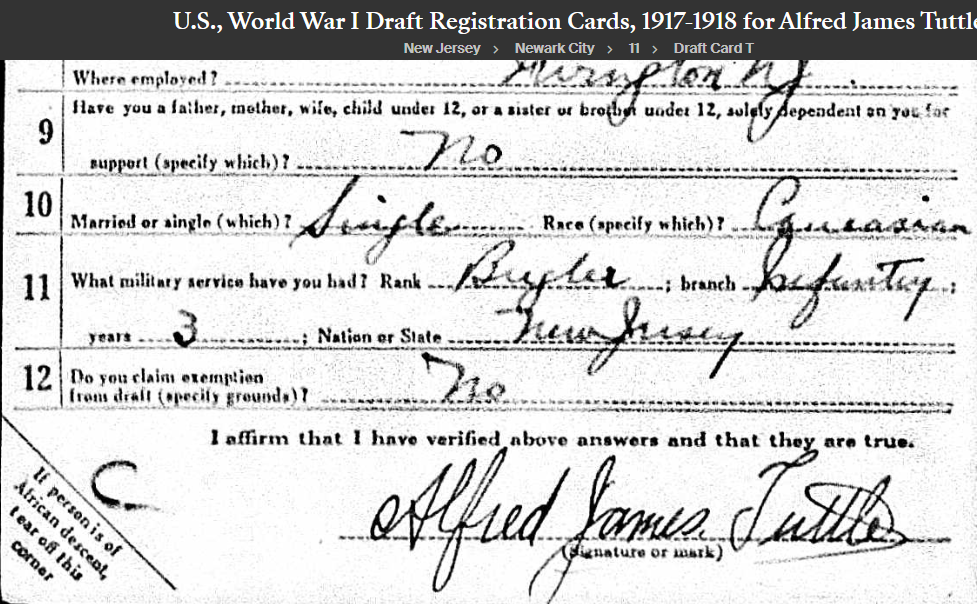
    Alfred James Tuttle was the son of John Jackson Tuttle and Florence Mabel Hart, born on 25 Nov 1892 in Rockaway, Morris County, New Jersey. Alfred was the oldest of 12 children, and John supported his large family by working as a machinist and mechanic. During World War I, John worked as a tool-maker for the International Arms and Fuze Company in Bloomfield, New Jersey. Alfred registered for the draft on 5 June 1917 and indicated that he had already served 3 years as a bugler in the New Jersey Infantry.

    Alfred’s WWI Draft Registration on Ancestry

    Less than two weeks later, on 27 Jun 1917, Alfred married my great-grandmother, Edna Lyle Frey (1895-1985).

    The records that we have do a pretty good job of “proving” all of this, and they are the sort of records that most people should have easy access to. U.S. Census records show young Alfred and his siblings living with his parents; Social Security and World War records document full names and birth dates; and they were members of the First Reformed Church (a Dutch Reformed Church) in New Jersey, which has records of most of their major life events.

    Alfred died in New Jersey when I was less than a year and a half old, and I wouldn’t expect to have any memory of him, but my mom and grandma told me about him when I was growing up.

    Conclusion: this is a pretty solid connection – and a very good place to start our climb.

    As always, I encourage you to take a look at the WikiTree profiles I’ve made for the folks in this post. Let me know if you’re a cousin – I’m pretty sure I know all of my 1st and 2nd cousins (everyone descended from Alfred and Edna) but say hello just so I know you’re reading!

    And if you want to follow along as we ascend this particular ladder: Subscribe!

    1. Spoiler: what I found only suggested he was an ancestor. This series intends to investigate that possibility! ↩︎