Tad Callin has been working on family history and genealogy since the late 1990s. He does most of his research on Ancestry and posts what he learns to WikiTree.
In which we arrive in a world full of Johns Green(e)
For nearly ten years, I have held onto the notion that I was descended from one of the founders of Rhode Island – a surgeon named John Greene. I was very excited about the idea, and the research I did on his biography became one of my more detailed essays, Foundation Found, Providence Provided, on the original Mightier Acorns blog.
But, now I have finally done the legwork. And boy, there were a lot of men named “John Greene” in colonial Rhode Island.
I am also not related to this John Green.
The journey to get here has been tricky. We have looked at more than 10 generations of my ancestry, beginning with my great-grandfather, Alfred Tuttle. Along the way, we saw families that struggled to carve out lives in cold and remote parts of what was then the frontier of America. They lived next to significant places from American history, and they might not have left a lot of records behind, but what they did leave behind brought us this far.
And now, we have reached a point where I can go no further. Martha Greene married Joseph Matteson, and the record says her father’s name was John (Greene):
“Rhode Island, Town Clerk, Vital and Town Records, 1630-1945,” database with images, FamilySearch; various city archives, Rhode Island.
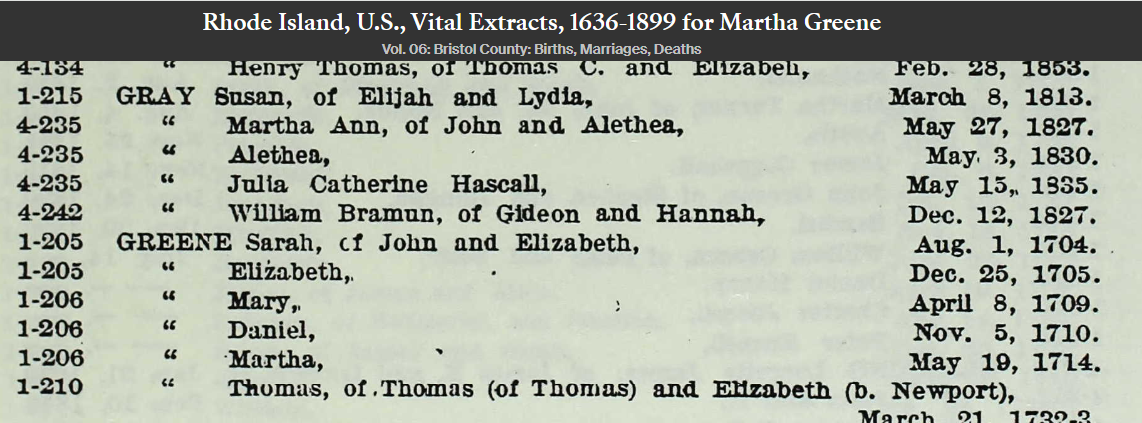
Further digging through the Rhode Island vital records reveals the birthdates of what are most likely Martha’s siblings, as well as her mother’s name:
Arnold, James N. “Record of Rhode Island, 1636-1850; 1st Series, Births, Marriages & Deaths” Providence, R.I., USA: Narragansett Historical Publishing Co., 1894.
Note that these children’s births were recorded in Bristol County, while the other Greene and Matteson families we’ve been looking at were in East and West Greenwich, Kent County. In my original essay, I accepted the flawed evidence that showed my John Greene was the son of James Greene (c. 1626-1698), who in turn was the son of John Greene, surgeon. That particular James Greene had two sons called John – one of whom likely died young, and the other who married Mary Increase Allen (not Elizabeth) and whose children do not match the list of children belonging to our John Greene.
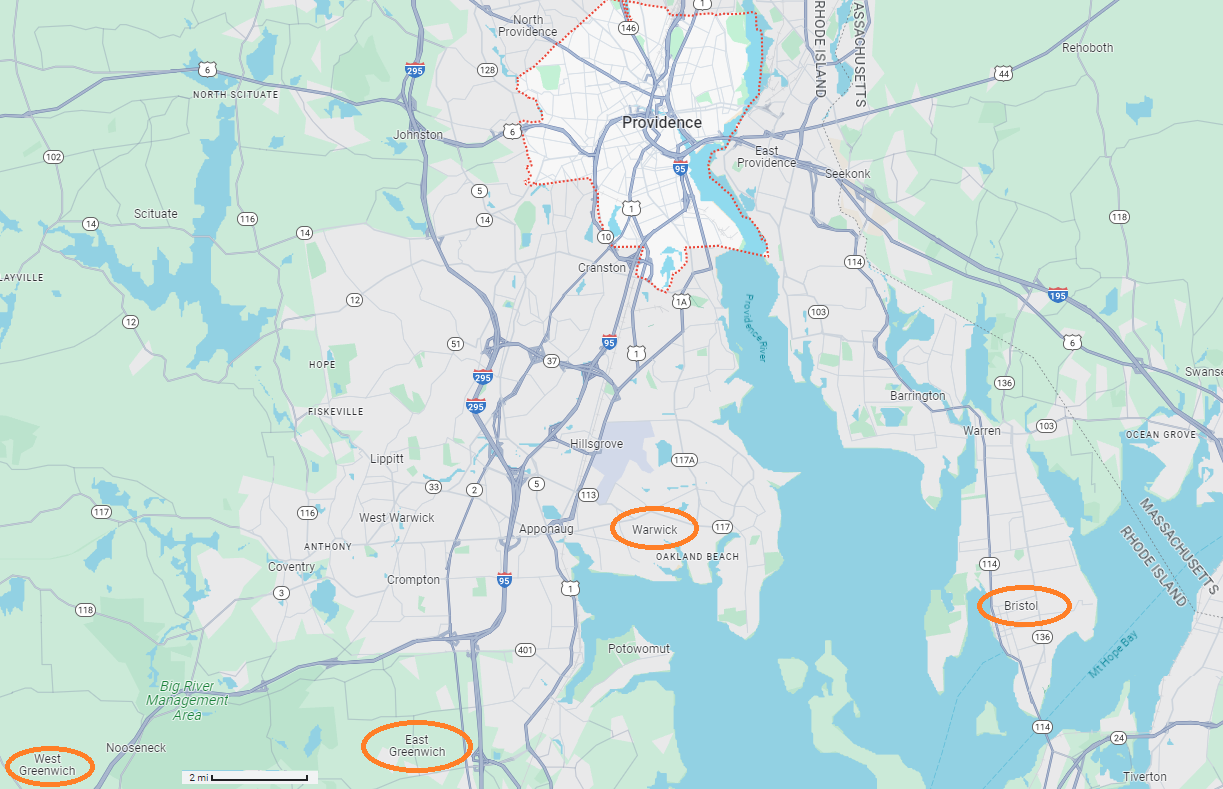
Here is a look at the area where we have found records for all of these Greene and Matteson families:
Providence, RI, and the pertinent towns to the south
It is possible, but not likely, that we will be able to find the answers we’re looking for – but not without digging through primary sources and finding more clues. Other researchers who have looked for this family have settled on this conclusion for John Greene (abt. 1679-1747):
His origins are unknown at this time. He doesn’t fit into any of the Puritan Great Migration Rhode Island arrivals, those John Greene’s are ‘all spoken for’. Ship passenger lists, land and probate records after 1641 need to be researched to see if he can be further identified. Because this is a Pre-1700 profile, and because of his common name, primary source vital records are needed to establish a credible ancestry.
For now, we have arrived at the top of our ladder to Providence. We did not prove what I set out to prove, but we at least arrived in the right town. Along the way, we learned a lot and improved a lot of WikiTree profiles.
There is a certain amount of frustration involved in having to let go of a misimagined story that you have shared and invested in for a decade. But I don’t think it’s a mistake to imagine a goal or a story when you’re at the bottom rung of your ladder. The story can motivate you to find more information. Imagination can help you make sense of the clues, and when you are stuck with potential gaps – as we were when we needed to connect Harlow Wells to his grandfather, Greene Whitford – imagining his story helped us bridge those gaps.
Just be ready to let go of your story when the evidence reveals the gap between facts and imagination.
At the risk of sounding pleased with myself, I wanted to share some of the habits and organization that go into this newsletter. Folks new to writing often start a project like this only to tire of the constant deadlines. They may feel like they’ve run out of things to say after only a few posts. Making certain strategic choices early on will help avoid that kind of exhaustion.
This Substack newsletter is only about half a year old at this writing, but I have been doing some sort of weekly writing since the early 2000s – much of it related to family history. This is how I tackle the big project:
Set the Tone
The hardest part of any creative activity is facing the blank page.
If you hope to produce something with any regularity, you need to figure out how to inspire yourself to fill that page on a schedule. I am writing about two things: Genealogy and Family History. They are related1, of course, but they are different disciplines, and most of my posts draw their narrative from fusing the two.
Either of my chosen topics can get super-dry if I approach them academically. Simply writing out lists of ancestors or reciting names, dates, and places isn’t fun for the writer or the reader. (Besides that, WikiTree or FamilySearch are better platforms for building an online tree.) But whether you are new to this or have been doing it for years, something grabbed you about the research and excites you enough to keep digging. Whatever that something is, use that as your starting point for generating story ideas.
Any time you hear yourself muttering, “Well that’s interesting!” you’ve got a story idea. Write it down.
Map Your Route
Once you have ideas, they need a framework and a schedule.
I decided when I started that I wanted this newsletter to be primarily a genealogy project. Everyone I write about is related to me in some way, and the individual posts are organized around that – talking about how we are related, discussing the evidence that shows the relationships, my research and analysis methods, and the resulting family histories that come out of that research are all up for discussion.
I also decided that I could handle publishing two posts a week and that the individual posts should aim for a 500 to 1,000-word limit. (For me, it is hard to stay under 1,000 words in any context. Ask my former supervisors.)
Those decisions gave me some “rules” for structuring my calendar.
Try to balance my subjects by not writing about the same “side” of the family twice in a row.
Serialize big ideas – this will help with “giving myself space” and spreading out the amount of work necessary in a given week.
Try to balance between “biographical” stories and “research drama” stories – sometimes they blend well, but when they are distinct, spread them out.
Give Yourself Space
For Mightier Acorns, I use my drafts as my “idea list” – currently, there are 24 “drafts” in various stages of composition sitting in my queue. I also have the next 7 posts scheduled – which gives the anxiety monster and the procrastinator inside me enough space to work on the 24 drafts and begin putting them on the schedule.
When I launched this newsletter, I took advantage of some of the better pieces from my “back catalog” at my previous blogs, cleaned them up a little bit, and put them into that drafts folder. If you don’t have a back catalog, consider holding off on launching your project until you have 3 to 6 weeks’ worth of posts polished and ready to schedule.
As of Christmas, I had finished posts scheduled through the beginning of March. Nine of my 50 posts have been recycled favorites, and the first 16 Family Reunion posts were easy to pull together. Serializing what began as an idea for a very large single essay, “Climbing the Ladder to Providence,” gave me 11 posts in total, which bought me more than 13 weeks in which to research, compose, and edit – while maintaining my two-post-a-week pace. (If you subscribe now, you’ll get the 11th and final post in your inbox on Friday!)
The point is to avoid having nothing for your readers to read while also not stressing yourself out or scrambling to put something/anything together at the last minute. A healthy buffer will keep this labor of love from becoming a burden.
Editors Are Your Friends
If you have a partner you trust who wants to read your drafts and help with copy-editing, let them help.
If you don’t have an editor, take some time each week to read the posts you have scheduled with a critical eye. Regular readers may cock an eyebrow and say, “But, your posts are riddled with errors and awkward wording.” And that’s because I do my best, but mistakes are inevitable. I use Grammarly’s free service to catch big errors, and I spend an hour or so each Sunday going over the two posts in the queue for that week – but I’m only human.
But if you have someone else to review your work, be open to their feedback. They will tell you to change things you might not want to change – and it is up to you to find the balance between having enough humility to see things their way and enough confidence to fight for what is important to you.
No matter what, strive to be gracious when someone is kind enough to offer help.
Yeah, So…
In yoga practice, you are told, “Set your intention for your practice.” I like the explanation “…intention is usually recognised as the practice of bringing awareness to a quality or virtue you’d like to cultivate for yourself.”
During yoga, you stretch muscles and connective tissue to release tension and improve your flexibility. In your writing, you stretch your mind and seek to connect with your readers – hopefully expanding what they know. Both take effort and discipline but also require patience and forgiveness.
If you set reasonable limits, give yourself room to let artificial deadlines slip, and establish a loose plan with the freedom to generate new ideas, you should be able to look back after a few months and realize, “Wow – I did a lot of work, a little at a time.”
They can be tricky – leading to a really long post today
Alice Matteson married Thomas Whitford on 9 Jan 1752 in West Greenwich, Kent County, Rhode Island. We know this from the marriage record which was documented in the 21-volume Rhode Island, U.S., Vital Extracts, 1636-1899, compiled by James Newell Arnold and published from 1891–1912.1
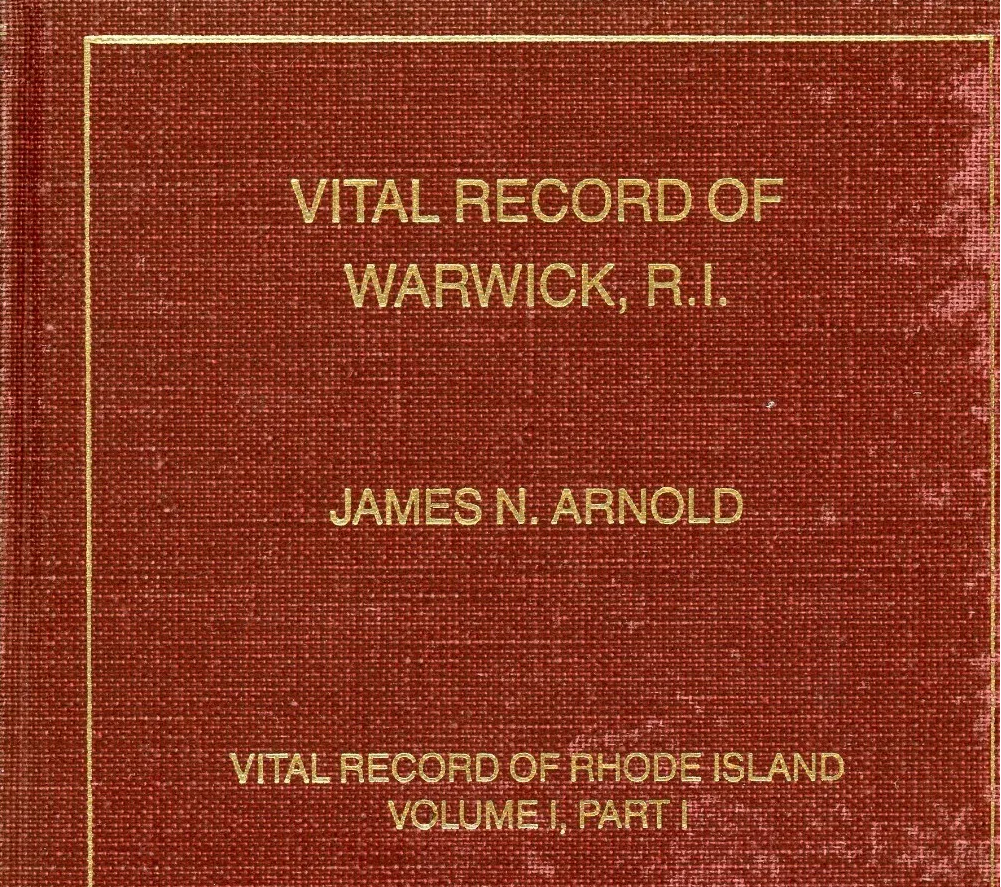
One of many book covers published by James N. Arnold
Arnold organized the original vital records for Rhode Island by town and condensed each record into one or two lines, depending on how much information was recorded on the original record. He sorted the marriage records within each town by the bride’s surname and the groom’s, so those appear twice. In the West Greenwich section, in the W’s, among the other Whitfords, you find:
1-83 [Whitford] Thomas, of Pasco, and Alice Matteson, of Joseph; m. by Jeremiah Ellis, Justice, Jan. 9, 1752.
And in the M’s, with the Mattesons, you find:
1-83 [Matteson] Alice, and Thomas Whitford, Jan. 9, 1752.
Arnold does warn in his introduction that “nothing beyond the book and page of the original Town Record, the names and the date are given when the bride is placed first. That under the groom the notes are so extended as to include all the items of the record from whence it is taken. The reader will therefore consider the bride being placed first as merely an index for him to consult the other entry.”
Arnold’s work is a good example of a reliable secondary source – these aren’t the original records. Still, if you don’t have access to them (and if you pay attention to Arnold’s introduction) this should be a useful tool for documenting these family connections.
Now what?
Finding Joseph Matteson
Considering how many Whitford and Matteson families are in West Greenwich, it stands to reason that we should look for Alice’s parents in nearby Rhode Island locations. A search did turn up another secondary source: The Genealogical Dictionary of Rhode Island compiled by John Osborne Austin in 1887. Page 132 gives us a picture of three generations of Mattesons.2
Henry Matteson (1646-~1690) and Hannah Parsons appear in a column on the left, their children are listed in a large central section, and their grandchildren (where known) are in a column to the right, lined up with their parents’ entries. I’ve pulled out the information you need in this outline:
I. Henry Matteson (d. 13 Apr 1752) and Judith Weaver (d. 1751) – dau. of Clement Weaver
10 named children
II. Thomas Matteson (d. 19 Jan 1740) and Martha Shippee – dau. of David and Margaret (Scranton) Shippee
6 named children, including:
4. Joseph Matteson (b. 1 Jul 1705)
III. Joseph Matteson (d. 1758) and Rachel (no further info)
1. Joseph Matteson (b. 22 Mar 1707)
(III.) Joseph and 2nd wife, Martha (died after 1757; no further info)
5. Alice
Take note: there are three men named Joseph Matteson in this chart:
Jospeph “III.” – son of Henry (no birthdate reported).
Joseph “1.” – son of Joseph, born on 22 Mar 1707.
Joseph “4.” – son of Thomas, born on 1 Jul 1705.
Austin’s 1887 “Genealogical Dictionary” predates Arnold’s register of vital records by at least four years, so Austin’s information probably comes from the primary sources. We see Alice Matteson listed, and now we have the names of her father and mother – Joseph “son of Henry” Matteson and Martha.
Looking for more information, I came across two more interesting sources that add to what we know about Joseph “son of Henry”:
History and genealogy of a branch of the Weaver family3 tentatively claims that Judith Weaver is the daughter of Clement Weaver (1647-1691) and wife of Henry Matteson, above (“I. Henry Matteson (1646-~1690)”). It then includes this brief mention:
“VII. Rachel, b. Dec. 24, 1684; m. Joseph Matteson (Henry). He was a brother of her sister Judith’s husband. CHILD (Matteson): I. Joseph, b. March 22, 1707.
Rachel’s birth in 1684 suggests that her husband and his brother were probably born close to that same year (within reason). Then, more helpfully, Ancestry and descendants of William Curtis of Marcellus, N.Y.4 named Joseph as the third child of Henry and Hannah Matteson:
“iii. JOSEPH, d. 1758, m. Ist, Rachel –, 2nd., Martha Greene.
Now that we have Martha’s surname, we can look for sources that mention her, and what a find that uncovers! According to The Greene family and its branches from 861 to 1904 by Lora La Mance (emphasis mine):5
“MARTHA GREENE-MATTESON. She was married 10 days before her brother, James Greene, being married to Joseph Matteson May 8, 1727. He was her mother’s first cousin, and had at that time a grown son by his first marriage. Had nine children. Of Obediah, Elizabeth, Thomas and Eunice I have no records. Martha’s line is a most extensive one, and cannot be given as fully as I would wish, from lack of space.”
(excertped from the biographies of Martha’s children:) –ALICE MATTESON-WHITFORD, wife of Thomas Whitford, her cousin. Line inter-married with the Tarbox branch later.
Based on this book, the work to connect Alice (Matteson) Whitford to the surgeon John Greene is already done. All we need to do is look for primary source records to confirm that. Except…
Not So Fast, Cousin
“Wait a second, Tad,” you might be saying. “Some of this information doesn’t add up. If Joseph’s first wife was born in 1684, and her sister married his older brother, wouldn’t he be too old to marry Martha and father eleven children…?” Probably. It’s good that you’re being skeptical. Let’s take a look at that 1727 marriage record.
Back in Arnold’s “Vital record…” this time in East Greenwich, we find bride and groom records for:
1-8 [Matteson] Joseph, of Thomas, and Martha Greene, of John; m. by Thomas Spencer, Justice, May 8, 1727.
That simple statement of fact contradicts those earlier secondary sources and calls their other facts into question. Further digging reveals that genealogist H. Porter Matteson addressed the discrepancy between the Rhode Island vital record identifying Joseph’s father as “Thomas” and these other family histories confusing him with his uncle, as shown above, in his 1938 manuscript, Mattesons in America.6
Simply Stated
Matteson’s work in 1938 points out many flaws in earlier works that focus on the Greene and Matteson families in Rhode Island. My own research seems to suggest that several of these family histories referred to the Austin Genealogical Dictionary of Rhode Island (some cite him specifically) and either did not refer to Arnold’s later, more authoritative Vital Record or simply did not notice the “of Thomas” in Joseph Matteson’s marriage record.
But take some notice of the fact that I wouldn’t have found my way to the 1938 Matteson book without those flawed sources to follow. It would be irresponsible and unhelpful to throw out works that have these kinds of errors and hide them from view. But now our job as researchers is to document what the errors are, and leave our work correcting them for others – the way Matteson did.
Unfortunately, The Greene family and its branches from 861 to 1904 is a widely available, frequently re-published work. It is engagingly written, includes a lot of colorful commentary about the relationships between the families, and some poetry from the author. Matteson’s work is a typewritten manuscript, hard to read, written with cryptic abbreviations, and not available in any kind of attractive hard copy options.
You can see how I addressed this problem if you look through the Research Notes section of Alice (Matteson) Whitford’s WikiTree profile. I also linked the WikiTree source page for The Greene family… back to the Matteson work and updated the Errata section.
To Sum Up:
We only have one solid primary source that connects Alice to her mother, Martha Greene – but we have a lot of context from secondary sources, including her father’s will (which was misattributed to an uncle of the same name).
And we have a clue connecting Martha Greene to her father, who bore the incredibly unique name, “John.”
Austin, John Osborne, 1849-1918, The genealogical dictionary of Rhode Island: comprising three generations of settlers who came before 1690: with many families carried to the fourth generation, J. Munsell’s sons, Albany, 1887, page 132.
Weaver, Lucius E.; History and genealogy of a branch of the Weaver family, Rochester, N.Y.: DuBois Press, 1928; Provo, UT: Ancestry.com Operations Inc, 2005; page 69 – accessed 12/31/2023.
La Mance, Lora Sarah Nichols (1857-), Stowe, Attie A. Nichols (1843-); The Greene family and its branches from 861 to 1904; Mayflower publishing company, Floral Park, N.Y., 1904; Collection: The Library of Congress, pp. 120-121.
Ida was born in Ackley, Iowa, and married a Dutch immigrant named Bernard Blom on 21 Nov 1885. You may recall reading about Bernard’s family in an earlier post if you need a refresher:
Ida Slight’s story begins with her grandfather, Jan Harms Sligt, who was born about 1798, in what was then known as the County of East Frisia (or “Ostfriesland”) within the Kingdom of Prussia. We know from their children’s records that Jan married Antje Martens, and we can guess they were married about 1823. They had three children: Hilke (b. 18 Sep 1824), Marten (b. 17 Jan 1828), and Johann (b. 28 Nov 1834).
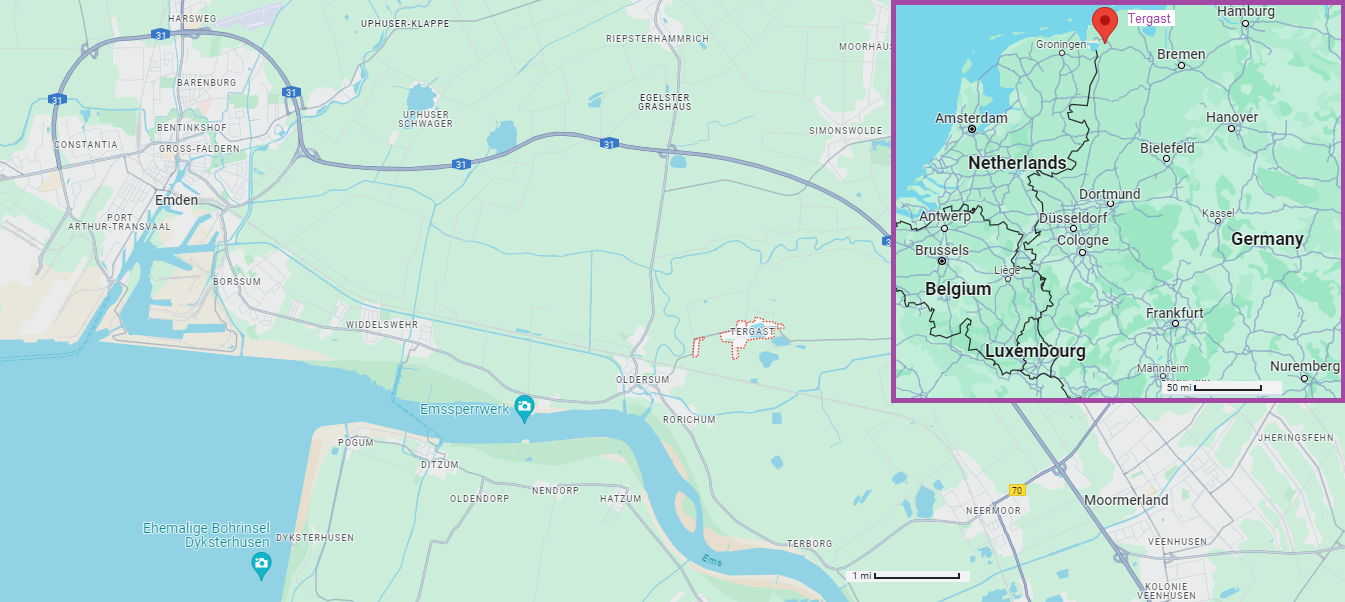
The political climate at that time was turbulent. The records we have say the Sligt family lived in the village of Tergast, which is located a few miles east of the city of Emden. Emden had been annexed by Prussia in 1744, some 54 years before Jan was born. It was then captured by French forces in 1757, during the Seven Years’ War, and by Anglo-German forces in 1758. In 1807, when Jan was about 9 years old, East Frisia was added to the Kingdom of Holland, which had been created by Napoleon Bonaparte a year before to control the Netherlands. After Napoleon’s downfall in 1815, East Frisia was transferred to the Kingdom of Hanover, which was officially ruled by George III, the king of England.
Tergast (center) in relation to Emden. inset: Tergast within modern Germany
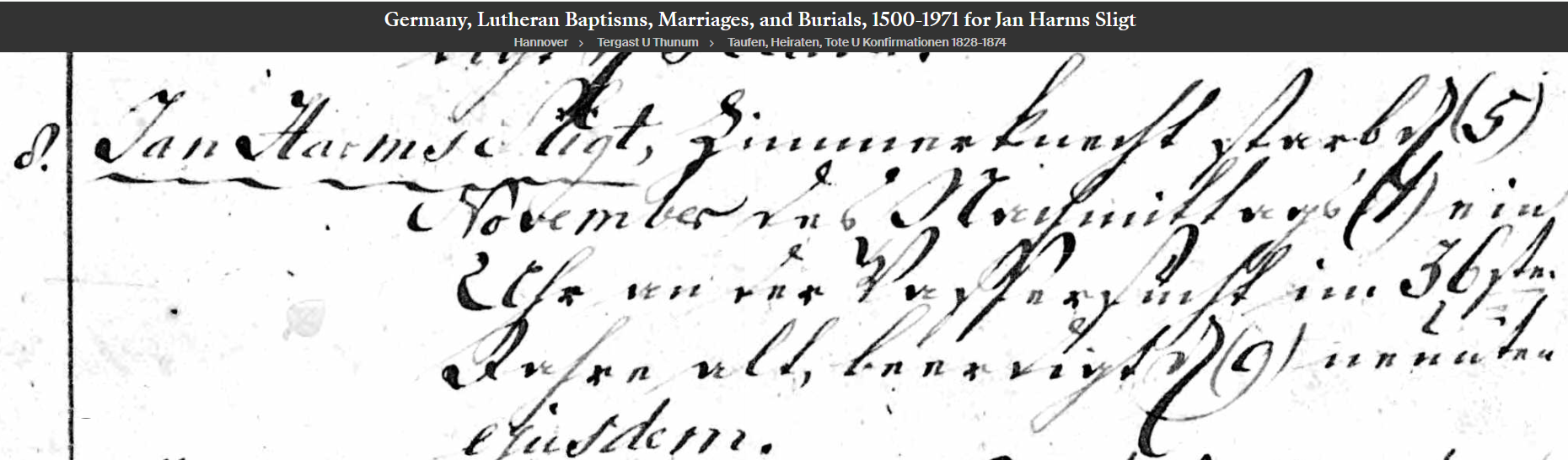
I suspect that there might be more records to find – from Prussia or the short-lived Kingdom of Holland – but the records I do have appear to have come from Lutheran church records in the Kingdom of Hanover. From Jan’s death record, we know that he was a carpenter (“Zimmerkunsst”) who died on 5 November 1834, just a few weeks before the birth of his youngest son, Johann.
Jan Harms Sligt record from Germany, Lutheran Baptisms, Marriages, and Burials, 1500-1971, Lehi, UT, USA: Ancestry.com Operations, Inc., 2016.
(If you can read old German script, please feel free to flex your superior skills and drop a translation of this record in the comments. The first contributor to do so wins a free subscription to this newsletter and the title to the Kingdom of Holland1!)
Jan’s death left his widow, Antje, to raise ten-year-old Hilke, six-year-old Marten, and infant Johann on her own. This probably meant that they relied on the support of their church, which would most likely have been the General Diocese of Aurich, part of the state church, the Evangelical-Lutheran Church of Hanover.
On 11 May 1851, Hilke married Christian Berends Freese (1816–1890), becoming his second wife and stepmother to his two daughters. Christ’s first wife was Hilke Emmen Garrelts, who died in 1848. They lived in Needermoor, a few miles southeast of Tergast.
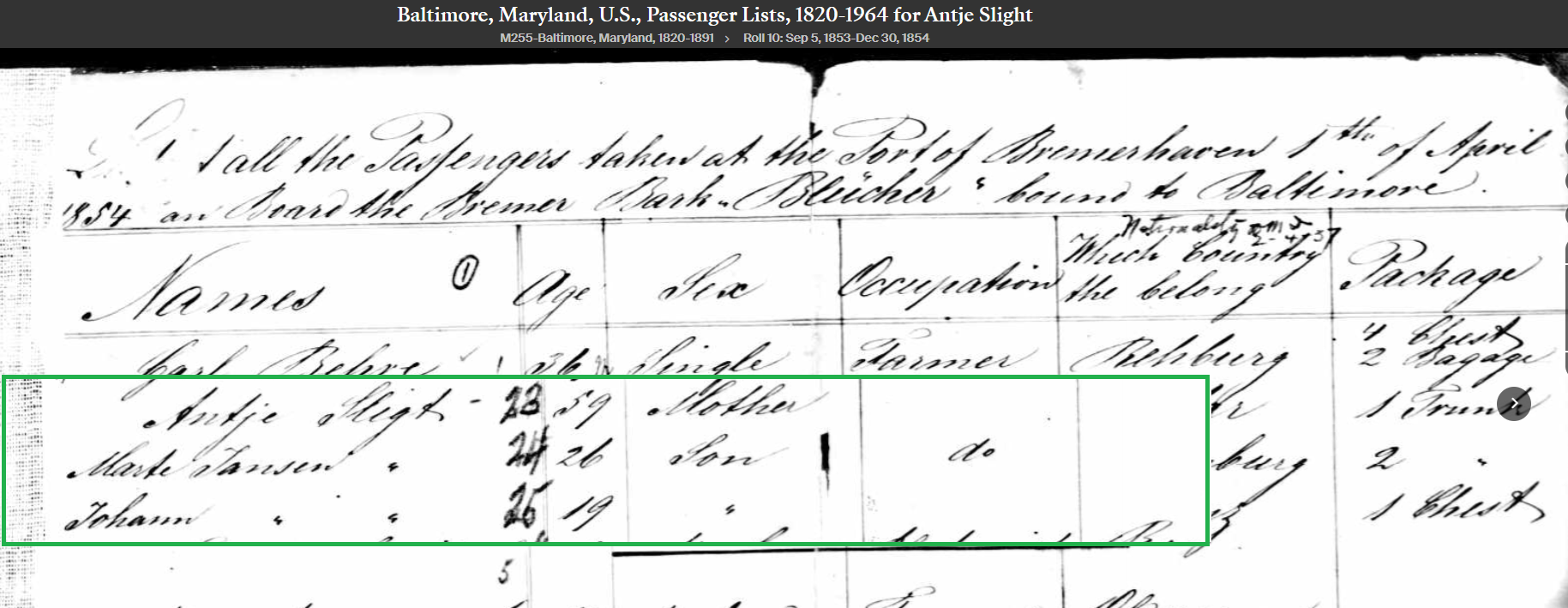
On 24 May 1854, Antje, Marten, and Johann Sligt arrived in Baltimore, Maryland, aboard a bark (a sailing ship) called the Blücher. Hilke and her family appear to have come over the same year, though I have not found immigration records to confirm that, yet. After living in Illinois for several years, they all settled in Iowa during the 1860s – some in Grundy County, and some in Hardin County.
With a slight change in spelling,2 “Johann Sligt” became “John Slight” – and he married another recent immigrant from the former East Frisia. Frauke Margrette Swidden (or Sweeden) and John Slight were married in Ogle County, Illinois, on 23 March 1856. They lived in Grand Detour in 1860, and their daughter, Anna, was born in Illinois on 28 March 1862. They moved to Iowa soon after that, as their second daughter, Ida, was born in Ackley, Hardin County, Iowa, on 24 July 1863. Their youngest daughter was born in Hardin County on 22 Jun 1866, and they named her Hilke.
All three of John and Margrette’s daughters were named in honor of a relative: Anna was named for John’s mother, “Antje,” which was probably pronounced like “Anya” to our American ears. “Ida” was named after Margrette’s mother, who was born “Itje” and began spelling it “Ida” when she immigrated to America. Obviously, “Hilke” was named for John’s sister.
Ida Slight had no brothers, but she did have five male cousins, the sons of her uncle Marten. So if your family traces back to the Slights who lived in Grundy and Hardin Counties in Iowa, Ida’s descendants might just be your cousins.
If you would like to learn more about what the trip over might have been like for the Sligt family, check out Rainey Mitchell’s piece describing another German immigrant’s journey from Emden in 1848:
We began climbing our ladder to Providence with my great-grandfather, Alfred Tuttle. Our goal was to examine the available evidence connecting each generation of his ancestry back to the founding of Providence Plantations, Rhode Island.
Rung 1: Alfred Tuttle to his mother, Florence (Hart) Tuttle. Confirmed with records.
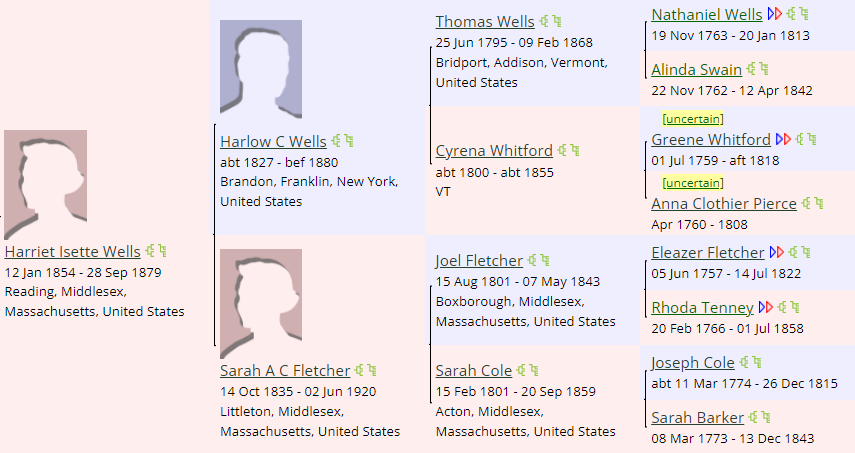
Rung 2: Florence Hart to her mother, Hattie (Wells) Hart. Confirmed with records.
Rung 3: Hattie Wells to her father, Harlow C Wells. Confirmed with records.
Rung 4: Harlow C Wells to his mother, Cyrena (Whitford) Wells. Tenuous connection; documents don’t directly confirm the relationship, but clues do support it.
Rung 5: Cyrena Whitford to her father, Greene Whitford. Weak support from available evidence; no direct confirmation, but plausible.
Rung 6: Greene Whitford – his mother, Alice Matteson:
Hattie (Wells) Hart’s ancestry
Greene Whitford (1759-c. 1816) was the son of Thomas Whitford (1734–1818) and Alice Matteson (1734–1818). We know this because Thomas’s will, proved in 1818, named Greene among his heirs, and because Alice’s maiden name was handwritten on the document.1
While we are missing documentary evidence of key facts about Greene’s life (birth, death, AND his first marriage) we have evidence placing him in Vermont and New York that generally supports the account recorded by his cousin, William Whitford.
Thomas’s will is a fairly solid piece of primary, documentary evidence that Greene was his son – and because it lists several other siblings, we have a lot of points of comparison to look for. Finding marriage records to confirm that Greene’s sisters married men with the surnames indicated in Thomas’s adds support to the reliability of that document for our genealogical purposes. We also have, of course, the marriage record of Thomas Whitford and Alice Matteson on 9 Jan 1752 in West Greenwich, Kent County, Rhode Island.
This is still not an overwhelming amount of evidence, but what we do have feels nice and solid after two generations of tenuous evidence, speculation, and theorizing!
However, now we have a different problem to contend with – that of (perhaps) too many sources telling slightly different stories. Our ladder moves up to Alice Matteson, and there are several published works that record the genealogy of Matteson, Whitford, and Greene families in Rhode Island, but not all of them have stood up to historical scrutiny.
We’ll take a look at the view from Rung 7 next week!
Ancestry.com; ”Rhode Island, U.S., Wills and Probate Records, 1582-1932”, extract from East Greenwich, R.I. Wills, Book 5, page 502; [membership may be required to view]; Lehi, UT, Ancestry.com Operations, Inc., 2015.
Note: I wrote this post near the beginning of my Callin Family History project, and I have done a bit of copy editing and added WikiTree links for key individuals – I’ll put my usual reminders to subscribe and comment up front here:
A Few Words About the Walkers
After reposting my piece on the 20th Century Callin Clan, I wanted to take some time to share what I’ve learned about the parents and siblings of Amanda Walker Callin since that piece was originally written. Strictly speaking, this extended Walker family isn’t part of the Callin Family History, but they have presented several tough puzzles and brick walls over the years, and I wanted to document what I know for sure.
William Walker was born on 24 July 1833 in Ithaca, Tompkins County, New York. He died on 27 December 1915 in Perrysburg, Wood County, Ohio. He was known in Webster township as “Yankee Walker,” according to one obituary. He farmed and raised his family in Scotch Ridge, and was buried in the Webster Township Cemetery there. Here is a detailed obituary I found in the Perrysburg Journal.
DEATH OF WILLIAM WALKER
On monday morning, Dec, 27, 1915, William Walker passed away at the age of 82 years, 5 months and 3 days.
Deceased was born in Ithaca, Tompkins Co., N.Y., on July 24, 1833, and was married on May 13, 1856, at Fairfield, Huron Co., Ohio, and moved to Wood County, locating near Perrysburg. To them the following children were born: Mrs. Mandy A. Collin of Elyria; Mrs. Martina Springstead and W.R. Walker of Sherwood, Mich.; J.S. Walker of Perrysburg; Mrs. Mary A. Dennis, residing in Michigan; James P. Walker of Gibsonburg; Mrs. Wm. Budd of Perrysburg; Henry F. Walker of Bowling Green; Mrs. Emma E. Kelley of Pemberville. Mrs. Walker died on October 13, 1879, and in November 1885 he was united in marriage with Mrs. Louise DeFrehn, and of this union there is one son, Harold Walker, who with his mother survives.
The family moved from the farm into Perrysburg about 12 years ago. The funeral services for the deceased will be held on Thursday, at the late residence, conducted by Rev. Dr. Pheley.
William married Lydia Bowen in Fairfield, Huron County, Ohio, on 13 May 1856 (note the erasure of her identity from the obituary), and we find their young family in the 1860 U.S. Federal Census living in Webster township, Wood County, Ohio – the post office listed is Scotch Ridge.
There are three people listed who ought to give us important clues to identifying the parents of both William and Lydia:
Household members: Name Age William Walker 32 Lydia A Walker 28 Lydia A Walker 3 Martina Walker 2 William Walker 1 Adelade Bowin 14 Elizabeth Walker 60 Jesse Walker 21
This 1860 record has a few details wrong – this is the only record I’ve found that puts William’s birthday around 1828 instead of 1833 – but it is definitely our William Walker. The 3-year-old “Lydia A” is our Amanda (referred to as “Mrs. Mandy Collin of Elyria” in his obituary), and Martina and William (age 1) match her two eldest siblings. While the 1860 Census does not identify relationships the way more recent Censuses do, Elizabeth Walker (60) is most likely William’s mother, and Jesse Walker (21) could be a brother or nephew.
Looking at the 1840 Census for Ithaca, there is a Richard Walker listed who had two sons between the ages of 5 and 9; they could well be William and Jesse. There are also three other Walker men listed in Tompkins County, all living in Lansing: Edward, James, and William. Each of them has sons who could plausibly be our William Walker. The 1850 Census does not seem to have any records that would tie the 1860 Walker family to anyone in the 1840s, and I have not found anything that indicates when Elizabeth Walker might have died.
Jesse Walker, though, left a lot of records behind. He enlisted in the Union Army on 1 July 1863, in Webster, Wood County, Ohio. According to his Veteran’s Headstone application, he reached the rank of Sergeant. After the war, he married Anna Samantha Fox (1844–1918), and they established a farm in Swan Creek, Fulton County, Ohio. They raised five sons and three daughters, and in the early 1900s, they relocated to Michigan. Annie and Jesse each died in Coldwater, Branch County, Michigan. Jesse died on 25 March 1925 and was buried in Oak Grove Cemetery. His death record (which puts his birthday on 13 March 1838) does not name his mother and only gives his father’s surname.
Lydia A. Bowen (1828-1879) leaves almost as many questions as her husband. A lovely Ancestry user uploaded a scan of their 1856 marriage certificate, which confirms the date and location – Huron County, Ohio – and based on that, I think we can safely identify her in the Bowen family listed in Fairfield, Huron County, on the 1850 Census:
Household members: Name Age William Bowen 67 Mary Bowen 62 John Bowen 25 Lidia Bowen 23 Edward Bowen 18 Edwin Ball 26
Lydia would have aged more than 5 years between 1850 and 1860, but that just tells us that the 1860 record has misstated her age, the way it misstated William Walker’s age.
I have high confidence that William (67) and Mary (62) Bowen listed here in 1850 are Lydia’s parents, and her brothers are John (25) and Edward (18). I am slightly less confident that the same family is listed in Fairfield in the 1840 Census (the enumerator’s handwriting could say “Brown”), but there are about six children listed in that record whose ages would accommodate John, Lidia, and Edward.
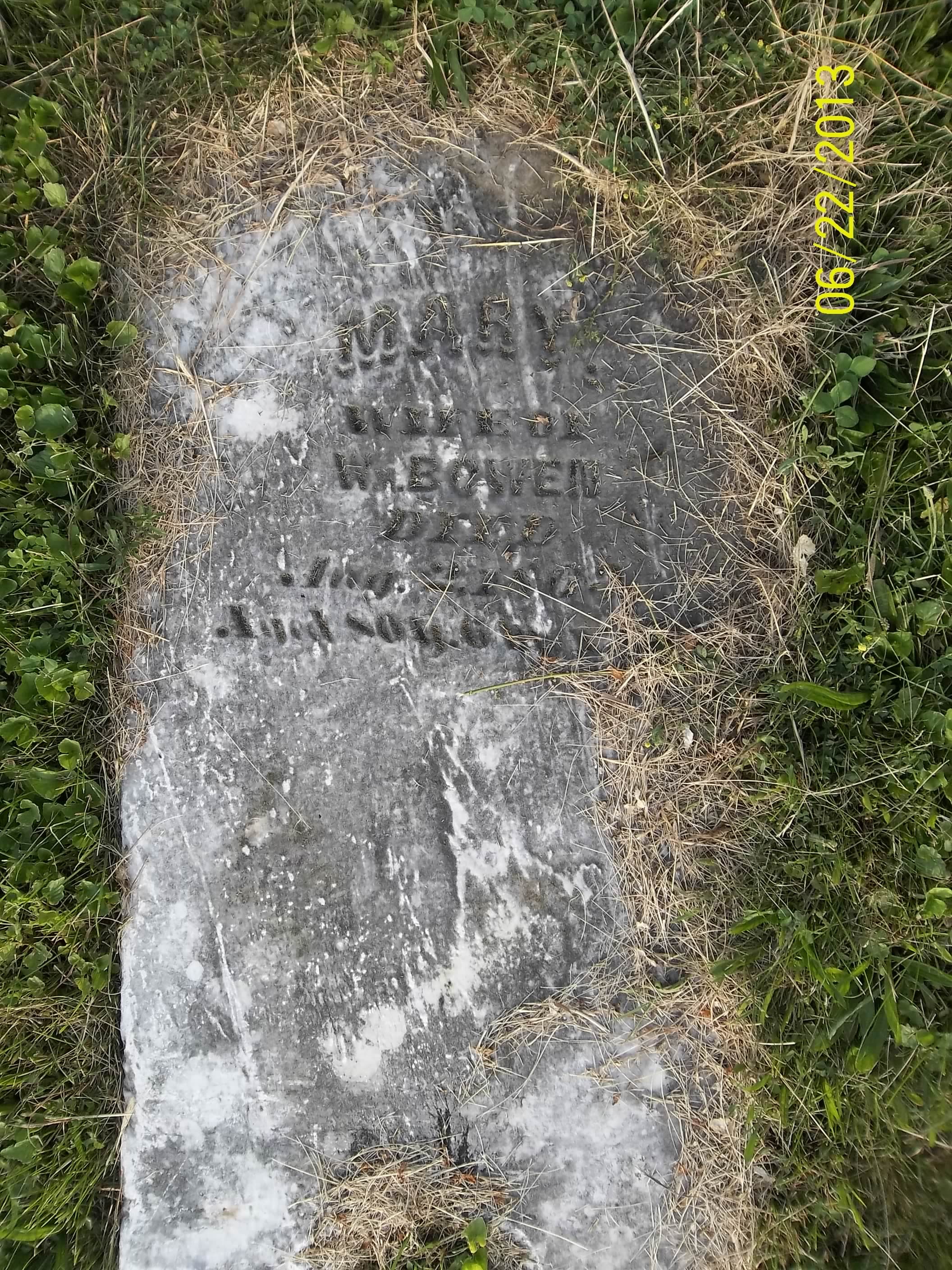
There is a Mary Bowen buried in the “Old” Cemetery in North Fairfield. The marker (pictured below) gives her date of death as August 2, 1863, and her age: 80y 6m 13d. The 1850 record approximates her birth in 1788 in New Jersey.
Mary Bowen marker on FindAGrave
There are at least two men named William Bowen who have records in Ancestry’s Wills & Probate database, but they died in Stark and Jackson counties, respectively, and neither of these wills mentions people who match our Bowen family. Mary is listed in the 1860 Census, living with their son, Edward, and his wife and daughter in Fairfield, but William is not; I would expect to find a record of his death in the 1850s, but so far, no luck.
But, we still have the mystery of who Adelade Bowin might be. She is listed in the Walker household in 1860; she would seem not to be Lydia’s sister – otherwise, she ought to have appeared in the 1850 record as a girl between the ages of 4 and 6. Unfortunately, none of the records for Adelaide or AdelineBowen (or similar spellings) turn up any clues that match what we already know about the Bowen family.
We have been climbing a ladder of evidence for a couple of months now – a metaphorical ladder leaning against the side of one of my “family palm trees”. The first several rungs felt like very solid footing, but the last three have been increasingly shaky. Depending on who you are and what your skill level is, you might have a different comfort level with the conclusions I’ve accepted along the way and I want to take a moment to address that before moving on.
Evidence Standard
You may have run across several different “rules of three” in other fields, but when I use it in this post, I’m referring to a standard for judging whether a piece of evidence should be included in the profile you are building for your ancestor. The standard is that at least three points of comparison (three facts) in the new document or narrative you are evaluating should match what you already know about your ancestor. I want to be crystal clear: this is not a standard for proof. It is a standard for judging whether a document is even about your ancestor.
Almost every document will have the person’s name – that is almost always the first of the three facts to compare. Other facts will depend on the document you’re examining – date and/or place of birth/death/marriage, names of parents or siblings, addresses, and identification numbers (like Social Security or service numbers in more recent generations) can all add up and help identify a unique individual. The rule is that if three facts match each other (name, date of birth, and place of the event; name, relatives’ names, and time frame; gender, birth event, and parents’ names, etc.) that indicates that you can add the information in that document to “what you know” about that individual. Again, this isn’t “proof” but it is a way of figuring out which puzzle pieces belong in your ancestor’s picture, and can tell you where to look for more pieces.
Being appropriately skeptical means that any new evidence you find should be judged against what you already know – and if the facts don’t add up, you should be mentally prepared to change your mind about what you thought you knew, depending on what all of the evidence tells you. I would give you a specific example, but this whole series of posts is meant to be that example.
Types of Evidence
If you aren’t already familiar with the terms “primary source” and “secondary source,” there are a lot of good resources out there for learning more. (This page is a good start.) The most important thing to keep in mind is that the terms “primary and secondary” are not the same as “correct and incorrect” or “right and wrong” – one is not “better” or “more reliable” than the other.
For example, last week’s post about “An Old Man’s Memory” talked about a book that collected the firsthand knowledge of William Whitford. William’s book could be seen as both a “primary” source because he was a firsthand witness to events he documented, and as a “secondary” source, because some of the information he recorded was told to him by his parents and his older relatives.
Over the next couple of weeks, I’m going to be looking at several secondary sources – compiled lists of vital records (not the original records), family histories published by genealogical researchers, and local histories. Some of these published sources offer a tantalizing amount of information but can be disappointing in relevance and/or quality.
What Is Our Goal?
I started this series hoping to confirm a direct ancestor connection to a specific person – the surgeon, John Greene, of Rhode Island. The evidence supporting my case is thin, at best, and depends on several assumptions that might not be “provable” with existing documents. I keep going because I have not found evidence that contradicts what I have pieced together. I may need to plan a trip to Rhode Island to seek out un-digitized documents at some point, assuming I can figure out whether such documents exist.
This tree, from Harriet Wells to Green Whitford, is only plausible – not proven.
If my goal was to prove my case now, with the information I already have, I would have to stop. But my goal is to assess the work done by myself and others for weaknesses – and so far, what I have learned has encouraged me to continue investigating. There are leads; there are clues.
I would love to find solid, documentary evidence in vital records that allows me to declare Rungs 4 and 5 “confirmed” – but I have found evidence that suggests that isn’t likely to happen. In 1972, Burton Bernstein published a book called “The Sticks: Profile of Essex County, New York,” portions of which had originally appeared in the New Yorker magazine. According to Bernstein, “General Washington made a victorious inspection of both Crown Point and Ticonderoga in 1783, but what he saw was mostly sad ruins. Crown Point quickly reverted to pastureland and Ticonderoga was disposed of in a grant to Columbia and Union Colleges by the new State of New York.”1
According to the records we do have, Greene Whitford and his family lived in Brandon, Vermont, in 1788, in Hampton, Washington County, New York, from 1799 to 1801, and in Crown Point from about 1803. We have seen the evidence that his daughter was born in Crown Point. Her name doesn’t show up reliably (Cyrena/Irene/Anna, depending on the source), but we also know that women were poorly documented at that time – census records at all levels (local, state, or federal) only listed the heads of households, and remote or rural areas were slow to begin documenting vital records with any regularity.
All of this explains why there are no definite records tying Harlow Wells to his likely grandfather, Greene Whitford – and the remoteness of the area suggests that his family was the most likely origin of Cyrena and Harlow. “Absence of evidence is not evidence of absence” – but until we find more evidence, I will continue.
Hopefully, I’m getting into families that have been researched by other descendants, and if you are one of those who have trod this path before, I’d love to hear from you.
Next week, we’ll continue up the trail, seeking firmer footing. Join us!
Let’s do a little bit of math, just for fun. (A thing my math teachers would never have predicted I would say.)
Starting with “one” – that’s you – and working backward through preceding generations, you have probably already noticed how each generation doubles in size. You, your two parents, their two parents are your four grandparents, etc. For me, a person born in the 1970s, My Sixteen great-great (or “2x-great”) grandparents were all born roughly 150 years ago, putting them in the era of the U.S. Civil War. Their 2x-great grandparents, most of whom would have lived in the Colonial era and seen the events of the American Revolution, would number 256.
My Millenial children are descended from 256 people on my side, and 256 different people (as far as I have been able to tell) on my wife’s side. If we take the Palm Tree Approach to look at each of those “lines” we are talking about 512 ancestors – each of whom likely had several siblings, leading to thousands of descendants of their own.
So far, I have researched two of my 256 Colonial Ancestors thoroughly enough to be confident that I know their identities and stories. (If you’re subscribed to this blog, you’ll get to learn about a third family in Friday’s post, From Bridport to Brandon… as soon as it comes out!) And since I finished my big project to compile the Callin Family History in 2022, I’ve begun working in earnest on my wife’s side of the family, too.
Which led me to the first of her Colonial American ancestors. (508 to go! Whee! Isn’t math fun?)
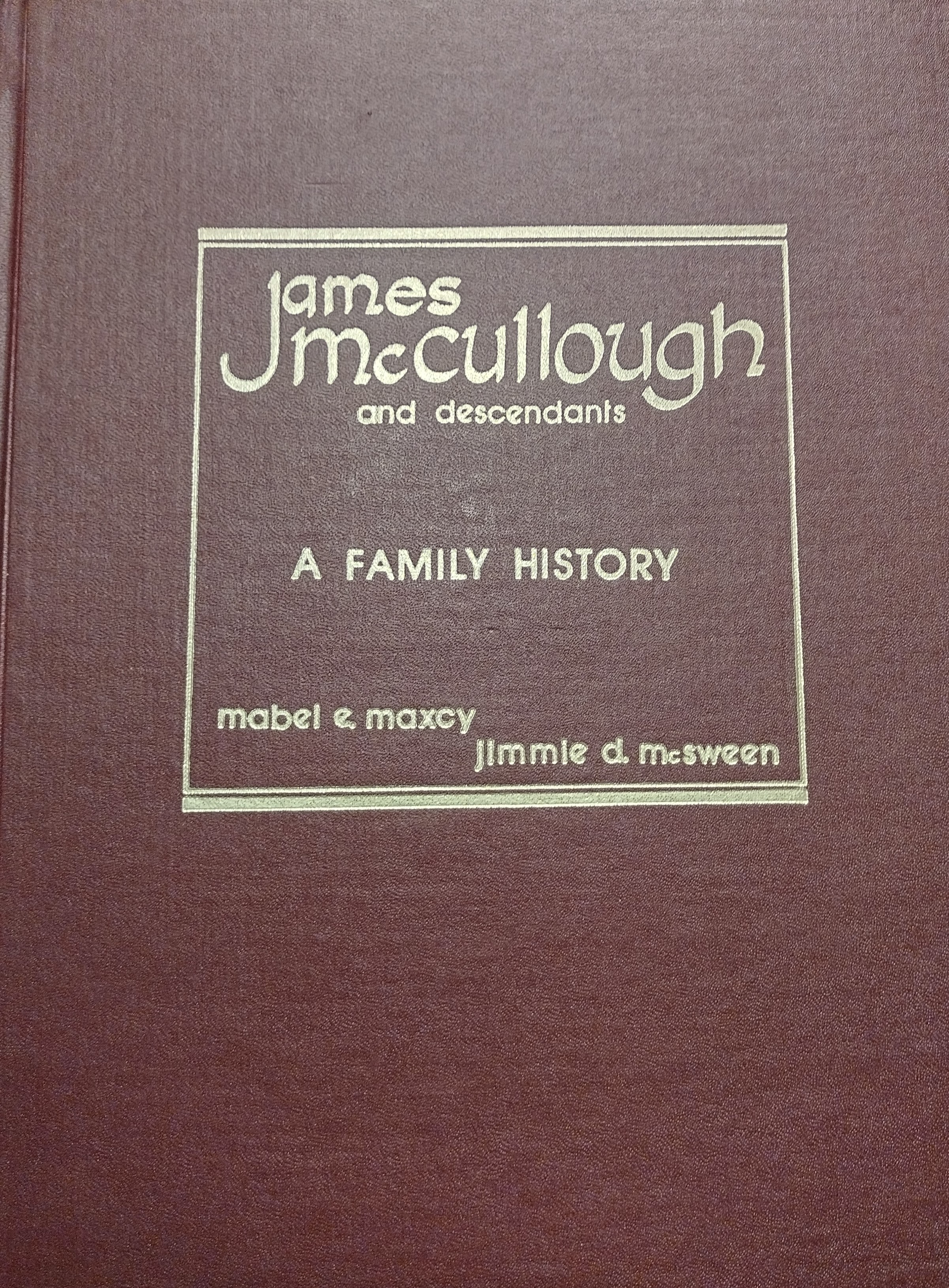
“James McCullough and Descendants” published 1991
For those who aren’t familiar with my methods, I have created several family tree “projects” on Ancestry – one for each of the eight great-grandparents of my children. I use my Ancestry membership to build back each line as far as I can, augmenting any gaps in the records available on Ancestry with other sources, if I can find them. Then, once I have built out the profiles for a full family – husband, wife, both of their parents, all of their children, and their children’s spouses – I add what I have learned about that family to WikiTree.
As you might recall from an earlier post, Family Reunion: McCullough, I had worked my way back to my wife’s 2nd-great grandfather, John Riley McCullough. Since that post, I have found and adopted WikiTree profiles for his parents, James McCullough and Nancy Fort – and spent some time in Ancestry looking for primary sources to help improve their biographies.
Census records and a will found on Ancestry led me to biographical sketches of two of John Riley’s brothers in Charles Blanchard’s Counties of Clay and Owen, Indiana, published in 1884. I spent a fair amount of time piecing together clues, and then I finally found a citation for the book you see above James McCullough and Descendants.
A lot of other researchers on Ancestry, Geneanet, and older forum sites had referred to this book or quoted it, but nobody’s source citations had included enough information to allow me to track it down. Finally, I ran across a reference to the author, Mabel Maxcy, and I was able to track down a copy for sale on Abe Books.
After reaching out to the seller, I was able to confirm that my wife’s family was listed in the book and that the compilers cited primary sources, so I ordered it.
Thanks to the work I had already done on Ancestry, I was able to quickly determine that I was on the right track. This book confirmed what I had learned from the wills and census records I had access to, but it also cited tax rolls and court documents that I either hadn’t found yet or did not have ready access to. Armed with the solid research done by Maxcy and McSween, I can now flesh out the stories of my wife’s colonial ancestors.
When I told my wife what I had found, and showed her that her Scottish ancestors had settled in pre-Revolution North Carolina, her eyes lit up. We have been watching recent seasons of Outlander, which, of course, should not be confused with history, but is set about five counties west of where her Scottish McCullough ancestors lived. I may not be able to interest her in dry facts and fun math trivia, but the Value of Fiction is its ability to make you feel what it’s like to be someplace else.
I’d love to hear from you if you have found a valuable source in the course of your research. Friday’s post will be about standards of evidence, and next Friday’s post talks about these kinds of secondary sources and how to judge their quality – so make sure you’re subscribed!
Genealogists urge each other to talk to their oldest living relatives and record their memories as best they can. This is difficult for a lot of people to do – the researchers might be unsure of themselves, or their relationship with their relatives might not make interviewing them in their old age a comfortable experience. I know I ran into a problem with my Grandma Alberta when I asked her to share her memories because she couldn’t remember a lot of facts (names/dates/places/etc.) and she considered other kinds of stories and anecdotes to be “gossip” and she didn’t want me spreading gossip about her family.
Fortunately for me, a man named William Whitford did not share Grandma’s sense of concern about collecting stories about family and writing them down. William was 81 years old in 1862 when he was persuaded to document everything he could recall about his Whitford ancestors and their descendants. In 1939, Walter John Coates typed up copies of William’s manuscript to share with genealogy researchers, and in 1998, Coates’s transcript was published by a small press run by the late Don Shaefer in Fayetteville, Arkansas. You can read a digital copy if you log into FamilySearch.org and follow this link.
Here is William’s account of how his cousin, Green Whitford, came to Shaftesbury, Vermont, from Rhode Island in 1781 and married his wife, Anna Pierce:
Green Whitford (Son of Thomas)
Cousin Green came to my father’s (Peleg’s) in Shaftesbury, Vt., in 1781, I think; I have heard my mother tell an anecdote about him. Clothen Pierce lived a short distance from my father’s. Mrs. Pierce was standing at the door or looking out at the window when Cousin Green with another young fellow was passing the house, going to my father’s for the first time from Rhode Island. Says Anna to her mother (for that was her name); “There goes my husband.” Her mother asked which one. She answered, “The one with [the] red plush jacket,” which was my cousin; and as she predicted, so it turned out, for in less than two years they were married, and their eldest daughter, Jimima, was married the same day that I was to a man by the name of William Conelly.
pg. 4
If you found that difficult to read, so did I. His phrasing made the story hard to follow, and he alluded to several facts that are either mentioned elsewhere in his text or are simply things that he figured a reader would already know. For example, he calls Mr. Pierce “Clothen” here, but in two places on the same page uses his correct name, “Clothier.” If I were Mr. Coates, I might have been tempted to “fix” William’s syntax and spelling a little bit:
In 1781, my cousin, Green Whitford, came to my father’s house in Shaftesbury, Vermont, from Rhode Island. Green and his traveling companion passed by the house of Clothier Pierce, a close neighbor. Mrs. Pierce and her daughter Anna saw them and Anna said, “There goes my husband.” Her mother asked which one, and Anna indicated Green by saying, “The one with [the] red plush jacket.” As she predicted, they were married in less than two years. Coincidentally, their eldest daughter, Jimima, married a man named William Conelly on 25 Dec 1800 – the same day I was married.
But the important thing is that William recorded his memories!
Thanks to this passage, I can begin piecing together the facts in Green Whitford’s biography. I haven’t been able to find a marriage record for his marriage to Anna Pierce, but some other facts are supported by documentary evidence.
My cousin Green had a large family of children, went to Puts Creek, New York, near his brother Constant, where he was quite a bear hunter; was treed by one on one of his hunting excursions, and had to remain out on the tree all night. Had some ten children by his first wife. Their names, as far as I now recollect them, were Jimima, Clothier, Hiram, Thomas, Sylvenus, Alden, Dimmas, Celia, and Anna.
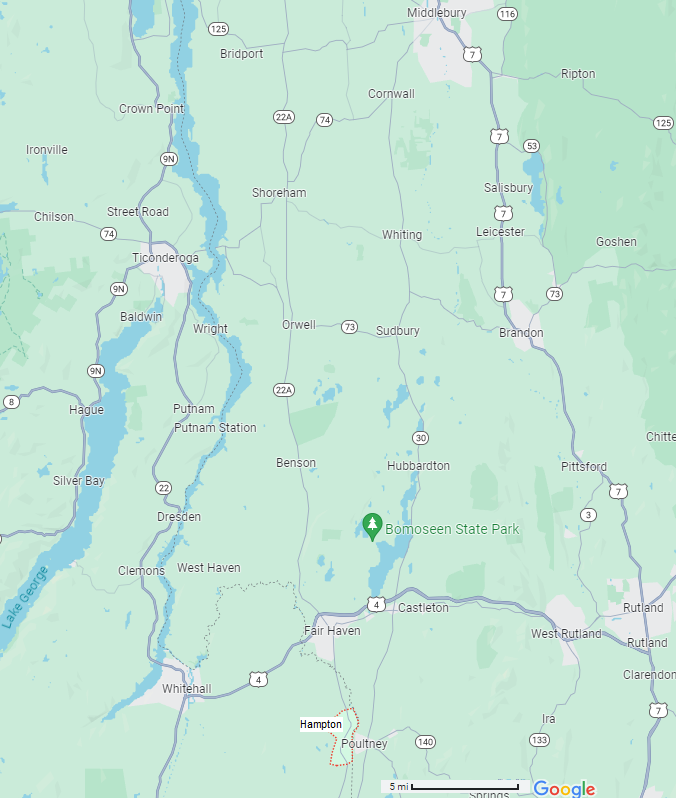
I determined that “Puts Creek” is a reference to “Putnam’s Creek,” which is located just north of Ticonderoga, New York. Census and tax records found on Ancestry show Green in Brandon, Rutland County, Vermont, in 1788; in Hampton, Washington County, New York, from 1799 to 1801; and in Crown Point, Essex County, New York, in 1803 and 1810. You can see where these places are on this map – and Shaftsbury, Vermont, is another 45 miles south of Hampton:
Green Whitford: resided at Hampton, Brandon, Crown Point, and near Ticonderoga
If you recall last week’s post, I determined that Cyrena Whitford was probably born around 1800 in Crown Point, Essex County, New York. Other researchers identified her parents as “Greene Whitford and Anna Clothier Pierce.” And here we have a family member’s contemporary account of Green Whitford marrying Anna Pierce, and documents placing the family in Crown Point at about the right time. But William didn’t list “Cyrena” among Green and Anna’s children in that second paragraph above. He did, however, provide this memory of their daughter, “Anna”:
Anna married Thomas Wells of Bridgeport [sic], went to St. Lawrence County; there lived and died. I visited him once, had rather a hard place to get a living in, I thought. Had quite a family, most of them girls.
pg. 5
Technically, Thomas lived in Franklin County, to the east of St. Lawrence County; but if William’s memory could turn “Cyrena” into “Anna” it seems reasonable that he would get the county name wrong, too.
Conclusion:
Once again, we’re leaping to accept the tenuous threads of evidence that tie Harlow Wells, Thomas Wells, and Cyrena Whitford to Green Whitford. I don’t like relying on an old man’s memory and a chain of assumptions to prove my family connections – but considering how remote some of these places were at the time these people lived there, sometimes an old man’s memory may be all we get.
There is one other tiny, interesting tidbit of information in the records that feels important, even though on its own it doesn’t tell us much. William may have forgotten Cyrena’s name, but she did have a sister named Anna. Anna married Leonard Sherman and moved “to the West” – and the 1876 death record for Anna Whitford Sherman names her father, Green Whitford. That death record is found in the Wisconsin, Death Records, 1867-1907 on FamilySearch; her place of death is recorded as Fort Atkinson, Jefferson County. The same Fort Atkinson where Harlow Wells and his family appeared in 1870.
Taking all of this nebulous evidence and trying to determine what the whole story is might be difficult – but the challenge is what makes this such an interesting hobby. One day, I (or another researcher) will find a record that makes sense of it all.
Until then, I’m going to continue working from the assumption that I’m on the right track. So next, we’ll look for Green Whitford’s parents. Be sure to subscribe so you don’t miss out!
And if you’re a descendant or just a fellow researcher interested in these folks, drop a comment and say hello!
Note: I composed this post before I discovered WikiTree, so you might find information here that I haven’t posted there, yet. At this writing, Henry B Opp(1811 – 1884) is as far back as WikiTree has documented this family.
Things Are Looking Opp
The Opp families that lived in and around Easton, Pennsylvania, typically came to Philadelphia from a town in the Rhineland during the 1730s or 1740s. They were generally members of the Evangelical Reformed Church (Evangelisch-reformierte Kirche), and many of them can be documented through church records available through Ancestry.
When I began writing up my Opp family, I discovered that I had fallen victim to a couple of common problems. Most of these Opp men I am researching were given traditional Reformation-style German names; almost all of them appeared in earlier records with the first name “Johan” or a variation. Their middle name was typically the name they used once they arrived in America, and it was common for fathers to name their sons after themselves and their male relatives. As it turns out, I confused two men who lived in Easton and operated taverns – both of whom were named either “Johann Jacob Opp” or simply “Jacob Opp.” After reviewing the available records, I think I’ve figured out who is who.
I suspect that three men with the Opp surname – Jacob, Michael, and Valentine – were either brothers or cousins who emigrated from the Rhineland when they were in their twenties. Their daughters married into families with names like Bixler and Bidleman, which were prominent in their way in the community. The Bixlers, in particular, would be important members of the Northampton County Historical & Genealogical Society, which published some of the sources I will cite and runs the Sigal Museum (also at that link) in Easton.
Johan Michael Opp (1732-1803) appears in the Pennsylvania and New Jersey, Church and Town Records, 1669-1999 database. He was buried at St. John’s Lutheran Church in Easton, Northampton County, Pennsylvania on 28 May 1803. He is listed in many church and tax records as “Michael Opp” or “Michael Opp Sr,” to differentiate him from his son, Michael Jr, who lived nearby.
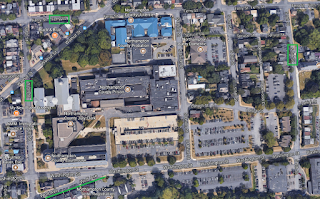
Satellite image of the old Michael Opp farm
The senior Michael was a weaver, and property and tax records placed him in Easton. I took a description of the boundaries of his farm from Historic Easton from the window of a trolley-car, published in 1911, and used Google maps to make the image [above], depicting the site of the old Opp farm. The Northampton County Courthouse and Prison occupy the western half of what was once Michael Opp’s farm.
I believe Michael’s wife was called Catharine Elizabeth, but I know very little about her. If my research bears out, then this couple would be my 6th-great grandparents. And their son, Jacob “Junior” would be my 5th-great grandfather. I found a mention of them in two articles published in 1997 in the local newspaper:
J Floyd S. Bixler, an early corresponding secretary of the Northampton County Historical & Genealogical Society, wrote a history of Easton’s early taverns in 1931. He noted that the Golden Swan Tavern was located at 460 Northampton St. This is confirmed by James A. Wright, whose 1993 history of taverns reaches beyond Easton to encompass all of Northampton County. Jacob Opp Jr., son of Michael Opp, was an early landlord at the Golden Swan. That was before 1813. —The Morning Call from Allentown, Pennsylvania; Thursday, July 24, 1997, Page: 13
Bixler tells the story of Theophile Cazenove, an agent for the French Land company on a tour of observation. “This Frenchman was a man of distinctive tastes, and traveled with a coach and four, a valet, a coachman, and a postilion,” says Bixler. “He also had an extra saddle horse along for a change when he became weary of his coach.” Cazenove stopped at the Golden Swan. He had a party of three men and three horses. Jacob Opp was the proprietor at the time. He charged Cazenove $3.90 for the night’s lodging. One assumes this included supper and breakfast. Bixler comments, “Jacob Opp was no profiteer.” Profiteer, no. But promoter, yes. Good service and a good price prompted Cazenove to write that the town of Easton could be proud of the Golden Swan. Bixler writes, “As he Cazenove always chose the best hotels, and was a critical judge of the service rendered, we may judge that Opp’s Golden Swan Hotel was a credit to Easton in its day.” —The Morning Call from Allentown, Pennsylvania; Thursday, July 24, 1997, Page: 25
Church records from St. John’s Lutheran Church in Easton also establish that Jacob was Michael’s son. For a long time, I mistakenly believed Jacob’s father was “John Jacob Opp,” who is described in two histories of the area:
In September of 1757 this property was conveyed to Adam Yohe, who had previously occupied the premises as a tenant. Yohe conducted a tavern which he called the Red Lion. This was Easton’s principal hostelry during the French and Indian War. Yohe disposed of the property in 1760 to George Cungware who still owned it in 1772. Later Jacob Opp became owner and continued to operate the tavern. Just when Opp secured possession is not known but as the 1776 assessment list refers to him as a tavern keeper owning a house it is assumed that he lived here during the war. In 1806 the Orphans Court adjudges the property to Elizabeth, the daughter of Jacob Opp, and the wife of Abraham Horn. Eve, the eldest daughter of Opp, married Daniel Wagener. Opp’s daughter Catharine married Christian Bixler. A frontier village, pre-revolutionary Easton p. 239-240; by Andrew Dwight Chidsey, 1940; Easton, Pennsylvania
Notably, this source ruled out the relationship to my ancestor:
John Jacob Opp, father of Catherine Opp, was born in Chur-Paltz, Germany, in the year 1740, came to the colony of Pennsylvania and died in 1805. He was appointed a commissioner of Northampton county June 22, 1776, to receive bounty money to be paid to the three hundred and twenty-seven men who completed Northampton’s first quota to the forces of the Flying Camp, as shown by the muster roll of Revolutionary militia. In addition to the sum of $981, he was also to exchange all saltpetre made in the county, this to be handed over to Capt. George Huber, to be used in the manufacture of gun-powder. John Jacob Opp became a large landowner in Easton, and by his wife, Anna Maria Hoffman, had four daughters, one of whom became the wife of Christian Bixler, the founder of the jewelry business which has been in the Bixler family one hundred and thirty-three years… History of Northampton County (Pennsylvania) and the grand valley of the Lehigh, p. 316; by William Jacob Heller, American Historical Society, Boston New York etc., 1920
Michael Opp and his wife had at least one other son, Michael Jr. (1767-1843), and a daughter, Anna Margareta, who married Michael Odenwalder (1750–1828) on 8 March 1775. Michael Sr. left behind a will, recorded in an index record in Pennsylvania, Wills and Probate Records, 1683-1993. It looks like I will need to make a trip to Easton one of these days to find that will and learn more about these folks.
Jacob Opp Junior (1763-1848) may have been named for an uncle or grandfather, which suggests to me that Michael Opp Sr. and John Jacob Opp (of the Red Lion Tavern) might have been related. Whatever the case, my Jacob – the proprietor of the Golden Swan – married a widow named Elizabeth Reynale, probably around the time of Michael’s death in 1803, if not a bit later. Elizabeth had a son from her first marriage, and she and Jacob also had a son in 1811 whom they named Henry. Jacob relocated the family to Dansville, New York, around 1814.
Once again, property and tax records seem to support what the local histories published later claim about their biographical information. Jacob figures into the biography of Elizabeth’s son, Dr. William H. Reynale:
Dr. Reynale was one of the earliest physicians and surgeons of Dansville. He was born at Quakertown, Hunterdon county, N.J., Feb 27, 1794. Very early in life he lost his father. His mother died in 1835. Soon after his father’s death he was adopted by Henry Bidleman, a maternal uncle [N.B. – suggesting Elizabeth’s maiden name must have been Bidleman] who was an accomplished scholar… After a severe and critical course of medical reading, he entered the University of Pennsylvania in January, 1811, as a medical student, and was graduated from there April 9, 1814. Soon after this he went to Dansville, at the invitation of Jacob Opp, a connection of Dr. Reynale, who was at that time building the well-known flouring and grist-mill south of Dansville, which is now, and has been for several years, owned by Benj. F. Readshaw. History of Livingston County, New York : with illustrations and biographical sketches of some of its prominent men and pioneers, pg. 194-195; by James H. Smith, Publisher: D. Mason, Syracuse, N.Y., 1881
According to his newspaper obituary, “Dr. Reynale came to Dansville for the first time in 1814, with his stepfather, Mr. Jacob Opp.” (Dansville Advertiser, Dansville, Livingston County, New York; Thursday, August 11, 1870 – emphasis mine.)
Jacob’s move to Dansville was further documented in the History of Livingston County:
[Col. Nathaniel] Rochester took up his residence in Dansville, and purchased a large tract of land, embracing most of the water power within the village, including the mills built by Daniel Sholl for the Pultney estate. He added to the other mills a paper mill, which was the pioneer of its kind in Western New York. In 1814 he disposed of his property in Dansville, in part to Rev. Christian Endress, of Easton, Penn., and in part to Jacob Opp, from the same place. …Jacob Opp’s purchase, which embraced the present Readshaw mill and site, was made in January, 1814, and in May of that year he moved his family here from Easton. He continued his interest in the mill property till about 1840, and died in Dansville in 1847, aged 84 years. Henry B. Opp is the only one of his family left here. p. 162
The grist-mill owned by Benjamin F. Readshaw, on the corner of Gibson and Main streets, to which reference has been made in connection with the early settlement of the town, occupies the site of the gris-mill built in 1796 by David Sholl for the Pultney estate. It was soon after burned and rebuilt by Sholl, who eventually became its owner, and was succeeded in possession of the property by Col. Nathaniel Rochester, the founder of the city of Rochester. In January, 1814, Mr. Rochester sold it to Jacob Opp, who owned it till about 1840. The mill contains three runs of stones, which are propelled by water from Little Mill creek, with a fall of thirteen and a half feet. p. 174
Henry B. Opp (1811–1884) was born in Easton, and at the age of three, moved with his family to Dansville, New York, in Livingston County. Henry was known as a miller, though after his father sold the mill around 1840 when Henry was 29, records list Henry’s occupation as a farm laborer.
Around 1839, he married Susan Karcher (1818–1903), daughter of William Karcher (1782–1852) and Magdalena Welch (1786–1869). Henry and Susan are my 4th-great grandparents. They spent their entire lives in Dansville, where they had five sons and two daughters.
I. Henry K Opp (1840–1908) served in the U.S. Navy during the Civil War. He was the paymaster aboard the USS Pocahontas. After the war, he married a woman named Mary, and they settled in Wellsville, New York, where he ran a clothing store.
Jacob Edward Opp
II. Jacob Edward Opp (1842–1913) was my 3rd-great grandfather. He married Mary Elizabeth Palmer, and we looked at their descendants in a previous post.
III. William Opp (1845–1920) served in the 21st Regiment, New York Cavalry during the Civil War. In 1868, he married Martha E. Fenstermacher (1846–1919), and they raised three daughters:
A. Theda W Opp (1871–1961) remained single her whole life, working for many years as a saleslady in a dry goods store in Wellsville. About her 70th year, she moved to Rockland, Maine, to live with her niece’s family. She is buried in Wellsville.
B. Adela “Addie” Opp (1873–1954) also remained single, working as a clerk or as a housekeeper to support herself. When Theda went to Maine, she appeared to have gone with her, and she, too, was buried in Wellsville after her death.
C. Edna P Opp (1877–1954) was born in Dansville, grew up in Wellsville, and married William F. Yewdall (1870–1932) in 1901. She moved to Thomaston, Maine, to live near her daughters after his death, and her sisters followed a few years later.
i. Helen Marlee Yewdall (1908–2008) married Joel Murray Miller Jr (1908–1987), and was 100 years old when she died.
ii. Margaret F Yewdall (1914–2011) married Dr. Frederick Collins Dennison (1908–1994). He served in the Knox County Hospital for many years. They are survived by their daughter, three grandchildren, and five great-grandchildren.
IV. Amelia J. Opp (1847–1922) She married Samuel H. Peterson, whom you might recall from the post about his grandfather, Samuel Peterson, New Jersey Shipwright. Samuel (b. 1847) was five years old on the 1850 Census, but later records dispute his birth date. On the 1860 Census, Samuel and his sister, Annie, appear listed in the same James Palmer household as their grandfather, Sam Peterson. According to a newspaper obituary for Amelia, they married in 1873 and moved to New York state.
Samuel and Amelia were in Deerpark, New York, according to the 1875 New York State Census, and they were in North Dansville with their daughter and three sons in 1880. When Amelia shows up in 1900, she is listed in North Dansville as a widow, but I have not been able to find Samuel’s death records. Amelia lived in North Dansville until she died in 1922. She was buried near two of her sons in Green Mount Cemetery.
They had a daughter and three sons, altogether:
A. Susan Peterson was born in 1874 and only appeared in the 1880 U.S. Census. It is possible that she grew up and married, or may have died young. Until some records turn up, I do not know.
B. James Henry Peterson (1875–1942) lived in East Rochester, New York, where he likely worked for the Foster & Armstrong Company manufacturing pianos. He married Julia H Sullivan (1878–1950) about 1903, and they had five children. The couple is buried in the Holy Sepulchre Cemetery in Rochester.
i. Charles H Peterson was born about 1904, and appeared in the 1905 New State Census and the 1910 and 1920 U.S. Census records with his family.
ii. Helen Amelia Peterson (1907–1942) married Joseph Seward Little (1897–1939) in 1937. He was a U.S. Navy veteran of World War I who died just two years later while living in the Veteran’s Administration facility in Tucson, Arizona; he was only 41.
iii. James H Peterson Jr (born 1907) followed his father in the piano-building business.
iv. George Peterson was born about 1913 and was seven years old in the 1920 U.S. Census, which is the only record I have for him.
v. John Richard Peterson (1916–1985) married Margaret Jean Race (1926–2003) in the 1940s, and they lived in Rochester, where they raised four sons and a daughter. They were survived by their children and seven grandchildren.
C. Samuel Hoffman Peterson (1878–1951) was a lifelong bachelor and resident of Dansville. He worked in a plant nursery for many years.
D. Henry K Peterson (1880–1962) married Charlotte Alice “Lottie” Wilcox (1880–1964). He served as superintendent of mail at the post office at the time of his retirement and lived in Dansville his whole life.
V. Lewis Isaac Opp (1851–1927) was a lifelong bachelor who spent his whole life in the Dansville area. He died at 74 of a stroke.
VI. George Benjamin Opp (born 1859) lived with his older brother, Henry, in Wellsville, from at least 1870. I have not found any records for him more recent than his appearance in Henry’s household in the 1880 U.S. Census.
VII. Mary Elizabeth Opp (1864–1867) died at age 3 and was buried in Green Mount Cemetery, in Dansville, near her parents.
There you have it – to me, it always seems like a lot of names, but also a lot of “lifelong bachelors,” which makes finding modern cousins tricky. I especially dislike having so many mysterious loose ends, but until more records are online – or I find time to travel around the Eastern seaboard! – they will remain mysterious.
Of course, if you recognize any of these folks from your research, I’d love to hear from you. I welcome any corrections and updates.
Be sure to subscribe to get two newsletters in your inbox each week.






 Mightier Acorns