Mightier Acorns

Journeys through Genealogy and Family History

A parody of a family coat of arms designed with acorns as elements, with the motto "ex gladnis potentioribus" Latin for "from Mighty Acorns"
From Mighty Acorns
  • Leopold Zindle: The Story Behind the Story

    Why we keep doing research after we think we found all the answers

    Last week, we revisited a story about my 6th-great grandfather, a Hessian soldier who was captured by General Washington’s troops and sent to work in Mount Hope, New Jersey, for John Jacob Faesch, who needed laborers to continue making ammunition for the Continental Army.

    In 2014, I posted a compelling and dramatic story to my old Mightier Acorns blog: “Me No Go; Me Die First”. The source attributed that story to a neighbor, Mr. William F. Wiggins, who claimed to know Leopold after he died in 1820, but I needed more information to prove the connections between Leopold and his children, and to try to trace Leopold’s origins in Germany.

    While digging for this information, I found evidence that the story attributed to Mr. Wiggins in the History of Morris County, New Jersey1 might not reflect events as exactly as they played out.

    So what did happen to Leopold Zindle, exactly?
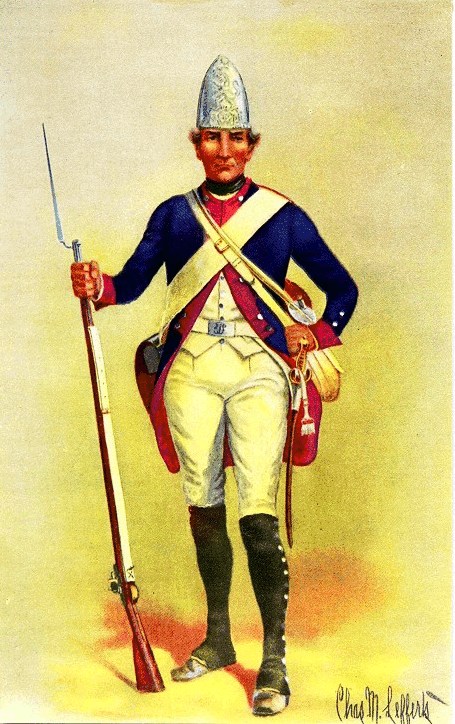
    Uniform of a Fusileer from the Regiment Erb Prinz of Hesse-Cassel, 1776 (from the Sons of the Revolution in the State of California website)

    Leopold enlisted in the Hesse-Kassel Regt. Erbprinz, 1. Comp., and was reported on the unit’s muster roll in August 1779. The prisoner lists I referenced last week show a Leopold Zuendel (Zindell) from the Kassel Regt. Erbprinz, including a remark saying “Captured at Paulus Hook 8-20-79.” Then, after John Jacob Faesch from Mount Hope, New Jersey, requested German prisoners of war as laborers he received thirty-five men (not 250) from the Commissary of Prisoners in Philadelphia on April 29, 1782, and put his furnace into blast. Among the soldiers sent to work for Faesch were two men from the Hesse-Cassel Erbprinz (“Prince Hereditary”) Regiment captured at Paulus Hook in 1779: Adolph Assmann and Leopold Zuendel.

    The rest of the story comes from two sources: an article published by Daniel Krebs2, and Peter Lubrecht’s book, “New Jersey Hessians”3, both of which I will try to summarize:

    The month after Faesch received his 35 laborers, several Continental leaders decided that German prisoners of war could either be recruited for the Continental Army, ransomed for 80 Spanish dollars, or sold into indentured servitude. Brigadier General Moses Hazen, whose regiment already guarded the prisoners of war, was sent to tell the prisoners of their new options. Accounts of what happened next differ between the American authorities and the correspondence of the German soldiers.

    Both sides agreed that officers from Hazen’s regiment arrived in Mount Hope in November 1782 to announce the new policies. One of the American officers, Captain Selin, a German immigrant, told the prisoner laborers that they could choose between enlistment, ransom payment, or a return to the New Gaol in Philadelphia. The men refused to serve as soldiers but asked for more time to consider the other proposals.

    In February 1783, some of the German prisoners in Mount Hope attempted to escape to British-occupied New York. They made it as far as Newark, New Jersey before they were caught. At the beginning of March 1783, officers from Hazen’s regiment returned to Mount Hope. When the prisoners refused to enlist in the army and refused to ”redeem” themselves, Selin began to march them back to Philadelphia. After one day’s march, the German soldiers demanded to talk to Faesch and supposedly “entered into a voluntary agreement with him” to become indentured servants, with the intention to pay their ransom of 80 Spanish dollars (or 30 pounds of Pennsylvania currency) and then become citizens of New Jersey. Not all thirty-five prisoners signed their indentures with Faesch for three years, and on March 11, 1783, Faesch returned two prisoners of war to Hazen.

    In a letter dated March 20, 1783, to General von Lossberg, commander of the Hessian troops in America, the remaining German soldiers told a different story.

    “The Captain told them they were at his disposal, because they were Continental Servants, to which they replied, that they were no Servants, but the King’s Soldiers. Upon which the Captain drew his sword, put it to their breasts threatening to kill them, and struck them, till he broke it upon the head of one of them. He then carried them off, and that night put them into a house surrounded with sentries, and allowed them neither bread not water.”

    (Krebs, pg. 134)

    Jacob Peter, a prisoner of war in Mount Hope, who was able to pay the ransom with his wages on June 23, 1783, added in his account that Captain Selin was the officer who struck the soldiers. According to Peter, the two were Leopold Zindel and Valentin Landau. Peter stressed that the German soldiers gave up and agreed to the contracts with Faesch only because of American pressure and lack of provisions. Peter also claimed that he and his comrades did not know that they signed an oath of allegiance and an indenture for three years because nobody explained the English documents or translated them into German.

    But the prisoners of war at Mount Hope almost certainly talked to Captain Selin in German. To later claim that they did not understand what they heard and signed is unconvincing, even when you consider the fact that some sources say that Captain Selin spoke Swiss German (or “Schweizerdeutsch”). It is also worth considering that while the newspapers and local histories often refer to him as a “Dutchman,” Jacob Faesch appears to have been born in Hesse himself4, so he would have been able to speak to Hessian soldiers in their mutual native language.

    Not all of Faesch’s German prisoners of war returned from Mount Hope when Lossberg bought their freedom from Faesch in the summer of 1783. Leopold Zindel and Adolph Assmann (both of the Erbprinz Regt.), and Georg Schmidt (of the Knyphausen Regt.) are the only settlers known to have remained in New Jersey and to have left records behind.5 All of this suggests that these prisoners knew what they wanted after the end of the war – to remain in America and build a new life – and played the German, British, and American officers off of each other to get it.

    What Does This All Mean?

    Now that we know more facts from contemporary witnesses, and can compare differences between somewhat official accounts, a few things become clear about the story I found in 2014:

    • The officer who abused Leopold was American, not British.

    • The townspeople of Mount Hope may not have been present, and if they were, their interference did not make it into the formal report.

    • William F. Wiggins got those details wrong when he repeated his story to Halsey for the History of Morris County.

    Wiggins’s version of the story is still important evidence because we can compare the stories and learn something from the differences. Krebs relates several examples in his article where German prisoners of war told their German commanders an altered version of the truth to avoid the consequences of desertion. On page 135, Krebs describes one group that agreed to enlist as marines aboard an American frigate, the South Carolina. When captured, they were interrogated and claimed they had enlisted on the American ship only because they had heard from Loyalists that the South Carolina would be captured and sent back to New York. They all left out the fact that they had fought hard to resist being captured by the British.

    The story Wiggins tells suggests an element left out of the reports: the reaction of the local population. Eyewitnesses, especially younger ones, probably wouldn’t have known the difference between an American officer (who, if it was Selin, was probably speaking German to his prisoners) and a British or Hessian officer. Townspeople would probably be unaware of the details of the policies being explained to the prisoners, and it seems reasonable that they would have misunderstood the dynamics of the situation.

    That could explain why, in Wiggins’s story, it was a British officer beating Leopold, and why he thought the officer’s anger was due to the cost involved in Leopold remaining behind. It was due to the cost – but that cost was to the Continental Congress, and not the British Crown.

    To my mind, the most important part of Wiggins’s tale is that he captured the sentiment that Leopold was welcomed into the community despite being an “enemy soldier” – and that was probably because many of the inhabitants of Mount Hope were German immigrants themselves, and knew Leopold from his years as an indentured man at Faesch’s iron works.

    So, whether or not Leopold ever said, “Me no go; me die first!” to the abusive Captain Selin, he did stay in Mount Hope, and in 1820, after raising a family of seven children, he did die there.


    I hope that you find a story in your family history that you love as much as I loved Leopold’s story. And I hope that just because you love a story, you are open to accepting new evidence and changing what you thought you knew – because the “story” part of “history” is always fluid and elusive.

    1

    Halsey, Edmund D., “History of Morris County, New Jersey…”, W.W. Munsell & Co., New York, 1882, page 337.

    2

    Krebs, Daniel, “German Captives in the American War of Independence“, from Krieg, Militär und Migration in der Frühen Neuzeit. Germany, Lit, 2008; pg. 121-135.

    3

    Lubrecht, Peter, New Jersy Hessians; Truth and Lore in the American Revolution; The History Press, Charleston, SC, 2016.

    4

    Lubrecht; pg. 107: “His handwriting in the old German script and his word choices indicate a Hessian background.”

    5

    Lubrecht; pg. 112.


  • Inter-cultural ties to the larger family tree

    If you’ve been following my new music newsletter, All Kinds Musick, you may have noticed my recent post about the Los Lobos album, La Pistola y El Corazon. In it, I said:

    I credit [David Higaldo’s] work on this album as the final puzzle piece that made me accept the accordion as a favorite instrument instead of seeing it as just an oddity. This journey took me from Weird Al’s parody polkas through the Pogues and into Zydeco records. The instrument also features so prominently in these Latino traditions, that I began to wonder how it got there.

    There is a good answer to that.

    The accordion was first developed in the 1820s by Viennese and German instrument makers.1 It was inspired by a centuries-old Chinese instrument called the “cheng” or “sheng” introduced to Europe in the 1770s by a Jesuit explorer. The addition of bellows and Western-style keyboards allowed players to make chords with one hand while playing a melody with the other, and various designs spread quickly throughout Europe and the rest of the world. German immigrants brought the instrument with them when they settled in Texas in the 1840s along with styles like polka, waltzes, the “schottische” and mazurkas.2

    The Tejanos who lived in Texas incorporated this music into their own culture, sometimes replacing guitars with accordions and setting the corridos they wrote to tunes that were built around these new European styles. After only a couple of generations, the music that came out of this fusion was strongly associated with Tejanos and Mexican musicians to the point where the descendants of the German immigrants forgot their own cultural ties to it.

    My own German immigrant heritage is a small part of my family tree. The only German immigrants I have traced back to Germany were Joseph Frey and his wife, Elizabeth Horn, who probably arrived in New York in the 1840s from their birthplaces in the Duchies of Baden and Hesse. I do have German heritage in older lines who arrived in North America much earlier.

    • The Witter and Piper (or Pfeiffer) families appear to have been in Pennsylvania by the mid-1700s, and their descendants married into the Tice (or Theiss) family that arrived slightly before them.

    • The Shriver and Cline families that ended up in Kansas probably came from Germany before 1800 and also lived in Pennsylvania for a few generations.

    • Elizabeth Berlin’s family almost certainly arrived before the Revolution and lived on the Pennsylvania/Maryland state line.

    • And we just finished reading about Hessian soldier Leopold Zindle!

    German ancestry can be tricky, because the nation of Germany didn’t exist until 1870, and the fiercely independent states that formed it had been part of the Holy Roman Empire for a thousand years before the Napoleonic Wars put an end to that in 1806. Cultural identity as “German” did exist, but people tended to define themselves by their religion or by their language before “nations” became common, and it can be difficult for us to look back now and sort out who “belonged” to the numerous shifting populations that lived in Europe.

    The United States struggled to figure out how to integrate its English-speaking and German-speaking populations in its early years. Benjamin Franklin wrote of the German-speaking settlers in Pennsylvania after he began serving in the Pennsylvania legislative assembly:

    “Few of their children in the country learn English; they import many books from Germany… The signs in our streets have inscriptions in both languages, and in some places only German. They begin of late to make all their bonds and other legal writings in their own language, which (though I think it ought not to be) are allowed good in our courts, where the German business so increases that there is continual need of interpreters; and I suppose in a few years they will also be necessary in the Assembly, to tell one half of our legislators what the other half say.”

    In other places, he wrote about the impossibility of mixing the two cultures. He contrasted the German standards of beauty for their wives against that of the English in terms which, if he were saying them about Latinos today, would have likely scuttled his political career.

    He also turned out to be wrong about the permanence of the divide between the two cultures. Today, the German language barrier is all but forgotten, except that many Americans have very long surnames that are hard for people to spell. The anti-German sentiment that rose during the two World Wars seemed to drive many families to ignore or deny German heritage. One unfortunate facet of this assimilation process seems to be that people descended from German immigrants forgot so much about what was good, and adopted some bad habits from their English neighbors – like Mr. Franklin.

    The good news is that despite the blinkered view that one group is somehow “superior” to another, the wild diversity of musical traditions – or of one’s ancestry – is never entirely out of reach. People will make the bonds and connections that are important to them, and then later generations can sort out and promote what they value. For my part, I’ve learned that I value this instrument more than I thought I did – and I can thank my buried German heritage for its existence!

  • The Hessian soldier in our family tree

    This week, I want to talk about Leopold Zindle, my 6th great-grandfather, a Hessian soldier who was taken as a prisoner of war by General Washington’s troops during the Battle of Paulus Hook in August 1779.

    To get to Leopold, we go through one of My Sixteen, John Jackson Tuttle:

    Ancestors of John Jackson Tuttle, as seen on his WikiTree profile
    Ancestors of John Jackson Tuttle, from WikiTree

    On December 19, 2014, I posted “Me No Go; Me Die First,” sharing a fascinating story about how Leopold came to reside in Morris County, New Jersey, after the end of the Revolutionary War.

    I found Leopold’s story fascinating because if you go up my paternal line, my 5th great-grandfather, James Callin, was serving in the Continental Army that Leopold was hired to defeat. James was not in a unit that participated in the attack on Paulus Hook and I don’t believe his unit ever fought Leopold’s on any other battlefield. He was probably on his way South to join the Siege of Charleston by the time the Paulus Hook attack took place, but being able to place two ancestors on opposite sides of such a famous conflict still creates some interesting dramatic possibilities.

    The story I learned about Leopold was even more dramatic – at least, the first version I encountered was:

    The object of General Washington’s visit to Mount Hope was partly to arrange with [John Jacob] Faesch about taking some Hessian prisoners to board for their work in chopping wood in Faesch’s coaling job; at least we know that Faesch took 250 of these prisoners from General Washington, and erected five log houses for them. At the close of the war the British had a certain number of days to gather up these hired soldiers, as they were required to pay for every one they did not return to the old country. Among the 250 men was Leopold Zindle.

    When the British officer visited Mt. Hope for the purpose of getting these men he commanded Zindle to go with him. Zindle replied, “Me no go; me can die first.” This so aroused the officer that he drew his sword and struck Zindle in the breast, breaking the weapon in three pieces — one remaining in Zindle’s body, one in the officers hand and one falling to the ground.  Zindle still persisted in saying “Me no go, me die first.” This occurred in the presence of a large crowd, and seeing the resistance which Zindle made, and the many friends he had, the officer was obliged to retreat to save his own life. Zindle ended his days at Mt. Hope about 1820, a very old man. William F. Wiggins, who relates this incident, knew him very well, and was at his funeral.

    Halsey, Edmund D., “History of Morris County, New Jersey…”, W.W. Munsell & Co., New York, 1882, page 337.

    There are a lot of compelling elements in this story that appeal to an American descendant.

    • The comeuppance of a haughty British officer.

    • The image of the townspeople of Mount Hope embracing Leopold, a former enemy, in defiance of the king’s representative.

    • The personal friend who fondly remembered Leopold sharing the story directly with the historian.

    This story was republished in 1998 in the Morristown “Daily Record” as part of a piece celebrating “treasures from the pages of Morris history,” quoting parts directly, and emphasizing those points I just mentioned. But some details are missing, of course, and we wouldn’t be doing a proper job of documenting Leopold’s life if we didn’t look for primary source documents that might enhance what we know about this story.

    There are some records of muster rolls for the Hessian troops. Several other researchers have saved the text of a 1998 post from a now-defunct genealogy forum that asked about Leopold’s story. The response refers to the “HETRINA volumes” and the “Schwalm journal” – referring to original records that were (at the time) held by the Johannes Schwalm Historical Association (JSHA) in Pennsauken, New Jersey. A researcher named John Helmut Merz relayed the contents of those sources and shared his analysis and insights.

    I have not succeeded in acquiring access to those original documents, but I have been able to confirm that they exist, at least. For now, I am taking Mr. Merz’s word that they say what he claims, but some future trips to visit the JSHA archives at their home in Lancaster, PA, may be necessary.

    These sources do support the basic facts that a man whose full name was probably Johann Leopold Zuendel, listing his birthplace as “Essingen or Oessingen, old postal code D6741,”1 enlisted in the Hesse-Kassel Regt. Erbprinz, 1. Comp., and was reported on the unit’s muster roll in August 1779. The prisoner lists show a Leopold Zindell from the Kassel Regt. Erbprinz, including a remark saying “Captured at Paulus Hook 8-20-79.”

    But it turns out that exciting story didn’t happen quite the way it did in Halsey’s book or the subsequent newspaper item. There are a couple of more recent publications, one from 2008 and one from 2016, which analyze some primary sources that tell a very different version of Leopold’s story.

    The first thing a modern reader needs to understand is what being a “prisoner of war” meant during the American Revolution.

    In those early years of the war, American revolutionaries at the local level had developed the practice to allow both common British and German prisoners of war to work for craftsmen, farmers, manufacturers, and revolutionary authorities. Essentially, captivity for common soldiers in the period between 1776 and 1782 came to mean labor outide of their places of imprisonment rather than confinement in some kind of prison or barracks. Work gave British and German prisoners of war an opportunity to earn additional pay and live outside the cramped barracks. Local communities were glad to have a large reservoir of potential laborers at their disposal.

    – Krebs, Daniel, “German Captives in the American War of Independence“, from Krieg, Militär und Migration in der Frühen Neuzeit. Germany, Lit, 2008; pg. 121.

    According to Krebs, “John Jacob Faesch from Mount Hope, New Jersey, also requested German prisoners of war as laborers. On April 29, 1782, he received thirty-five men from [Thomas] Bradford [Commissary of Prisoners in Philadelphia] and could put his furnace into blast. Among the soldiers were…two men from the Hesse-Cassel Regiment Prince Hereditary captured at Paulus Hook in 1779…”

    Leopold was one of those two men, as confirmed by the primary sources in the JSHA collection. So, the arrangement was that Faesch would pay for the room and board for his 35 POWs, pay them a generous wage, and then turn around and invoice the Continental government for housing their prisoners for them.

    A month after Leopold and his fellow prisoners arrived at Faesch’s factory, however, the Continental authorities instituted a new set of policies that led to the showdown described in Leopold’s story.

    But the real story is very different from the one I found in 2014.

    1

    I had to run to the r/Genealogy group on Reddit to ask for help with the postal code; apparently, Mr. Merz added it to clarify which Essingen he thought it was – which can be looked up using this site.

  • And a face to go with the name…

    As many folks may know, I have a deep affection for unusual names. The person at the center of today’s post possesses my all-time favorite unusual name – beating out the likes of “Gladimere Schreck” and “Thor Glyde Day” for the honor.

    But before we get to our honoree, some background:

    Frances Campbell was born on 30 March 1842. She was the fourth of five children born to Henry Campbell and Ann Callin. Ann was a granddaughter of James Callin, the Revolutionary War soldier, and she was one of fifteen Callin cousins who grew up on the farm settled by James’s two sons in Milton Township, Richland County, Ohio. According to the Callin Family History, Henry and Ann were married on 20 August 1833.

    Frances had two older brothers, Cyrus and Harrison, and an older sister, Elizabeth. They had a younger sister named Cornelia, who was born on 13 October 1843 and died on 13 March 1849, at only 5 and a half years of age. The surviving siblings grew up in Ashland County, Ohio on their parents’ farm.

    When the Civil War broke out, both Campbell brothers enlisted. Harrison enlisted on 15 September 1861 in the 59th New York Infantry, and he likely fought in the Battle of Antietam the following year. Cyrus is listed in two Missouri Cavalry units, Berry’s Battalion, and the Cass County Home Guard, both of which fought for the Union.

    Early in the war, on 20 February 1862, Frances married John B Hoot, a harness maker in Ashland. John enlisted in the 196th Ohio Volunteer Infantry near the end of the war, serving six months beginning on 27 February 1865, likely serving garrison duty in Baltimore and Fort Delaware. Gen. Lee surrendered at Appomattox on 9 April of that year, and the hostilities ended on 6 November, with the surrender of the CSS Shenandoah. Coincidentally, John’s sister, Catherine Hoot, married Frances’s brother Harrison on 9 November 1865.

    Frances and John named their eldest child Agnes Cornelia, likely in honor of the little sister Frances lost when she was young. Agnes was born in 1863 before John went away to war; their second child, Ida, was born in August 1865, about a month before he returned home. Their third child was a son, Byron, followed by three more girls: Clara, Hattie, and Abbey.

    At last, on 2 June 1877, a sixth daughter was born, and John and Frances gave her a name that defied the ordinary and stands as an inspiration for parents seeking unique names:

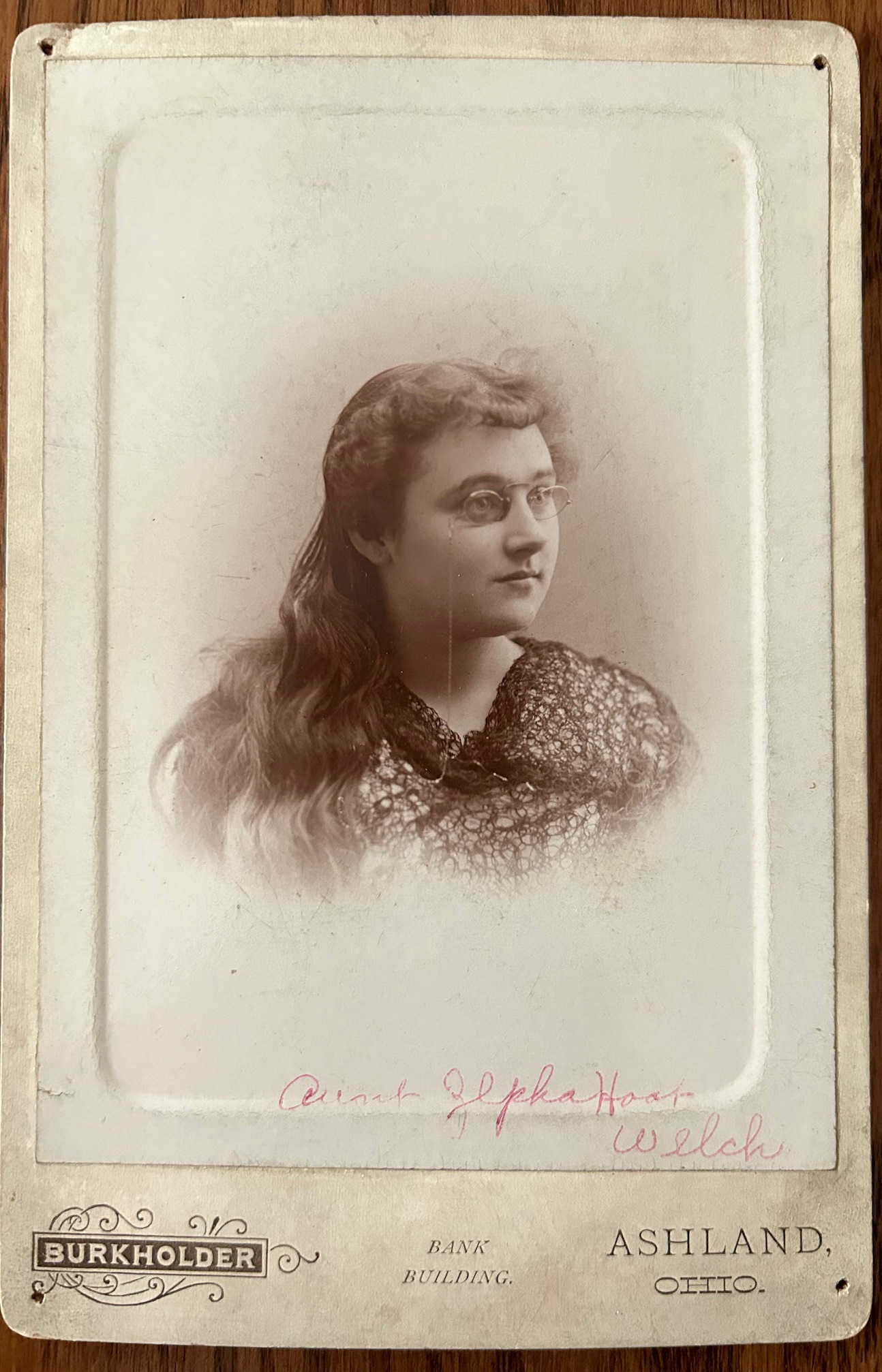
    Zelpha L. Hoot

    Portrait taken in Ashland, Ohio, probably around 1900; Inscribed “Aunt Zelpha Hoot Welch” (probably by her nephew, Kenneth Roseberry)

    The Hoot family lived in Nankin, in the southern part of Orange Township, Ashland County. Zelpha’s father was a successful saddler, and he and Frances had one more child, Walton Wesley Hoot, in 1879. The eight Hoot children grew up in Nankin, but John eventually retired from the harness-making trade and after 1890, moved to Mount Vernon in Knox County to run a boarding house.

    Zelpha was 23 years old in 1900, and I suspect that is about when this photograph was taken. She would have finished school by then, and while the census did not record an occupation for her, other girls her age have been recorded working outside the home.

    Zelpha married William Crawford Welch on 31 October 1900 and moved with him to Columbus. William was born in 1875 in Pennsylvania, and he worked as a brakeman and a fireman for the railroad. They had two daughters in Columbus: Leota, born in 1906, and Frances Dana, named for Zelpha’s mother and born in 1909. William died on 10 September 1917, and Zelpha found work as a dressmaker and as a bookkeeper to support her daughters.

    On 4 March 1924, Zelpha married Edward L. Kraner in Columbus. Edward was a widower whose first wife had died in 1911. He and Zelpha were only married for a few years, and by April of 1930, Zelpha was divorced from him and living in San Diego, California, with Frances. This may have been related to legal and financial troubles. In September of that year, the Columbus Mutual Life Insurance Company sued several defendants, including Edward and Zelpha, in a case involving a mortgage on a property in Columbus claiming the defendants owed taxes and assessments. According to an item in the Mansfield News Journal1, the plaintiff asked:

    …that in the event of a sale that in execution on the judgment a commanding officer cause the money to be made out of goods, chattels, rents, etc., and that the property of Edward and Zelpha Kraner, be exhausted before any of the property answering defendants be taken on execution.

    Zelpha’s elder daughter, Leota, married Walter William Roseberry (1904–1990) in 1928, and they raised their son, Kenneth William Roseberry (1932–1991), in Columbus. By 1933, Zelpha and Frances had returned to Columbus, where they lived in Leota’s home at 50 Wisconsin Avenue. Zelpha worked as a nurse, and later, as a dressmaker; Frances found work as a clerk. They remained there until 1940, but by 1942, Frances was married to Roy D Gilmore, and Zelpha resided with them in San Diego.

    Zelpha L (Hoot) Kraner died on 12 August 1951 in San Diego, California, and was interred at Cypress View Mausoleum and Crematory. Roy Gilmore died in 1957, and after that, Frances moved back to Columbus, where she died in 1963.

    Zelpha’s only grandchild, Ken Roseberry, had one daughter (still living) who also had one daughter (still living) – which means that Zelpha’s great-great grandchild’s closest cousins from the Hoot family would be 3rd or 4th cousins, at best.

    Connections that distant can feel like they don’t count for much – and yet, they are connections. After so many generations, Zelpha’s descendants are just as much a part of James Callin’s legacy as I am. We don’t need to share a name for that to be true.

    1

    News Journal, Mansfield, Ohio; Wed, Sep 3, 1930, Page 6,

  • The story behind the book

    You can get your copy here:

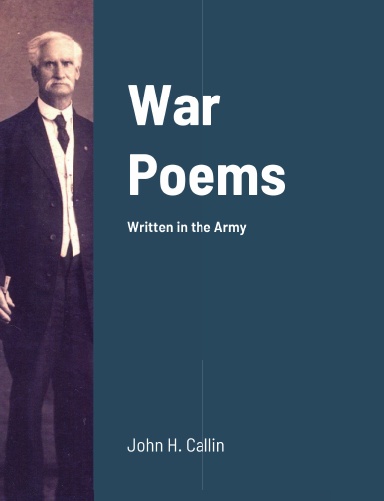
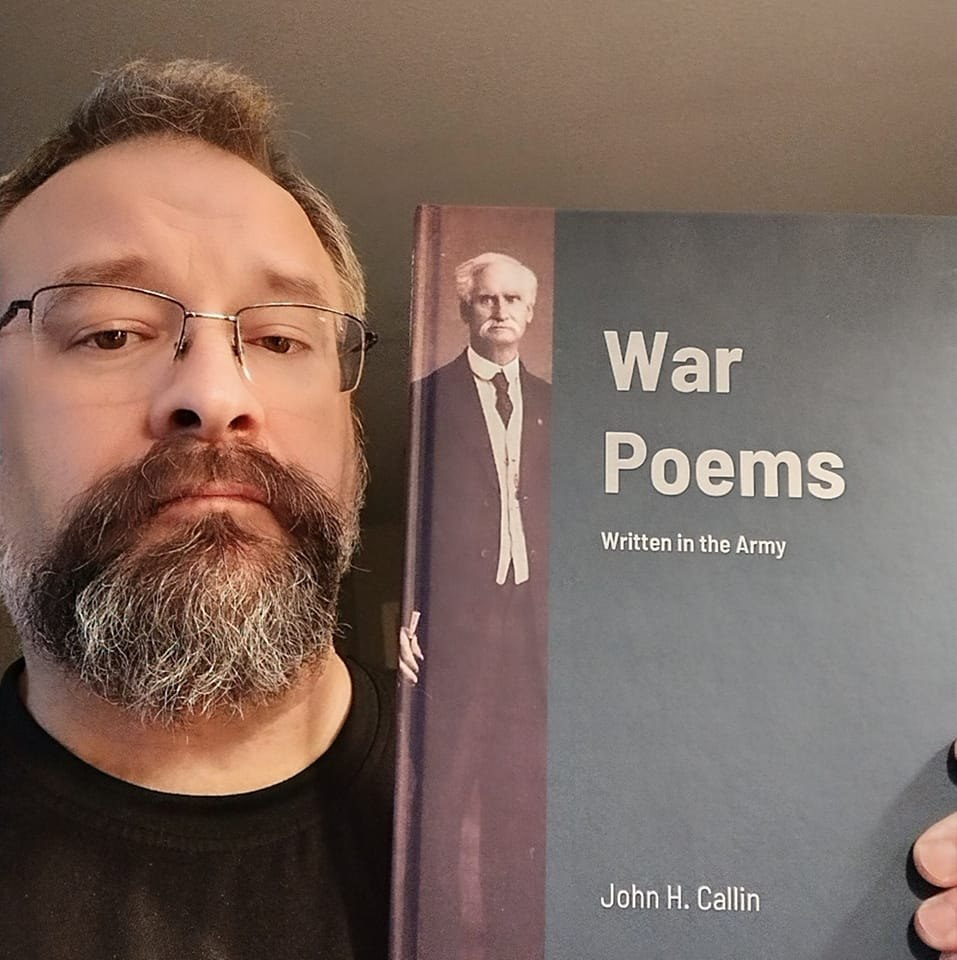
    War Poems:Written in the Army
    Hardcover (only): $38.10

    I don’t remember when I first learned about Grandpa John’s book of poems, but I feel like I remember the adults – Dad, Aunt Vicki, Grandma Nancy, and Grandpa Bob – were standing between me and Grandma’s swimming pool at the time, so details are going to be sketchy.

    It would come up on occasion over the years, but it was always something that “Grandma has stashed away somewhere” or, later, “Vicki has in a treasured place of honor.” They probably found it amongst boxes of photos and keepsakes when they were clearing out the old house on Gardenia Avenue in the early 2000s. I think I remember Vicki writing a paper on it and whenever the subject came up, she praised her great-grandfather’s grasp of meter.

  • Surveying the surface of an ancestral ocean

    Last week, I wrapped up the last of the “Family Reunion” series, which gave a (sometimes) brief overview of who each of my sixteen great-great-grandparents was. That was useful because it forced me to revisit each of those families, confirm my connection to them using documentary evidence, and review the WikiTree profiles for each of them. And, I did the same thing for my wife’s Sixteen – which means anyone descended from any of those 32 people should be able to find a connection back to us if they can trace their ancestry back that far.

    Today I’d like to build on that foundation with the first in a new series. “Wavetops” will look at individuals who are as far back on any given branch of my tree as I have been able to go. They might be someone who puts me up against a brick wall – or they might just be someone who got neglected while researching other lines.

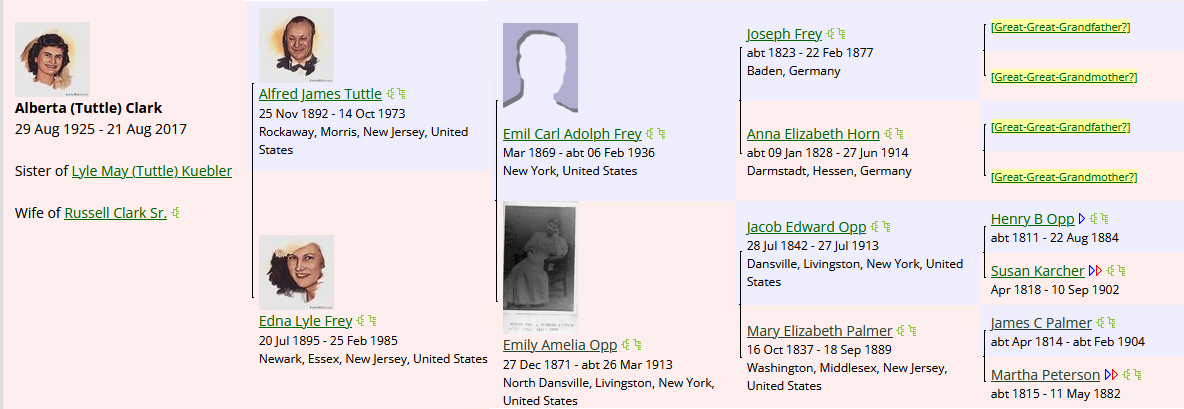
    an edited screenshot of the WikiTree profile for Alberta (Tuttle) Clark
    Maternal ancestry for my grandmother, Albert (Tuttle) Clark

    James C Palmer was my 4th-great grandfather. I felt he was a good first Wavetops subject because a) he was a shipbuilder, and b) his name was “Palmer” – as in, the Palm Tree Approach. (I assure you, I am very funny.) The real reason, of course, is somebody on Ancestry asked me a question about James Palmer, and I went on a three-day bender of research to get them an answer – and it turned out I hadn’t written about him here, yet.

    Fun fact: I first signed up for WikiTree on 6 Jun 2019. Before that, I was posting whatever information I could gather into long blog posts at my old Mightier Acorns site. The entry for James C Palmer and Martha Peterson was posted on Sunday, July 16, 2017. And if you look at the “Changes” tab on his WikiTree profile, you can see that I created James’s profile on 17 July 2019 – two years and a day after posting his bio on the blog.

    What I find fascinating about all of this is that the two versions (the blog post and the wiki page) were researched independently from each other. The information I collected and used to write the blog post is in one large, private “master” tree on Ancestry, but the information I used to build the WikiTree profile was collected in a tree called “The Alberta Tuttle Project” – which is public, so you should be able to view it with your (free) Ancestry account. The point of the Alberta Tuttle Project was to rebuild her tree using only verified sources and to apply the skills I had developed for finding and documenting evidence while working on the Callin Family.

    The conclusions I made about the Palmer and Peterson families seemed to hold up between one version and the next, but I found more sources (particularly the 1850 Census) and a lot of city directories with clues that helped me flesh out James’s biography. Now I need to move on to his children and build their WikiTree bios.

    If you have already read his WikiTree page, I don’t have a lot to add to what is there. There is still work to be done on James; I have yet to find death or burial records for him or for Martha.

    Be sure to check out his “Research Notes” section. I did some searching on the people mentioned in the Palmer families in America, but I could not find the will for Alice Palmer mentioned in that story, nor could I find any evidence that belonged to the people named (Alice Palmer, his alleged wife, nor Isreal Palmer, his alleged father). I need to keep digging until I find evidence that either rules out Israel Palmer as James’s father, or tells me who his father is.

    Since all of James and Martha’s children were daughters, it’s highly unlikely that any of their descendants will carry the surname “Palmer” – but if you see are a Palmer and you see me and Carol (the other cousin listed in the “DNA Connections” section) in your DNA matches, you could be descended from a brother or cousin. That would be interesting, so say hello!

    I don’t really know where Wavetops will take us, but if you want to surf along with me: Subscribe!

  • The Box

    I got a call back from Wiley’s niece, Nancy.

    At first, she was understandably hesitant. A strange man calls out of the blue and tells you, “I am a family history researcher, and I think your estranged uncle (who you may or may not have ever met) just died.” What would you think?

    But we talked for several minutes, and I explained what had happened (remember part 1 from two weeks ago?) and how I had gotten involved. Since Wiley was a veteran, there were certain benefits available to next-of-kin (ie, not a distant relative like me), and without a family member to sign for those benefits, it wasn’t clear what would happen to his remains or his estate. I gave her the contact info I had – for the apartment managers, the neighbor, for me – and assured her that while I was curious about my distant family, I did not feel entitled to any information or keepsakes.

    Wiley’s older sister, Fran, lives in California, in a town not more than a 45-minute drive from San Francisco. She hadn’t seen or heard from Wiley in nearly 40 years – and hadn’t know where he was or what might have happened to him.

    Fran couldn’t recall whether there may have been some disagreement over money or a business proposal – the sort of thing that might have seemed critical at the time – but the point was that Wiley had chosen to isolate himself from his closest relatives for his last decades. Now the fact of his death had forced an end to that isolation and robbed them of any chance at reconciliation.

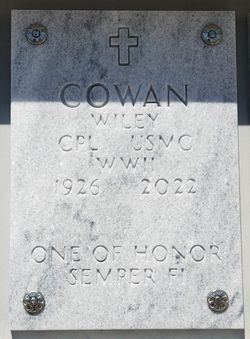
    When the dust settled and Wiley was at rest in Sacramento Valley National Cemetery, his family found time to process what they had seen and learned.

    Going through Wiley’s apartment and having to dispose of his possessions with limited time must have been excruciating, but it had to be done. There were some interesting discoveries. According to Nancy:

    He did have a few old books on WWII, one that detailed the 1st Division Marines arriving in Okinawa, and on the cover of the book, he wrote, “I was there!” … Life has sure changed in the years since Wiley was there. There were also a few pictures of him as a much younger man and we kept them. Truthfully, it was emotional for my 99 year old mother as he had no pictures of any family and she basically feels she never knew him. Apparently he and my grandfather did not get along, and he left home immediately after high school.

    In the end, I think we all felt better for having done our part. Nancy told me:

    We are all doing well, and we do feel some closure about Wiley, especially my sister and me. His picture was always on my grandmother’s dresser and we often wondered where is our uncle, but no one talked about him. His expired passport reveals lots of travel to England and South America…

     It has been interesting for our family to get to know him this summer, but h[e] is now in the VA Cemetary and [we] feel this chapter is closed.

    A few months later, they kindly sent me some things they thought might interest me. They were right! However, I was moving into a new house at the time, and between moving in and renovating, it took me several months to find time to see what was there.

  • Where did Wiley Cowan come from?

    After the Revolutionary War, we lost track of James Callin. We don’t know for certain where he lived or how many children he had, but we are reasonably sure that he had two sons, James and John, who settled on a farm together between 1810 and 1816 in what would soon become Milton Township, Richland County, Ohio.

    Between them, James Callin and John Callin had 15 children (that we know of) – cousins who all grew up on that farm near the town of Olivesburg. James died in 1820, after being struck in the head with a rifle by a neighbor; John died in 1835 from tuberculosis. And between 1835 and 1840, those 15 cousins got married and began to move away.

    Of John’s nine children, only two sons remained in Ohio. His fifth child, Eliza (1811-1870), married James L Ferguson (1810–1886) about 1832, and after the birth of their tenth child in 1848, they moved to Auburn, Indiana, taking Eliza’s widowed mother with them.

    In March of 1847, while still in Ohio, James and Eliza Ferguson named their ninth child Eliza Ferguson. She grew up in De Kalb County, Indiana, and married Welby N. Myers (1842–1931) there on 16 April 1863, two years into the Civil War. Their eldest child of five was born almost exactly one year later on 13 April: Mary Augusta “Mollie” Myers.

    (Coincidentally, Eliza’s older sister, Sarah, married Welby’s younger brother, Daniel – just to give you an idea of how close the Myers and Ferguson families in Auburn were.)

    Mollie married in Knox County, Indiana, on Valentine’s Day 1884; her new husband, Richard Jefferson Davis Cowan (1863–1948), took her back to his hometown of Greenville in Wayne County, Missouri. They had eleven children, including their fourth child, James Wiley Cowan (1879 – 1973).

    James – who went by either “J. Wiley” or just “Wiley” – grew up in Wayne county, surrounded by extended family from his father’s side. The Cowan family was prominent enough to claim at least one elected congressman, and in the 1870s, there was even a small town called Cowan. But they all worked hard to support themselves in Greenville, and several of Wiley’s siblings left Missouri to seek their fortunes elsewhere.

    Wiley married Beryl Viola Ferguson (1897–1965) on 10 Jan 1919 in her hometown of Paragould, Greene, Arkansas. (I have not been able to find a connection between Viola’s Ferguson ancestors and Wiley’s, but I doubt they were related closely, if at all.) There is no evidence that Wiley served in the war, and his WWI Draft Registration, dated 5 June 1917, stated that he was farming in Mississippi County, Arkansas, to support his parents and siblings.

    After Wiley and Viola were married, they moved Wiley’s parents to Hornersville, Dunklin County, Missouri, and Wiley and Viola went to Detroit. There Wiley probably found work in the auto industry. His older brother, Uriel Cleveland Cowan, had also moved to Detroit, but most of the rest of his siblings either remained in Missouri or gravitated to Illinois or Saint Louis.

    By 1930, they were established in Detroit with their son and daughter, and Wiley worked as an auto mechanic. They lived in Detroit until after 1942, occasionally returning to Hornersville to visit.

    Wiley Cowan family visits, item from Nov 18, 1938, The Twice-A-Week Dunklin Democrat (Kennett, Missouri)

    Cowan reunion Article from Aug 7, 1941, Greenville Sun (Greenville, Missouri).

    Wiley Davis Cowan was born on 11 Jan 1926 in Hornersville and grew up in Detroit and Muskegon, Michigan. He started school at Muskegon High School in 1941. Then, about 1943, his father moved the family to Arcadia, Los Angeles County, California.

    It’s not clear why James Wiley moved his family to California during the war – though wartime opportunities for machinists may have been a factor. His youngest brother, Brewster, and their sister, Thelma, had settled in the L.A. area about 1930. One of his brothers, Everett Austin, had lived there in the early half of the 1930s before returning to Missouri. Another sister, Bessie (Cowan) Krapf, moved there after Wiley’s family did. But even if they were a close-knit family, none of young Wiley’s aunts or uncles had kids his age for him to bond with.

    We can only imagine how the disruption of leaving his friends and his home behind in the middle of high school affected Wiley, and we only have hearsay from surviving relatives who had the impression that he didn’t get along with his father. What we do know is that Wiley Davis Cowan enlisted in the U.S. Marine Corps as soon as he was 18.

    Private Cowan spent the latter half of 1944 and all of 1945 in the First Signal Company, Headquarters Battalion, of the First Marine Division. We don’t have records that tell us exactly where and when he served, but the First Marine Division was heavily involved in the island fighting in the Pacific Theater and it seems unlikely they would have left eager young leathernecks in California during the Okinawa campaign.1

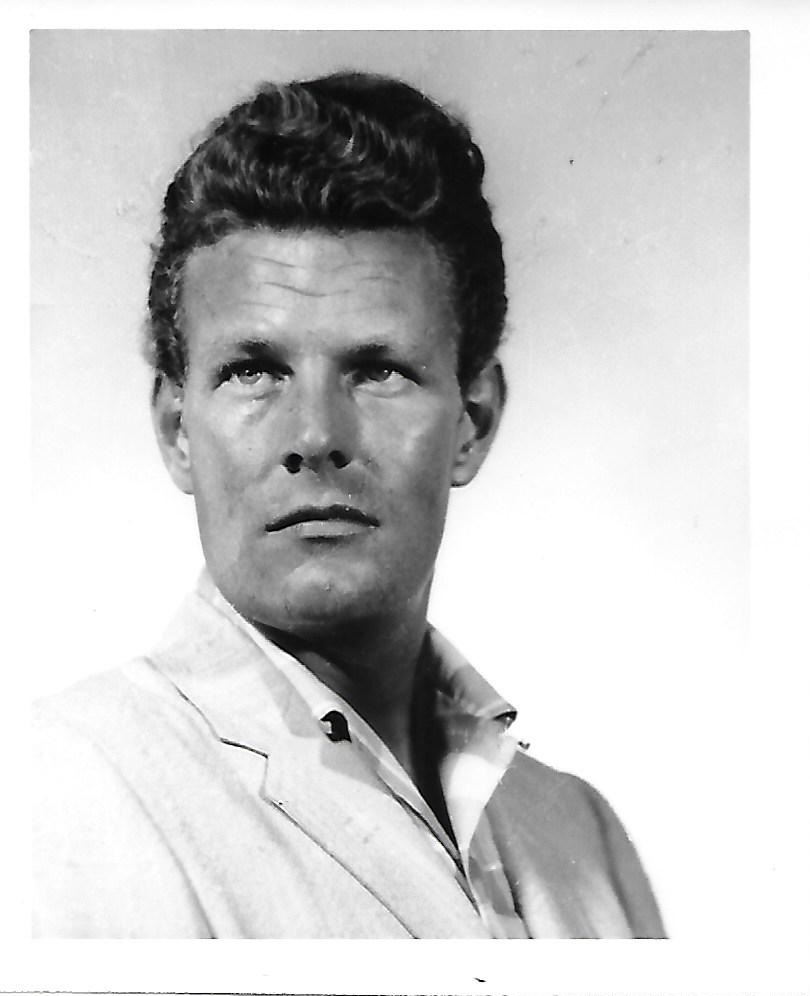
    portrait of Wiley Davis Cowan, probably taken in the early 1950s
    Wiley Davis Cowan, early 1950s

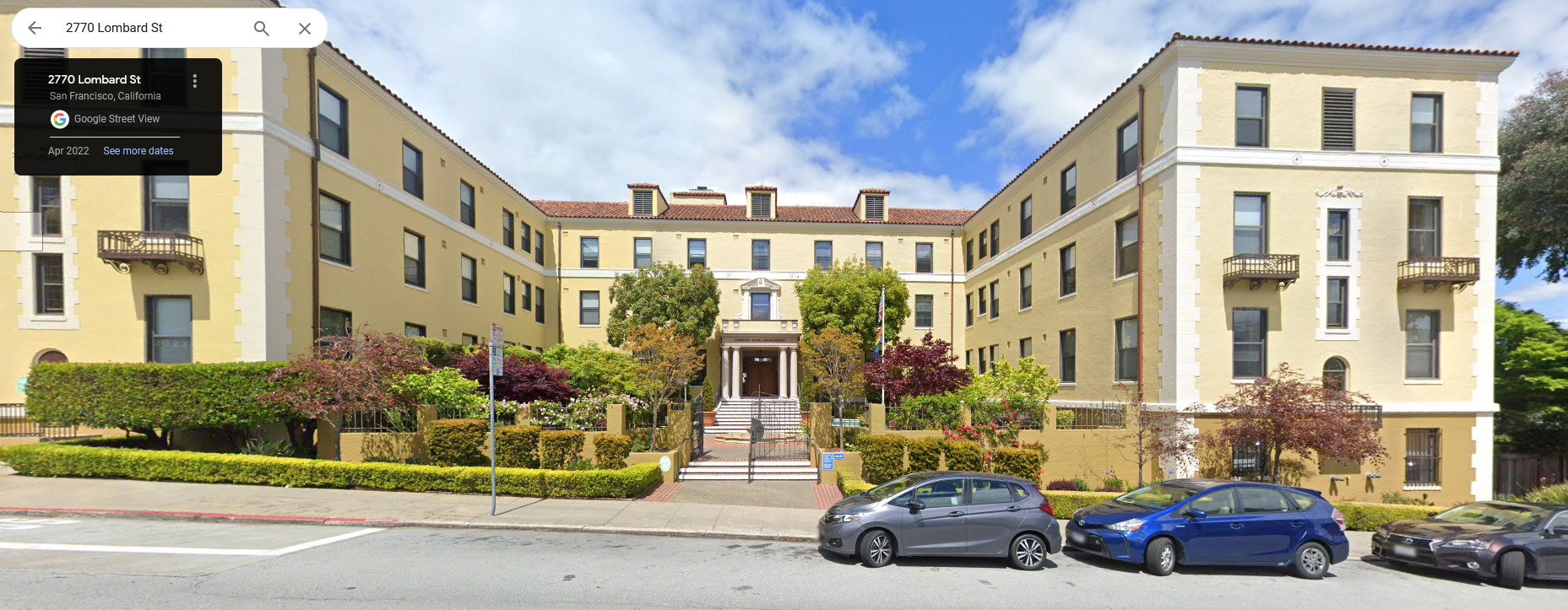
    Some city directories place Wiley in California during the 1950s, and there is evidence of an April marriage and August divorce in 1968, but I don’t know much else for sure until he appears in San Francisco in 1989. In 1995, the city directory placed him in his apartment at 2770 Lombard Street and he remained there until 2022.


    There’s a remote chance that someone out there who knew Wiley might be reading this. If you’re comfortable saying hello in the comments, then please use the Contact Form.

    And if you haven’t already subscribed, you can do that for free anytime – and make sure you don’t miss next week’s post!

    1

    Thacker, Joel D. Thacker, USMC; The History of the 1st Division Through World War II, from the Leatherneck Archives: October 1945, hosted by the Marine Corps Association, https://www.mca-marines.org/, accessed 14 July 2024.

  • Going four generations back to find another line

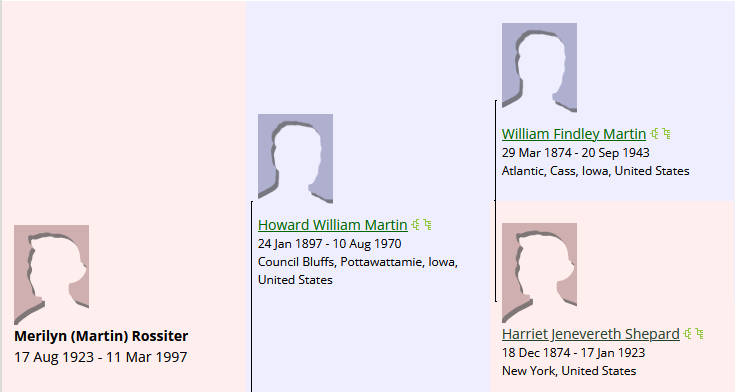
    This surname can be found among my wife’s Sixteen great-great-grandparents. We have to go that far back to find the first Shepard –

    Harriet Jenevereth Shepard – 18 Dec 1874 – 17 Jan 1923

    Merilyn Martin’s paternal ancestry

    Hattie was the paternal grandmother of my wife’s maternal grandmother, Merilyn (Martin) Holmquist Rossiter. Hattie was the wife of William Findley Martin (1874–1943) and we talked mainly about their son, Howard, in the Martin post last year:

    I am always fascinated by unusual names, and “Jenevereth” is one of the most unusual given names I’ve encountered. Hattie seems to have gotten the name from her maternal grandmother, and I know at least one of Merilyn’s cousins was given the name in honor of Hattie.

    This spelling of “Shepard” is also a bit unusual. Still, the records I found for this family consistently used that spelling, and Hattie’s father is buried under a marker with that spelling. My rule of thumb is that if a family paid to set the name in stone, they probably got it right. (Not always, but often enough!)

    Hattie’s parents were Sylvanus Sylvester Shepard (1850–1921) and Lucy Gertrude Rounds (1848–1920).1 Sylvanus and Lucy were from near Rochester and Syracuse, New York, respectively. They married around 1869 and moved from Onondaga County, New York, to Council Bluffs, Iowa, between 1875 and 1880. Hattie’s two older siblings, Otis D Shepard (1870–1954) and Lillian M (Shepard) Schmidt (1872–1943), both married and each had two children they raised in Council Bluffs.

    Sylvanus Shepard is the youngest son of Anson Nathaniel Shepard (1803-1857) – and his wife, Eunice; but I only recently figured out that there are two men named Anson Shepard with wives named Eunice, and most researchers seem to have them mixed up with each other. Sylvanus was born just after the 1850 Census, so he doesn’t appear in that record but in the New York State Census in 1855. From there, we can see that the family we’re interested in lived in Ogden, Monroe County, New York, and the records suggest that Anson was born around 1803 in Massachusetts, and died between 1855 and 1860.

    I’ve been able to piece together a tentative biography for Sylvanus’s parents, but I’m still searching for records to confirm some of my guesses. For now, the editable sources (Find-A-Grave, Geneanet, and some of the index databases) are a bit messed up. What I can tell is that Anson had at least 8 children with three different wives and he is the youngest son of four born to his parents, Nathaniel and Alice Shepard. Our Anson Shepard was born on 10 Jan 1803, in Otis, Berkshire County, Massachusetts.

    If you’ve got Shepards in your tree, and they look like they might connect to any of these folks, let me know!

    1

    I have not had the cycles to add this branch to WikiTree – but if you’re looking for a chance to practice making WikiTree profiles, I can send you the Ancestry link to any of the folks in this post so you have my sources and notes.

  • Part 1: A note from San Francisco

    On 10 June 2022, I found a note in my Ancestry messages. It began:

    Hi Tad . . . this will seem odd. Your tree shows J Wiley Cowan. Do you have any contact with his family? His son Wiley died in my senior apartment building a week or so ago he was 96. The management “claimed” he had no living will or contacts. Therefore, they will basically keep all of his possessions. I thought to go to Ancestry.com to see if there are any relatives out there.

    I had just published my Callin Family History that March, documenting as many descendants of James Callin as I could, and I remembered the Cowan family. I did the bulk of my work on their branch in 2016 and posted what I had on my old Mightier Acorns blog: Myers Family B – The Cowans of Missouri.

    James Wiley Cowan (1879-1973), Wiley’s father, had two children – and since both were living in 2016 when I was researching that branch, I did not post any information about them. But Wiley’s neighbor, Bronte, had found my work on Ancestry, and she went on to give me some details.

    Wiley lived at 2770 Lombard St., in San Francisco, CA. He was the sweetest of men and it was heartbreaking that he died. He was 96. I found a sister listed but she would have been older. In cases like this the management basically just keeps everything. I know Wiley use to get letters and read them in the lobby. But they will not bother to look for anything. It’s not that he was rich but to see people in his unit that he kept so lovely looting through his life makes me sick. If there are any relatives near San Francisco they should have the right to his things, not managers who are not very nice, to begin with. I know Wiley was a Marine which he was very proud of. Again, sorry for writing out of the blue like this.

    Google maps street view of Wiley D. Cowan's apartment building at 2770 Lombard St., San Francisco, California
    Wiley’s apartment building (on Google maps)

    In the eyes of the law, I am distantly related to Wiley – 4th cousins, once removed – which means that legally, I have no right to claim any “next of kin” status. I did my best to find someone more closely related, but the folks I could find contact information for were almost as distantly related as me, and worse, no one had any memory of James W. and Beryl Cowan. They had moved to California and lost touch with all the family in Detroit and Missouri.

    I gave Bronte the limited information I could find, but after a couple of days, she was no closer to finding an answer.

    The manager is refusing to even take the names of the family members as far as they are concerned they own everything in Wiley’s apartment. Legally they can not even enter the unit as Wiley’s June rent was paid in full until the 30th.

    I think it is important you make contact with the owners of this property. I have seen this before. A very old person dies they claim they had no contact, which makes no sense as we are required to provide one. What they will do is come in and basically loot the apartment of anything valuable and then let the other tenants come for the rest of the property. They are like piranhas fighting over things. Wiley had a lovely apartment with many things he loved in it they should go to his family or to a charity.

    There is also his savings and checking account that will revert to the government if a family member does not come forward.

    Wiley would have been taken to the Veteran’s hospital in San Francisco… He was a Marine. The story from the management was he fell over the holiday weekend and was found, still alive, by his health care person. That is someone who you need to talk to.

    Wiley told me he had a living will. The manager said he did not. The manager is not a person I trust or respect. Only been here a year.

    Again, I had no legal claim to get involved with any of this – and I had just moved to San Antonio the year before, so I was nowhere near the West Coast. Next of kin could contact an elder care attorney to guard Wiley’s property and ensure his family received it. But that wasn’t me.

    The situation felt a bit desperate, so I dug deeper. Wiley’s sister had eluded me before, but I went back and pored over all my other documents, looking for clues.

    I found some.

    There was evidence that Wiley’s sister had married – and while she appeared in early records under what turned out to be her middle name, she began using her first name when she got older. She was older than Wiley – about three years older – so I thought the odds that she might still be alive were slim, but I could find no death records or obituaries for her.

    But once I knew her married name, I found an obituary for her husband and tracked down her daughter’s phone number. If you know me well, you will understand how hard it was for me to make a telephone call, but I did it.

    And I left a message.


    On the off chance that you recognize the Cowan family, please say hello!

    I have more to tell you, next week – when will I tell you about Wiley’s family history connection to the Callin Family History – so if you don’t want to miss the next chapter, be sure to subscribe. My newsletter is free, and you don’t have to give Substack any information you don’t want to give to access my posts.

    Hold on, Wiley! We’re coming!