Mightier Acorns

Journeys through Genealogy and Family History

A parody of a family coat of arms designed with acorns as elements, with the motto "ex gladnis potentioribus" Latin for "from Mighty Acorns"
From Mighty Acorns
  • What does social media do for you or your research?

    This post was intended to be a “here are some social media platforms I’m on and some of the people/groups I follow” post, but I felt like some explanations were needed, and it kind of ballooned into … this. If you already know or don’t care to know what a mess the social media environment is in, and you just want to see my links to other platforms, skip down to “Some Other Platforms.

    The Backstory

    For a while, from about 2008 to 2012, I taught a class on “virtual collaboration” to federal employees. After the 9/11 Commission Report was released in 2004, the ODNI (Office of the Director of National Intelligence) pushed to make it easier for the military and intelligence agencies to share information. This was a hard cultural problem because decades of tradecraft were built around compartmentalizing and protecting information so that “the adversary” could not use it against the U.S. Part of the solution was to allow organizations to create tools and platforms on their internal that mimicked the features of various successful social media platforms on the open internet.

    The Intellipedia trowel is awarded to those who contributed significantly to improving the encyclopedia.

    My favorite tool was Intellipedia, built using the open-source Wiki Markup software that powers Wikipedia. There were also attempts to recreate platforms to provide the features of Facebook, Twitter, Reddit, and more specialized services for things like social bookmarking. But like their Internet counterparts, none of these tools had any value without users. That’s where my class came in.

    Teaching this course was a challenge for several reasons. For one thing, people with careers in the intelligence community tended to avoid social media, so we had to teach them about the social media environment “in the real world,” sell them on the idea of being social in a professional way, and then show them how a one-to-many communication tool like Facebook would be more helpful to them than email.

    Every class I taught had at least one crusty old coot sitting in the dead center of the room who would listen with a confused look on their face as I walked them through the benefits of working collaboratively, and they would always wait until everybody else was on the verge of accepting the new way of thinking I was offering – and then they would ask:

    “But what is this Twitter thing FOR? Who has enough of an ego to think anyone will care what they think?”

    Thanks for reading Mightier Acorns! Subscribe to feed my ego and show you care what I think.

    What Is It All FOR?

    I never did have a good answer to that question. The correct answer is “The platform is FOR you to connect with people who share your interests and coordinate with them to achieve goals you wouldn’t be able to achieve on your own.”

    But the last decade has shown us that the owners of the platforms aren’t always interested in your goals.

    Facebook has been selling user data, using its algorithm to keep you from seeing what your friends and family post (the people who share your interests), and pushing targeted ads into your feeds, including disinformation from foreign governments seeking to sow chaos and doubt in our population. Twitter is no more, having been purchased by a billionaire who changed its name to “X” and made the platform unusable for anything but political influence.

    Back in 2008, when optimism was a realistic view to hold, none of this had happened yet. Not that there weren’t people valiantly warning us that it could happen. People like Cory Doctorow told us early on that we could not and should not trust tech corporations to protect our privacy or our speech – and in 2023, the concept of “enshittification” of social media became more widely understood as people began to catch up to what has been going on for years.

    Now we are in a place where people like us – people who want to build a community around a shared interest like Genealogy – have fewer options for doing so. And we have to be more careful about where we invest our efforts so that we are not simply exchanging one bad corporate actor for another.

    So What Can We Do?

    If you’re reading this, you’re probably already on the Substack platform. Substack (so far) appears to have solved part of the enshittification problem by building itself around a business model that centers us – the users.1

    Conventional wisdom tells us “If you are not paying for a service, then you are the product.” We’ve seen how that played out with Facebook and X-Twitter; and for the time being, Substack seems to derive its income from taking a cut of the contributions that readers can pay to writers. This is good, in that the corporation’s motivation is to increase the number of readers, and thus the amount being paid to writers/creators.

    Substack’s main purpose is to give a platform to newsletters and podcasts, but they also offer Notes as a Twitter-like tool for spreading awareness and fostering discussions. The algorithm there still seems to be tailored to pushing things that Substack wants you to see to the top of your Notes feed – instead of giving you the option to see newer posts from your friends, first.

    Even if you like and trust Substack right now, it is probably a good idea to diversify – if you have a presence on more than one platform, you are more likely to attract an audience from there to your Substack or to find your way to communities or content creators that are not on Substack.

    Some Other Platforms – and who to follow there

    Bluesky – I am @tadmaster.bsky.social I don’t post much, and when I do, I usually re-post things I like or promote my Substack writing. If you’re looking for interesting people to follow there, click here to see the list of who I follow. They tend to be people from three main circles:

    1. writers and podcasters associated with my work as an associate editor for Pseudopod

    2. Genealogical societies and enthusiasts

    3. music people

    Bluesky logo - from Wikipedia
    By Eric Bailey – Own work using: https://drive.google.com/drive/folders/1RDpuQOQMfM9mXQ61wUYWNZUbgvDc8r-n, Public Domain, https://commons.wikimedia.org/w/index.php?curid=145139541

    Reddit – I am u/Tadmister, but Reddit is more about following communities than individuals. I belong to several fan-based communities built around sci-fi franchises and musicians. To get an idea of what to expect, dip your toe into:

    Mastodon – this one is a little tougher to get into – but for the genealogy community, there are a few different servers you can join. I am @mightieracorns@genealysis.social

    I use the Tusky Android app to access and post, but I haven’t found Mastodon to be as easy to work with as Bluesky, Notes, or even Facebook.

    WikiTree – yes, wikis count as social media! If you sign up for a WikiTree account, look for me at Callin-50; you can use their Connection finder to calculate how closely we might be related.

    Wikipedia – the granddaddy of the wikis. I have not actively edited in quite a while, but I am still there as User:PapaSmirk, and I have been a financial supporter for many years.

    Do you have a favorite?

    Who/What to Avoid

    Meta (aka Facebook, Instagram, Threads) – I’m still on Facebook, and I try to maintain the Mightier Acorns page there, along with a couple of private groups (that don’t have any activity). If I recognize your name, I might accept a friend request – but they have been swamped with bots and fake accounts lately, so I might not see your friend request or might not know if I can trust it. I have an old Instagram that I ignore, and won’t touch Threads or any of their new products on principle.

    X (formerly Twitter) – the biggest and most notorious flame-out in the history of social media. Elon Musk famously purchased the platform, fired anyone capable of making it function, and turned it into an attack vector for cyber-bullies and foreign political influence. If you find either of my accounts there, @tadmaster or @mightieracorns don’t expect much interaction. I keep them alive only to prevent someone from stealing my identity.

    Some platforms are purpose-built to advance ideologies or specific communities that I wouldn’t be welcome in or that I would avoid on principle. There are dozens of these.

    For example, “Truth Social” was created to give a former U.S. president (and now president-elect) his own platform after he was kicked off of social media for organizing a coup. If you are sympathetic to him, politically, or to his principles2, you might be tempted to join that platform – but you should be aware that its “free speech” ethos is a cover for launching scams and cybercrime activities aimed at its users.

    Whatever platform(s) you decide to use, do your homework first, be careful with your personal identifying information, and protect your wallet.

    1

    We should all remain skeptical of corporate motivations; if their business model changes, or if they are bought by a larger media company, we could end up back in a Facebook-like situation.

    2

    If you are sympathetic to him, you probably won’t be happy with much of what I have to say about him. The actual truth hurts.
  • Wavetops: James McCullough (Sr.) (1757-1838)

    When John McCullough died in 1766, he left four orphans without family or support in Rowan County, North Carolina. The courts bound each child to an apprenticeship, each with different terms.

    “II:679. 16 Jan. 1767. Orderd P Cur that JAMES McCULLOH Orphant Child of JOHN McCULLOH Decd Be Bound to JAMES SMILEY to larn him the Art, & mistery of a Weaver he being Aged 9 1/2 Years Old & that he Sarve his sd Master till he Arive to the Age 21 Years & to Give, him at the Experation of his sd Time a Loome & Tackling to the Value of 4 pounds [symbol] in Money & to Comply with an Act of Assembly in Such Cases Made & Provided &c”

    In her 1991 Ph.D. dissertation, Johanna Lewis1 noted that of 52 orphans placed as apprentices before 1770, only one (a Martin Basinger) completed his apprenticeship and remained in Rowan County working as a hatter. Based on his age in Jan 1767, James would have turned 21 in 1778, but in the fall of 1775, one of the few things that could release an apprentice from his bond presented itself, and James enlisted in the North Carolina Line under Col. Martin’s Regiment.

    Becoming Lieutenant McCullough of Kentucky

    James McCullough (1757-1838) enlisted as a private from Rowan County in Col. Martin’s Regiment – most likely referring to the 2nd North Carolina Regiment – serving 9 months beginning in the fall of 1775, and his record placed him in the 1776 Battle of Sullivan’s Island, soon after which, his enlistment expired. He re-enlisted for three more terms in 1777 and 1778; in the spring of 1778, James moved to Kentucky County, Virginia.

    In Kentucky, James signed up under Capt. William Smith’s company to guard some families moving to Kentucky, and he continued with them until they reached Harrodsburg. From Harrodsburg, the company marched to Logan Station, where modern-day Stanford now stands, and during that tour, James was wounded in a confrontation with Indians. When he recovered, he was employed as an Indian Spy until he was ordered into service in the militia of the State of Virginia at Harrodsburg in May 1779.

    At the time, Kentucky was known as Kentucky County, Virginia. In 1780 it was divided into Lincoln, Jefferson, and Fayette Counties. In 1785, the part of Lincoln County around Harrodsburg became Mercer County. In 1792 Kentucky separated from Virginia.

    From May 1779, he was a Lieutenant in Capt. McGary’s Company of Col. Bowman’s Regiment, and served during an expedition against Indians on the Little Miami. His unit was in the Battle of Blue Licks on 19 August 1782, and his name is included on the monument at the Blue Licks Battlefield State Park near Mount Olivet.

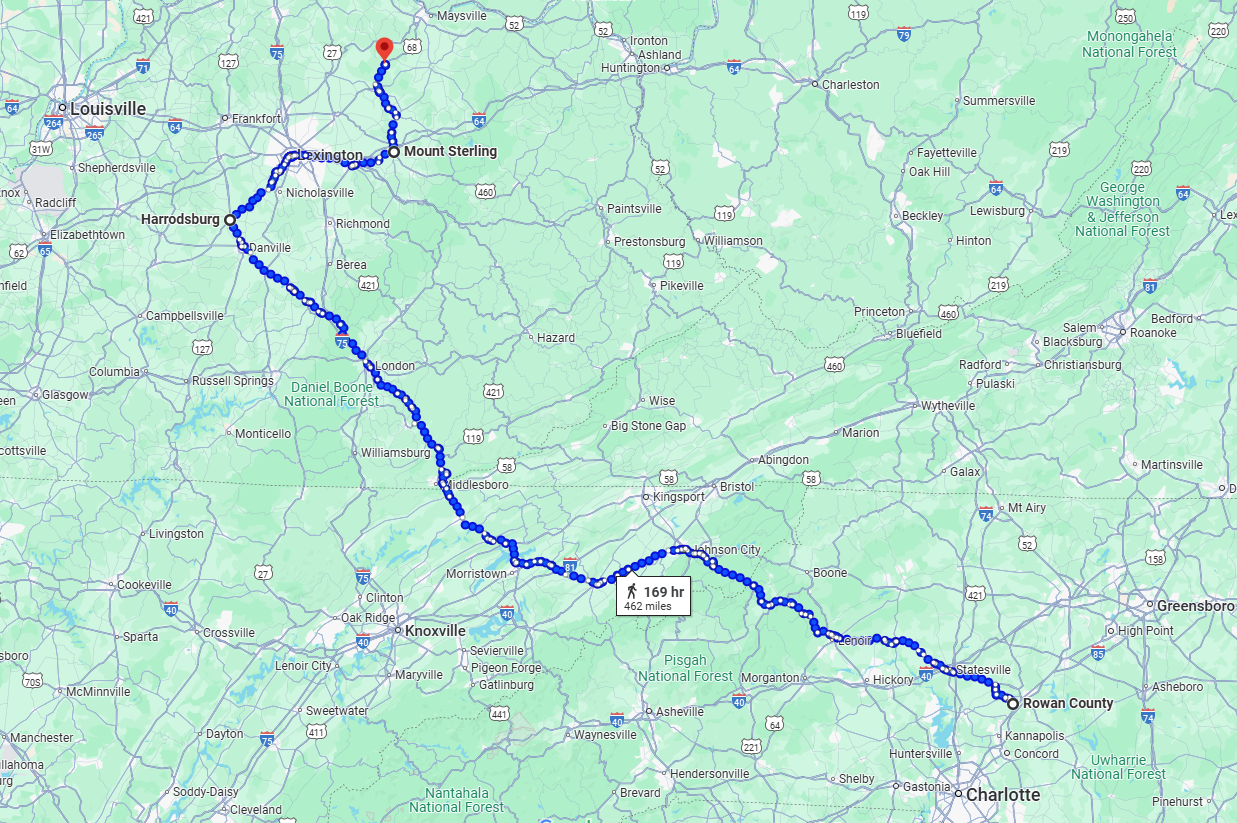
    map of North Carolina and Kentucky, showing places where James McCullough lived or served
    Born in Rowan County; traveled to Harrodsburg, settled in Mount Sterling. Red pin indicates location of Battle of Blue Licks, near Maysville.

    Landowner in Mercer County, KY

    In 1794, James McCullough was on the Mercer County Tax List, with horses, cattle, and 300 acres of land in Green County. He bought 50 acres on the waters of Shawnee Run from Simeon Moore, out of Moore’s 1000-acre survey.

    In May 1776, Simeon Moore had come down the Ohio River with nine other men and traveled up the Kentucky River landing at a place they named Harrod’s Landing. The group surveyed the land and built ten improvements, then drew lots. Simeon Moore received the 1000-acre tract in what later became Mercer County.

    Simeon had three sons – Samuel, John, and Thomas – and by the time he made his will, his wife Mary, son Samuel, and daughter Drusilla were all deceased. He left $5 to the heirs of Samuel and $5 to the heirs of his daughter “Drusy” who was married to James McCullough.

    James and Drusilla had seven children, and their youngest son was James McCullough, Jr.

    After Drusilla’s death, James married Eleanor in about 1804 and moved his family from Mercer County to Mount Sterling, Montgomery County, Kentucky. They had six more children. According to the Maxcy book:

    “James evidently made a very good living for his family in Montgomery County. When he wrote his will in 1834, he was holding notes on several men and had loaned money to his sons, quite different from his Harrodsburg days – when he was the borrower. His will was a lengthy one as he tried to divide his assets equally among his children and he set everything out in detail. He was probably a strict parent, but a kind one, too. He visited his sons, Simeon and James, Jr., in Rush County, Indiana, (see p 6 ) about 1835 so he kept up with all of his family. He made a Codicil to his will in 1836, making a few changes and additions. James died in 1838.”2

    Wavetop sighting

    From this point, available information is sketchy, but the Maxcy book does give us some information about James Sr.’s ancestors. Next time, I’ll talk a bit more about what is in that book, and see what we can reliably say about them with evidence from available records.

    If you’re a McCullough cousin, say hello!

    1

    Lewis, Johanna Carlson Miller, “Artisans in the Carolina backcountry: Rowan County, 1753-1770” (1991). Dissertations, Theses, and Masters Projects. Paper 1539623804. https://dx.doi.org/doi:10.21220/s2-3kw4-kw88

    2

    Maxcy, Mabel E, McSween, Jimmie D.; James McCullough and Descendants, A Family History; 1991, Penny Press, Inc., Denton-Fort Worth-Arlington, Texas, U.S.A.


  • A Hard Row to Hoe

    You might recall I was very excited to find a book documenting this family last year:

    I finally got to spend some quality time looking at the evidence presented in this book and untangling some of the questions it raises – and when all is said and done, there are some interesting stories to share.

    But you have to sort through a LOT of men with the same two or three names: James, John, and William McCullough. Starting with John Riley McCullough (1848-1918) whose grandson, Bob, was my wife’s paternal grandfather:

    • his father was James McCullough (Jr.) – the subject of today’s post

    The Facts (as related)

    James McCullough, Jr., was the youngest child of James and Drusilla McCullough. His birthdate was passed down in a family Bible as September 1, 1804 – but where most young men in Kentucky were placed on the Tax Roll as voters when they turned 21, James, Jr. appeared in 1822, about three years early. His father also sold his Mercer County property in June 1804 and Drusilla did not sign the deed; this suggests she may have died before that date, which would mean James, Jr. was born earlier than that. This is why some sources put his birthdate in 1801.

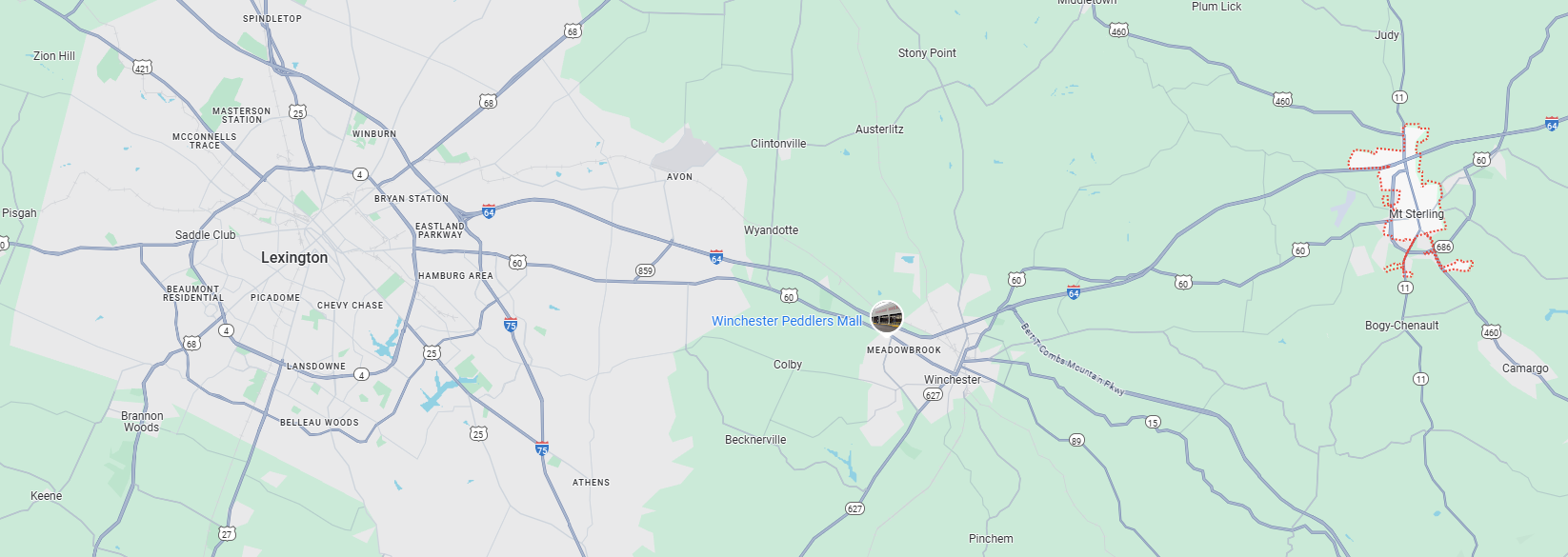
    map showing Mt. Sterling to the east of Lexington
    Mt. Sterling, Montgomery County, Kentucky

    James, Jr. grew up on a farm near Mount Sterling, Montgomery County, Kentucky. His mother (Drusilla) died when he was an infant, and his father remarried, so James was raised by a stepmother, Eleanor, and had six younger half-siblings.

    James married Nancy Fort (or Ford) about 1829, and their first three children were born in Kentucky. In April 1834, his father gave him 80 acres of land, which he sold to his younger half-brothers, Daniel and John, that September. In 1835, James and Nancy moved 170 miles north to Rush County, Indiana, where they bought 80 acres, about halfway between Cincinnati and Indianapolis.

    The dry historical facts and dates sometimes downplay how difficult this time was for a young family. When James and Nancy moved to Indiana, their first three children were a 5-year-old son, Benjamin Franklin, a 3-year-old daughter, Drusilla, and an infant James III. Little James III died in May 1836, and the Maxcy book reports that they lost another, unnamed infant in 1838 – possibly during childbirth. A daughter born in 1840, Emily J., died at age six – just a few months after her little sister, Hannah, was born in May 1846.

    One of James and Nancy’s surviving sons, Andrew, wrote this description of their life in 1896:

    “My father was in very good circumstances when he came to Indiana but like thousands of other men, he couldn’t say ‘No,’ when asked to go on Security1, and the result was, he was soon reduced to poverty – and his family increasing in numbers, and he growing older and less able to accumulate, poverty followed him the remainder of his life.

    “My mother was not a very stout woman. She was the mother of nine children, five of whom are living at this writing. We resided in Rush county . . . three years, then, having lost all his property paying others debts, we moved to the adjoining county of Decatur. But this move didn’t better his financial condition . . . he concluded Clay county was the ‘Eldorado’. So, on the 26th of December, 1842, we ‘struck our tent’ and started for old Clay.”

    “. . . two young men, friends of my father, living here and anxious to have Clay County settled up, hired an old wagon and came for us. This wagon broke down three times during the trip . . . we did not arrive in Brazil till January, 1843. The snow was about ten inches deep and the weather cold. . . Our entire possessions consisted of a few old household goods, such as could be crammed into the wagon, leaving room for my mother, five children and the driver. Our live stock consisted of one horse, a cow and six sheep . . . . It seems to me my parents must have had great courage to endure the situation, their whole earthly possessions less than $100, with five helpless children, in mid-winter, and it seems to me a more desolate, dismal and god-for-saken place would have been hard to find than Clay County at that time. No roads, no schoolhouses, no churches and no mills. The nights were enlivened by the howl of the wolf, and in summer you had to be on the alert to esape the fangs of the rattlesnake and copperhead. Neighbors were few and money was scarce.”

    Andrew was six years old when the family moved to Clay county. He was 14 when his mother died in October 1850, leaving James to care for Andrew and three small children – William (8), Hannah (4), and John Riley (2).

    James married Sarah Yocum (1826-1858) in about 1852; she was about 25 years younger than James, suggesting that he probably expected her to be around to take care of his children if anything happened to him. They had a daughter, Nancy, and a son, Charley, before Sarah died in October 1858.

    According to the Maxcy research, “A family took the young son Charley; Hannah went to live with the Francis Yocum family; William D. and Andrew J. went out on their own; so only John Riley and Nancy (Sarah’s daughter) were at home by 1860, and their father died in 1864.”

    The Facts (as contradicted)

    A lot of these facts are relayed to us through secondary sources – like Andrew J. McCullough, who was young when these fairly traumatic events played out, and who wrote down his memories about half a century later.

    Records are contradictory or missing for a lot of these key events. Moving to a Midwest County before it has a courthouse means vital records were probably not taken – and when we do find records, they could be referring to different families. There are several men named “James McCullough” – with various spellings, like “McCalla” and “McColley” – who may or may not be our James McCullough residing in various Indiana counties at the same time: Clay County and Rush County, but also Clay Township in Wayne County, or Union Township in Montgomery County (Indiana, not Kentucky).

    Complicating some of this is the way later records misstate some information. For example, Nancy (McCullough), Sarah Yocum’s daughter, would have been raised by another family from an early age. On her Iowa death certificate in 1943, Nancy’s parents are recorded as “William McCllough” born in Scotland, and “Elizabeth Baldwin” born in Ireland. I suspect that “Elizabeth” was the name of the person who took Nancy in after her father’s death in 1864, but I don’t know for certain.

    More work is required to address some of these problems, but we seem to have a solid chain of evidence connecting John Riley McCullough to his parents, James and Drusilla.

    If you are researching any of these folks, I’m happy to compare notes!

    Thanks for reading Mightier Acorns! Subscribe for free to receive new posts and support my work.

    1

    Most likely, “to go on Security” refers to making a speculative investment—the money accumulated by the great “Captains of Industry” came from many small investors like James McCullough. UPDATE: helpfully defined “to go on Security” in the comments: “The phrase “go on security” as said during the late 1800s meant to pledge collateral for a loan. Not only banking but pawn shops would offer this type of service. If you can’t pay the loan back, you lose your collateral.”

  • New Wavetop: William Bowen (Sr.) (1760-1854)

    To orient ourselves:

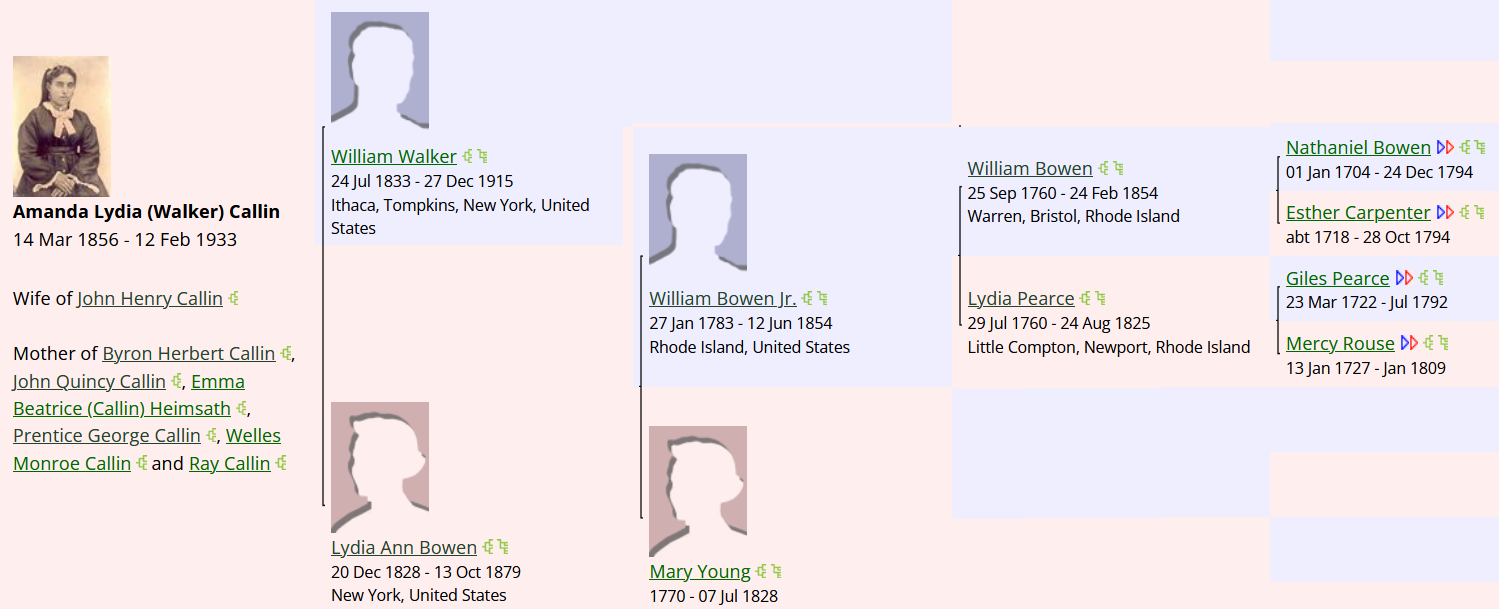
    Amanda Lydia (Walker) Callin (1856 – 1933) was my 2nd great-grandmother – one of My Sixteen. A few weeks ago, we talked about her maternal grandfather, William Bowen, Jr.:

    Today we’re talking about his father – William Bowen (1760-1854) – and some of the speed bumps I ran over on my way to improving his WikiTree biography.

    image of Amanda Walker Callin's ancestry from her WikiTree profile
    Edited ancestry chart for Amanda Lydia (Walker) Callin (1856 – 1933) from her WikiTree profile

    After spending time on his son’s profile, I dug into William Bowen “Senior” (he never actually referred to himself that way, as far as I can tell) and found a lot of good, but poorly sourced, information on his Find-A-Grave page.

    I’m not a stickler for a specific format of source citation, but if I’m looking at a fact and the “citation” that goes with it doesn’t give me enough information to find the same source, I can’t verify that the source was quoted accurately or determine whether the source is primary or secondary. I don’t need a perfect citation – I just need Good Enough.

    We learned from the biography of William Bowen, Jr., that the Bowen family that migrated to Ohio came from Sempronius, Cayuga County, New York. The senior William Bowen was buried in the West Niles Rural Cemetery in Cayuga County, New York, but most of the documentary evidence cited on his Find-A-Grave page puts him in Warren, Bristol County, Rhode Island.

    This is where verifying the sources becomes important. There is a lot of information on that Find-A-Grave memorial, and some of it seems to be mistranscribed (the poster put “American Civil War” when the dates clearly correspond to the Revolutionary War) or is separated from the source information.

    Digging through this information and comparing it to what I could find and attached to my Ancestry page for William, I figured out that a Fold3.com copy of a pension claim from 1833 (which was already transcribed on Find-A-Grave, just not cited as such) presented 72-year-old William Bowen’s sworn statement of when he was born, where he lived, and where and when he served in the Revolutionary War.

    This sworn statement tells us he was born in 1760 in Warren, Rhode Island, where he lived until “about three years after” the end of the war. In about 1786, I calculated, he moved to western Massachusetts for five years (the penmanship is hard to read, but it looks like “five”) before relocating to Sempronius, where he lived for 32 years. Near the end of his life, he moved back to his birthplace in Warren, where he applied for the benefits allowed to Revolutionary War soldiers by Congress in the 1832 Revolutionary War Pension Act. He gave detailed recollections of being enrolled in the Town of Warren and that he was called up to serve several month-long tours as part of the Rhode Island Line.

    His first enlistment put him in Capt. Thomas Allen’s Company, in Col. John Cook’s Regiment for three months – from October to December 1776. He described his duties as guarding the shore of Narragansett Bay as a private in Capt. Allen’s Company when it was attached to Col. Archibald Crary’s Regt. of the Rhode Island Line.

    Most of the other information posted by other researchers fits with this timeline, but there are a number of census and other records that don’t fit.

    As it turns out, Fold3 and NARA have another sworn testament from another William Bowen – who served in the Rhode Island Line for two enlistments – under Capt. Christopher Garnder’s Company from May to December 1775, and under Capt. Nathaniel Hawkins Company from December 1775 to December 1776. He recalled being discharged at Peekskill, New York, having served in the Battles at York Island and Trenton. These battles took place while our William Bowen was guarding Narragansett Bay.

    This second William Bowen gave his statement in 1819 in his home of Grafton, New Hampshire – about 300 miles east of Sempronius, New York. Census records say he was born in Connecticut, and there are several muster rolls and other documents that don’t match our William’s description of his service in Rhode Island that might be evidence of this other William’s service.

    Now that I know which William Bowen is mine, it is a lot easier to make sense of the other documents – and with a sworn statement supporting what can be found in the Rhode Island vital records, I’m a lot more comfortable accepting the records that tie William Bowen Jr. to his father.1

    Incidentally, all of this digging led me to the 2011 New England Historical and Genealogical Register article on William Bowen (Sr.)’s family.2 Rather than feeling frustrated that I re-did all this work, I feel pretty good about my skills at finding most of the same sources cited in the NEHGR report, and for finding the 1850 Census record that eluded Cherry Bamberg.

    Are you related to any of these Bowens? Hit that “Leave a comment” button and say hello!

    Thanks for reading Mightier Acorns! Subscribe for free to receive new posts and support my work.

    1

    Coincidentally, I learned about these Rhode Island sources working on the John Greene branch of my tree – and wrote about them here:

    2

    Bamberg, Cherry Fletcher, “Nathaniel and Esther (Carpenter) (Bardeen) Bowen and Their Family,” ”The New England Historical and Genealogical Register”, <https://www.americanancestors.org/DB202/i/12636/53/24451527&gt; Vol 165 (2011), pp. 53-61; Boston, MA.

  • Approaching faith traditions respectfully and academically

    Oh everyone believes
    From emptiness to everything
    Oh everyone believes
    And no one’s going quietly

    John Mayer, “Belief

    Religion is a tricky thing to wrap your mind around. A person’s faith is both a personal, private thing and a public signifier of how they think about moral and spiritual issues. Each of us has a set of beliefs, a moral code, and traditions that we observe – and sometimes learning about the religion of an ancestor can give you insight into what that person was like.

    In the right context, knowing a person’s religion can tell you things that you need to know about them, as a genealogist, such as “how and where they were buried” or “how and why they were married.” Those are external behaviors, though. The tricky part is understanding the internal feelings that inform or come from a particular person’s faith in that particular time and place.

    As a family history researcher, you need to be aware that your assumptions about religion might give you a false picture of what your ancestors’ lives were like. When you find an obituary that declares a person was a “staunch Christian,” you can’t assume that because you also consider yourself a “staunch Christian” you share the same beliefs, or that they would make the same choices you would make.

    Think about how diverse attitudes in your own religious community are towards things like divorce, alcohol, or tolerance of political dissent within the community. Your ancestor’s “staunchness” doesn’t tell you anything about which side of a given issue they would have been on.

    Maybe you do the math and see that a baby was born far too soon after the wedding date. In many/most other cultures, that date discrepancy might signify that the marriage became necessary after the pregnancy was discovered – and could indicate hard feelings between in-laws. There are also communities and situations where this might have been ignored or even encouraged by the community.

    Consider the Oneida Community that existed in upstate New York from the mid-to late-1800s. They formed at the end of the Second Great Awakening, which gave rise to many new religious movements in the United States, such as Adventism, Dispensationalism, and the Latter Day Saint movement. The Oneida famously practiced group marriage, lived communally (in the sense of communal property and possessions), and practiced “male sexual continence” – a concept I won’t go into here, but which is not typically associated with “Christian mores.”

    Granted, most of us won’t find roots in the Oneida community. (I do have a “mother-in-law of 4th cousin 2x removed” who was named “Freelove” and was born in 1846, but that only shows that the Oneidas weren’t alone in holding that particular value.) But you will find ancestors who belonged to faith traditions that regard each other as heretical, backward, apostate, or just plain “weird.” And you will have to be on guard not to draw incorrect conclusions about them.

    You will be well served to treat “religion” the way you would treat the size label on a new pair of shoes – the label may tell you what the size is supposed to be, but you don’t know that they will fit until you try them on and walk around for a bit.

    Just for one example:

    My 3rd great-granduncle, George Callin (1804-1879), was described to me by a cousin who is directly descended from him as “a strict Presbyterian” – implying they were opposed to alcohol consumption and the use of profanity. Meanwhile, another source referred to George’s ancestors as “hard-drinking Scots-Irish Presbyterians,” which on the surface seems contradictory.

    Another source – written by the daughter of George’s nephew, Rosemary Callin – emphasized this memory:

    “Father said they were warned not to say nothing at school about it, but their cabin was a station on the Underground Railway. I don’t know whether it was William or Elizabeth, probably the latter, who awakened them softly in the middle of the night and led them to the window. The moon flashed out and they saw a white man, maybe William, leading a string of blacks through the clearing around their cabin and into the woods. They were on their way to Great Uncle George’s barn. From there he would take them onto the next stop.”

    When you dig into the history of Presbyterians and abolitionist movements, you can see evidence that convictions among members ran the gamut from openly opposing slavery to defending a “moderate” approach to releasing slaves from bondage. But among those who were strong abolitionists, you could see other patterns emerge, as well.

    Abolitionism, temperance and prohibition movements, and women’s suffrage were all deeply linked.1 It seems likely that since George, and probably his wife, Polly, were associated with abolition activism, and their descendants remember them for being sober, you might be safe in assuming that they were part of a community that supported all three reform issues.

    photos of George Callin and his wife, Mary "Polly" Lewis
    George (left) and Mary A “Polly” Lewis – Presbyterian abolitionists

    While you would not be correct in assuming that anyone remembered as a “strict Presbyterian” would necessarily support any of these movements, knowing that George was involved in at least one of them can give you some insight into how George’s faith looked to him. To break the law and take the risks associated with transporting escaped slaves through Ohio in the 1840s showed a deeper commitment than simple belief.

    Ultimately, a person’s religion doesn’t dictate what kind of person they are or were. Just as your religion is more often a reflection of how you see yourself and how you want to live, your ancestor’s stated faith gives you clues to how they thought about themselves and their place in the world. If you use what you know about a specific faith to prompt questions about the ancestor who practiced it, you can learn a lot about their motivations and their views that you might get from a few words in an obituary.

    Just don’t jump to conclusions. As Paul said in his first letter to the Thessalonians:

    Test all things; hold fast what is good.

    (1 Thessalonians 5:21)

    In this context, “good” means “supported by evidence.”

    If you tested Mightier Acorns and find it to be good, subscribe to hold fast!

    1

    National Park Service, NPS.gov, “Abolition, Women’s Rights, and Temperance Movements

  • The top of my ladder is the bottom of another

    Abe Witter (1859-1918) was my 2nd-great-grandfather – one of My Sixteen. After I added his profile to WikiTree in 2019, another WikiTreer connected it to the profile of Abe’s father, Adam Piper Witter (1829-1909). I have since taken on the Profile manager role for Adam and his father, Abe’s namesake.

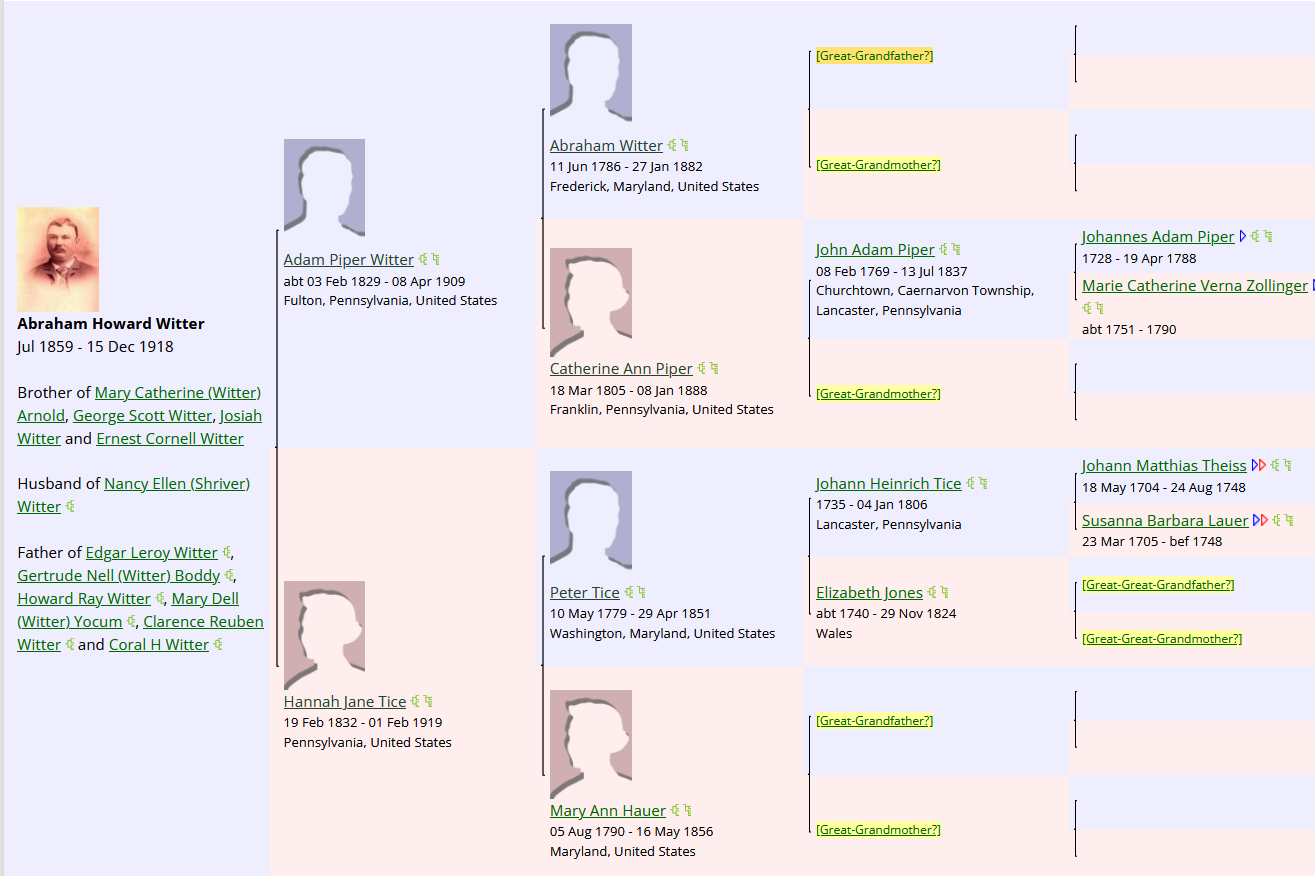
    But, in connecting to Abe’s parents, I found myself looking “up” along his maternal line at connections to a Tice family that originated in Germany in the 1500s. Here’s Abe’s ancestry going back to Johann Matthias Theiss, born in a German principality in 1704.

    screenshot of Abe Witter's WikiTree ancestry chart
    Abe Witter’s ancestry chart, from WikiTree

    Of course, I’ve only done the work to verify Hannah’s biographical details, so far. I have my work cut out for me if I want to trust the skeletal, unsourced connections above her in the family tree. The profile for Johann Matthias Theiss, for example, was improved by several contributors through the Palatine Migration project – but the two generations between him and Hannah are placeholder profiles for Peter Tice and Johann Heinrich Tice.

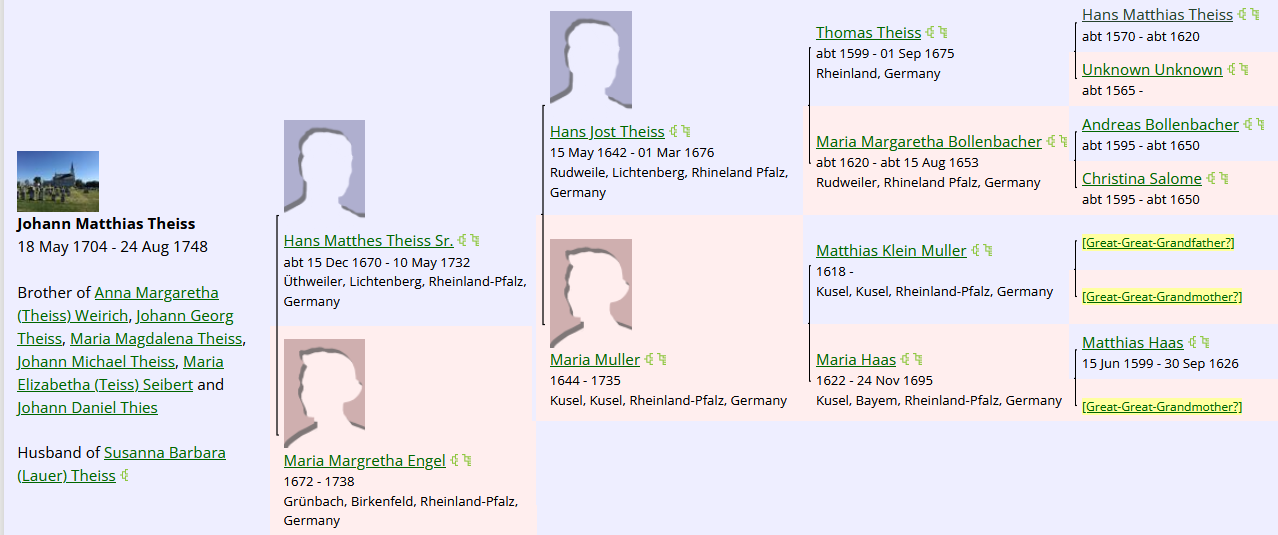
    The profiles for Johann Matthias Theiss’s ancestors are slightly more developed:

    screenshot of ancestry chart for Johann Matthias Theiss
    Johann Matthias Theiss ancestry chart from WikiTree

    Profiles for his grandfather and great-grandfather appear to be well-sourced, but I will have to do a lot of homework before I am comfortable relying on them.

    That homework begins with Hannah. Her biography resembles that of the typical prairie farm wife. She married Adam Witter in Fulton County, Pennsylvania – just beyond the western edge of Pennsylvania Dutch Country. They migrated to Kansas between 1860 and 1865 – just after the years known as “Bleeding Kansas” – and raised their five children there.

    Hannah survived her husband by a decade and went to live with her children in her old age. She spent her last few years in Boise living with her daughter, Mary (Witter) Arnold. Her Idaho death record from 1919 names her parents as Peter Tice and Mary Hower.

    She was 20 when she married in 1852, and 18-year-old Hannah is listed in her parents’ home on the 1850 Census. So building from there, I’m confident we can start building up the profiles of Peter and Mary.

    If you’re interested in this Tice/Theiss line, I’ll post updates as I learn more, and link back to this post. If you drop a note, I’m sure it will motivate me to keep working on this branch:

  • The life of Leo Homer Callin (1893-1958)

    I am descended from John Callin, one of two brothers who settled in Milton Township, Ohio, in the 1810s. Leo Homer Callin (1893-1958) was descended from John’s brother, James. Their father was (most likely) James Callin, the Revolutionary War soldier I’ve written about

    Leo was the son of George L Callin (1860-1917) and Catherine Bell Imhoff (1868-1941), born on 30 Nov 1893 and raised in Mansfield, Richland County, Ohio. After he finished school, he found work driving a grocery wagon for F. E. Helt. His father, George, and his uncle, Fred, both worked as drivers in Mansfield in 1900 and 1910.

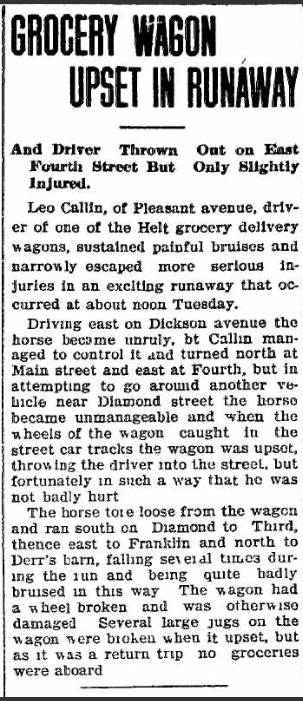
    In September 1910, Leo’s horse became unmanageable, and Leo was thrown from his wagon into the street.

    Mansfield News, 20 Sep 1910

    After that, Leo’s occupation was grocery clerk – not a driver. And you can hardly blame him!

    Leo married Mildred M. Apgar on 6 July 1915, and their daughter, Evelyn Ruth, was born on 27 Dec 1915. In 1917, his draft card claimed an exemption so he could support his wife and child. They were still listed at the same address as late as 1922, but in 1925, Leo was granted a divorce and custody of Evelyn by probate judge C. L. McClellan.

    The divorce was granted on 9 July 1925 in Richland County, Ohio. Less than a week later, on 13 July 1925, Leo married Mildred Hartman in Monroe County, Michigan, just over the state line from Toledo.

    The First Mildred

    Judging from the City Directories records I have found, Mildred (Apger) Callin ran the Callin Beauty Shop at 11 E. 4th Street and lived there with her daughter, Evelyn, after parting from Leo, despite the court’s custody decision. 1926 newspaper ads call her “Mildred M. Callin graduate of the Cleveland Academy of Cosmetology.”

    Mildred seems to have married someone named Smith after 1930. Records and obituaries for her mother (in 1957) and her sister, Flossie (1961), refer to her as “Mrs. Mildred Smith” and she is listed as Mildred Smith, a hairdresser, living in Lakewood (near Cleveland) in 1940. That 1940 census says she is married, but in 1950 she is listed as separated. I have not found a record to tell me who Mr. Smith was. But the last we see of the first Mildred is in Cleveland in 1961, probably working as a hairdresser.

    Evelyn was married twice, and her second husband, William Primm, died in 1979. She died in 2002 in Largo, Florida, and her obituary said, “Survivors include several nieces and nephews.”

    The Second Mildred

    Mildred Hartmann was born on 10 October 1907, meaning she was about 16 when she got pregnant in 1923. Her parents had divorced between 1910 and 1920, and in 1920, Mildred and her brother Frank lived in the Richland County Children’s Home.

    Her daughter, Doris, was born on 26 April 1924 – more than a year before she married Leo. If 30-year-old Leo was the father, that might explain why the first Mildred divorced him. It’s possible that Leo met the second Mildred after the first Mildred left him, and he decided to take care of this young, pregnant girl, but I think the first scenario is more likely.

    They had a second daughter, Betty Jean, born 9 September 1926. I can’t find them in the 1930 Census, but the Mansfield City Directory lists them at different addresses in 1926, 1928, and 1930. In 1932 and 1934, the directory only lists Leo’s name and shows him living back at his parents’ home on 26 Pleasant Avenue.

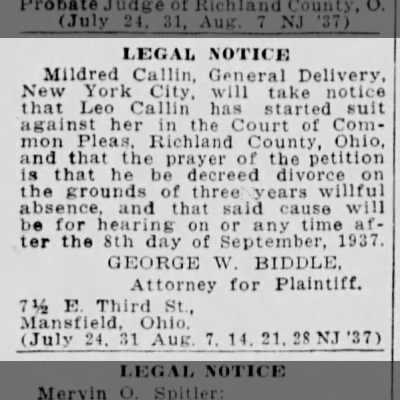
    screenshot of newspaper item from the Mansfield News Journal dated 7 August 1937
    News Journal, Mansfield, Ohio, 7 August 1937

    Leo’s attorney placed this notice in the local papers, suggesting Mildred left Leo and ran away to New York around 1934, taking their daughters with her. She married Mathias Barth on 10 August 1938, and in 1940 they are all listed under the name Barth living on Gerard Street in the Bronx.

    Betty Jean died on 13 June 1943 from a heart infection – subacute bacterial endocarditis. Her death records give her name as “Betty Jean Edwards” but list her father’s name as “Leo Callin.” She was only 16 and there are no marriage records, so it’s not clear where the name “Edwards” came from.

    Doris Callin married in Dec 1943 and by 1950 had two children. They may all still be living1, so I will simply assume “they lived happily ever after” until I learn more.

    Mildred and Mathias Barth eventually moved to Long Island. Mildred died in Florida on 24 March 1985, and Mathias died in Levittown, NY, on 3 January 1994.

    Post-Mildred Leo

    Leo’s situation deteriorated after his second divorce. He was admitted to the hospital in 1939, and in 1940 the Census listed him in the “paupers infirmary” in Richland county. By 1950, he appears to have been moved to the Central Ohio Psychiatric Hospital in Columbus. He died on 24 March 1958 and was buried in the Columbus State Hospital Asylum Cemetery.

    There is no way to know what Leo’s affliction may have been. Even if some records indicated what his condition was called at the time, the state of psychiatric medicine in the mid-1900s was not very advanced. Treatment could be brutal, and non-scientific notions about how the mind works persist to this day.

    To learn more about researching mental health and disability, check out Emma Cox’s recent interview with Kathy Chater:

    Researching mental health and disability
    My recent interview with Kathy Chater covered researching ancestors who may have suggered from mental health issues. There is a separate Substack post with a list of resources to help with your research. A short clip is below and the main interview is available via…
    Read more

    Leo’s family did have a history of alcoholism and that could explain a lot of Leo’s story. I don’t like to judge, since I don’t know all of the facts, but it seems likely that he made several poor life choices and made life more difficult for two amazing women named Mildred.

    Nevertheless, his grandchildren are my 6th cousins, and they share as much DNA with our Revolutionary War ancestor, James Callin, as I do. I hope that despite the less savory aspects of Leo’s story, they might find their way here and find some satisfaction in learning about their family’s past.

    Thanks for reading Mightier Acorns! Subscribe for free to receive new posts and support my work.

    1

    My general policy is to not post information about living people, but I also think people who live past 100 deserve to be celebrated far and wide. This is my compromise.

  • Rescued from obscurity

    Before we begin: I’ve been struggling to make these Wavetops posts work the way I wanted them to work – so I’m taking a slightly different approach. Instead of pointing at the “top” and talking about the work that still needs to be done, I’m going to start at the “bottom” and work my way up. Surf’s Up, Cousins!

    John Jackson Tuttle (1872-1963) was my 2nd-great-grandfather – one of My Sixteen, of course – and for many years, I looked past the questions I should have had about who his parents were so I could focus on earlier generations. So I only recently thought to dig in and ask myself: “What do I know about John Tuttle’s mother?”

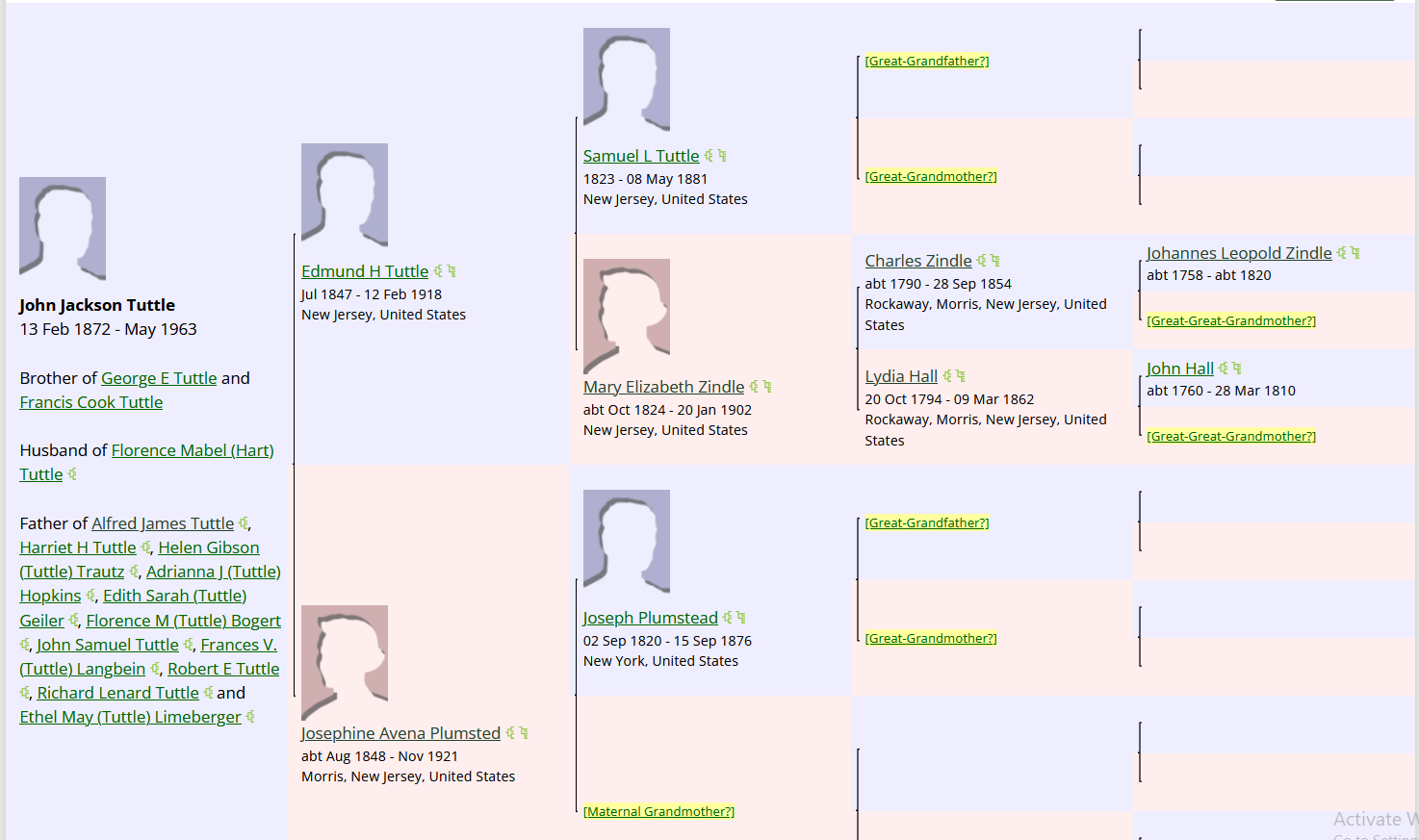
    Screenshot of John Jackson Tuttle's WikiTree Ancestor chart
    WikiTree Ancestor chart for John Jackson Tuttle (1872-1963)

    As you can see from this chart, John’s father was a great-grandson of my Hessian soldier ancestor, Leopold Zindle. Sadly, finding records for the folks on this chart has been difficult. My usual tricks seem to be failing me, partly, because the Tuttle family was so prominent in Morris County, New Jersey, and my particular ancestor, Samuel Tuttle, was not as prominent as some of his cousins. The books that mention Leopold Zindle made vague references to the “prominent Tuttle family” without going into any detail. The Samuel Tuttle that does get mentioned in some of the local history books is the Rev. Samuel Tuttle who lived in Rockaway Township, and not the bloomer from the steel plant.

    After a while, it occurred to me that I was neglecting John’s mother, who I knew as “Avena” from the few documents I had when I started. I’m pretty sure that “Avena” was probably a nickname for “Josephina” but I didn’t find anything at first, searching for those two variations. Then I found a marriage record for “J.A. Plumsted” and “E.A. Tuttle” that set me on the right course.

    Despite having a name to work with, I still had to wring the information I wanted from the databases. Normally, once I have a name and a few dates and places, I can tease what I want out of very fuzzy results. But THIS family was not going to make it easy. They wanted to hide!

    I started with the common assumption that their marriage record from 30 Mar 1870 in Roxbury, Morris County, New Jersey, indicated that the bride was probably from Morris County. I didn’t find a Plumsted family in Morris County in 1860 that had a girl named Josephine or Avena (or any reasonable variation) the right age. I couldn’t find a Plumstead family in 1850 at all, but I did find something interesting in 1870.

    There is a Plumstead family listed in Roxbury in 1870. Succasunna is listed as their nearest post office, which caught my attention because John Tuttle’s marriage was recorded at Succasunna in 1891.) This family consisted of[24]:

    • Joseph Plumstead – age 49

    • Abbey Plumstead – 42

    • Emma Plumstead – 18

    • Joseph Plumstead – 15

    • Mary Plumstead – 7

    Joseph, Abbey, and Emma matched three people in the 1860 record I had already ruled out[22]:

    • Jos Plumstead – age 40

    • Abba Plumstead – 35

    • Jas A Plumstead – 16

    • Harriet Plumstead – 14

    • Adrian Plumstead – 11

    • Emma Plumstead – 8

    • Joshua Plumstead – 6

    • Clarrisa Plumstead – 63

    Okay, so the ages are a bit off for Abba/Abbey, but Jos/Joseph is close enough and Emma is dead on. Joseph/Joshua could be an easy mistake – but I need more information. That’s when I took another look at the 1850 records and found this family in Jefferson, Morris County:[21]

    • Joseph Bumplin – 29

    • Abagal Bumplin – 26

    • James Bumplin – 5

    • Harriet Bumplin – 3

    • Josephine Bumplin – 1

    While Josephine does not appear, at first, to be listed with the other children, James/Jas and Harriet match – and then there is a son named “Adrian” listed who is the age Josephine should be in this record. Adrian Plumsted does not appear in any other records related to this family. And if the family told the census taker her name was “Avena”… I can see how mistakes added up.

    With those pieces in place, I was able to assemble the rest of Josephine’s biography, and move one more branch up the Plumstead tree to a new wavetop:

    Joseph Plumstead (1820 – 1876)

    And so the adventure continues…

    Thanks for reading Mightier Acorns! Subscribe for free to receive new posts and support my work.

    If you are particularly interested in the Plumstead family of Morris County, New Jersey, drop a note!

  • The post I *meant* for last week!

    I failed to post anything last Wednesday and didn’t realize it until my Friday post went live. This happened because when I was drafting my posts, I didn’t have the photos from my daughter’s wedding I wanted to share and I forgot to go back and finish drafting and scheduling.

    So, you get those today instead!

    This was a very small wedding, held at the Redwall Castle near Germantown, Maryland. My youngest child, Mileidy, and her partner, Elliot, both suffer from anxiety disorders and they wanted to have (literally) a small, fairy-tale princess wedding. I think they succeeded – and their choice of venue looked the part:

    Image of Redwall Castle from the Mocoshow website
    Main house front walk, from the Mocoshow webpage

    The man of honor and both fathers spoke at the reception. For my speech, I focused on the fact that my youngest child was the first of my four children to get married, and how happy I was that she got to be first at something after years of being the littlest.

    The family of the couple outnumbered the guests by a little bit, and my two rambunctious granddogs, Jinx and Bug, were delighted to meet so many people.

  • A lifetime in Baltimore without finding my cousins

    My grandfather, Bob Callin, had two older siblings. Bob was the baby, born in 1920; Yvonne, the oldest of the three, was born in 1907, and Norman was born in 1912.

    John Norman Callin graduated from Fostoria High School in Ohio in 1930 and then moved to Orlando, Florida. His parents moved there about that time, probably because great-grandpa John had followed his older brother, Byron Herbert Callin, looking for business opportunities.

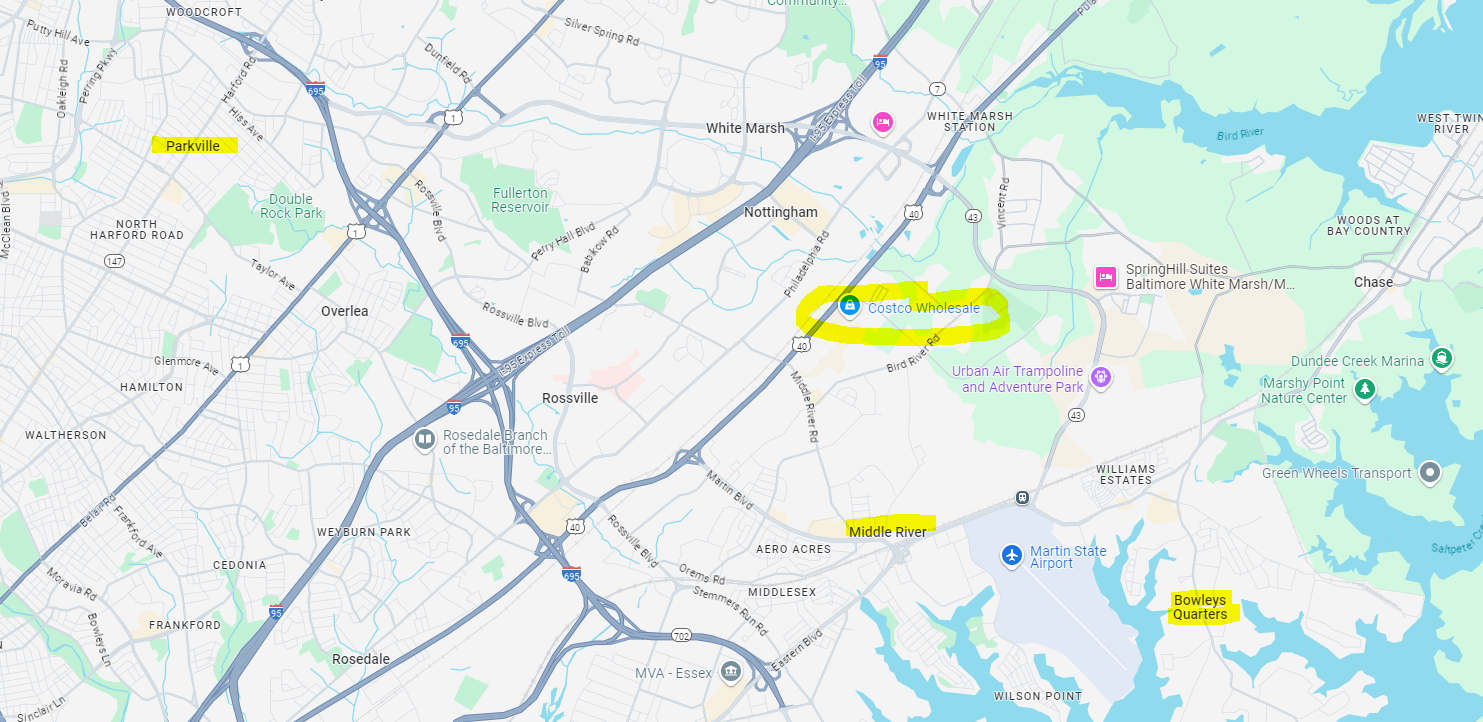
    Norman married Ruth Frees Harpster in 1933, and at some point after 1940, they moved their family to Baltimore County, Maryland. I know from his 1964 obituary that he worked as a machinist for the American Can Company for 18 years, so I would guess they moved about 1946.