Mightier Acorns

Journeys through Genealogy and Family History

A parody of a family coat of arms designed with acorns as elements, with the motto "ex gladnis potentioribus" Latin for "from Mighty Acorns"
From Mighty Acorns
  • The Biography of a Building

    Crestline School Dist. No. 78, 1921-2023

    I only know the beginning and ending of this story. In between are a century’s worth of individual tales of growth, learning, and the childhood memories of an unknowable number of children.

    The first time I learned about the existence of the Crestline School was when another researcher called Seth sent a message through the WikiTree profile of Albert Callin, saying:

    Albert designed the District 78 school, which was built in 1921 in the tiny town of Crestline, KS. It can be seen on streetview at the intersection of US 400 and Wyandotte. It was demolished in 2023.

    This led me to a site called Abandoned Kansas with an article about Crestline School Dist. No. 78, which includes a photo of one side of the building’s cornerstone (just not the side with Albert’s name on it).

    from Crestline School Dist. No. 78, on Abandoned Kansas

    Fortunately, Seth kindly grabbed a photo of his own and let us share it:
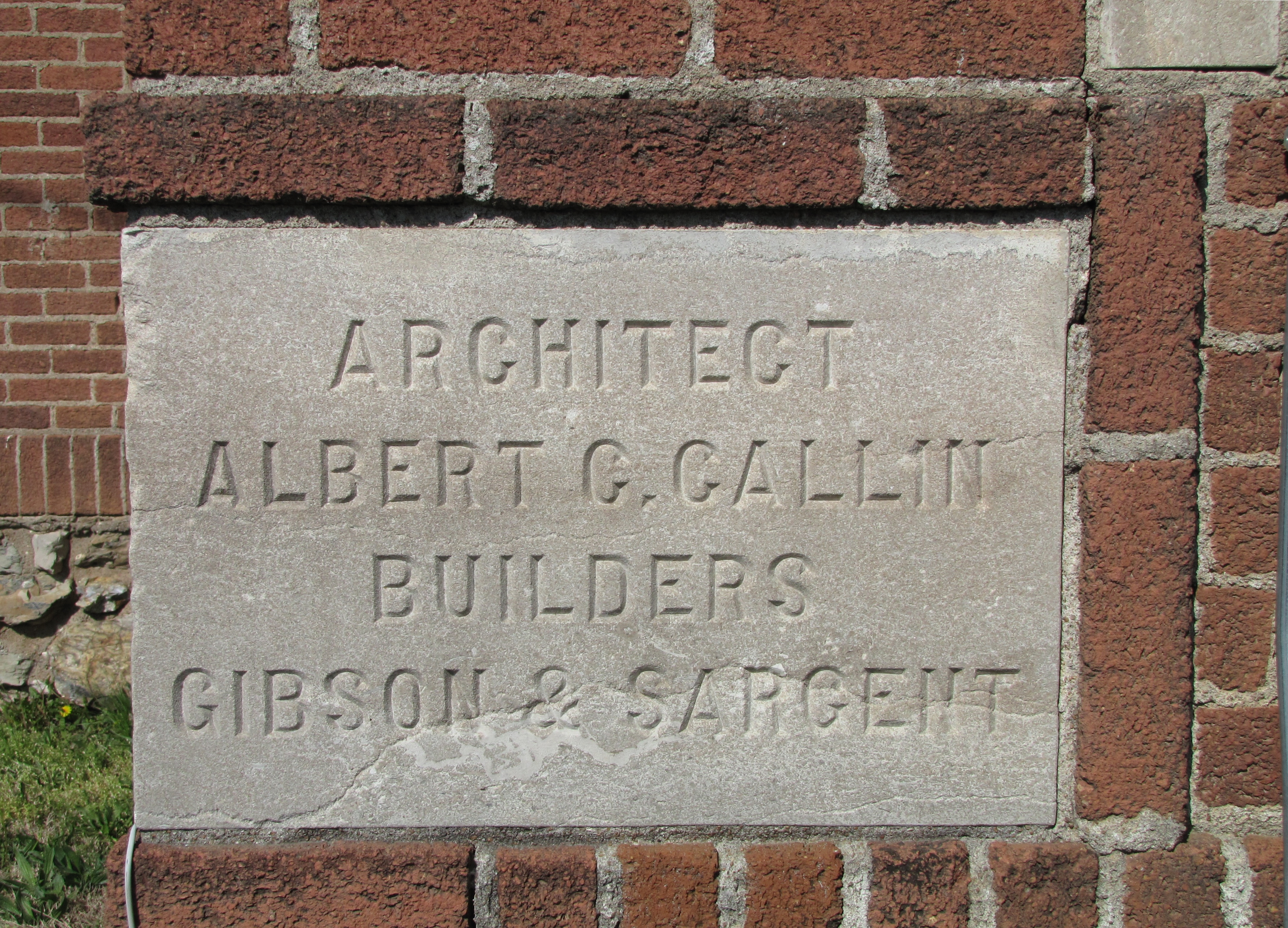
    Some minimal digging brought me to newspaper items from 2 July 1921 that helps confirm Albert’s involvement in the building of the school:
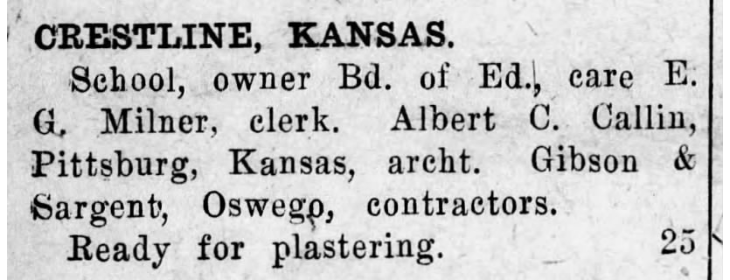
    Two jobs by architect Albert C. Callin Article from Jul 2, 1921 Kansas Construction News (Topeka, Kansas)

    All About Albert Callin

    Albert Clifford Callin was the son of James Monroe Callin (1844-1901) and Rosalina Bedora Davenport (1848-1876), the oldest brother of Jessie Chudley (if you recall our earlier post about her mysterious life).

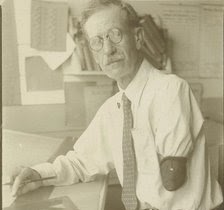
    Albert at his drafting table, c. 1927

    By 1921, the Albert Callin family had been through some dark times. Twenty years before he designed the Crestline school, Albert’s business partner in Toledo had embezzled their investors’ money and left town. Albert insisted on paying back every penny stolen by the partner, and took his family south to Galveston, Texas, where a 1903 hurricane had devastated the town and created a need for builders like Albert.

    While working his way to Galveston, Albert took on a number of small jobs to pay his way. On one occasion, he undertook to repair a cotton gin that had jammed or broken. While he was working, someone accidentally turned it on, catching his left arm. He remained conscious and directed his own extraction from the gin. However, the doctors were unable to save the mangled, filthy arm, and it was amputated above the elbow.

    The family still made a living in Victoria, Texas, until 1914, when flooding there claimed the life of their 10-year-old son, John Albert, and they moved to Pittsburg, Kansas, where Mamie’s half-brother offered them a place to live. This is where Albert re-established himself as an architect.

    The End of the Story

    We don’t know how long the Crestline School building stood abandoned before it was demolished in 2023. We know it was a one-room schoolhouse, noted as such in this 1921 article about a school contest:

    Union school of Crestline - contest winnerUnion school of Crestline – contest winner 24 Feb 1921, Thu Modern Light (Columbus, Kansas) Newspapers.com

    The town of Crestline lies in Shawnee Township, Cherokee County. The school district there was No. 78, and they boasted two high schools as of 1904.1 The one-room Crestline school would have served as a primary school feeding into the high schools. The most recent reference to the school I could find was from a 1931 wedding announcement:

    Marriage of Bray / Riker

    Article from Oct 9, 1931 The Galena Journal (Galena, Kansas) Marriage <!— –>
    https://www.newspapers.com/nextstatic/embed.js

    In general, one-room schoolhouses were phased out during the 1940s and 1950s in favor of larger, more centralized schools. Given the devastation of the Great Depression on rural areas throughout the Midwest, it’s possible that the Crestline building stood unused for as long as 90 years, if it closed down in the mid-1930s.

    We do know that Albert and Mamie Callin retired to Greenwood, Colorado, around 1929. They died in the early 1930s and were buried in New Hope Cemetery in Fremont County, Colorado. It’s possible that one of the buildings Albert designed is still standing somewhere, but we know the Crestline school is not one of them.

    Perhaps with more digging, we’ll find a survivor one day.

    1. Allison, Nathaniel Thompson, ed, History of Cherokee County, Kansas and representative citizens, Biographical Publishing Co., Chicago, Ill., 1904; page 84. ↩︎
  • Grandma Merle’s Travelogue: Glendale, Arizona, in 1907

    Last time, in Great-Grandma Merle’s Travelogue, we looked at the first 15 minutes of Great-Grandma Merle’s hour-long recording of her memories of moving from Kansas to Arizona. In the next 15 minutes, Grandma Merle talks about her family settling into life in Glendale: starting businesses, finding homes, and (for some) returning to Kansas.

    Some of the people mentioned in this recording appear in this photo, which was probably taken around 1932 or 1933. Albert C Huff (with his two pipes) died in 1936:

    Back, from left: Ernest “Uncle Ern” Kinman, Bertha (Huff) Kinman, Albert Burton Huff, Mary (Ezelle) Huff, Harry More, Iva (Huff) More, Dick Witter, Hannah Merle (Huff) Witter; seated, from left: Merle’s parents, Albert C. Huff, and Rosa (Murray) Huff.

    Upon Arriving in Arizona…

    Our first night here, we stayed in a hotel in Phoenix, and the next morning, we got up to catch a train over to Glendale. Perry had been in Glendale and liked that location the best, so we came over here to look for a location. 19-and-7, and it was some time in November when we got here.

    And we found a place to stay, to rent, and it was what was then known as the old Eire place. They were the people, I don’t know if they homesteaded, but they had built it. And it then was later, as most people remembered as the Pullens place. But there was another man…

    When we rented the place, it was owned by a man by the name of Doctor Tuttle, and that it was about a quarter of a mile, I guess, north on Lateral 18. And we lived there for, oh, at least a year, I imagine, because we were still living there when Bertha and Roy came out.

    “Lateral 18” was later named 59th Avenue, and you can see some historical photos of the area on AZCentral’s site in their article from May 2025: “This is what Glendale used to look like: See the historical photos.”

    Bertha Huff’s first husband was Roy Sample. Bertha was Merle’s older sister. I wrote about Bertha and her family’s butcher shop in “Sample-More Meats – a Businesswoman’s Story” a while back. There are some photos there showing the butcher shop and early Glendale.

    Then, they got, when the boys started up – Perry and Roy started a butcher shop, and Bertha and Roy got a place, and they lived in town. But Dr. Tuttle gave Grandpa a job as foreman on his ranch. That was a mile north of town, and about a quarter east, then up into the field, where that was. And, Dr. Tuttle’s wife was …those guys’ names… The Tuttle house, where we lived, was on the north side of the road, and just a little ways from the Sands ranch. Mrs. Tuttle was related to the Sands. I don’t know if it was Mrs. Sands or the boys, but she was related to them.

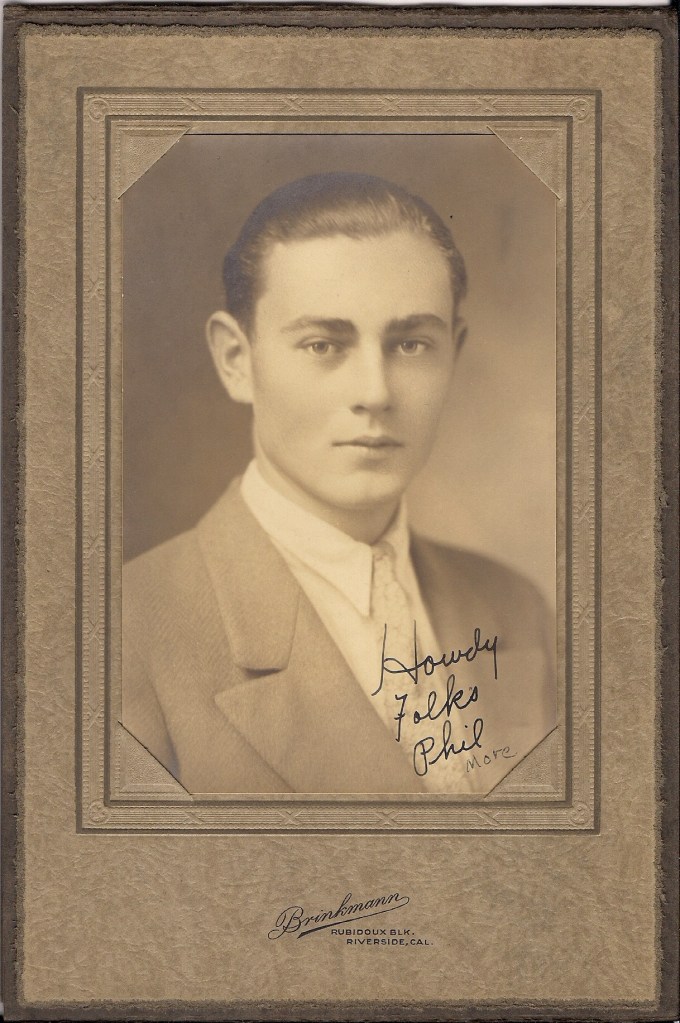
    We were there, oh, probably a year and a half. But in the meantime, while we were still living at that place, my sister Iva and her husband Harry and they, at that time, had baby Phil. He was only a few weeks old, about three weeks old when they came out. Of course, in the meantime, …[Thelma] Sample was a little older than he was about six weeks. And she later married and was Thelma Akin.

    Bertha and Roy’s children were Thelma (born 1909) and J.L. (for John Leroy, born 1913). Iva (Huff) and Harry More had one son, Phil, born in 1909. They can all be seen here in photos from the collection Merle handed down to my Grandma Nancy. (I owe all of them some attention on WikiTree.)

    Grandma Merle never gives us Roy Sample’s full story, but he died on 21 December 1918 from typhoid-pneumonia. Considering all of the illness that struck the family during this decade, I’m not surprised she left some details out.

    The Family and Tuberculosis

    Merle alluded to Perry’s illness before as a reason for the family’s move, but here she goes into more detail about how many of them were affected by tuberculosis.

    But Iva and them, and Perry hadn’t been feeling too good. The work was too heavy for him or something. So when Harry [More] came out, he sold his interest in the butchers’ shop to Harry. And that is where the Sample and More Meat Market came in. And Perry didn’t seem to get over that; that was too much, and he kept going down.

    So, the doctors advised him to go to a sanitarium in Colorado, and I can’t name that place. But he was there a while and tried it, and we stayed on in Glendale. When the doctors told him there that he wouldn’t really get better, that wherever he would prefer to live was the place for him to be. 

    Well, he knew everybody back in Kansas, Savonburg, so he decided he wanted to go back there. So Grandpa gave up his job, and we caught the train, and went and met him over there, then, together we all went back to Kansas. 

    He lived there with us, we had to stay in town, in a place in town, because our old home was rented out. When we got possession of that, then we moved out there.

    It isn’t clear from what Merle said about “Iva and them…hadn’t been feeling too good,” but if Iva (Merle’s sister, and the wife of Harry More, both seen in the photo above) was ill, that might have factored into the More family’s decision to move to Glendale. Next, Merle tells us how they think the family first contracted the disease, starting with Perry’s wife, Pearl Lucy (Enos) Huff:

    When Bertha and Roy first came out here [to Glendale, AZ], Bertha wasn’t very well, and she had come for her health, too. But before that, Perry’s wife had passed away with tuberculosis. Her name was Pearl, and Perry had contracted it from her, and of course, they was watching the baby to see that she didn’t come down with it, and she never did, to my knowledge.

    And …It helped Bertha right away, she began to get better. But Bertha then developed it too, because she had been living with them, and she and Pearl had had a milliner’s shop in Savonburg, Kansas, and they contracted it from their cow. 

    They had a really nice, and you never saw a prettier cow, but one day when we went out to the barn to milk the cow, she was laying there dead, and when they had an autopsy, they found that the cow had TB. And that’s where Pearl had gotten it, and Bertha living there, and Perry, they had all gotten it. But it just developed with Pearl, first.

    But Bertha got better right away when she came out. And, when we went back with Perry, we stayed there… I did… I stayed there, but in the meantime, Bertha and Iva had come out, and they were running the butcher shop, and they used to butcher their beeves out in the open, back of our… where we lived there on fifty… on Lateral 18. They done their butchering out there on a Sunday, and then they sold a lot of it to the beet camps. They had beet fields out, and the camps would buy sometimes a quarter of a beef at a time. And that was Perry’s job, and it was too heavy for him to unload that. That was one reason he didn’t get any better.

    But after we went back, then we got our own place and we lived there, and… back in Kansas, and … we, I stayed there then until Perry passed away, and then I think it was, I know it was on my birthday, December 11, about in 19 and 12, because I didn’t come back out here to Arizona again then, until I came out here in June the 13th – 1913. It was on a Friday, besides.

    Perry Huff did die on 11 December, but in 1911. Next time, Merle will tell us about moving back to Arizona and how she met Howard Ray “Dick” Witter, my great-grandfather!

  • From Orphan to Preacher

    The life and times of James T. Reynolds (1852-1911)

    I haven’t talked about the Reynolds family since Family Reunion: Reynolds, and even there, I didn’t say much about my great-great grandfather. One of My Sixteen, James Thomas Reynolds was the son of Reuben Reynolds and Martha Arthur.

    Starting out with just state and federal records, I didn’t have much information about Reuben Reynolds. We find the names of “Reuben Reynolds” and “Martha” or “Marthia Arthur” from the death records of their two known sons. When their elder son, James Thomas Reynolds died in 1911, the informant recorded on his death certificate was his oldest son, John Reuben (recorded as Reuben Reynolds). The informant on the 1931 death certificate for their younger son, John Harold Reynolds, was his youngest son, Roy Stanley Reynolds. These two grandsons agreed on Reuben and Martha’s names, but gave different information for their respective places of birth: one said Virginia, the other said Kentucky.

    Reuben and Martha were most likely married in 1839, when they were 19 and 20 years old, respectively. Reuben is listed on the 1840 Census as a head of household in Greenup County, Kentucky, and just the two of them appear in the household at that time. They appear again in Greenup County in 1850, still just the two of them. This census gives Reuben’s place of birth as North Carolina and Martha’s as Virginia. All of these records indicate that Reuben was a farmer.

    The boys were born after 1850: James in 1852 and John in 1855, and Martha married her second husband, Jeremiah M Shy (1814–1895) on 14 Oct 1858 in Greenup County, Kentucky. There are records for other men called Reuben Reynolds after 1855, and it is possible that Reuben and Martha could have divorced or separated between 1855 and 1858, but the most likely scenario is that Reuben died about 1856.

    A Lot of Family in Kentucky

    Not long ago, we talked about the Dangerous Time in Kentucky leading up to the Civil War. That story focused on James Madison West, an abolitionist preacher, and his father, Thomas West, who was murdered in Lewis County, Kentucky, in 1862. You might recall that an early suspect in the murder was Thomas’s son-in-law, John Shaw May. He will re-enter this story in a moment.

    But first…

    James and John Reynolds grew up in the home of their step-father, Jeremiah Shy, along with his children from his first marriage. That home was in Boyd County, Kentucky, near Catlettsburg, in 1860, and in Esculapia, Lewis County, near Tollesboro, in 1870.

    I ran into the same trouble finding evidence of James’s marriage that I had with his parents. I know that he did marry, and I know his wife’s name, thanks to the death records of their children, but I have not been able to track down a marriage record. That said, we know he married Mary Frances May, probably in 1875, and that his brother, John Harold, married Catherine Rebecca May on 20 Apr 1876 in Lewis County, Kentucky.

    And yes, Mary and Catherine were sisters, the daughters of John Shaw May and Frances Mary West.

    There’s a Hole in my Census

    For a long time, I didn’t have direct evidence that my great-grandmother, Mary Ann “Vicie” Reynolds, was the daughter of James T and Mary (May) Reynolds. I had unsourced trees passed to me from my grandfather and from different cousins I found on the internet, but I couldn’t find the Reynolds’ 1880 household when and where it was supposed to be. Since Vicie was born in 1879 and married in 1898, the only record likely to place her with her family would be the 1880 Census.

    I haven’t found it, yet.

    But I did find indirect evidence in the obituary for John Reuben Reynolds:

    Retired Minister Dies at St. Albans

    Rev. John Reuben Reynolds, 71, a retired Baptist minister, died Sunday at his home in St. Albans. He had been a minister for more than 50 years and was a pioneer in Baptist missionary work. Surviving are his widow, Mrs. Norma Hazel Reynolds; a son, Paul J. Reynolds of Nitro; a daughter, Frances May Reynolds of St. Albans, and a sister, Mrs. Vincie Clark, Middletown, O.

    Charleston Daily Mail, Charleston, West Virginia, 7 Apr 1947, Page 2

    The only record from 1880 that looks like it might belong to our Reynolds family is for a “James Reyonalds” listed in the household of William and Mary Crawford as a “hired farmhand” in Elk Fork, Lewis County. He’s the right age to be our James Reynolds, but he’s listed as “single” – and he ought to be married with three of his four children. What’s interesting is that the two households below the Crawfords both have the surname “May” – a James May (age 34) and John May (age 56). That is John Shaw May, with his second wife, Mary (St. Clair) Brooks.

    That means that if this James Reynolds is our guy, and his wife and kids are living somewhere else (probably in Lewis County), they aren’t living with her parents. For now, I will have to keep looking for other avenues of evidence.

    Regardless of the situation in 1880, the youngest of James and Mary Reynolds’s four children, William Smith Reynolds, was born in October 1881, and Mary died on 19 May 1882. After that, James appears to have raised the children on his own, but we don’t see them in the census again until 1900.

    So far, I’ve only talked about evidence that paints James as an orphan who found work as a farmhand and suffered the loss of his wife. But after that gap in the records, clues in his later life tell us a different, less lonely story.

    Religion: Tool and Problem

    While examining the later records to find clues, I noticed that James was identified in the 1900 Census with the occupation “Clergyman” – and further, his son, John Reuben, was, too. The 1910 Census listed his occupation as “Preacher” and his industry as “Intinerant” – which suggests that rather than being the pastor of a specific church, he may have been a circuit rider, a traveling preacher who held services in areas too rural and remote to support a full time church.

    James died in 1911, and his death certificate specifies that he was a “Baptist minister” – which raises several questions and gives me some of those other avenues in which to look for evidence. Which kind of Baptist he was might tell me something about his beliefs and his story, and how he fit into post-Reconstrution Kentucky, but I wasn’t sure how to begin looking.

    I Googled “Is there a record of Baptist ministers who were ordained in Kentucky in the 1870s?” and the AI answer and several top results told me that, no, there was no single record of members or ministers, unless I knew the local church. Fortunately, further digging led me to “History of Greenup Association 1841 – 1941“, by L. H. Tipton, published on the Baptist History Homepage.

    The History was a 36-page pamphlet printed to commemorate the Centennial of the Association, and it turns out that Rev. James Thomas Reynolds and his son were descended from Thomas Reynolds, who was a founding member of the Greenup Association in 1841. The text answers many questions I hadn’t asked yet, and also raises a few. For example, it says that James “began his pastoral work in the Association in 1890 as pastor of Union Baptist Church, Lewis County.” It also points out that his son, J. R. (John Reuben, as we discussed) Reynolds, was a pastor in the Association, and the earliest date given for the J.R.’s ministry was 1898, when he would have been 46 years old.

    This history gives me enough details about the lives of James T and John Reuben to be sure we’re talking about the same men. But there are more details, particularly about James’s grandfather and his uncle, Thomas Kelley Reynolds, that I need to unpack, document, and verify.

    As exciting as it is to find a source that can tell me something deeper about the people found in the dry Census records and vital statistics, I need to be careful about how I approach these more personal stories. When we go from talking about records, which are more reliable despite the gaps and occasional spelling errors, to talking about stories repeated from pulpits over the course of decades, I have to take into account the biases and motivations of the people who repeated those stories, what they were trying to achieve by telling them, and how they were passed down to the publishers of the Greenup Association’s history.

    For now, I’ll just enjoy the fact that I have some solid information to confirm that I’m on the right track and researching the right people.

  • HAMP: Harmonizing with Find A Grave

    part of a series, “Harmonizing Across Multiple Platforms

    You want to ensure that your work as a family historian and your family’s history are well-represented online. To accomplish that you will need to pay attention to the information that appears on all of the websites that might include your family.

    But, before you try to dive in and “fix” everything that is out in the world (not recommended!), you need to consider how these different platforms function, what they are designed for, and how much effort you are willing to expend on updating them.

    I’m talking less about “this is how you click the buttons to make changes” and more about “how do you make it easier for people to find what they are looking for?” These are Strategies for maintaining work on the same families over time, rather than Tactics for specific tasks.

    One major player that you shouldn’t ignore is Find a Grave.1 For about the first half of its existence, it was one of several online databases for cemetery information managed by individual people. In 2013, it was acquired by Ancestry.com, and while it still maintains an independent existence, that corporate relationship is important to keep in mind.

    Find A Grave: the Strengths

    There are few key points about Find A Grave that everybody should know:

    • It’s free*. (So create an account and experiment with finding your ancestors’ memorials.)
    • It’s collaborative – meaning anyone with a free account can:
      • Request headstone and gravesite photos (which are fulfilled by volunteers)
      • Submit photos (primarily of cemeteries and gravestones – read the Terms of Service carefully)
      • Edit individual memorials (why we’re talking about it today)
      • Link memorials (parents to children, spouses, etc.)
      • “Collect” memorials in Virtual Cemeteries

    (I wrote about this site a while back in Using Find-A-Grave, and I touched on some of these points there. If you’re a Mightier Acorns completionist, you can go check that piece out.)

    *Free!

    …meaning, you don’t pay money for an account or to use the services of fellow volunteers. But read the Terms of Service carefully when you sign up, and again before you contribute anything like family photos to the site. Pay special attention to Ancestry’s use of AI with regard to your contributions.

    There’s a useful and concise history of the site on their Wikipedia article that gives more detail, but the gist is that what started out as a personal development project was sold to Ancestry.com in 2013. Over the following five years, Ancestry updated the mobile app and made improvements to the back end and user interface.

    Right now, you can sign up by creating either a stand-alone Find a Grave account, or by signing in with an existing Ancestry account.

    Because it is owned by a large for-profit corporation, there is always the danger that it could be converted into a profit stream or shut down. Be mindful of that possibility – and make sure that you download the photos and information you depend on and store them in your personal archives so you don’t lose access to them. In the meantime, Find a Grave remains a valuable resource for many researchers.

    Set In Stone

    The core value of Find-A-Grave lies in the photos and transcriptions of individual grave markers. If the only source you have for your ancestor is a photo of their headstone on Find-A-Grave, that is still one of the most reliable “records” you can have. After all, gravestones are expensive, and families usually want their loved one to be well-represented by their marker.

    The rest of the site’s features revolve around that core concept. The database of cemeteries, the individual memorials, and all of the functions for editing and linking the memorials depend on finding the physical resting place of the ancestors in question.

    Your key takeaway should be this: of all the great things you may find on Find-A-Grave, the only thing you can rely on as a source is that physical grave marker. You will run across people citing Find-A-Grave on other platforms as a source for their ancestors’ vital information, but when you see someone citing Find-A-Grave as a source, you should verify that the memorial has that photo before you trust the information in it.

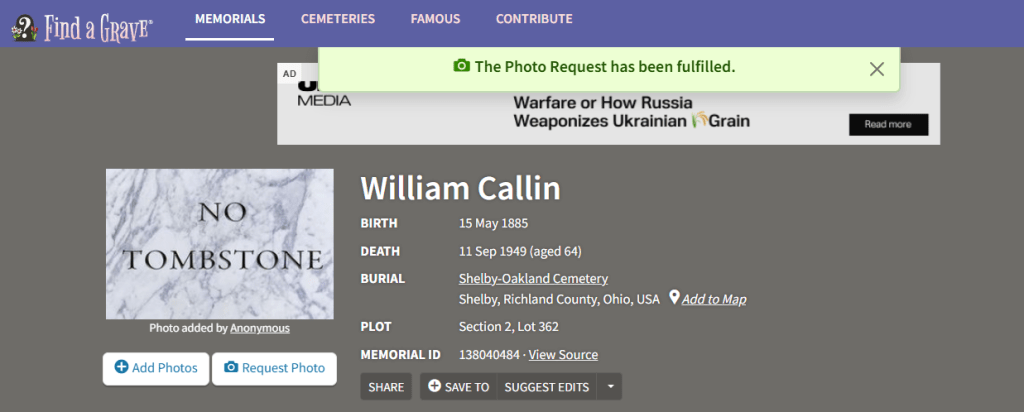
    There are cases where there is no headstone, but the memorial can still serve as evidence of the burial place. In Using Find-A-Grave, I talked about a photo request that was fulfilled with a “No Tombstone” response:

    My fulfilled request – for William Callin

    At first, it was disappointing to see the “No Tombstone” photo. The one thing that Find A Grave is most useful for is providing some physical evidence to support what you know about your target family. But I quickly moved past that disappointment to realize that “Anonymous” had provided the plot – Section 2, Lot 362 – which does confirm that William was buried in that cemetery.

    Outside of headstone photos, other information on Find-A-Grave needs to be treated with skepticism. Even if there is a thorough biography with proper source citations on a Find-A-Grave memorial, it’s not appropriate to cite Find-A-Grave as the source for the other biographical information. Cite the original source instead. All of that other information – the links between memorials for parents, spouses, children and siblings; the obituaries; the photographs – can be added by anyone without including sources and only needs to be approved by the individual memorial manager. If you’re lucky, that manager is has enough experience with genealogy to ask for sources before approving changes.

    Are you lucky, friend?

    It is also possible to create memorials without a specific cemetery, for people who were (for example) buried at sea, or who were not interred in a specific place. Those memorials might have accurate information, but again, without that physical evidence of a grave marker, the value of having the information on Find-A-Grave is not as solid as a platform where the information can be properly sourced.

    Using Find-A-Grave as your main platform

    In our first HAMP post, I talked about the unicorn of the one-stop shop, and there are people on Find-A-Grave who seem to have made that platform the “one place” where they try to manage their family trees.

    If that’s your choice, I wish you well, and I applaud those who attempt to keep the information on the platform as accurate and well-sourced as possible. When the memorials are well-organized and have their headstone photos in order, the site can look very satisfying. Here is one of My Sixteen, for example (and almost all of the hard work was done by others on that page, not by me!):

    Find-A-Grave memorial 35331914, Nancy Ellen Shriver Witter

    But, Find-A-Grave wasn’t designed to manage or house family trees, and you may find it extremely difficult to use that way.

    The main drawback (aside from the lack of a system for enforcing proper sourcing) is that only the manager of each memorial has the ability to approve edits. This means that if you run into a situation where a non-relative “owns” a memorial, or if the person is a relative but is not responsive, you may have trouble getting necessary edits approved. If you’re lucky, the person is a skilled genealogy researcher familiar with verifying sources, but if not, then the information that is/is not allowed on the memorial will be up their judgment (for better or worse).

    If you go in with a positive attitude and practice the de-escalation techniques we discussed in the first HAMP post, you shouldn’t have any lasting problems. But unless you become the manager for every profile you care about, you won’t have the same freedom to edit and update information that you have on other platforms.

    Harmonizing Tips:

    Wherever you decide your “one-stop shop” should be, Find-A-Grave will inevitably be a part of your research. There are several things you can do to help improve the completeness and the utility of the database that can make it more useful and reliable. If you refer to the Nancy Ellen Shriver Witter image above, you’ll see four words to the right of the “Find a Grave” logo:

    Memorials – Cemeteries – Famous – Contribute

    Clicking “Contribute” can get you started – you can add memorials from here, manage your photo requests and suggested edits, upload photos (read the TOS, first!), and get involved Transcribing photos on the site.

    • If you are one of those marvelous people willing to volunteer to visit cemeteries in your area and fulfill photo requests, adding GPS information to the memorials is an important part of that project. Click on “Cemeteries” to see open requests at cemeteries in your area. And check out “Five Easy Steps for Better Grave Stone Photography” by David Shaw at Serengenity to make your contributions count.
    • Transcribing headstone photos can be a huge help, especially with photos that may be hard to read due to lighting or the condition of the headstones.

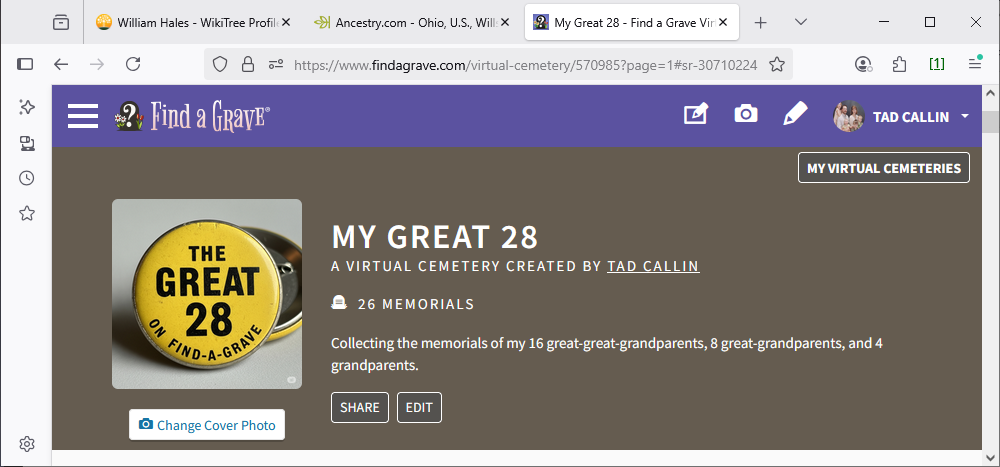
    And, of course, the Virtual Cemeteries feature lets you organize the memorials you frequently visit, or that you have an interest in. I’ve used this to organize my search for the gravesites of my 28 grand/great-grand/and 2nd-great-grandparents.

    My Great 28 collection

    (You may have noticed I only have 26 out of the 28 here – I am still missing Emil Frey and his wife Emily Amelia Opp.)

    Next up…

    In the next HAMP installment, I plan to take a look at FamilySearch.org – a free site with lots of records and a “one family tree” feature that requires some close attention. If you have a favorite site you’d like to talk about in a future post, comment or use the Contact Form. I’d love to hear from you!

    1. Note: I am writing from an American perspective – I know I have an audience in Australia and Europe, so if you have different experiences with Find-A-Grave, or if there is a better resource for grave markers in the rest of the world, please leave a comment or send me a note. ↩︎
  • The Ubiquity of Prominence

    or “When All of the Acorns Are Mightier”

    Sometimes the number of people who existed in our past is too much for us to easily grasp. One way that people in the past tried to grasp that number was to emphasize only the most prominent members of society.

    They would choose a subject, and talk about that person, often without saying as much of substance about the person. Sometimes they might allude to the rest of the subject’s family while emphasizing the individual’s relative influence in their local community. Of course, the anonymous authors were usually related to the subjects, and this often resulted in the kinds of biographical sketches we are now accustomed to seeing in old books.

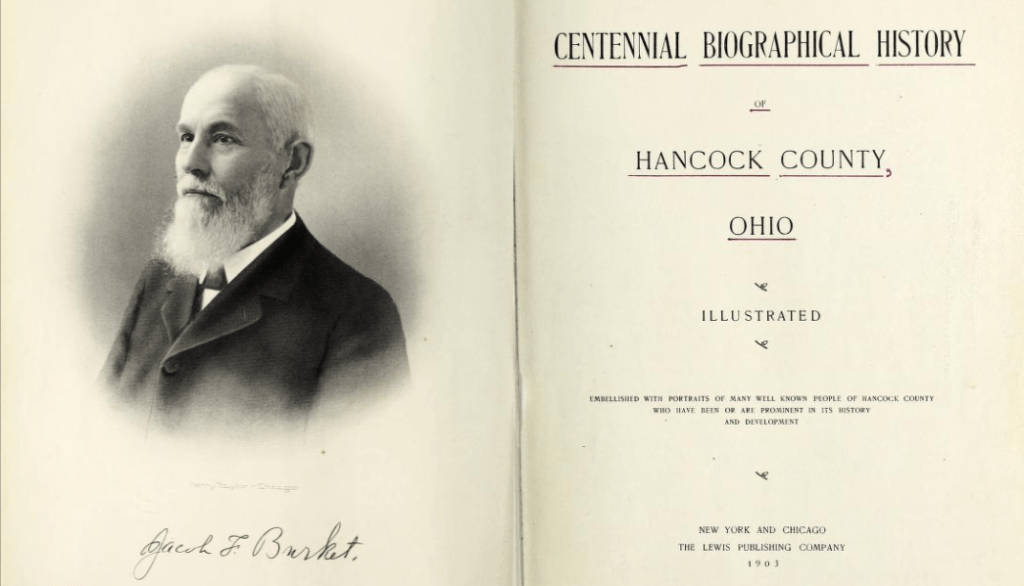
    In A Centennial biographical history of Hancock County, Ohio1, we find such a biographical sketch for Baker Dailey, nephew to my 4th-great-grandfather, Baker Hales (1803-1880). I do not mean to suggest that Baker Dailey did not deserve a biographical sketch of his own, but I am perplexed by some of the editorial decisions made by the people assembling this book.

    Just look at the florid and expansive way this is written. (I’ve bolded the section that I would consider “the important bit” for my purposes.)

    Page 511:

    BAKER DAILEY.

    A stranger driving through the beautiful county of Hancock cannot help being impressed with the healthfulness of the section, for he will meet with more gray heads to the square mile than in any other section of the state. They are hale and hearty people, some of whom have passed from seven to nine decades in agricultural pursuits in the county. We here present for the consideration of our readers one of this class of citizens, who is a well known farmer of Cass township, and a man of fine repute in the neighborhood. He is a direct descendant of D. J. and Mary Elizabeth (Hale) Dailey. The former of whom was born in Steubenville, Ohio, in 1811, and came with his parents and other members of the family to Hancock county, and located near the center of Washington township in 1825. The latter was a native of Virginia was born in 1815, near Wheeling; she came to this county with her brother Baker, and located in the center of Washington township, where Baker Hale entered one hundred and sixty acres of uncultivated land from the government about 1830. Later in life D. J. Dailey and Mary E. Hale were united in marriage, and made a purchase of their own of eighty acres, which was in time brought under subjection. Mr. Dailey was a hard working man, as indeed all pioneers were in that age, and he labored hard to clear his farm, and to rear his family of ten children, four of whom survive, Baker, Samuel, Alonzo and Margaret. The father and mother were members of the Methodist Episcopal church, and the former affiliated with the Whigs, politically, and in his time was a man of influence in his community, some of the offices…[page 512]…of which he administered. He died February 23, 1890, and his wife June 8, 1883.

    From the way the author discusses D.J. Dailey’s political influence, one might think he was the real subject of this sketch!

    Throat-clearing and Florid Explication

    I can’t complain too much about this particular piece, because in the end, that bolded section gives me some important information about Mary Elizabeth (Hales) Dailey (1815-1883), that isn’t readily available in the pre-1850 Ohio records. I appreciate that the author confirms that Baker Hales and Mary Elizabeth were siblings who came from “near Wheeling” West Virginia.

    But look at those first three sentences! Almost none of it is about Baker Dailey, and could be condensed to “Our subject is a farmer of Cass township…” without losing anything of value to the reader.

    Whoever wrote this was determined to impress the reader with his ability to inflate bare facts into a tale of bold pioneer life…even though the bare facts are rather plain and ordinary, and the subject was not a “pioneer” in any respect. When he does finally get around to talking about the subject of the sketch, he packs a great deal of information into Baker Dailey’s two paragraphs. Still, if I were the editor, I would have pared down a sentence like:

    “Mr. Dailey, while not a politician in any sense of the world, has always manifested a disposition to do his share of the work necessary to carry on a rural community, and has been trusted with some of the offices of the township.”

    As a reader, I would prefer a succint: “Mr. Dailey has been entrusted with several township offices.”

    I can’t help but wonder if the author didn’t have more information about the family that could have helped me with my research, had he been more focused on communicating the family’s details than on inflating the importance of his subject.

    Parsing through indirect language

    Even the relevant genealogical information must be carefully teased out of the looping grammatical logic of this text. For example, the author never plainly states that Baker Dailey is the son of D. J. Dailey and Mary Elizabeth Hale. Instead, he breaks up that fact and the reader must look for it in two places within that large paragraph. First, he says, “He is a direct descendant of D. J. and Mary Elizabeth (Hale) Dailey.” Then later, “Mr. Dailey was a hard working man…to rear his family of ten children, four of whom survive, Baker [the subject of the sketch], Samuel, Alonzo and Margaret.”

    From this sketch, with minimal use of sentence diagrams, I can flesh out some of the story of my ancestor and his family, and add it to the much more concise sketch of Baker Hales that was published in the History of Hancock County, Ohio2:

    “Baker Hales came from Brooke County, Va., in the spring of 1834, and located on the southwest quarter of Section 15, which he entered October 17, 1833. His father, William, came with him, and died at his son’s home. Baker reared a family of six children, two of whom reside in the township, and died upon the home farm. His widow lives in Fostoria.”
    pg. 508, Chapter XXVI. Washington Township

    Of course, if I could have a wish granted regarding these sources, I would wish that the author of the first example could spare some of his word budget to augment the details in the second, because I would dearly love to know more about William Hales! But at least with these two secondary sources to point me at Brooke County, Virginia, I have some leads to work with.

    1. A Centennial biographical history of Hancock County, Ohio, by Lewis publishing company, Chicago, publisher, 1903 ↩︎
    2. Brown, Robert C; History of Hancock County, Ohio: containing a history of the county, its townships, towns …, Publisher: Warner, Beers & Co. (Chicago, Ill.), 1886. ↩︎
  • Great-Grandma Merle’s Travelogue

    The Artifact

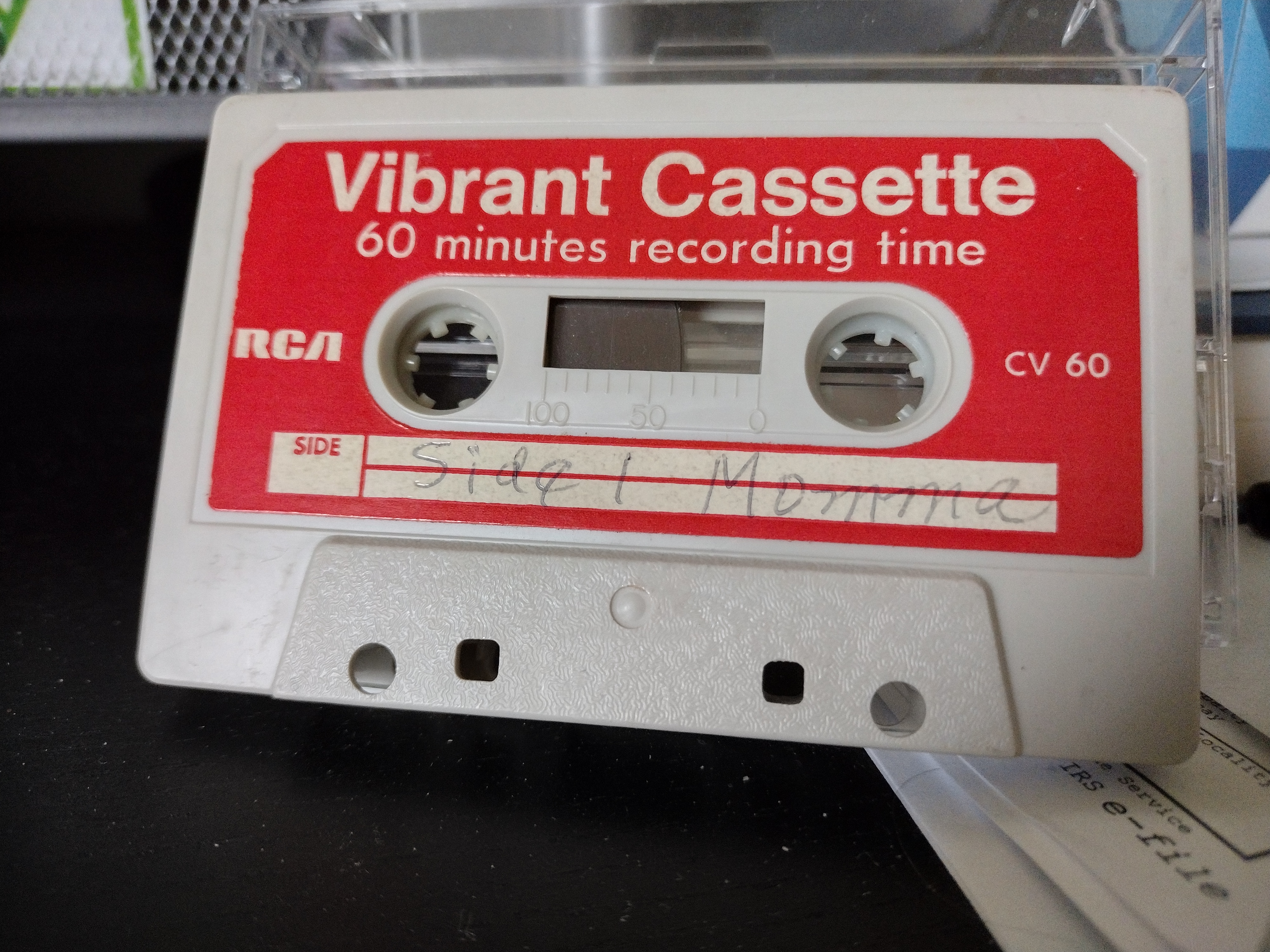
    There are dozens of great articles out there about preserving family artifacts, like photos and recordings. But despite reading them and thinking, “I need to do that with my artifacts,” I never quite find the time to do what I need to do with the Stuff I have accumulated. What I need is a prompt.

    Cousin Pat Witter (my dad’s first cousin) recently came across an artifact and decided to send it to me so I could do something with it. A prompt!

    A transcription of an old memory

    The whole recording is an hour, and features my great-grandmother, Hannah Merle (Huff) Witter, with some “off camera” comments from her daughter, my paternal grandmother, Nancy (Witter) Callin. I don’t know exactly when the recording was made, but I suspect it may have been the mid-1970s, if not earlier.

    Grandma Merle spoke off the cuff to Nancy, referring to her husband, Dick Sr., as “Daddy” and referring to her parents as “Grandpa” and “Grandma.” Her narrative rambles a little, and she sometimes gets details wrong when she stops to explain things to Nancy. There are two main “stories” that she covers: Her family’s first trip from Kansas to Arizona in 1907, and her early life with Dick, including their return to Glendale from San Diego after his post-World War I discharge from the Army. For today, we’ll look at that first part.

    From Kansas to Arizona in 1907

    Merle begins:

    I was born in Savonburg, Kansas on December the 11 19…1889. Daddy was born in Wamego, Kansas. It might have been St. Mary’s but it was Wamego County. And he was born in November the 2…7th… November the 28 1890.

    We never did meet in Kansas. He came out here when he was quite young, about 17 or 18. I came out here in 18… 19 and 7.

    On our trip, we came out on account of Perry being sick and we had a sale of everything in Kansas except the ranch itself. And we started out in a covered wagon. That was grandpa and grandma, Perry, Doris, and I, and Chester went along with us for the first week or ten days until he had to catch a train or something back to start teaching school in September.

    Perry Huff was Merle’s half brother, Albert’s oldest son, from a previous marriage. Perry’s infant daughter was Doris Fay (Huff) Pullins (1907–1998), born on March 8 1907. Her mother, Pearl, died from tuberculosis on March 27, and when the family set out on this journey, Perry knew he had the disease, but none of them knew whether baby Doris would develop it.

    Chester A. Huff was Merle’s brother, two years older than Merle. Since Chester was due back in Savonburg in September, we can assume this trip started in mid- or late-August of 1907.

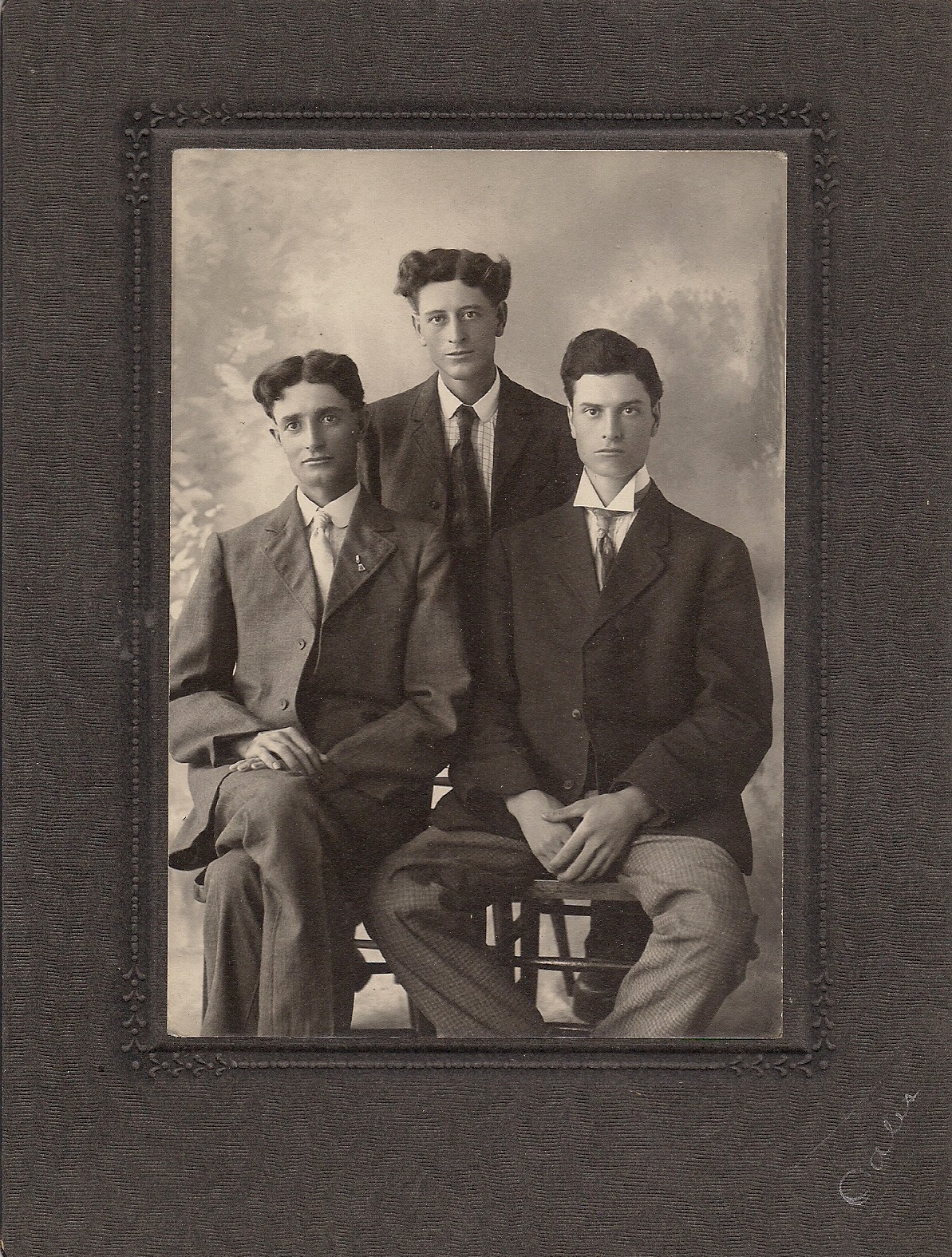
    I’m not sure which of these men is Perry, but Chester is seated on the right of the photo. I believe Perry is seated on the left, and their brother, Albert Burton Huff, is standing between them.

    We traveled about… oh, we averaged about 20 miles a day. We could have gone faster, but the idea was to kill time between… before it got too cold in Kansas, and to kill time until it got cool enough in Arizona. It had been too hot for us at that time.

    Our first stop, we didn’t make too big a long journey, we stopped at Big Creek, which is a little ways west of Savonburg. Oh, maybe 10, 15 miles – something like that. But we almost never went there. But we just thought we had an ideal place for our first camp. It was cool, and it was shady down in there, and we started to unpack and make camp. The boys grabbed fishing hooks and went down to see if they could get some fish for supper.

    We didn’t get entirely unpacked because we was a fighting mosquitoes. They were down at the creek bottom, too. So we had to hitch the team up again and get out of there and get up onto higher ground. By that time, the boys didn’t have time to go back for supper.

    It’s been so long since I made that trip, the majority of the details I don’t remember, but we always tried to make camp in daylight. Well, we didn’t have the facilities… we had a lantern, I imagine. But we usually had our meal cooked and ready to go to bed anytime we wanted to after long before dark. 

    We usually …well, we tried every day to make it from one water place to the next. We’d inquire ahead about 20 miles ahead, if there was water. At first, we didn’t have any trouble, because there was settlers along there and wheat farms and things, but the farther west we got, the scarcer the water was. And just two nights – we had water with us, we had kegs of water on the side of the wagon. But we had to make camp without any water supply other than what we carried with us. And that meant the poor horses didn’t get…. Well I think grandpa usually would give them a bucketful a piece in that case. ..was all the water they’d get until we’d come to some the next morning. 

    I remember one time we camped, it looked like it was coming up a cloud and it was gonna rain or storm or something, and we were right close to a little country school house out on the prairie. Grandpa drove the team and the wagon up right close, it had an open porch on it. Drove the wagon right close up to this little porch. Perry always slept outdoors in his camp, in a cot and covers, so he could get under that, and the wagon would protect him from the rain. And it did. We got in there and got his bedding out, and of course, grandpa … they had a little barn at the back where the school children tied their horses in the wintertime. Grandpa got the team around and brought them, old Dan and Daisy, and got them sheltered and fed, and got back to the wagon. We hadn’t got anything cooked or even started a fire. And boy, the rain started and the wind and it kept it up all night long that night. So we didn’t get much sleep, but we were dry and the team was dry.

    We tried to follow the railroad track just for to keep the correct direction, but I’ve forgotten the place that we were instructed to leave the railroad and start off across country. But when we finally traveled to that place, we saw we was to go across country until we came to a little place they called Crow’s Roost. And that’s …there wasn’t even a trail to follow after that. So we was to stop there and call my aunt, Mrs. Keen, and they were to come and meet us at Crow’s Roost.

    “Mrs. Keen/Aunt Francy” was Rosa’s sister, Hanna Frances (Murray) Keen. Frances Murray married John Keen in 1880, and sometime after their three children were born in Kansas, they moved 590 west to Colorado Springs. Here is a rough estimate of the journey Merle and her parents took to get there.

    By that time, we was in Colorado. We had crossed the border. There was nothing to the border different from one side to the other, except that there was a town of prairie dogs, right there, we said that was on the dividing line.

    Anyway, we called the folks, mother’s sister, and they had a telephone. They had two receivers so the kids could talk. That was the kids’ amusement there. They’d get on the telephone and call a friend and they could all talk. But anyway, they came for us and we followed them on over to their place that night. And that was what – made it 30 days and 30 nights that we traveled. We didn’t actually travel at night except that last night, the 30th night.

    Nancy just now reminds me that she never heard me say before that we went to Colorado to mother’s sister, Aunt Francy Keen. Mr. Keen was there, and he was running sort of a little store. Nothing much except needles and threads and buttons and things, little things that the people …that somebody might want that live in two to three miles and didn’t want to go into Colorado Springs to get.

    The three Keen “children” Merle talks about here were Julious, who was about 26 in 1907, Iliff Basil (17) and Beatrice (15). Merle herself was about 18 at the time.

    I can’t remember how far it was to get to Colorado Springs. But when I got there, we …the first evening, I guess they was at a loss to know what to do, because they always talked to their friends on the telephone for entertainment and stuff, and I wouldn’t have known any of them. So..

    Their mother, Aunt Francy, told them to show me the family album. So they did, and they started showing me the pictures, one on each side of me. Me, I didn’t notice, but I began to say, “Oh, that’s uncle so-and-so,” or “That’s cousin Ralph,” or “that’s Earl” or “that’s somebody else” – and I knew them all, and they just sat there never said a word, and would have never met any of those cousins or relatives back there. of course, they didn’t know me either, until I got out there. But that was the first that they knew of any of us. So they got enlightened with me telling them who their relatives were in the album. 

    One day I went with Beatrice to school and we must have walked across a little prairie lane, oh, possibly a mile and a half or so to her school. It was just a little one room, one teacher, all grades in together school, and there couldn’t have been more than 6 to 10 pupils all told. But I enjoyed that too, and then when it came time that they felt… they could…

    Well, one time, Francy and her family drove our team and wagon into Colorado Springs, and we drove partway up Pike’s Peak, just with our team of horses. And, we decided we wouldn’t go all the way, so we had to turn around and come back, then. But we went about half to two-thirds of the way up. We made that trip, and then we went back to Aunt Francy’s and stayed the rest of the time, until they was ready to…well I think Perry and Daddy went in to see about selling the team of horses one day. They made that trip in.

    And, they did sell them, broke grandpa’s heart because we had to sell ‘em and he didn’t get too good a price for them. But then they come home and gathered us up and we went in and he turned the team and the wagon and everything over to the man we’d sold them to, and we caught the train to come out here to Arizona.

    And I don’t remember much about the trip out here, although I think we changed cars at Ash Forks to come on down to Phoenix.

    I couldn’t find a clear map of the railroad route from Colorado to Arizona in 1907, but this is a close approximation of their route:

    Next Time: Settling in Glendale

    We’re barely at the 15-minute mark in this 60 minute tape, so we’ll hear more from Merle about living in Glendale next time!

  • HAMP: Harmonizing Across Multiple Platforms

    An argument for collaborative genealogy

    I’ve been working with collaborative platforms of one kind or another since about 2006. (See The Backstory here!) For several years, between 2008 and 2012, I taught courses on using collaborative media to federal employees. So I have observed for myself how people use or abuse the tools available to them, and have seen these tools succeed (Wikipedia is a great example of success) and fail (too many to mention).

    Collaborative tools have been a part of genealogy for a long, long time. Sites like FamilySearch, Find-A-Grave, and WikiTree are the best known and the most open, but a lot of people shy away from exploring them because of what they see as too much openness. (In other words, other people can threaten to undo your hard work.)

    I’d like to take a deeper look at each of those sites and how to get the most out of them. That discussion will have more to do with how they work, but before we get to that, we need to talk about “expectations” and define the difference between flaws in a collaborative tool and flaws in the users of any given collaborative tool.

    In other words, I need to make sure we’re not blaming the technology for our own personal quirks.

    The Flaw in Collaboration

    Any tool or platform that allows users to edit content or participate in an online activity is going to suffer from the same basic, unavoidable flaw: the Users.

    You may already have a collection of horror stories about dealing with “wrong information” about your ancestors and contributors/other users/site managers who refused to correct it or take it down. That is a problem that we’ll talk about when we get to the specific platforms, but you must always remember that you, too, are one of those Users, and thus you are an important part of the problem you are trying to solve. Before you jump into a new online community, make sure your goals and expectations are realistic, and make sure your choices and actions are designed to achieve those goals.

    No matter what your skill level is, or which tool you decide to invest your time into, you must be mindful of how you behave and you must constantly remind yourself that you are interacting with Strangers On the Internet. This is always going to be a part of using collaborative tools.

    Basic Rules of Netiquette

    Before you dive in and try to “fix” Find A Grave or make sense of the FamilySearch tree, be sure that you are thinking things through before you start communicating with other users.

    1. Assume Noble Intent – there are a lot of people (and bots) out there on the internet who intend to cause problems. But when you first encounter somebody using a family history platform, you should approach them the way you would approach another person in (for example) a public library. If you’re going to ask them for help or offer a suggestion, make sure you sound friendly, interested, and approachable. Remember that they might not know these rules, and they might not “assume noble intent” about you, at first. So be professional and try to make a good first impression.
    2. Stick to Facts and Evidence – if you found something incorrect in an ancestor’s profile, you might feel angry or annoyed that the mistake is there, especially if it is a mistake you have seen duplicated in more than one place. But if you have to ask someone for access or permission to fix the error, you must NOT begin your interaction with a stranger by talking about your negative feelings; that is almost never going to get you the reaction you want. Instead, open by explaining your connection to the ancestor and (most important) that you have evidence to help improve the profile.
    3. Always Think About De-Escalation – once you make contact with someone and start interacting, you can’t let your guard down. Practice de-escalation techniques throughout your conversation. (There are many good resources for learning how to de-escalate conflict – maybe read “6 Ways to De-Escalate a Heated Argument” before you approach someone online.)
    4. Be Open to Being Wrong – you already know that genealogy is difficult and challenging; even if you think your facts are solid before beginning your conversation, there may be a very reasonable explanation for the “error” you are trying to correct. Try not to think of this as “losing” the argument.

    Baked into all of this advice on personal interaction is the assumption that your research is based in evidence and that you are using Critical Thinking effectively. (If you aren’t familiar with the term “Critical Thinking,” or if you want to test whether I know what I’m talking about, go read that earlier essay.) I don’t say that because I think I’m a master of critical thinking techniques; quite the opposite. I have been working on myself and trying to center those skills for a couple of decades. My goal is that someday I will use Critical Thinking effectively!

    But I do think it’s important that you take a hard look at how you work and think, and examine your assumptions as often as you can. Keeping your head on straight is the first step to meeting your own goals.

    What is “Harmonizing Across Multiple Platforms”?

    If you spend any time in a discussion about all of the different genealogy tools and platforms available online, you will run across someone expressing a wish that there was a “one stop shop” that “did everything well.” That someone might be you, or you might just find yourself agreeing with the sentiment. But reality is often very different from what we imagine we want.

    The person on the left is describing their idea of the perfect fantasy unicorn, and the person on the right is visualizing a rhinoceros. This is meant to show that what you imagine you want may exist in a very different form.
    What you want may be a fantasy that doesn’t look anything like what you can actually have.

    The point I’m trying to make is that the Internet itself is The Rhinoceros: it’s big, ugly, and can sometimes be dangerous. But that is also our “one-stop shop” for everything we want to do. That’s where we can find a growing number of databases for finding records, software for tracking research and publishing our work. It’s where we can find distant cousins or researchers with common interests. If you do in-person research, you probably organize your travel plans and set appointments through the Internet before you go. And of course, the Internet is where we can find the variety of collaborative tools that let us tie all of that together.

    The Unicorn is the shiny fantasy we all of have finding a single website or walled garden that will let us safely do the things we want to do without paying a lot of money or dealing with obnoxious people. That creature does not exist. It never has, and it never will.1 And I’m sorry about that.

    But I’m not here to discourage you. Rather than try to find a unicorn, I’d rather help you ride the Rhinoceros. And that will mean taking our time to look at several tools and platforms to see how they work, how they can work together, and help you decide whether and how you should use them to reach your goals as a genealogist and family historian.

    My own approach is to spend most of my time and money working on Ancestry2. From there, I take what I learn and build profiles on WikiTree; I also have free accounts on several other sites and I try to take the time to make sure that what I see on Ancestry and what I put on WikiTree is harmonized with what can be found on FindAGrave, FamilySearch, and (to a lesser extent) on MyHeritage.

    In the coming weeks, I plan to talk about each of these sites in a “HAMP” series, and along the way, talk about strategies for making sure that the best, most accurate information I have is available on all of these sites. I don’t know everything, and I don’t pretend to be the expert at any one tool, so if you have suggestions, want to suggest a tool for me to explore, or have a write-up you’d like to share with the rest of the class, you can tell me using The Contact Form!

    Let’s get ready to explore!

    1. I feel your pain. I even wrote a fantasy story about a real unicorn: “Silver” from the Dunesteef podcast. ↩︎
    2. Nobody sponsors me, but if that ever changes, I will be transparent about it! ↩︎
  • Dangerous Times in Kentucky

    A Tale of Harassments and Murder

    Note: this piece was originally published on Projectkin in Feb 2024 in their Member’s Corner. It is being re-published here with permission.

    Kentucky was not the safest place to live in 1862.

    Several Southern states seceded from the Union after Fort Sumter, but Governor Beriah Magoffin declared Kentucky to be neutral on 20 May 1861. That neutrality only lasted until 11 September, when the legislature called for Confederate troops who had entered the state a week before to leave. They asked Union forces to drive the Confederates out, and since a majority of Kentuckians supported the Union, it was officially a Union state from then to the end of the war.

    That did not mean that Kentucky was united behind the Union cause.

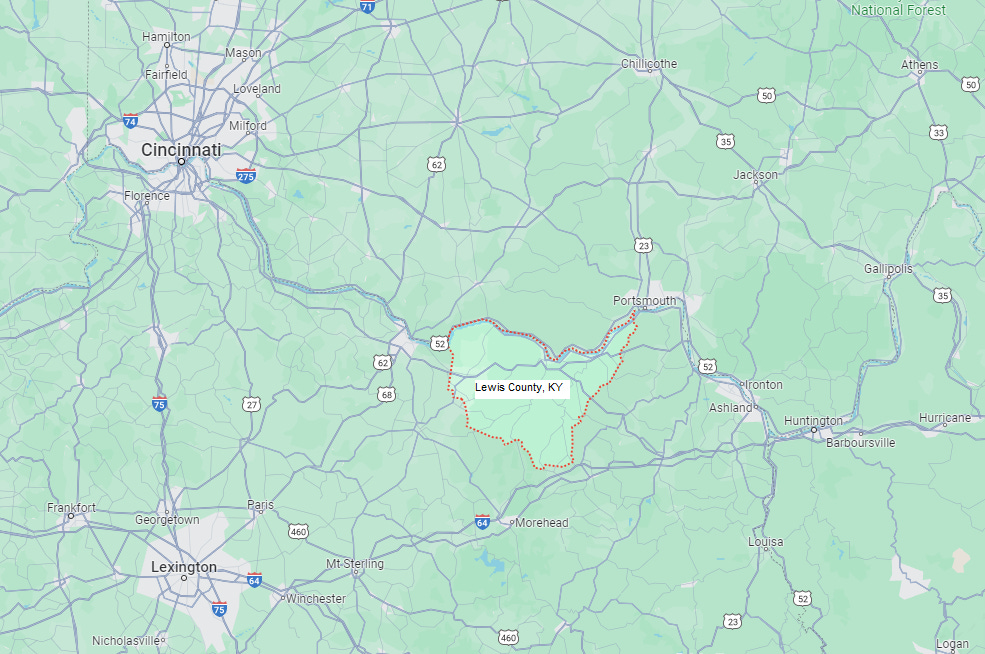
    In 1862, Thomas West lived in Lewis County, Kentucky, which sat south of the Ohio River, about equidistant from Cincinnati and Lexington. He was an old man, having been born in Maryland in 1789 – which made him about three years older than the state of Kentucky itself.

    Lewis County, KY, in relation to other cities (Mapbox made in Paint using Google Maps)

    Thomas probably came to Kentucky as a child. He married Rebecca Staton in Mason County on 16 August 1809, and they moved to Lewis County sometime between the 1820 and 1830 U.S. Federal Census. The census records suggest that they had four sons and eight daughters, though we only know the names of three of them: Elizabeth (West) Wallingford (1823–1899), Frances Mary (West) May (1825-1871), and one of his sons.

    James M. West – Exiled in “Egypt”

    Thomas’s son, James M. West, was a farmer and preacher for the American Missionary Association. As an abolitionist, he angered the local slaveholders, and they tried to drive him out of Kentucky. In 1855 he moved to Pope County, Illinois, where he followed the occupation of farming during the week and preached on Sunday.1

    Miller Grove was a Pope County community founded northwest of Golconda in 1844 by a small group of free African Americans from Tennessee. Evidence suggests that Miller Grove served as a way station for the Underground Railroad. James West lived near the Miller Grove community, visiting often. He would spend the night with Henry Sides, a white man who entered the bonds for many of the freed families from Tennessee. He and his wife Barbara moved from Tennessee to Miller Grove with the original four African American families. West was known in the area for distributing Bibles, and documenting contributions to the “Canada Refugee Fund”. In 1857, he praised residents who became recipients of antislavery literature as “messengers who seem to be doing a work that would otherwise be hard to accomplish”.2

    Pope County, Illinois (in relation to Louisville, KY (Mapbox made in Paint using Google Maps)

    While Pope County may have been James’s refuge from Kentucky, it was not necessarily safer, as the country inched closer to the Civil War. In the spring of 1860, James was singled out in the local newspaper:

    Golconda Herald – 9th or 16th of March 1860

    “We have been credibly informed that an Abolition preacher named West has been engaged in circulation incendiary prints throughout this and adjoining counties, and he has even gone so far as to send some over to gentlemen living in Kentucky. If he has no particular desire to wear the martyr’s garment–tar and feathers–he had better decist. Look out for yourself you imp of Baal; for you will be dealt with roughly, if you don’t attend to your proper calling, more closely.

    “At the request of our Kentucky contemporary, the Uniontown News, we publish a description of Jas. M. West, the abolition preacher whom we noticed last week. Rumor says that once upon a time he was tarred and feathered up in the neighborhood of Uniontown for the same offense of which we accuse him, i.e., circulating abolition prints. We have been informed that said West is agent for an abolition book and document publishing house of Boston, and received $25 per month for his services. We are in favor of the free toleration of all religious and political opinions; but when a traitor comes among us wrapped in the sincere garb of a minister of Christ, and endeavor to rob men of their property, we feel bound to expose him, that those most interested may be on the watch for him. He is about 9 inches over 5 feet high, slenderly made, stooped, sunken breast, long visaged, with Roman nose, light black eyes, dark hair and complexion, free spoken, and is about 40 years old. We don’t think he has sufficient courage to steal a negro, but he’ll bear watching.”

    James responded:

    Broad Oaks, Pope Co., Ill.

    March 22d 1860

    Mr. F. H. Hinan, Dear Sir:

    In your editorials of March 9th and 16th, in Golconda Herald, you seem disposed to crush the reputation of a Civil, law-abiding citizen, without any just grounds on which to base the abuses therein contained against me. You base some false statements on what you call “credibly informed,” rumor, &c.

    1st.–I have never sent what you call “incendiary prints to gentlemen living in Kentucky,” within one hundred miles of Golconda, Illinois.

    2d.–I was never “tarred and feathered up in the neighborhood of Uniontown,” nor at any other place, for circulation abolition documents, nor for any other offense against the law of God or man.

    3d.–I am not an “agent for an abolition book and document house of Boston,” and never was.

    But if believing slavery to be a sin against God and a crime against man, and as such, ought not to be tolerated in church, and proclaiming this from the pulpit and the press, is a crime, then am I a criminal. And if this renders me worthy of wearing the “martyr’s garment” then bring on your tar and feathers, and bring those “gentlemen” with you, to put it on, to whom I sent those “incendiary prints living in Kentucky.” Find a certificate below of my standing among my neighbors…

    I send also a statement of Jas. H. Davis who was well acquainted with me while living in Kentucky. Please do me the justice to give this a place in the columns of the Herald. In haste, yours for Christ and human elevation.

    Jas. M. West

    Colp. A. M. A.

    Not long after that, James was driven out of Pope County and published another letter from his new home in Richview, Illinois:

    Chicago Tribune – May 1861

    Letter from one of the Persecuted.

    (The following is from a worthy and excellent man, who with his family was expelled from Pope County, Ill., for the crime of being a Republican.)

    Richview, Ill., May 1st, 1861

    Editors Chicago Tribune:

    The losses which we have sustained, connected with our expulsion from Pope County, Illinois, including robbery, damage, sacrifice, and removal, amounts to much more than we at first supposed it would be, say from $1,200 to $1,500… This has reduced us to circumstances of great necessity; but Christ said, “blessed are ye, when men shall revile you, and persecute you, and shall say all manner of evil against you falsely, for my sake.”

    It is very gratifying indeed, to know that our persecutors had nothing to charge against us that is immoral, or that which the law of God, or the law of the land condemns…

    The secessionists in this part of “Egypt” are growing more mild, and many of them have abandoned their disunion principles, and with the exception of four or five of the Southern counties, our State may be said to be a unit against secession.

    The cloud of gloom overhanging this part of the State, is fast disappearing, and we trust the Union States may adhere to the principles of justice, love, and mercy, and avert the evil with which we have been threatened. May God speed the right.

    It may be gratifying to you to learn that I have no disposition to relax my efforts to promote the cause of Christ, and of Liberty and human elevation.

    In haste, yours truly,

    Jas. M. West, Colp. A.M.A

    The Murder of Thomas West

    While James lived and worked throughout Illinois, seeking to defeat secessionist sentiments in that state, his father remained in Kentucky. James’s mother, Rebecca, died in 1859, leaving her husband alone, and Thomas took a young family into his home. That family departed for the weekend on Saturday, 18 June 1862, and returned the following Monday to find Thomas dead.

    Newspaper accounts vary. The clipping from the Shelby (KY) News James received said Thomas was found “in his bed, dead, with a bullet hole through his body.” That account also said, “Circumstances attached suspicion to his son-in-law, named May & a possee [sic] went to his (May’s) house & near it found a letter revealing a conspiracy on the part of five strong secessionists to murder old man West who was a Union man for his money, some $600, & also to murder Capt Brown & Major Hambrick for their political sentiments.”

    James forwarded a copy of that account on 11 August to his correspondent, Rev. S.S. Jocelyn of New York, saying, “The foregoing conflicts considerably from what Mr. May wrote me.” In a second letter to Rev. Jocelyn, dated 8 September, James stated:

    “I am sorry that I have nothing more definite relating to the brutal murder of my Father. All that we have goes to prove the certainty of the foul deed, but all accounts conflict with each other in many respects. My brother-in-law, J.S. May, wrote me on the 10th of July, that the rebels failed to find the money after committing the murder & that they found $754, & this morning we received a letter from my sister, & her husband living in Marion Co., Iowa, containing a copy of a letter sent to them by said May dated July the 6th, stating that they found $557.80. In other respects the two letters harmonise.”

    A more complete newspaper account was published in The Courier-Journal of Louisville on 24 July 1862.3 That account described Thomas as “a Methodist classleader,” and printed a coded message from the five conspirators detailing their plans to attack West and three other men.

    John S. May: Confederate in the Family

    John Shaw May married Frances Mary West in Lewis County on 5 August 1846, well before her brother’s troubles began. While John appears not to have been involved in the murder of his father-in-law, records show that John S. May accepted a commission as a Second Lieutenant in the Kentucky 6th Cavalry, Company C – a Confederate unit – on 12 September 1862. John was captured in battle at Buffington Island, Ohio, on 19 July 1863. John’s record in U.S., Civil War Prisoner of War Records, 1861-1865 shows him listed as a private, imprisoned on 19 July, and sent to Camp Douglas, near Chicago, on 22 August. He remained there until his release on 21 Feb 1865.

    Buffington Island spelled the end of “The Morgan Raid,”1 an event which put my 3rd-great-grandfather, John May, on the other side of the battlefield from my 2nd-great-grandfather, John Henry Callin, who fought in an Ohio artillery unit that day. It’s sobering to think that 161 years ago, either of these two men could have died at the hand of the other – with the result being that I wouldn’t be here to write about it.

    After the war, John returned home, and he and Frances had two more children before she died in 1871. While we may not have letters explaining his point of view or defending his participation in the secessionist cause, we do know that he remarried and had a son and three daughters with his second wife, Mary St. Clair (1839–1925). John named his son Samuel Tilden May, presumably after the New York Democrat who ran for president in 1876, Samuel J. Tilden. That is the election that famously ended without a clear majority of electoral votes, and was only given to the Republican candidate, Rutherford B. Hayes, in exchange for an agreement to end Reconstruction.

    Samuel Tilden May was born on 28 January 1877. Perhaps that is the only political statement we will ever get from John Shaw May.

    1. from “War Poems Written in the Army” by John H. Callin and Tad Callin, available on Lulu ↩︎

  • Defined By One Place

    Adam Brookhouser, Jr. (1803-1865) of Hayfield Township, PA

    The history of a place doesn’t begin with people, and this place was no exception. Recorded history does begin with people, although we have to acknowledge that we have a “selection bias” towards history that we can access through the written word. The reality is that there were people with a long oral tradition living along these rivers and in these valleys for centuries before the people I’m going to talk about showed up.

    One oral history that was recorded in writing appears in the “1876 Atlas” 1 came from an early settler, Joseph Dickson (1790-1888), who described how a James Dickson (probably his father) left Pittsburgh in 1793 and found his way to a place known then as “Magoffin’s Falls.” In his words:

    Here he made a tomahawk improvement, as the early settlers were wont to do,—that is, he deadened a few trees and marked others by cuttings in the bark. This act gave no legal rights, but was respected by the settlers as establishing a priority of claim, with which it was discreditable to interfere. … Dickson worked in company with a man named William Jones from east of the creek, and raised a supply of corn and potatoes. As winter approached he returned to Pittsburgh, and passed that season in preparation, and, in the spring of 1794, brought his family up French Creek in a keel-boat to Meadville. Dread of the Indians prevented improvement; but in 1796 that fear was removed, and the family of seven persons moved to the future farm. … In 1797, three brothers named Mason,—David, George, and Isaac,—moved in, and the Brookhousers came about this time to Woodcock Township.

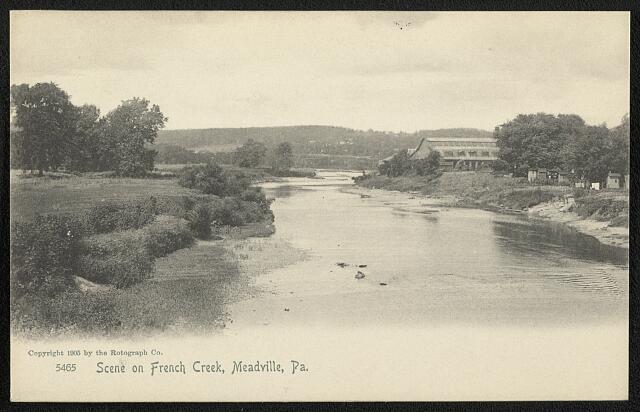
    This is Hayfield Township in Crawford County, Pennsylvania, today:

    The Brookhousers are the family I am talking about today, but before we get to them, there is a sentence that needs to be unpacked a little bit: “Dread of the Indians prevented improvement; but in 1796 that fear was removed…

    We talked about this in Fear of the Foreigner, recently. A century or more of violence between competing indigenous and European powers fed both rational and irrational fears of attacks on white settlers by the people they had displaced. The struggles between them were more complicated than the dynamic of colonizers vs. indigenous people, but when Dickson says “that fear was removed,” he is probably referring to two events: the Treaty of Greenville (signed in 1795 after the Battle of Fallen Timbers2) and the Treaty of New York (1796). Those were the treaties that ended the organized resistance to settlers from the new American government in what is now Ohio and western Pennsylvania.

    And so, the Brookhousers arrived in Crawford County.

    Settlement of the Brookhousers

    The Brookhouser family moved to Woodcock Township in about 1797, and Adam Brookhouser, Jr. was born on 21 October 1803, the son of Adam Brookhouser (1776-1863) and Keziah Mason (1775-1860). Their family was counted in Meadville in 1800, and in Venango Township, Crawford County, in 1810 and 1820. When village of Saegerstown was incorporated in 1838, Adam Sr. and his two sons, Adam (Jr.) and Jacob, were counted among the early settlers.3

    Writing about a man like Adam Brookhouser, Jr., presents the problem of oversimplification. We have a few records, a very nice headstone, and almost no details about who he was or what he was like. He was too young to be the Adam Brookhouser who fought in the War of 1812; that was more likely his father. He was too old to fight in the Civil War, though you can find online references in personal trees that suggest he was a Civil War veteran. And he died just two years after his father died, adding to the confusion over which records belonged to which man.

    Adam Jr. was a farmer, descended from a German immigrant who fought in the American Revolution. He worked his land and raised a family of seven children on the land that his family felt they had won. Most likely, he was illiterate, and he signed his will with an “X” for his mark.

    That will is the best evidence we have of his connection to (most of) his children and his wife, particularly the second section:

    I give and bequeath unto my dear wife Mary all my estate both real and personal to have and to hold the same during her natural life, provided she remains my widow and after her decease (or marriage) I give and bequeath the same to my seven children to wit: Cornelia, wife of John Boyd, Nathan Brookhouser, Keziah wife of Ephraim Mills, Susana wife of David Jones, Martha Ann wife of Wm. Patterson, Orvilla Brookhouser and Phares Luther Brookhouser, to be divided amongst them share and share alike.

    Three of Adam’s sons (Martin, Samuel, and William) died young, thus were not named in the will. The loss of Martin at age 6 in 1845, and of Samuel Augustus and William Marcellus (12 and 7, respectively) in 1853, certainly delivered a blow to the legacy he hoped to leave behind. By the time Adam drafted his will, it probably seemed unlikely that his two remaining sons would take over the farm. His eldest son, Nathan, had already moved west to Pottawattamie County in Iowa, and his youngest son, Ferris (or Phares) Luther was only 11 years old. That may be why he ordered that after the death (or remarriage) of his wife, Mary, all of his real estate and personal estate should be sold and divided between his surviving children.

    Quintessential Acorns

    We tend to see history in terms of great deeds and adventure, but the wars, treaties, and establishment of new governments are just that part of history that is visible above the surface. Underneath, those landmark events are the everyday and the normal. Planting and harvesting, caring for children, chores – those are just a few of the events of history that never make it into the Historical Record.

    My wife and I started our first garden when we moved into our house a couple of years ago. When we moved into our house in Baltimore in 2005, there were two pine trees that I had to cut down and remove. In between those events, we remodeled two houses and took our children camping a thousand times. When I learn about an ancestor who cleared a field, built a cabin, and raised ten children in a place without running water or health services, that knowledge sits in the back of my mind until something reminds me.

    Weeding our little vegetable patch and fighting off the squash borers one or two weekends a month reminds me that a farm family would have been depending on those squash for meals. The ache in my back after chopping up and bundling a single pine tree gives me a new appreciation for the effort expended to clear a field for crops. Sitting up with a feverish child waiting for medication to take effect or worrying in the emergency room while stitches are stitched gives me a taste of the helpless horror of watching a child die from some mysterious disease.

    Historians and genealogists may sneer at the accuracy of these old secondary sources, like the Atlas of Crawford County, and they may be right to sneer at the biases of the editors and the over-reliance on the memories of survivors who are inclined to inflate the importance of their settler ancestors. But you can get a glimpse of the daily life of the farmers and tradesmen in these places and imagine how they spent their days, weeks, seasons, and years building their lives.

    If all you have after spending 60 years in one place, doing all of those ordinary, daily things, is a record that you were there and a nice headstone, that is still history. And that is worth knowing.

    1. Combination Atlas Map of Crawford County, Pennsylvania, Compiled, Drawn and Published From Personal Examinations and Surveys (Philadelphia: Everts, Ensign & Everts, 1876); found at https://crawfordcopa.com/history/1876/hayfield, accessed 28 June 2025. ↩︎
    2. I believe my 5th-great grandfather, James Callin, fought under the Kentucky Cavalry in the Battle of Fallen Timbers. See Theoretical: James Callin’s Military Career ↩︎
    3. Bates, Samuel P. (Samuel Penniman), 1827-1902, Our country and its people. A historical and memorial record of Crawford County, Pennsylvania; Boston : W. A. Fergusson; 1899, pg. 667-668 (accessed 29 June 2025) ↩︎

  • No Fit Ending

    Unearthing things people wanted buried

    Jessie Callin was the youngest of four children born to James Monroe Callin (1844–1901) and Rosalina Bedora Davenport (1848–1876). She was born in March of 1876, so she was only a few months old when her mother died on 20 September.

    Her father was the brother of John H. Callin (my great-great-grandfather, author of War Poems) and George W. Callin, author of the original 1911 Callin Family History. George was married to the former Mary Ann St. John, and it was her parents who took Jessie in as an infant and raised her. Jim and Rosa’s three older children, Albert, Arthur, and Bessie, went to live with Rosalina’a parents.

    Jessie seems to have remained with the St. John family, even after her father remarried in 1880. Jim and his second wife, Almira, had three daughters, Cora, Carrie, and Aurilla, and an unnamed infant who died in 1887. At some point they relocated to Deerfield, Michigan, before returning to Bowling Green, where Almira died of tuberculosis in 1889. She was only 31, and Jim was left widowed again with three daughters under 10 to care for.

    Meanwhile…

    Al Chudley, An English Tailor

    Albert Henry Chudley was the son of Henry Chudley (1844–1914) and Emma Lattaney (1846–1878), most likely born on 4 Nov 1867 in Saint Thomas, Devon, England. He was raised in Saint Sidwell, Devon, and lived with his maternal grandparents in Crediton, Devon, after his mother’s death. Then, at age 15, he arrived in America on 1 April 1883.1

    Within a decade, Al had become a well-liked resident of Bowling Green, and went into business as a tailor, forming the Hull & Chudley tailoring firm. On 25 June 1893, he married “Jessie Callin, better known as Jessie St. John,” and his naturalization as a U.S. citizen was completed on 3 November of that year. At first, the young couple lived in the home of the St. John family, and things seemed to be going well.

    But at this point in our history, the records stop telling us what we need to know, and we only have the outline of their story. Despite having a lot of little pieces of evidence, the bigger picture seems to disappear…

    Behind a Cloud

    When George W. Callin compiled his Callin Family History in 1910, here is what he recorded for his niece, Jessie:

    Record of Jessie Callin Chudley, who was the 2nd daughter of James Callin, who was the 2nd son of William Callin, who was the 3rd son of John Callin, who was the 2nd son of James 1st.

    Born in 1876.

    Married in 1893.

    Born to this union two children.

    Laverne, born in 1894.

    Lila, born in —-.

    There are records to support those facts, as well as a few additional details. Wood County marriage records and The Daily Sentinel-Tribune in Bowling Green recorded the wedding. Birth records show that Al and Jessie had a daughter, Lu Verne, on 30 Jan 1894, in Bowling Green.

    On 13 February 1896, The Daily Sentinel-Tribune told us cryptically that, “A. H. Chudley’s child is reported quite sick.” Two weeks later, on 26 Feb, “Dr. C. S. St. John reports a new baby at the home of Mr. and Mrs. Al Chudley.” I would have to conclude that Lu Verne was “quite sick,” but there was no follow up to tell us when she got better.

    At first, I assumed this second baby was Lila, but the Wood County birth records show that Al and Jessie had a baby they named “Chas.” on 25 Feb 1896:

    Details taken from images at FamilySearch.org – top is 2 bottom is 3

    Confusingly, one of those records indicates that “Chas.” is female, and the other indicates male. We’re going to let that marinate for now.

    In May of 1896, The Daily Sentinel-Tribune published two brief items about the Chudley family moving to Gallipolis, which is 230 miles south of Bowling Green on the state line between Ohio and West Virginia. On 12 May, the household effects of A. H. Chudley were shipped to Gallipolis, “where Mr. Chudley has a position at his trade.” On 16 May, “Mrs. A. H. Chudley and baby left to-day for Gallipolis, their future home.

    On 30 January 1899, in The Daily Sentinel-Tribune, a funeral notice for Mrs. S. W. St. John (the mother of the family that raised Jessie) noted that “Mrs. Jessie Chudley and children, of Tecumseh, Mich.” attended. Tecumseh is in Lenawee County, about 40 miles north of Toledo, Ohio.

    In 1900, Jessie and Lila R Chudley are recorded in Jackson, Jackson County, Michigan. Jessie is recorded as “married,” but there are no records for Al, Chas., or Lu Verne in 1900. I have concluded that by this point, probably between Gallipolis and Tecumseh, Albert Henry Chudley left his wife and children. He is not seen in any records I can find between 1896 and 1906, notably the 1900 Census. (His story will come on a later date.)

    There are only a few more clues before we lose sight of Jessie and Lila, too. In 1901, the Jackson Citizen Patriot reported brief items about Jessie visiting her sister, Bessie McFann, in Toledo (January) and Mrs. Jessie Chudley and daughter, Miss Lila, visiting friends in Tecumseh. City Directory entries in 1902 and 1904 list Jessie in Jackson, but in 1904, the obituary for her grandmother, Laura Davenport, and a Toledo City Directory also place her in Toledo.

    Our last information about Lila has her spending the 1903 Christmas holiday in Sandusky with Mrs. A. A. Magill, of that city.

    No Clear Explanations

    Those were the facts, but what do they tell us?

    One explanation might be that “Chas.” and Lila were twins, and that Chas. did not survive the birth. An even simpler explanation might be that Lila’s given name was something like “Charlotte” and the clerk abbreviated it as “Chas” for some reason.

    George Callin didn’t know Lila’s birthdate, so it’s possible Lila was born a year or so later, when her parents were still living in Gallipolis.

    I’m fairly sure that Lu Verne and Lila were sisters, and that the family was together until around 1897, and living in Gallipolis. But I don’t know what happened to Albert or Lu Verne. Albert, as I said, may have left as early as 1897, and the last mention of Lu Verne (as one of Jessie’s “…and children” in 1899) doesn’t even name her. And the last sighting of Jessie (1904) or Lila (1903) does not tell us much.

    I assume they were alive, probably in Toledo, when George compiled The Callin Family History, but none of them appear in the 1910 Census. At least, I haven’t found them.

    A Sad Fate for Lu Verne

    There are census records for someone named “Harriet L Chudley” who was a patient of the Traverse City State Hospital for the Insane in 1930, 1940, and 1950. She died in Kawkawlin, Bay County, Michigan, on 28 February, 1976, and her birthdate was recorded as 30 January 1893 (in Ohio). The 1930 Census recorded the birthplaces of her parents as England (father) and Ohio (mother).

    Despite the birthdate being a year off, the rest of the facts are consistent with this being Lu Verne. Since she doesn’t appear in the 1920 Census, I suspect she lived with her mother until after 1920, and since she was committed in northern Michigan, I suspect they may have lived in the state. But again, there are no records to help us figure that out.

    And so, we don’t know what happened to Jessie Callin Chudley after 1904, we don’t know what happened to Lila R Chudley after 1903, and we don’t know what happened to Harriet/Lu Verne Chudley between 1899 and 1930. Judging by Harriet’s fate, it seems apparent that this family had a difficult time, and given the stigma surrounding mental illness, it is no wonder they didn’t leave a record for us.

    We do know what happened to Albert Henry Chudley, but his story doesn’t answer any of these questions. For now, we will have to sit with the mysteries we have, and hope to learn the answers another day.

    1. “Wood, Ohio, United States records,” images, FamilySearch (https://www.familysearch.org/ark:/61903/3:1:3QS7-L99C-15WP?view=explore : Jun 18, 2025), image 302 of 2024; Ohio. County Court (Wood County).
      Image Group Number: 005486563 ↩︎
    2. “Wood, Ohio, United States records,” images, FamilySearch (https://www.familysearch.org/ark:/61903/3:1:33S7-9RYW-SP57?view=explore : Jun 18, 2025), image 89 of 282; Ohio. County Court (Wood County).
      Image Group Number: 004017405 ↩︎
    3. “Wood, Ohio, United States records,” images, FamilySearch (https://www.familysearch.org/ark:/61903/3:1:33SQ-GRKJ-9725?view=explore : Jun 18, 2025), image 122 of 283; Ohio. County Court (Wood County).
      Image Group Number: 004978700 ↩︎