Tad Callin has been working on family history and genealogy since the late 1990s. He does most of his research on Ancestry and posts what he learns to WikiTree.
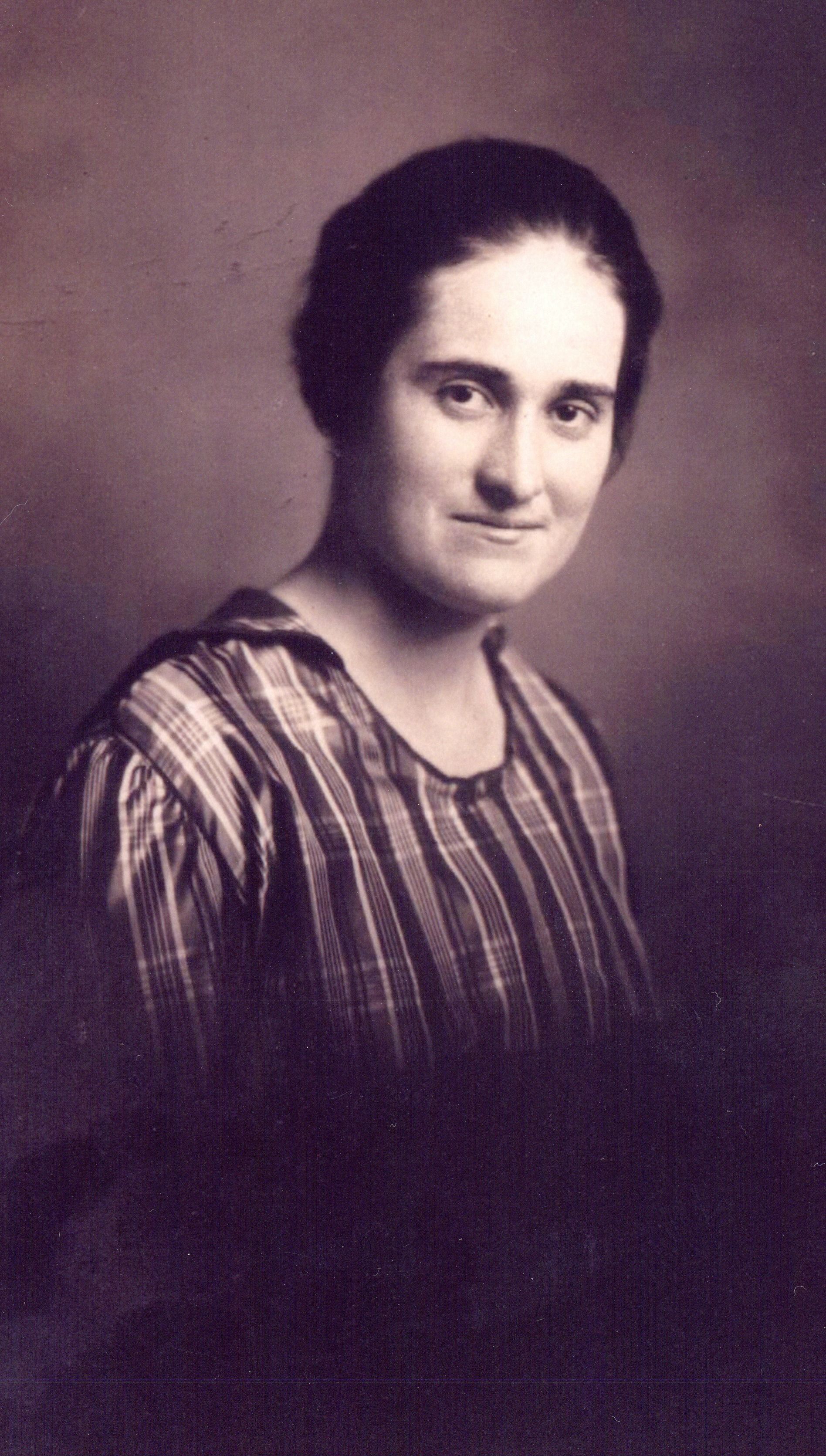
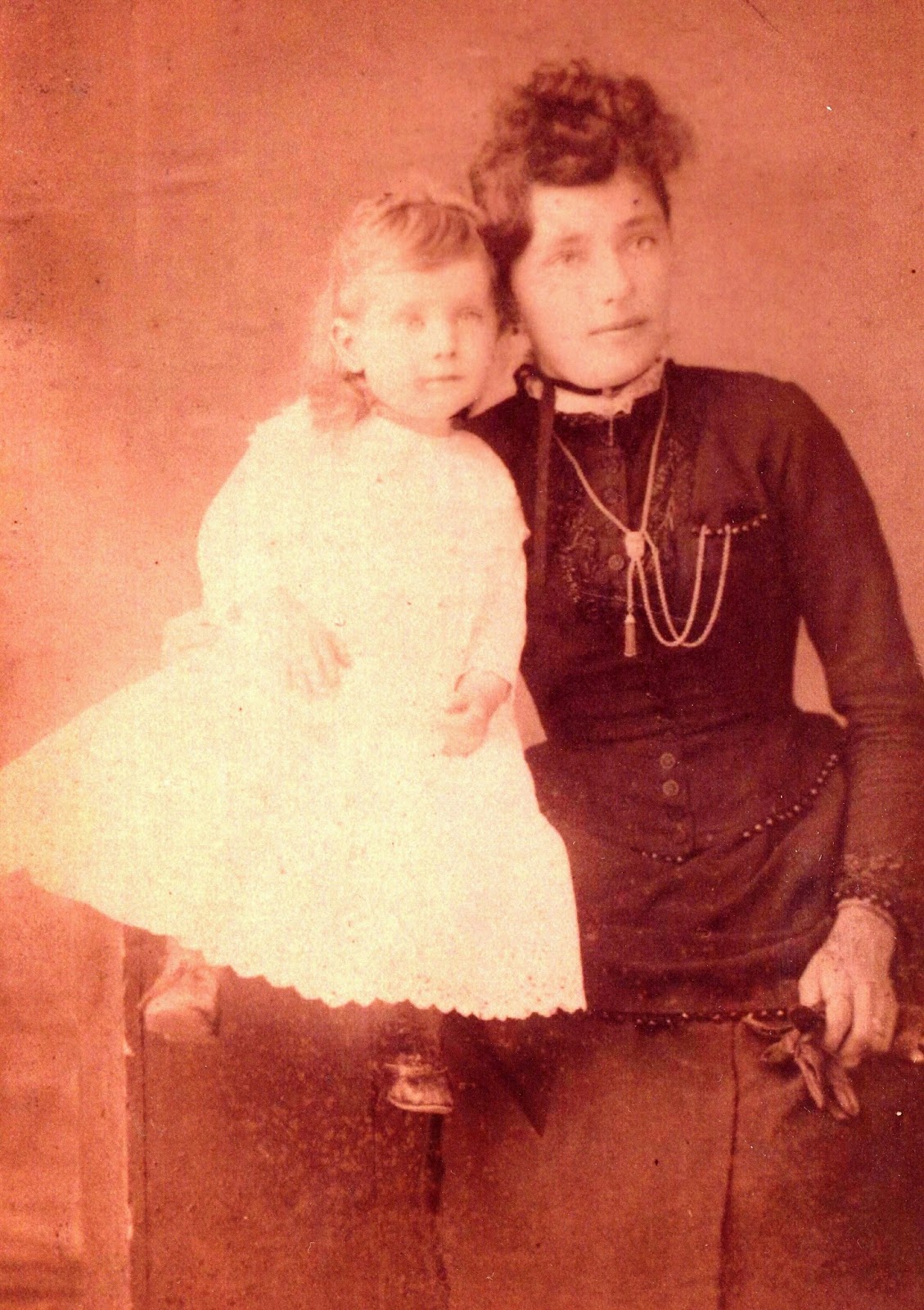
Aletha Frederick Putnam was the daughter of Charles Walter Putnam (1859–1922) and Daisy Deane Frederick (1871–1964), born on 16 Nov 1899 in New Albany, Floyd County, Indiana. Her family moved to Council Bluffs, Pottawattamie County, Iowa, between 1904 (when her younger brother was born in New Albany) and 1910. Aletha attended Council Bluffs High School in 1916.[1][2][3]
Aletha married Howard William Martin (1897–1970) on 3 Jul 1919 in Pottawattamie County, Iowa. They resided with Aletha’s family in 1920.
We looked at Howard’s line in Family Reunion: Martin, so today we’re looking up Aletha’s tree.
Her father, Charles Walter Putnam, was the son of George C Putnam (1835–1873) and Elizabeth Ann Force (1836–1918), born in Oct 1859 and raised in Rochester, Monroe County, New York. After the close of the Civil War, the Putnam family lived in Brownstown, Wayne County, Michigan. After the death of George Putnam in 1873, Elizabeth took Charles and his sister, Carrie, back to Rochester. In 1880, Charles moved from Rochester to New Albany, Floyd County, Indiana, where he lived with his maternal grandparents.
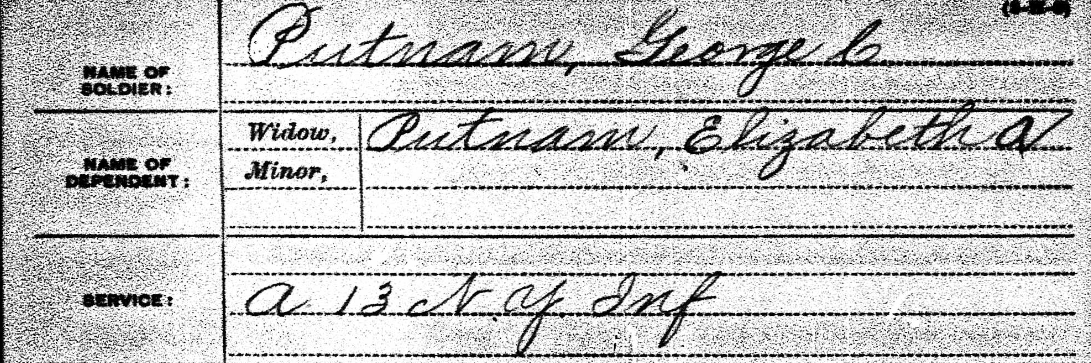
George C Putnam was the son of John Putnam (1802–1854) and his wife, Elmira, born about 1835 in Greece, Monroe County, New York. George appears to have served as an officer in the New York National Guard from 1858 to 1860, and he served in the 13th New York Infantry during the Civil War, rising to the rank of captain.
George had at least one brother named John and two sisters – but there are a lot of folks named “Putnam” out there to investigate. If any of these folks are interesting to you, I’d love to hear from you!
And don’t forget to subscribe so you can keep up with the latest developments!
Re-posting Note: this post covers the family of my paternal grandmother’s maternal grandfather, Albert C. Huff (1854 – 1936). I think I tested all of the links to make sure they worked, but let me know if you find one that doesn’t.
Sample-More Meats – a Businesswoman’s Story
Note: I’m making some assumptions to turn all of these disparate facts I have into a story. If you find mistakes, comment or email me, and I’ll update it!
Albert C. Huff was born in Ohio just 6 years before the beginning of the Civil War. His father moved the family to Savonburg, Kansas, not long after it was founded in 1879. There, Albert met and married Rosa Edith Murray. They raised seven children in Savonburg, but somewhere around 1905 or so, the family felt the pull to move to the Arizona territory. Based on the postcards and letters between Glendale, Arizona, and Savonburg, they didn’t all move at once, but by 1910, most of the clan appeared on the federal census records in Glendale.
Perry Huff was the eldest of Albert and Rosa’s seven children. He and his wife, Pearl, along with two of his three sisters, Bertha and Iva, and their husbands, were probably the first to relocate. Perry started a meat market on Glendale Avenue in partnership with his brother-in-law, Bertha’s husband, Roy Sample. It was one of the first businesses in the young town: the Huff/Sample Meat Market.
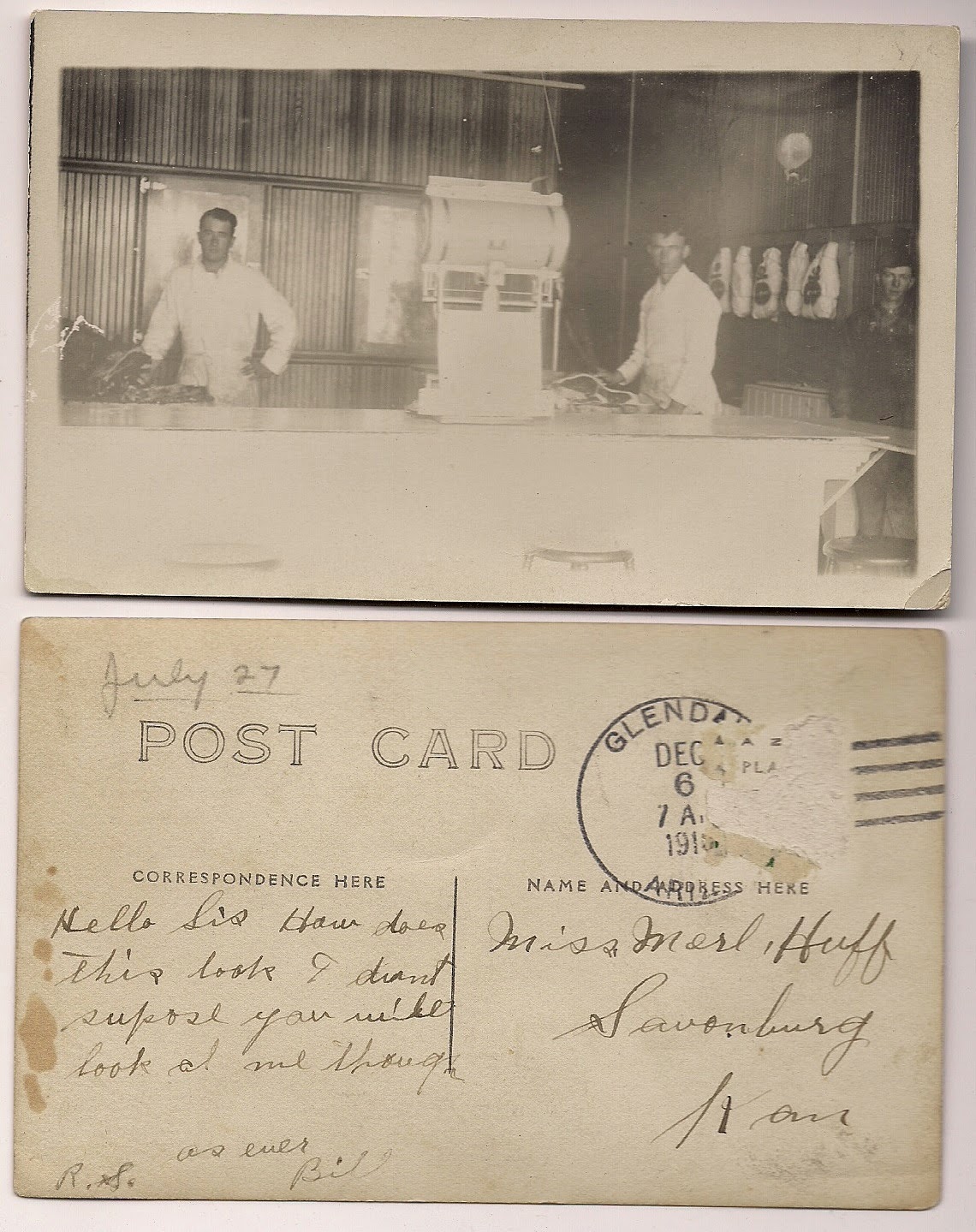
This postcard addressed to “Miss Merl Huff” (my great-grandmother!) appears to have been written by Perry – based on the greeting “Hello Sis” – it shows the meat market, and possibly its owners. The “R.S.” at the bottom may refer to Roy Sample, on the left; Perry ought to be the other man in white to the right of the slicer; and “Bill” might refer to the other man to the far right. [1]
Sadly, Perry’s young wife, Pearl, did not survive to see his success. She died in 1907, possibly in Las Vegas, New Mexico, during the move from Kansas. Perry and his infant daughter, Doris, were living in his parents’ new Arizona home by the time of the 1910 Census, but the family’s correspondence indicates that his health was giving out, too. When Perry died in 1911, Doris was sent back to Kansas where she was raised by Pearl’s mother, Lucy Enos.
Harry More and Iva Huff possibly a wedding photo
After Perry’s death, Perry’s other brother-in-law, Harry More, took over the business. The Sample & More Meat Market thrived, and so did all of the young Huff families living there in the young state of Arizona.
Harry and Iva had a son, Phil, who was born in 1909. Roy and Bertha had Thelma in 1909 and a boy named J.L. in 1914. By this period, Albert Burton Huff (everyone called him Burt) had moved to Glendale, and he and his wife Mary had four little girls: Maurine (1908), Maxine (1910), Bruce (1917), and Ezell (1919) – who would grow up to have quite a few adventures of her own!
After President Taft signed the bill establishing Arizona’s statehood, Phoenix became the new state capital, which spurred growth in the surrounding towns, as well. Glendale grew, along with the Huff families, and they were all part of what changed the area from a wild frontier into something more like a city.
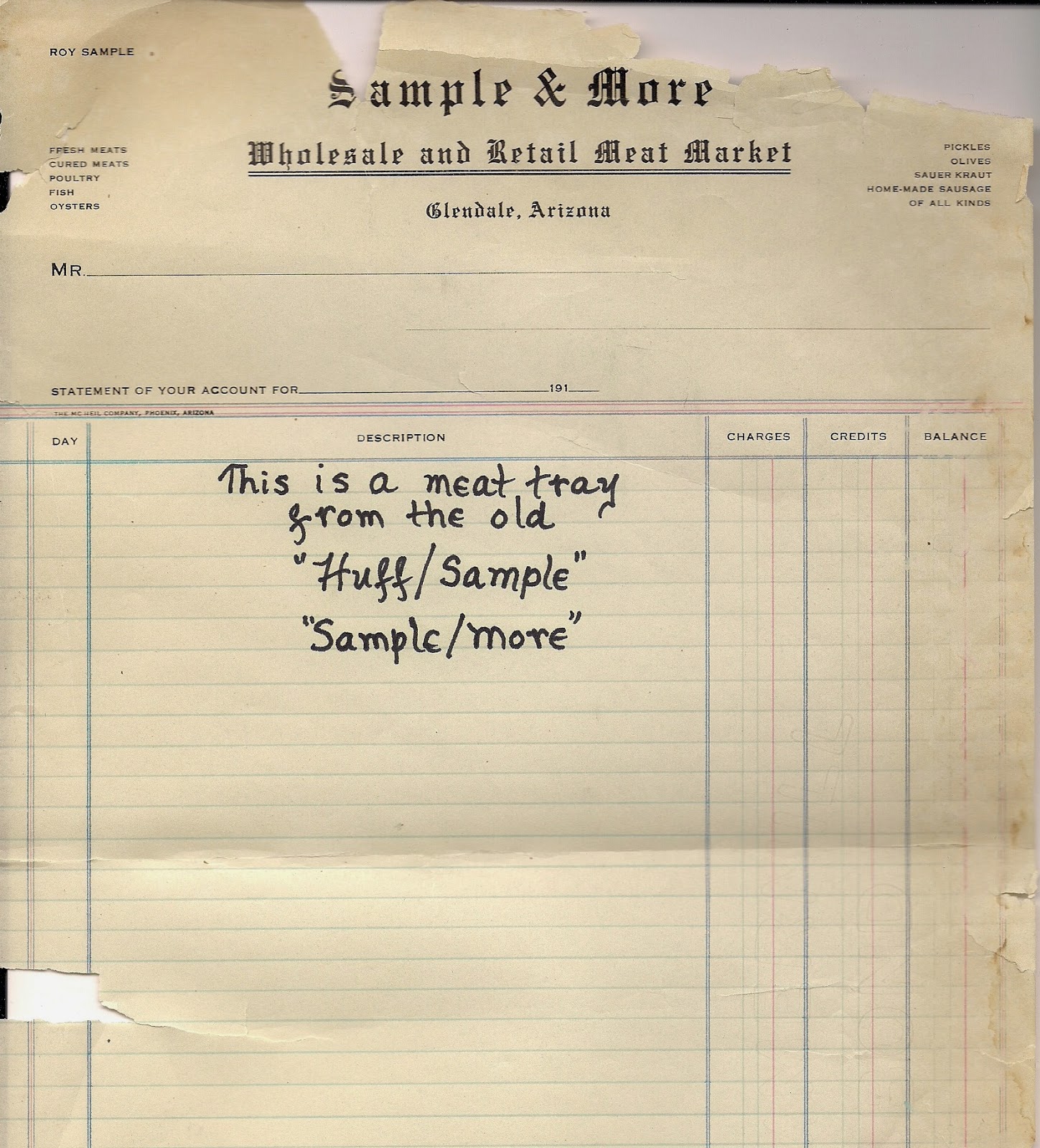
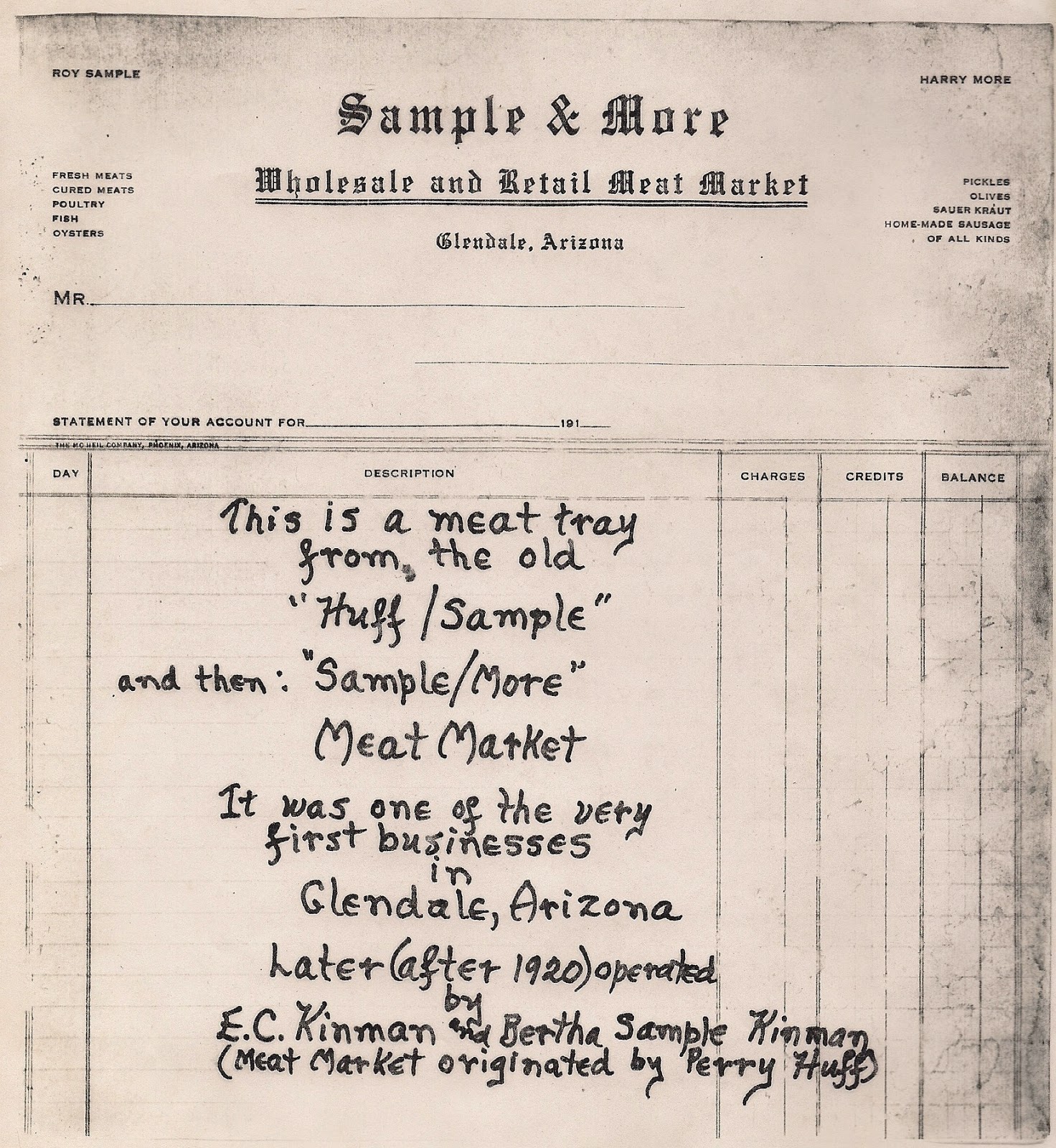
Scan of original “meat tray” – order form for Sample & More meat market [3]
It might not seem that wild when you’re looking at some old photos of a butcher shop and reading a list of babies’ birthdays, but it’s worth remembering that between the births of young J.L. Sample and Bruce Huff, General Pershing spent a year trying to catch the Mexican outlaw, Pancho Villa – and there was every chance that chase could have turned north into Arizona. The migrating Huffs also had to pass by the famous Fort Apache on their 1,200-mile journey from Kansas. Located not quite 200 miles to the east of Glendale, it operated until 1924, when the native Americans were granted U.S. citizenship – even after that, the possibility of unrest and some kind of “Indian attack” of Old West lore was a real, potential threat in the back of their minds.
In spite of the risks of frontier life, Arizona was also a place that was looking ahead. After having removed parts of their original constitution – containing things like direct election of senators, women’s suffrage, and other reforms – things which were delaying the passage of their statehood bill, Arizonans turned around and put those parts right back in a referendum election, effectively making the Huff sisters voters earlier than many of their contemporaries in the rest of the country.
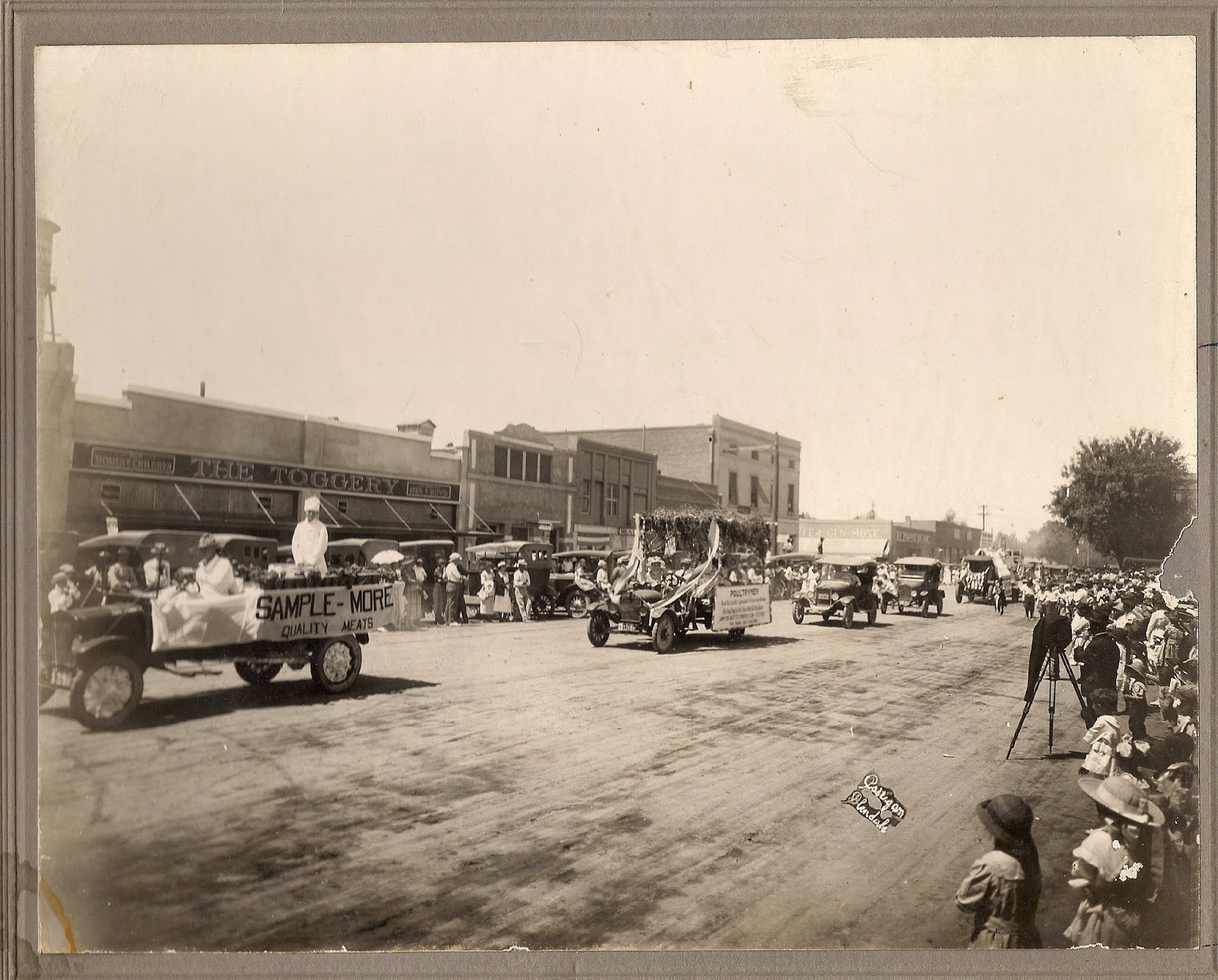
Parade down Glendale Ave. c. 1915
And so it goes – a simple photo of a parade of old cars down an empty street under a big desert sky turns out to be a story about brave, ordinary people, carving a home out of the dirt, setting up shop, and trying out the wonders of a new age while living in the setting of the old one. Knowing that these people came to the area in covered wagons barely a decade before, and built all of this in the heat and the dust, with the possibility of death from outlaws, displaced indigenous people, or unnamed diseases around every corner makes this a triumph.
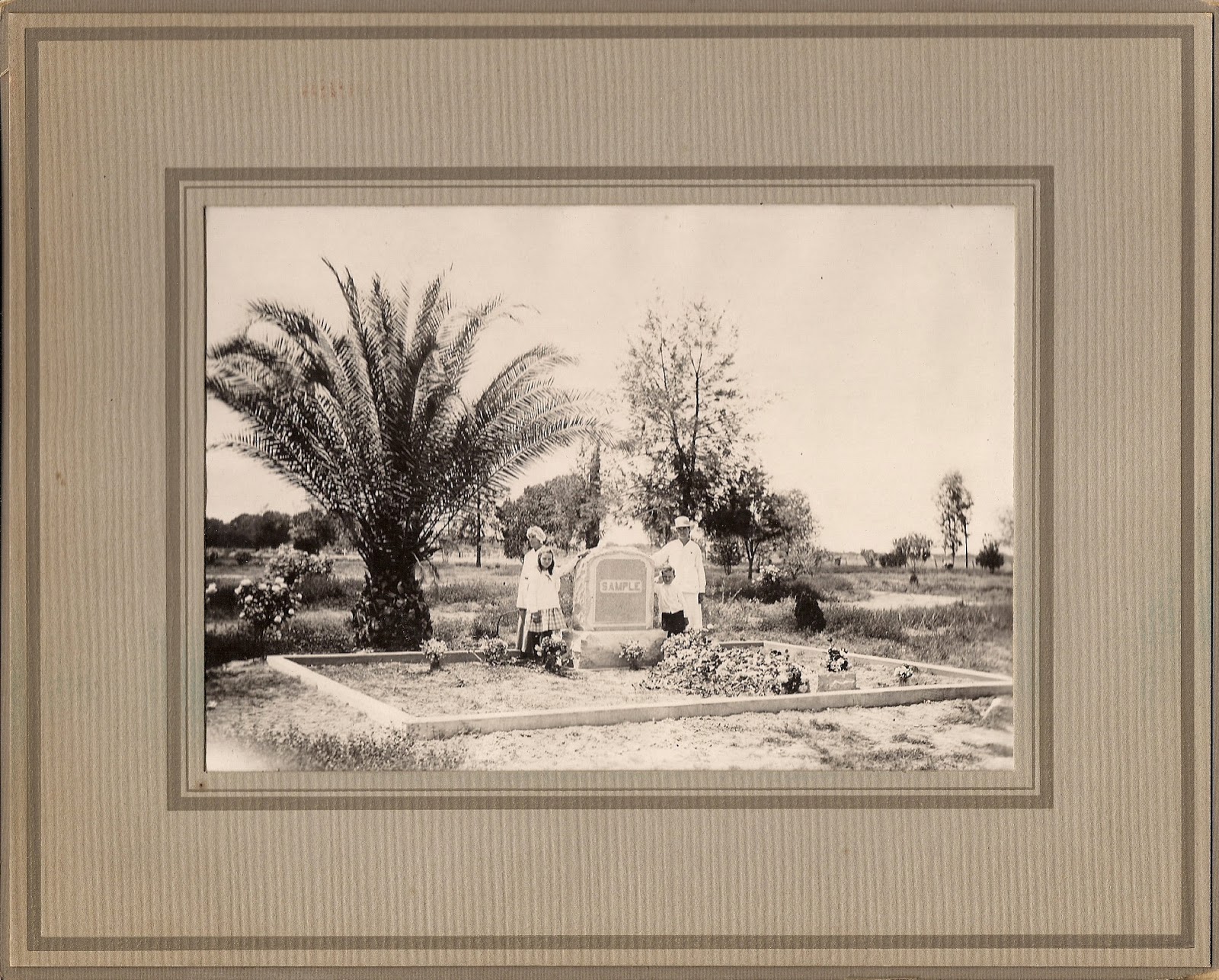
Bertha, Thelma, and J.L. at Roy’s gravesite
Life being what it is, though, Bertha and her two youngsters lost Roy just before Christmas in 1918. [2] This seems to be when Bertha began to take charge of more of the business, and by the time she re-married in October of 1920, she was described in the local newspaper article about the event as, “a well-known business woman and property owner in Glendale.”
The man she married, Earnest Kinman, was a well-liked and outgoing friend of the family. His best friend was my great-grandfather, Dick Witter, who had only married Bertha’s little sister, Merle, a couple of years before – before getting himself drafted and going off to join the Army, of course.
Harry More would pass away in 1925, and after that, his widow Iva moved on to California with Phil, leaving the meat market to Earn and Bertha to run. By the time Bertha died in 1965, the Wild West was 100 years in the past, the pioneer families were all but gone, and meat markets were being replaced by supermarkets. But along the way, the family had grown, loved, lost, fought, and eventually became a small background part of history.
As we all do, if we’re lucky enough.
Aunt Bertha and Uncle Earn
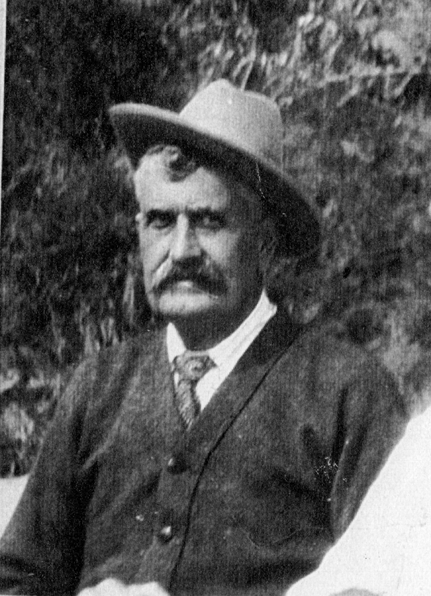
1. My identifications of the men in the postcard of the Meat Market are pure speculation. I am guessing based on what is on the back of the postcard. The Glendale Arizona Historical Society has a photo of Roy outside the market with an Albert Huff, but they identify Albert as Roy’s father-in-law. I think the man in the photo is actually his brother-in-law, Albert Burton (who went by “Burt”); Burt’s father was Albert C Huff, and this is what he looked like:
Albert C. Huff
2. Despite the timing of Roy’s death and his eligibility for the draft, I don’t have any indication that he served in the war. Of course, his brother-in-law, Dick Witter, did – but that’s a different post!
3. The scanned “meat tray” above is of an original sheet saved by my great-grandmother, which was photocopied by her daughter, Nancy Witter Callin, and annotated with the historical notes you see in this picture. I used her notes as a sort of timeline for putting this essay together and filled in other facts based on official records, postcards, and letters.
As always, I love to hear from fellow descendants. If you’ve got any of these folks in your family tree, say hello!
I’m always open for suggestions – subscribe to get updates or corrections.
When I was new to genealogy, I did what a lot of people do: I uncritically relied on the work of others. A lot of what I know about the Huff family came to me via the late Max Huff. Unfortunately for me, by the time I decided to get serious and disciplined about researching my ancestry, Max was in poor health and he died in 2018 while I was in the middle of my Callin Family History project.
Lesson: life moves fast, and you never know how long you have before the universe deprives you of a resource or mentor.
Kansas to Arizona
My great-grandma Merle Witter was born Hannah Merle Huff (1889-1984) in Allen County, Kansas. By 1910, Merle and her family had migrated to the Arizona Territory where they settled in a town called Glendale.
My grandma Nancy and aunt Vickie always said that the Huffs came to Arizona in a covered wagon – and if I hadn’t been so obsessed with Star Wars and Indiana Jones movies, I might have remembered the stories Great-Grandma Witter surely told me about traveling to the desert and staring a new life only a few years after the last of the wars with the indigenous tribes of the Southwest, and during a time when Pancho Villa threatened to bring the civil war in Mexico north into Arizona.
Hannah Merle (Huff) Witter
Virginia to Ohio
The most distant Huff ancestor I have been able to confirm is Lewis Huff who originated in Virginia and moved with his family to Ohio and then Kansas. There are a lot of people to investigate and document, so they will require a great deal of attention.
The Devil is in the details. Or, so I have heard. But that aphorism, according to Tally over on Medium, “derives from an earlier German proverb — “Der liebe Gott steckt im detail”, which translates as ‘God is in the detail’.”
Any genealogy researcher can tell you that both are true. If you read my earlier posts, The Corruption of Names, or Finding John Witter, you can see examples of the details playing games and hiding in the available evidence, sometimes enlightening me and sometimes taunting me. In the end, I often have to make a judgment call on which facts are “correct” so I can move on to other mysteries.
Sometimes, my judgment calls are spot on – and sometimes they aren’t. I try not to let the fact that I don’t know which ones are which bother me. Knowing that there are mistakes, errors, or inaccuracies in my work is something I have learned to live with and that is why I am constantly encouraging people to reach out and let me know when they see something “wrong” in my research.
But for a lot of people, those inevitable errors are hard to accept. I frequently see posts in the various genealogy forums I visit where people are complaining that “you can’t trust obituaries” or “online trees are unreliable” as if the fact that errors exist prevents a person from ever really knowing anything. I rarely comment on that sentiment, but sometimes I will respond and encourage them to include the offending information in their trees, along with the evidence demonstrating why it is wrong.
In my experience, there are different kinds of “wrong” that can creep into the work we do and alter the stories we tell. Sometimes the obituary is wrong because the person writing it didn’t know the person as well as other family members did; sometimes the rank that your great-great-grandpa held in the Civil War differs from what was handed down because his children and grandchildren didn’t know the difference between an artillery sergeant on the battlefield and a post colonel in the Grand Army of the Republic. And that’s okay. Sometimes mistakes are part of the story.
There is a tendency to want to throw out or hide mistakes, which is perfectly understandable. But in genealogy, the best practice is to document everything and try to make the most accurate and precise picture you can make from the information that is available to you.
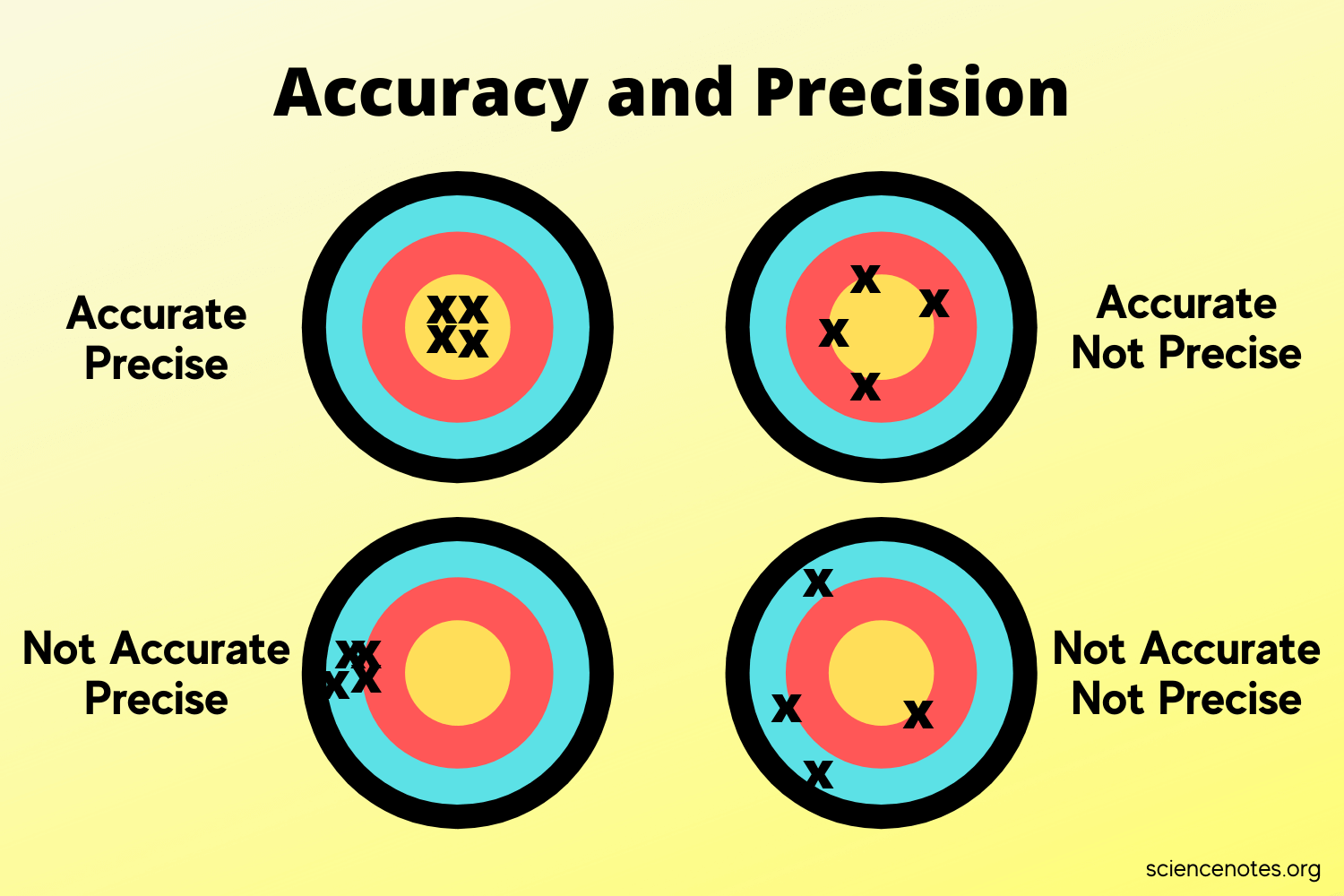
from Sciencenotes.org – What is the Difference Between Accuracy and Precision?
Consider all of the different records you might find that tell you an ancestor’s birthdate. Census records usually ask for the person’s age as of their last birthday on the date the information was recorded, which means the estimate of their date of birth might be off by a year. It can be off by more than that if the enumerator collected the information from someone who didn’t know the exact ages of everyone in the household. I have also observed a pattern with U.S. World War I registration documents where the year of birth is off by one year even though the information was provided by the person being registered. U.S. Social Security files are generally pretty reliable, but if all of the other evidence is also reliable and their Social Security information is different, how do you tell which birthdate is “correct”?
In practice, if the records disagree with each other, I create alternate facts for the different sources and use my judgment to figure out which is the most likely “correct” fact. If I find the “correct” information later, I still keep the alternate facts and add an explanation for how I determined which one was correct. This can be interesting – “this person lied about their age on their World War I registration so they could enlist” – or mundane – “this person lived alone and nobody knew how old he was” – but either way, including the explanation and the evidence saves everyone time in the long run.
Getting comfortable with errors (or the possibility of errors) can be difficult. Sometimes the family legend you want debunked and forgotten is something painful or controversial. It is still important to address it for future generations of researchers because if there is one thing we have learned over the last few years, it is that misinformation and disinformation are persistent! For some reason, even basic facts have to be re-litigated and re-proven before some people will accept them.
The moral of the story is that as hard as we may work to leave a legacy of “perfect” information behind, we have to accept that there will always be questions, mistakes, and enduring mysteries.
Sometimes, we have to simply live with what is Good Enough.
Mary Blom’s parents were Bernard Blom (1861–1917) and Ida Slight (1863–1949), who were married in Ackley in 1886, about ten years after Bernard’s family immigrated from the Netherlands. Ida was born in Ackley, but her parents were immigrants from Prussia who had arrived in the U.S. about 1854 and had married in Ogle County, Illinois in 1856.
Bernard was the son of Bernard Blom (b. 1829) and Anna Maria Heijting (1832–1916), born on 30 Jun 1861 in Angerlo, Zevenaar, Gelderland, Netherlands. Both Bernards worked as carpenters or cabinetmakers – in fact, most of the Blom men seemed to follow that trade, both in the U.S. and in Holland. If you get a chance to dig up their Dutch records, you will see the occupation “Timmerman” on many of their documents! So far, I have only traced back as far as the elder Bernard’s parents, Jan Blom (1792–1859) and Aaltje Slotboom (1793–1860).
Angerlo, Gelderland, Netherlands
We don’t know when the elder Bernard died, but he appeared on the 1910 U.S. Federal Census and Maria was listed as “widowed” in the 1915 Iowa State Census. She lived alone in a house near that of her son, George, and she died in a fire that consumed her house in March 1916. George was grief-stricken by the loss of his mother and he took his own life in May 1916 because, according to the note he left behind, he couldn’t stand being confronted by the charred reminder of her ruined house every morning when he woke up.
The younger Bernard died a year later, in May 1917, when the limb from a tree he was trimming struck him in the abdomen. He was survived by four brothers and two sisters, as well as his wife and four daughters.
Be sure to hit that comment button if you think you are connected to this Blom family – especially if you’re looking to connect your WikiTree profiles!
When we talk about our “family tree,” we tend to focus on “lines” – which leads us to an over-simplification of what our “tree” looks like. For the sake of understanding who we’re talking about, we will skip over several generations to get to a particular family, and we can end up picturing that tree like this:
Palm Tree art from supercoloring.com
Sometimes your tree actually works out that way. In the case of my great-grandmother, Bertha (Greenlee) Callin, for example. If you just go up her paternal line:
Robert Greenlee (many siblings)
Allen Greenlee (only child)
Bertha (one half-sibling)
More often, you have a lot of siblings in each generation, and visualizing them all can feel a lot more complicated:
Fractal Tree Animation from “make a gif”
There is nothing wrong with simplifying things to make them easier to explain. But when you’re building your tree, it’s important to remember the Big Picture. You have to zoom in and focus on one family at a time to get anywhere, but you also need to figure out good maps for navigating both up and down your trees.
I have spent a lot of time adding profiles to WikiTree and connecting them so that I can take advantage of their visualization tools and figure out where I need to focus my attention for future research. Usually, I start with one of the eight grandparents (my four, and my wife’s four) and click the “Ancestors” button, follow the line back to where I am stuck, then click that person’s “Descendants” button and figure out which family has been most neglected.
That might sound like a daunting task – a fractal tree is always branching further, always growing, and never ….done. But that’s good news for me because I like to keep going.
If you want to have a say in which way I am going, drop a note.
If you just want to keep following along… Subscribe!
Normally, I would give you a brief overview on Wednesday followed by a story or essay on Friday – but this post sort of fits both descriptions, so I’ll think of something else to share on Friday.
This 2015 post buries the lede, but it is about the ancestry of my Grandpa Bob Callin’s maternal line.
The Unknown and the Unknowable
The book doesn’t say where in Scotland Robert Greenlee and his brother came from, but it could have been Lanarkshire as easily as anywhere else. The famous mobility of Lowland Scots was nothing new, and even though the coal industry was just taking off, there were bound to be good reasons for a pair of enterprising young men to follow the flood of people pouring through Ireland and on into the New World.
The settlement of Ulster in the northern counties of Ireland was also nothing new – that had been going on for two centuries by the time the Greenlee brothers came to Ireland around 1770; Robert settled in County Armagh, in the village of Tandragee, while his brother went on to America. The book says he was there in time for the Revolution, but we’ll have to take the book’s word for that. Robert, a manufacturer of goods, stayed in Tandragee, married, and raised a family of four boys and two girls.
Most of Robert’s children would end up in America, but not Robert. His eldest son, Samuel, born in 1795 would grow up to become a linen weaver and marry Nancy Jamphry in 1819. For nearly 20 years, Nancy and Samuel would bring another Greenlee into the world in each of the odd-numbered years, though Robert would only see the first six – he passed away in 1832. By 1837 they had six boys and three girls in their home. Their youngest son, born in 1835, was named Robert, after his grandfather.
We don’t know the cause, since the book and the records don’t say, but their third eldest, a daughter called Margaret, died in 1843 at 18 years of age. Nancy died the following year, in 1844. It’s possible that they were taken by disease, and it is certain that the year after that – 1845 – saw the beginning of what would be known as the Great Famine. It could be that chronic hunger, loss of income from the economic impact, and spreading disease associated with the famine made the family decide to move; it could be that their occupation as weavers kept them from feeling hunger, but their political and religious affiliations as Presbyterian Unionists made them targets of their starving Catholic neighbors frustration. Regardless of the source of the pressures that drove them, the Greenlees would soon leave Armagh.
Thus, as his uncle and some of his brothers and sisters had likely already done, Samuel decided to bring his family to the United States. On 14 November 1846, Samuel arrived in Philadelphia aboard the Ship Champlain accompanied by a 28-year-old Anne Greenlee. This was most likely his eldest daughter, Mary Ann, who would go on to marry Robert Willis. In 1850, the family was settled in the township of Aston in Delaware County, Pennsylvania. Samuel, along with his sons – Samuel, Jr., Matthew, Thomas, and Robert – worked as weavers; Samuel, Jr. had his wife, Ann Jane Sinton, and their baby daughter, Ann, in the household, and it must have been very… close and cozy.
The Greenlee children began to disperse themselves across the country. John and Mary Ann each married, and ended up in Wineland, Ohio, with their new spouses. James moved to Michigan, and Robert also moved to Ohio, settling in Hancock County, where he married Sarah Bollman in 1857. Thomas married and may have been in New York, as he joined the 67th Regiment of the New York Infantry in 1861 on the outbreak of war.
Robert and Sarah had their son, Allen, in April of 1861, the month that the Civil War began. Robert enlisted in the 21st Regiment, Ohio Infantry, and he served for 3 months, mustering out in August of 1861. His unit was sent on a reconnaissance expedition down the Kanawha River in West Virginia, but they do not appear to have seen any action or suffered any casualties. His brother, Thomas, was not as fortunate, as the 67th NYI was involved in the Battle at Fair Oaks outside Henrico, Virginia, where he was killed at the end of May 1862.
Here, the story becomes darker and harder to see. As little detail as the book gives us – the book being Ralph Stebbins Greenlee’s Genealogy of the Greenlee Families, to be specific – it got us this far. It tells us enough to connect everything we just read to what happened next…but what did happen next?
Sarah Catherine Bollman was born in 1838 in Ohio. In 1850, she lived with her mother, Eleanor, and a younger sister and brother (Elizabeth Ann and Solomon, respectively). They lived in Cass Township in Hancock County, which is where Sarah’s marriage to Robert Greenlee was recorded in 1857. In 1860, she and Robert showed up in the census, still in Cass Township. We have records of Robert’s enlistment, and they give us no reason to believe that he did not survive the war, and yet in 1870, Sarah and a 9-year-old Allen are back living with Eleanor.
It’s impossible to guess from the information available, but the lack of information itself (and the fact that Sarah is listed in 1870 by her maiden name) suggests that something unheroic befell Robert Greenlee. We only know he died because the Greenlee book says so – “died at Vanburen, Ohio.” It doesn’t say how or when.
(Update: Sarah died in January 1875 and was buried in the Bechtel Cemetery, in Allen township, Hancock county. Robert was buried there after he died in 1879, and Allen in 1887. Sarah’s marker lists her as “Sarah C. Greenlee,” but the obituary index gives her name as Bollman.)
Allen Greenlee’s life was similarly mysterious, in that very little solid information about him exists. We see him in the 1870 and 1880 census records, living with his grandmother (though the 1870 lists his name as “Ellen”), and we do see him listed on his daughter’s birth record, so we are at least not guessing at the relationship. But aside from a single appearance in the Cincinnati Enquirer in 1882, when he was raising sheep in Findlay, Ohio, he only left one other trace behind.
[Update: thanks to the digitization of the Weekly Jeffersonian on Newspapers.com, we know that Allen was a teacher and that he died after contracting typhus. Details are on his WikiTree page.]
Bertha May Greenlee and Alice Ava Hales – c. 1889
Bertha May Greenlee, my great-grandmother, was born December 5, 1885, in Arcadia, Ohio, to Allen Greenlee and Alice Ava Hales. By the time she was four years old, her father was gone, and her mother remarried George McClellan Cramer on November 28, 1889. George adopted her, and Bertha Cramer grew up with her half-sister, Mamie Cramer, her mother, and her adopted father in turn-of-the-century Fostoria, Ohio.
If Bertha knew what happened to her father, or her grandfather, it did not get passed down to us. She did name her youngest son Robert, but that’s not necessarily a clue. Her grandchildren and great-grandchildren can only imagine how dangerous life was in those days and be grateful that we’re here to marvel at it! And we are here because Bertha married John Quincy Callin, of the 20th Century Callin Clan, on June 6, 1906 – but that is a whole other story.
There is a lot we still don’t know – about Allen and Robert, at least – and it’s not likely we’ll ever find out what happened to them. We’ll keep looking, of course, because that is how you find out what is unknowable, and what is merely unknown. If we don’t search, we certainly won’t find any answers.
If you spend any time interacting with me, you will come to realize that “Critical Thinking” is my answer to almost any question. But not everyone understands what the term “Critical Thinking” means, and that sometimes causes trouble.
The Three Meanings Of “Critical”
Wikipedia’s article on “Critical Thinking” gives us a good starting point. Critical Thinking “is the analysis of available facts, evidence, observations, and arguments in order to form a judgement by the application of rational, skeptical, and unbiased analyses and evaluation.” But that’s not what everyone immediately thinks of when they hear the word “critical”.
If you put “define critical” in your search bar, here are the top three definitions you should get:
expressing adverse or disapproving comments or judgments.
“he was critical of many U.S. welfare programs”
expressing or involving an analysis of the merits and faults of a work of literature, music, or art.
“she never won the critical acclaim she sought”
(of a situation or problem) having the potential to become disastrous; at a point of crisis.
“the flood waters had not receded, and the situation was still critical“
Synonyms for that first definition include “condemnatory,” “disparaging,” “disapproving,” “fault-finding,” “judgmental,” and “pedantic.” The opposite of this definition of critical is “complimentary.” If someone gets angry at you for suggesting that they apply critical thinking to a problem, they probably think this is what you meant by “critical.” The third definition, with synonyms like “grave,” “dangerous,” and “hazardous” may also lead to misunderstanding.
That second definition is the one that relates to the desired kind of “critical thinking” with synonyms like “analytical,” and “explanatory.”
How Thinking Is Critical
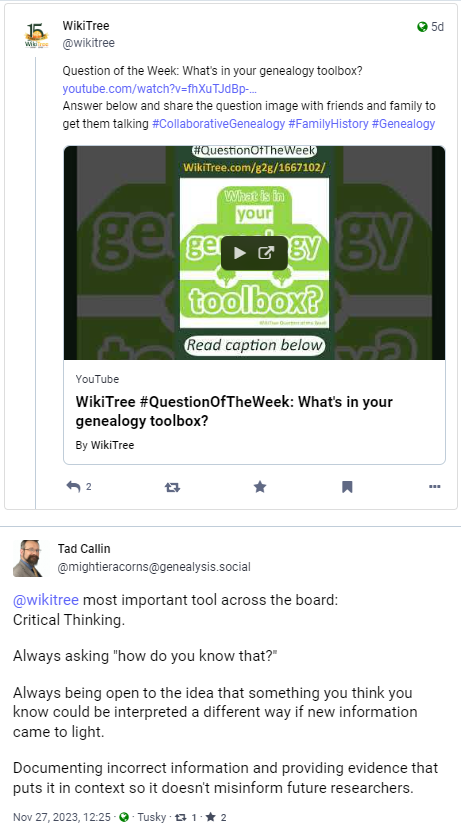
When you are researching your family history, it is critical (definition 3) that you think critically (definition 2) even if that means criticizing (definition 1) the existing stories that you think you know about your family. As I said in my Mastodon “toot” critical thinking means:
Always asking “how do you know that?”
Always being open to the idea that something you think you know could be interpreted a different way if new information came to light.
Documenting incorrect information and providing evidence that puts it in context so it doesn’t misinform future researchers.
These three statements work together and should be the foundation for all of your research. Every document, every public tree, and every fact you uncover should provoke that first question: “How do you know that?” If you’re lucky, the answer will be some reliable source – though you still have to ask that reliable source “How do you know that?” What makes a source reliable will depend on a lot of factors. Is it an official record? Is it an original copy (or a digital scan of an original)? Does the information match what other sources say about the same facts or events?
And if there isn’t a source citation supporting a story or fact, that isn’t the end of the inquiry. Perhaps you have an eyewitness account from a long-dead relative providing information about events that you can’t verify or disprove with records. Perhaps you have stories handed down about the same event through different generations that don’t match each other. Those stories can give insight into what your ancestors thought about events even if the stories themselves prove to be inaccurate or false. Just be sure to mark them as such – so that the next person asking “How do you know that?” doesn’t have to re-do the work you have done.
The Other Three Words
Throughout your process of finding and critically evaluating evidence, be mindful that you are staying rational, skeptical, and unbiased.
“Rational” means “based on or in accordance with reason or logic” – and that means keeping your emotional investment in the subject from making you ignore facts and evidence that contradict what you may want to believe. It does NOT mean that you aren’t allowed to feel excited or relate to the joys and tragedies of the family stories you tell. And you also can’t forget the emotional investments of others; discovering that something is (or isn’t) true may be shocking to relatives who have a different perspective from yours. If you find someone is behaving irrationally towards you or your research, be as kind and patient with them as you can be.
“Skeptical” is another word that has some negative baggage. Like “critical,” a lot of people associate “skepticism” with negativity and they often confuse it with “cynicism.” But a healthy skeptical outlook means that you are willing to ask questions that might imply that there are uncomfortable answers. Asking those potentially uncomfortable questions is how you figure out…
“Bias” – which is a prickly problem no matter who you are. Everyone has some built-in assumptions and shortcuts in their thinking that help them make sense of the world. Being “unbiased” is probably impossible, but constantly examining what your biases are and making sure you are behaving rationally despite them is the goal.
The Journey Is The Goal
Like a lot of things in life, this is about practice. You’re not going to instantly Be In Shape if you start doing modest daily exercise. You’re not going to become a scholar overnight. There are no easy tricks to get meaningful results.
But if you are always thinking critically about the things you read, and asking questions about your assumptions (and the assumptions of others), those habits will get you where you want to go.
Have you got an example of something you learned from asking “How do you know that?” Have you got a story that is important to your family whether it is exactly “true” or not? Share a comment – and subscribe to see updates.
Merilyn (Martin) Rossiter (1923 – 1997) was the daughter of Howard William Martin (1897–1970) and Aletha Frederick Putnam (1899–1981), born on 17 Aug 1923 in Council Bluffs, Pottawattamie, Iowa. She married Arvid Wesley “Bud” Holmquist (1920–1996) in 1943 in Douglas County, Nebraska.
Merilyn was my wife’s maternal grandmother, and from her, I showed her matrilineal line as far back as I have been able to go. On Merilyn’s paternal line, I have only been able to trace a couple of generations, so there is work to be done in that direction!
Here-We-Go Howie
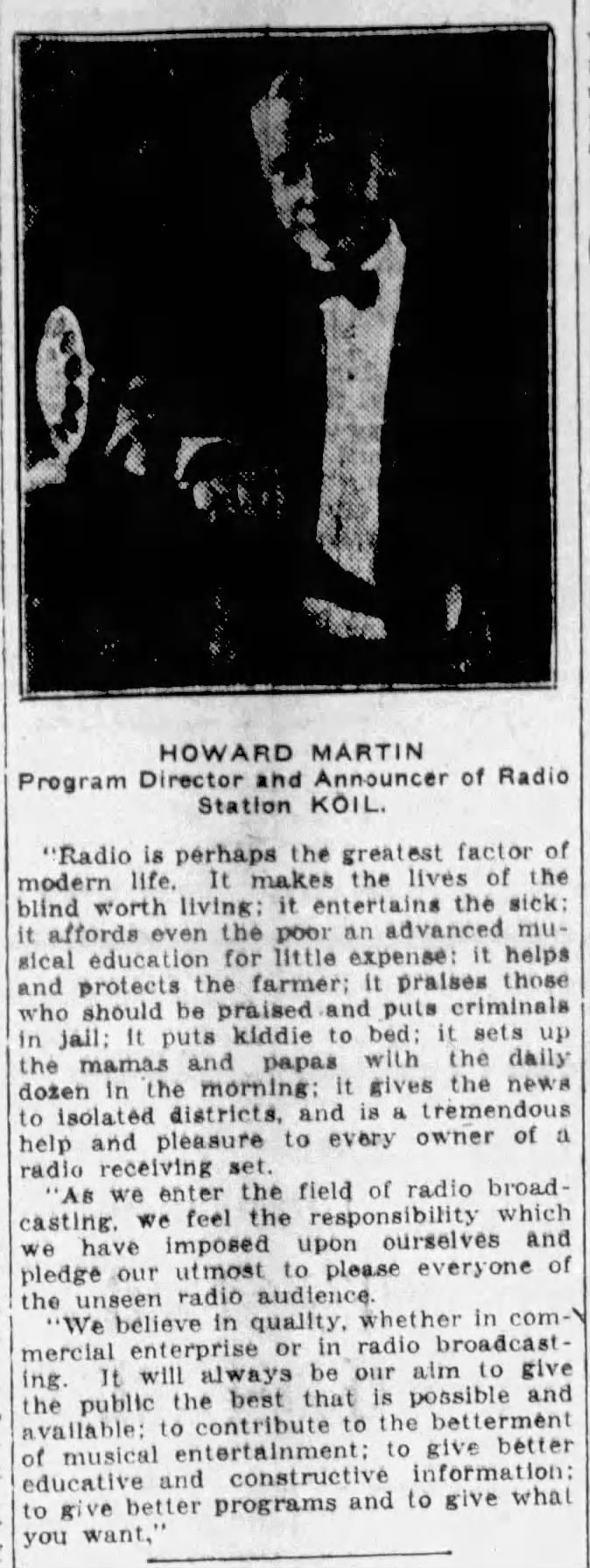
Merilyn’s father was Howard Martin, a World War I army veteran and businessman in 1920s Iowa. He ran his own Texaco filling station and held positions at several successful companies. He even had his own radio program on the local Omaha radio station, KOIL, where he was known as “Here-We-Go Howie”. You can see from this 1925 opinion piece that he thought very highly of the radio:
The Stockman’s Journal Omaha, Nebraska • Thu, Nov 5, 1925
Howard was the only child of William Findley Martin (1874–1943) and Harriet Jenevereth “Hattie” Shepard (1874–1923). I have been able to establish that William Findley Martin’s parents were Charles R Martin (1847–1916) and Elizabeth L Caughey (1844–1926) and that he had a brother, Oscar J Martin (1870–1934), but I have a lot of work to do if I hope to find out more about this family.
As always, I’d love to hear from descendants of these folks, and if you have questions about them, that will help me plan my future research. Drop a comment to connect:
And be sure to subscribe – it’s free and you will get something in your mailbox twice a week for as long as I can keep digging!
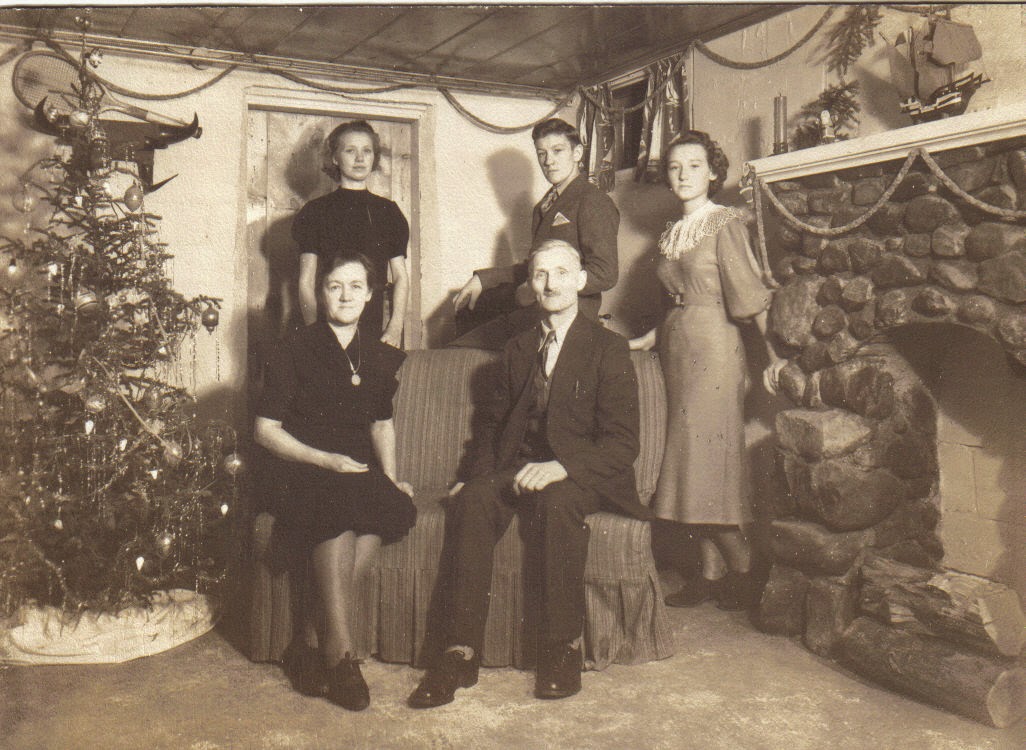
This is the Holmquist family in the festive living room of their home in Mahtomedi, Minnesota. William Arvid is seated, with his wife, Hilder; their three children – Ruth, Arvid Wesley (“Bud”), and Lillian (“Lil”) behind them.
William Arvid was born in Sweden in the 1880s, arrived in the U.S. around 1910, and married Hilder in St. Paul. Hilder was born in New York in 1888, her parents having immigrated from Sweden around that time. Bud was the grandfather of my lovely bride.
Here’s hoping your holidays are warm and cheerful!





 Mightier Acorns