Tad Callin has been working on family history and genealogy since the late 1990s. He does most of his research on Ancestry and posts what he learns to WikiTree.
This surname can be found among my wife’s Sixteen great-great-grandparents. We have to go that far back to find the first Mårtensson – but with a Swedish twist!
As you’re probably aware, laws for Scandinavian surnames were adopted at different times, depending on the country of origin. Elna was born in a village called Annelöv in Skåne County, Sweden. Her father’s name was Mårten Esbjörnson, and his father’s name was Esbjörn Mårtensson.
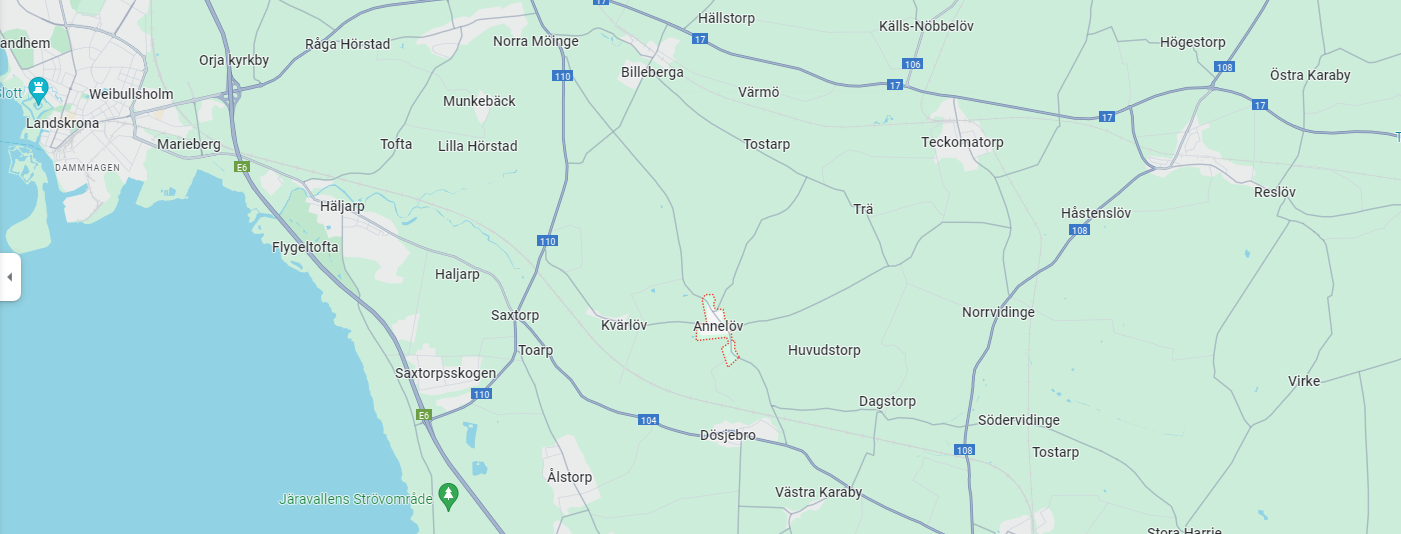
Annelöv, Sweden, and surrounding villages (Malmo is several miles to the south)
Evidence suggests that when it came time to baptize his daughters, Mårten decided that instead of using the traditional patronymic, his daughters would carry “Mårtensson” as their surname. So in 1846, 1848, 1853, and 1860, you can find baptism records for Elna, Anna, Hanna, and Emelie (respectively) that list their surname as “Martensson”. Sweden abolished patronymics in 1901 and required everyone to adopt a surname, so Mårten was quite the trendsetter.
If you decide to dig into the very detailed records from the Sweden, Selected Indexed Household Clerical Surveys, 1880-1893 database, you can find records placing the family in several of the places named on the map above:
Billeberga (where Mårten Esbjörnson married Pernilla Åkesdotter on 4 Nov 1845);
Östra Karaby, where they farmed from 1855-1863; and
Reslöv, where Mårten died on 1 Dec 1876.
Mårten’s mother, Else Andersdotter, was born on 7 Nov 1778 in Annelöv; his father, Esbjörn Mårtensson, on 3 Sept 1773 in Västra Karaby.
Odds are that the family were members of the Lutheran Church of Sweden – though, considering that membership in the State church was legally enforced until 1860, it’s hard to know how they actually felt about their membership. Not only did the enforced religious membership end in 1860 but rules regulating emigration were also eased. The country’s population had doubled from 1750 to 1850 and was still growing, meaning that tillable land was increasingly scarce. This was hard on farm laborers like Mårten. All of these factors led 100,000 Swedes to travel to America between 1868 and 1873 alone!1
Elna’s brother, Anders Mårtensson, was among them. He left his home in the village of Reslöv, boarded a ship called the Spain, and arrived in New York on 5 Nov 1872. I don’t know where Anders ended up, but his nephew, Arvid Holmquist, came about 40 years later and settled near Minneapolis, Minnesota.
As always, I’d love to hear from you if any of these folks are in your family tree. I know the odds are slim, but it doesn’t hurt to invite you!
I’m working my way through the second set of Sixteens – my 2nd-great grandparents and my wife’s – in these Family Reunion posts. If you’d like a simplified list of the first set of Sixteen (the 16 great-great-grandparents of my children), you can find that here. And if you’re curious about who is in this second half of the series, be sure to subscribe!
Note for fellow researchers: I’m still trying to find evidence that will confirm the parents of Elizabeth (Berlin) Callin – that WikiTree link presents the few documents we have. Here is the fullest version I have of the memoir written by her granddaughter, Rosemary Callin.
(I am working on more about this part of the family – so be sure to subscribe for updates when they are ready!)
Silk or Satin
Transcribed from a letter dated 1973:
Things I Have Been Told About My Grandmother, Elizabeth Berlien (Barline) Callin.
The Revolutionary War soldiers were given land in the Northwest Territory — Pennsylvania, Ohio — to settle their wages for service, I believe. But this was a generation before Elizabeth’s time. I am under the impression that my grandfather William Callin fought in the War of 1812. I don’t know how or where he met up with Elizabeth Berlien. My father’s Callin family history says they settled first in around Ashland, Ohio, later moving to Wood County.
Anyhow they lived in a Lincoln-like log cabin in Wood County. My father, George Callin, born in 1846 said they would waken in the morning and find a light layer of snow over their bed. William paid his taxes by cutting wood and hauling it into town, 50 cents a load.
William and Elizabeth had six children, five boys and a girl. I believe the girl was the oldest — Harriet (Sly), John, Zimri, George, Hugh and Jim. Father said they were warned not to say nothing at school about it, but their cabin was a station on the Underground Railway. I don’t know whether it was William or Elizabeth, probably the latter, who awakened them softly in the middle of the night and led them to the window. The moon flashed out and they saw a white man, maybe William, leading a string of blacks through the clearing around their cabin and into the woods. They were on their way to Great Uncle George’s barn. From there he would take them onto the next stop.
William was a powerful man, six feet tall. The boys had to be in the fields around sunup. He had a big, black whip. I don’t know whether it was Elizabeth or her mother-in-law who would say pleadingly, “Now, William, don’t whup ’em.” It was a brutal age.
The first thing the children heard in the morning was the sound of her spinning wheel and the last thing at night. Papa said that one time she didn’t get the buttons sewed on their shirts or maybe she didn’t have any buttons so she sewed their shirts together with thread and so off they went to school or wherever.
When the Civil War came all five enlisted. I have a strong feeling that probably Elizabeth always had a Bible and encouraged visiting preachers and friends who could read it to her. She possibly taught the children verses and stories from it. I have known among my Appalachian friends people who couldn’t read and write at all who knew their Bible by heart, sometimes more strongly and sincerely perhaps than literate people because to them it is the one book. They think about it and discuss it constantly.
The five boys went to war and for the first time Elizabeth learned to read and write so that she could communicate with them. This was probably not too hard for her as those “Dotsch” are good at everything anyway.
William died at maybe around 62 and I don’t know what Elizabeth did then. I believe she lived to be about 84. In her very last years she came to live with us at 331 Pearl Street in Bowling Green. And this is where this picture1 must have been taken, probably by my mother who had a camera. Later I inherited my half-sister’s (Mabel Callin’s) dress-up picture of my father. I was handling it when it fell apart and here was this picture that I didn’t know existed of Grandmother Callin.
I don’t remember her but she knew me. She sat by the window mostly in the east bedroom. Papa loved to go in for a chat and he delighted in her witty answers. Mother was going to make her a dress and Papa asked — he knew well enough that it would be calico or gingham, but he said playfully, “What’ll it be, Mother, silk or satin?”
“It’ll be sat in, all right.”
“George, sometimes I wish I had gone over the hills to the poor house.” (In those days considered a great disgrace.) “There would be old people there and they would know the things I want to talk about.”
Another day she said to him. “The woman next door (mother) is going to have a baby (me).” After I came she said; “I guess you better call her “Melia”. (Sure glad they didn’t.)
Mother went in one time and laid me on the bed for a moment. When she came back, Grandmother had grabbed me by the skirts and was pulling me toward her. I was almost off the bed. Mother probably let her hold me. She liked old ladies and was kind to them. When I was a young girl I used Elizabeth for my middle name but later I decided that Rosemary was enough.
Elizabeth passed away in 1903 and was probably buried from our house. I don’t know where. There is a George Callin lot in Oak Grove Cemetery at Bowling Green and, by-the-way, there are still two places on it if any one in the family should need them. She and William might be buried on Uncle John Callin’s lot also in Oak Grove, but I don’t think so. I don’t remember ever seeing them there.
If any of you know any more about Grandmother Callin I would certainly appreciate hearing about it. I see from the Callin family history that I have the order of the children wrong. It was John, Zimri, Jim, George and Hugh. Jim was possibly the flower of the flock. Papa said he once accused Elizabeth of liking Jim best. She answered that he needed her the most.
Rosemary Callin September, 1973
Some notes [from Tad Callin]:
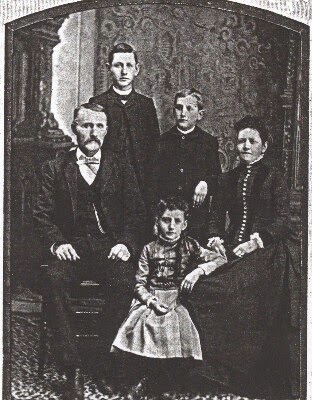
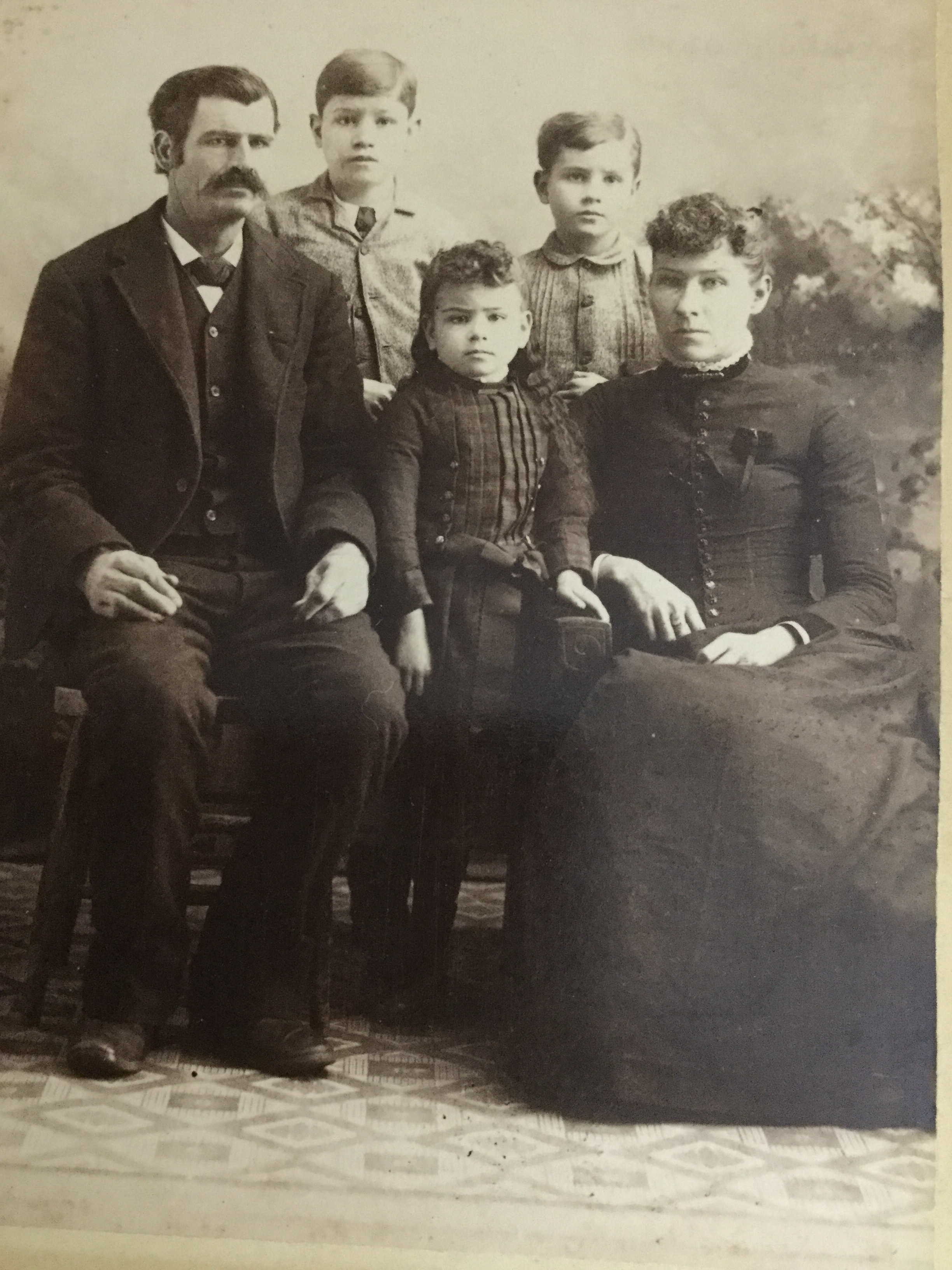
George W. Callin, Everett (standing), Clem, Mary Ann, and Mabel – c. 1890
I have a photocopy of this 1973 letter, though I don’t know if the original was typed or handwritten. I would love to get copies of any of the photographs mentioned in this letter, so if you have them, please comment below or email me (mightieracorns at gmail dot com).
The writer of this memoir is Rosemary Callin (1902-1978), daughter of George W. Callin (1846-1921), the man who compiled the “Callin Family History” in 1911. Rosemary was born to George and his second wife, Lura Warner, in 1903. She never married, and she made a career as a journalist for her local newspapers. It’s not clear who was her intended audience for this memoir.
As far as Rosemary’s facts:
I haven’t found any proof of William (who would have been about 3 years old) fighting in the War of 1812. His father and uncle migrated from Westmoreland County, PA, around 1816, though, so either or both of them may have been involved in the fighting around the Great Lakes. As of the date of this post, I’m still looking for evidence to show where they came from and where they might have served.
I believe the “Great Uncle George” referred to would be William’s brother, George Callin (1804-1879), who shows up in Huron County on the 1850, 1860, and 1870 census records.
When the Civil War began, I don’t believe “all five” Callin brothers enlisted – I have found pension records for John, Jim, and George, but Hugh would have been 13 when the war began, and Zimri would have been 15 at its close. (In an interesting twist, Zimri’s son, Edward, is the only relative of mine that I have found to date who served in the Spanish-American War.)
According to the Find-a-Grave database (thanks to cousin Joan!), Elizabeth is indeed buried in Oak Grove Cemetery.
If you are like me and you live in the Americas, you are bound to have ancestors from somewhere else. Even if one of your ancestors was among the earliest known people to arrive on a pristine, post-glacial continent from Asia1 (and assuming you don’t count that as “immigrating”) you also have approximately 1,024 8x-great grandparents who lived around 200 years ago, so your odds of not being descended from someone who came from elsewhere are pretty slim.
I’ve been having a lot of fun researching my wife’s family tree because she has a lot of relatively recent immigrants for me to study. Her Swedish great-grandfather, Arvid Holmquist, arrived in 1910. Other branches arrived from the Netherlands, Denmark, Norway, and Germany during the mid-19th century. My family’s earliest arrivals were probably Joseph Frey who came to New York from Germany, or the Greenlees who came from Ireland during the infamous famine – both in the 1840s.
Is this a good time to share one of my favorite songs?
Thousands are sailing Across the western ocean Where the hand of opportunity Draws tickets in a lottery Where e’er we go, we celebrate The land that makes us refugees From fear of priests with empty plates From guilt and weeping effigies Still we dance to the music And we dance
Most of my ancestors have been in North America for longer than there have been immigration laws. It wasn’t until 1882 that the first general immigration law was enacted. The Immigration Act of 1891 established a Bureau of Immigration in the Treasury Department. The Immigration Act of 1924 (the Johnson-Reed Act) finally set up the first “consular control system,” which required that visas be obtained abroad from a U.S. consulate before admission.2
The earliest European folks who came here were (most likely/most often) religious dissidents or non-conformists fleeing Europe, or they were “transported” – meaning their emigration from England was involuntary and they became someone’s property for a period of service when they arrived. My earliest known Bellamy ancestor started his time in North America as an indentured servant. We also have to acknowledge that many, many people were stolen from their homelands and brought to the Americas to spend their entire lives performing the labor that made the country viable.
The point is that if any of my ancestors had been required to follow our current immigration laws, I wouldn’t be here. I wouldn’t be. And neither would most of you.
That’s why I find the common insistence that immigrants who want to come here should come in “the right way, the way my family did!” to be so odd. When people say that, they seem unaware that their ancestors most likely did come in the way modern migrants come in – they showed up unannounced and did their best to find land or work to feed their families. That’s what my ancestors did!
The sad thing about this insistence that there is a “right way” to immigrate is the cruelty this inflicts on people who are fleeing here for many of the same reasons my ancestors came. Most Americans don’t even know who their immigrant ancestors were – they might know they were “German” or “Irish” and they might even know some of their names – but I have learned over the years that they are rarely interested in the details. (Details like, “What did ‘German’ mean before 1870?” or “Which kind of Irish were they?”)
Coming to America used to require a dangerous ocean voyage with no guarantee of work or prospects upon arrival. There were risks from diseases or being exploited upon arrival, and little chance of a welcome from the people already living here. Modern Americans seem to believe that our immigration laws have changed those factors when the truth is we have only made it harder on the poor, the vulnerable, and the desperate while doing nothing to bar the people the laws are intended to keep out.
When I look at the people trying to make America their home today, I see my ancestors. They’re from countries torn apart by war, they speak dozens of languages, and they just want the same breathing room to raise their children that my ancestors wanted. And if you judge today’s immigrants by the yardstick of my ancestors, they are coming in “the right way” – making a long and dangerous journey and showing up, hoping for their chance to be one of us.
Maybe the problem isn’t them, or how they get here, as much as it is how we treat them – and how we contribute to the causes that drove them to leave their home countries in the first place.
Archaeological and genetic evidence suggests the first humans arrived in North America between approximately 25,000 and 16,000 years ago. (University of Oregon, “New data suggests a timeline for arrival of the first Americans” by Becky Raines, Museum of Natural and Cultural History, 24 Feb 2023.)
This surname can be found among my Sixteen great-great-grandparents. We have to go that far back to find my first Murray – Rosa Edith Murray (23 Apr 1861 – 19 Nov 1943)
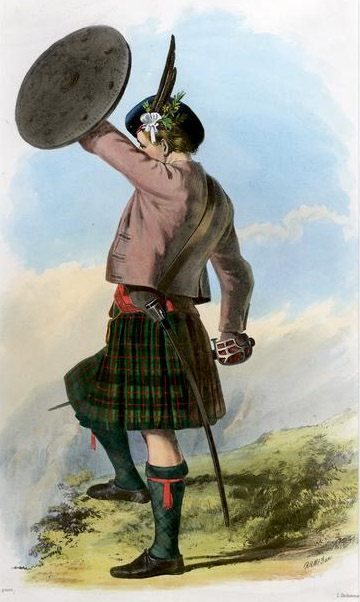
My great-great-grandmother was a Murray, and her grandfather was a Scottish immigrant who came to the newly established United States around 1800. He may or may not have looked exactly like this:
“Murray”. A plate illustrated by R. R. McIan, from James Logan’s The Clans of the Scottish Highlands, published in 1845. (from “Clan Murray” on Wikipedia)
I don’t know much about Thomas Henderson Murray. In truth, I have a single piece of evidence to hang my hat on:
Many unsourced online trees insist that Thomas’s parents were James Murray and Isabel Carmichael, who married in Aberlour, Banffshire (now Moray), Scotland. James and Isabel contracted to marry on 21 Nov 1778 and were married on 10 Dec 1778. This would only give them eight months or so for a 12 Jul 1779 birthdate to fit – but the real reason I am skeptical that these are Thomas’s parents is that there are baptism records for seven children born to James and Isabel in either Aberlour or Mortlach from 1779 to 1800, and none of them are named “Thomas.” The oldest of these children, John, was baptized in Mortlach on 18 Aug 1779, which suggests strongly that Thomas’s parentage lies elsewhere.
I would love to learn more about Thomas’s origins so that if I make another journey to Scotland, I can visit places of more specific interest. If you are a Murray descendant who recognizes this American family, please do get in touch!
That said, I do know a fair bit about Thomas’s youngest son, Aaron Murray.
Aaron and Hannah
Aaron was born in Ohio, probably near Springboro in Warren County. Aaron’s maternal grandparents (Thomas’s mother- and father-in-law) were members of the Hicksite sect of the Quaker faith that had moved west from Pennsylvania to form a community in Springboro. Thomas’s family appeared in nearby Clear Creek Township on the 1820 Census.
Aaron married his first wife, Maria P. Harris, and they had two sons in Wabash County, Indiana, before Maria’s untimely death in 1854 – probably from one of the many outbreaks of cholera, typhoid, yellow fever, or other diseases that decimated prairie towns in those days. Aaron soon remarried the widowed Hannah (Bender) Eby, who had two sons from her first marriage. They had five more children together, the third being Rosa.
Rosa was born within days of the outbreak of the Civil War. The family lived in Liberty Mills, Wabash County, Indiana, just west of Fort Wayne. By the following year, Aaron had moved his family about 300 miles south and west, to Illinois. He enlisted in Company F of the 113th Illinois Infantry at Belmont, Iroquois County, Illinois, on 12 Aug 1862 – the same unit as Hannah’s brother, Lyman Bender. Lyman was captured and died in Andersonville prison on 10 Oct 1864; Aaron was discharged at Camp Butler for disability on 27 Oct 1864.
Two years later, Aaron and Hannah named their youngest son Lyman in his honor.
Rosa (Murray) Huff – seated; Nancy (Witter) Callin and Nancy’s best friend, Bobbe Harris (striped shirt) standing behind her; Glendale, AZ, abt. 1941
After the Civil War, Aaron and Hannah moved their family to Big Creek in Grant Township, Neosho County, Kansas. Rosa grew to adulthood in Kansas and married Albert Huff in 1883. They farmed in Elsmore, Allen County, Kansas, and had five Huff children. In 1908, they sold their farm equipment, rented the land, and moved to Glendale, Arizona. You may recall an earlier post about that move:
As always, I post twice a week, so if you want regular updates: Subscribe!
The surname “Jones” dates back to Wales in about the 1270s, when it probably evolved from the patronymic meaning “John’s son” – making it very common in Wales after the Laws in Wales Acts, passed in the mid-1500s, led to the Anglicisation of Welsh names. This makes “keeping up with the Joneses” significantly harder when you’re tracing your genealogy.
David E Jones1 first appears in the 1850 Census as a 19-year-old furniture maker in the household of Augustus Bradley in Meadville, Crawford County, Pennsylvania. Given that Mr. Bradley was also a “Chairmaker & Painter” in the Furniture and Fixtures industry, it seems likely that David was his apprentice. If so, he probably completed his apprenticeship two years later upon turning 21.
In about 1854, David married Susanna Brookhouser (1836–1924), and they lived in French Creek, Mercer County, Pennsylvania, with their daughter, Frances, age 4, in 1860. A 9-year-old Albert Jones also appears in their household on that census, but we don’t see him again in later records – it seems likely Albert might have been a nephew. David and Susanna had two more daughters during the 1860s.
[Update: I don’t think this enlistment refers to our David Jones.] On 21 August 1865, someone named David Jones enlisted at Utica, New York. He was about the right age – 35 – to be our David and gave his birthplace as Philadelphia, Pennsylvania. His recorded description: blue eyes, brown hair, a medium, and standing 5 feet, 9 inches. He was recorded with the 15th Infantry and the following day, 22 August, was his discharge date.
By 1870, the Jones family had moved west, settling in Missouri Valley, a small community in Saint John Township, Harrison County, Iowa, which sits just east of Council Bluffs and across the river from Omaha, Nebraska. That is where Alice met John Riley McCullough (1848–1918) and married him on 4 Nov 1877.
Alice’s family: from the left: John Riley, William Edgar, Elsie Ann (center), Earl Randolph, and Alice Frances (Jones) McCullough c.1890 – from James McCullough and Descendants, page 90
Alice had several siblings who raised families of their own in Iowa. Her sister, Martha (Jones) Fickel (who died Martha Sublet), and her brothers, William and Bert Mac Jones, all had large families and stayed in or near Harrison County all their lives. William Jones lived until 1958 and had five sons to carry on the Jones family name.
I’ll keep looking for David’s ancestors – for now, I don’t have a lot to go on. If you’ve researched this Jones family, say hello!
Thanks for reading Mightier Acorns! Subscribe for free to receive new posts and support my work.
David’s name is frequently given as “David Eligh Jones” but I haven’t found any documents referring to his middle name. The closest I’ve seen use his middle initial.
This is one of my favorite finds – thanks to my cousin, Chad, for sending it my way all those years ago! I’d love to hear about your famous connections if you’d like to share.
For those who may not be familiar with him, here is a little YouTube introduction to Marty Robbins, performing two of his songs about El Paso in 1965 and 1978:
I remember hearing about grandma’s famous neighbor from time to time when I was growing up, but aside from being an interesting thing to mention whenever Big Iron came on the radio, it wasn’t something that seemed to have much to do with family history – until my cousin Chad acquired a copy of Means’s book, signed by the author, and sent it to me a few years ago.
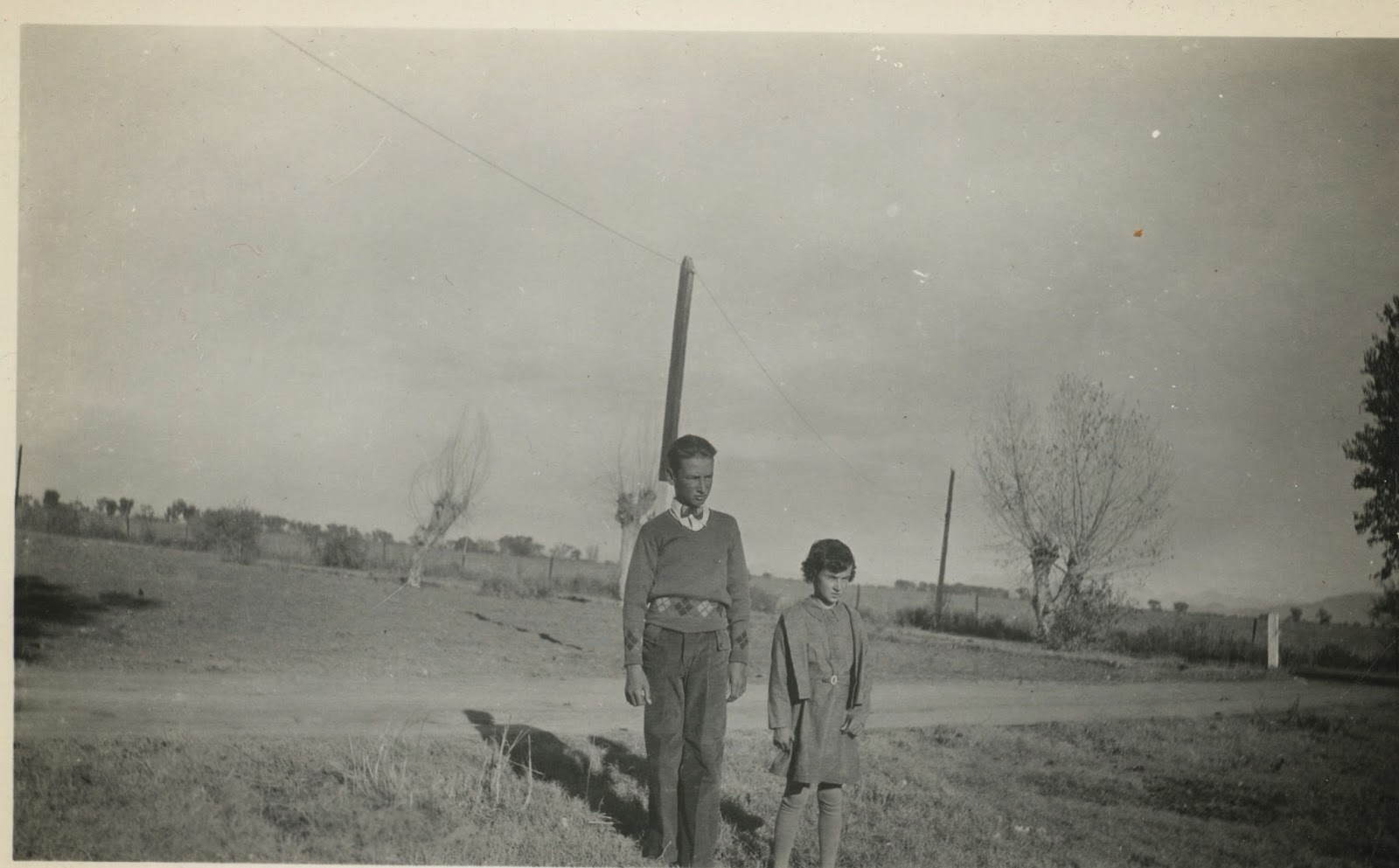
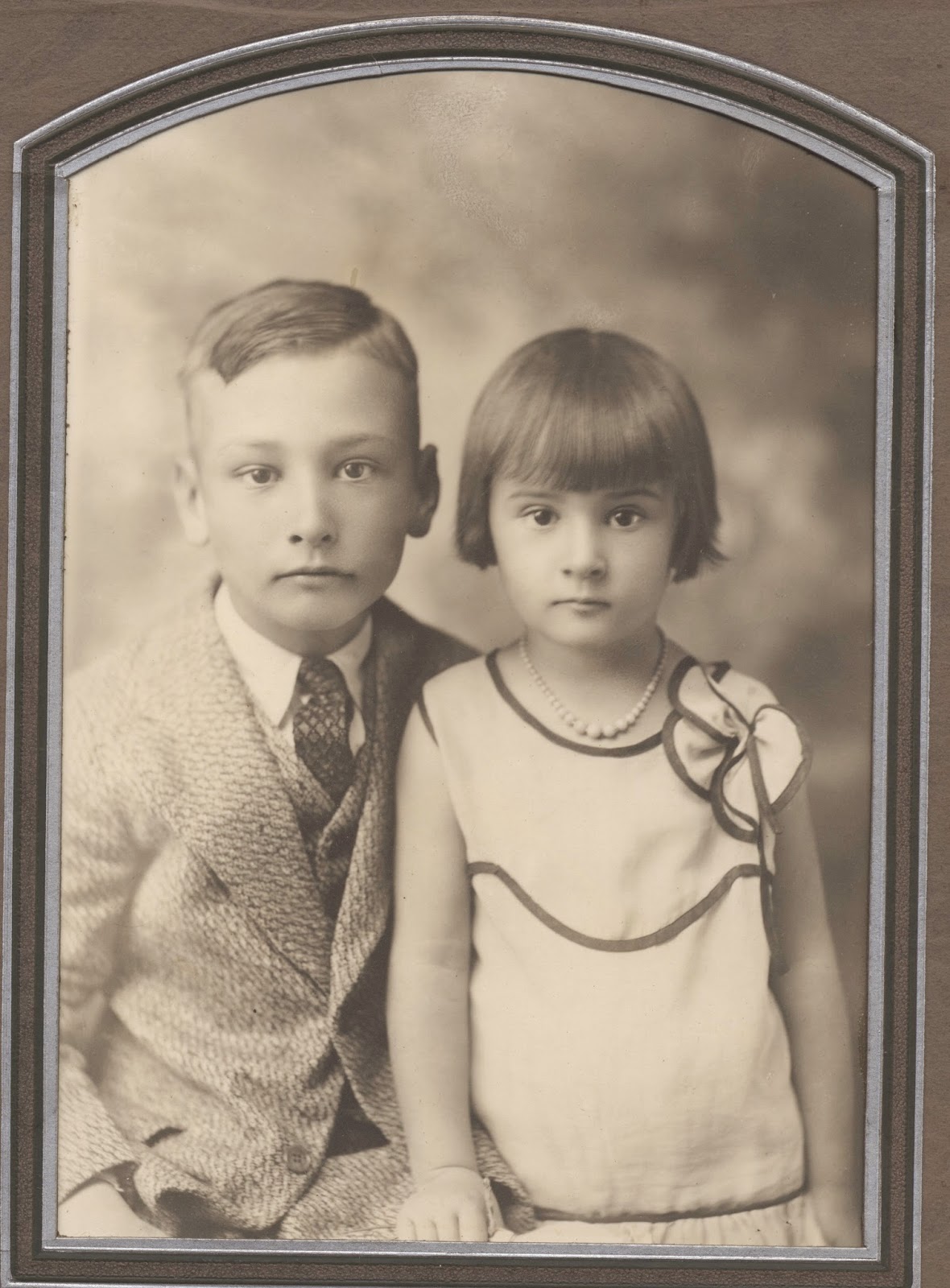
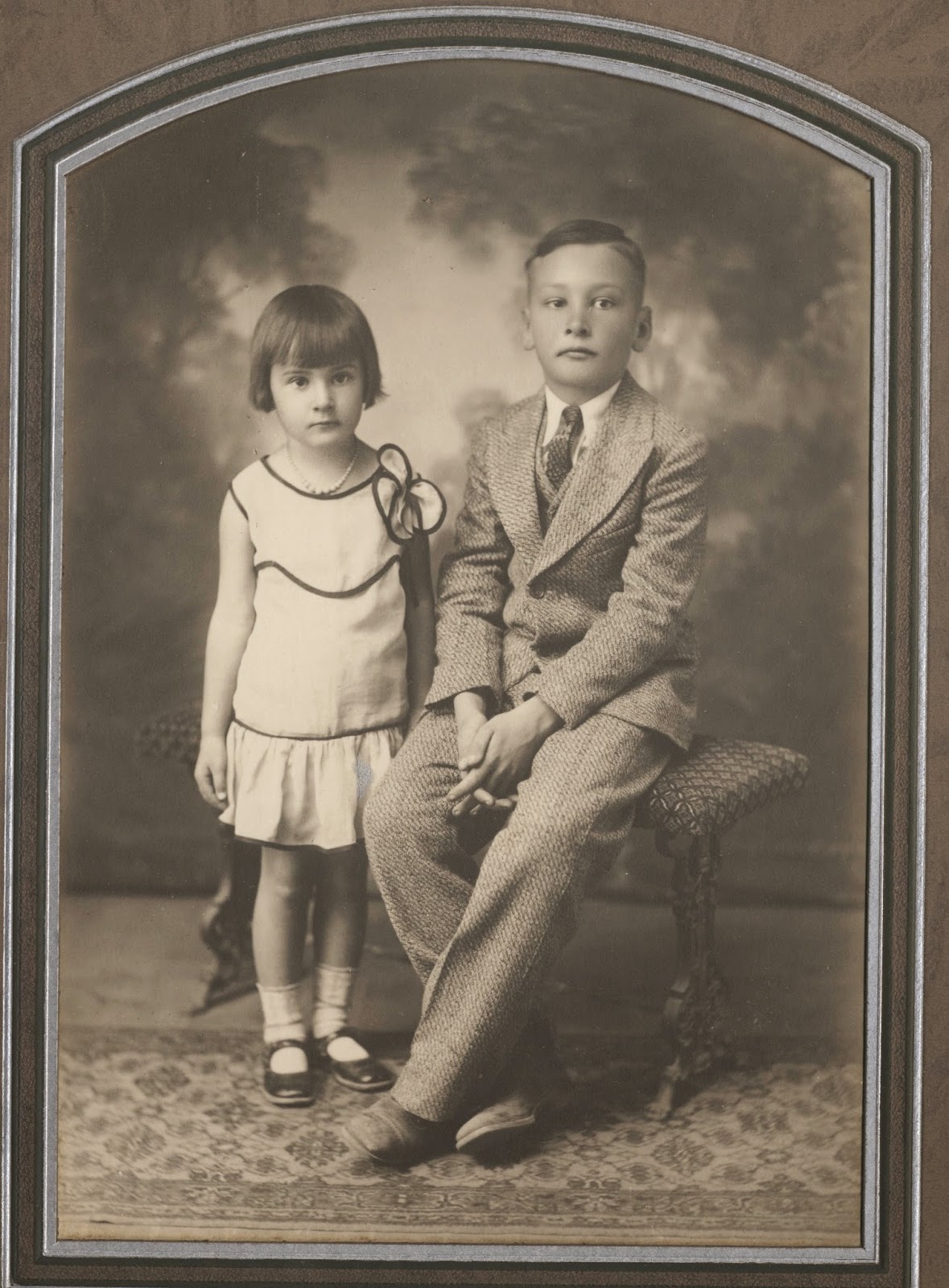
Dick Jr. and Nancy Witter, 1930s Glendale
Mamie and Martin Robinson – “Marty Robbins” was his stage name – were twins, born five minutes apart in September 1925 in a two-room house near Glendale, Arizona. The family moved around quite a bit, from that house (which was about 8 miles north of Glendale along what is now 59th Avenue) to Prescott, to Phoenix, north to Cactus (which no longer exists, being absorbed by Phoenix suburbs around the intersection of Thunderbird and Cave Creek Roads) and eventually, back to Glendale.
Dick Witter Sr., my great-grandfather, ran a dairy farm there, and Hannah Merle raised their two kids, Dick Jr. and Nancy. Nancy was born in March 1925, and Richard in February 1921. (Read more about the Huff and Witter families settling in Glendale here: The Huffs Move West. Twice.)
Around 1932 or 1933, Mamie recalls moving from Cactus, where they attended Sunnyside Elementary (which later became Greenway Middle School), to Glendale, where they enrolled in the Peoria School District. “We walked about half a mile to catch the bus,” she says, “and it seemed we rode a long way to Peoria.”
I attended Peoria Schools myself, though 50 years later. In high school, I had to ride the bus about 15 miles from my house at 89th Avenue & Deer Valley Road to Cactus High, so I have a pretty good idea of what that bus ride might have felt like to Mamie and Martin. And this is where my grandmother comes into the story!
“A little girl named Nancy came over to me and asked me my name. I told her it was Mamie and she laughed, saying it was the funniest name she had ever heard. I happened to agree with her, but nevertheless I started to cry. Later she became my best friend during the years we went to Peoria School.”
Richard and Nancy, c. 1930
That does sound like my grandma, I have to admit. I’ve inherited a bit of that trait myself – the tendency to notice the odd and call it out without picking up on the social cues that would alert a normal person that they had offended somebody. Nancy probably had no idea that she had caused Mamie any distress! Despite the initial hurt feelings, though, when Nancy invited Mamie to play with her at recess, all was forgiven.
Mamie had a lot to say about her twin brother’s antics. He liked to challenge other boys to wrestle, torment her and her friends with taunting nicknames, and he even indulged in the occasional bit of petty shoplifting from the local store – much to Mamie’s horror.
She also had some interesting things to say about her friend’s family – giving me a view of my grandmother’s life I wouldn’t have otherwise had:
“These were depression years for everyone, although at the time it seemed as if some were far richer than others in this farming community. It wasn’t until years later that we found out that other families were just as doubtful about making it financially as we were. “Besides, riches are all a matter of how you see things. I thought my friend Nancy was really rich when I visited her and saw that she lived in a house that wasn’t falling down, and that she had her own bedroom with pretty blankets and bedspreads. “Years later she told me she liked to visit me as a child because I had so much more to play with than she did. By that she meant spaces to roam, trees to climb, and the endless thickets that served us as imaginary rooms and houses in which to play. “Nancy was from a small family. She had one brother. I thought he was cruel and scary because he was a bully. On the school bus, he would take my nickel away from me. Not even Martin could help me get it back. “When we had no school, Nancy would often visit with me all day. She would arrive early in the morning and stay until her father came after her. “When she came to play, there would be a certain amount of jealous rivalry between my cousin Lois – another frequent playmate – and me. But in an effort to outfox Martin, the three of us would usually end up banding together and the visit would turn out well. “We had to watch continually for Martin and his tricks. Once I thought I had lost Nancy’s friendship because of him. We were playing around a haystack. It seemed awfully high to me at the time, but in reality was probably only a few feet. Martin sneaked up on one side of it and jumped down on us, taking us completely by surprise and scaring us badly in the bargain. “Nancy began crying and wanted to go home right then. She had no way of getting to her house, so instead she went with Lois to her home. I was sure I had lost my best friend, and was really upset with Martin. I began crying and chasing after him. He tried to say he was sorry for scaring us, but at that point it was too late for apologies.” (“Some Memories”, pg. 80-81)
Nancy and Richard, c. 1930
It would seem that the girls were close enough friends to survive these setbacks. As they got older, some of the problems they faced were a little more serious. Martin and Mamie’s father had long had a drinking problem, and it either got worse as they grew older, or they simply noticed it more. Either way, after a few years, the family moved out of their house and into two big tents they set up near what is now 59th Avenue and Thunderbird Road.
Life there was busy, and Mamie, her brothers, and their parents seemed to have an increasingly fractious relationship.
“Sometimes I would go to my friend Nancy’s house, about five miles away, and play with her in peace. I would be given a ride over there, and we would play house or paddle in an irrigation ditch. “Even at these times, we did not escape entirely. Often Martin would show up and throw rocks at us. It seemed as if he came from nowhere. When we went after him, he ran away laughing like crazy. “Needless to say, Nancy didn’t like him at all. Telling on him did no good, so we had to suffer. Mom definitely had a blind side when it came to Martin’s tricks. The ditch, by the way, is still there. I think of us playing there every time I drive by it.” (“Some Memories”, pg. 94)
In 1937, Emma Robinson took Mamie, Martin, and the other siblings still living at home, moved into Glendale, and divorced their father. It would seem that Mamie and Nancy saw less of each other after that. A few years later, when things got serious, Martin joined the Navy and went to War. Life moved on for everyone as he returned and eventually became an internationally famous country singer.
As a kid, my dad would always get excited when he heard a Marty Robbins tune on the local country station, KNIX. Sometimes he would allude to grandma’s acquaintance with the singer, but it wasn’t something the family talked about in great detail – just an interesting fact. For us, it was the beautiful voice, the cowboy tales, and the sense of a local boy making it big that made the songs important to us. But the older I get, the more I appreciate the small ways we are tied to our history and our culture.
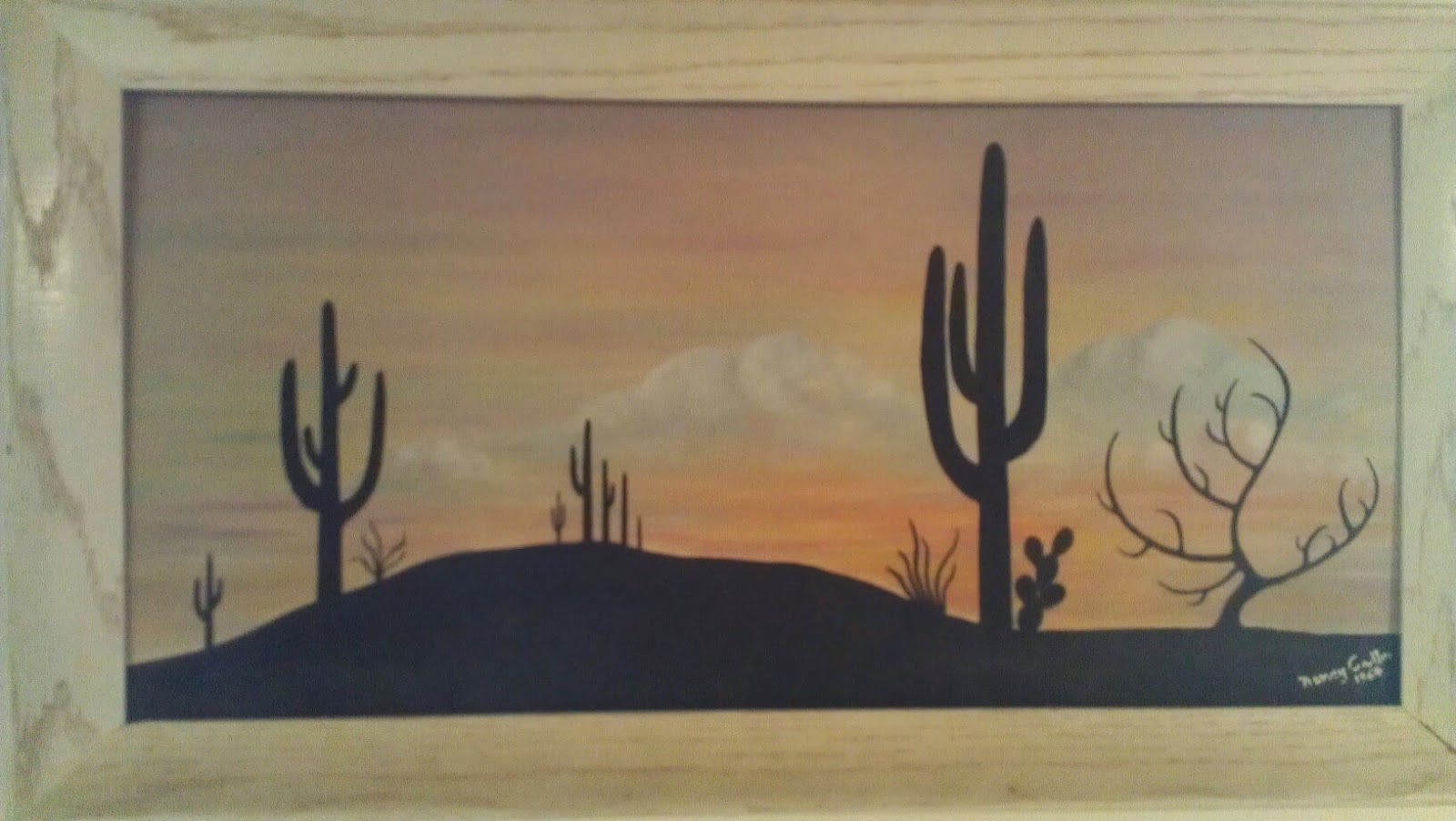
Grandma died in 2004, the same year Mamie Robinson died. Without Mamie’s recollections, I would only have a vague family legend about their relationship – but thanks to her (and to Mr. Means for making sure those recollections got published!), I have something small and precious to remember about the woman who painted this sunset, and a reason to hum a certain cowboy’s tune while looking at it.
What to expect when you’re expecting collaboration
By now, you may have noticed that I love using WikiTree. I do my original research primarily using my Ancestry membership (which is expensive and not an option for everyone), and then take what I learn about each family/relative and craft it into a biographical profile on WikiTree so that it is easier for me to share my research with others.
If you see me mention a relative in a Substack post, odds are that I’ve linked their name to their WikiTree profile – for example, Thomas Henderson Murray (about 1779 – about 1837), who I am hoping to trace back to Scotland.
Another practice I enjoy is creating “Free Space” pages for the unique local histories and published family histories that I run across in my research. Here are three WikiTree pages that explain what these are and how to make them:
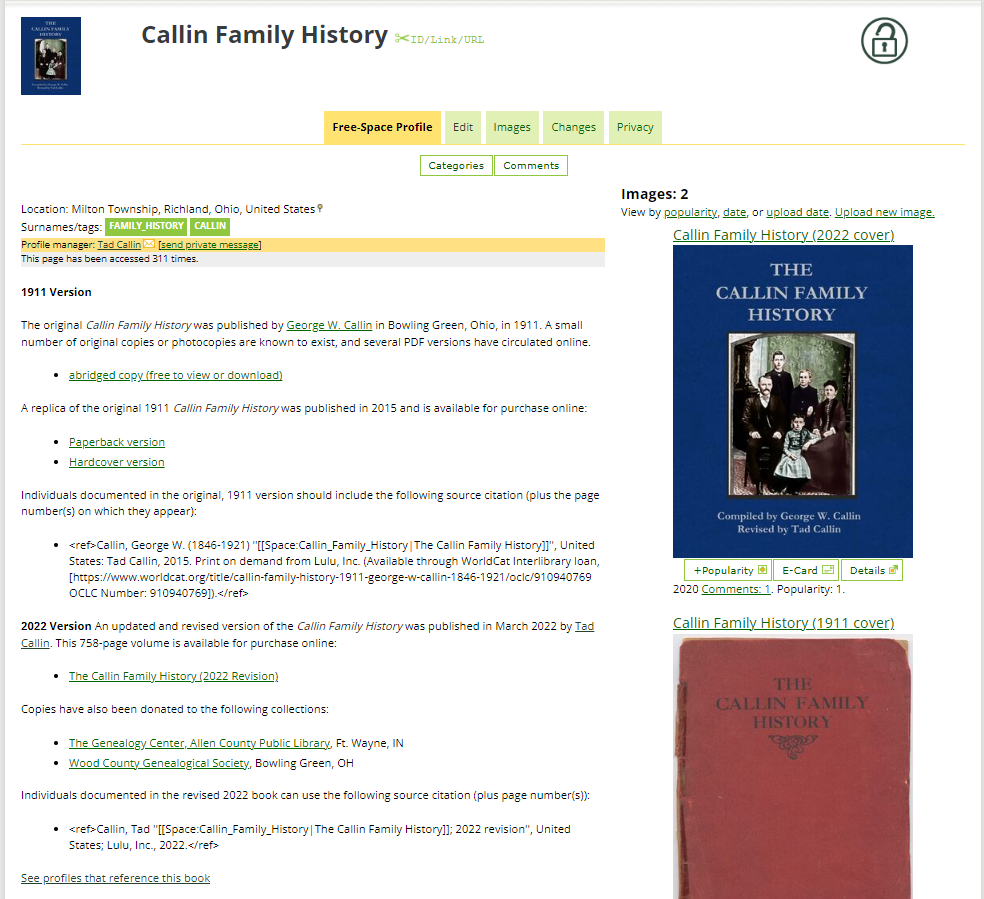
And if you visit my profile, Callin-50, I have a “Local Histories” section linking to the various Free Space pages I’ve made or contributed to. Like this one:
Screenshot of the “Callin Family History” Free Space Page
So What?
When America’s first Centennial approached (1876, for those who need a number) it became a trend for towns and counties, especially across the more recently settled MidWest, to publish large histories of their town or county, and they often included biographical sketches of the most prominent citizens. Despite hiring historians and scholars to edit these massive projects, they rarely met any kind of academic standard – they cited no sources or primary records and often relied on close relatives or (in some cases) the subjects of the biographies to submit the sketches to the editors.
At best, these biographies give us a sense of what these “prominent citizens” thought about themselves, or how their families saw themselves in local society. They are often useful for tracking down primary sources, and they often provide a detailed list of ancestors and siblings for the person featured in the sketch.
At their worst… these biographies can be full of errors, bias, and a near-constant elevation of white men with property over the rest of the residents of a given area. The erasure of the contributions of women and ethnic minorities to these towns and counties, combined with the almost universal reinforcement of the myth of “rugged individualism” that “built our country from nothing,” puts the racism and casual superiority of the men of that time on full display.
There are a lot of places where you can find local histories – Internet Archive, Hathi Trust, Google Books, FamilySearch.org, and Ancestry collect a lot of them. The benefit of a Space on WikiTree is that researchers can create links to all of those repositories and include information about the reliability of the information, as well as provide source citation text that can easily be pasted into any WikiTree profiles you might be making. Example:
<!– wp:image {"caption":"copy the \u201c\u2026everything\u2026\u201d and paste into a profile citing this source”,”sizeSlug”:”large”,”linkDestination”:”none”} –>
copy the “<ref>…everything…</ref>” and paste into a profile citing this source
The Wiki platform also has a few neat features that make it easier to see, at a glance, how many individual profiles cite or link to a source. If the source citation text includes a link to the Free Space page for that source, any profile that cites that source using that text will appear at the “What Links Here” link for that Free Space page. Users can also use Categories that can build an index of related pages, so you can see profiles based on their family groups or local areas, or even Categories for “People named in this source,” if that is useful.
The Down Side
You might be leery of “trusting” what is on WikiTree – or you may be one of the people I see complaining online that you had an unpleasant interaction with another contributor or a profile manager. These are valid concerns – and your experience may vary wildly from the experiences of others. But there are a lot of us out here who want to help – never be afraid to ask for help.
Using any collaborative platform – any user-editable web page – will inevitably lead you to cross paths with people who don’t behave the way you expect or desire. You mustn’t let common human behaviors (including, perhaps, your own) discourage you from learning how to use a potentially helpful tool. But the behavior of other people is often a mask for the real problem, which can be boiled down to a fear of the loss of control over your work.
The real downside for many people is that posting on a collaborative platform means putting work into something that you don’t have absolute control over. That’s the trade-off you have to make if you want other people to benefit from your work – they have to be able to access it. In my experience, though, whether I’m editing Wikipedia, WikiTree, or any of the other work- and hobby-related wikis I’ve used over the years, it is far more common for the work I do to be ignored than it is for it to be vandalized or altered by another user.
This is why I’m so grateful to see you reading my work here – sometimes it can get lonely doing this kind of work, and seeing you regular subscribers enjoying my efforts is more rewarding than you might think!
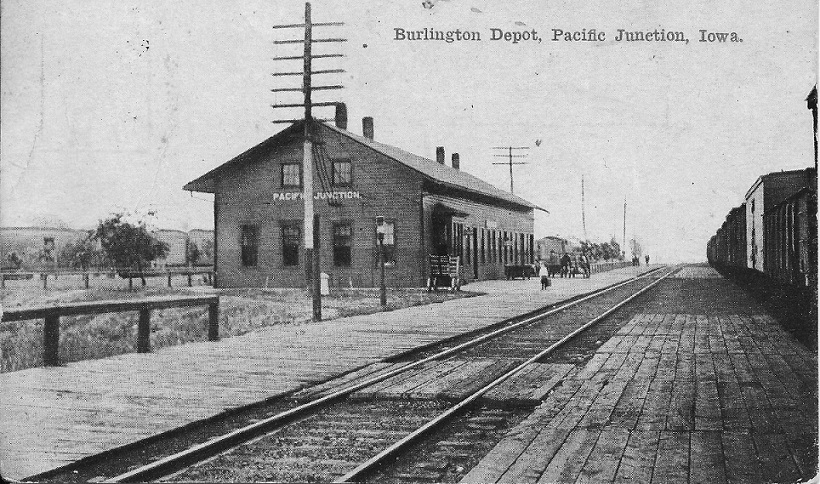
Three railroads converged in Mills County, about 25 miles south of Omaha, Nebraska. The western terminus of the Burlington and Missouri River Railroad and the eastern terminus of the Nebraska Burlington & Missouri Railroad met at a station on the Kansas City, Council Bluffs, & Saint Joseph Railroad – and that spot was given the name Pacific Junction in 1871.
Burlington Depot, Pacific Junction, Iowa (from the Mills County, Iowa IAGenWeb Project)
That was a magical year in American history – in many ways, it marked the beginning of a dramatic industrial transformation of the country from a rural landscape of disconnected farms and frontiers to an inter-connected economic and technological world power. Between 1870 and 1890, the amount of railroad track in the United States tripled1. Total trackage increased from 35,000 miles in 1865 to 254,000 miles in 19162. Railroad magnates took advantage of generous federal subsidies (usually in the form of land grants) and of the lower costs of using steel tracks instead of iron, and they made fortune after fortune from building this new infrastructure – often on the backs of workers who had to fight for fair treatment and reasonable wages. This sometimes led to violence, as it did in Pacific Junction in 1888, during the Burlington Railroad Strike of 1888.
Pacific Junction was also a farm town.
Stock and produce bound for Chicago and Boston, or the West coast, or points South, converged on a place like Pacific Junction, where auctioneers with silver tongues and lightning lips spoke for the Invisible Hand of the market. One of those auctioneers was a man named Frank Shuffler.
Frank was a dashing young man, born in Hubbell, Thayer County, Nebraska, on March 29, 1888. His father was Valentine Shuffler, a farmer who moved his family to Pacific Junction when Frank was 10 so Valentine could work for the railroad. The violent years of the labor battles were ten years in the past, and the steady work of the railroad probably insulated the Shufflers from the notorious boom-and-bust cycle of farming in what we now call the Gilded Age.
In 1907, at age 18, Frank married a local girl from a Pacific Junction farming family. Virginia Ballard was also 18, the second of five daughters of Isaac and Mary Ann Ballard. Her father was a former drayman who later became a railroad man, working as a brakeman on the trains that passed through Pacific Junction. Sometime after 1900, though, Virgie’s parents divorced, and in 1904, Isaac married a girl from Saint Joseph who was nearly half his age and moved with her to Oakland, California. It seems likely that Isaac was not at Frank and Virgie’s wedding in 1907.
But Frank was handsome and popular in town and ran a barbershop with his partner, Thomas Martin. As mentioned above, he was also an auctioneer – and at some point, Frank even served as mayor of Pacific Junction. So we have an Iowa railroad town in 1912 with a thriving young community centered on a barber shop – the only thing missing from this scenario is a charismatic flim-flam man hoping to sell the school board marching band uniforms!
(If you’re not familiar with the 1962 film production of The Music Man, a show set in 1912 in the fictional town of River City, Iowa, please allow me to correct that, now.)
Frank and Virgie had four sons between 1909 and 1915: Don, Darrell, Dale, and Duane. You could almost pick them out of the crowd of children in the park; you could almost see Virgie in one of those magnificent hats, standing with the other young mothers. This family must have enjoyed a wonderful decade after their 1907 wedding.
Sadly, Frank’s dad, Valentine, died on February 1, 1916. And while America had tried to stay out of the growing war in Europe, events conspired to draw the country into it. The U.S. Congress declared war on Germany on April 6, 1917, and on Austria-Hungary on December 7. Some 5 million young Americans – out of a total population of just over 103 million – would enlist over the next year.
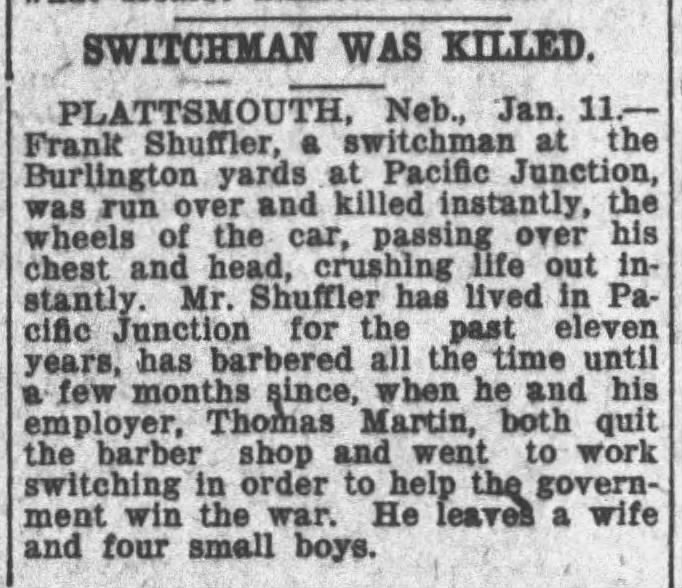
Frank and his partner, Thomas, were too old to enlist and had dependent families. However, such a massive disruption to the labor pool created a shortage of workers to operate the railroads the country depended on. Both men quit the barber shop and went to work as switchmen for the railroad “in order to help the government win the war.”
On the night of January 9, 1919, Frank slipped on the tracks and was run over by a moving train, killing him instantly.
Lincoln Journal Star, Lincoln, Nebraska; Sat, Jan 11, 1919, Page 2
Virgie and her four small boys, ranging in age from 10 to 4, were not left entirely alone. Her mother, Mary Ann Ballard, moved in with them to help care for the boys and Virgie found work as a cook in a hotel.
The Arrival of Mr. Steele
Orin Durant Steele was born in Newbury, Massachusetts, on 3 Sep 1882. As a young man, he worked as a weaver in the woolen mill in Newbury. Orin married Estella W Winct in 1903 and they had two sons. After Orin’s mother died in 1912, his father, Horace, came to live with Orin and Stella until he died in 1920.
A lot had happened to Orin in that decade. About 1915, he took a job as a state fish and game warden, and about 1917, the family moved to Quincy, Norfolk County, Massachusetts. Then the war came, and Orin enlisted in the U.S. Army on July 2, 1918, He served as a sergeant in the 316th Company Tank Corps (Salvage And Repair). His unit sailed from Hoboken, New Jersey aboard the Kroonland on 30 Aug 1918, and may have participated in the Meuse-Argonne Offensive. He returned from the war and was discharged on 10 Apr 1919.
After the war, things went back to normal, mostly. Around 1925, Orin was hired to be a U.S. Game Warden. His job was the enforcement of the Migratory-bird Treaty and the Lacey Acts for the U.S. Department of Agriculture. He was posted to Council Bluffs, Iowa, from 1925 to 1927. Rather than go west with Orin, Stella went to California, where she married Samuel Willis in 1926. His sons were grown by this point, his older son, Arthur, having married in 1924, and his younger son, Marcus, entered the U.S. Naval Academy as a midshipman.
I don’t know the details, but it is easy to imagine that a game warden based in Council Bluffs would have occasion to stay in a hotel in nearby Pacific Junction. And if Virgie Shuffler was anything like her granddaughter, June (Shuffler) McCullough – or like June’s granddaughter, who I married – then it is even easier to imagine that he would fall in love with her.
When his posting to Iowa ended, Orin spent 1928 based in Kansas City, Missouri. But by 1930, he was assigned to the region based around Cambridge, Maryland, and he took his new wife and her three younger sons with him. Virgie’s oldest son, Don, was married by then and had two daughters, Elaine and June. They remained in Council Bluffs.
Orin and Virgie lived in Cambridge for about ten years, until his career took them to Long Island, and then back to Massachusetts. But Cambridge was home for them and for Virgie’s younger sons. After Orin died in 1950, Virgie returned to Cambridge, where she lived until her death on November 4, 1977, at age 88.
Pacific Junction had already begun to decline, too, by that point. The Pacific Junction Public School, in a building built in 1914, graduated its last high school class in 1961 and closed for good in 1986. The town population, which peaked at just over 700 people during Frank Shuffler’s time had dwindled to 96 by the 2020 census. And those remaining families would have been devastated when the Mills County levees failed on March 17, 2019, flooding the city.
Of course, the moral of the story is that good times and bad times will come – and overcoming the bad times may require some steel.
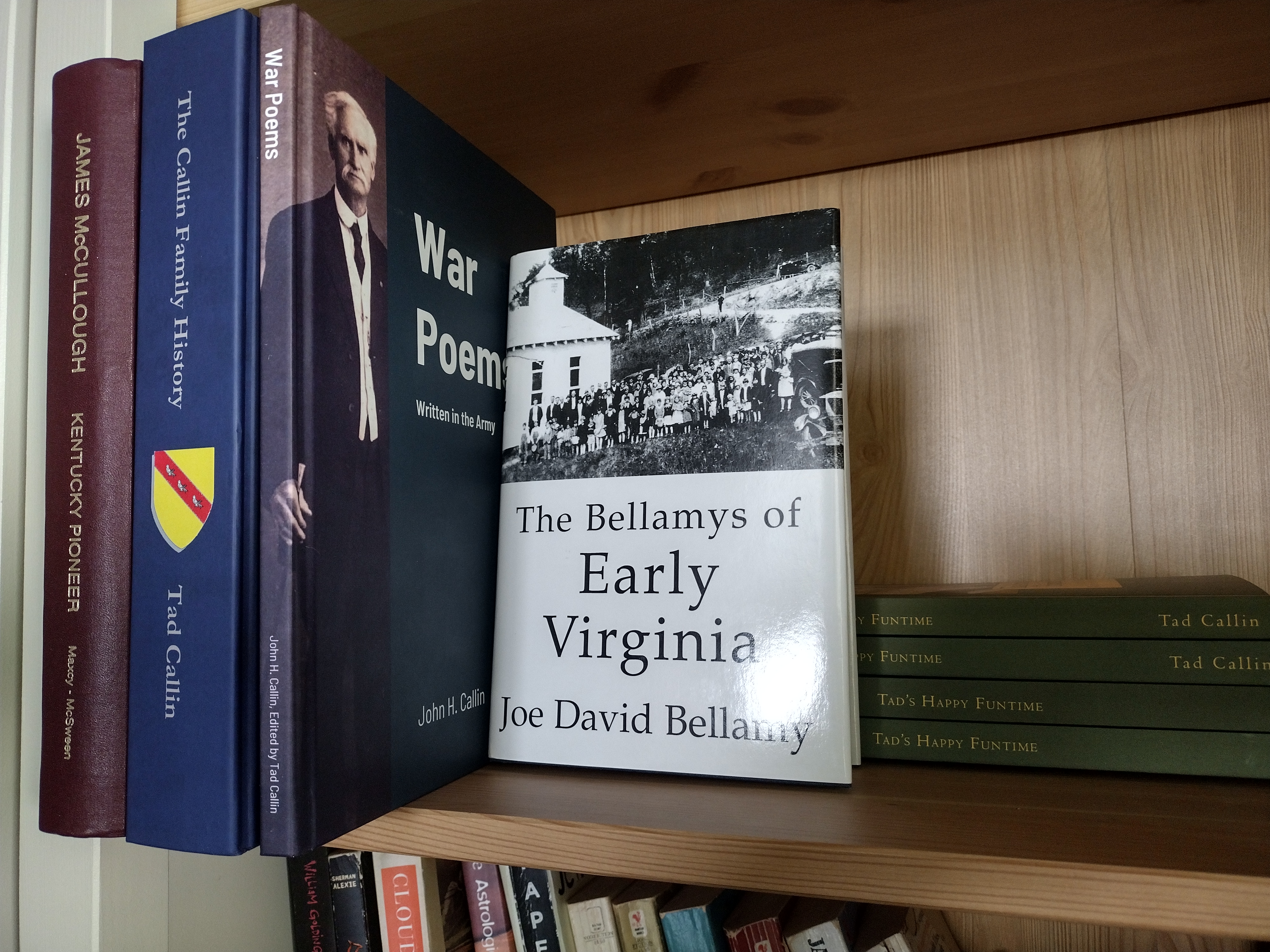
This surname can be found among my Sixteen great-great-grandparents. We have to go that far back to find the first Bellamy – my maternal grandfather’s paternal grandmother:
Sarah is named in The Bellamys of Early Virginia, by Joe David Bellamy. We know she married Joel Clark (of Family Reunion: Clark fame), but Mr. Bellamy’s book didn’t give us a lot of detail about her family. There is a skeletal genealogy for Sarah’s parents, with names and birthdates for her siblings, but not a lot of additional information.
Several generations of Bellamy men married women from the West family. Sarah’s parents were Bennett Bellamy and Jane West; Bennett’s parents were Matthew H. Bellamy and Nancy West. Sarah’s son, David Ulysses Clark, married the granddaughter of Frances (West) May, whose father was murdered by secessionists in 1862. I have no idea how or whether these West families are related to each other, yet, but I am working on finding out!
The Bellamy book covers a lot of territory. It is not a straightforward descendency report, but it does trace descendants of a John Bellamy who was “imported” to be an indentured servant of Dorothy Pleasants in Henrico County, Virginia. Based on the available records and what is generally known about the terms of indentured servitude, John most likely arrived from England around 1710 or 1711, purchased 120 acres of land in 1717, and died in 1729. By the time he died, the land he had purchased in Henrico County in 1717 was in Goochland County.
Joe David Bellamy offers a great deal of analysis, rather than simply drawing conclusions and presenting them as facts. I appreciate this approach. Being able to see the journey he took and the facts that led to his conclusions about John’s origins makes the factual claims that are here more reliable and shows me where further research needs to be done. Along the way, he includes photographs and personal stories where he finds them.
As I said, Sarah Bellamy was the paternal grandmother of my maternal grandfather, Russ Clark. I have been working my way through these branches of his tree slowly, and adding profiles to WikiTree – but I have been slowed down by the fact that several generations in a row had as many as a dozen children each. Their large families intermarried with the same handful of families, making it hard to document exactly how the cousins are interrelated.
Be sure to subscribe so that you can see when I post updates about these families.
And drop a note so I know you’re interested – if I know there is an eager audience waiting, I can schedule updates accordingly.
Postscript: Joe David Bellamy died in August 2014, not long before I discovered his book. He was an award-winning author and professor at several colleges. You can learn more about him at that link, and let me know if you read any of his work.
The Bellamy name is often seen spelled “Bellomy” but I can’t tell if that is a preference used by actual Bellamys or if it is just a transcription error; I apologize if I misspell somebody’s name, but I will usually default to using “Bellamy”.
The short, tragic life of Paul Olin “Pretty” Callin
Paul Olin Callin (1902 – 1930) was the youngest of three siblings: he had an older sister, Ruth, and a brother, Martin. They grew up in Ashland, Ohio, where their father worked as a blacksmith. Delbert Dean Callin (1863-1934) was a descendant of my 5th-great grandfather, James Callin, making Paul and his siblings my 4th cousins, twice removed.
Delbert had married Hettie Stull in June 1890, only to lose her in death that August to unknown causes. Widowed Delbert married his second wife, Mary E Coleman (1872–1962) on 31 December 1891, and Ruby was born the following October. Martin was born in 1894 and was probably named for Del’s older brother, who had been a prominent businessman in Crawford County, Ohio, until his tragic death in a train accident in 1889.1
Life as a blacksmith in Ohio at the beginning of the twentieth century was probably not easy. “By the end of the 19th century, most blacksmiths found themselves out of their typical line of work, and needed to diversify to get by. Shoeing horses became a major source of income for displaced blacksmiths, but the development of the automobile industry quickly reduced the need for this work in the early 20th century.”2
Dell seems to have found work in the shops and factories around Ashland, but his household struggled as his kids got older. In December 1914, Mary filed for divorce, charging “habitual drunkenness and failure to provide.” According to Mary, “her oldest daughter has worked to help support the family since she was 15 years old and the son since he was 10 years old.”3 The judge granted the divorce in Jan 1915 and gave Mary custody of the children.
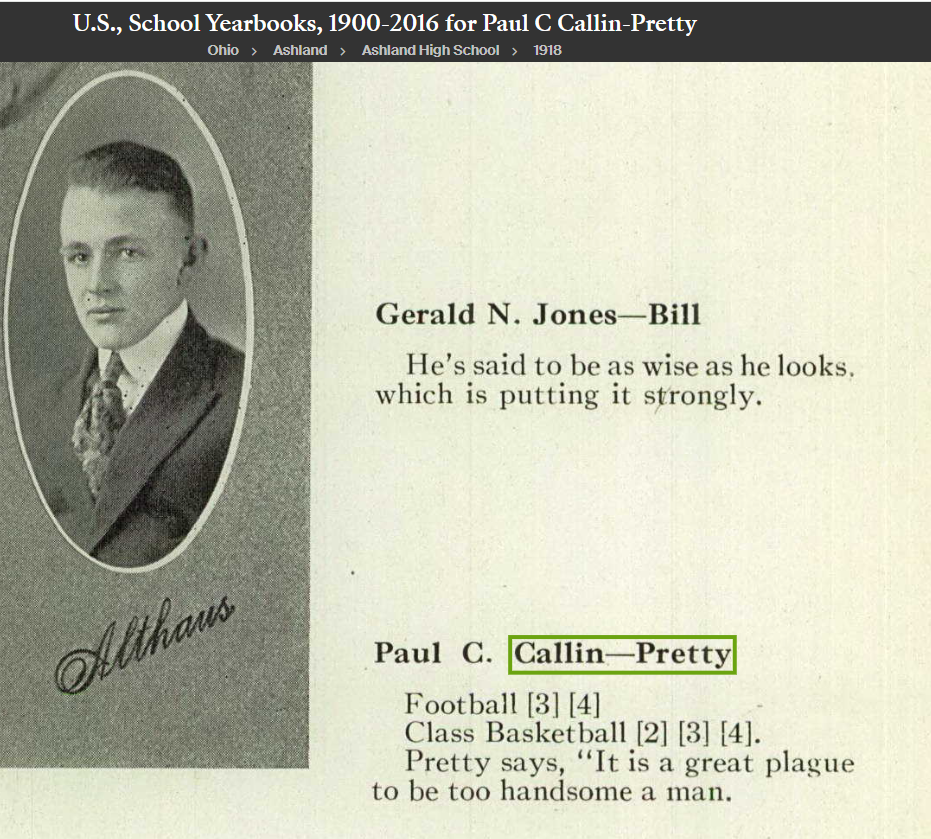
We can only speculate as to how the children felt about this. Paul, for one, put on a brave – and handsome – face, according to his senior yearbook entry in 1918. His big brother enlisted in a medical unit in the National Army in May 1918 and returned the following year.
It’s not clear whether that portrait is Paul or Gerald – but if it’s Paul, his High School Senior quote says a lot! (found on Ancestry)
Paul lived in Ashland at least until 1921, when he was listed in the city directory, working as a druggist clerk. He and his family moved to Akron where they lived at 184 Eureka Terrace together. On 16 Jul 1924, 23-year-old Paul married Ruth Claudine Warren (1903–1980) of Columbus.
Akron, Ohio, had a lot going on in the mid-1920s. The Prohibition Era was in full swing, coinciding with the rise of “flapper culture” – when young women were out to have fun. “They bobbed their hair, applied colorful makeup, wore short dresses, rolled down their stockings, chewed gum, swigged gin and even smoked cigarettes. Worst of all, they listened to jazz and danced. Oh, how they danced.”4
We don’t know what Paul or Ruth thought about all of this, but it seems likely that Paul, at least, liked to live a little. We know he was proud of his looks, and if he suffered from an unhappy childhood, he may have found himself enjoying the Roaring ‘20’s – and the criminal elements of it that came along with the party atmosphere.
If I had to guess, I would say that Ruth was not happy about Paul’s life choices. She divorced him in October 1928 and moved back to Columbus. She supported herself as a stenographer and telephone operator, and as far as I can tell, remained single until she died in 1980.
On December 1, 1928, The Akron Beacon Journal reported that detectives “swooped down upon the headquarters of a holdup gang … and captured four men and one woman, who is alleged to be the ring-leader.” Members of the gang included Paul Callin, 28. All were charged with highway robbery.
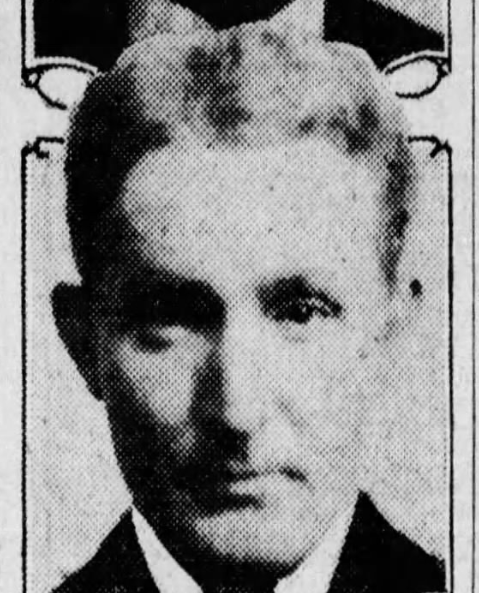
Paul Callin in The Akron Beacon Journal, Tuesday, April 22, 1930, Page 35
Paul and his compatriots confessed to several holdups, and Paul was convicted and sentenced to 10 to 25 years. Mrs. Leona Steele, the woman arrested as the ringleader, tried to deny her involvement, but Paul and another man, Frank Butler, testified that they had plotted the robberies at her home.
The 1930 U.S. Federal Census for Columbus, Ohio, was enumerated on April 16, 1930. Paul Callin, 29 and divorced, is listed as an inmate in the Ohio State Penitentiary. Interestingly, he is listed as a veteran of the World War – though I have not found any records to support that.
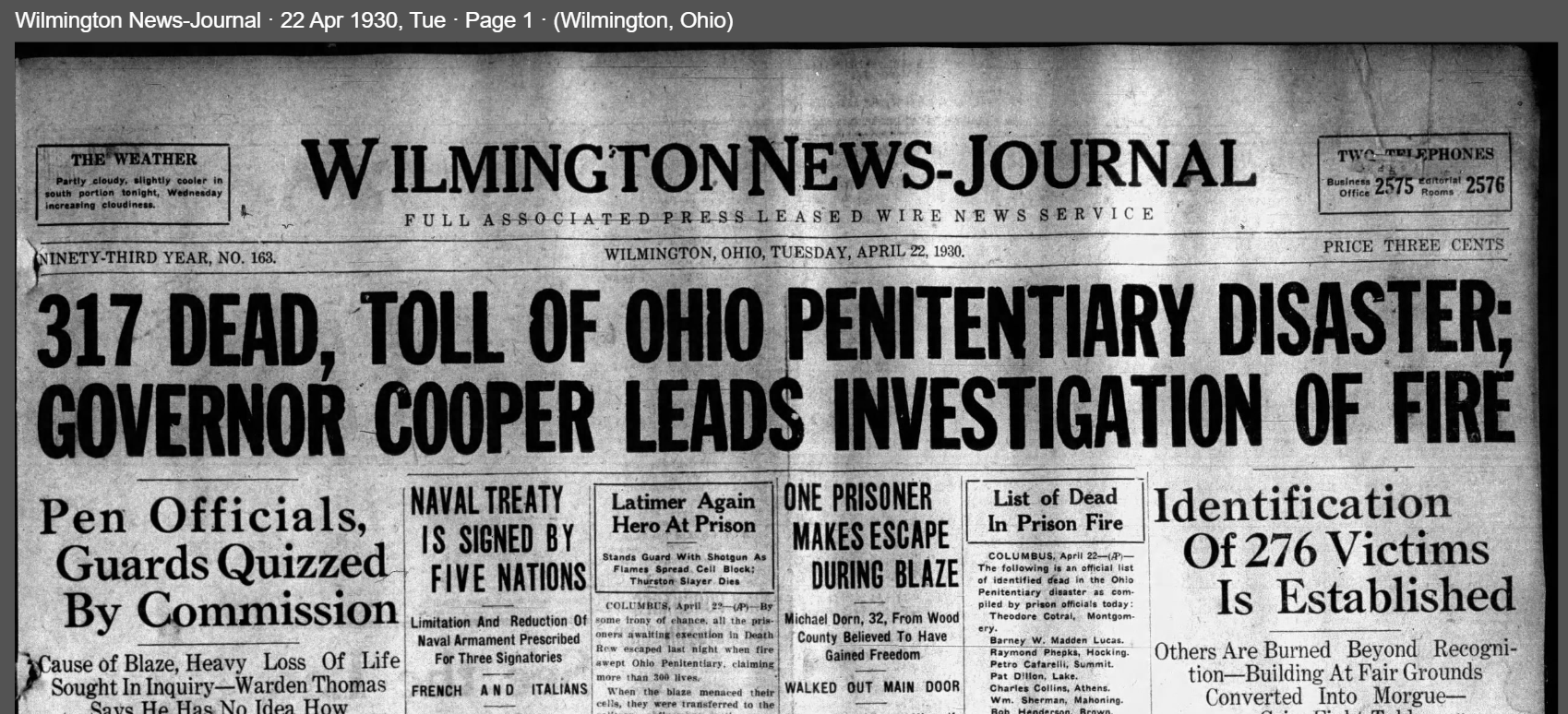
A mere few days after that census was taken, Paul was killed in a terrible fire at the penitentiary that claimed a total of 317 people on 21 April 1930.
Wilmington News-Journal, 22 Apr 1930, Tue, Page 1
This was the deadliest prison fire in the history of the United States. An investigation, hampered by the unwillingness of the convicts to talk about what they knew, turned up evidence of arson as part of a failed escape attempt. The prison had been built for 1,500 and at the time of the fire it held 4,300.
Paul’s family had stayed in Akron. His brother, Martin, married and had a daughter, Vivian, in 1926, but sadly, his wife, Irene, died in 1931. Martin and Vivian went to live with Martin and Paul’s sister, Ruby, and their mother, Mary. Vivian married in 1949 and lived with her husband in Albuquerque, New Mexico. After Mary died in 1962, Martin and Ruby eventually moved to New Mexico, where they died – he in 1976, she in 1984.
This story unfolded in a very roundabout way for me. For a long time, all I knew about Paul came from the Census and a few city directories, and I hadn’t looked very closely at the 1930 Census. In my defense, I was in the middle of the massive project that would turn into the Callin Family History, and even though I saw he was included in the population of the Ohio State Penitentiary, I didn’t realize he was an inmate initially – since several of my family members have appeared on the census in institutions like this as employees. It wasn’t until I noticed that he was listed as divorced that it occurred to me to look harder and I noticed he was a prisoner.
Once I found the newspaper articles reporting his death, along with so many others, I began searching for other details: the trial of “Bandit Queen” Leona Steele, details of his marriage and his ex-wife’s life, and the timeline of events.
There is a technique to this kind of story recovery – check out Kate’s list of prompts on Motley Stories:
As always, it’s hard to fill in the gaps and the context accurately. I don’t know whether his arrest and conviction showed Paul the error of his ways, or if it hardened him and made him determined to be a smarter, more dangerous criminal when he got out of prison. I don’t know whether his wife was a wild flapper and partner in his criminal life, or if she wanted a quiet family life and simply wouldn’t follow him down the path he chose. I think the latter is more likely, but we don’t know.
If you are telling a factual story, like I’m trying to do, that’s where you have to stop. If you’re looking to expand the narration and capture a possible version that gives your reader insight into the times and places… you can do that. (Just make sure your reader knows what is fact and what is speculation!)
Let me know what you think in the comments – especially if you know you’re related to that branch of the family.



 Mightier Acorns