Mightier Acorns

Journeys through Genealogy and Family History

A parody of a family coat of arms designed with acorns as elements, with the motto "ex gladnis potentioribus" Latin for "from Mighty Acorns"
From Mighty Acorns
  • They only point the way… the rest is up to us

    If you were a fly on the wall… or if I set up a Twitch stream… the scene that would play out in front of you might disrupt your image of the studious researcher.

    I know I like to think of myself as a jovial and sedate scholar, calmy reviewing search results and zeroing in on the information that lays out a sensible map of where my ancestors were, what they were doing, and when it all happened.

    But then there’s reality.

    Reality often involves me, in my pajamas at midday, craving a third cup of coffee and spluttering exasperated questions at my monitor.

    “How is he in Iowa? He’s supposed to be in Indiana?” (Frantically rechecking all place names beginning with “I” to make sure I didn’t confuse them.)

    “Wait – who is Eunice? I thought he married Elizabeth!!”

    “Why were they married in North Carolina??? THEY LIVED IN IOWA! No, wait… INDIANA! Augh!”

    Those who practice the art of profanity may insert words beginning with “f” as they see fit. I know I did.

    These outbursts were also periodically punctuated by me, raising a fist at the heavens and cursing the patriarchy for effectively erasing women from history at every opportunity.

    The Back Story

    I try to balance the posts you see between my family and my wife’s family. I believe my children (and perhaps, someday, grandchildren) deserve to see their whole family history and not just my half.

    So, when I look at my output on Mightier Acorns and see a growing imbalance, I dive back into the story of my in-laws. And the best stories come from asking questions about the gaps and anomalies. Today’s anomalies lie in the ancestry of my wife’s grandmother, June (Shuffler) McCullough.

    June’s great-grandfather, Valentine Shuffler, is overdue for an appearance in my Wavetops series, but most of the information about his parents comes from “received wisdom” – online trees and unsourced notes on Ancestry. To tell Valentine’s story, I have to know more about his mother…and anyone who has read Laura Numeroff’s “If You Give A Mouse a Cookie” knows where this story goes.

    At any rate, the scene I described above came out of my attempts to trace Valentine’s mother, Ruth Dyer, and her origins.

    Quakers On the Move

    The Religious Society of Friends kept extensive records of the lives of its members. Ruth Dyer’s parents were Friends – better known by outsiders as “Quakers” – but the Society’s records operate a little differently from the local county vital records I’m familiar with.

    For one thing, the Friends were a lot more intrusive than local governments were in the types of things they recorded. In addition to the expected birth/death/marriage records, the Friends recorded members’ movements and various actions or behaviors in which members might engage.

    According to this list of Quaker abbreviations found on the Indiana Genealogy website, INGenWeb.org, the Friends recorded disciplinary actions and infractions like “deviation from plainness of dress” (dp) or “using profane language” (upl) in addition to movements between congregations, known as Meetings.

    The key to understanding how this applies to the Dyer family lies in understanding that a member of a Meeting did not “officially” leave the Meeting until they gave written notice asking to be removed from the rolls. When Ruth’s father, George H. Dyer, moved from his home state of North Carolina to the western states of Indiana and Iowa, the Society in Stokes County, North Carolina, continued to record events related to George and his family.

    This was helpful, of course, because if not for the Society of Friends, I might not have found evidence to support George’s biography at all. But I had to do some digging to figure out how to interpret the records that have been digitized, and piecing it all together can lead to a series of outbursts that might draw an “upl” reprimand from your local Meeting.

    Interpretation of the Records

    I began with Ruth, so my task was to find records to tell me about her parents. Her 1852 marriage records established her maiden name as “Dyer” – and she was married in Marshall County, Indiana. I soon found a record on Ancestry that gave me her date of birth and the names of her parents – George and Elizabeth – but confusingly gave her birthplace as “Guilford, North Carolina” and her residence as “Wayne County, Indiana.”

    North Carolina marriage records show that George H. Dyer married Elizabeth Willetts on 15 Jun 1822 in Stokes County, NC. The U.S., Hinshaw Index to Selected Quaker Records, 1680-1940 gave me a record showing George, Elizabeth, and their first three daughters (and all five birth dates) recorded in the New Garden Monthly Meeting. That source placed the New Garden Meeting in Wayne County, Indiana.

    Knowing this led me to inspect the records turning up in both Indiana and North Carolina more closely, and I soon found this record from Ancestry’s U.S., Quaker Meeting Records, 1681-1935, which listed seven children born to “George and Elizabeth Dyre” with birth dates for all nine people, and county of birth for all of the children. The first three daughters clearly matched the three daughters in the New Garden record, and this new record was reported to the Dover Monthly Meeting.

    Friends Meetings are organized around an annual and monthly calendar, so records are usually sourced to (for example) “Dover Monthly Meeting” under the state “North Carolina Yearly Meeting” – and the Monthly Meeting should identify the “Meeting County” – in this case, Guilford County, NC.

    An 1839 entry in the Dover Monthly Meeting reported that the Meeting had received a certificate of marriage for George Dyer and Eunice Bishop from the Chester Monthly Meeting, and the “Society of Friends Records, 1803-1962” resource on IndianaHistory.org, told me that the Chester Monthly Meeting was also located in Wayne County, IN.

    More to the Story

    Now that I’ve learned enough to understand what the records are telling me, I have a lot of work left to do to untangle the facts and find the details that are left out. None of the records I have so far tell me when people died, but it’s pretty clear that Elizabeth died around 1837 – and several of the children for whom I have birth dates don’t show up in the household in 1850. Some of the children who are in that record may be from Eunice’s first marriage.

    There is a lot of exciting historical context implied by all of this, too. The Quakers in Wayne County were active abolitionists and helped escaped slaves find their way to freedom via the Underground Railroad through their county. I don’t yet know enough to tell whether the Dyer family was involved, but maybe that will be a story for another day.

    Marengo meetinghouse
    Galen Preparative Meeting House, built 1813; BICENTENNIAL MINUTE: The Quakers in Wayne County, By Loreen Jorgensen, Jan 5, 2023

    Thanks for reading Mightier Acorns! There’s always so much more to learn.

  • The lifetime of Margaret Forbes (1903–1997)

    As we begin a New Year, I thought I’d start with a biography of one of those “Mighty Acorns” I set out to discover so many years ago. A cousin of mine, but also a genealogist/family historian who left behind a significant piece of her family’s puzzle.

    Margaret Althea Forbes (1903–1997) was born on 20 August 1903 in Ashland, Ohio, the younger daughter of William Tawse and Amy Bernice (Sattler) Forbes. Her grandmother was born Mary Etta Callin – Margaret and her siblings are my 3rd cousins 2x removed.

    William was a telegraph operator for the Pacific Railroad – and he apparently used his middle name, “Tawse,” and not “William.” He and Amy had four children, starting with Margaret’s older sister, Marabelle Ada Forbes (1901-1995). The two younger brothers were Robert Lyle Forbes (1907–2008) and Scott Callin Forbes (1914–1979).

    The Spectre of Divorce

    Judging by the evidence in the City directories, Amy and Tawse had a rocky marriage in the years after Scott was born.

    In 1917, the Ashland City Directory lists “Forbes Amy S Mrs” at 711 Cottage and “The Nothern” at 717 Cottage. Tawse is not named in that edition of the directory—there are two other men named William (“Wm” living at 34 W. Main and “Wm C”, a bricklayer married to Emily and residing at 717 Ohio).

    On his World War I Draft Registration Card, dated 12 Sep 1918, Tawse gives his address as 525 Vine and lists his nearest relative as “Mrs. Jane Forbes” at that address. This is his mother. She appears in the 1919 Ashland City Directory at 525 Vine; Amy is again listed as the proprietor of The Northern at 711 Cottage.

    On the 1920 Census, Amy is listed as head of the household with her four children, managing the boarding house at 711 Cottage – and it says she is divorced. Strangely, Tawse Forbes (and Amy) are listed at that address in 1921. (So are “Wm” and “Wm C,” which is how I knew neither man was Tawse.)

    Amy married Robert Marion Greenlun (1880–1966) on 31 July 1923, convincing evidence that she was divorced from Tawse. Bob moved into 711 Cottage and worked for the state highway department. In 1930, they still appear to have been operating the Northern Hotel boarding house, as the census lists five boarders, but by 1940, everyone in the household was a relative.

    Margaret Comes of Age

    Margaret graduated from Ashland High School in about 1921. Her sister, Marabelle, had married Noah C. Shull (1897-1986) in 1919, but marriage was not the choice Margaret made. She remained in her mother’s home at 711 Cottage and probably worked as a clerk for several businesses in Ashland.

    The start of the war opened up an opportunity, and she went to Dayton in 1943 to work at Wright-Patterson Air Force Base. Evidence suggests that she was posted to Hickam Field, Hawaii, for a year, and returned to the mainland in Dec 1944 aboard the S.S. President Johnson.

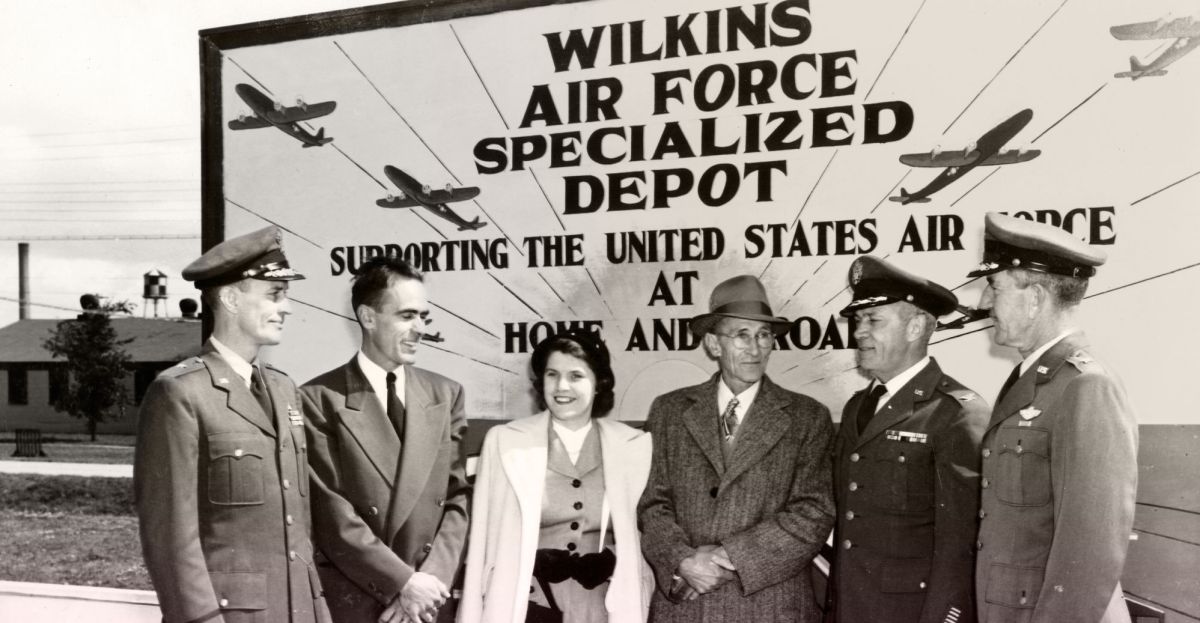
    Margaret remained a civilian Air Force employee for 22 years, sometimes working at different locations, but most of the city directories during the 1950s show her residing at her mother’s home at 711 Cottage, so she may have spent most of her career at the Shelby depot. Established as “Army Air Force Supply Depot” in Shelby, Richland County, Ohio, in 1943, the facility survived the war and was renamed Wilkins Air Force Specialized Depot after the Air Force became a separate service.

    The Richland Source, “Then & Now: Army Air Force Depot in Shelby 1943,” 7 Feb 2017 – The photo was not labeled, but I don’t think that’s Margaret.

    The Shelby depot was closed in January 1961, leaving only a single independent depot, the Dayton Air Force Depot at Gentile Air Force Station, Ohio. Margaret may have finished her career there.

    Becoming One Of Us

    After her retirement in 1965, Margaret traveled to Scotland six times to follow up her Forbes family tree. She was a member of the Ohio and Ashland Genealogical Society and, in her eighties, volunteered at the Ashland County Historical Society’s Museum.

    In 2019, I wrote to the Ashland County Genealogical Society (ACCOGS), asking whether they had any research donated by Margaret. They initially came up empty and referred me to Richland County, which forwarded my query to the Ohio Genealogical Society. Tom Neel, Library Director at Samuel D. Isaly Library for the OGS, was able to confirm that Margaret Forbes, Ashland, Ohio, was a member of the Ohio Genealogical Society from 1976 to 1982.

    Unfortunately, none of these organizations were able to find any materials donated by Margaret. However, Mr. Neel mentioned my query at a meeting, and one longtime member of the Ashland County Chapter thought to check the chapter’s collection at the Ashland Public Library, where they found a typewritten “History of the William Forbes Family” filed under “Martha Forbes,” which turned out to be Margaret’s work.1

    While I would have loved to find more information about her Callin heritage, it is understandable that she would focus on her father’s line. But – Margaret was not the only family historian I discovered while assembling the Callin Family History. (More on that another day!)

    Endings

    Tawse Forbes left Ohio after his divorce and was living in Minnesota when his mother died in 1933. By 1942, he was back in Ashland. He died of a heart attack while working as a night clerk at the Southern Hotel on 3 January 1956.

    Bob Greenlun died in the Collins Nursing Home in Hayesville at the age of 86 in May 1966. Amy S. Greenlun died at her home at 711 Cottage a year later, on 7 September 1967, at age 92.

    Scott Callin Forbes, the youngest child of Amy and Tawse, was 64 when he died at the Veterans Administration Medical Center, Biloxi, Miss., on 1 July 1979. He was survived by two sons and a daughter.

    Marabelle (Forbes) Shull died at Good Shepherd Nursing Home in Ashland on 5 March 1995. She was 92 and was survived by two sons, Lyle Richard Shull (1921–2001) and Ronald James “Jim” Shull (1924–2013).

    Robert Lyle Forbes lived to be 100 years old and died on 31 March 2008 at Vitas Healthcare, Laud Lakes, Florida. He and his wife, Eva, never had children of their own.

    Margaret died on 24 August 1997 at Kingston of Ashland when she was 94 years old.

    Margaret Forbes, at home – 22 August 1994

    Much of the information in this biography is based on a profile published in the Ashland Time-Gazette the day before her 90th birthday. Her own Forbes family history said only: “Margaret Althea, born 1903. She never married and lives in Ashland, Ohio.”

    I have noticed that when we get into researching our family histories, we all tend to de-emphasize ourselves and view our lives as mundane or unadventurous. Margaret did this, too. But even though there are a million identical stories of individuals who lived quiet lives in their corner of history, each one is worth remembering.

    Mightier Acorns is dedicated to remembering as many as we can. Everyone is part of the tree – and has a story.

    1

    I uploaded this document as a PDF under Margaret’s profile in my “Callin Family History – G.W. Callin 1911” tree on Ancestry. If you are interested in it and can’t access that link, let me know and I can email it.

  • The family of Sarah Jane (Bellamy) Clark

    Sarah Jane Bellamy was born in Cabell County, Virginia, on 17 December 1836. She is my maternal grandfather’s paternal grandmother—and she is one of My Sixteen. Since writing about her grandfather, Matthew Bellamy, in The Slaveholders, I have spent some time improving the WikiTree profiles for this family, and most of that time has been focused on learning as much as I can about Sarah’s siblings.

    One more NOTE: I have a hard time pinning down who in this family spelled the name “Bellamy” and who spelled it “Bellomy”—I assume it was “Bellamy” unless there is evidence (like a headstone or obituary) that tells me the person had another preference.

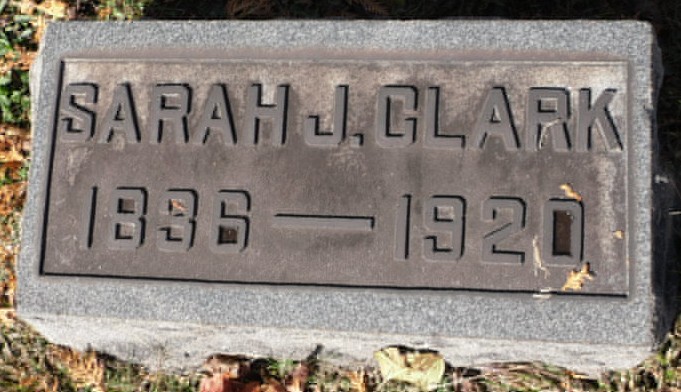
    memorial image from Find A Grave
    Sarah J (Bellamy) Clark marker – Photo added by Emily Kelley

    Beginning With Bennett

    Sarah’s parents were Bennett and Jane (West) Bellamy. Since Bennett’s mother was Nancy West, and both the Bellamy and West families lived in Bedford County, Virginia, we assume that he and Jane were cousins, but we don’t know how distant.

    Bennett and Jane were married on 30 Aug 1831 in Cabell County, Virginia, according to unsourced information on public trees. (I recall being told that information was recorded in a family bible, but I don’t have any confirmation.) The 1850 Census1 shows this family living in Greenup County, Kentucky, and indicates that their oldest child was Matthew, age 18 (thus, born about 1832) – and their youngest, Benard F., was born in January 1859. Jane does not appear on the 1860 Census, so we assume she died between Benard’s birth and the enumeration of the 1860 Census on 11 July 1860.2

    As far as we know, Bennett Bellamy and Jane West had 14 children in the 28 years between 1832 and 1860:

    • Matthew Bellamy (1832–?)

    • Nancy A (Bellamy) Dixon (1832–abt. 1900)

    • Mary Elizabeth S Bellomy (1835–1912)

    • Sarah Jane (Bellamy) Clark (1836–1920)

    • Jesse W Bellomy (1838–?)

    • Columbia (Bellomy) Whitmore (1839–1927)

    • Thomas J Bellomy (1840–1862)

    • Joseph William Bellamy (1843–1904)

    • Eliza E Bellamy (b. 1847)

    • Cleopatra “Claspa” Bellamy (b. 1849)

    • Caroline (Bellamy) Spicer (1853–1893)

    • James W Bellamy (1853–1853)

    • Catherine Bellamy (1855–1855)

    • Benard Franklin Bellomy (1859–1938)

    The 1850 and 1860 census records are mostly helpful in confirming what we know about these children. The birth dates and places of birth are not reliable and are sometimes contradicted by what the children later put on their vital records, obituaries, or grave markers. But we see everyone we expect to see on those two records, with two exceptions:

    1. Nancy was married to Peter Dixon by 1860, so she appears in his household in Boyd County, Kentucky.

    2. Jesse W. is simply not found in 1860.

    Caroline and Benard were born after 1850, so they are not listed then, but everyone else was in both records.

    The Knowns

    Later records let us trace ten of the 14 Bellamy children.

    Nancy was married to Peter Dixon (as mentioned above).

    Mary Elizabeth never married, but from 1880, she took care of her youngest sibling, Benard, and she lived with him and his family (mistakenly listed as his mother, due to their age difference) in Columbus, Ohio.

    Sarah Jane Bellamy married Joel Clark (they are my 2nd-great grandparents).

    Columbia Bellamy married William Whitmore; she died in Huntington, Cabell County, WV.

    Their brothers, Thomas and Joseph, joined the Union Army; Joseph survived and raised his family in Ashland. Thomas was killed early in the conflict.

    Caroline married James Spicer in Cincinnati, OH, and died in 1893.

    Two children died young – James W at six months in 1853, and Catherine at birth in 1855.

    The Known Unknowns

    1. Nancy (Bellamy) Dixon appears to have survived her husband, but I don’t know when she died. They lived in Fayette County, Ohio, about 135 miles northwest of Huntington, WV.

    2. Matthew Bellamy (b. 1832) is a mystery. He appears in the two aforementioned census records, and he may be the unmarried Matthew Bellamy listed in U.S., Civil War Draft Registrations Records, 1863-1865 in 1863 – but I don’t know where he went after that.

    The Unkown Unknowns

    1. Jesse W Bellomy (b. 1838) only appears in the 1850 Census. Several trees online confuse him with his brother, Thomas J. Bellomy, the Union soldier – but they are both on the 1850, so that’s not correct. (Thomas is listed as “Jefferson” in 1860, which may explain the confusion.) I don’t know if he died young or moved away, or if he simply appears by a middle name in later records.

    1. & 9. Eliza and Cleopatra Bellamy were probably married by 1880, but there is no evidence of that. They could have died, or been married somewhere other than in Kentucky, and the best place to look for clues would be…

    The Missing 1870 Census Record

    Bennett Bellamy married Sarah Dixon on 5 June 1862, in Boyd County. I assume he needed help raising his younger children; but after he died in 1867, I can’t find most of his surviving family on the 1870 Census.

    I think I found Bennett’s widow living under the name Sarah Bellamy in the home of George O Dixon in Greenup County, KY, but none of the Bellamy children are there.

    We’ve already discussed some of the known/married siblings – like Nancy and Sarah – and I’ve looked at other closely related Bellamy families found in the 1870 Census. I have looked carefully at their neighbors on the preceding and following pages to see if I could find evidence that relatives or neighbors took the missing kids in.

    I hoped to find that Matthew or Jesse, or perhaps Mary Elizabeth (maybe listed as “Lizzie”) might have stepped into the role of Head of Household. Lizzie was caring for her brother Benard in 1880, and it is possible that in 1870 they might have also lived with their three sisters, Eliza, Cleopatra, and Caroline.

    Since Caroline married in 1872, she should have been in that theoretical household, even if the two older sisters married sooner than that. (I didn’t find any Bellamys living in a household with a woman named “Cleopatra” – or “Eliza,” though that one is harder to rule out.)

    It’s possible the lot of them moved across the river into Lawrence County, Ohio, or into a neighboring county (Greenup, or Cabell County, WV), but I didn’t find any hits when I searched those three states.

    Conclusions

    With so many gaps, and so many records either missing or unavailable, it is difficult to reach any conclusions about what happened to the missing siblings, or where everybody else went in 1870. But, for now, I will content myself with documenting what I can on WikiTree and circling back later.

    In the meantime, if you’re a Bellamy/Bellomy descendant and you have any insights, email me or:

    Thanks for reading Mightier Acorns! Subscribe for free to receive new posts and support my work.

    1

    1850 United States Federal Census; Place: District 2, Greenup, Kentucky; Record Group Number: 29; Series Number: M432; Roll: 202; Page: 195a; Lehi, UT, Ancestry.com Operations, Inc., 2009.

    2

    1860 United States Federal Census; Place: Boyd, Kentucky; Record Group Number: 29; Series Number: M653; Roll: M653_356; Page: 751; Family History Library Film: 803356; Lehi, UT, Ancestry.com Operations, Inc., 2009.

  • More of Aunt Vicki’s legacy

    We lost my Aunt Vicki this summer.

    But before she left, Vicki spent her time on countless thoughtful projects that will continue to remind us what was most important to her.

    Her son, Jeff, was the first of my generation of cousins, and for Christmas of 2021, Vicki assembled 50 years’ worth of Christmas cards and snapshots into a book, which she had printed by a small (and, unfortunately, unknown!) press.

  • The downfall of one turn-of-the-century American family

    Martin L Callin (1853 – 1889) was born in Weller Township, in Richland County, Ohio, and grew up working on farms near Olivesburgh. His father was a shoemaker, Thomas Jefferson Callin, a respected businessman well-known in the town of Mansfield.

    Martin was this Callin family’s oldest son, though he was the third child born to Thomas and Susan Callin. Alice had died in infancy in 1850, and Martin’s older sister, Mary, died at age ten in 1861. Martin grew to healthy manhood, though, and showed promise as a businessman early on.

    You might recall me mentioning Martin’s younger brothers not long ago – Fred and George were named in A Tale of Two Mildreds, and their youngest brother, Delbert, was the father of “Pretty” Paul Callin.

    On 11 March 1876, Martin married Mary Elizabeth Rearick (1854–1913). Elizabeth’s father, Christian Rearick, was born in Prussia and came to the United States in his youth. He served as a private in the Union army during the Civil War – a conflict Martin was too young to fight in.

    Martin and Elizabeth built a family and a business for a dozen happy years. Martin ran a dry goods shop, and earned appointments as a U.S. postmaster, first in Olivesburgh and later in Tiro. They had a daughter, Pearl (b. 1877), and a son, Ben Frank (b. 1878), and they seemed happy and successful. Around 1884, they made the move from Olivesburgh to Tiro, a growing town in Crawford County, Ohio, and they had two more sons there: William Jefferson (b. 1885) and Gaston N. (b. 1888).

    But in February of 1889, tragedy struck – literally.

    Train vs. Sleigh

    On the morning of 13 February 1889, a yard engine for the Ohio Central Railroad pushed three gondolas carrying railroad ties out to the north of Tiro and distributed the timber along the tracks. The engineer needed to get his cars back to the city before the southbound passenger train came in that morning, so he sped back to the yard – witnesses differed on his estimated speed, ranging from 8 to 20 miles per hour. “As the train approached the pike road, the whistle was sounded and the bell was rung continuously. A second whistle was sounded for the Annapolis road crossing, and a third for the station,” according to the Bucyrus Telegraph-Forum.1

    Jacob Bloom was driving a sleigh carrying himself and Martin Callin toward Bucyrus at about 11:30 a.m. Witnesses testified that Bloom noticed the approaching engine, but due to the high embankments, he could not see the three gondola cars in front of it. He prodded his horses into a gallop, trying to beat the train at the crossing, and his horses had just crossed the track when he saw the danger and arose to leap out of the sleigh.

    It was too late.

    The horses were unhurt, but Bloom and Callin were thrown violently from the sleigh and killed instantly. Martin was propelled over a fence some 45 feet away; Bloom was thrown against a fence adjoining the cattle guard with enough force to break some of the boards. The coroner determined that the signals required by law were sounded, but that the train was traveling at more than ten miles per hour, and that the crossing was too dangerous not to have a flagman on duty.

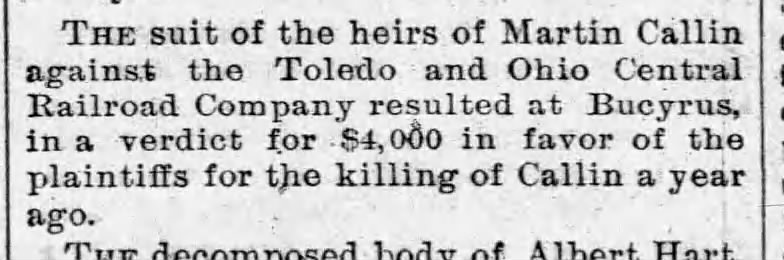
    A year later, the family won the resulting lawsuit:

    Newspapers.com, Fulton County Expositor, Wauseon, OH, 22 May 1890, Page 1.

    A Taste For the Good Life

    This lawsuit judgment was no small thing for a grieving family. $4,000 in 1890 is equivalent in purchasing power to about $138,753.41 in 2024.2 Compared to his working-class brothers, Martin was already doing very well for himself at the time of his death, and while it is good that his widow and small children were not left destitute, that kind of wealth comes with its negative effects.

    The two older children turned out alright. Pearl Blanche Callin (1877 – 1951) was 12 when her father was killed, and she married ten years later, probably after completing her education. Her husband was Robert Lester Todd (1873-1956), a school teacher who moved up to become a superintendent of schools. They retired to Lakeside, Ottawa County, Ohio, about 1940, and lived out their lives there in relative comfort.

    Benjamin Franklin Callin (1878 – 1953) served in the Ohio National Guard in 1899 and soon established himself as a traveling salesman. In 1905, he married Virginia Daisy White (1878 – 1966), and they raised their daughter, Virginia Lee (Callin) Knepper (1911-1999), in Toledo.

    However, William Jefferson Callin (1885-1949) and Gaston N. Callin (1888-1925) had different experiences shaped by lawsuits, fights over money, and a difficult relationship with their mother.3

    A Picture of Privilege

    The widowed Mary Elizabeth Callin did remarry at some point – her husband’s name was William Harrison Carlisle, but we don’t know much else about him. Judging from the evidence we have, she resided with her sons and depended on them for her care.

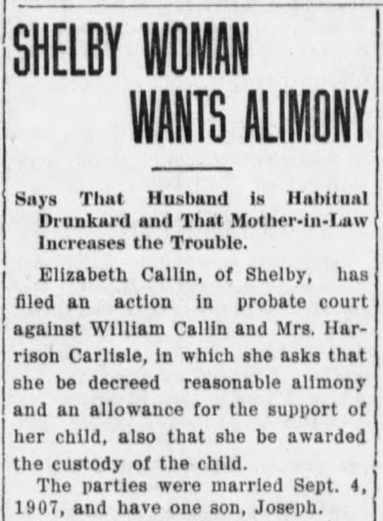
    William married in 1907 at age 22. His wife’s name, like his mother’s, was “Mary Elizabeth” – Mary Elizabeth Zeiters (1890 – 1970). It’s hard not to read into that coincidence when the news of their acrimonious divorce was reported in 1910:

    Newspapers.com, “Shelby Woman Wants Alimony”, News Journal, Mansfield, OH, Wed. 13 July 1910, page 7.

    The article recounts Elizabeth’s accusations: “…that her husband has been guilty of habitual drunkenness covering substantially the whole period of their married life; that during the times he was drinking he was neglectful of his duties toward her in that he remained out late at night and repeatedly ordered her to leave their home. She says that for some time he has caused her to live in the same house with his mother, Mrs. Harrison Carlisle, who has urged and increased the trouble between them.” She also stated that “by reason of her present physical condition is unable to maintain herself and child” – suggesting she was already pregnant with their second child, a daughter whom she named “Virigia Alice”.

    In 1916, Elizabeth remarried, and her second husband, Carl Don Lindsey, adopted Joseph and Virginia. They were raised with the surname Lindsey, and may not have known their biological father.

    William married a second time in 1915; this wife’s name was Pleassia Wallet, and they seem to have divorced sometime between 1920 and 1930 – though without any apparent headlines. William moved to Toledo, living with his brother Ben for a time, and he died in 1949.

    Gaston married Evelyn Jessie Purvis (1894–1976) about 1912, and it seems that it fell to them to care for his mother. Gaston was a traveling salesman, like his older brother, and his work seems to have kept him away from Ohio for extensive periods.

    In 1914, Jessie and Gaston sued his stepfather’s estate after his mother’s death, claiming $378 (worth about $11,500 today) for her board, washing, and a trained nurse. Whatever the outcome of that lawsuit, it does not appear to have improved Jessie and Gaston’s marriage, and five years later, she sued for divorce. At the time, Gaston’s last known address was in Holyoke, Massachusetts, so the notice for the divorce was published in the newspaper, giving him until March 1919 to respond.4

    Jessie remarried the following July to Raymond L. Williams, and they went on to raise two daughters of their own. Gaston died in Plattsburgh, New York, in 1925, and was brought back to be buried in the Shelby-Oakland Cemetery in Richland County, Ohio.

    The End of a Line

    If we consider the order of events, it appears that Martin’s traumatic death sparked a chain of events that resulted in the decline of his family. Of course, had he not been killed by a train, things might have played out in roughly the same way.

    If you take a patriarchal view, this Callin line ended with his three sons. Between them, they only gave Martin three grandchildren, two girls and a boy who did not carry on the Callin name. But if, like me, you take a broader view, it is good news that there are an unknown number of cousins out there who might like to know where they came from.

    Even if the story is a sad one.

    1

    Newspapers.com, “An Awful Fate,” Telegraph-Forum, Bucyrus, Ohio, Friday, 15 Feb 1889, page 3.

    2

    “$4,000 in 1890 → 2024 | Inflation Calculator.” Official Inflation Data, Alioth Finance, 19 Nov. 2024, https://www.officialdata.org/us/inflation/1890?amount=4000.

    3

    William Jefferson Callin’s Find-A-Grave update was the subject of the post, “Using Find-A-Grave” and prompted me to tell you his story.

    4

    Newspapers.com, “NOTICE. In the court of Common Pleas, Crawford County, Ohio.”, The Bucyrus Evening Telegraph, Bucyrus, Ohio, Sat, Feb 15, 1919, Page 4

  • Not everyone will make you proud

    My maternal grandfather, Russ Clark, did not like to talk about his family history. He loved to tell tales of growing up in Depression-era Arkansas and Kentucky, but he rarely said anything specific about his family. He had one brother, Jerry, who he seemed to like, but all he would say about the others was that they were drinkers and smokers, and lived “rough lives.”

    When I set out to research my ancestors, I fully expected to find that somebody would prove to have been involved in the “peculiar institution” that has poisoned America’s history since its earliest days – and I suspected that since my other three grandparents were descended from Northern families with prominent Union ties, I would find those slaveholders in the ancestry of Russell Clark.

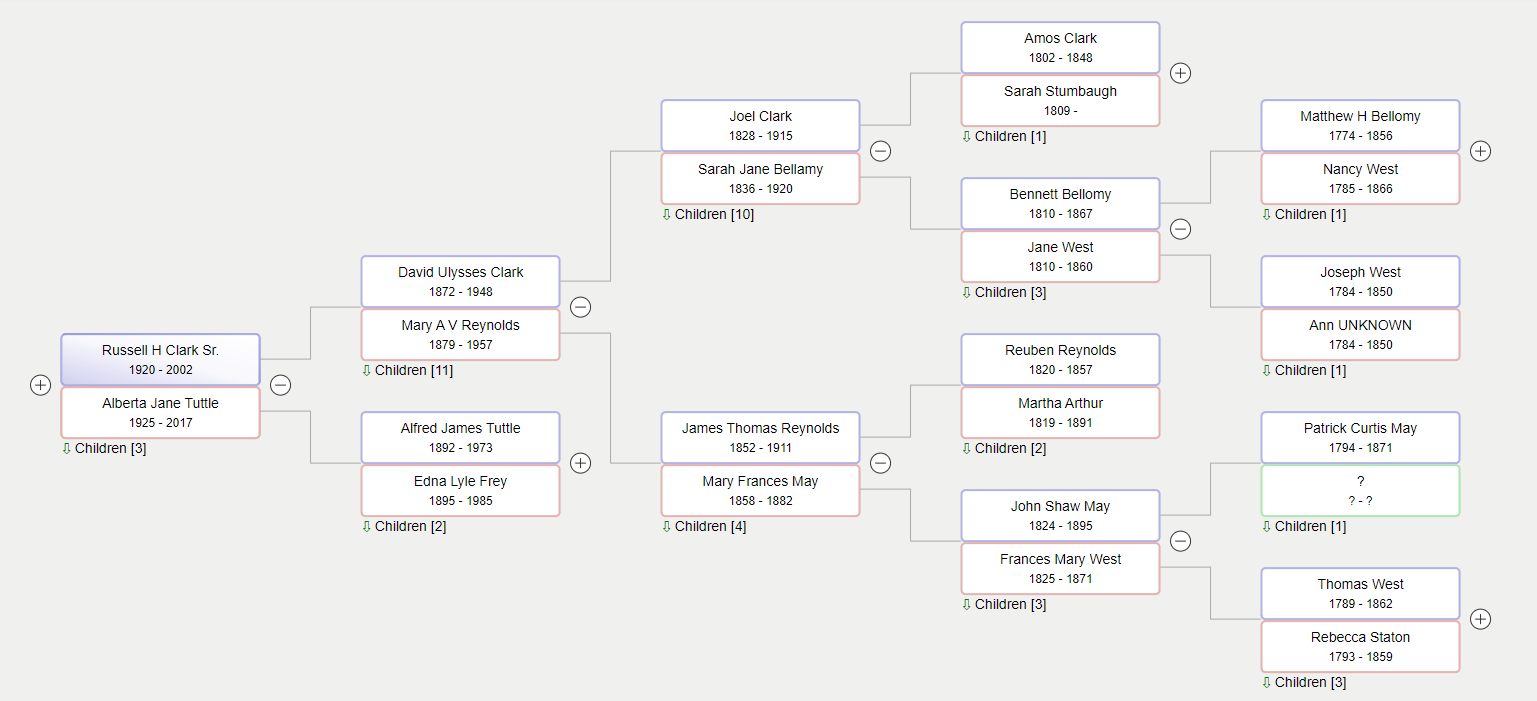
    Ancestry of Russell Clark

    Indeed, we have talked before about how John Shaw May (who went on to be a Confederate soldier) was named as a suspect in the murder of his father-in-law, Thomas West, an ardent Union supporter:

    Dangerous Times in Kentucky
    Our guest writer Tad Callin of Mightier Acornsjoins us as part of our first cohort in the Projectkin Members’ Corner. Monthly posts from members celebrate their contributions to family history storytelling — in all its forms. Posts may be written or recorded (audio or video) will be shared for free each month. Explore the entire…
    Read more

    On Russ’s paternal side, we find his grandmother’s family, the Bellamy family of Virginia.

    Matthew H Bellamy was born in 1774 in Albemarle, Virginia, and by 1810, he and his wife, Nancy West1, were raising their three sons in Lynchburg, in Campbell County. At some point before 1830, several Bellamy families moved west to Cabell County, which would eventually be one of the counties that would break off from Virginia to form the state of West Virginia in 1863.

    Finding Enslaved People

    The issue of whether to secede or support the Union was hotly debated, and the separate issue of whether to abolish slavery was only a part of that debate. Without writing to tell us how individuals felt about the relevant political issues of their day, we rely much on what official records can tell us about their actions. The U.S. Census records list the following enslaved people in the Matthew Bellamy household in Cabell County:2

    1830 – 2 male slaves under 10 (born after 1820)

    1840 – 7 slaves listed:

    • 2 females ages 24 thru 35 (1805-1816)

    • 1 male under 10 (after 1830)

    • 4 females under 10 (after 1830)

    In 1850, slaves were counted separately, in the Slave Schedules; they appear under the name of the slaveholder by age, sex, and “color”. Matthew H. Bellamy’s Wayne County, Virginia, household included:

    • Female, Black, age 44 (b. 1806)

    • Female, Black, age 49 (b. 1801)

    • Female, Black, age 13 (b. 1837)

    • Male, Mulatto, age 13 (b. 1837)

    • Female, Black, age 12 (b. 1838)

    • Male, Mulatto, age 9 (b. 1841)

    Matthew Sr. died in 1856, possibly in Greenup County, Kentucky. In 1860, his two surviving sons, Bennett and Matthew Jr., were listed in Boyd County, Kentucky, near Catlettsburg. There are no records that show Bennett held slaves, but Matthew Jr. might be the “M Bellamy” listed in Boyd County in 1860 with 5 enslaved people. This record gives names of the enslaved people in his household, in addition to their age/sex/color:

    • Judy, 32 (b. 1828), female, Mullatto

    • Clarry, 18 (b. 1842), female, Black

    • Edward, 11 (b. 1849), male, Mullatto

    • John, 4 (b. 1856), male, Mullatto

    • Andrew, 4 (b. 1856), male, Mullatto

    There are no obvious connections between the enslaved people listed in these records; nobody seems to have remained in the same place from decade to decade. I have also found no wills for any of the Bellamys that could tell me what happened to the slaves after Matthew Sr.’s death.

    Drawing Conclusions

    I don’t know what conclusions about my ancestors’ feelings about slavery I can draw from the evidence or lack of evidence. At least two of them (Matthew Sr. and Matthew Jr.) are on record as slaveholders. The fact that Bennett (my third-great grandfather) does not may indicate that he favored abolition—or it may simply indicate that he was too poor.

    America is still trying to come to terms with that history, so I don’t expect any tidy answers. It is worth considering events like the 1831 Insurrection led by enslaved preacher Nat Turner and how these events might have affected the way the Bellamy family, who lived 400 miles away at the time, might have reacted.

    There are a lot of unanswered questions about these families; I don’t have any records outside of The Bellamys of Early Virginia3 to support some of the basic facts. I may need to return to the Ashland area to look for death records and wills for these folks.

    When I do, I need to make sure I document as much information about the people they owned, so that if their descendants are looking for them, I can help them find closure. If you are looking for enslaved ancestors, and you think they might have lived in this part of the country at that time, please let me know how I can help. (“mightieracorns” is my Gmail address, or you can leave a comment.)

    Finding out that my ancestors were directly involved in the more shameful parts of our national history isn’t something I’m proud of, but it is an unavoidable part of our shared history. The least I can do as a researcher is document what I can and take some responsibility to acknowledge what my ancestors did.

    Mightier Acorns takes the good and the bad – take them both, and there you have…something to subscribe to.

    1

    If you notice the several “West” surnames, you may be wondering about the family’s endogamy – so far, it remains unclear whether any of these Wests were related to each other.

    2

    Matthew H. Bellamy on WikiTree

    3

    Bellamy, Joe David, The Bellamys of Early Virginia, IUniverse, 2005.

  • The right tool for the right job

    When I was putting together the Callin Family History, I spent about seven years doing research to augment the work I had inherited from George W. Callin, my 2nd-great uncle. Along the way, I submitted dozens of photo requests to Find-a-Grave.

    By the time the CFH was ready to publish, volunteers had supplied many headstone photos in response to my requests – but many of my requests came back without a response. Either there was no marker, or that person turned out not to be buried in the cemetery in question. And some requests have simply lingered, waiting for a volunteer to notice them.

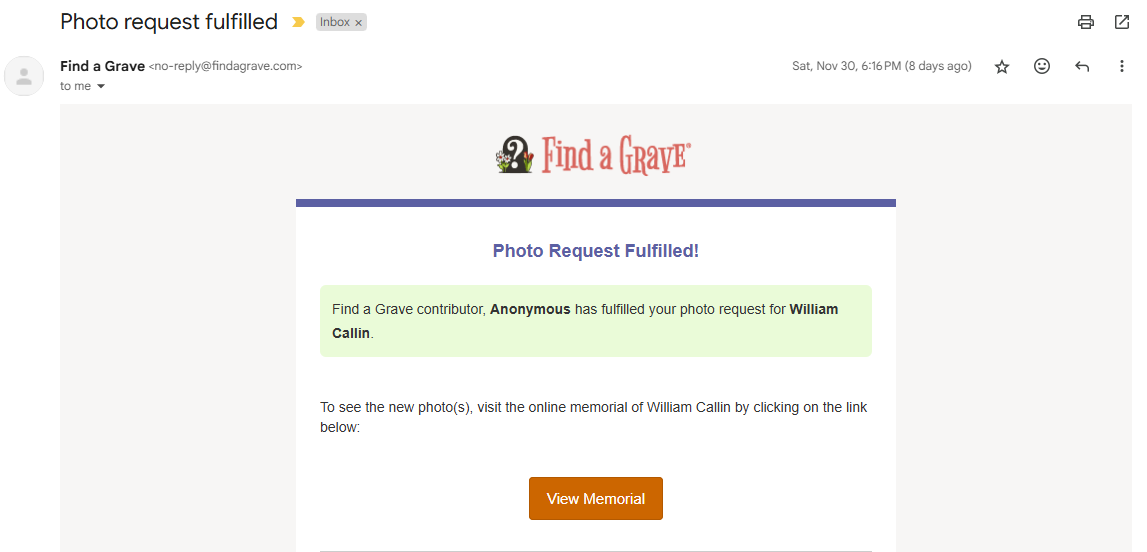
    I haven’t submitted many new requests since finishing the CFH project, so I was surprised to see this in my inbox last month:

    example of a Photo Request Fulfilled notification from Find a Grave
    Example notification from Findagrave.com

    There are many men named “William Callin” in my ancestry, but it turned out to be William Jefferson Callin (1885-1949), the third-great grandson of our Revolutionary War ancestor, James Callin.

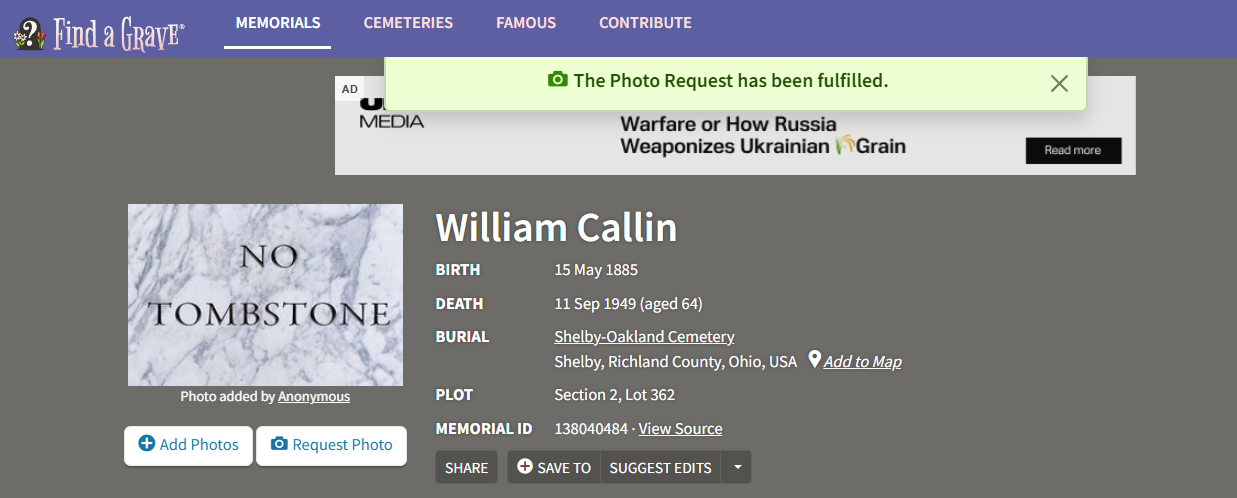
    Screenshot of my fulfilled request
    My fulfilled request – for William Callin

    At first, it was disappointing to see the “No Tombstone” photo. The one thing that Find A Grave is most useful for is providing some physical evidence to support what you know about your target family. But I quickly moved past that disappointment to realize that “Anonymous” had provided the plot – Section 2, Lot 362 – which does confirm that William was buried in that cemetery.

    What You Can Trust

    I have seen a lot of discussions over the years about which tool or platform is or is not reliable for family history research. Find A Grave usually comes under fire for a couple of reasons:

    • They do not require source citations for information submitted by users.

    • There is a sub-culture of Find A Grave users who comb through obituaries and create memorials without respect for the families of the recently deceased.

    • The site does not have a lot of resources for moderating disputes between a memorial’s manager(s) and other contributors.

    I’m not here to re-litigate any of those discussions – if you spend time on any Genealogy forum or #genealogy thread on social media, you will find people angry about a run-in they had with someone on Find A Grave.

    But I am here to point to the most useful aspect of this resource: you can (mostly) count on what is set in stone.

    Virtual Cemeteries

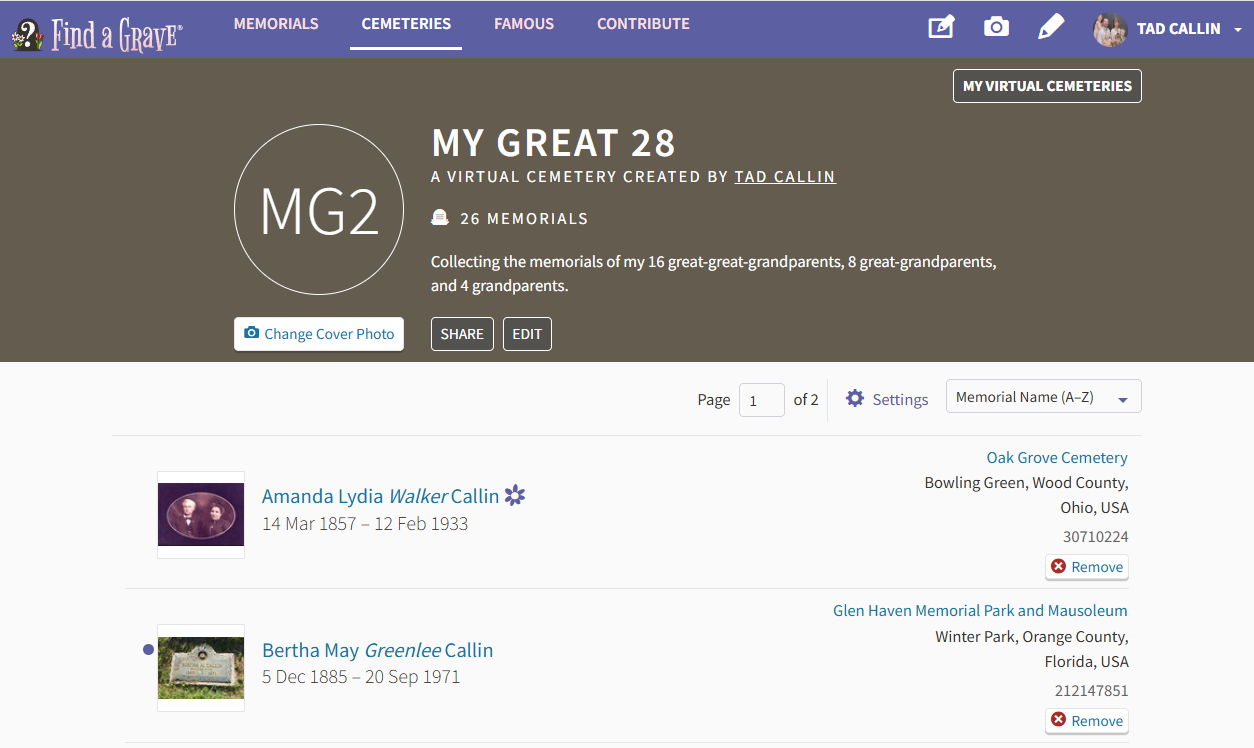
    One of the more useful features is the ability to create and curate “Virtual Cemeteries” – which is a collection of memorials that you can use to keep track of your ancestors. Here is my only Virtual Cemetery, for example:

    My Virtual Cemetery – collecting the memorials I have located.

    I used this to organize my search for the gravesites of all 28 of my grand/great-grand/and 2nd-great-grandparents. You may have noticed I only have 26 out of the 28 here – I am still missing Emil Frey and his wife Emily Amelia Opp.

    Collaboration that works

    For all of the frustrating stories about poorly sourced information or uncommunicative memorial managers, there are some examples of good collaboration on Find A Grave. For instance, the memorial for my great-grandfather, David Ulysses Clark.

    If you follow that link, you can see the photo of the headstone (Added by P. V. Hays), but also some respectful discussion of the discrepancies in David’s recorded birth date. There is also a portrait of David and his obituary (added by Eric) which may or may not be strictly permitted by the site’s Terms of Use.

    With the help of several unknown and unattributed cousins (a downside of the site – no one can tell who made which edits), we have a very thorough collection of memorials for David’s family. His parents (Joel and Sarah (Bellamy) Clark), his wife, Vicie, their 12 children (including my grandpa Russ Clark), and David’s 11 siblings are all in one place.

    If I Were the King of the Forest…

    I realize this isn’t going to happen at this point, but there are a couple of things I would change about Find A Grave.

    First: the branding. “Find A Grave” is easy to remember and does tell you instantly what the site is for… but the initials are problematic. I have seen a few discussions where the site was being referred to by its initial in all caps… and it just ends up looking like the participants are angrily shouting a slur at each other.

    I think I would call it “Grave Markers” or “The Virtual Cemetery” instead.

    Second: build in a mechanism for tracking edits.

    Even if you can’t do much to remove incorrect or poorly sourced information from a memorial once it’s there, at least an attribution system would give you an idea of where bad information is coming from.

    But even if they never fix any of my pet issues with the site, Find A Grave is an incredible resource. It is worth getting to know, especially if you plan on doing an extended project with a lot of potential rabbit holes and gaps that can only be filled in by getting voluntary help from strangers across the country.

  • A two-for-one development – and a lesson in Endogamy

    Harriet Jenevereth “Hattie” Shepard (1874–1923) was the paternal grandmother of Merilyn Martin, my wife’s maternal grandmother – and thus, one of “Her Sixteen.”

    Hattie was born on 18 Dec 1874, the youngest of three children of Sylvanus S Shepard (1850–1921) and Lucy Gertrude Rounds (1848–1920). Her family moved from Clay, Onondaga County, New York, to Council Bluffs, Pottawattamie County, Iowa, around 1880, when she was 6 years old.

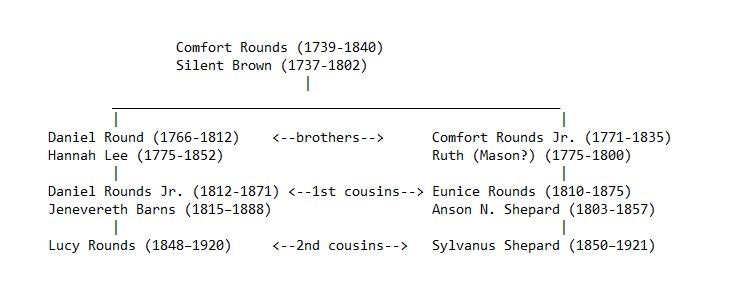
    The Rounds and Shepard families appear to have lived in the same communities for several generations, first in Bristol County, Rhode Island, then in Onondaga County, New York. As is common in small communities, some endogamy should be expected:

    en·dog·a·my /enˈdäɡəmē/ – noun Anthropology

    In this case, Sylvanus and Lucy were 2nd cousins through the Rounds side of the family.

    Rounds family endogamy
    Rounds family endogamy

    This information was found on FamilySearch and a lot of work needs to be done to verify it before I am comfortable putting profiles on WikiTree. But for now, it looks accurate.1

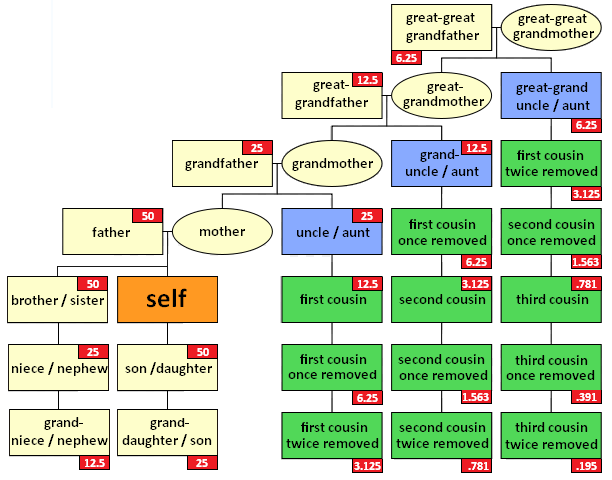
    A tiny bit of Googling tells me, “In the United States, second cousins are legally allowed to marry in every state. However, marriage between first cousins is legal in only about half of the American states.”2 And Wikipedia has a handy chart for looking at the DNA implications – note that 2nd cousins share only about 3% of their DNA:

    Dimario, Public domain, via Wikimedia Commons

    What I find more interesting than marriage between 2nd cousins is the persistence of names. Not only are there two Daniels and two Comforts, but notice that Lucy gave her mother’s unusual name, Jenevereth, to her daughter. And I won’t say more out of respect for the privacy of living people, but I do know that one of my wife’s 2nd cousins inherited the name, as well!

    One other thing I noticed in the FamilySearch tree was that they show the Rounds family extending back several more generations in Rhode Island and descending (in part) from the Bowen family that my William Bowen descended from. Again – I need to do a lot of work to confirm the links in between, but what they have there suggests that my wife and I are 10th cousins! (Please don’t tell her – she is revolted by the idea of cousin marriage.)

    But it just serves to reinforce my tagline: We’re all cousins if you go back far enough!

    1

    There is a lot of data to parse from the book, “The John Round family of Swansea and Rehoboth, Massachusetts : the first six/seven generations” on FamilySearch (Comfort Sr. is on page 147).

  • “The Oldest Living Confederate Widow Tells All” (1989), by Allan Gurganus

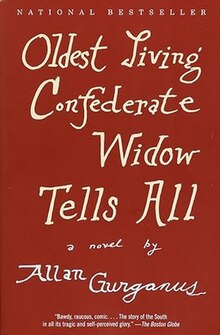
    “The Oldest Living Confederate Widow Tells All” was a 1989 novel by Allan Gurganus in which the titular widow, Lucy, tells the story of her 1900 marriage to “Captain” William Marsden when she was 15 and her husband was 50.

    The specific details of Lucy’s story are not unique to this fictional family, though I hope your real family history doesn’t combine as concentrated a dose of cringe and tragedy into a single lifetime as Lucy’s family history does. I find a lot of interesting and useful ideas about the nature of storytelling in this novel, but here are the highlights.

    cover of Allen Gurganus's 1989 novel
    By Allan Gurganus – https://www.amazon.com/Oldest-Living-Confederate-Widow-Tells/dp/0375726632, Fair use, https://en.wikipedia.org/w/index.php?curid=75619839

    My paperback copy of this book weighs in at a hefty 875 pages, but what I find striking about that is the way Gurganus uses that space to expand a relatively small handful of small tales into a sprawling historical story.

    The entire narration comes from Lucy, a resident of a nursing home tucked away in a corner of the fictional town of Falls, North Carolina, where she spent her 99 years. Lucy is the classic “unreliable narrator,” given to looping digressions and asides, and constantly breaking the fourth wall to explain to her unseen interviewer what the reader already knows: it’s hard to tell a story like this.

    Dwelling On the Details

    Lucy’s wandering narrative is designed to do two things at once:

    1. Worldbuild (setting the scenes and introducing a large cast of characters), and

    2. Stretch a few key points out to maximize their impact.

    There are only four central characters in this book whose stories are intertwined, but Lucy’s indirect and layered approach to delivering her narrative gives the reader a chance to absorb what she is telling you about their lives. It can be maddening to watch her lead up to a particular question or event only to swerve off into talking about her soap operas or her routine in the nursing home, but there is a purpose to this.

    In our own family histories, we rarely have much more to work with than Lucy gives us in the early chapters. You know facts from a handful of census and vital records: who married who and when; where they lived; major historical events that touched them.

    To tell compelling or interesting stories about our ancestors, we have to find ways to engage our audience of (often disinterested) relatives in a way that fills them in on the historical backdrop and leads them toward an understanding of who our ancestors were.

    Sometimes we have to weave what we know with what we imagine to be true – and if we aren’t careful, we can undercut our credibility by imagining too much.

    Flinching at the Painful Bits

    There is a lot of difficult historical material to confront in Gurganus’s novel.

    The age difference between Captain Marsden (50) and Lucy (15) is an uncomfortable fact; one that is only slightly more extreme than some relationships I’ve observed in my own research.

    The burning of Marsden’s plantation and manor house – and his mother – during Union Gen. Sherman’s “March to the Sea”.

    Willie Marsden’s experiences as a 13-year-old private in the Confederate Army.

    The grinding discomfort between freed slaves and former owners during Reconstruction.

    Many of Lucy’s digressions are a matter of walking up to an Uncomfortable Fact, and then turning away to delay the inevitable. The reader knows as well as Lucy what is bound to happen at the end of her tales, but her digressions allow her to prepare her audience – usually by adding context and layering on more detail – presumably to help you deal with it once the ugly truth is out.

    The key to telling your own family history is to identify where those truths are. You may have to make inferences about why people did what they did (why did they move?) or how they felt about events. What political party did they belong to? What influence would their church have on their choices? Can you weave those facts into what is known about their daily lives?

    Taking this narrative approach in your own writing will allow you to do more with your family’s story. Rather than bluntly stating a historical fact and moving on, you can create more context.

    Giving a Voice to the Invisible

    I have written before about the frustration of finding so little information about my grandmothers. Beyond a certain point, it is rare to find anything in the records beyond their names, and sometimes even those are erased.

    But occasionally an artifact gives us an unexpected insight into someone’s personality, as with the memories of my 3rd-great-grandmother, Elizabeth Berlin:

    If I were to try to tell Elizabeth’s story directly, as a historical document, it would be difficult to fill many pages with facts. But I know a thousand tiny, incidental things about her – most from Rosemary’s “Silk or Satin” account – that if I treated Elizabeth as the unreliable narrator, I could borrow her voice to tell a bigger, broader story about her and her family.

    In other words, if I made Elizabeth my “Lucy Marsden,” it would give the reader fair warning that the facts may be true, but the opinions and feelings about them belonged to the narrator.

    Ultimately, the voice is yours – but as long as you stay true to the facts and let your reader know when you are speculating, employing Lucy Marsden’s narrative techniques could be the key to bringing your family to life for modern readers.

    Thanks for reading Mightier Acorns! Subscribe for free to receive new posts and support my voice – and I’ll try to be a reliable narrator.

    Gurganus (through Lucy’s voice) tells us some important things to remember about history – something that we often forget when looking at official documents and big, famous events: the banal, daily humanity of our ancestors.

    A while back, when you first started coming and see me, you said I ought to spill my tidbits for ‘‘history’s sake.’’ Oh, I don’t need that big an excuse. I like talking. Only got one subject: what happened next. Besides, ‘‘History,’’ who’s she? I been breathing a while, never met her once. I just saw people waking up for work and hoping to doze those twenty minutes extra. Later, you traipse in by the back door—loaded with names and dates and reasons. Then all that’s up in front of you appears to be history.

    But at the time, child, history’s just keeping your rooms neat and hoping company’ll give you a little notice so you can tuck your extras under the bed. What you call history is really just that luxury of afterwards. History is how food the soldiers gobbled at 11 A.M. sets with them at two when the battle starts, how one snack’s heartburn chagnes everybody’s aim. Honey, history ain’t so historical. It’s just us breaking even, just us trying.

    Darling, you know what history is?

    History is lunch.

  • Or “Being dragged down the rabbit hole”

    Our story today begins with the Bowen family. You may recall my September post on William Bowen: Wavetops: William Bowen, Jr.

    The WikiTree pages for William’s siblings were not well-developed, and since researching William (Sr.) led to a very well-done NEGHR report on them at American Ancestors1, I decided to tidy up their pages by adding the information from the NEGHR report.

    When I improve a WikiTree profile, I never want to copy someone else’s work without verifying their sources. Fortunately for me, Cherry Bamberg did an outstanding job, and it was easy for me to find the sources she cited. For most of William’s children, I just needed to take what she found and build a quick biography with the source citations I found in Ancestry.

    I was working my way “up” from William’s youngest child (Lydia (Bowen) Brace) and fleshing out details along the way so they had as full a biography as possible with minimal effort on my part.

    Then I got to Mercy Bowen.

    Here’s her entry in Bamberg’s report (with bolding added by me):

    (pg. 59) – “iv. MERCY BOWEN, b. N.Y. ca. 1794; d. after 1870 when counted in the census; m. ENOS ROGERS, b. N.Y. ca. 1795, d. of dysentery in Ripley Township, Huron Co., Ohio, in Sept. 1849 age 55.

    “Enos Rogers and his large family lived in Ohio as early as about 1833 when a child was born there and in Ripley by the 1840 census. Enos left a will dated 6 April 1847, proved 1 Nov. 1849, mentioning one son, Leroy Rogers, and six daughters: Phidelia Graham, Laydean Wickam, Gennet Carl, and Girtrude, Celesta, and Lorada Rogers. One of the executors was Mercy Rogers, and the other was Merritt Ketchum, one of the witnessess. The 1850 census shows “Mersey” Rogers, 56, living in Ripley with Gertrude, 20, Selesta 18, and Lorada 17. In 1870 Mercy Rogers, 77, b. N.Y. was living in the house of John Davidson, 62, and Mary Davidson, 58, in Greenwich, Huron Co., Ohio.”

    Mercy (Bowen) Rogers disappeared after 1870, suggesting she died in the 1870s, probably in Huron County. I thought I could dig into her children to see if their records reveal any clues about Mercy. The NEGHR report was missing an 1860 Census record – maybe if I could find that, it would have some clues.

    We are already two steps further down the rabbit hole than I had intended to go – but as Sherlock said, “Needs must when the devil drives.”

    The Will of Enos Rogers

    A record from the New York, U.S., Marriage Notices, 1800-1855 database shows Enos Rogers and Mercy Bowen were married in Sempronius, Cayuga County, New York, on 8 Dec 1818. His will, dated 1849, was recorded in Huron County, Ohio. Here is the bit where his daughters are named:

    found on Ancestry: Ohio, U.S., Wills and Probate Records, 1786-1998

    Sometimes you can attribute inaccurate spelling to transcribers, but in this case, you can see what the county clerk wrote down. I sometimes wonder whether the individuals who gave the information to the clerk knew how to spell, or if they would have corrected the spelling, had they been allowed to see what the clerk wrote. Either way, here’s what I learned about their names and lives, with varying degrees of difficulty.

    Phidelia Rogers Graham

    This case is pretty straightforward. We see her named as “Phidelia Graham” in her father’s will, and there is an 1838 Huron County marriage record for “Fedelia Rogers” and Elmer Graham. (No screenshot because it was too blurry.) Regardless, Phidelia died in 1855, and there is no evidence her mother lived with her family after that.

    Laydean-Lydia Ann Wickham

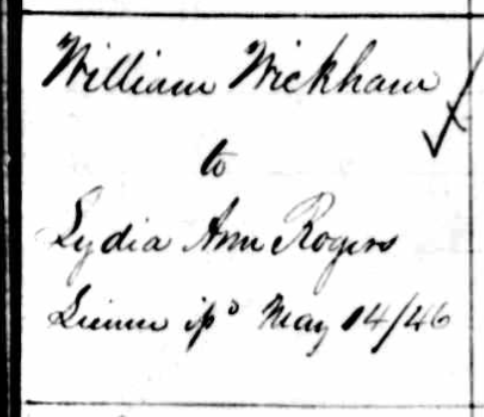
    The name “Laydean” seemed unusual, but I thought it would turn out to be something phonetically close to that – “Nadine,” perhaps. I struggled and ran several kinds of fuzzy searches before I came up with this record showing her real name: Lydia Ann:

    detail from marriage record of William Wickham and Lydia Ann Rogers
    Ohio, U.S., County Marriage Records, 1774-1993

    It took some sleuthing, but William Wickham was a prominent physician who took his young bride to Goshen, Indiana, soon after their marriage. They had two daughters before Lydia Ann died in 1853. Dr. Wickham has an extensive obituary that tells us her name, that she died, and came from Ripley Township, Huron County.

    There is no evidence that Mercy (Bowen) Rogers or Lydia Ann’s sisters lived in the Wickham household, in 1860 or at any time.

    Gennet-Jeanette Carl

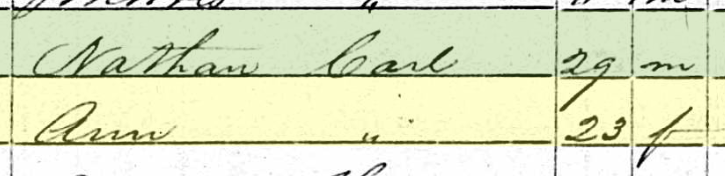
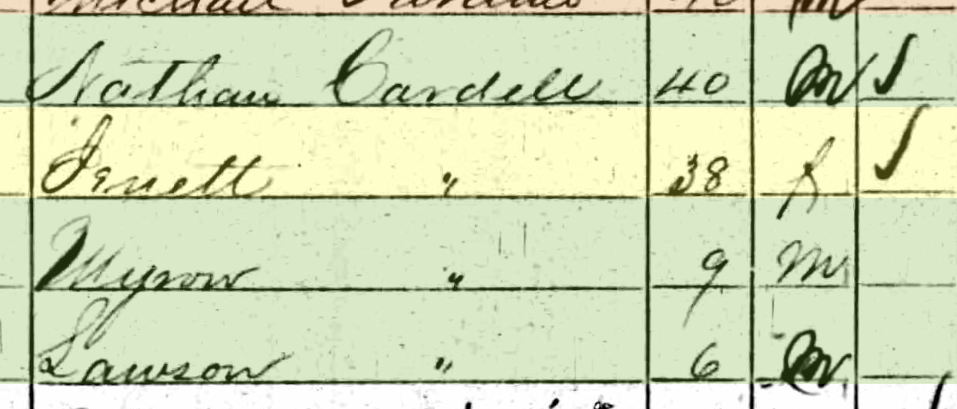
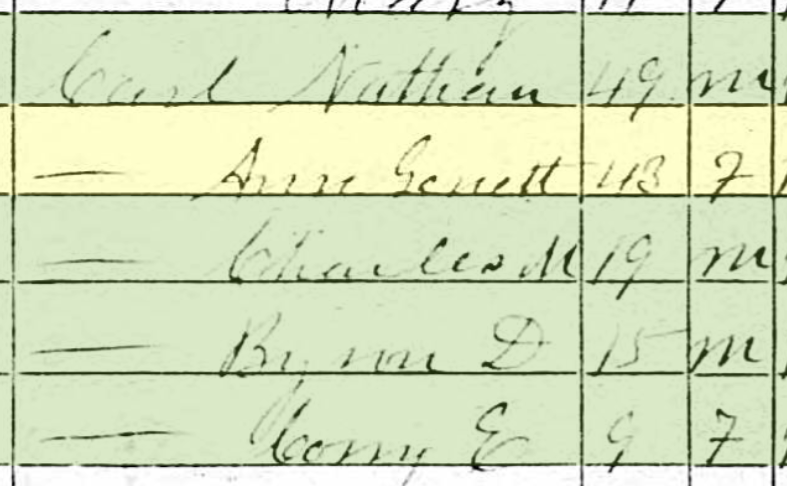
    With this daughter, I think her full name was “Ann Jeannette” but nobody knew how to spell “Jeannette” – so we have several examples of how different clerks rendered her name.

    In her marriage record, she is “Annette”:

    marriage record of Nathan Carl and Annette Rogers
    Ohio, U.S., County Marriage Records, 1774-1993

    In 1850, she is “Ann”:

    detail from 1850 U.S. Census
    1850 United States Federal Census

    By 1860, they managed “Jenett” (and they turned “Carl” into “Cardell”):

    detail from 1860 Census
    1860 United States Federal Census

    And in 1870, she became “Ann Genett”:

    detail from 1870 Census
    1870 United States Federal Census

    Ann Jenett/Genett/Jeannette died in 1874, and none of these records indicate that her mother or any siblings lived in her household.

    Lorada-Lauretta Butler

    detail from marriage record for Erastus Butler and Lauretta Rogers
    Ohio, U.S., County Marriage Records, 1774-1993

    While appearing as “Lorada” in both the will and the 1850 Census, I think this marriage record showing “Lauretta A Rogers” from 1852 is probably Mercy’s youngest daughter. She and Erastus were married in Huron County, where I would expect to see Mercy’s child married. That said, all of the records for Lauretta Butler give her birthdate as “abt. 1826 in Pennsylvania” – so this could be a different person.

    If Lauretta Butler is the daughter of Mercy (Bowen) Rogers, there is no evidence that Mercy or any siblings lived in the Butler household in 1860, 1870, or 1880.

    Selesta-Celestia Rogers

    A record in the Ohio, U.S., Wills and Probate Records, 1786-1998 dated 15 Dec 1853 tells us that Celestia died in Ripley Township, Huron County, Ohio, and left whatever she owned to her mother, Mercy Rogers.

    Of course, I only learned this after finding an 1868 Delaware County marriage record and spending time tracing the family of Celestia Rogers and Alonzo Van Tassel – unlike our Celestia, however, Celestia (Rogers) Van Tassel appeared in the 1860 Census with her parents, Elisha and Jane. Time lost chasing that rabbit: about ninety minutes.

    Girtrude-Gertrude Rogers…???

    We know that Mercy lived with Celestia, Lauretta, and Gertrude in 1850. Celestia died in 1853, and if we assume that we are correct about Lauretta getting married in 1852, then we should be looking for evidence of Gertrude’s wedding in the 1850s to see if Mercy shows up in the home of Gertrude and a yet-unknown son-in-law in 1860.

    We see Mercy Rogers (77) and Gertrude Rogers (41) listed in the Davidson household in Greenwich, Huron County, Ohio, in 1870. And if I zero in my search for either of those ladies in 1860 in Huron County, I find a Gertrude Rodgers (30) listed in Ripley Township, Huron County – right where I expect to see her. But this Gertrude is listed as a widow with two children: Alice (8) and Josephine (11). I would rule her out, except that this household is at the top of the page, and the household at the bottom of the previous page is that of Orel and Miranda Smith – and it includes a “Mercena Rodgers” (67).

    There is a marriage record for Gertrude Rogers and Milton Brown in Huron County on 25 Dec 1850. It is possible that they had two daughters, and that Milton died around 1853, and it is possible that the census taker got her name from “Mercena Rodgers” – if she told them, “That household is my daughter, Gertrude, and her two children” I could see them getting recorded as “Rodgers” instead of “Brown”…but none of these theories led to any documents.

    By 1880, Gertrude (with no attendant children) became the fourth wife of Robert Patterson Fauver (1826–1896) of Ridgeville Corners, Huron County. She died in 1910.

    Conclusion: Where is the Rabbit?

    For all of that effort, you might think I would be upset that I didn’t learn more about Mercy Rogers’s life. But I’m not.

    While I don’t plan to take the time to add profiles for all of Mercy’s children and -in-laws, I do have a list of their full names and birth/death dates to add to her profile. That’s not nothing.

    And perhaps all of this work will save another researcher some time down the road.

    1

    Bamberg, Cherry Fletcher, “Nathaniel and Esther (Carpenter) (Bardeen) Bowen and Their Family,” ”The New England Historical and Genealogical Register”, Boston, MA; <https://www.americanancestors.org/DB202/i/12636/53/24451527> Vol 165 (2011), pp. 53-61.