Tad Callin has been working on family history and genealogy since the late 1990s. He does most of his research on Ancestry and posts what he learns to WikiTree.
I don’t know how I did it, but at some point, I shifted from scheduling my Mightier Acorns posts on Wednesday and Friday mornings. My music newsletter was posting Tuesday and Thursday nights at midnight, and I think I mentally shifted both schedules back during a transition from one month to the next.
Before I “fix” the problem, I thought I would ask you all, do you have a schedule you like better?
I plan to continue writing two posts per week, and my goal is to have two or three weeks’ worth of posts in the queue at any time. I just don’t know if it matters to my audience when they hit your inboxes!
Don’t worry – I’m not counting this as one of your two posts this week. You have one more scheduled for Friday!
Identifying “political correctness” as a bias in our research
As I have conducted my family history research over the years, I have had to go back more than once and reconsider my biases.
Like anyone else, I tend to think of my point of view as “neutral”—but it rarely is. My point of view was shaped by the culture I grew up in and by the relationships I have with other people. As I learn more about American history, I must adapt my thinking and correct for the biases I was taught.
Sometimes, I have been guilty of over-correcting. While trying to avoid projecting one set of biases onto the data, I may project a different set of biases. Sometimes this over-correction is an important and intentional academic exercise. For example, when writing about the European settlement of the Eastern United States, it is easy to find resources that record the point of view of those settlers—but it is very difficult, if not impossible, to find any written records of the people they displaced.
To correct for that bias in the written records of history, one must challenge the assumptions and biases of those who wrote the records and sometimes speak on behalf of people who are no longer here to speak for themselves. That can be risky and can provoke people who are invested in maintaining the notion that their point of view is a true or neutral one.
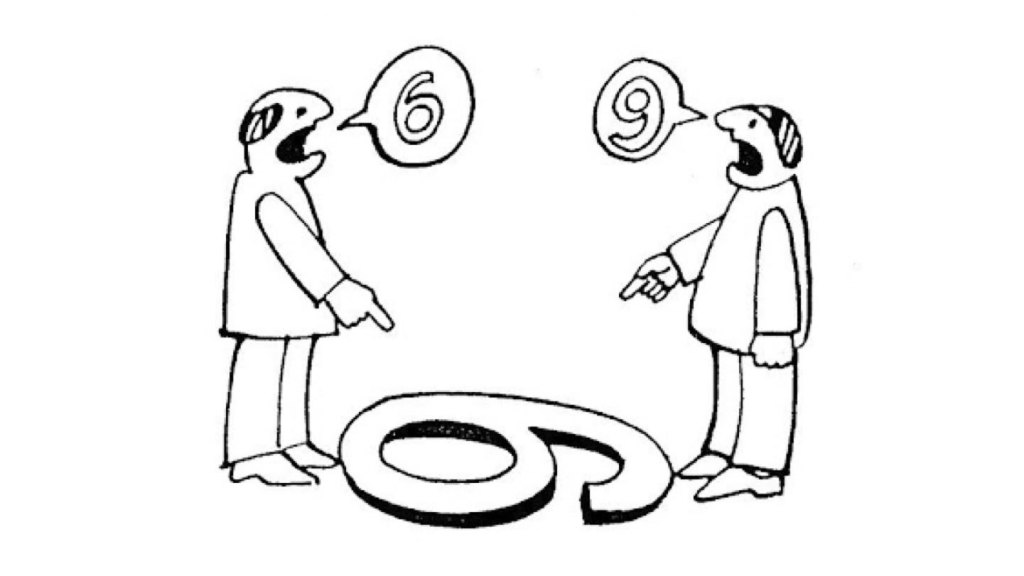
The famous “6 or 9” meme
The Reactionary Party Line
When provoked by a threat to their self-conceptions, people often argue out of ignorance of the available facts, and they may claim that attempts to understand and correct biases are, in fact, the real mistake. They will reach for a ready-made term for this—another explicit bias that has dogged scholars under many names for as long as scholarship has existed.
I was a cynical 20-something in the 1990s when a wave of backlash against what was called “political correctness” swept through pop culture. It was a loaded term then, and it has stayed a loaded term – along with ideas about “the PC police” and more recently “woke” culture.
None of this is new. Before the term even originated, Americans were practicing political correctness:
The original meaning of “politically correct” arose from post-revolutionary Russia, when adherence to the Communist party line often meant accepting things that were not true as facts. The idea was that saying that you accepted non-factual things as fact kept you from being shot or imprisoned. George Orwell’s book, 1984, captured the idea of “Doublespeak” and spurred countless middle schoolers in the late 1980s and early 1990s (hi! It’s me!) to start second-guessing things they were told by people in authority.
More modern understandings of the term look more like this:
political correctness (PC), [is a] term used to refer to language that seems intended to give the least amount of offense, especially when describing groups identified by external markers such as race, gender, culture, or sexual orientation.
The irony here is that this shift in meaning is, itself, a form of political correctness.
Trends in the U.S. towards greater individual freedom and equitable inclusion in society for women, people of color, and religious and ethnic minorities culminated in the Civil Rights legislation of the late 1960s. But that historical moment also fed into a backlash in which the majority of the population—usually white, usually men—cast themselves as victims being targeted by “the state” for expressing mere opinions.
Even though few, if any, laws exist to police or punish “offensive” speech, we are expected to accept the counterfactual argument that giving offense is a crime. And even though America has a well-documented history of terrorism against those pushing for equal rights between the end of the U.S. Civil War (1865) and the signing of the Civil Rights Act of 1965, many specific events—like the 1921 Tulsa Massacre, Wounded Knee—are treated as if they don’t exist for the sake of “not offending” people who might be uncomfortable discussing them.
Unfortunately, much about our shared history is uncomfortable.
Why We Are Talking About This
Discussing the violence that accompanied the rise of labor unions, the removal of Native Americans from their land, and the struggle to correct the fundamental moral error of allowing slavery is—and should be—central to any historical research. The fact that violent events occurred is undeniable. Sometimes our ancestors were involved, and the role they played may or may not sit well with you now.
However, discussing violence of any kind is always disturbing, and many people cope with it by disassociating it from themselves or their ancestors. This is a bias that is baked into the stories Americans have told themselves about their origins and their heritage. Confronting that bias is rarely something that people are willing to do.
I am in the process of learning everything I can about my ancestors. My 5th-great grandfather, James Callin, is a major focus of my research. Most recently, I wrote about his possible association with military units that fought to drive the original Native American inhabitants from what is now Ohio:
When researching the battles he might have been present for, I ran across material like this:
The Battle of Fallen Timbers was the culminating event that demonstrated the tenacity of the American people in their quest for western expansion and the struggle for dominance in the Old Northwest Territory. The events resulted in the dispossession of American Indian tribes and a loss of colonial territory for the British military and settlers.
As a human being, I know I have a baked-in bias toward viewing events like this through a binary lens—two sides, with one victor and one loser—but the reality of that moment in history is that there were multiple “sides” and motivations were as numerous as the participants. In 1794, the British were still trying to destabilize the new American government and were using allies among the First Nations to do it. Tecumseh (Shawnee) and Chickasaw leaders were recognized for helping the U.S. forces and protecting them from the British side.1
Framing the Battle as “the culminating event that demonstrated the tenacity of the American people” is not a neutral statement. Tenacity is usually seen as a positive characteristic. That framing casts the “American people” as the “good guys” while acknowledging that their tenacity was in service of expansion and dominance. But dominance is the thing that our foundational myths tell us we were fighting against—and acknowledging that our quest was for dominance undercuts our self-image as the righteous underdogs.
For many people, that is an uncomfortable thing to live with.
Sticking to Facts
The pursuit of any kind of “neutral” point of view is impossible, but we still try to understand the facts. Understanding the violent events that accompanied the building of the railroads and the establishment of America as a global power in the late 19th century is a necessary part of understanding my family history. So is the relationship between abolitionist sentiments and segregationists; or the slower push for suffrage and gender equality. But I don’t always have direct evidence of the part individual ancestors played in the larger history – and that means challenging family lore and treasured stories and rethinking the way we cast our ancestors as “heroes” or “villains.”
There is a good-faith debate to be had about what political correctness is, and when it is appropriate for one group of people to insist that another group of people change the way they speak or act. But I find that people often use that newer definition of “political correctness” I listed above to derail discussions that make them uncomfortable. Challenging a person’s sense of who their ancestors were is one of those discussions.
Objecting to “political correctness” also implies that the idea you are being forced to accept is not a fact.
I tell my fellow researchers that I use this Substack newsletter as a family history tool, but what does that mean?
Spotting the Gaps
The main function of the newsletter is to share stories about my research. I don’t use Substack to search records or manage the tree, but crafting the stories is part of my process. Doing that makes up for some other things I should be doing— like maintaining a research log—that I don’t do.
The stories can be roughly categorized as “what I found” and “how I found it.” The “how I found it” stories tend to be about processes, record analysis, tips, etc. The “what I found” stories sometimes exist as fleshed-out stories with characters, a beginning-middle-end structure, and a thematic idea. Sometimes they give a few facts and pose questions about the gaps.
Those gaps are crucial.
When I look at the pattern of previous posts here, I pay attention to what is missing. Which branches of which families have I been ignoring? What obstacles have I been avoiding? Where am I weak?
Answering these questions helps me break down the larger problems that confront anyone attempting to document their family history. Problems of scope and scale, and questions like, “Where do I draw the line?” We’ve established the importance of following up on “shirttails” – but that fuzzy, porous border between “relative” and “not really relative” is going to be different for everyone.
Diving Down Deep
When you start out in genealogy, there are lots of neat, tidy charts to help you visualize what your ancestry “looks” like.
But most of the tidy charts force us to ignore siblings and cousins, adoptions, childless marriages, unmarried relatives, etc. because if we don’t ignore them, our “tree” might start to look more like this:
That is a visualization of the Mandelbrot set, which is a mathematical concept defining the perimeter of an object in a way that becomes infinite as you look more closely at the edge. I’m oversimplifying, but the point should be clear: we can’t deal with the infinite, so we make choices.
I spent a lot of time (about 7 years) running down as many of the descendants of my most distant Callin ancestor as I could. When I began, I was working with a 1911 family tree that included about 100 people; by the time I was done, my estimated count of direct descendants from James Callin topped the 2,500 mark. With spouses and their parents’ names, my index ballooned to the point where it didn’t fit into the final publication.
We’ve established that we all have Sixteen great-great grandparents and that the number of greats doubles with each generation. James Callin, my 5th-great grandfather, is one of 128 5th-greats. If running down his descendants over 8 generations clocked in at 2,500 people, and there is no sign of pedigree collapse between them, I have to assume that collecting just the direct descendants of my 128 5th-greats would run to 320,000 individuals.
And then there are siblings….
On the Bright Side…
With numbers like those, it’s unlikely a newsletter like mine will ever run out of content.
The real challenge lies in finding the time to thoroughly document everyone and put their profiles into WikiTree. I’ve done alright, according to the “Ancestor Lines Explorer” app on the site:
“Out of 62 possible direct ancestors in 6 generations, 62 (100.00%) have WikiTree profiles and out of them, 0 (0.00%) occur more than once due to pedigree collapse.”
“Out of 126 possible direct ancestors in 7 generations, 104 (82.54%) have WikiTree profiles.”
If I plug in one of my kids as the base person, instead of me:
“Out of 254 possible direct ancestors in 8 generations, 160 (62.99%) have WikiTree profiles.”
What is less easy to capture is the amount of work I’ve done beyond the simple direct ancestors. For each generation, I’ve determined to add profiles for all of the siblings of each ancestor – a number that can vary wildly, of course. For my grandma Alberta, that means one additional profile for her sister, Lyle (Tuttle) Kuebler. But my grandpa Russ, Alberta’s first husband, was one of 12 children… and his father, David Ulysses Clark, was one of 10.
Depending on the availability of records, I spend between 2 and 8 hours on each WikiTree profile, so even if we assume a low average of 3 hours per profile, Grandpas Russ and David Clark cost me 66 hours of work, give or take.
And if that feels overwhelming, just remember: this is what I do to relax.
Thanks for reading Mightier Acorns! Now I’m going to go stare at that Mandelbrot set for a while.
So What?
So, we’re back to looking at the balance and mix of Mightier Acorns posts. I do my best to spend equal amounts of time on the various branches of the family, but the stories are going to favor the branches I’ve worked on most recently—like Valentine Shuffler’s group—or who have more identifiable people with stories I can tease out of the records.
And at this rate, if I ever run out of “gaps” I will be very, very surprised.
Then, as now, the media told the story they wanted to sell
“If it bleeds, it leads.”
Newspapers are a valuable resource for family history research. I frequently incorporate newspaper articles (often obituaries) into my WikiTree profiles. Newspapers helped me tell the story of when Martin Callin was killed in 1889:
However, newspapers were never meant to be a permanent record, and while we love to romanticize the importance of a free press to a democratic society, we must never lose sight of the primary reason newspapers exist: to make money.
That means that the truth of a story is less important than the sales it might generate; and if the audience has a strong bias toward one narrative, the reports that make print are likely to be shaped by that bias. Then, as now, the more outrage a story can generate, the better.
Martin Callin’s uncle Marquis
Marquis Callin was the son of Thomas Callin and Nancy Burgett, born about 1833 in Ohio. After his father’s death, he may have been apprenticed outside his mother’s home in 1850. He was in Olivesburg, Richland County, Ohio in 1860, a 27-year-old shopkeeper listed as “Munfer Callan” living in the household of his brother, a shoemaker named Thomas Jefferson “Jeff” Callin. Jeff Callin was the father of Martin Callin from “A Tragic Wealth.”
Marquis was named in the 1911 Callin Family History, but it was only in 2020, after years of looking, I found evidence that told me where he went after 1860. (If you enjoy details, see the old Mightier Acorns blog essay, “The Price of Progress: An Update”.)
The 1870 Census record for Wauseon, Fulton County, Ohio, listed Marquis under the name “Martin”—fortunately, the 1880 Census listed Marquis in Wauseon by the correct name. With wife, Caroline, and elder son Fred in the household on both records, I am comfortable asserting that the “Martin” in 1870 was a clerical error.
But because his nephew Martin was a well-known businessman before his 1889 death, I have to carefully judge records attributed to “M. Callin”—especially in newspapers—because they could refer to either Martin or his uncle Marquis. I’m pretty sure this one refers to Marquis, because Martin would have only been 17 at the time, and unlikely to own a building:
The Republican – Wauseon, Ohio · Thursday, June 02, 1870, page 3
After the loss of his building, Marquis did not make the newspapers again. The entirety of his Callin Family History biography is: “Born 1840, died in Chicago, date not known.” The most recent evidence we have of his life is the 1880 Census placing him in Wauseon. If he did die in Chicago, I have found no other evidence of it.
The Factual Records
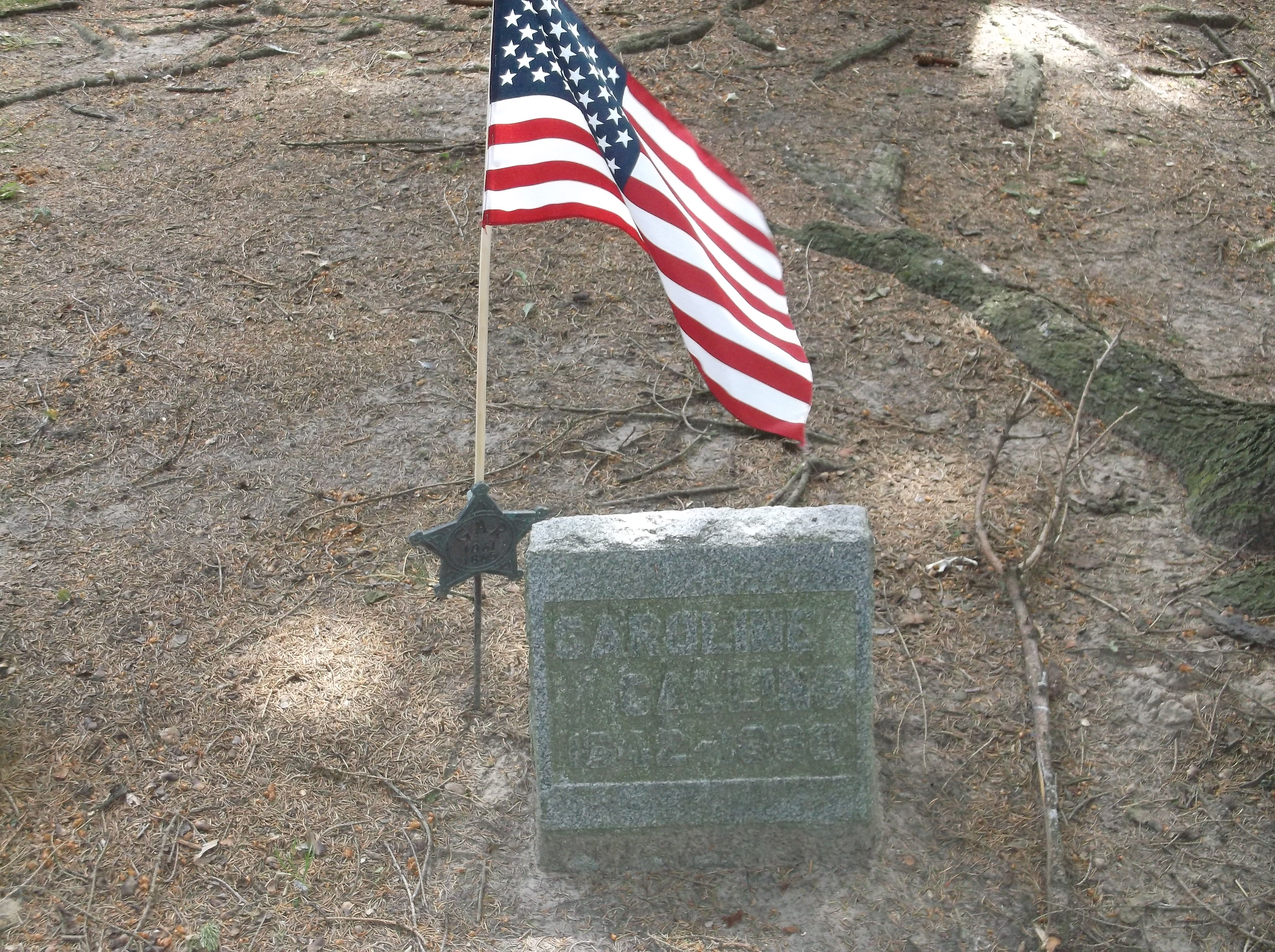
We know that Marquis and Caroline were married about 1865, and we know from his father-in-law’s will that he and Caroline (née) Snyder, had two sons: Fred and John. We see their family in Wauseon in 1870 and 1880 when Caroline is noted as suffering from an unspecified lung disease. She died in 1880, probably after the 8th of June when the census was enumerated, and she is buried in Wauseon Union Cemetery.
FindAGrave memorial for Caroline (Snyder) Callins
As far as the solid evidence of census and vital records goes, that’s all I have to connect Marquis to his sons, but thanks to the flawed and sensational reporting of the 1890s, I have enough clues to find at least one of his sons in later records.
Two Callin Boys Go to Court
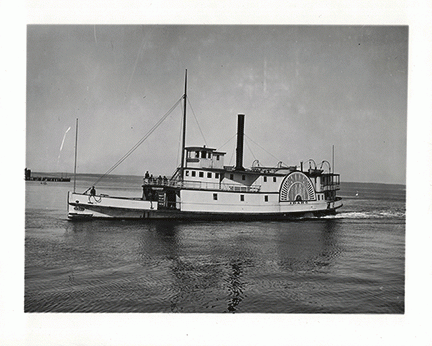
On August 30, 1890, Fred S. Callin was arrested in Seattle, Washington, for stealing $1,000 in gold coins from a canvas sack containing $5,000 belonging to the Western Express Company. The thief had cut a hole in the seam of the sack, taken the money out, and sewn the hole back up, and the theft had gone undetected for a week. Fred was a freight clerk working aboard the S.S. Idaho, a sidewheel steamboat that ran on the Columbia River and Puget Sound from 1860 to 1898.
Photo from Puget Sound Maritime Historical Society; provided by PSMHS – S.S. Idaho (neg. no. 1192-8)
The arrest was reported by the Associated Press and printed in The Los Angeles Times on 31 August. The AP account described Fred as “a young man scarcely 21 years of age” and refrained from making any assertions about Fred’s guilt or innocence. But The Post-Intelligencer in Seattle showed less restraint in their 31 August report. After saying that the “dapper young freight clerk” was arrested, they state “The evidence against the prisoner, who is scarcely 21 years of age, is very clear and his guilt is almost proven.”
The Post-Intelligencer goes on to describe the theft and the investigation in detail, and ends their piece with this prejudicial paragraph:
This is not the first time the young suspect has been summoned involuntarily to answer to charges in the couris. A short time ago he was arrested with two girls in the Occidental hotel on Pike street, the tenor of the main complaint having been kept quiet. It was known, however, that the trio were in a beastly state of intoxication, and were beld to answer on a serious charge of vandalism.
On Monday, 1 September 1890, the Spokane Chronicle weighed in under the headline “A Smooth Freight Clerk.” Once again, “a dapper young man, scarcely 21 years of age” was arrested, and after describing the crime, the paper asserts:
When the robbery was discovered the young clerk’s movements were shadowed, and the authorities claim that there is not the slightest doubt as to Callin’s guilt.
The Post-Intelligencer reiterated the strength of the case against Fred on 3 September, quoting Deputy Sheriff Woolery:
Captain Woolery said: “No, we don’t want any more evidence; we couldn’t have any more; it’s conclusive.”
The crime was also reported on 3 September in The Anaconda Standard in Anaconda, Montana. Their objective reporter repeated the claim that “The evidence against the prisoner, who is scarcely 21 years of age, is very clear and his guilt is almost proven.” They added this opinion: “The circumstances under which the money was lost are peculiar and shows [sic] the job to have been done by a nervous and bungling hand.” Obviously, they did not agree that Fred was a “smooth freight clerk.”
On Saturday, 6 September 1890, The Post-Intelligencer reported on the opening of the trial:
Callin came into court, occupied a chair near his attorneys, Wiley and Scott, and during the hearing stroked his light moustache and appeared perfectly cool and unconcerned.
Taking up several column inches of Page 5, the report quotes several witnesses giving testimony, and describes them as “reticent” or otherwise unwilling to “divulge anything” – but reading the statements, it becomes clear that the case was built on the idea that Fred was seen spending a lot of extra cash after the robbery occurred, and that nobody actually saw him with more than three or four $20 coins in his possession.
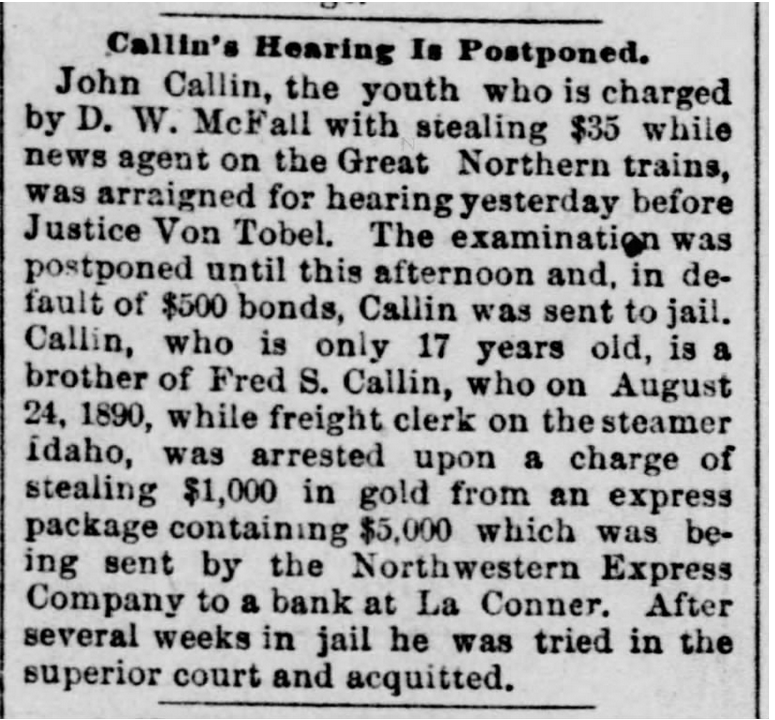
For all of the buildup and coverage, I was unable to find any reports of the verdict—at least not in 1890. But we finally get to see what happened in Fred’s story when John gets arrested in 1892:
The Post-Intelligencer; Seattle, Washington • Sat, Jul 23, 1892, Page 5
The day before, The Post-Intelligencer had reported that John Callin was charged in Tacoma with grand larceny for taking $35. Once again, they seem convinced of his guilt, stating, “He was locked up in the city jail. Callin is about 18 years old and seems to realize his position keenly.”
This time, though, we get to see the outcome, and The Post-Intelligencer’s editor is clearly miffed by it. Under the unbiased headline, “Newsboy Callin Goes Scot Free,” we learned that Justice Von Tobel dismissed the charges after the complaining witness, Daniel McFail admitted “that there was a partnership between himself and the boy,” leading the justice to declare that the defendant could not be prosecuted for grand larceny.
A Happier End for Jack Callin
Given the events that placed Fred and John Callin in Seattle, I looked there for evidence of their lives after the 1890s. Fred seems to disappear completely after his trial, but John shows up during the 1900s in both Seattle and Alaska, where he went into the restaurant business.
Eventually, Jack Callin, proprietor of the Arcade Cafe in Valdez, Alaska, married Nina Gifford of Seattle in 1913. He made the papers when he installed electric heaters in the cafe in February 1916, and again when the cafe burned down in January 1917. Jack moved into other business endeavors, establishing an automobile dealership in Anchorage by 1918, the Callin Motor Company, which he was still running in 1930.
Nina died in May 1938, and Jack appears to have left Alaska to live in the Seattle area after that. He married again on 9 December 1938, and he and the former Edith Ferris lived in Hillcrest, King County, Washington.
He died on 12 May 1940 and was buried with Nina in Lake View Cemetery in Seattle.
It’s impossible to tell from these sources whether he led a happy, crime-free life, but at least we get glimpses of his story. And those glimpses remind us to take every source with a grain of salt.
Last week, I left off after making a few basic assumptions:
Benjamin Franklin Shuffler’s father was Valentine Shuffler, who appeared in the 1840 Census for Marshall County, Indiana.
Sarah A. Bailey, who swore an affidavit stating Valentine’s widow was Margaret Shuffler, was Benjamin’s sister.
Based on the 1840 census, there were seven more children to look for.
But I still didn’t have any direct evidence that put Benjamin in Valentine’s household.
I kept digging, thinking this would all be easily resolved as soon as I found one key piece of evidence. I found record after record that suggested I was on the right track, but something was missing to tie it all together: the 1850 Census.
If His Daughter was Sarah…
Sarah Ann (Shuffler) Bailey’s biography began to come together, but she was married in 1841; so while I could assert that she was in the 1840 household, she wouldn’t be in Valentine’s household in 1850, anyway. I needed to find more siblings.
I did find a baptism record for “Sarah Anna Schaufler” in Trinity Tuplehocken Reformed Congregation Births, Lebanon County, Pennsylvania, 1800-56 on Ancestry. She was baptized in Lebanon County, Pennsylvania on 18 Feb 1821. Her birth date was recorded as 27 Jan 1821, father: Valentine Shaufler, mother: Maria Margaret Schaufler; sponsors: Benjamin and Anna Maria Schiffler. This is consistent with the birth information on her 1860 Census record – when she was listed as Sarah Shinabarger. (Several records confirm that after David Bailey’s death, John Shinabarger was Sarah’s second husband.)
This means that the Valentine Shuffler I’m looking for probably originated in Lebanon County, PA. More on that in a bit.
What About Other Children?
I kept coming up empty with Ancestry searches for the 1850 Census, so I went to FamilySearch.org and turned up marriage records for three other women who were married in Marshall County and were likely siblings of Sarah and Benjamin. With luck, I could identify candidates to search for in the Shuffler household in 1850:
As I did with Sarah Bailey, I was able to put together a fairly complete biography for Cecelia (Shuffler) Sealey Vancamp (1826-1906), despite the infinite number of ways the county clerks found to spell “Suscilia” or “Schaufler” – but because Cecilia was married in 1846, I knew she would not appear in the household I’m looking for in the 1850 census.
Mary (Shuffler) Carpenter seems to have died before 1860, and not long after her marriage to David. He appears in his parents’ 1860 household as “single” and has no apparent children, so I assume Mary died, probably in childbirth; but there are no records stating when her death was. Elizabeth (Shuffler) Craig was difficult to find because there were too many couples named “Henry and Elizabeth Craig” in 1860 for me to ascertain which one was our couple. This was disappointing, as I had hoped to find their birth info from later records. That information would be in the 1850 record – but I was skeptical that the “Mary” and “Elizabeth” would be unique enough names to find it if “Valentine” wasn’t doing the trick.
Too Many Valentines
I also tried approaching the problem from the other side, looking for more records of Valentine himself, but I kept coming up empty. By now, I knew I was looking for a Valentine (probably) from Pennsylvania, arriving in Indiana by 1836, so I spent a lot of time digging around for more records in Lebanon County, PA.
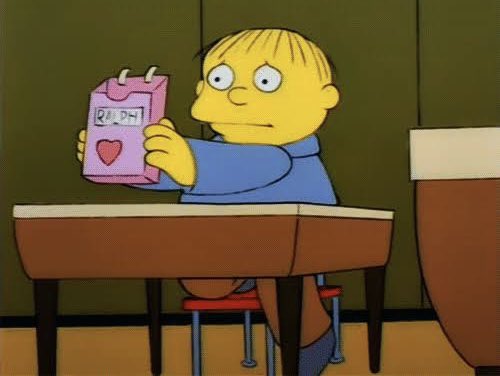
No Valentines for us, Ralph.
The problem here stemmed from the fact that there is a Revolutionary War soldier named Valentine Shuffler (spelling may vary) who lived in Lebanon County, Pennsylvania, and a lot of other researchers consider that veteran to be the same person as our Valentine or the father of our Valentine.
It is possible that my Valentine could have fought in the Revolution, depending on his age in 1855 – which we don’t know yet. Valetine’s age range on the 1840 census was “40-49” (pegging his DOB between 1791 and 1800), and in an 1832 affidavit of veteran Valentine’s testimony, he gave his age as 82 (DOB abt. 1750). Not a match.
Other details don’t quite line up between Veteran Valentine and Indiana Valentine. Benjamin’s obituary stated that he was born in Ohio in 1833, and there was a “Valentine Soufler” in Israel Township, Preble County, Ohio, in the 1830 Census. Veteran Valentine’s affidavit put his then-current home in Lebanon County, Pennsylvania in 1832. This would seem to confirm the two were not the same man. (Unfortunately, Veteran Valentine’s Revolutionary War pension application does not mention any family.)
Census records before 1850 are known for having little concrete information, but the Ancestry scan of the 1830 Israel Township page was unreadable. I hoped that by going to FamilySearch I could get a better version of the page and see how many children were in the household, and maybe narrow down Valentine’s date of birth.
But instead of the 1830 Census, FamilySearch served up an unexpected result:
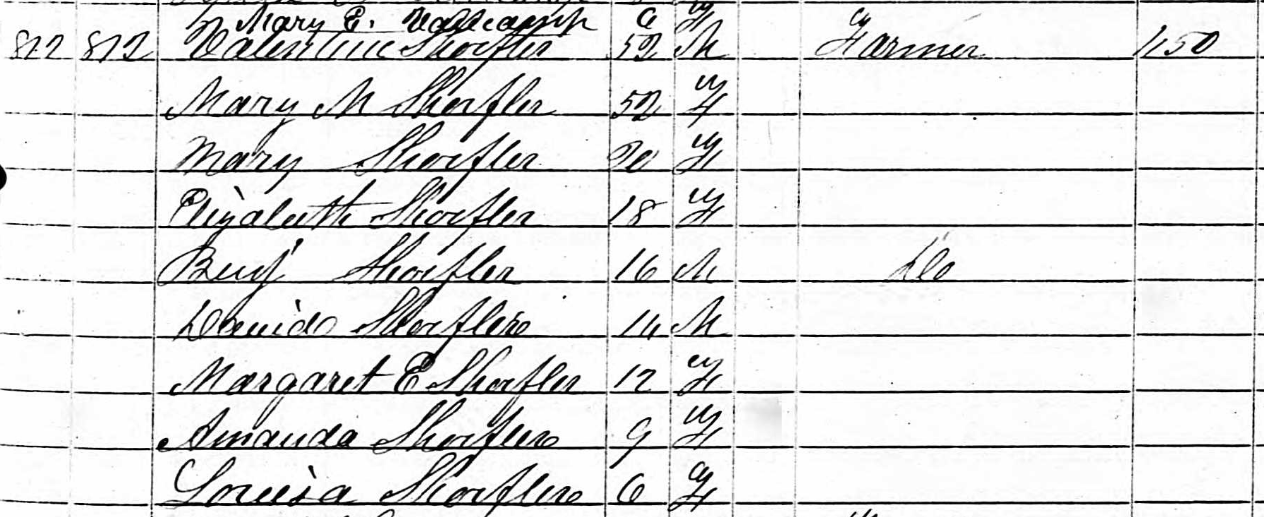
The 1850 Census
Valentine Shorfler2 lived in Plymouth (mistakenly recorded as “My Division”), Marshall County, Indiana, and was enumerated on 15 Oct 1850. He gave his age as 52 (est. DOB 1798) and was born in Pennsylvania. His wife was Mary M. (52, Pennsylvania), and their household included the following children:
Mary Shorfler – 20
Elizabeth Shorfler – 18
Benj Shorfler – 16
David Shorfler – 14
Margaret E Shorfler – 12
Amanda Shorfler – 9
Louisa Shorfler – 6
So, there we have Mary, Elizabeth, and Benjamin, plus four more previously unknown children – two of whom (David and Margaret) fit in the “Under 5” categories for Valentine’s 1840 household.
There are still a lot of questions and gaps to fill in – but finding this record validates all of the other work I’ve been doing around the edges, trying to establish Benjamin Shuffler’s parentage.
I’m just salty about one thing – the one obstacle that kept me from finding this record days ago when I first started hunting for it. Does this look like “Shorfler” to YOU?
If the transcriber had seen “Shoufler” – like I do – I would have found this immediately!
Thanks for reading Mightier Acorns! Subscribe for free to follow my quest—which is apparently to find every spelling variation of “Shuffler”.
While updating the Callin Family History, I ran across another cousin who researched the Callin family. His name was Dr. Frederick Blecker Callin – and I am left with questions.
Hugh Callin (1817–1856) was the youngest son of John and Elizabeth (Simon) Callin. He was born in 1817 while his family still lived in Pennsylvania. His older brother, William, was my 3rd-great grandfather, which makes Hugh my 3rd great-granduncle. Their sons were 1st cousins, and almost certainly knew each other:
John H. Callin – my 2nd-great grandfather; William’s oldest son, and author of the book of War Poems I published in 2022.
George W. Callin – John’s younger brother, and author of the 1911 “Callin Family History.”
Dr. Fred Callin – Hugh’s son, and the subject of today’s post.
Origins
Hugh married Barbara Ann “Barbary” Mathews (1826-1886) on 13 April 1843, and they settled on a farm in Milton township, not far from where Hugh grew up. In 1850, they are listed next door to a Mathews family, which may be Barbary’s parents, sister, and brothers. Hugh’s occupation is listed as “chairmaker,” and they already had two of their four children:
Mary Etta Callin1, born 29 Apr 1846, Ashland County, Ohio; married Jacob L Sattler, 26 Sep 1871, Ashland, Ohio; died 18 Aug 1913, Ashland County, Ohio.
John F Callin, born in 1850, Ohio; married Catherine Ann Steigerwalt, 26 May 1879, Ashland County, Ohio; died 27 Dec 1907, Ohio.
Frederick B Callin was born in 1854 – this post is his story.
Margaret L “Maggie” Callin was born in 1856 in Ohio. Maggie died, unmarried, on 19 Dec 1882 at the age of 26 and was buried in Ashland, Ashland County, Ohio.
Hugh died on 17 April 1856, at 39 years of age. After Hugh’s death, Barbary’s older sister, Mary Mathews, appeared in the household on the 1860 Census, likely helping Barbary raise the children.
In November 1874, Barbary married William Davis (1836–1915), a widower with three small children of his own. His first wife, Rebecca, had died in May 1874, barely two years after the birth of their son. Barbary died at the end of 1886, and her will was executed in January 1887. She left money, furniture, and bedding to her daughter, Mary Sattler, and her granddaughter, Amy (whom Barbary names in the will as “Emma B. Sattler”). She left the rest of her estate to Mary and to her son John, minus $133 he owed her. She specified in her will that the forgiveness of the debt of $400 she loaned to Fred when he went to medical school would be his bequest.
Doctor Fred B. Callin
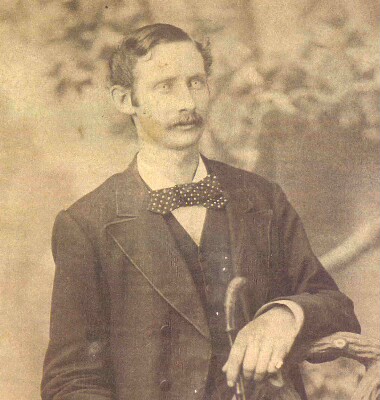
Dr. Fred B. Callin
Frederick Blecker Callin(1854–1920) was only two years old when his father died, and was 22 when his mother remarried. As discussed above, Barbary loaned Fred the money he needed to attend medical school, and she forgave his debt as her bequest to him when she died in 1886. He graduated from Ohio Medical University, Columbus, in 1893, after returning from a year studying medicine in Germany. He established an allopathic medical practice in Akron, Ohio.
He married Harriet R “Hattie” Crippen (1859–1944) in Ashland on 25 March 1883. They had a son, Sampsell Callin, in May 1884. Sampsell died in January 1887, and his brother, Moreland Guy Callin, was born that October.
The Angry Doctor
I always hesitate to judge people based on the records I find, but Fred seemed to get into a lot of trouble. As I’ve researched the various Callin families over the past two years, articles about Fred kept turning up in my other searches, painting a picture of a proud man who may have had a bit of a temper. He also seemed to incite the ire of those around him.
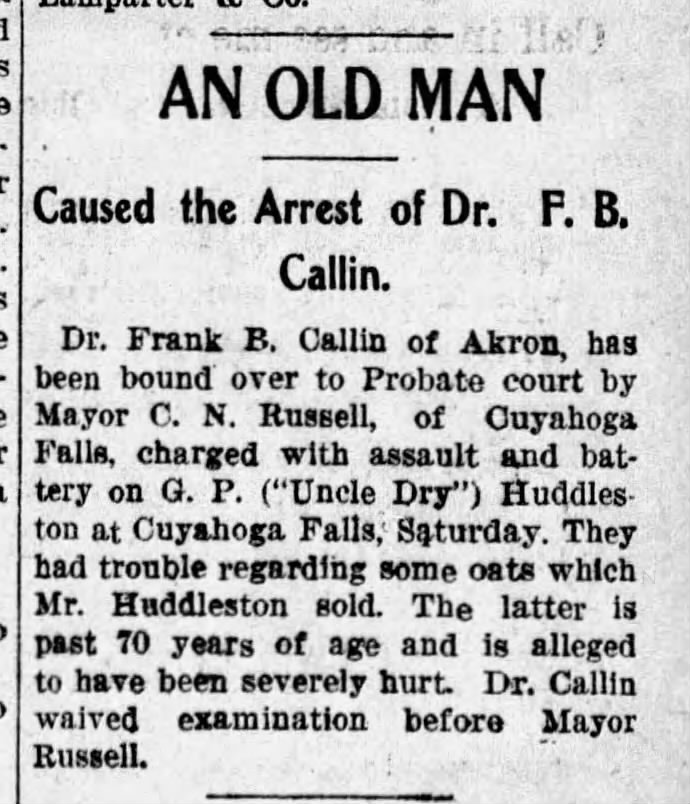
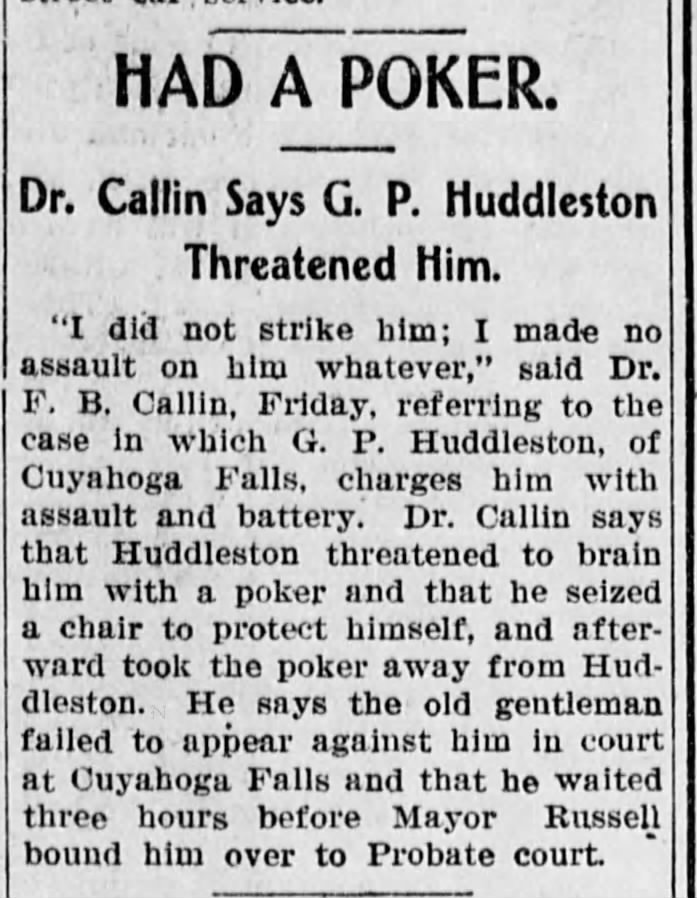
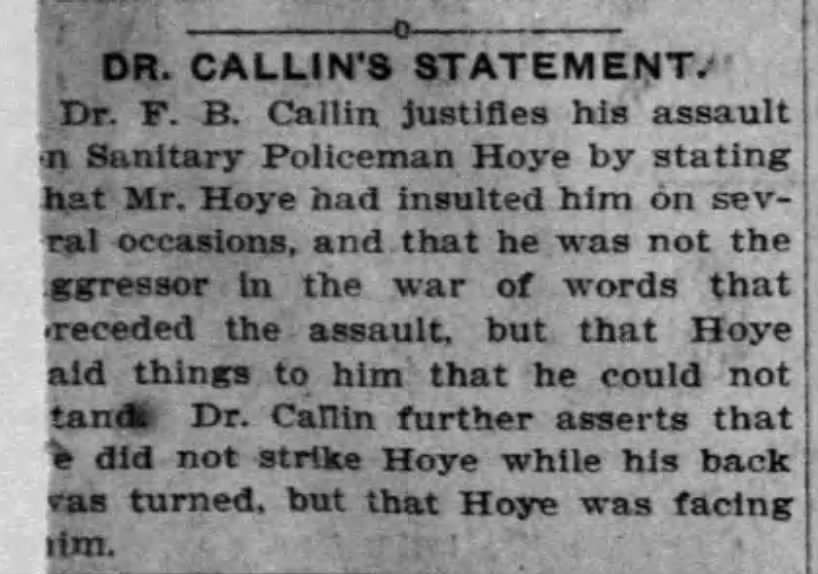
In 1901, there were two newspaper items about an alleged violent incident between Dr. F.B. Callin (incorrectly named as “Frank” in the first article) and G.P. “Uncle Dry” Huddleston:
Another clipping from 1912 recounts a dust-up between Dr. Callin and a would-be poet:
Akron, O., June 22 [1912] – It wasn’t an iceberg that struck M.L. Atwater, author of the poem, “The Titanic Struck an Iceberg,” but the fist of Dr. Fred B. Callin, Akron physician, according to the story the poet told the police today. Atwater asked Callin to buy a copy of the poem, and Callin asked to read it. Atwater held the paper up, but with the blank side toward Callin. Callin’s blank stare turned to wrath, and he is alleged to have slapped Atwater, first on one cheek and then on the other. The doctor was arrested on the charge of assault and battery.
“Doctor Failed to Take Stock in a Blank Poem,” from The Chronicle-Telegram, 22 Jun 1912, Sat, Page 1
Dr. Callin was sued for “performing a criminal operation” by a patient named Mrs. Clara Shinn in 1917, which was reported in the newspaper. The article seems to show that despite the incidents chronicled above, he was well-known in Akron, and had many friends, which made jury selection difficult.
Fred planned to spend the winter of 1920 in Florida on his son’s farm, but after he arrived in St. Augustine, Fred unexpectedly dropped dead in the street on 28 March. After his death, his body was returned to Akron, and he was buried in Stow Cemetery.
One Remaining Mystery
Dr. Fred may or may not have been a genealogist himself, but he seems to have known who his relatives in Ireland were. He made a trip there in 1907, and despite writing to the relevant genealogical societies, no one has a record of this trip or any clues to learn more:
Since there is no “County South, Ireland” I assume he visited County Louth – but again, I have found no evidence in any of the available resources.
We keep digging, trying to learn more about our common Revolutionary War ancestor, James Callin, and looking for DNA matches.
Rest well, Dr. Fred, and try to stay out of trouble!
Thanks for reading Mightier Acorns! Just don’t offer us any blank poems, and we won’t slap your cheeks.
Discovering the origins of Valentine Shuffler (1853-1916)
Writing an accurate history means leaving out assumptions. Sticking only to facts and evidence, and refraining from speculation about things that we cannot know, such as personal motivations or attitudes of the people involved.
But writing a complete history means adding a human element to the facts—putting what we know about the personal motivations and attitudes of the people involved back into the story so that we have some idea why they did the things they did.
Sometimes, finding those facts in the first place requires us to make imaginative assumptions about the people named in other facts. Assumptions are tricky. Without them, we might not know where to look for more evidence; but we have to be careful and devise tests to tell whether the evidence we find is telling us what we wanted to know.
This can be a real balancing act.
The Starting Point
Our starting point today is this guy:
Valentine A Shuffler was the eldest child, and only son, of Benjamin Franklin Shuffler (1833–1915) and Ruth Dyer (1837-1899), born on 16 Aug 1853 in Indiana. When he was seven years old (in 1860), his family lived in Cass County, in the southeast corner of the Nebraska Territory, and by 1870, they had relocated to a farm 340 miles East, near Scott, Fremont County, Iowa.
Valentine’s son was Frank Benjamin Shuffler (1888-1919), one of my wife’s Sixteen great-great-grandparents. I shared Frank’s story last year:
I “know” some of Valentine’s ancestry from seeing what other researchers have shared on Ancestry and FamilySearch—but I don’t always see the evidence that supports what they claim, and even when that evidence is there, I don’t always see the chain of reasoning that led from a piece of evidence to a conclusion.
In other words, my job is to challenge what I see by asking “How do you know that?” and examining the answers carefully before adding those answers to my tree.
So, my task for today is to answer the question, “Who are Valentine Shuffler’s ancestors, and how did they get to Iowa?”
We have three pieces of evidence to work with:
1860 Census – the family of Benjamin “Shifler” (the transcription of what looks, to me, like “Shufler”) in Cass County, Nebraska Territory
1870 Census – the family of Benn and Ruth Shuffler in Scott Township, Fremont County, Iowa
1852 marriage record for Benjamin Shuffler and Ruth Dyer in Marshall County, Indiana
Finding Facts
I talked about the research I did to find Ruth Dyer’s family a couple of weeks ago:
Her parents were Quakers from North Carolina, and that essay talked about how the records kept by the Society of Friends (aka, Quakers) in North Carolina tracked the Dyers family in Indiana.
Traditionally (in other words, an assumption), a marriage took place where the bride or her family lived. So, the 1852 Marshall County, IN, marriage record of Benjamin and Ruth would normally indicate that the Dyer family lived in Marshall County. However, the Dyers’ records indicate that Ruth was born and raised in Wayne County, IN, and in 1850, the census showed her living in the household of her married sister, Mahala Cook (who we know about from the detailed records from North Carolina) – in Salem, Henry County, Iowa.
Wayne County, IN to Salem, IA, via Marshall County, IN
Salem, IA and Marshall County, IN, are about 330 miles apart, and Wayne County, IN and Marshall County are about 175 miles apart; which makes me think that Benjamin’s family probably lived in Marshall County. Another assumption – but let’s see what we find there:
1840 U.S. Census record in Marshall County, IN, for “Valentin Shoepler”
1844 land record in Marshall County issued to “Volentine Shofler” for 168 82/100 acres in “the North West quarter of Section two, in Township thirty-three, North of Range one East, of the second principal Meridian, in the District of Sands subject to sale at Winamac, Indiana.
1855 probate document for a man called Valentine Shuffler, including an affidavit from Sarah A. Bailey attesting that his widow is Margaret Shuffler.
The History of Indiana, vol. 2 (pg. 31 and 33) talks about the elections organizing Marshall County, held in Aug 1836 at the Plymouth court house in Center Township includes a list of known voters, which includes Valentine Shuffler.
Further sleuthing turns up a marriage record in Marshall County for Sarah Ann Shoffler and David A. Bailey, dated 15 Apr 1841. Sarah A. Bailey, then, is probably the daughter of Valentine Shuffler.
Resting on Assumptions
None of these facts are, by themselves, “proof” that Benjamin is the son of this Valentine Shuffler in Marshall County, IN. But when taken all together, there are compelling reasons to conclude that this Shuffler family is the family of Benjamin Shuffler. Not only does his marriage to Ruth place him in Marshall County, but Benjamin named his oldest son “Valentine” in 1853 – and the younger Valentine named his son “Frank Benjamin” in 1888.
Accepting these assumptions and facts into our story may be the right call, but they aren’t the end of the search. Now, we need to look for more information about Sarah Bailey and Benjamin’s other siblings – and see if we can trace their parents back east to where they probably married. Benjamin’s obituary stated that he was born in Brown County, Ohio, in 1833, about three years before his father’s appearance in Indiana. Other clues will likely arise as we chase down the other children who lived in the household in 1840.
There are seven other children in that household – there are many facts and assumptions to be gathered and tested before we know who they all are!
If you enjoy digging up facts and testing assumptions, subscribe to MightierAcorns. (If you don’t, how did you get this far? Do you need help?)
A “shirttail relative” is a distant or honorary relative, such as a fourth cousin or family friend who is treated as a relative. For example, I am “Uncle Tad” in a few households where I bear no familial relationship – so that would make me a “shirttail” to those kids.
As I assembled the Callin Family History for its 2022 publication, chasing down the descendants of James Callin meant that I was adding more and more shirttails to the family tree. These people would not necessarily know that we were related, or might not have had a “Callin” in their family for five or six generations. But thanks to the math of DNA, they are every bit as much a descendant of James Callin as I am.
The Montgomery family
Here’s just one example:
I learned on 30 July 2018 that Elizabeth Callin married Caleb Montgomery in Richland County, Ohio, on 13 August 1822.
I had thought I was done with my Callin Family History research, but this record set me off on a whole new quest – and I wrote about the find and what it meant in a post called Echoes & Rhymes on the old Mightier Acorns blog.
Slowly, as I continued to dig and explore, I was able to piece together the story of James “2nd” Callin’s children and grandchildren, and the lesson I took from all of this was that the common advice to research your ancestors’ “FAN club” (Friends And Neighbors) is vital to uncovering the whole story of the past.
The Montgomery family – Benjamin Montgomery (1766–1841) and Nancy (Ann) Nottingham (1768–1866) were early settlers of Milton Township, just like my Callin ancestors. Three of Benjamin’s and Nancy’s children – Caleb, Jonathan, and Lucinda – married three of James “2nd” Callin’s children: Elizabeth married Caleb, Sarahmarried Jonathan, and Hugh married Lucinda.
The Callin farm was near the town of Olivesburg, which was named for Benjamin’s daughter, Olive. The History of Richland County says that Benjamin built the first grist mill in the township on the Whetstone, at Olivesburg, in 1817. That book also describes the town in 1821:
“The village of Olivesburg was laid out by Benjamin Montgomery in the year 1816, and called Olivesburg in honor of his oldest daughter, Olive. In 1821, the village contained one tavern, kept by Benjamin Montgomery; one blacksmith-shop, by Abel Montgomery; one tailor-shop, by John Grum; one cabinet-shop, by Thomas Beach; one tannery, by Joseph Burget; one horse-mill and water-mill, by Jonathan Montgomery; one wheelwright-shop, by William Lee, or James Hall, and about the usual per cent of loafers.”
Mary Callin, James “2nd”’s wife (mother of Elizabeth, Sarah, and Hugh), was a founding member of the Hopewell congregation, which met in Olivesburg.
Dozens of little facts and coincidences of timing that make up the story of my early Callin family in Milton Township are inextricably linked with the Montgomerys – even though we are “only shirttails” to each other.
Milton Township Side-Quests
Montgomery is not the only surname that keeps popping up in Milton Township.
Individuals from the Ferrell family can be found marrying more than one Montgomery, including Olive Montgomery, the sister of Caleb and Jonathan for whom Olivesburg was named. Elizabeth and Caleb’s oldest daughter, Mary, married a Ferrell, too.
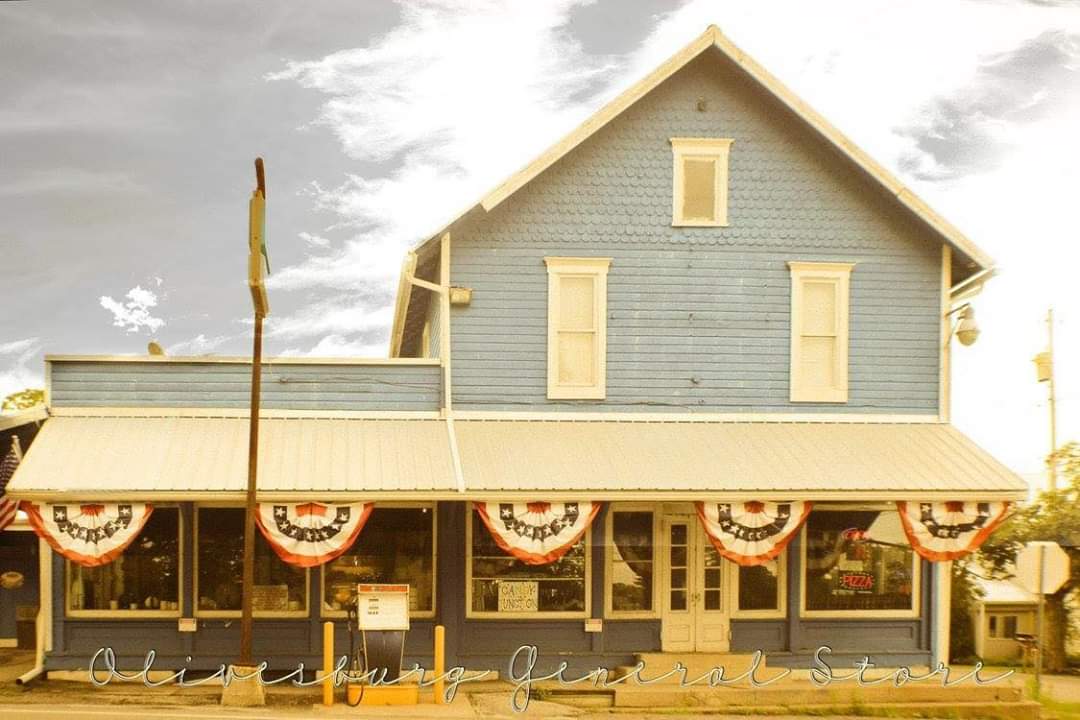
Olivesburg is still there, by the way. The Olivesburg General Store has been operating since the 1840s, so all of these people could have visited there at some point.
Olivesburg General Store – founded in the 1840s, when the Callin and Montgomery families still lived there
Later in life, Olive also married Boston Burget, who was probably a relative of the tanner, Joseph Burget, and of Nancy Burget, who married Elizabeth’s brother, Thomas Callin.
In the end, I ran out of time and resources and published what I knew in 2022. But I do take time to circle back with these families to see if I can learn more. One day, I’d like to be able to tell their whole stories. Until then, the best we can do is chase those tantalizing shirttails and see where they lead.
They lead to a lot of places – and a lot of people.
A Purely Maternal Line of Descent
Following the Montgomery line led to dozens of new families as each generation of children proliferated across the country. I will never have time to find them all.
Kim (Butze) Wheelwright (1946–2001) was born in Corvallis, OR, and died in Odgen, UT. She was born the same year as my dad, and we never met. I didn’t start doing research on the Callin Family History until 2015, and I didn’t track down her family’s line until after 2018. But, she and I were 6th cousins. Here’s her line back to our common ancestor:
Gretchen B Movius (1914-1966) – Mother of Kim Butze
If you click on this link to James Callin’s WikiTree profile, and click the green “Show Descendants” button, you can see that line of descent down to Gertrude E (Bushnell) Froom; and take note that Kim would have to have gone back six generations to know that she had any Callins in her family tree.
As I put this example together, I learned that Kim’s husband, A. Stuart Wheelwright, just passed away last December. If they see this post, I’d like to offer my condolences to his surviving family – particularly his two living daughters. (I did not know that he and Kim had any children until today when I read his obituary. I’m happy to learn my kids have two more 7th cousins, but sad at the price of that knowledge.)
All of this means that in my quest to be thorough, and track down as many of James Callin’s descendants as possible, I opened up an enormous (and possibly endless) number of branching pathways connecting me to total strangers – who may or may not care about any of this history.
Maybe someday some of them will find my work and marvel at the great complexity of it all. I hope so.
Because marveling is the best part!
Mightier Acorns keeps digging – if I uncover someone you recognize, say hello! Subscribe for free to receive new posts.
By this point in any New Year, you may have had your fill of annual retrospectives, best-of lists, motivational etudes, and resolutions. (If you haven’t, here are some good resources at Projectkin and Mission:Genealogy to help launch your New Year.)
But if you’re like me, feeling leery of 2025 and what is waiting for us around the corner, you may be feeling a bit punk rock about things – a mix of general defiance and exhausted pugnacity.
What keeps me going when the yawning, gravitational temptation of nihilistic futility beckons from the headlines? Why do this, of all things, when the world is on fire?
The Work Is the Focus
I don’t know what drew you to genealogy/family history – I don’t really know what drew me to it. How I got here doesn’t matter as much as the work itself.
But what do I mean when I call it “the work” – it isn’t some single, coherent mission with an endpoint. There will never be a point at which I can state “I am done” because for as long as I live, there will be more history.
When I say “the work is the focus,” I mean that the processes we go through, the steps we take, and the disciplines we learn are important.
Maybe there was some idea in your mind of finding someone Notable in your direct ancestry, or some mystical or religious notion that sparked your initial entry to this world. But once you learned the skills necessary to do a proper job of telling and proving the stories about your ancestors, something probably changed. In the process of finding and evaluating evidence, and digging past the superficial legends that were handed down to you, you either drifted away from the work (and thus, are not reading essays like this one) or you adopted a more realistic vision of the past that let you continue.
Critical Thinking Is Critical
To my mind, there is no tool more important to the work of family history (or science, or any learning endeavor) than critical thinking. I may have mentioned this before:
When you are researching your family history, it is critical (definition 3) that you think critically (definition 2) even if that means criticizing (definition 1) the existing stories that you think you know about your family.
Getting better at thinking critically means getting in the habit of constantly asking, “How do you know that? And how do I know that?”
Thinking critically also means evaluating yourself and your biases – understanding that “bias” is normal, and just refers to the shortcuts and assumptions that are necessary for a brain to process masses of information. A bias only becomes a problem if you don’t examine it and compare your results to the work of others – asking “How do I know that?” until you can be confident that your starting assumptions were correct.
Once you have acquired that habit, you will find yourself applying critical thinking to the news and your daily interactions. This may be good because you will be more resistant to misinformation, but it can also be frustrating because those around you (often, people you care about and want to think well of) won’t want to confront their own biases and assumptions.
For me, throwing myself into the work of genealogical research is an escape from the madness.
Know Your Audience
We have to be careful about escapism.
And I can’t lie – a major motivation for me to put my thoughts and research into a blog (first on Blogger from 2009-2021 and now on Substack) is to curb my tendency to keep obsessively pursuing more information. Writing about the Work forces me to apply critical thinking to it; editing my essays forces me to question my assumptions and deconstruct the narratives that I, and my relatives, have built around the people in our past.
So, writing is a necessity – but when you write, the first thing you have to identify is “who is my audience?” Every time I face the blank screen of a new post, who am I addressing?
I am grateful that so many of you have found your way to my writing, and that you find value in what I have written. Your support and interaction encourage me to keep going when I doubt myself. And you inspire me constantly to think in new ways and to dig deep to find stories in the data.
But… if I’m honest, I’m not writing these posts for you. You are necessary and welcome, but you are not my audience.
And I am delighted when someone I’m related to, however distantly, finds their way to my work. Those moments when you find me and say hello are intensely gratifying, like payday, or that season-ending cliffhanger in a favorite show. Your attention is welcome, and I like to think that when I’m gone, the work I’ve done will be of use to descendants and cousins in the future.
But again, if I’m honest, I’m not writing these posts for you, either. You are necessary and welcome, but you are not my audience.
I hope that someday one or more of my children might take an interest in the work, but I also understand that it’s a lot to take in. It may take them as many years of study to comprehend what I’ve done here as it took for me to learn how to do it.
So, while I’m writing for them in a distant, intellectual way, they are not my expected audience. They aren’t who I am addressing.
There is only one person who has to care about the things that I write. There is one person whose opinion and engagement are indispensable to this project:
It ME!
Was that Humor or Ego?
Both – and neither.
The point I’m trying to make is that none of our projects will mean anything to other people if they don’t mean something to us, first.
The thing that makes people want to read what you write is your obvious delight and satisfaction in writing it. And the only person who is required to read everything you write is also you – so make sure that person’s needs are being met.
Whatever 2025 holds for us, take care of yourself. You deserve a good audience.
Before 1803, when Ohio joined the United States, it was part of the vast Northwestern Territory. Established in 1787 by the Congress of the Confederation through the Northwest Ordinance, it was the nation’s first post-colonial incorporated territory. At the time of its creation, the territory’s land was home to several Native American cultures, including the Delaware, Miami, Potawatomi, Shawnee, and others.
The European notion of “property ownership” and the attraction of vast, seemingly underdeveloped tracts of arable land drew increasing numbers of settlers looking to establish themselves in what they saw as unclaimed land. The conflicts between these settlers and Native American inhabitants resulted in the Northwest Indian War culminating in General “Mad” Anthony Wayne’s victory at the Battle of Fallen Timbers in 1794. The subsequent Treaty of Greenville in 1795 opened the way for settlement, particularly in southern and western Ohio.
I suspect that my ancestor, James Callin, was a private in a mounted cavalry unit that fought under Wayne in the Battle of Fallen Timbers:
Whether he fought there or not, two of his sons, James and John, settled in what would soon become Milton Township, Richland County, Ohio, around 1810.
Becoming Ohio
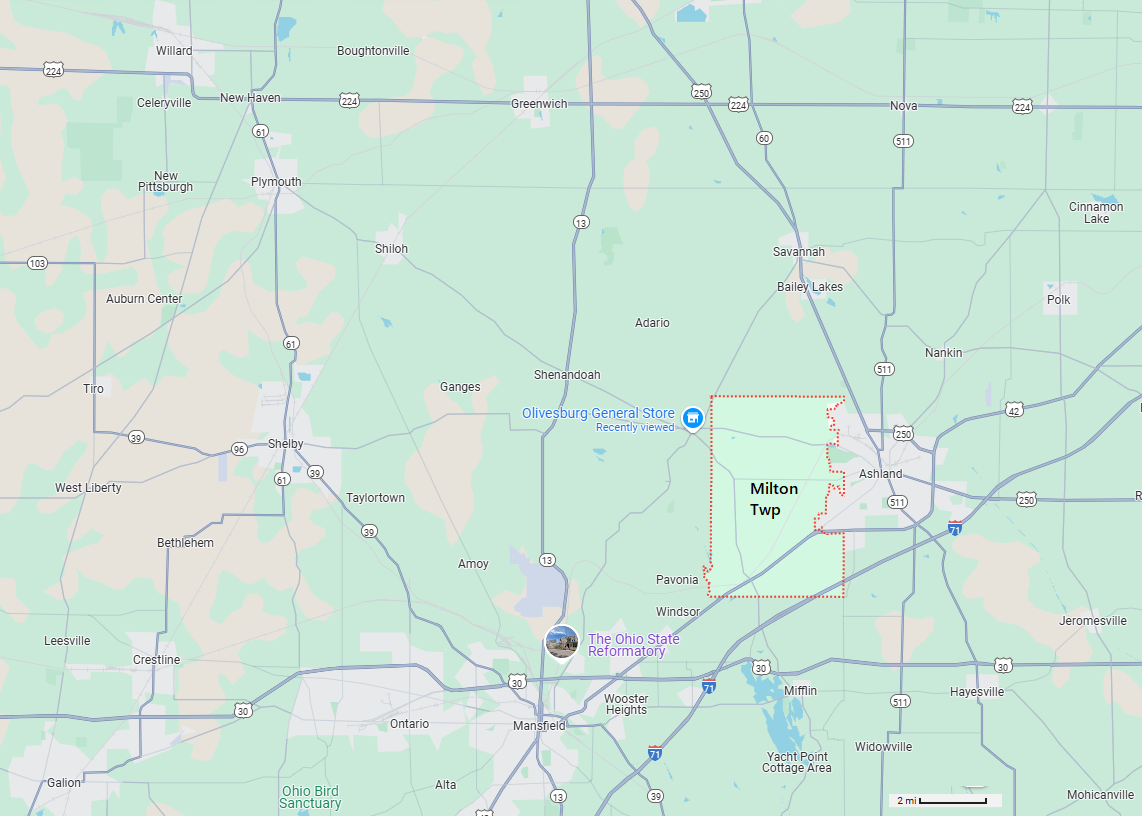
Milton Township was organized in Richland County, in 1816. Two years later, it was reduced in size to six miles square when Clear Creek Township was organized from the north half of Milton Township on 15 October 1818. When Ashland County was formed from portions of Huron, Lorain, Richland, and Wayne counties on 24 February 1846, Milton Township was again divided. The four columns of sections on the east were included in Ashland County (forming the territory on the map below), and the other two columns remained in Richland, where they were joined with part of old Franklin Township to create Weller Township. That left Milton with its present dimensions of four by six miles.
Milton Township, Ashland County, Ohio
Early Days: Statehood (1803) to 1816
In the early days of settlement an occasional minister, either Presbyterian or Methodist, traversed this region. The pioneers would assemble in a log cabin to hear preaching. If the weather permitted, people often gathered in the forest, and sometimes in a log barn to hear a new minister.
The Eckley Church was a log building erected in Vermillion Township. While it was the first church building built in the county, it was a “union building” – free to all Protestant ministers, occupied mostly by Methodists, who were the more numerous group.
George William Hill assessed in his 1880 History of Ashland County, Ohio, that the first organized congregation was within Montgomery township. Its membership was largely composed of the residents of Milton township and was organized by the settlers who arrived from (mostly) Western Pennsylvania in 1815-1816.
The Hopewell Congregation
These people were visited by Rev. Joshua Beer, who preached a few sermons in the cabins of the pioneers. About the same time Rev. William Mathews also became a candidate for employment as pastor of the new congregation.
In 1817, the Hopewell congregation was organized. It is not recorded whether they were aware of the Hopewell Culture that had lived on lands to their south for untold generations. The Hopewell congregation hired Mr. Mathews and employed him one-third of the time. The balance of his time was divided between Mt. Hope, in Perry, and Jeromesville, in Mohican township.
Twenty-two members were received on certificates from other congregations and twelve on examination. In 1818, Robert Nelson and Abraham Doty were elected elders, ordained and installed. The members, according to Hill’s research, were:
The Rev. William Mathews continued to spend a portion of his time at Hopewell until 1821. He was succeeded by Rev. Robert Lee who remained until 1826, when he was succeeded again by Rev. William Mathews. As before, Rev. Mathews devoted one-third of his time until 1833, when he was succeeded by Rev. James Robinson, who gave half his time, until 1837.
The congregation, in the meantime, increased to about one hundred and fifty members. Around 1838, a lot was purchased in Ashland, and the congregation moved to a large frame church erected there.
The minister officiating at that time was Rev. Samuel Hare. In 1839, Rev. S. N. Barnes supplied the pulpit. He was succeeded by Rev. Robert Fulton, then principal of Ashland Academy, who remained until 1841. He was succeeded by Rev. James Robinson, who remained until 1843, when he was succeeded by Rev. Samuel Moody, who was pastor until his demise, in 1856.
The Service
William Andrews and George Ryall were chosen to conduct the music. They were both considered excellent singers. They stood near the pulpit, on a platform, where they led the congregation to read or sing.
Services began about ten o’clock and continued until about twelve o’clock, when there was a recess after which services continued for one or two hours. In the absence of the pastor, a leader was selected from among the church officers, who read a printed or written discourse for the edification of the members. This task frequently fell upon Elder Robert Nelson, who is said to have been a fluent reader.
The Building
In 1819 the congregants erected a hewed thirty by thirty-five-foot log church on what is now the Olivesburgh road, about one and a half miles west of Uniontown (now the city of Ashland).
According to the recollection of Mr. John Nelson, son of Robert:
“the building had a cabin roof, plank floors and door, plank benches without backs or cushions, the windows very high from the ground, the pulpit elevated after the old style, four or five steps, and boarded as high as a man’s shoulders. The church was heated, in winter, by a large box-stove, capable of receiving four-foot wood. The building was erected by tire voluntary efforts of the pioneers and members, some furnishing a quota of hewn timber, others, plank and boards, and others, clapboards, sash, glass and nails, while others, with teams, hauled the materials to tire ground where the church was to be erected.”
The church building served for twenty years before the congregation moved to the new building in Ashland in 1839. It stood unused until 1864, when Bishop Rappe of St. Edward Catholic Church purchased the “Old Hopewell” Presbyterian Church which had not been in use the previous 18 years. By that time, the original Hopewell congregation had dissolved and connected with other churches.
The church burned to the ground in 1869.
Dissolution
A community is never just one person or just one family. There is only one Callin (“Mary Callen”) on the list above but she lived on a farm with her husband and his brother’s family. Between those two Callin families, they had 15 children – and whether they were all members of the church or not, they would have participated in the social life of the church and the town.
But Mary’s husband, James, was killed by a neighbor named Sutton Fowler in 1820, and her brother-in-law, John, succumbed to tuberculosis in 1835. By 1839, when the growing Hopewell congregation moved to their building in Ashland, the 15 Callin cousins had begun to grow up, marry, and move away – often in groups that settled further to the west.
By the mid-1840s, fewer than half of the Callin cousins remained in Ohio. Several of Mary’s sons moved to Iowa, where they were decimated by outbreaks of typhus and cholera. Mary had gone with them and is buried in Muscatine. The Scott family resettled in Winnebago County, Illinois, and the Fergusons took John’s wife, Elizabeth, with them to Auburn, Indiana.
But by the time the Old Hopewell church burned down, very few Callin family members remained in the Ashland area to mourn it.
Mightier Acorns can’t make any promises, but this newsletter is unlikely to burn down. So if you haven’t already, subscribe!









 Mightier Acorns