
When we are just starting out in genealogy the best piece of advice we get is to “start local.”
Depending on your immediate family, this might be very simple, or (more likely) unexpectedly complicated and messy.1 Growing up, I was taught to think of the classic nuclear family (one dad, one mom, 2 and 1/2 kids) as “Normal” – with the assumption being that mom and dad also came from a similar family.
Of course, reality is an endlessly inventive and creative beast, and families can vary wildly from what I was taught to believe was “Normal.” So wildly, in fact, that “Normal” turns out to be a rare oddity.
(Would you like to see a song about it? Well, here ya go!)
Sorting out the Who’s Who of your immediate family is step one. Talk to the living, learn their stories. If your grandparents, aunts, and uncles are still there when you are starting out on your genealogy journey, learn what they can tell you about where they lived, how they grew up, and what they experienced. Take the best notes you can! (Record who said what for your future citations!) Along the way, you’ll learn about their parents and find yourself needing some kind of family tree software to keep track of them all.
Building That Tree
Whether you come from a blended family or from a sprawling extended family, or from a relatively small “nuclear” family, finding out about your ancestors starts with who you know, but takes you back through time, beyond what the living can tell you.
That’s where the research comes in, and that’s where all of the different systems for reporting who your ancestors were can start to make sense.
The Ahnentafel system is one way to do that. Actually, if you check out that Wikipedia article, you’ll see that there are several systems that share some of the same characteristics – but basically we’re talking about a way to count backward through ALL of your previous generations. Usually, it starts with yourself as the subject:
The subject (or proband) of the ahnentafel is listed as No. 1, the subject’s father as No. 2 and the mother as No. 3, the paternal grandparents as No. 4 and No. 5 and the maternal grandparents as No. 6 and No. 7, and so on, back through the generations. Apart from No. 1, who can be male or female, all even-numbered persons are male, and all odd-numbered persons are female. In this schema, the number of any person’s father is double the person’s number, and a person’s mother is double the person’s number plus one. Using this definition of numeration, one can derive some basic information about individuals who are listed without additional research.
You or your family may also need to account for adoptions, non-paternity events, same-sex couples and/or transgender individuals – and some software and online trees have begun to account for those factors. The Ahnentafel concept is designed to count your biological ancestors, so before 1978, when in vitro fertilization became practical, it will probably work for 99.9% of families without much need for adaptation.
Outgrowing “My Sixteens”
If you’ve been a Mightier Acorn for more than a few months, you’ve probably read about My Sixteen and Her Sixteen – my effort to document all 16 of my 2nd-great grandparents, and all of my wife’s 16. The goal for that extended exercise was to make sure that all 32 of those individuals have WikiTree profiles. (And there are copious links on both of those Sixteen pages!)
I’m ready for the next step, which would be to move back to the next oldest generation – but I’ve also learned a lot about what makes a good WikiTree profile good, and before we go further back in time, I feel like I need to do some “gardening” on the more recent generations.
So what I’m going to do is this:
Starting with my own kids as “1.” (the “probands”), I’m going to skip the living generations (me and my wife, 2 & 3; our parents, 4-7), and start with the Great Eight. Every week, staring next Friday with #8, Bob Callin, we will look at the health of their WikiTree profile, and I’ll talk about what I’ve learned about the life story of each person, how I learned it, and what I might still need to learn.
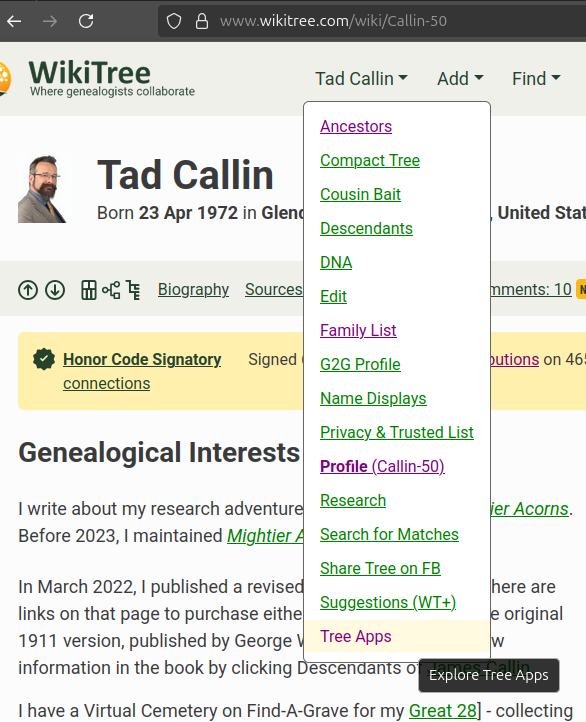
If you want a preview of who is coming up from week to week, there is an easy way for WikiTree users: go to my WikiTree profile (Callin-50), click the pulldown arrow to the right of my name, and look for “Tree Apps”.
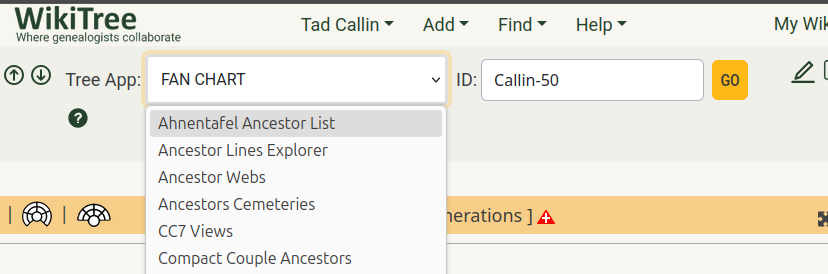
Once you’re there, change from “Fan Chart” to “Ahnentafel Ancestor List” using the pulldown:
As we work our way back through the earlier generations, we should learn a thing or two about a thing or two – and maybe if you follow along with your own Ahnentafel, we might even find some overlap…
Because we’re all cousins if you go back far enough!
Not Just My Idea
Lest you think I might be stealing ideas from others without giving them credit, I’ve seen other genealogy bloggers do some form of this for years:
- Amy Crow Johnson’s “52 Ancestors in 52 Weeks” challenge (seems to have started this in 2014)
- Randy Seaver’s “Ancestor biographies” on Genea-Musings
- Dom’s “52 Ancestors” at The Family Mess
Feel free to link to your own Ahnentafel or “52 Ancestors” series, or that of someone you follow, in the comments!
Bonus Internet points if your list and mine have the same people on them!
- See “Counting Cousins” for example ↩︎

 Mightier Acorns
Leave a reply to Anne Young Cancel reply