
The Artifact
There are dozens of great articles out there about preserving family artifacts, like photos and recordings. But despite reading them and thinking, “I need to do that with my artifacts,” I never quite find the time to do what I need to do with the Stuff I have accumulated. What I need is a prompt.
Cousin Pat Witter (my dad’s first cousin) recently came across an artifact and decided to send it to me so I could do something with it. A prompt!
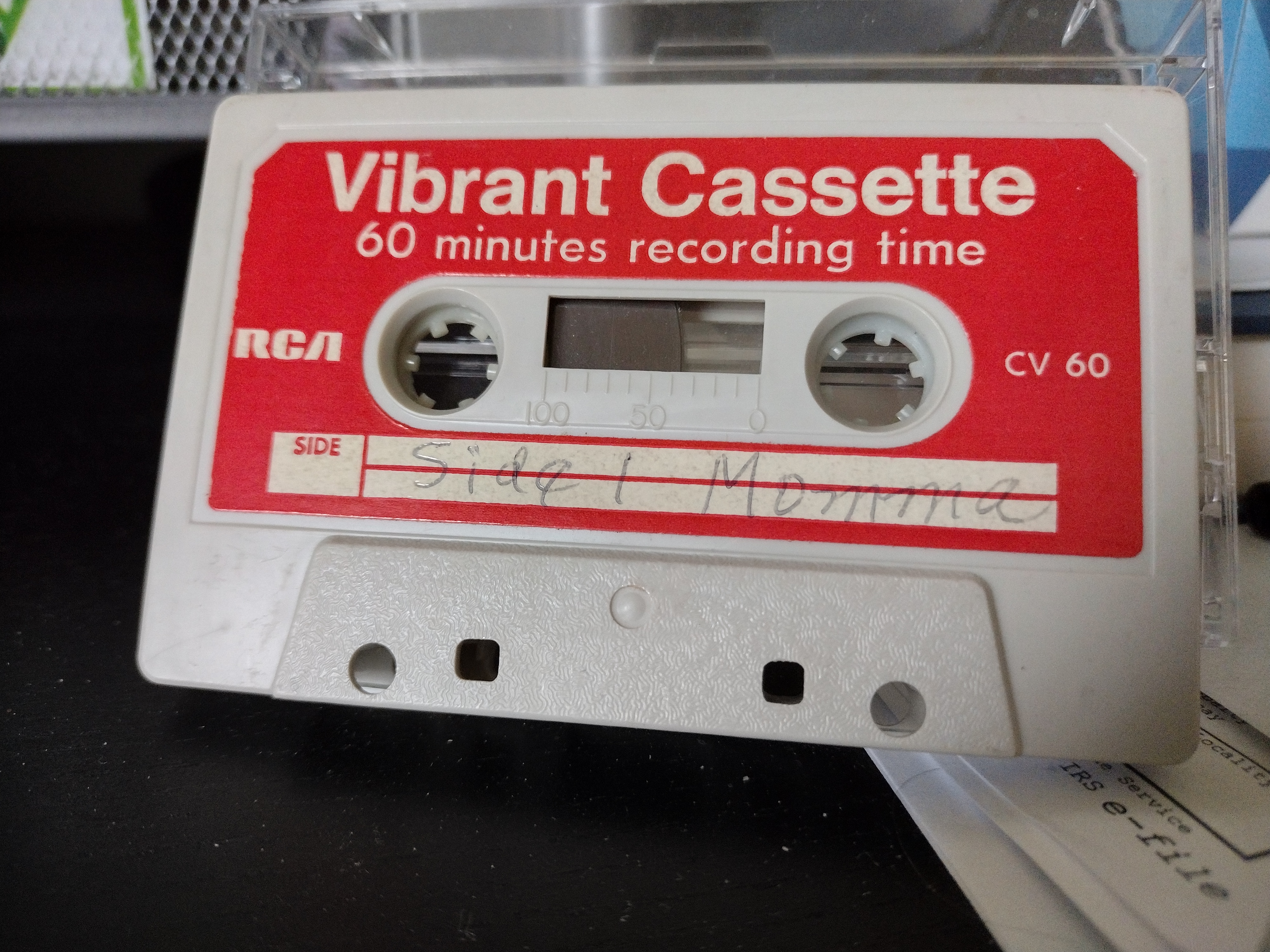
A transcription of an old memory
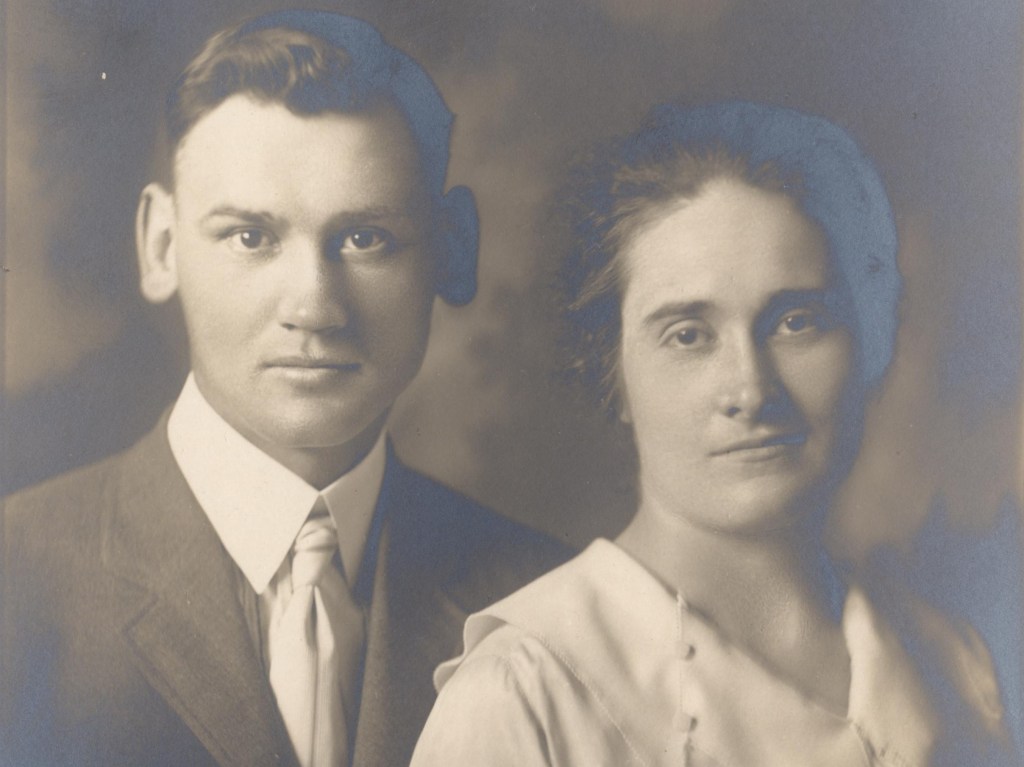
The whole recording is an hour, and features my great-grandmother, Hannah Merle (Huff) Witter, with some “off camera” comments from her daughter, my paternal grandmother, Nancy (Witter) Callin. I don’t know exactly when the recording was made, but I suspect it may have been the mid-1970s, if not earlier.
Grandma Merle spoke off the cuff to Nancy, referring to her husband, Dick Sr., as “Daddy” and referring to her parents as “Grandpa” and “Grandma.” Her narrative rambles a little, and she sometimes gets details wrong when she stops to explain things to Nancy. There are two main “stories” that she covers: Her family’s first trip from Kansas to Arizona in 1907, and her early life with Dick, including their return to Glendale from San Diego after his post-World War I discharge from the Army. For today, we’ll look at that first part.
From Kansas to Arizona in 1907
Merle begins:
I was born in Savonburg, Kansas on December the 11 19…1889. Daddy was born in Wamego, Kansas. It might have been St. Mary’s but it was Wamego County. And he was born in November the 2…7th… November the 28 1890.
We never did meet in Kansas. He came out here when he was quite young, about 17 or 18. I came out here in 18… 19 and 7.
On our trip, we came out on account of Perry being sick and we had a sale of everything in Kansas except the ranch itself. And we started out in a covered wagon. That was grandpa and grandma, Perry, Doris, and I, and Chester went along with us for the first week or ten days until he had to catch a train or something back to start teaching school in September.
Perry Huff was Merle’s half brother, Albert’s oldest son, from a previous marriage. Perry’s infant daughter was Doris Fay (Huff) Pullins (1907–1998), born on March 8 1907. Her mother, Pearl, died from tuberculosis on March 27, and when the family set out on this journey, Perry knew he had the disease, but none of them knew whether baby Doris would develop it.
Chester A. Huff was Merle’s brother, two years older than Merle. Since Chester was due back in Savonburg in September, we can assume this trip started in mid- or late-August of 1907.
We traveled about… oh, we averaged about 20 miles a day. We could have gone faster, but the idea was to kill time between… before it got too cold in Kansas, and to kill time until it got cool enough in Arizona. It had been too hot for us at that time.
Our first stop, we didn’t make too big a long journey, we stopped at Big Creek, which is a little ways west of Savonburg. Oh, maybe 10, 15 miles – something like that. But we almost never went there. But we just thought we had an ideal place for our first camp. It was cool, and it was shady down in there, and we started to unpack and make camp. The boys grabbed fishing hooks and went down to see if they could get some fish for supper.
We didn’t get entirely unpacked because we was a fighting mosquitoes. They were down at the creek bottom, too. So we had to hitch the team up again and get out of there and get up onto higher ground. By that time, the boys didn’t have time to go back for supper.
It’s been so long since I made that trip, the majority of the details I don’t remember, but we always tried to make camp in daylight. Well, we didn’t have the facilities… we had a lantern, I imagine. But we usually had our meal cooked and ready to go to bed anytime we wanted to after long before dark.
We usually …well, we tried every day to make it from one water place to the next. We’d inquire ahead about 20 miles ahead, if there was water. At first, we didn’t have any trouble, because there was settlers along there and wheat farms and things, but the farther west we got, the scarcer the water was. And just two nights – we had water with us, we had kegs of water on the side of the wagon. But we had to make camp without any water supply other than what we carried with us. And that meant the poor horses didn’t get…. Well I think grandpa usually would give them a bucketful a piece in that case. ..was all the water they’d get until we’d come to some the next morning.
I remember one time we camped, it looked like it was coming up a cloud and it was gonna rain or storm or something, and we were right close to a little country school house out on the prairie. Grandpa drove the team and the wagon up right close, it had an open porch on it. Drove the wagon right close up to this little porch. Perry always slept outdoors in his camp, in a cot and covers, so he could get under that, and the wagon would protect him from the rain. And it did. We got in there and got his bedding out, and of course, grandpa … they had a little barn at the back where the school children tied their horses in the wintertime. Grandpa got the team around and brought them, old Dan and Daisy, and got them sheltered and fed, and got back to the wagon. We hadn’t got anything cooked or even started a fire. And boy, the rain started and the wind and it kept it up all night long that night. So we didn’t get much sleep, but we were dry and the team was dry.
We tried to follow the railroad track just for to keep the correct direction, but I’ve forgotten the place that we were instructed to leave the railroad and start off across country. But when we finally traveled to that place, we saw we was to go across country until we came to a little place they called Crow’s Roost. And that’s …there wasn’t even a trail to follow after that. So we was to stop there and call my aunt, Mrs. Keen, and they were to come and meet us at Crow’s Roost.
“Mrs. Keen/Aunt Francy” was Rosa’s sister, Hanna Frances (Murray) Keen. Frances Murray married John Keen in 1880, and sometime after their three children were born in Kansas, they moved 590 west to Colorado Springs. Here is a rough estimate of the journey Merle and her parents took to get there.
By that time, we was in Colorado. We had crossed the border. There was nothing to the border different from one side to the other, except that there was a town of prairie dogs, right there, we said that was on the dividing line.
Anyway, we called the folks, mother’s sister, and they had a telephone. They had two receivers so the kids could talk. That was the kids’ amusement there. They’d get on the telephone and call a friend and they could all talk. But anyway, they came for us and we followed them on over to their place that night. And that was what – made it 30 days and 30 nights that we traveled. We didn’t actually travel at night except that last night, the 30th night.
Nancy just now reminds me that she never heard me say before that we went to Colorado to mother’s sister, Aunt Francy Keen. Mr. Keen was there, and he was running sort of a little store. Nothing much except needles and threads and buttons and things, little things that the people …that somebody might want that live in two to three miles and didn’t want to go into Colorado Springs to get.
The three Keen “children” Merle talks about here were Julious, who was about 26 in 1907, Iliff Basil (17) and Beatrice (15). Merle herself was about 18 at the time.
I can’t remember how far it was to get to Colorado Springs. But when I got there, we …the first evening, I guess they was at a loss to know what to do, because they always talked to their friends on the telephone for entertainment and stuff, and I wouldn’t have known any of them. So..
Their mother, Aunt Francy, told them to show me the family album. So they did, and they started showing me the pictures, one on each side of me. Me, I didn’t notice, but I began to say, “Oh, that’s uncle so-and-so,” or “That’s cousin Ralph,” or “that’s Earl” or “that’s somebody else” – and I knew them all, and they just sat there never said a word, and would have never met any of those cousins or relatives back there. of course, they didn’t know me either, until I got out there. But that was the first that they knew of any of us. So they got enlightened with me telling them who their relatives were in the album.
One day I went with Beatrice to school and we must have walked across a little prairie lane, oh, possibly a mile and a half or so to her school. It was just a little one room, one teacher, all grades in together school, and there couldn’t have been more than 6 to 10 pupils all told. But I enjoyed that too, and then when it came time that they felt… they could…
Well, one time, Francy and her family drove our team and wagon into Colorado Springs, and we drove partway up Pike’s Peak, just with our team of horses. And, we decided we wouldn’t go all the way, so we had to turn around and come back, then. But we went about half to two-thirds of the way up. We made that trip, and then we went back to Aunt Francy’s and stayed the rest of the time, until they was ready to…well I think Perry and Daddy went in to see about selling the team of horses one day. They made that trip in.
And, they did sell them, broke grandpa’s heart because we had to sell ‘em and he didn’t get too good a price for them. But then they come home and gathered us up and we went in and he turned the team and the wagon and everything over to the man we’d sold them to, and we caught the train to come out here to Arizona.
And I don’t remember much about the trip out here, although I think we changed cars at Ash Forks to come on down to Phoenix.
I couldn’t find a clear map of the railroad route from Colorado to Arizona in 1907, but this is a close approximation of their route:
Next Time: Settling in Glendale
We’re barely at the 15-minute mark in this 60 minute tape, so we’ll hear more from Merle about living in Glendale next time!


Say hello, cousin!