
Adam Brookhouser, Jr. (1803-1865) of Hayfield Township, PA
The history of a place doesn’t begin with people, and this place was no exception. Recorded history does begin with people, although we have to acknowledge that we have a “selection bias” towards history that we can access through the written word. The reality is that there were people with a long oral tradition living along these rivers and in these valleys for centuries before the people I’m going to talk about showed up.
One oral history that was recorded in writing appears in the “1876 Atlas” 1 came from an early settler, Joseph Dickson (1790-1888), who described how a James Dickson (probably his father) left Pittsburgh in 1793 and found his way to a place known then as “Magoffin’s Falls.” In his words:
Here he made a tomahawk improvement, as the early settlers were wont to do,—that is, he deadened a few trees and marked others by cuttings in the bark. This act gave no legal rights, but was respected by the settlers as establishing a priority of claim, with which it was discreditable to interfere. … Dickson worked in company with a man named William Jones from east of the creek, and raised a supply of corn and potatoes. As winter approached he returned to Pittsburgh, and passed that season in preparation, and, in the spring of 1794, brought his family up French Creek in a keel-boat to Meadville. Dread of the Indians prevented improvement; but in 1796 that fear was removed, and the family of seven persons moved to the future farm. … In 1797, three brothers named Mason,—David, George, and Isaac,—moved in, and the Brookhousers came about this time to Woodcock Township.
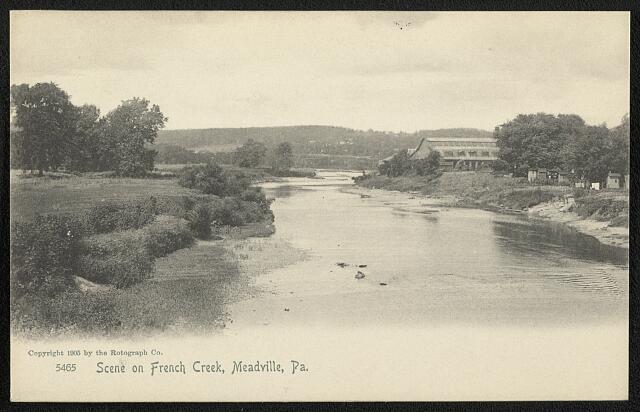
This is Hayfield Township in Crawford County, Pennsylvania, today:
The Brookhousers are the family I am talking about today, but before we get to them, there is a sentence that needs to be unpacked a little bit: “Dread of the Indians prevented improvement; but in 1796 that fear was removed…“
We talked about this in Fear of the Foreigner, recently. A century or more of violence between competing indigenous and European powers fed both rational and irrational fears of attacks on white settlers by the people they had displaced. The struggles between them were more complicated than the dynamic of colonizers vs. indigenous people, but when Dickson says “that fear was removed,” he is probably referring to two events: the Treaty of Greenville (signed in 1795 after the Battle of Fallen Timbers2) and the Treaty of New York (1796). Those were the treaties that ended the organized resistance to settlers from the new American government in what is now Ohio and western Pennsylvania.
And so, the Brookhousers arrived in Crawford County.
Settlement of the Brookhousers
The Brookhouser family moved to Woodcock Township in about 1797, and Adam Brookhouser, Jr. was born on 21 October 1803, the son of Adam Brookhouser (1776-1863) and Keziah Mason (1775-1860). Their family was counted in Meadville in 1800, and in Venango Township, Crawford County, in 1810 and 1820. When village of Saegerstown was incorporated in 1838, Adam Sr. and his two sons, Adam (Jr.) and Jacob, were counted among the early settlers.3
Writing about a man like Adam Brookhouser, Jr., presents the problem of oversimplification. We have a few records, a very nice headstone, and almost no details about who he was or what he was like. He was too young to be the Adam Brookhouser who fought in the War of 1812; that was more likely his father. He was too old to fight in the Civil War, though you can find online references in personal trees that suggest he was a Civil War veteran. And he died just two years after his father died, adding to the confusion over which records belonged to which man.
Adam Jr. was a farmer, descended from a German immigrant who fought in the American Revolution. He worked his land and raised a family of seven children on the land that his family felt they had won. Most likely, he was illiterate, and he signed his will with an “X” for his mark.
That will is the best evidence we have of his connection to (most of) his children and his wife, particularly the second section:
I give and bequeath unto my dear wife Mary all my estate both real and personal to have and to hold the same during her natural life, provided she remains my widow and after her decease (or marriage) I give and bequeath the same to my seven children to wit: Cornelia, wife of John Boyd, Nathan Brookhouser, Keziah wife of Ephraim Mills, Susana wife of David Jones, Martha Ann wife of Wm. Patterson, Orvilla Brookhouser and Phares Luther Brookhouser, to be divided amongst them share and share alike.
Three of Adam’s sons (Martin, Samuel, and William) died young, thus were not named in the will. The loss of Martin at age 6 in 1845, and of Samuel Augustus and William Marcellus (12 and 7, respectively) in 1853, certainly delivered a blow to the legacy he hoped to leave behind. By the time Adam drafted his will, it probably seemed unlikely that his two remaining sons would take over the farm. His eldest son, Nathan, had already moved west to Pottawattamie County in Iowa, and his youngest son, Ferris (or Phares) Luther was only 11 years old. That may be why he ordered that after the death (or remarriage) of his wife, Mary, all of his real estate and personal estate should be sold and divided between his surviving children.
Quintessential Acorns
We tend to see history in terms of great deeds and adventure, but the wars, treaties, and establishment of new governments are just that part of history that is visible above the surface. Underneath, those landmark events are the everyday and the normal. Planting and harvesting, caring for children, chores – those are just a few of the events of history that never make it into the Historical Record.
My wife and I started our first garden when we moved into our house a couple of years ago. When we moved into our house in Baltimore in 2005, there were two pine trees that I had to cut down and remove. In between those events, we remodeled two houses and took our children camping a thousand times. When I learn about an ancestor who cleared a field, built a cabin, and raised ten children in a place without running water or health services, that knowledge sits in the back of my mind until something reminds me.
Weeding our little vegetable patch and fighting off the squash borers one or two weekends a month reminds me that a farm family would have been depending on those squash for meals. The ache in my back after chopping up and bundling a single pine tree gives me a new appreciation for the effort expended to clear a field for crops. Sitting up with a feverish child waiting for medication to take effect or worrying in the emergency room while stitches are stitched gives me a taste of the helpless horror of watching a child die from some mysterious disease.
Historians and genealogists may sneer at the accuracy of these old secondary sources, like the Atlas of Crawford County, and they may be right to sneer at the biases of the editors and the over-reliance on the memories of survivors who are inclined to inflate the importance of their settler ancestors. But you can get a glimpse of the daily life of the farmers and tradesmen in these places and imagine how they spent their days, weeks, seasons, and years building their lives.
If all you have after spending 60 years in one place, doing all of those ordinary, daily things, is a record that you were there and a nice headstone, that is still history. And that is worth knowing.
- Combination Atlas Map of Crawford County, Pennsylvania, Compiled, Drawn and Published From Personal Examinations and Surveys (Philadelphia: Everts, Ensign & Everts, 1876); found at https://crawfordcopa.com/history/1876/hayfield, accessed 28 June 2025. ↩︎
- I believe my 5th-great grandfather, James Callin, fought under the Kentucky Cavalry in the Battle of Fallen Timbers. See Theoretical: James Callin’s Military Career ↩︎
- Bates, Samuel P. (Samuel Penniman), 1827-1902, Our country and its people. A historical and memorial record of Crawford County, Pennsylvania; Boston : W. A. Fergusson; 1899, pg. 667-668 (accessed 29 June 2025) ↩︎

 Mightier Acorns
Leave a reply to Anne Young Cancel reply