
In which we arrive in a world full of Johns Green(e)
For nearly ten years, I have held onto the notion that I was descended from one of the founders of Rhode Island – a surgeon named John Greene. I was very excited about the idea, and the research I did on his biography became one of my more detailed essays, Foundation Found, Providence Provided, on the original Mightier Acorns blog.
But, now I have finally done the legwork. And boy, there were a lot of men named “John Greene” in colonial Rhode Island.

The journey to get here has been tricky. We have looked at more than 10 generations of my ancestry, beginning with my great-grandfather, Alfred Tuttle. Along the way, we saw families that struggled to carve out lives in cold and remote parts of what was then the frontier of America. They lived next to significant places from American history, and they might not have left a lot of records behind, but what they did leave behind brought us this far.
And now, we have reached a point where I can go no further. Martha Greene married Joseph Matteson, and the record says her father’s name was John (Greene):

Further digging through the Rhode Island vital records reveals the birthdates of what are most likely Martha’s siblings, as well as her mother’s name:
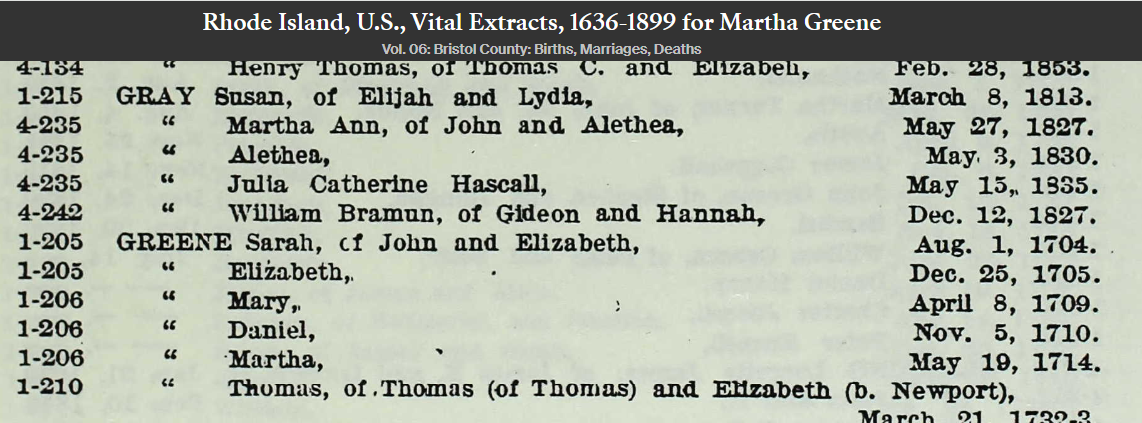
Note that these children’s births were recorded in Bristol County, while the other Greene and Matteson families we’ve been looking at were in East and West Greenwich, Kent County. In my original essay, I accepted the flawed evidence that showed my John Greene was the son of James Greene (c. 1626-1698), who in turn was the son of John Greene, surgeon. That particular James Greene had two sons called John – one of whom likely died young, and the other who married Mary Increase Allen (not Elizabeth) and whose children do not match the list of children belonging to our John Greene.
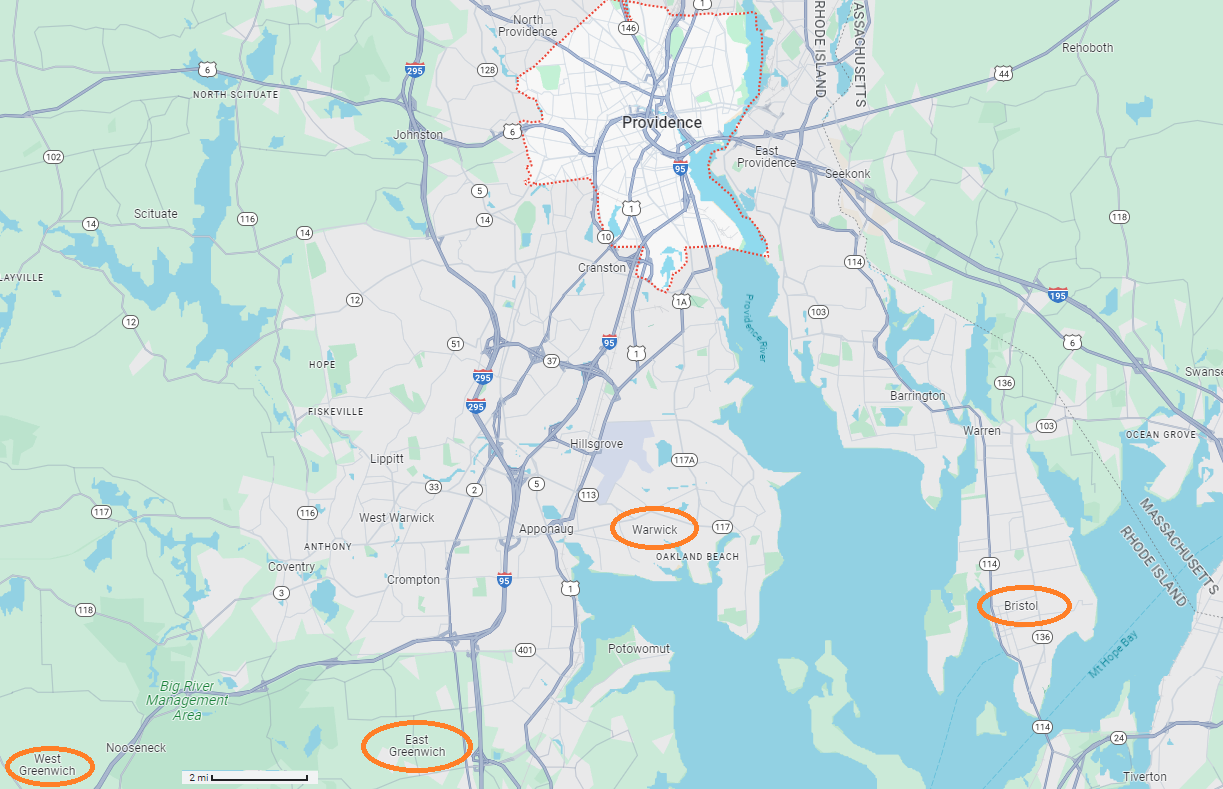
Here is a look at the area where we have found records for all of these Greene and Matteson families:
It is possible, but not likely, that we will be able to find the answers we’re looking for – but not without digging through primary sources and finding more clues. Other researchers who have looked for this family have settled on this conclusion for John Greene (abt. 1679-1747):
His origins are unknown at this time. He doesn’t fit into any of the Puritan Great Migration Rhode Island arrivals, those John Greene’s are ‘all spoken for’. Ship passenger lists, land and probate records after 1641 need to be researched to see if he can be further identified. Because this is a Pre-1700 profile, and because of his common name, primary source vital records are needed to establish a credible ancestry.
For now, we have arrived at the top of our ladder to Providence. We did not prove what I set out to prove, but we at least arrived in the right town. Along the way, we learned a lot and improved a lot of WikiTree profiles.
There is a certain amount of frustration involved in having to let go of a misimagined story that you have shared and invested in for a decade. But I don’t think it’s a mistake to imagine a goal or a story when you’re at the bottom rung of your ladder. The story can motivate you to find more information. Imagination can help you make sense of the clues, and when you are stuck with potential gaps – as we were when we needed to connect Harlow Wells to his grandfather, Greene Whitford – imagining his story helped us bridge those gaps.
Just be ready to let go of your story when the evidence reveals the gap between facts and imagination.


Say hello, cousin!