
That means all three things you think it means
Recently, I responded to a question posted by the WikiTree folks on their Mastodon feed:
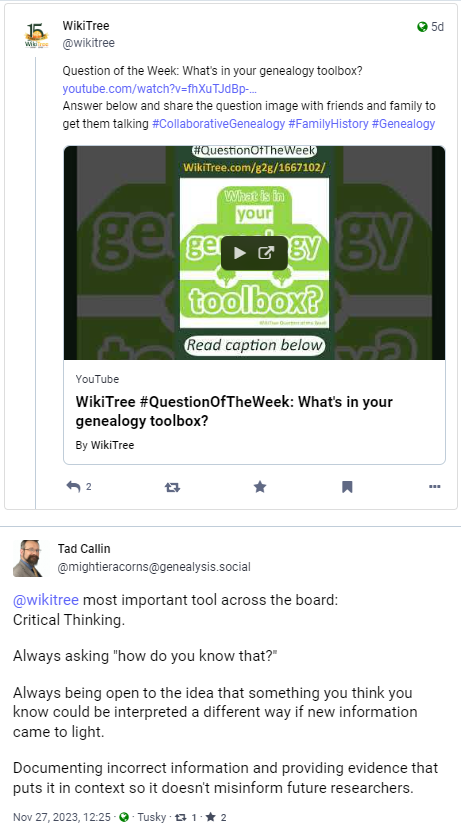
If you spend any time interacting with me, you will come to realize that “Critical Thinking” is my answer to almost any question. But not everyone understands what the term “Critical Thinking” means, and that sometimes causes trouble.
The Three Meanings Of “Critical”
Wikipedia’s article on “Critical Thinking” gives us a good starting point. Critical Thinking “is the analysis of available facts, evidence, observations, and arguments in order to form a judgement by the application of rational, skeptical, and unbiased analyses and evaluation.” But that’s not what everyone immediately thinks of when they hear the word “critical”.
If you put “define critical” in your search bar, here are the top three definitions you should get:
expressing adverse or disapproving comments or judgments.
“he was critical of many U.S. welfare programs”
expressing or involving an analysis of the merits and faults of a work of literature, music, or art.
“she never won the critical acclaim she sought”
(of a situation or problem) having the potential to become disastrous; at a point of crisis.
“the flood waters had not receded, and the situation was still critical“
Synonyms for that first definition include “condemnatory,” “disparaging,” “disapproving,” “fault-finding,” “judgmental,” and “pedantic.” The opposite of this definition of critical is “complimentary.” If someone gets angry at you for suggesting that they apply critical thinking to a problem, they probably think this is what you meant by “critical.” The third definition, with synonyms like “grave,” “dangerous,” and “hazardous” may also lead to misunderstanding.
That second definition is the one that relates to the desired kind of “critical thinking” with synonyms like “analytical,” and “explanatory.”
How Thinking Is Critical
When you are researching your family history, it is critical (definition 3) that you think critically (definition 2) even if that means criticizing (definition 1) the existing stories that you think you know about your family. As I said in my Mastodon “toot” critical thinking means:
- Always asking “how do you know that?”
- Always being open to the idea that something you think you know could be interpreted a different way if new information came to light.
- Documenting incorrect information and providing evidence that puts it in context so it doesn’t misinform future researchers.
These three statements work together and should be the foundation for all of your research. Every document, every public tree, and every fact you uncover should provoke that first question: “How do you know that?” If you’re lucky, the answer will be some reliable source – though you still have to ask that reliable source “How do you know that?” What makes a source reliable will depend on a lot of factors. Is it an official record? Is it an original copy (or a digital scan of an original)? Does the information match what other sources say about the same facts or events?
And if there isn’t a source citation supporting a story or fact, that isn’t the end of the inquiry. Perhaps you have an eyewitness account from a long-dead relative providing information about events that you can’t verify or disprove with records. Perhaps you have stories handed down about the same event through different generations that don’t match each other. Those stories can give insight into what your ancestors thought about events even if the stories themselves prove to be inaccurate or false. Just be sure to mark them as such – so that the next person asking “How do you know that?” doesn’t have to re-do the work you have done.
The Other Three Words
Throughout your process of finding and critically evaluating evidence, be mindful that you are staying rational, skeptical, and unbiased.
“Rational” means “based on or in accordance with reason or logic” – and that means keeping your emotional investment in the subject from making you ignore facts and evidence that contradict what you may want to believe. It does NOT mean that you aren’t allowed to feel excited or relate to the joys and tragedies of the family stories you tell. And you also can’t forget the emotional investments of others; discovering that something is (or isn’t) true may be shocking to relatives who have a different perspective from yours. If you find someone is behaving irrationally towards you or your research, be as kind and patient with them as you can be.
“Skeptical” is another word that has some negative baggage. Like “critical,” a lot of people associate “skepticism” with negativity and they often confuse it with “cynicism.” But a healthy skeptical outlook means that you are willing to ask questions that might imply that there are uncomfortable answers. Asking those potentially uncomfortable questions is how you figure out…
“Bias” – which is a prickly problem no matter who you are. Everyone has some built-in assumptions and shortcuts in their thinking that help them make sense of the world. Being “unbiased” is probably impossible, but constantly examining what your biases are and making sure you are behaving rationally despite them is the goal.
The Journey Is The Goal
Like a lot of things in life, this is about practice. You’re not going to instantly Be In Shape if you start doing modest daily exercise. You’re not going to become a scholar overnight. There are no easy tricks to get meaningful results.
But if you are always thinking critically about the things you read, and asking questions about your assumptions (and the assumptions of others), those habits will get you where you want to go.
Have you got an example of something you learned from asking “How do you know that?” Have you got a story that is important to your family whether it is exactly “true” or not? Share a comment – and subscribe to see updates.


Leave a reply to HAMP: Harmonizing Across Multiple Platforms – Mightier Acorns Cancel reply