Tad Callin has been working on family history and genealogy since the late 1990s. He does most of his research on Ancestry and posts what he learns to WikiTree.
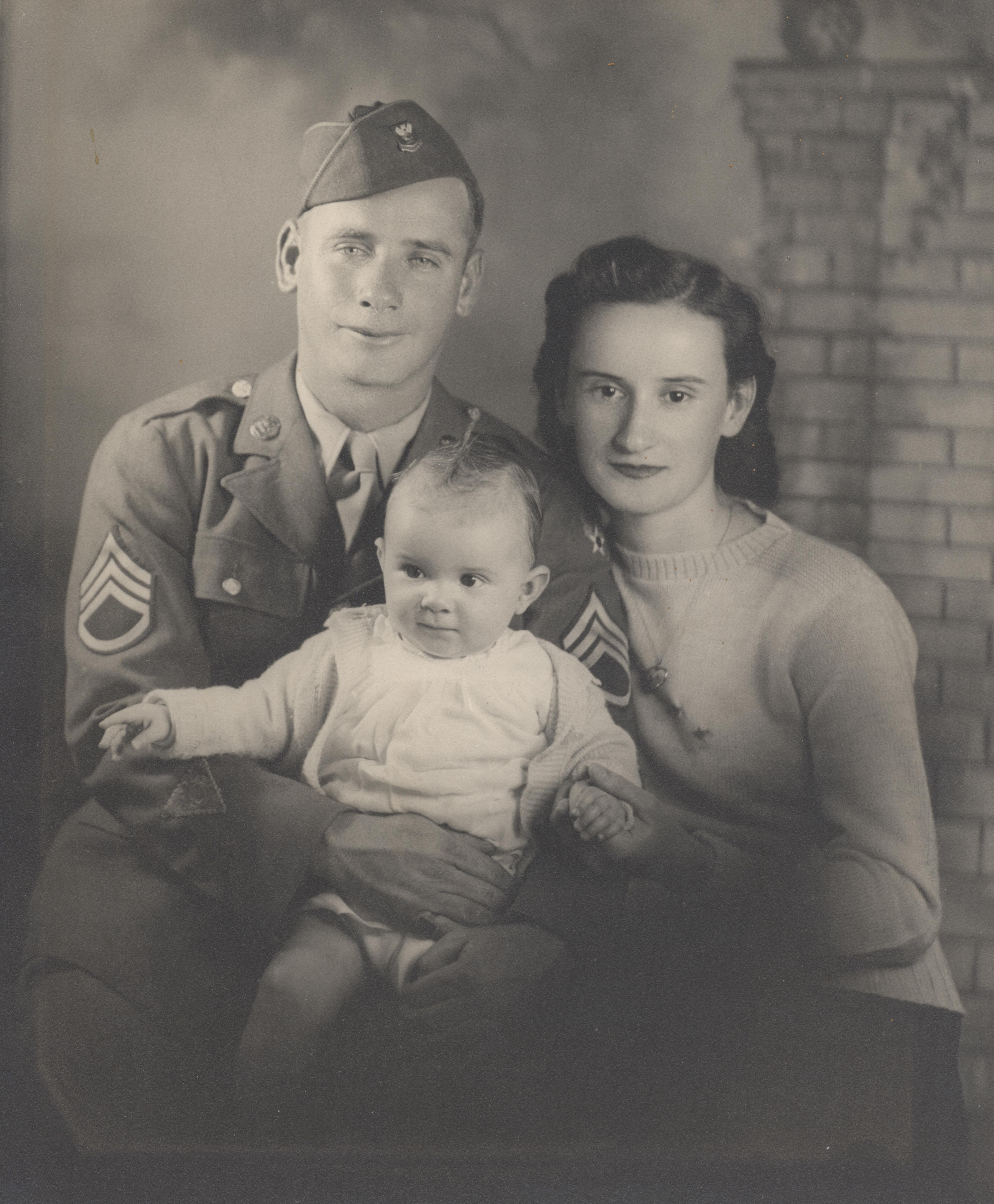
Vicki Lee Callin was born on 21 April 1943 to Bob and Nancy (Witter) Callin. Bob was an airman in the Army Air Corps (note the “Hap Arnold” star on his shoulder) serving at Luke Field near Glendale, and Nancy and Vicki probably spent a lot of time with her parents on their farm near Bethany Home Road.
1944: Vicki with Sgt. Bob Callin and mom, Nancy (Witter) Callin
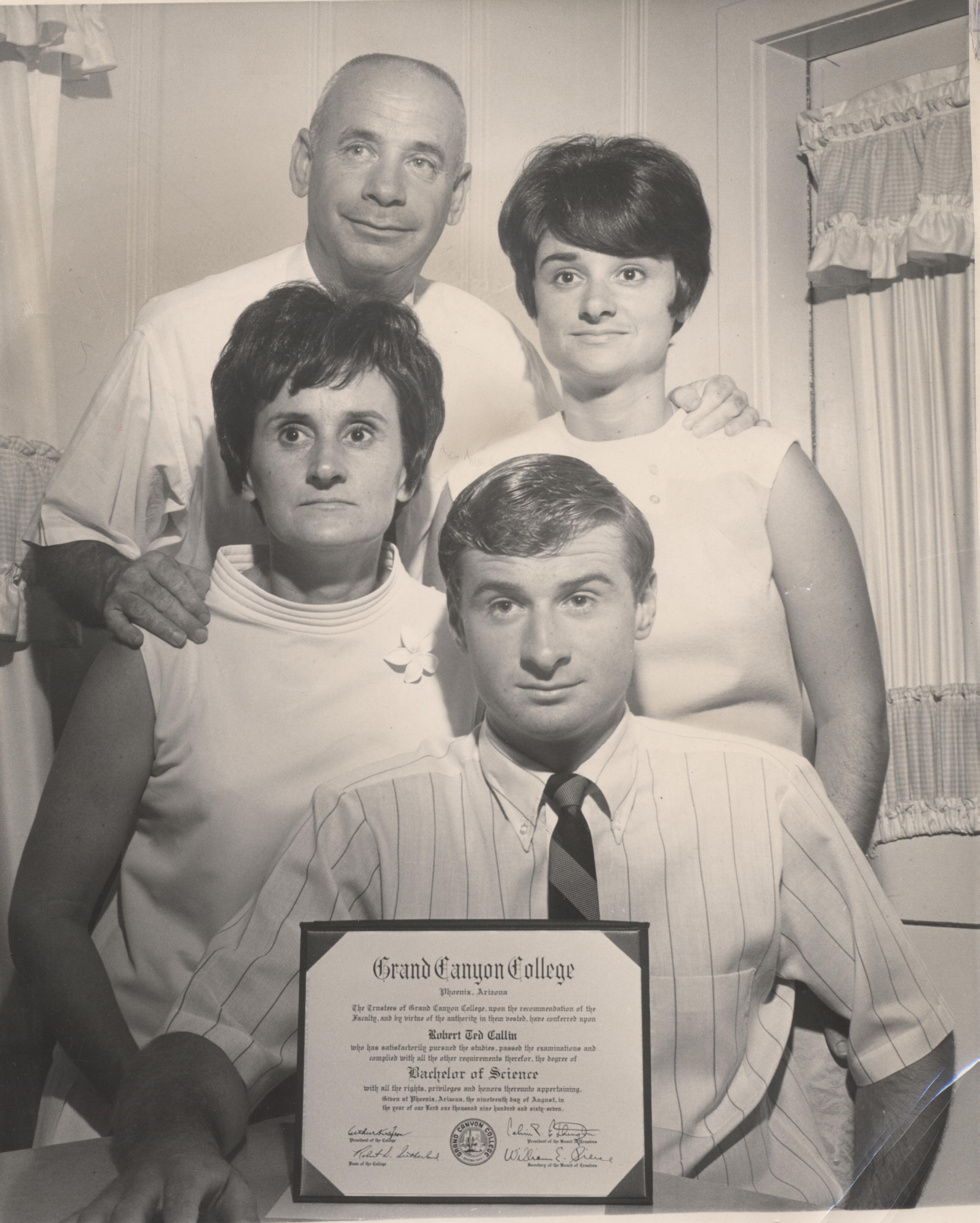
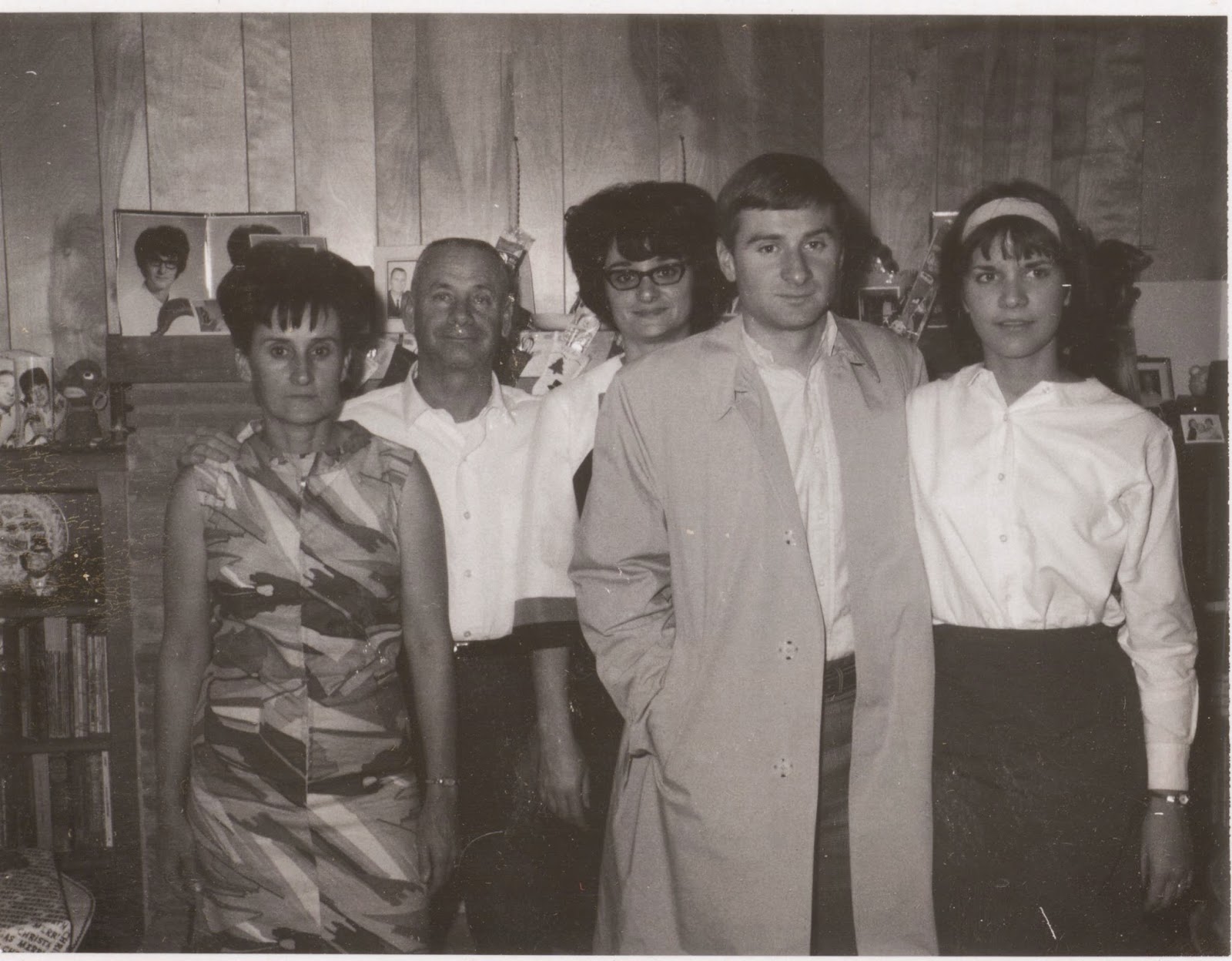
They had my dad after the close of the war, and Bob went to seminary in Texas before returning to Arizona and finishing his degree at ASU and Grand Canyon College. Nancy also went to Grand Canyon to get her teaching degree, and after Dad and Vicki graduated, their whole family was celebrated as Antelope alumni in 1968!
The Callin family: all Grand Canyon College alums in 1968
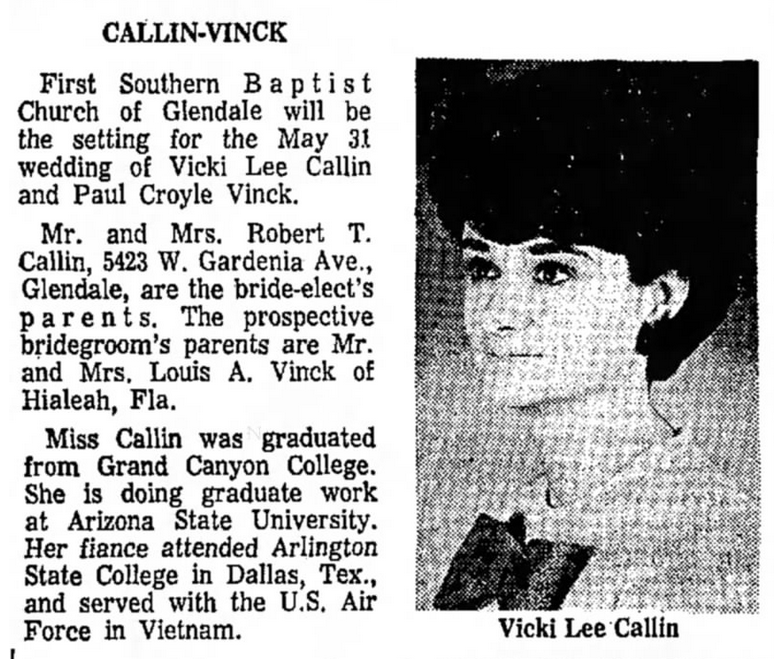
Vicki married her first husband, Paul, on 31 May 1969. They had two sons and adopted a daughter. Once they were old enough, Vicki started teaching English at Peoria High School in 1984.
Callin-Vinck wedding announcement, Arizona Republic, 4 Feb 1968
Vicki and Paul divorced in 1985 – my first memory of encountering a real-life divorce, and not just reading about it or hearing it discussed on Christian radio. She and Paul inadvertently taught me that divorce was not the family-destroying horror that I had been led to believe. It wasn’t an easy experience for anyone, but Vicki continued to run her home, manage her career, and raise three strong, happy adults.
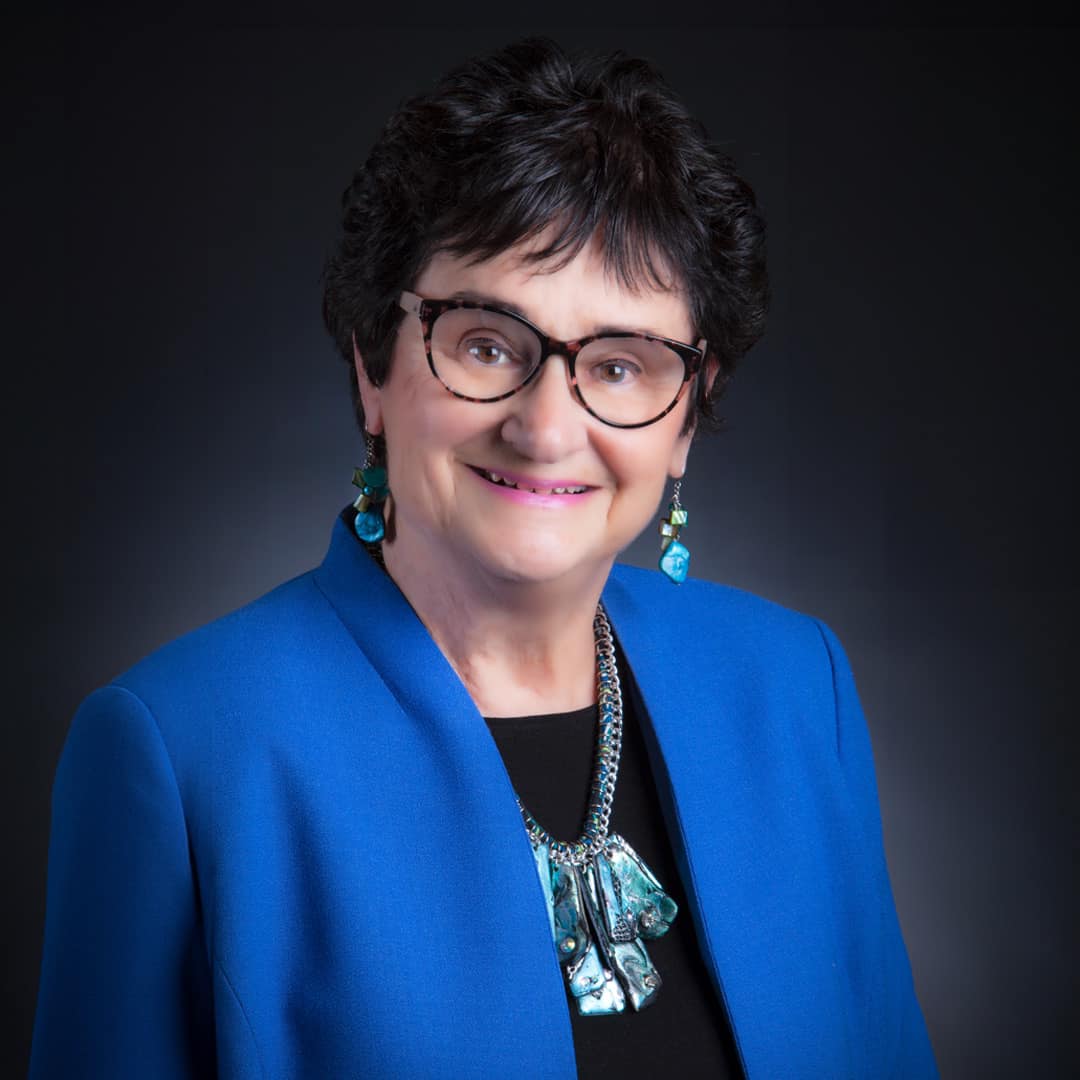
Vicki eventually remarried Tom Hunt, and after she retired from teaching, she got into local politics. She was on the city council from 2003 to 2010 and 2014 to 2022. Vicki was honored as the 2023 Peoria Independent Hometown Hero for Lifetime Achievement, and you can read about her lifetime of community work and achievement on the Peoria Independent website, where they included a video interview with her.
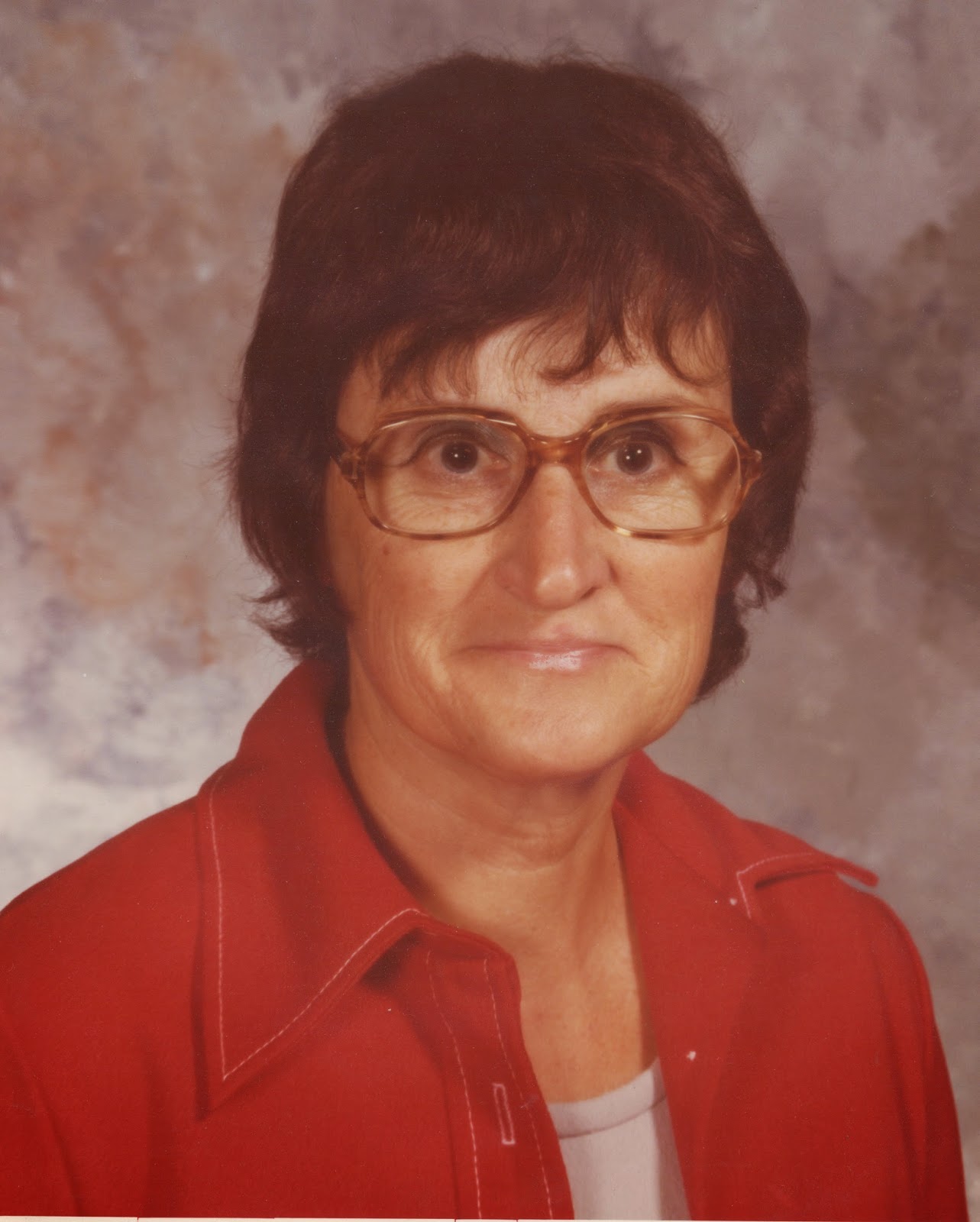
Portrait of Vicki Hunt from the City of Peoria Facebook page
Vicki was always the quintessential teacher, in my mind. She was a strong believer in her Christian faith who worked hard to strike a balance between walking her faith and giving other people room to walk theirs. When you hear her talk about God’s purpose for her in her interview, you see what drove her; but for her students and constituents, she knew to allow them the leeway to find their own way to their own purpose. As long as a person was doing their best to care for themselves and those around them, Vicki was there to support them.
She was always kind and generous to my children, even though we lived 2500 miles away in Baltimore and rarely got to visit. One of my favorite memories was our recent visit to Arizona in May 2022. Vicki took time to pull my wife, Kate, apart from the group to ask about our son, Lars. She knew we had taken him out of the public school system because the Baltimore County middle school he attended was not supporting his independent education plan after his autism diagnosis. She talked to Kate about her experiences homeschooling him and praised her for doing such a good job, getting him through his 8th-grade year and back into high school. The effect on Kate of having an award-winning educator recognize her accomplishment was profound, and we will always be grateful that she took the time to tell her that.
Vicki died unexpectedly on 25 July 2024. At 81 years of age, she was still taking care of her family, still thinking about their futures, celebrating a recent wedding and new careers.
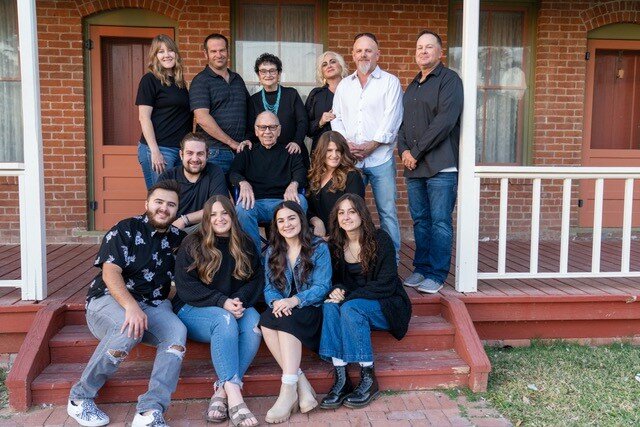
clockwise from the top-left: Carolyn, Chad, Vicki, Tabor, Jeff, Barry, Katie, Addison, Reagan, Macie, Alex, Ryan, and Tom Hunt in the center.
Vicki will be missed – and in our family, that means that when we gather, we will swap stories about her, share her jokes, and through her, remember those who came before. And in her community, the people and programs she promoted will carry on. Visit the Oral History project at “What’s Happen’ ‘n Art Movement” association to see part of her legacy.
Of course, this is a Scandinavian family, so the concept of “surname” is not exactly as simple as that. Ingeborg Olesdatter was the child of Ole Sivertsen (b. 1827) and Ingeborg Eriksdatter (b. 1831). She was born on 1 June 1858 in Byneset, a parish in the county of Sør-Trøndelag, Norway. Her family’s farm name was Svedal, one of the farms near the village of Aunet. When Ingeborg and her family came to the United States during the 1880s, several of them used variations of “Svedal” or “Swedahl” as their surname. (To keep things simple, assume that the spelling I use for each of them is the spelling seen on their grave markers, where I could find one.)
Ingeborg’s older brother, Erik Swedal (or Erick Olsen), was born on 16 Sep 1855 in Byneset and married Anna Arnsen (born “Anna Arntsdatter,” 1875-1958) in 1880. They arrived in New York on 24 May 1886 aboard a ship called the Republic. Erik’s parents and three of his brothers (John, Sivert, and Ole) traveled together. They settled in Todd County, Minnesota, and raised eleven children on their farm in Iona.
Her next younger brother, Michael Svedal (born Mikal Olsen), was born in Byneset on 17 Feb 1863. While he doesn’t appear in the same emigration record as his parents and brothers, he probably emigrated around the same time (1886), later enlisting in the U.S. Army from 1890 to 1891. He married Johanna Marie Graneg (1860–1947) in 1893, and they adopted a daughter, Nora, whom they raised in Saint Paul, Minnesota.
Sivert Svedal (born “Sivert Olsen,” son of Ole Sivertsen) was born on 6 Dec 1865 and came over with his parents in 1886. He married and settled in Iona, Todd County, Minnesota, where Erik lived. Sivert and his wife, Bertha (born Bergetta) had a son and a daughter before Sivert’s early death in 1897.
Born “Johan Olsen,” on 23 Jun 1868, John Olson Swedahl came over with his parents (see above), settling in Saint Paul. He married Mary Carman (1872–1905) in 1898, and after her death, he married Christina Fryklund (1869–1935) in 1907 in Pepin, Wisconsin. John and Christina raised one son and one daughter in Saint Paul.
Andrew Swedall (born Anders Olsen) was born in on 6 Apr 1871 and appeared in the 1875 Norway census, but when his family emigrated on 5 May 1886, he and his older brother Michael were not listed. It’s likely the two brothers traveled separately for some reason. Andrew Sweedahl is listed at the same address in Saint Paul as John and Ole Sweedahl in 1890 – so that is probably him. Andrew Swedall married Katie Hermann (1870-1957) and lived in Saint Paul.
The younger Ole Olsen was born on 16 Dec 1878 and seems to have chosen a more adventurous life than his brothers. “Oliver Swedahl,” as he was usually recorded, lived in Montana and then moved up to British Columbia, Canada, where he was naturalized in 1912. He seems to have remained single, and I see no records of children. He was 98 years old when he died on 11 Mar 1976.
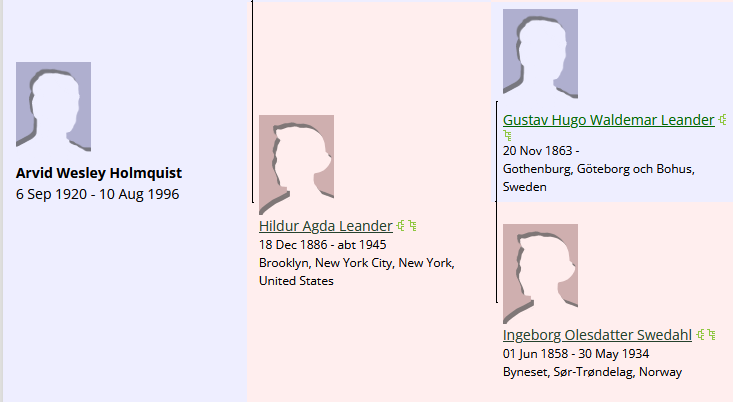
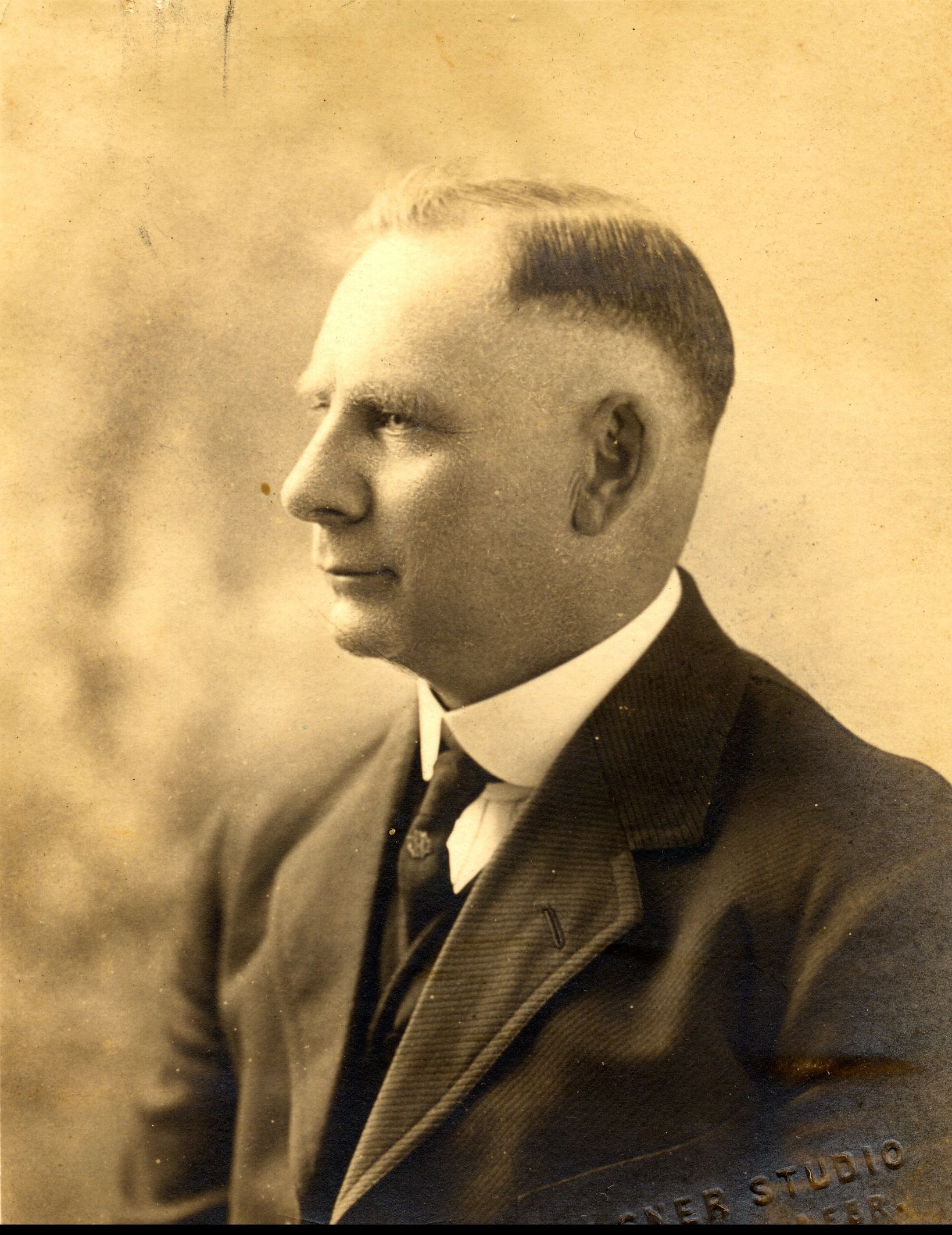
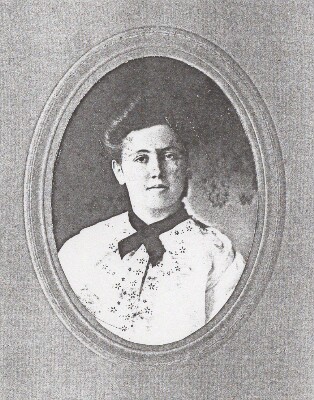
After arriving in the United States, Ingeborg married Gustav Leander – which you might recall from this previous post.
If you have any Swedal/Svedal/Swedahl ancestors from Minnesota, there’s a good chance you might be connected to this family. I have a lot of work to do before I can put them into WikiTree, so please say hello and let me know you’re there!
I removed the lists of Prof’s descendants for space. His children are linked from his WikiTree profile if you’d like to learn more about them.
I added information about Prof’s third wife, Ella, who I did not learn about until a couple of years after the original post went up.
If you happen to be one of Prof’s Progeny, drop me a note, or leave a comment!
Prof’s Progeny
In our earlier post, 20th Century Callin Clan, we recounted the colorful lives of the children of Civil War veteran John Henry Callin and his wife, Amanda Walker. This week, we will take a look at the descendants of their eldest son:
Byron Herbert “Prof” Callin (1874-1933) was a complex character. Studying his life, and tracing the records he left behind, it is clear that he was driven by ambitions and desires that conflicted with each other. His choices drove him to abandon his family – more than once – and led to his untimely death. There are a lot of questions we won’t be able to answer, and I will try to stick to the facts – but know that there are some parts of this story that are still contentious, and the implications of what we know happened may provoke some strong opinions among his survivors.
Byron Herbert “Prof” Callin (1874-1933)
Byron was a precocious student, and a well-known teacher from the time he received his teaching certificate at age 16. His nickname, “Prof,” came from his identity as a teacher, and it seems clear that he inherited his love of learning from his father. Prof seemed to have ideas about how the family name should be pronounced (“Collin,” with the round “ah” sound instead of the flatter “a” of “Callin”), and later in his life, he seems to have preferred to be called “Herbert” instead of Byron, feeling that Herbert was more refined.
He married his first wife, Frances Edith “Fanny” Muir (1873–1946), on 18 July 1896, when he was 21 years old. She was the daughter of one of the Scottish settlers that gave Scotch Ridge its name. John D. Muir (1841–1920) was the son of James Muir and served as a commissioned officer in the Civil War.
Byron and his father-in-law both featured in the local history of Wood County published in the late 1890s, each receiving their own hagiographic sketch. The impression this gives me is that Byron, as the son of one Civil War hero, felt some societal pressure to marry the daughter of another such war hero. The couple’s fathers may have put them together, and the connections between the Callin and Muir families through the United Brethren Church may have also added to that pressure.
Byron and Fannie moved to Dayton, where Byron was teaching in 1900; but not long after that, Byron took a teaching job in South Dakota, and left Fannie in Ohio. They had no children, and it seems to me that either Byron felt the Pull of the West (and Fannie did not), or the couple thought that after some time apart, he would return to her. Regardless of their intentions, Byron was living in Aberdeen, South Dakota in 1905; and by 1910, Fannie Muir was divorced, and living in her father’s home in Webster Township.
Ruby Mary Cole Callin (1885-1973)
Byron soon remarried. His second wife was Ruby Mary Cole (1885–1973), and it was during their courtship that Byron was injured by his shotgun during a hunting trip. As the story goes, he and Ruby were riding in a buggy, when the horse became spooked. In the subsequent furor, the gun that he had in the front of the buggy discharged and struck him in the right side of his jaw. He carried a terrible scar on his face for the rest of his life – and in the portrait above, you will note that he keeps his right side turned away from the camera. According to Truman Matcham, Byron’s nephew, the family was always suspicious of the story and felt there was more to it than Byron would admit.
Ruby was born in Shabbona, De Kalb County, Illinois, where her parents met. Her father, Elijah Cole, moved the family to South Dakota when she was in her teens. While it isn’t clear how long Byron was in South Dakota before he divorced Fannie, he and Ruby were married in 1906 – and they had three daughters in their household by 1910.
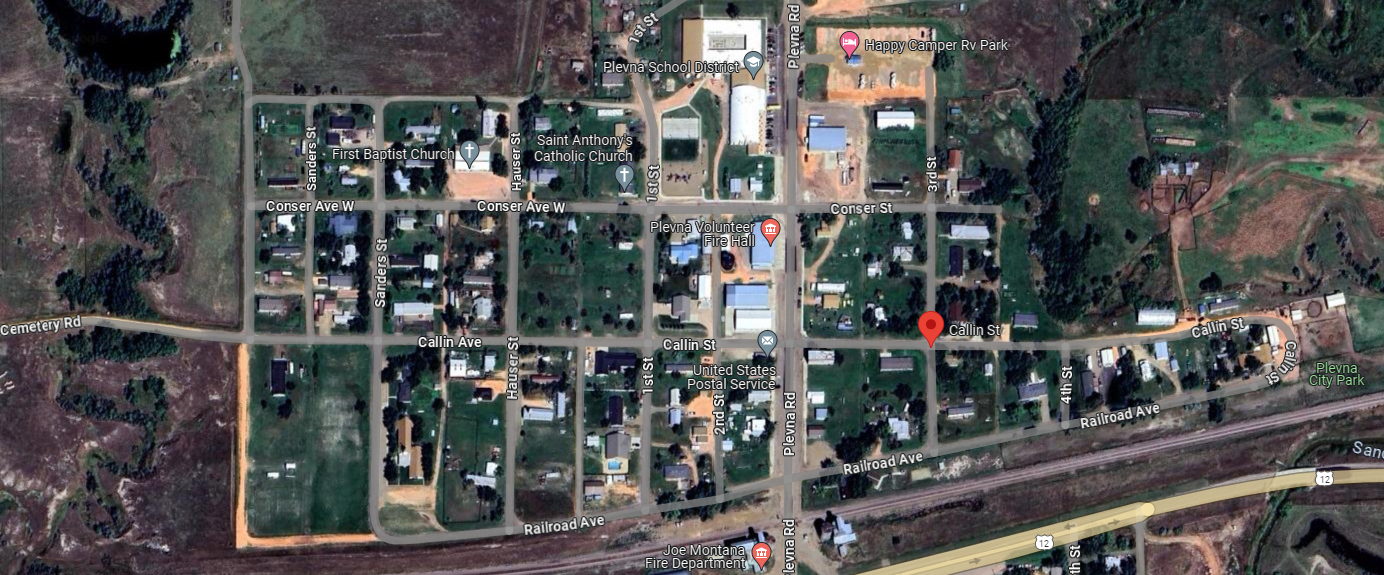
Byron was very much on the move during these years. His children were each born in a different state – Opal in Minnesota, Elda in South Dakota, and Pearl in Montana. Byron was so highly regarded by the town of Plevna, Montana, that they named the main East-West road “Callin St.” (Callin Ave. on the west side). Known then as Herbert Callin, he was the town’s first postmaster and owned the only store “in the midst of the wide prairie.”1
See Plevna, Montana, on Google Maps
In 1915, the family was settled in Middlefield, Otsego County, New York – known today as the site of Cooperstown – and they remained there for several years. Byron stayed put until 1923, when he moved the family to Reading, Pennsylvania; after that, it isn’t clear where they went, but probably by 1925, Ruby and the children were living back in Ipswich, South Dakota, and Byron stopped appearing in the records.
There is no nice way to say that Prof abandoned his family, but I am told that this is how they felt about it. Around 1930, he divorced Ruby.
Herbert appeared in 1929 in Coudersport, Potter County, Pennsylvania, where he was married to Sarah “Ella” Estright (1887–1931). Ella was the daughter of Samuel James Estright (1858–1956) and Hannah Lucas (1863–1940). She was born in Sep 1887 and grew up in Milesburg, Centre County, Pennsylvania, remaining at home until at least 1920. H.B. Callin and his new wife ran the Ohio Lunch service station and restaurant, which was quite successful. The couple spent their winters in Florida, and in Jul 1930, they sold their business and moved permanently to Panama City, Bay County, Florida, where their daughter, Dot, was born in Jan 1931. Sadly, Ella’s death in Panama City was reported in Coudersport in April 1931.
Left alone to raise a baby girl, Herbert quickly remarried Georgia I Hancock (1910-1996) in 1931. Georgia was the daughter of Robert Daniel Hancock (1874–1952) and Arleta Weaver (1874–1955), born on 17 Sep 1910 and raised in Alford, Jackson County, Florida. Herbert and Georgia had another daughter in Jan 1932, less than a year after Dot was born. Then, not quite two years later, Herbert died on 30 Nov 1933 at age 59 after being shot by his sister-in-law during a family disagreement in Alford.
On 29 November 1933, there was an altercation involving members of the Hancock family and Prof. According to reports in the Palm Beach Post on 30 November:
Alva Hancock, 23, was In the Jackson county jail Wednesday night charged with the slaying of her brother-in-law, H. B. Collins, about 62, in a family quarrel at Alford. “I won’t be here long,” she told officers after calmly reciting details of the killing. Officers quoted her as saying she shot Collins only after he had shot and wounded his wife, who Is Alva’s sister, and had also fired at her father, R. D. Hancock. A charge of buckshot struck Collins, and he died almost instantly, Coroner Douglas H. Oswald reported.
A few months later, in May 1934, the same paper reported that the Grand Jury had not indicted Alva, but she was under investigation for firing a shot at her sister, Georgia. Without other records, it’s hard to say exactly what happened that night. Herbert was buried in Mount Hope Cemetery in Lynn Haven, Bay County, Florida.
Georgia raised her daughters independently until 1942 when she married Abner Mondell Peacock (1889–1973). Georgia and Abner remained together until he died in 1973. Both of her daughters married career military men, one an Air Force technical sergeant, and the other an Air Force colonel. I hope someday to add their children and grandchildren to this history.
Florence was the paternal grandmother of my maternal grandmother, Alberta (Tuttle) Clark. Florence was also the subject of “In Search of Lovey Hart” – one of the solid, lower rungs on my “Ladder to Providence” series. She was the daughter of Seymour C Hart (1851–1934) and Hattie Isette Wells (1854–1879), born on 2 Nov 1874 in Clinton, Worcester County, Massachusetts. Her mother died when Florence was 5 years old, and she went to live with her grandmother: Hattie’s mother, Sarah (Fletcher) Wells, also in Clinton, Massachusetts.
Florence was an only child and didn’t seem to have grown up around other children. Her father remarried, but not until 1890; Florence married the following year, and the older of her two half-siblings, Charles, was born the year after that. Charles never had children, so we don’t expect to find any close cousins with the surname Hart; Florence’s half-sister, Harriet (Hart) Schaub, did have a daughter, two grandchildren, and great-grandchildren.
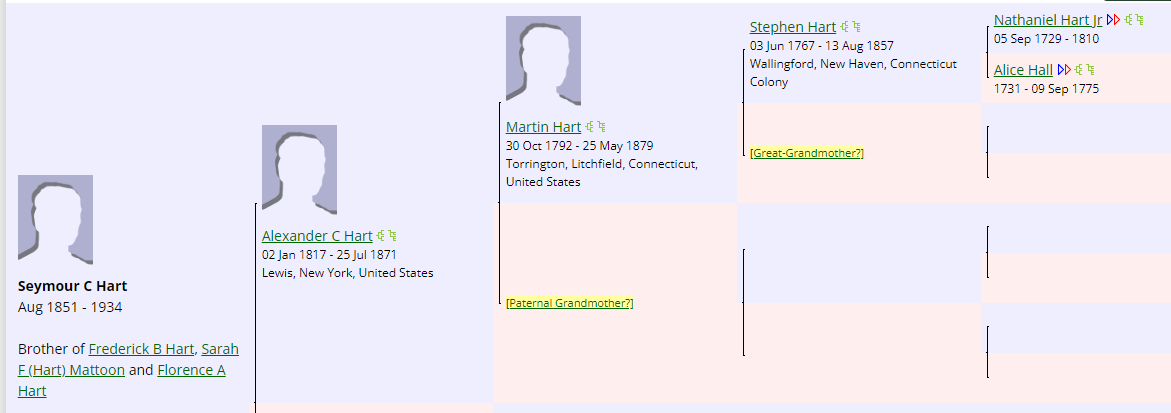
Seymour Hart was the youngest of four children born to Alexander and Frances Hart in Lewis County, New York. We do have information about his paternal line for several generations, thanks to the Hart Name Study on WikiTree.
Ancestors of Seymour C Hart
Alexander raised his family in Utica, New York, where he was a partner in a business that produced mill equipment – a business he learned from his father, Martin. I was able to determine that Martin was married to Sarah (or Sally) Collins, but I was unable to confirm whether Sally was the mother of Alexander or of his sister, Sarah.
Martin Hart was the son of Stephen Hart (1767–1857) and Eunice Seymour (1768–1848), born on 30 Oct 1792 in Torrington, Litchfield County, Connecticut. His family relocated to Turin, Lewis County, New York, in about 1800. Martin had six siblings who survived to adulthood, so there may yet be an unknown number of distant Hart cousins out there to find.
If you have a Hart in your tree, and you think you might be one of those cousins, say hello!
I recently contacted the Allen County Public Library genealogy department with some questions. According to WorldCat, they hold the only copies1 of The Berlin Family, compiled by Reginald L. Berlin and Terry Johnson-Cooney and published by Roy Rushka. There are five volumes, and it looks like my Berlin family is in one of them. They kindly sent me scans of the relevant pages, which answered one question… but raised many, many more.
If you have the Berlin surname (or one of its variations) in your tree, maybe we can shed some light on this puzzle, and find more pieces.
In 2018, I wrote this on my other Mightier Acorns blog:
When you sit down to solve a jigsaw puzzle, you have a few advantages working in your favor. Usually, you know that you have all of the pieces in your box. Usually, you have a picture on the box to show you what your solved puzzle should look like. Most importantly, you know that only the pieces that should fit together will fit together.
Solving a family history puzzle is the opposite of all of those things. You probably don’t have all the pieces and you probably never will. The picture on the box may not have been labeled properly, and when you do find clues, they may add up to give you three or four different answers – sometimes, even the right one!
Today, I’m taking a fresh look at the family of Elizabeth Berlin, rebuilding the case I made in a post from 2016.
If you visit those two earlier blogs, you might see some flaws in my work that I missed – so if you’re interested in helping me solve this puzzle, please go take a look at them.
The Pieces
To summarize the puzzle pieces you are about to see today:
The Callin Family History – a secondary source gives us our starting point with key facts.
Rosemary’s memories – not solid evidence, but hints about Elizabeth’s heritage.
William and Elizabeth’s marriage record – confirms the marriage date and names.
The Wood County History – a secondary source with some information on Elizabeth’s parents.
The Berlin Family History – another secondary source with important clues.
The U.S. Federal Census – several primary sources that help tie the story together.
The Ashland County history – a secondary source that adds more clues, and ties some of the census records into a narrative.
Record of William Callin, 3rd son of John Callin, who was 2nd son of James 1st. Born May 10, 1813, died Nov. 9, 1881, at Bowling Green, O.
Married to Elizabeth Barlene 1837 who died Nov. 14, 1903, at Bowling Green, O., aged 86 years.
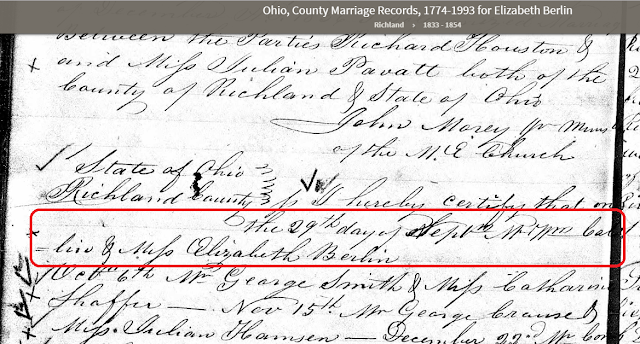
The information in the CFH led us to a marriage record:
Detail from Ohio, County Marriage Records, 1774-1993
Despite the florid handwriting and odd line break, it is easy to see that “Mr. Wm. Cal-lin and Mifs Elizabeth Berlin” were married on the 29th day of Sept. in Richland County, Ohio, in 1836. (I had to crop the part of the image that showed the year, but you can see the full page if you follow this link to Ancestry.)
Notice the CFH says William married Elizabeth Barlene in 1837, and the marriage record says he married Elizabeth Berlin on 29 September 1836. The year is close enough, and the spelling of her surname suggests that a combination of pioneer illiteracy and varied pronunciation could complicate things for us. Those spelling variations might be clues to how the family pronounced their name.
Rosemary’s memories
I recently reposted Silk or Satin, a short record written by Elizabeth’s granddaughter, Rosemary (the youngest daughter of George Callin, the writer of the 1911 Callin Family History) of her memories of Elizabeth after she died in 1903. It doesn’t give us a lot of clues to Elizabeth’s parentage, but it demonstrates that even Rosemary wasn’t sure how to spell Elizabeth’s maiden name. She titled her memoir, “Things I Have Been Told About My Grandmother, Elizabeth Berlien (Barline) Callin.”
Rosemary also comments on Elizabeth learning to read when her sons went off to fight in the Civil War: “This was probably not too hard for her as those “Dotsch” are good at everything anyway.” It would seem that the family was aware of Elizabeth’s German heritage.
The Wood County history
Pages 923 and 924 of the Commemorative Historical and Biographical Record of Wood County, Ohio have a biographical sketch of my great-great-grandfather, John H. Callin, son of William and Elizabeth. The description of William says: “In 1835, he married Elizabeth, daughter of John Barlin, of Ashland…”
Since Ashland County, Ohio, did not exist in 1835, when the Wood County book says William and Elizabeth were married, the book (which was published in 1895 or 1897 depending on which edition you find), probably refers to the counties as they existed in the 1890s. Ashland County was formed in 1846 from parts of Huron, Lorain, Richland, and Wayne Counties. When the Wood County book says “Ashland,” it could mean one of those other counties – most likely Richland, where William and Elizabeth were married.
The Berlin Family history
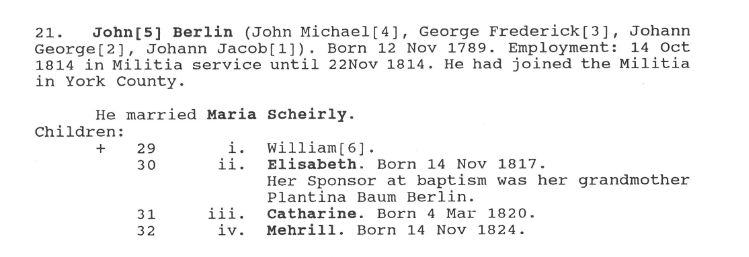
This is the new information I have acquired from Allen County Public Library. Here is the section showing Elizabeth’s parentage:
detail from page 17 of Vol. IV of The Berlin Family, compiled by Reginald L. Berlin and Terry Johnson-Cooney
The preceding page shows the will of John’s father, named here as “John Michael” – the will of Michael Berlin was recorded in Manheim Township, York County, Pennsylvania. (Take note: York County sits “on the Maryland state line” – this will be relevant later.)
The Berlin Family History also shows that this Berlin family was German in origin. That fits with the various misspellings we see in the records, suggesting that the family spelled the name “Berlin” if they were literate and that they pronounced the name in the German manner – something like “bear-LEAN” – which clerks and census takers did their best to transcribe phonetically.
The U.S. Federal Census
Elizabeth and William are thoroughly documented in the Census; William is listed in 1840 in Milton Township, and Elizabeth and the children are listed with him by name in the subsequent records, 1850-1880. Elizabeth is also listed as living in Middleton, Wood County, with her son, John, in 1900. That record gives her date of birth as Nov 1817, which matches what the Berlin Family history states.
We also have the following records that may give us more information about her parents:
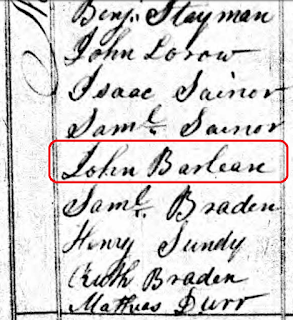
1830: Mannheim Township, York County, PA – John Barling is listed as head of household. His age is given as “40-49” putting his date of birth between 1781 and 1790. His wife would be between “30-39” and their household included one male “10-14” (possibly William), one female “10-14” (Elizabeth, perhaps), and two females “5-9” (could be Catharine and Mehrill).
1840: Mifflin, Richland County, OH – John Barlean is listed as the head of household. Mifflin is located in the southwest corner of Richland County; Milton Township is in the center-north of the county. The Barlean household is enumerated as having one male between ages 50 and 59 (presumably John, putting his birthdate between 1781 and 1790), one female between 50 and 59, and one female between 15 and 19 (possibly Catharine).
Detail from the 1840 U.S. Census for Mifflin, Richland County, Ohio
In 1850 and 1860, people named John and Mary Barlin were listed in Hoaglin, Van Wert County, Ohio; in both records, their household includes a girl named Elizabeth Barlin, born about 1848. It is unclear whether this couple is the same John and Mary Berlin who would be our Elizabeth Berlin’s parents – their birth dates do seem to match what we observed in the other records.
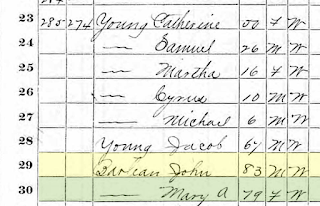
1870: Vermillion, Ashland County, Ohio – 83-year-old John Barlean and his wife, Mary A (age 79), are listed in the Young household. The head of that household is Catherine Young, 50 years old, and born in Pennsylvania – a match to the Catherine named in The Berlin Family.
Detail from the 1870 U.S. Census for Vermillion, Ashland County, Ohio
The Ashland County History
Catherine’s eldest son, Samuel, is featured in a biographical sketch in A. J. Baughman’s History of Ashland County, Ohio, published in 1909, which says (emphases are mine):
He is a son of Michael and Katharine (Berlean) Young, both of whom were natives of Pennsylvania as were the paternal grandparents, Mathias and Mary Young. … The maternal grandparents of our subject were John and Mary Ann Berlean, who were likewise born in the Keystone state and died in Ashland county. …John Berlean served his country in the war of 1812 and was at Baltimore during the hostilities there. The Berlean homestead, upon which the mother of our subject was born, was situated in Pennsylvania on the Maryland state line. …Michael Young …accompanied his parents on their removal to Mifflin township about 1829 and Katherine Berlean arrived about a year later [apparently after the 1830 census]. They were married here and became residents of Mifflin township, taking up their abode on a farm within its borders immediately after their marriage and remaining there until called to their final rest.
So, despite the 1850 and 1860 census records posing some problems, I think it’s safe to say we have successfully tied Elizabeth Berlin to the right parents, and to her sister, Catherine (Berlin) Young. We still don’t know for certain when John and Mary died, but this collection of evidence suggests they died between 1870 and 1880 in Ashland County, Ohio.
Questions
Who is that other John Berlin?
A lot of researchers who have this family in their online trees attach an extensive pension record for another John Berlin who fought in the War of 1812. If you have access to Fold3.com, you should be able to view it here. It gives a lot of information that doesn’t match our family; this John Berlin married his first wife, Anna Coy, who died about 1829, then married his second wife, Catherine Landis (or Landes) in about 1831 in Columbiana County, Ohio. Notably, this family also lived in Van Wert County, Ohio, in the 1850s, which overlaps with the 1850 and 1860 records we discussed above. So, John and Catherine Berlin would have lived in Van Wert County at about the same time John and Mary Barlin appeared in Hoaglin. However, I have not yet found John and Catherine in the census for Van Wert County. This is why I’m reluctant to include the records for John and Mary in my timeline.
This other John Berlin (Catherine’s husband) is the one who died in Stark County, Ohio, in 1874; so if you see his FindAGrave memorial attached to our John Berlin, that is a mistake. We have not yet found a record, but our evidence says John and Mary Berlin died after 1870 in Ashland County.
What do we know about our John Berlin’s service in the War of 1812?
Short answer: very little. There are records of men named John Berlin in the muster rolls of two other Pennsylvania companies, but all I have found is their names. One is a private listed in “Hill’s Regiment” (no further information) and the other is a private in Findlay’s Battalion, Pennsylvania Vols. Those muster rolls have no dates, no personal info – and no obvious clues. (I’ve looked in Ancestry, Fold3, and Googled extensively, but I’m sure there are sources I haven’t found, yet.)
What we know is that there are at least three different men named John Berlin who served in that war – and the one from our Berlin Family history does not match what we know about the man who married Catherine Landis. We also don’t know which of these other two men was the son of Jacob Berlin and Eva Carbaugh described in the Westmoreland County history (which I discussed in the 2018 “Spellchecking the John Berlin Mystery” post).
Who was Maria Schierly?
There is no clear evidence that tells us when Maria Schierly married John Berlin and no clear information about her birth or death. Other researchers have attached German birth records to her, and while I can’t rule out that possibility, the evidence suggests she was born in Pennsylvania. Of course, the records I discuss here assume that she is the same “Mary Barlin” we see in the Census records and histories of Wood and Ashland counties. She might not be.
She is most likely the mother of the four children named in The Berlin Family, but until we find more evidence, that’s all I can say.
For now. Let’s see what another year of research brings.
Thanks for reading Mightier Acorns! Subscribe for free to receive new posts and updates.
To clarify: ACPL has the only library copies I’ve been able to locate. My 3rd cousin, John Callin, has a copy of the volume with Elizabeth’s family, but I haven’t been able to get a full copy of the five-volume set for myself.
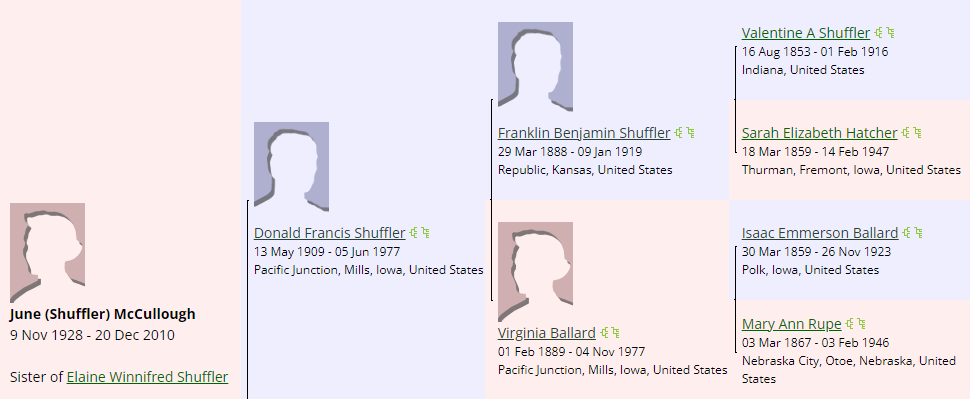
This surname can be found among my wife’s Sixteen great-great-grandparents. We have to go that far back to find our first Ballard, the paternal grandmother of my wife’s paternal grandmother, June (Shuffler) McCullough:
The paternal ancestry of June (Shuffler) McCullough
You might remember Virgie from The Ballad of Mrs. Steele a few weeks ago. She was the titular Mrs. Steele. Her parents were Isaac Emmerson Ballard (1859 – 1923) and Mary Ann Rupe (1867 – 1946). Her father was a former drayman who later became a railroad man, working as a brakeman on the trains that passed through Pacific Junction. Sometime after 1900, though, Virgie’s parents divorced, and in 1904, Isaac married a girl from Saint Joseph who was nearly half his age and moved with her to Oakland, California. It seems likely that Isaac was not at Frank and Virgie’s wedding in 1907.
Isaac E Ballard had five daughters with his first wife and a daughter and a son with his second wife, Edna May Purvis (1879–1972). His son, Ellis Emmett Ballard (1912–1987), had seven children – Virgie probably never knew these half-nephews and half-nieces, but they would be the only Ballard cousins to the four Shuffler boys.
Isaac’s parents were Isaac D Ballard (1817–1891) and Mary Ann Keith (1822–1894). They were married on 4 May 1841 in Vermillion County, Indiana, and they had ten children – of whom, Isaac E. was the second youngest. Their family moved from Indiana to Iowa in about 1845, and that is where the children were raised.
Isaac D Ballard’s father may have been a man named Simeon Ballard who appears in the 1840 Census in Vermillion County, Indiana, but I need to do more research to support that hint. Since Isaac D was born in Clinton County, Ohio, in 1817, it seems likely his parents came from elsewhere – but that is true of everyone, isn’t it?
As for Virgie Ballard’s four sisters, only one of them seems to have left children behind. Bessie Ballard married Daniel Aalberg and they had five: three daughters and two sons, Dan Jr. and Hobart. So if there are any Aalberg cousins out there, be sure to drop us a comment!
Thanks for reading Mightier Acorns! Subscribe for free to receive new posts and support my work.
My third child struggled through elementary school. He had a lot of difficulty dealing with the daily onslaught of confusing social interactions with teachers and other students. He would get overwhelmed and angry, then shut down, verbally. He wouldn’t speak, but he found ways to show us how angry he was.
Over time, we learned that several of his behaviors pointed to Autism spectrum disorder. Getting to that point and learning coping strategies took a monumental effort – most of which fell on my wife, because he would listen to her more than anyone else. But, those are all stories for another day.
Since his 5th grade year1 our family has spent a lot of time learning about “the ‘tism” and learning to see traits and behaviors associated with ASD in ourselves and our family. One key thing that everyone should know about ASD is that the person who gets the diagnosis may feel isolated and “weird” – but my son has learned that he is not all that different from the rest of us.
Some of the signs of ASD, such as obsessive behaviors, “stimming,” and repetition of sound patterns or vocalizations (a very mild form of echolalia) are things that I’ve experienced my whole life without knowing they had anything to do with each other. I have never been evaluated for ASD, so I may or may not fall on the spectrum – but if we think about ASD as a collection of inherited traits with variations in intensity, it’s easy to see how passing some of my traits to my children led to at least one of them falling on the spectrum.
When humans think about a “disorder” it usually has negative baggage. However, the echolalia has played a huge role in my development as a musician, and my obsessive behaviors have driven most of my family history work.
This leads me to my point today: obsession can take two forms – one orderly and methodical, and the other quite chaotic.
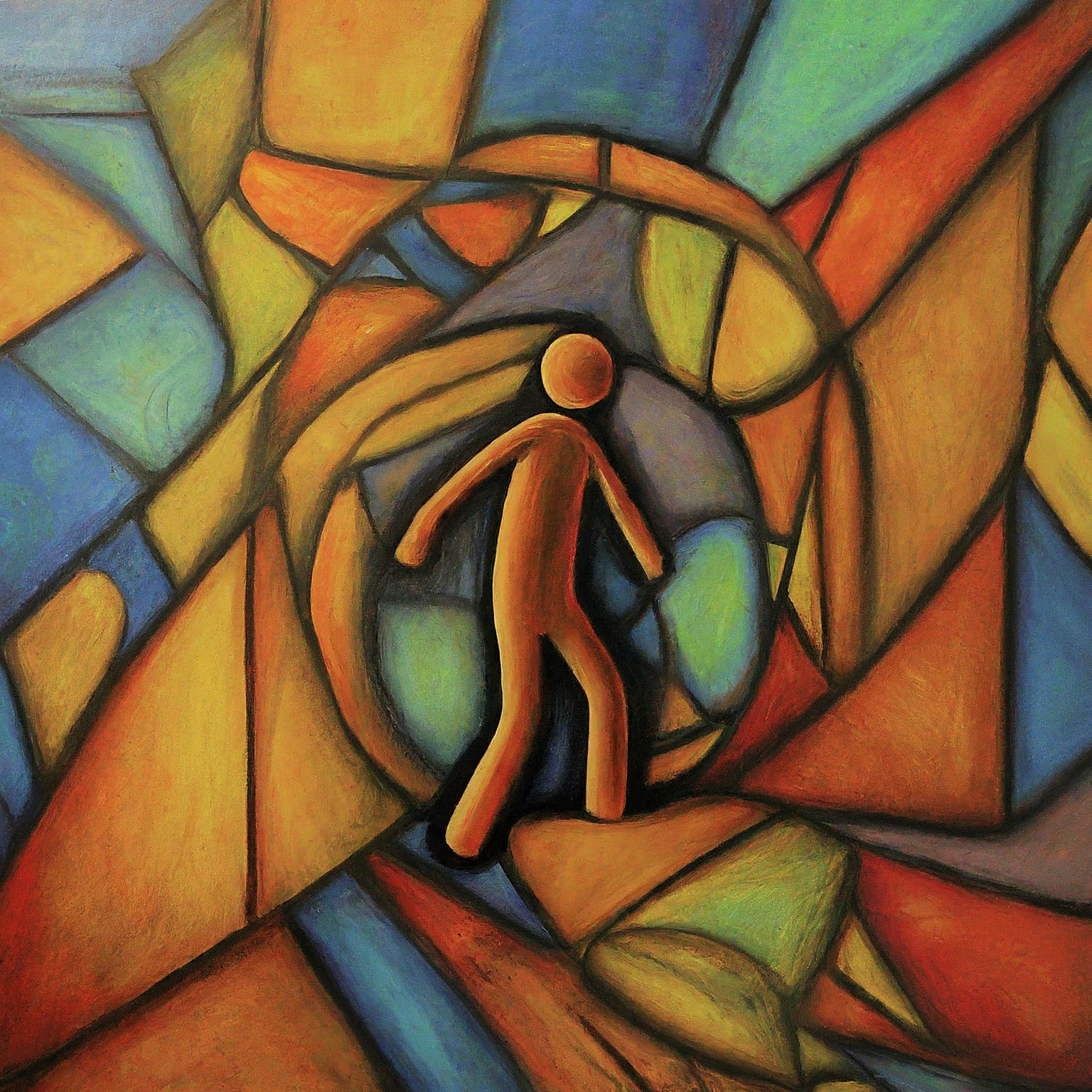
A person bringing order to chaos – image generated by Google Gemini
Form One: A Whole Lotta Structure
Part of my lifelong fascination with family trees comes from the neat, orderly vision of an expanding ancestry. You can see evidence of my love of structure in the WikiTree profiles I’ve built over the years. Start with my Grandpa Bob’s profile and marvel at the tantalizing neatness of the tree that displays if you hit the green “Ancestors” button.
Whenever I’m “working up” a tree, it is easy to see where the gaps are, where I should go next, and how far I have to go to “complete” a particular tree. (Not that anyone’s tree is ever “complete.”)
There is a different type of orderliness when I work “down” a tree. If you look at the profile of John Callin and click on the green “Descendants” button, there is a definite structure there, but it is less predictable, and you can’t tell how complete it is. Still, there is a visual indication when someone who should have children present does not yet have a set of profiles attached – and building those can follow a methodical and orderly process.
Form Two: Rabbit Holes
One of the dangers of any research project is the tantalizing lure of a rabbit hole.
Many of the essays you read on this blog only exist because I was trying to work on something else and noticed that something was missing or didn’t add up. All of the best advice for tracing your family will tell you that sometimes you have to go out of your way to research in-laws or siblings to find the information you need for your main focus – but sometimes when you do that, you get pulled into an interesting, if unrelated, side project.
Chasing leads and pulling threads to make sense of what the records tell me – or to figure out what they are hiding – takes up most of my time. I may aspire to take an orderly and methodical approach, but the rabbit holes are where I experience the most joy.
The Tension
There are a lot of excellent resources out there for you to learn how to be more orderly and disciplined in your approach to research. I follow several people here on Substack who give me good advice, and I try to apply their suggestions and methods. Those suggestions can help you plan where to look for information and guide your overall strategy for building the family history you want to build. If you follow their advice, you will have a solid battle plan.
Making a good plan is a good coping strategy – and at the end of the day, we all try to build coping strategies that capitalize on our strengths and minimize our weaknesses, whether we do that consciously or not. The most successful plans for me tend to be the ones that use my curiosity to overwhelm my tendency to procrastinate.
image generated by Google Gemini
But as someone wisely said, “No battle plan survives first contact with the enemy.” At least, in this case, the enemy is cute and interesting.
So, what strategies work best for you? (I plan to drop some links to fellow Substackers in the comments if you don’t!)
In Maryland, 5th grade is the last year of elementary school, followed by three years of middle school, and a four-year high school. 5th-graders are typically 10 or 11 years old.
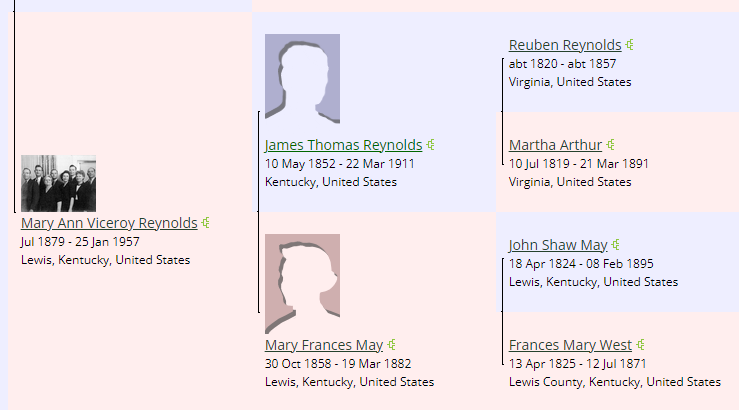
Mary (May) Reynolds was the maternal grandmother of my maternal grandfather, Russ Clark. Her parents were John Shaw May (1824–1895) and Frances Mary West (1825–1871). You may recall that John S. May and his father-in-law, Thomas West, were on opposite sides of the Civil War – I told their story in a guest post on Projectkin: Dangerous Times in Kentucky.
Russ Clark’s mother, Mary Ann “Viceroy” Reynolds, and her ancestors
The most fascinating thing to me about these families is the way they intermarried – the West, May, Reynolds, Clark, Arthur, and Smith families, in particular – and resided in the same three- or four-county area for several generations. Ashland in Boyd County, Kentucky, seems to be the place where most of them made their homes, but they can be found in Greenup County, Kentucky, and in Ironton and Lawrence, Ohio, or the area around Huntington, West Virginia. Spreading the records across multiple states and county courthouses means that if I don’t find information about a particular family in one place, I need to check three or four others before ruling anything out.
I have been able to find a conclusive document that says John S. May’s parents were Patrick Curtis May (1792–1870) and Catharine Spence(1804–1870) – but they probably were. I am still working on tracking down documents about his siblings. I was interested to learn that his two younger brothers, Joseph Spence May (1826-1890) and Henry Clay May (1828-1878) fought for the Union Army in Ohio units during the Civil War.
One of John’s sisters, America Ann May (1839-1926), stood out for having an unusual name. She married Evan H. Day (b. 1839) in 1861, and later became the second wife of Henry Clay Prater (1836–1920) of Lewis County, Kentucky. I contacted fellow Substacker, Alicia Prater, to see if there is a connection there to her Kentucky Paters, and while she does have a Henry Clay May (1860-1948) in her tree, it isn’t clear if he is part of the same May family.
For now, though, I have to resign myself to the fact that there were more people than records back then and keep digging. If you happen to have ancestors from this area or recognize any of these names, please let me know!
And, of course, subscribe to see any progress I make.
I found it difficult to compose a story about Grandma Nancy. She was probably the most present of my grandparents but I haven’t quite isolated a narrative thread for her, yet. This is the patchwork story I chose to tell a decade ago, in actual snapshots. (Lightly edited to update links and references.)
Today’s feature is all about one special person – my grandmother, Nancy Witter Callin.
Grandma was born and raised in Glendale, Arizona, and spent most of her life there and in the neighboring town of Peoria. She was an art teacher, traveler, souvenir collector, and notorious pack rat, so she left a lot of photographs and other visual artifacts behind to document her life. Most of the family photos I have are here because of her.
The Witter family, c.1931; Glendale, Arizona
Here she is in a rare snapshot of her whole family – her daddy, Dick Witter, her momma, Hannah Merle Huff (who preferred to go by “Merle”), and her brother, Richard (usually referred to as Dick Jr.). I call this portrait rare because Merle did not seem to be as fond of getting her picture taken as she was of having pictures of her kids. Her family, the Huffs, was fond of keeping and sending photos to each other, so I imagine she was motivated to continue that tradition.
Most of my family are familiar with Harper Lee’s classic To Kill a Mockingbird, and when we look at pictures of Nancy as a little girl with her big brother Richard, we see a real-life Scout and Jem Finch. I don’t think Nancy was ever quite the tomboy that Scout was, but I’m willing to bet that growing up on a dairy farm in Depression-era Arizona gave her plenty of opportunity to get a little dirty from time to time.
(Check out tomorrow’s Famous Playmates for a look at what young Nancy was like, and how she got on with one of her most famous neighbors!)
Dick Sr. with Dick Jr and Nancy c. 1936
Scout Finch wasn’t the only literary comparison we made to young Nancy. I remember the first time I saw this portrait of her as a young girl thinking that it looked like my cover of The Diary of Anne Frank:1
Nancy as a young teenager
In high school, Nancy’s best friend was Bobbe Harris, and it seems they did just about everything together. Here we see them visiting Nancy’s grandmother, Rosa Murray Huff. (Rosa and I share a birthday – only separated by 111 years!)
I don’t recall any specific details, but I always thought that Nancy inherited her passion for traveling the country from her Huff grandparents. The Huffs were the adventurous early settlers from Kansas, as you might recall from an earlier post.
Nancy (right) and her best friend Bobbe visiting Grandma Rosa Murray Huff, c. 1940
There isn’t much story behind many of these portraits. They are just the faces of people I knew – but they imply stories.
I have Grandpa Bob with his rakish Casablanca hat…and Grandma Nancy clutching her hands tightly.
Bob and Nancy – 1942 newlyweds
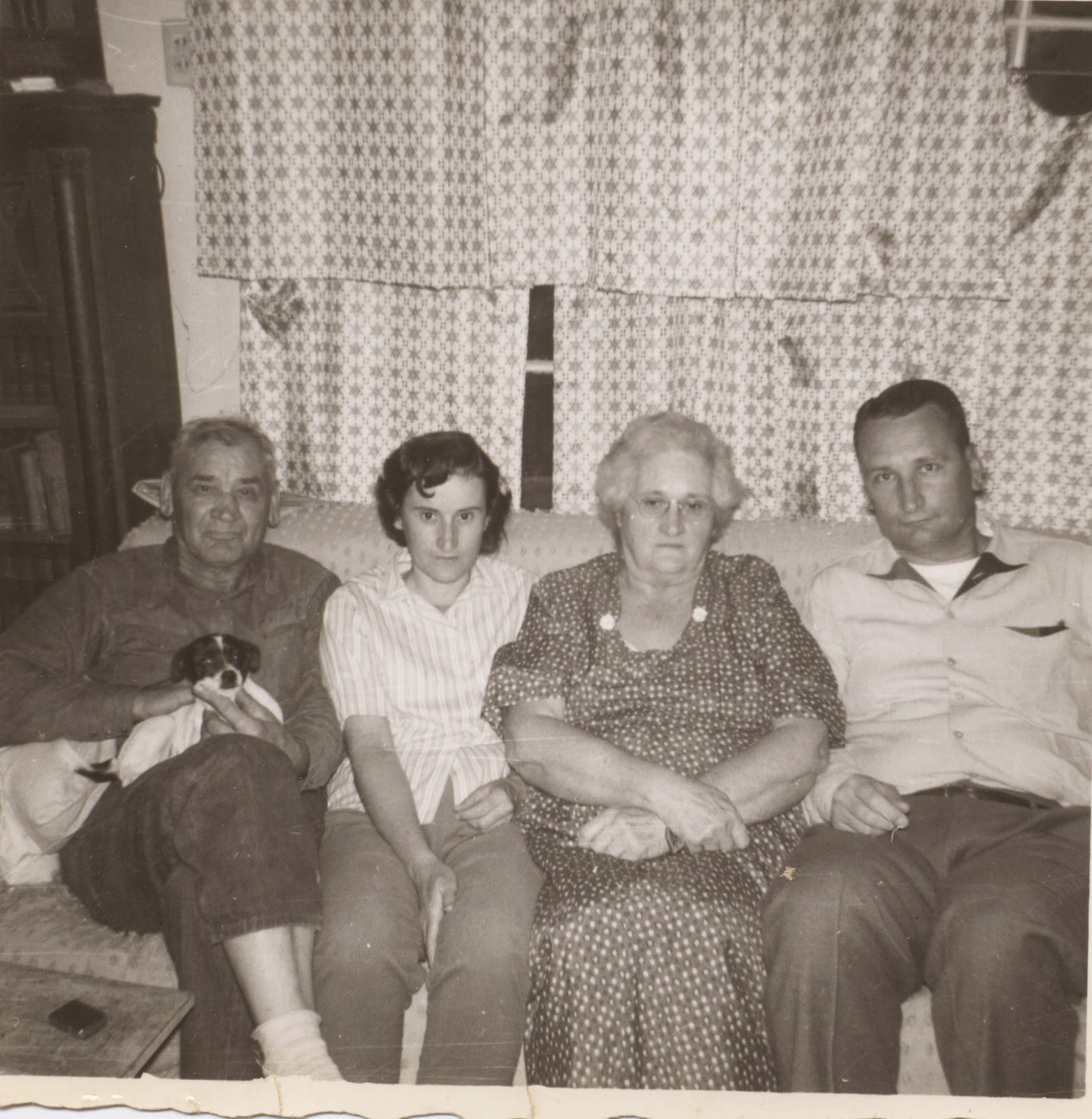
…and the Witter family relaxing on the couch – possibly in the late-1940s.
The Witters at home – Dick Sr., Nancy, Merle, and Dick Jr.
Only Grandpa Dick seems close to smiling here – even the dog looks resigned. Perhaps a later decade with fancy haircuts will improve the mood? Here are Grandma Nancy and Grandpa Bob with my mom and dad (and Aunt Vicki peeking out in the middle).
Nancy, Bob, Vicki, and my parents, Ted and Barbara
There are numerous copies of annual school photos from Nancy’s long career as an art teacher with the Glendale Union School District. This one is the lady I remember most strongly – another school photo, probably from the early to mid-1980s.
Mrs. Callin – Glendale Union School District
This is the Grandma who babysat my sister and me on occasional Friday nights, letting us watch The Dukes of Hazzard and play with her art supplies. This is the Grandma who let us come swim in her pool all summer long, and who fed us iced oatmeal cookies (Grandma’s brand, naturally) before bed.
This is also the Grandma who collected owls, loved art by DeGrazia and kept two cages full of finches in her dining room. I can still smell the soaps in her bathroom and feel the transition from her 65-degree house to the 100+ degree patio on the way to her swimming pool.
As I edited this for re-publishing, I was struck by the fact that Grandma rarely smiled in her photos. I don’t think she liked her smile – and that last school portrait shows what I remember as her happy face. The downturned smile of someone resisting the urge to let go.
She may have resisted smiling, but she never held back on affection. She made sure we knew she loved us fiercely.
I don’t remember who first made the comparison of Grandma’s photo to Anne Frank, but it was probably Grandma. As a result, when I read that book, it felt like it was happening to my family. Not just because of her resemblance, but because of the empathy she had for the suffering of others.
If you are a regular reader, you may have seen that I include links to WikiTree profiles for ancestors or cousins mentioned in my essays. I do this because I have found that people have difficulty viewing my Ancestry files without an Ancestry account.1 I also want other researchers to benefit from my work, and to be able to edit and fix any mistakes I might have made.
Researching on Ancestry and then building a profile on WikiTree also helps me generate essays and stories for my newsletter – sometimes in ways that aren’t obvious. Here are some basic tips for working with WikiTree.
Your Research
If you want to dive into WikiTree, think of it as an outgrowth of the research you’re doing anyway, using whatever tools and services you prefer. Once you’ve found enough information about a particular person to put into a biography, you can write the narrative – and you will need to include source citations.
How good your WikiTree contributions are depends entirely on how good your sources are – so as you’re deciding what needs to go into a person’s biography, focus on the evidence. If you have unsourced stories or “tales told by grandma,” that’s fine to include – just make sure it is clear in the narrative or source citations which parts of the biography are supported by evidence, and which are memories.
If you’re new to WikiTree, you will probably start building profiles with yourself. You can (and probably should) make your profile private – getting your account set up is a whole other topic, but you should be contacted by a WikiTree mentor who can help you get started if you have any questions. My profile, Callin-50, is set just one level below “Public” – so anyone can view the biography I have written and my family tree (living people on my tree who have higher privacy settings are obscured).
You can use your own profile to experiment and learn the tricks of editing a wiki page – since you marked yourself as “Private” no one else will be able to see it if you make mistakes. Once you’re comfortable with editing, you can build profiles for your relatives or, hopefully, connect to existing profiles for your relatives.
If your parents are living, you’ll want to discuss with them how they would like their profiles to be handled; my mom signed up so she could control hers, but dad (who doesn’t like dealing with computer technology) left his for me and mom to manage. Be mindful of putting information about living people on any internet platform.
A New Profile
Hopefully, you will find existing profiles made by other contributors and you can connect your tree to theirs. But you may need to create new profiles, first.
Usually, you will start the new profile process from an existing profile:
Click on “father?” “mother?” “spouse?” or “children?” links to add their profiles.
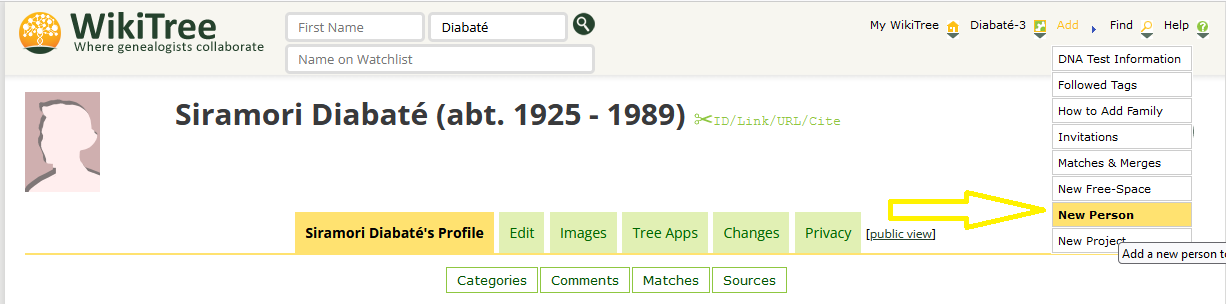
If you need to start a new person from scratch, you can do that from the “Add” pulldown menu at the top/right of the page:
Click “New Person” to create a free-standing, unconnected profile.
A Solid Biography
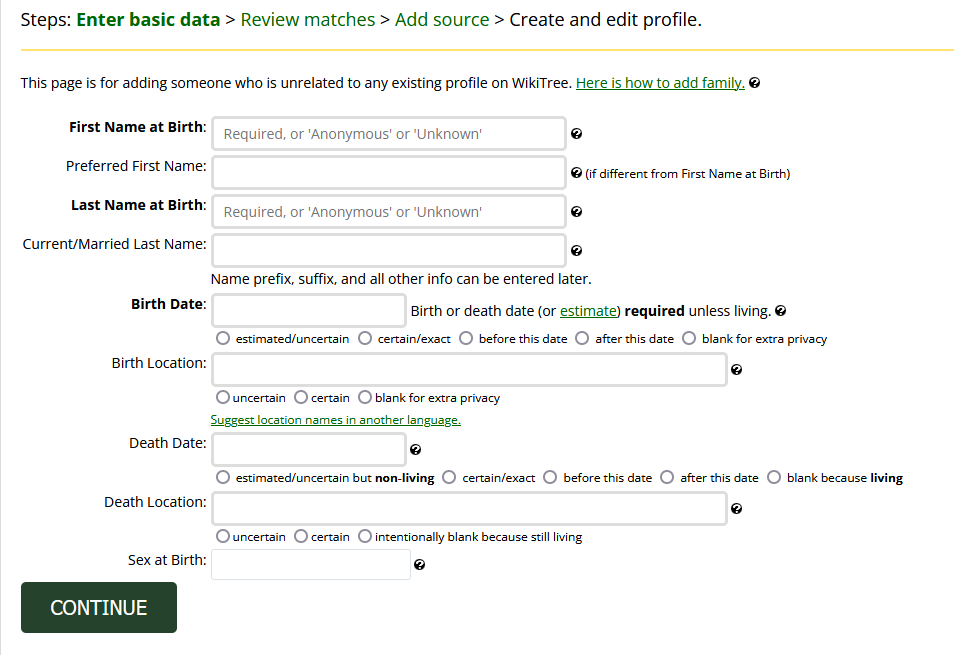
When you create a new profile, WikiTree will have you fill out a Basic Data form before sending you to the edit page for the Biography section. The Biography is where you will have a chance to do your free-form writing.
WikiTree’s basic data entry form.
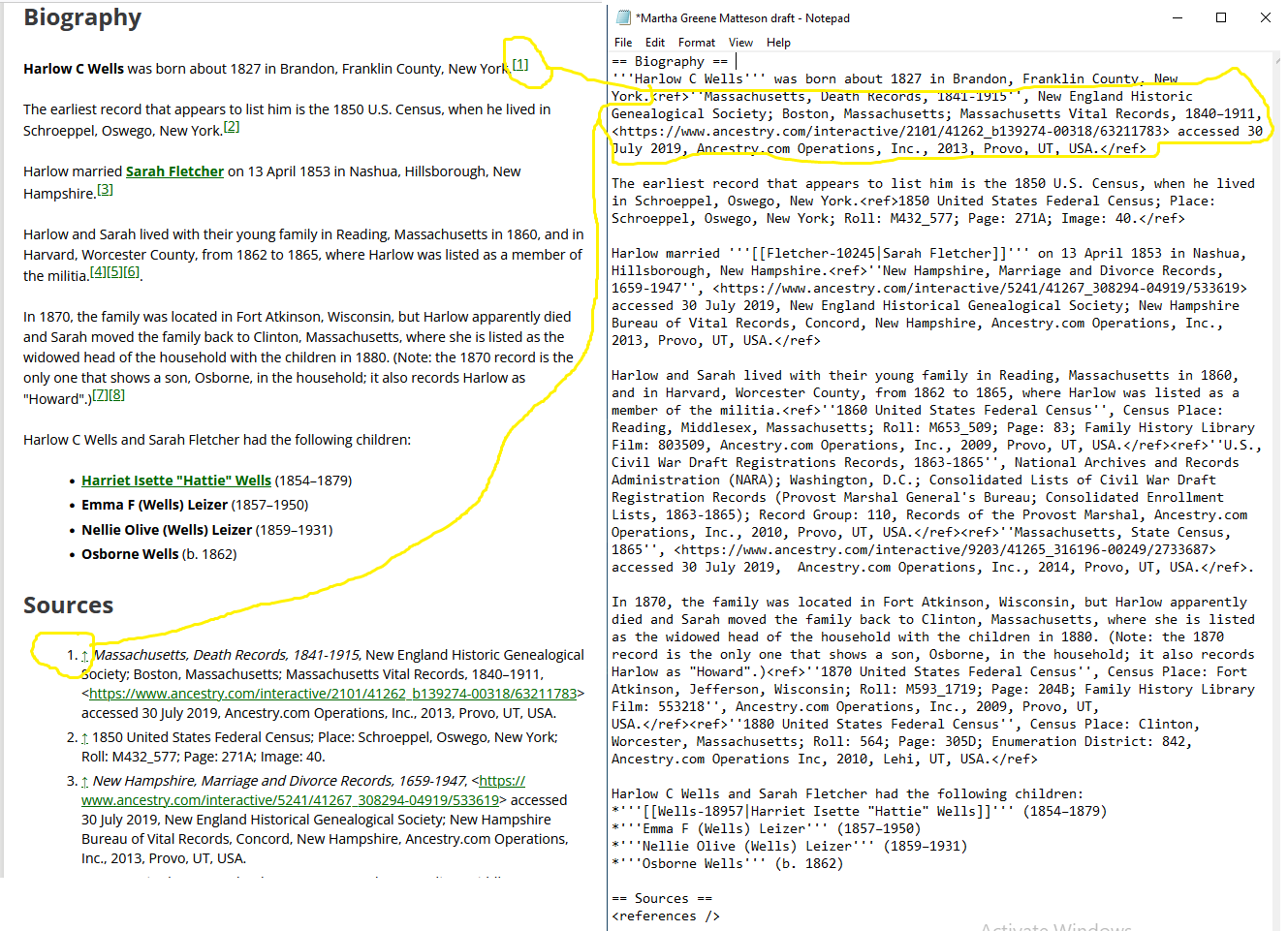
As I said, you should have already done your research, and you should have sources to support the facts you include in the Biography. WikiTree doesn’t care how you format your source citations – MLA, AMA, etc. – as long as you put them between the “ref” tags (the <ref> at the beginning of your citation and the </ref> at the end).
Some people are most comfortable composing in the WikiTree form; I am one of those people who likes to compose my text in Notepad first, then paste it into WikiTree. Here is an example of one of my ancestor profiles, my “code” on the right, and the “live” page on the left. I drew a yellow circle around the text of my first source citation, then drew lines to show how it renders on the final page:
Side-by-side view of a Biography page and the wiki markup code.
If you skim through that example, you can also see how I used links to existing profiles for spouses and children, and how some of the formatting works (bold, italics, and the like). The goal of source citations is that a reader should be able to find your source for themselves – if you can link to the source in your citation, that is great, but even just giving the reader the name of the database you used can be enough.
You will probably be surprised by how many existing profiles are already there. And don’t feel bad if you discover after creating a new profile that somebody already made one – that’s what the Merge function is for. (Though, again, they have helpful posts for that on WikiTree.)
Conclusion
WikiTree.com boasts on its front page that “Our community is now 1,107,821 members strong” and they take a bit of criticism for that claim in places like Reddit’s r/Genealogy thread, where you can find skeptical arguments that say the number is inflated or that (crucially) there is no way to know how many of those users are active. The lion’s share of criticism comes from people who have had a negative interaction with another WikiTree user or who found “incorrect information” on the site and decided to leave rather than try to fix it.
I usually find criticism of user-editable content sites (including my time on Wikipedia) to consist of about 5% valid criticism of the tool or site itself, and about 95% criticism of other people which, frankly, is a different problem the site shouldn’t be held accountable for.
But if you are doing your research and building thorough, well-documented profiles, you’re going a long way to address the 5% of valid criticism. Just be open to outside editors, make sure your sources support your claims, and don’t be shy about asking questions.
If you’re already comfortable with building personal profiles, maybe look at what you can do with Free Space pages:
Thanks for reading Mightier Acorns! Subscribe for free to receive new posts and support my work.
I am frequently reminded that anyone with a free Ancestry account should be able to see my public trees, but then I have to remind the reminding people that not everyone wants to create a whole account just to look at my research. Even that free account is a barrier and a limitation to freely sharing my work.





 Mightier Acorns