
David Clark, Sr., was a mystery to me for a long time. He still is, but at least the puzzle has some pieces now.
I have said before that I attribute my lack of knowledge about Great-Grandpa David Clark’s life to the fact that my Grandpa Russ refused to talk about him. It also didn’t help that David died before my mom and her two siblings could know him. Of all of my great-grandparents, he died the earliest, by 8 years.
I have also done a poor job of finding cousins from this side of the family and cultivating any relationships with them. Not only am I bad at maintaining contact, but I also think I must seem rather terrifying, with my questions and eagerness. It probably doesn’t help that I’m open about not being a Believer, and based on the few interactions I’ve had and posts I have seen, I have the impression that they are all committed to their faith traditions.
So what little I know has been gleaned from what pops up in my Ancestry hints – assuming I get enough clues to confirm what I find.
Figuring Out the Photographs
There are several photos that I have seen on different family tree platforms. I trust that these two show David Clark, Sr., because they have his name written on them. Unfortunately, I don’t know whose they are, or their provenance. And below, a picture of the family attending David’s memorial in 1948. (At least, that’s what my family told me!)
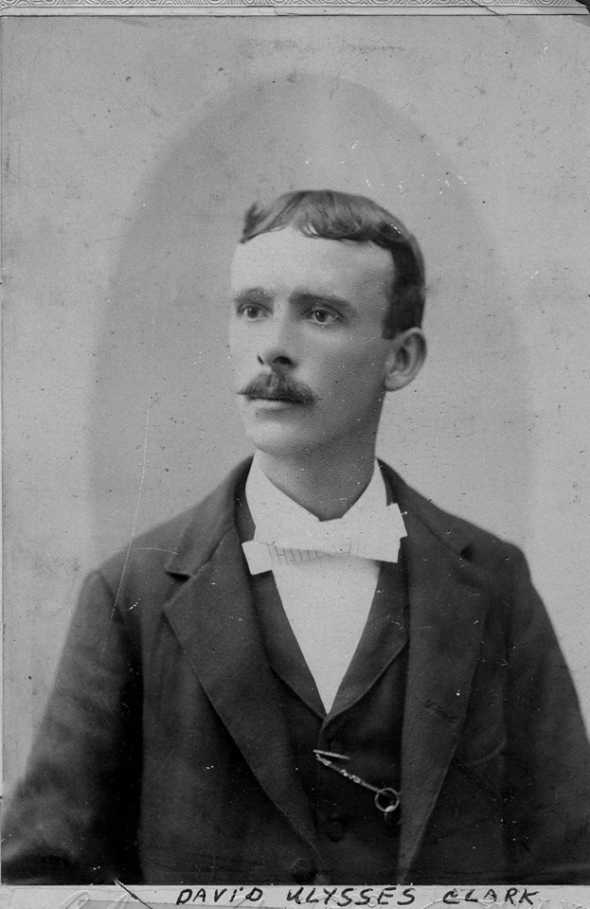
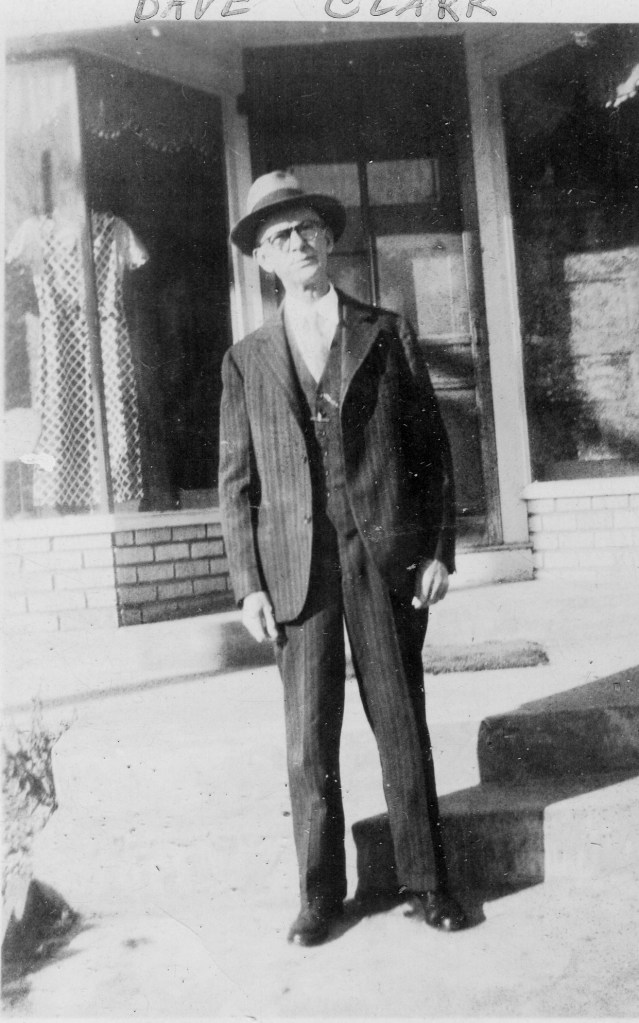
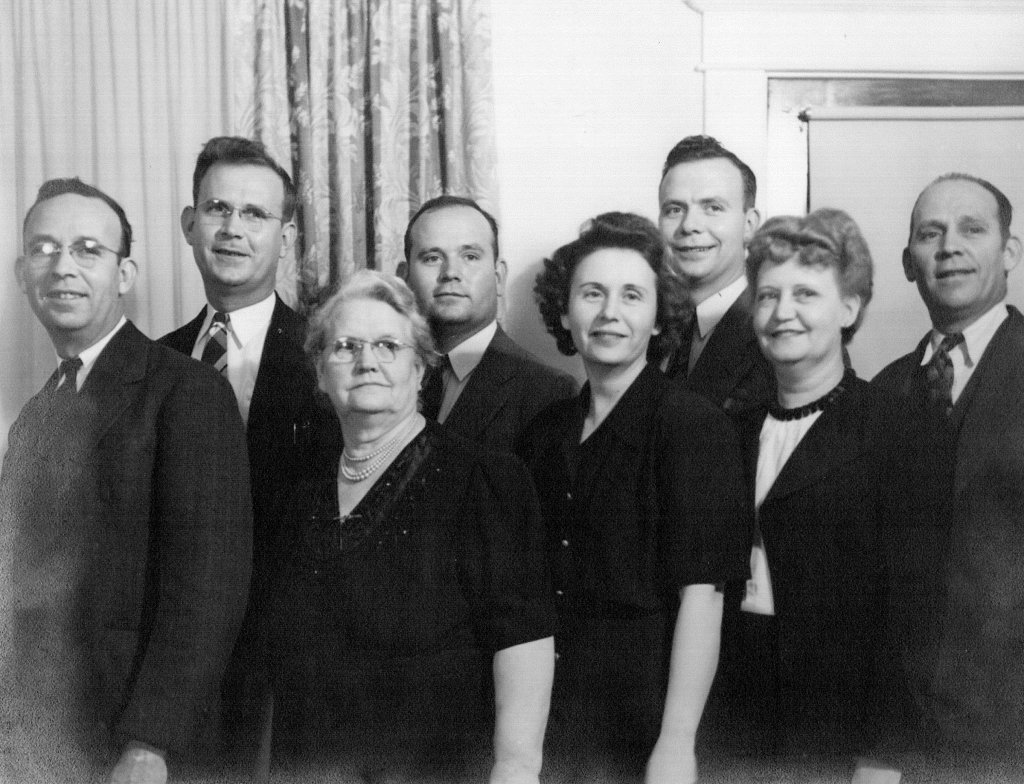
Being able to see these faces and compare them to each other is part of the puzzle. There is a danger of seeing similarities that aren’t there, especially if we aren’t sure about the provenance of the photos, but once the documentation starts to come together, the shared features start to make sense.
Life and Times of David Ulysses Clark
I have a lot of questions. Most of them are the sort of thing that wouldn’t be documented, like “who is the namesake of ‘Ulysses’? Homer, James Joyce?” But also, more mundane questions like, “Did he go to school? Was he a religious man, as the rest of his family seems to have been?”
The 1900 Census, taken just two years after David and Vicie were married, lists his occupation as “Day Laborer,” and 1910 and 1920 call him a woodworker and a laborer in a furniture factory. The 1910 also tells us he attended school and could read and write, but that only implies a high school level, not college or seminary. In 1930, he was in Arkansas, working as a sawyer in a stock yard. I think it’s safe to guess he was a tradesman rather than a scholar.
David’s early life was spent in Oakview, Boyd County, Kentucky, where his father, Joel, was a teamster and grocer in or around Ashland. David was a middle child among 10 siblings. I am pretty sure that he was born in June of 1872, but some of the records are murky on that point, and his grave marker says “1874.” There will be a lot of facts in his story that don’t add up or leave us wondering.
David and Vicie were married on 4 September 1898, “at the home of John Clark in Oakview,” witnessed by John (his brother, John Thomas Clark) and Joel Clark. Their daughter, Opal, was born the following May.
Growing up, I was always told that Grandpa Russ was the youngest of twelve, but I only have a total of 11 documented. Over the next decade, they had Traxel (1900), Alma (1902), David, Jr. (1904), Sallie (1907), and twins, Jennie May and Thomas Ray (1910). After 1910, the family added Jerry (1913), Floyd (1915), Frank (1917), and Russ (1920). They lost little Floyd in 1916; all I had been told about Floyd was that he “choked on a pear.” However, his death record says the cause of death was “cholera infantum,” an historical term for acute, often fatal, infantile gastroenteritis.
I don’t know whether the family moved to Arkansas before the Great Depression hit, or if that was what drove them to move. Either way, David and Vicie, and the four youngest boys, were in Bowie, Desha County, in 1930. All of the older children (including Jennie May) were married and on their own. Traxel lived in Bogalusa, Louisiana, and Sallie lived in Alabama, but everyone else stayed in the general area, either staying in Ashland or Ironton, or moving to Middletown, Ohio, a 3-hour drive north of the river.
Traumas, Large and Small
I want to be clear that I’m speculating about the impact the Great Depression and World War II had on this family.
Grandpa Russ was tight-lipped about what he thought of his parents and siblings, and I can only read between the lines of what he told me, and compare what he did tell me to the records. I’ve written before about the kinds of stories Grandpa liked to tell, and how unverifiable they were. I just mentioned the story about little Floyd, and how the record differed from what I had always been told.
I suspect that David and Vicie were separated for a time, probably around 1940, when their family is missing from the U.S. Census. It’s not hard to imagine that the hard times of the 1930s, and the start of a war that Russ fought in, put stress on the family’s financial situation. We know all kinds of stories about the struggles from illness or injuries in those pre-penicillin years.
Grandpa’s attitude towards alcohol, gambling, and other vices always left me with the impression that his father (and possibly his brothers) struggled with addictive behaviors. Because he wouldn’t talk about it, I could be misreading the situation. It could be that Vicie was the one who struggled with alcohol, and if either parent was involved in infidelity, that could explain the unspoken anger.
But even though I don’t know what happened, I know that Grandpa was affected by something.
And the result is that I don’t know what to say about his father.
And In the End
When David U. Clark died in January 1947 at the age of 74, he was living with his daughter, Jennie May, and her husband, Gene Cooper, in Benton, Arkansas. His obituary said he had lived there six weeks, and that he was a member of the Baptist church in Ashland, suggesting that is where he had been living. The obituary said that Vicie’s address was in Middletown, Ohio, where Alma and Russ were also residing with their families. As I said, that’s a few hours north of Ashland. And David was survived by four of his brothers and four of his sisters, most of whom still lived in Ashland. Was that where he had been living? Had Vicie been there, too? How recently had she moved to Middletown?
Again, I don’t wish to read too much into all of that, but the questions remain. Why did David move, but not Vicie? Was their health the issue? Was there some other factor involved?
When all is said and done, most of those questions don’t matter much. Those affected can’t be affected anymore; those who come after us may not know enough to ask the questions.
I will just have to accept that I know what I know.
 Mightier Acorns
Say hello, cousin!