
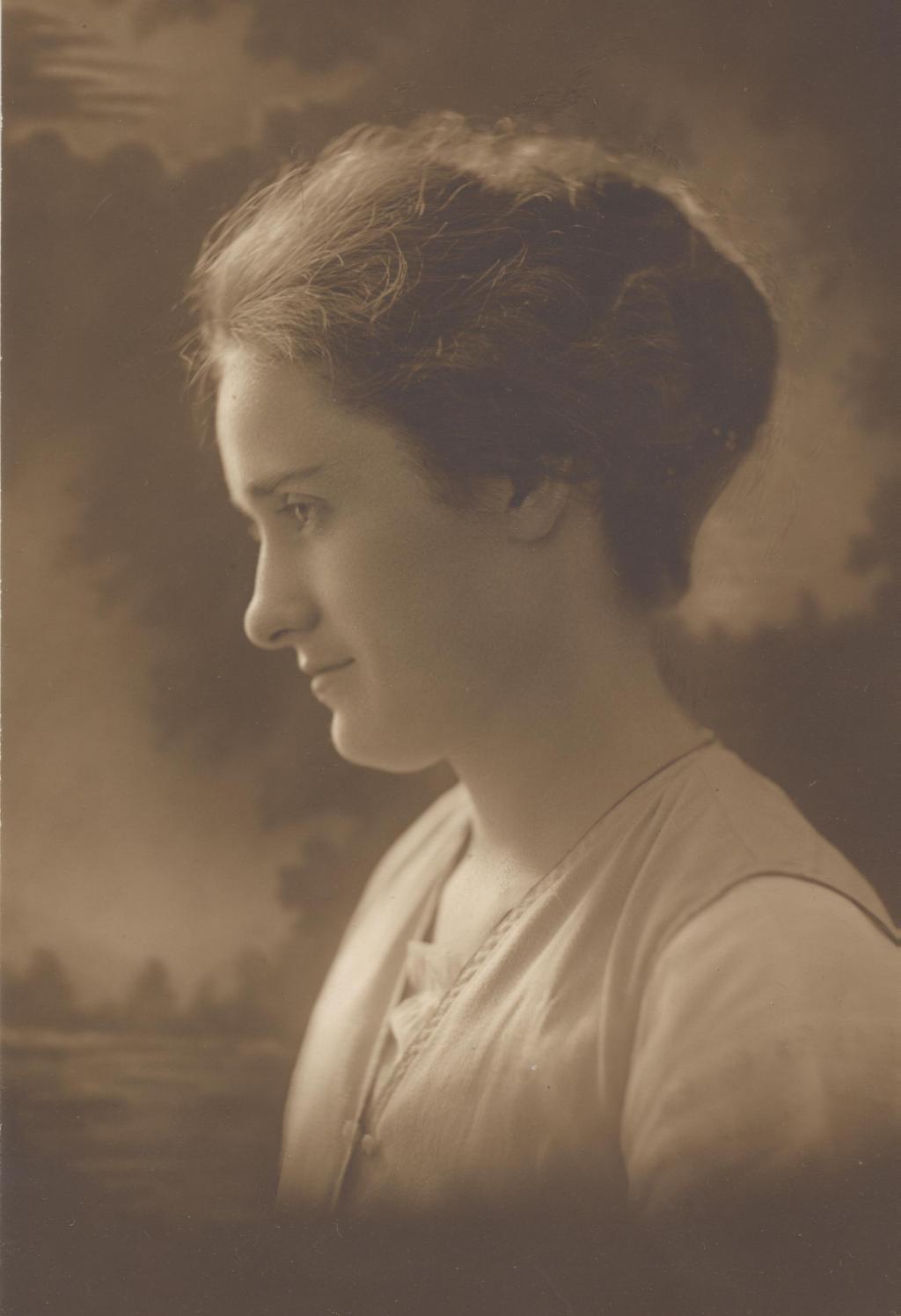
Merle Huff was the baby of the Huff family of Savonburg, Kansas. She also lived longer than her siblings, reaching her 95th year, if not her 95th birthday.
Here she is, surrounded by her family in 1983:
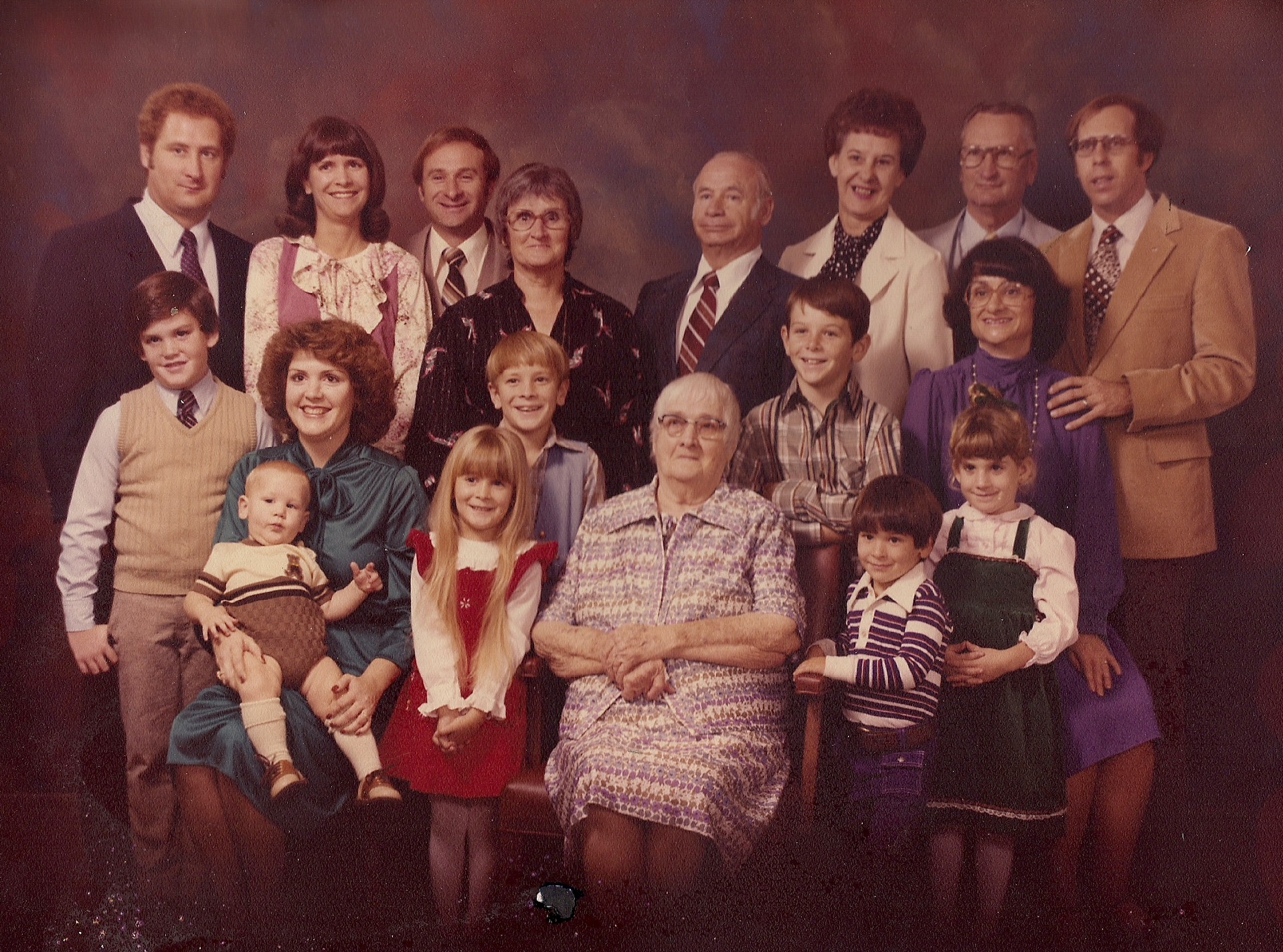
She died one month short of that milestone. I was 12 years old when she died, and because she lived with my Grandma Nancy, she was close enough for us to visit frequently. Thus, Great-Grandma Witter was one of the two great-grandparents I actually met, and the one I knew best, if a 12-year-old just beginning to realize there was a world outside his own head can be said to “know” anyone. So, when I say “I recall” things about her, keep in mind that my memory is not a trustworthy record. But I’ll do my best to convey what I do remember.
Grandma and Grandpa had a swimming pool, which meant that whenever my parents were willing to make the 30-minute drive from our house, we had a swimming pool. Their pool sat outside a large, screened-in patio area, and had a small pool house, which was detached from the patio and sat alongside the pool area. That pool house had a small bathroom and what I suppose was meant to be a changing room. It was just big enough for a bed, a TV stand, and a chair with a folding table. That is where Grandma Witter lived when some of the age-related illnesses that didn’t yet have names in the 1980s began to make it impossible for her to live on her own.
I don’t think I questioned her living situation back then. When you’re 12, and there is a Star Wars sequel due in theaters, you aren’t thinking about the living conditions of elderly relatives. Now, it might strike me as problematic to put an old woman in a pool shack in one’s backyard. But I have the impression that Grandma Witter preferred to keep that little piece of independence rather than live inside Nancy’s house – and I also seem to recall that Nancy kept her house at 65°F year-round, which was far too cold for a woman who had lived in the desert Southwest in unconditioned farm shacks since the 1920s.
Values and Mysteries
Grandma Witter wore voluminous floral print dresses, like the one in the portrait above; the kind I think of when I read about pioneer women in books. I remember that she smelled of baby powder, and that her hands were strangely soft despite looking like hands that had been doing hard work for half a century.
When we visited, we would go back to the pool house and sit with her for a while. She had a few hobbies that I didn’t understand, like her stamp album full of stamps she had saved from decades of correspondence with her family. She had not kept the letters or postcards, with a few exceptions, but she would tell us about some of the places her brothers and sisters had gone. She probably talked about how Grandpa Dick went off to join the Army and lived in California, or when her brother Chet, a teacher who lived in Texas and Colorado, would write during the school year.
We had no idea who these people were, of course. She would refer to “daddy,” and I didn’t know until years later that she didn’t mean my dad, or that when she talked about “grandpa,” she didn’t mean Bob. The people she remembered were completely unknown to me, although now, of course, I might have a better idea of who’s who.
I remember asking her whether any of the stamps were valuable. She would laugh and say they weren’t worth any money, but they were valuable to her, because when she looked through them, she remembered the people who sent them to her. I think that idea must have stuck with me and formed the seed that grew into Mightier Acorns, because few of the people I have learned about would be considered “prominent” from a collector’s point of view.
Their value has little to do with financial worth or historical prominence. But they were here, and they meant something to each other, and now, to me.
A Vanishing Breed
Despite belonging to a large and loving family, Merle’s siblings were scattered across the Western U.S. Only her older brother, Chester (Chet) Huff, had sons to carry the Huff name forward, and between them they had five daughters. Her oldest brother, Albert B. Huff, had four daughters: Maurine, Maxine, Bruce, and Ezell. And their older half-brother, Perry Huff, had a daughter, Doris. In no particular order, Merle’s nieces’ families can be found with the following surnames, if you care to go hunting:
- Pullins
- Sampson
- Davis
- Pendergast
- Cochrane
- Tullis
- Stokes
- Reeder
- Keyes
Merle’s two older sisters were Bertha (“Aunt Bercie”) and Iva, and their descendants include the names Sample, Akin, and More. All of these surviving cousins lived in Texas, Colorado, California, Washington, and Oregon. That’s a lot of stamps.
Albert B. Huff was the last sibling to leave Merle behind when he died in 1973. She survived him by more than ten years.
Stories That Stick
I said last week that Dick Witter was considered a “pioneer settler” of Arizona, but that it made more sense to me to frame his arrival as a halfway point between Arizona’s history and his own. Merle’s story, like Dick’s, seems to be less about forging something new and more about preserving something. What that something is was not something they put into words, and the more I learn about them, the more I think we don’t understand them.
But the wrong story is often the one that sticks.
If you read the first part of Great-Grandma Merle’s Travelogue, you can see that the Huff family left behind an established farm in Kansas in a covered wagon and journeyed West to Colorado before catching the train down to Phoenix. Everything about their journey speaks of a settled land, less dangerous than it had been a decade or two before. The roads they followed, the conveniences they took with them, and the railroad that took them through the more difficult terrain were all signs of civilization to them.
The farms they worked, the crops and cattle they grew, the town of Glendale they helped build: all of that represented progress to them. To Dick and Merle, the Pioneers were people who left the places where there was support for their journey, often facing unknown dangers… and some “should have known better” dangers, especially from the people the land belonged to. The railroads, the canals, the shops, the churches, the towns – those were the civilization they were moving toward when they left Kansas.
But in the popular imagination, Dick and Merle were the old-timey pioneer folk. Even my Aunt Vicki kept that version of their history in her head, remembering the Huff family’s journey as “coming to Arizona by covered wagon,” which was only partly true, at best. And I know from her recording that Merle did her best to pass her memory down straight.
In the end, none of us owns the history that our descendants will remember us for. The best we can hope for is that we’ll be able to pass on something of what we experienced to our children, and that they’ll be able to understand it.
I’ll be happy if they just learn what is valuable about us.
 Mightier Acorns
Say hello, cousin!