
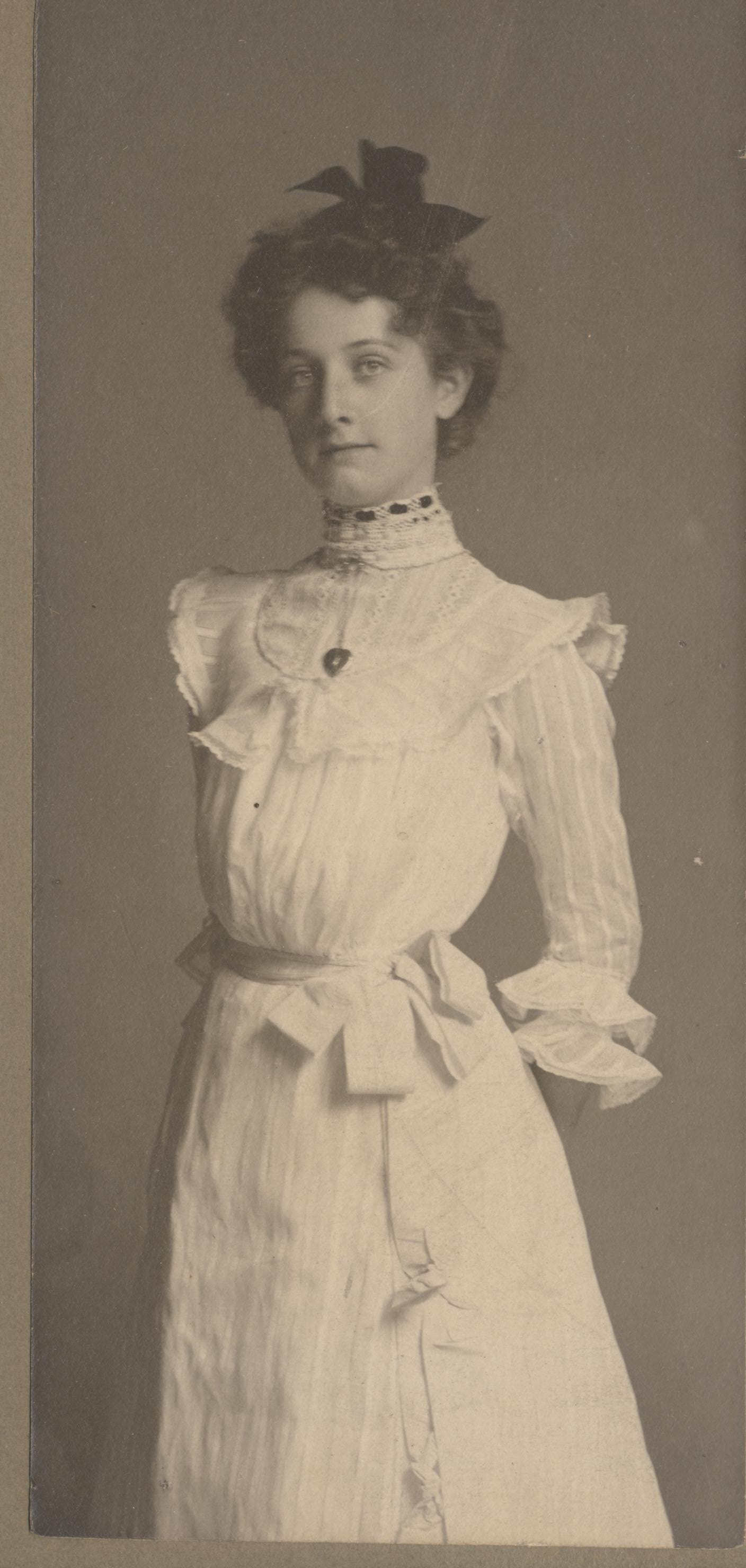
Bertha May Greenlee was the only child of an only child, the only surviving descendant of three generations of unrecorded tragedy.
Bertha was born on 5 December 1885 in Arcadia, Hancock County, Ohio. She was nearly 2 years old when her father, Allen Greenlee, died suddenly. Her mother, the former Alice Hale, remarried in 1889, when Bertha was four, and Bertha was adopted by her stepfather, George McClelland Cramer.
In 1891, when Bertha was six years old, her father’s grandmother, Eleanor, died at the age of 81. The only remaining relative on her father’s side of the family was a great-aunt, Elizabeth McComb, who also lived in Hancock County. But her mother’s family, the Hales, and her adopted family, the Cramers, made up young Bertha’s world.
Bertha’s half-sister, Mamie, was born in 1894, and they remained close after they grew up. I have the impression that Bertha was old enough not to feel threatened by the attention given to a new baby, and that she was well-loved and well cared for.
Love in the Twentieth Century
On 9 June 1906, 20-year-old Bertha Cramer married John Q. Callin in Fostoria. The Callin family had business interests across central and northern Ohio, and one might think that the sons of Union soldier John H. Callin would have had fine prospects and solid reputations.
But by 1905, I suspect that some of that reputation had begun to change. John Q’s older brother, Byron Herbert, who had married the daughter of John Muir in 1896, left his first wife behind in Ohio and was teaching in South Dakota. In November 1905, he was involved in a hunting accident that left one side of his face disfigured. The younger girl who gave him first aid and drove him to the doctor later became his second wife1. This wasn’t treated as a scandal by the newspapers, but that wouldn’t stop the gossip among the family or the neighbors.
John Q., as we mentioned last week, had married a fellow teacher in Dayton in 1901, and we don’t know how or why that marriage ended. Whatever his story was, Bertha must have known something about it, and she decided to marry John anyway.
I speculate that John H., known as “Colonel Callin” for his respected position in the Grand Army of the Republic in Wood County, had ambitions for his children, and I suspect he maneuvered Herbert into that first marriage to Fannie Muir. If so, John Q. certainly saw how his older brother’s first marriage played out, and marrying an older, divorced woman in 1901 might have been his way of rebelling. We do know that John Q’s sister, Emma, married one of John H.’s business partners, George D. Matcham, in 1907, which seems to support my speculation about John H.’s matchmaking activities.
Of course, nobody wrote anything down that might confirm or refute these wild guesses on my part. You will have to decide how to explain the facts we see in the records. That these things happened is evident; why they happened is an open question. Speculation aside, however it came about, John and Bertha made a successful 50-year journey together. And that tells me that whatever their circumstances before 1906, they chose each other and were happy with that choice.
Keeping the Children Close
From Bertha’s point of view, as an only child, she and John had a large family, but compared to the previous several generations of Callin families, having only three children was a departure. The birthdates of their children were spread out, too: Yvonne in 1907, Norman in 1912, and Bobby in 1920.
There is no doubt that John and Bertha’s affection for their children ran deep, but circumstances frequently kept them apart. During the 1920s, when Bob was a toddler, John took a job teaching in upstate New York, and while John, Bertha, Norman, and little Bobby lived in Schenevus, NY, Yvonne stayed in Ohio, living with the Cramers.
Hired about 1921, John left the Schenevus High school district in 1923 for another teaching position a Philmont high school in Columbia County. Bertha was honored by the Baptist church with a “gift of gold” for two years as a contralto soloist in the church choir, and Norman was awarded a scholarship. When they moved, they sold some household goods:
One oak buffet, 6 oak dining chairs, dining cook stove, with oven; oil heater, Simmons ivory bed (new), Foster Ideal springs (new), dresser, carpets, rugs, 150 Mason’s fruit jars, kitchen chairs, washtubs, boilers, clothes rack, and numerous other household articles, tools, etc. It is especially requested that all goods be removed on day of sale. Terms cash.
I think having Yvonne live in Ohio was difficult. She was 14 when John and Bertha moved to New York, so she began high school that year, and she seems to have spent a lot of time with Mamie, who was old enough to be an appropriate chaperone but young enough to feel like an older sister. By 1926, though, it was Norman’s turn to start school, and he attended Fostoria High, like his sister. Either the whole family had moved back by that year, or he prevailed on them to let him live with his grandparents, too. Either way, by the time he graduated, the whole Callin family was back in Fostoria.
Norman was a well-regarded boy and did well in high school. He was the humor editor of the school paper and was apparently a very funny person. Not long after he graduated in 1930, the family moved to Orange County, Florida, and Norman was married there in 1933.
Funny Papers
John Q. died in 1956, and Bertha survived him until 1971. I know what I know about them mainly through the scrapbook and letters I inherited from my Grandpa Bob, their youngest son, and from newspaper articles I’ve been able to find on Newspapers.com.
Norman’s success as a humor editor was apparently not an aberration. This could be a projection on my part, but based on what I read in their correspondence, all of these Callin people were very funny. I know this about myself, my children, my dad, and Grandpa Bob from firsthand experience, so it’s easy to see that same dry wit and jovial attitude coming through the notes John and Bertha sent to Bob.
Here’s a sample of Bertha’s wit from a letter sent in 1948 – rueful financial news, complaints of ailments, but each with a “stinger”:
Dear Kids – Recd. Your letter some time ago and have been wating to see how we came out with the house. We have finally sold it but only got $1500 down on it, and after the sellers commission comes out we won’t have but 1200 left.
We are going to try to get a little house up with it, but don’t know how far it will go. Was in hopes we might get cash for it but took the best offer. Got $5500 for it. I am hoping I can spend Thanksgiving with you, but don’t know as yet. Dad can’t get away and I am not sure I can. But here’s hoping.
We sold all our puppies but it has taken most of that money to pay our bills. So I guess the old Callin depression is still on.
I have been having a rash of some kind all over me and it is in my eyes also, so I have to get over this at least partially before I can go anywhere. It is an allergy so the Dr. says. I think it is one of Florida’s “finest.”
For reference, that cottage they sold for $5,500 was roughly equivalent to $75,000 today. They were building and selling cottages around Orlando for several years in this way, and if they managed to sell a house every year, their “old Callin depression” couldn’t have been too arduous.
By 1948, Norman and his family were living in Baltimore County, Maryland, and Bertha’s remarks in that same letter suggest some hurt feelings without giving us any great detail:
Norman has been back in the hospital for 2 weeks but is home now, and a lot more in debt. They say he has gall bladder trouble and I guess it is pretty severe. He says he is going to whip it or it will whip him before he goes back to the hospital. I haven’t heard from them for over a week so maybe he is getting better. I didn’t go up this time when he was sick, because they seemed to think I shouldn’t have come the other time. I was there, so from now on they will have to send for me if they want me.
Yvonne was living in Florida, too, and she was active in their church – but this was not without drama:
Yvonne isn’t playing at the church anymore and we are both pretty well fed up with the clique over there. They have kicked her in the teeth a couple of times and even tho most of the church is with her, they don’t have any back bone. But like everything else I guess it will all blow over.
These examples may not seem like much to someone outside the family, but I feel like I get a sense of their personalities.
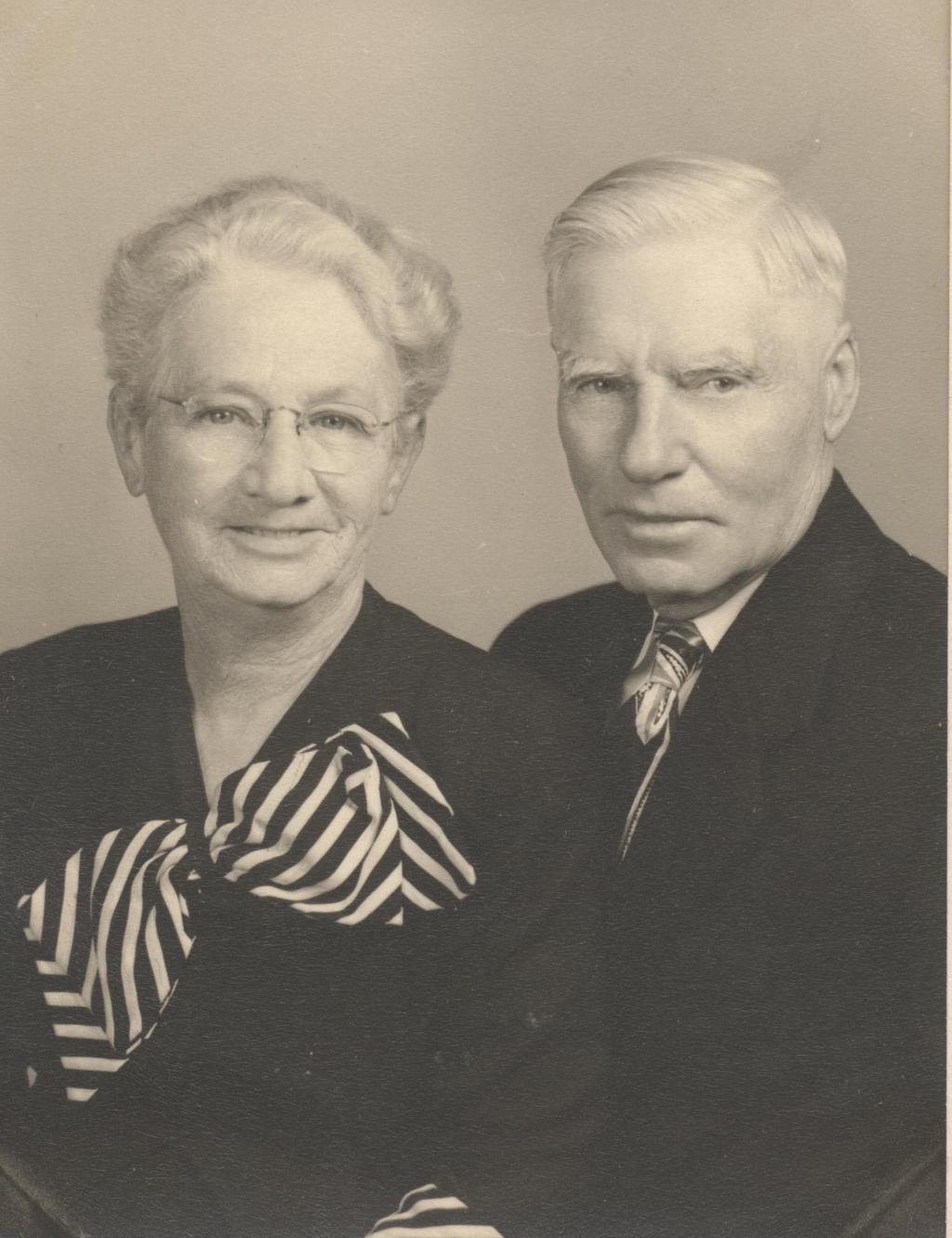
I could be wrong, of course. As I was editing John’s essay last week, my wife saw the portrait of John and Bertha you see above and said, “What an angry looking man!” And I suppose if you didn’t grow up seeing your dad and your grandfather making that face, you might not see the twinkle in the eye and the approach of the subversive joke.
Which is why it is so important to capture those feelings, intangible as they may be.
- Ruby Cole saves Herbert Callin Article from Nov 22, 1905 Argus-Leader (Sioux Falls, South Dakota) ↩︎
 Mightier Acorns
Say hello, cousin!