
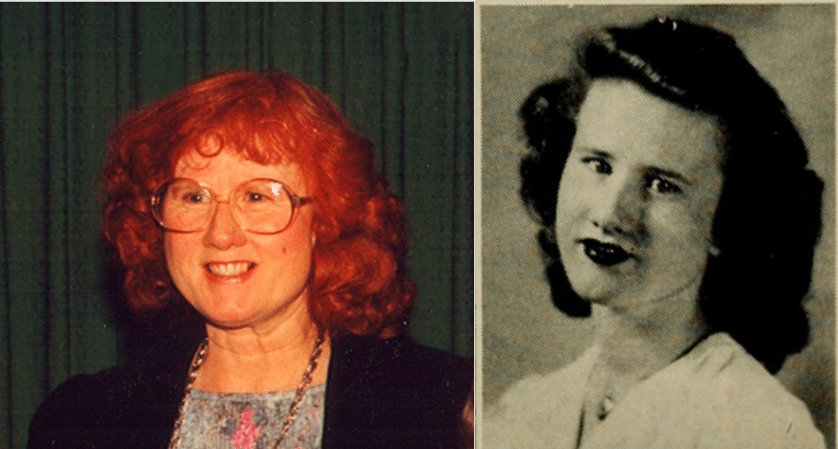
My wife’s paternal grandmother, June (Shuffler) McCullough, was the youngest of her four grandparents, and the last one to leave us. My wife inherited Grandma June’s “oatmeal butterscotchies” cookie recipe; our son inherited Grandma June’s eyes; and our youngest inherited her name. Someday, I expect, one of our descendants will inherit her fiery red hair.
You may have heard of “Midwest nice,” but June was, by all accounts, “Midwest kind,” too. When her kids share memories of her, they revolve around the way she worked hard to raise them, especially the loss of Bob McCullough in 1983. Her grand-kids speak of her warm kitchen, her playfulness, and her welcoming nature.
Much of what I know sounds like a stereotype of the Midwestern Lutheran church lady: the elongated “O”s in her speech, the inventive casseroles designed to stretch a budget, the warm kitchen always full of treats. These are the qualities that make impressions, but rarely find their way into family histories. Unless someone writes them down.
A Child of Wartime
Born in Council Bluffs, Iowa, in 1928, she and her older sister, Elaine, grew up there. Her family were members of Our Savior Evangelical Lutheran Church, where June was confirmed at age 13 in 1942. Her four years at Thomas Jefferson High School were bracketed by the beginning and ending of the Second World War.
June and Elaine had no other siblings, and they grew up only knowing their mother’s side of the family. Their father, Don Shuffler, was the oldest of four brothers, and the only one who stayed in Iowa when their mother remarried and moved to Maryland. (You may recall The Ballad of Mrs. Steele talked about that family.)
On the surface, it might appear that June’s family wasn’t touched by the war in the same way that others were. And it is true that none of the men in her family were of an age to serve in the military; but when your family is small and you are part of a large community, the parade of classmates who graduated and enlisted, the older brothers and younger uncles who never came back, has to make an impression.
And it is evident that those years taught those who stayed behind how to cheerfully adapt and overcome whatever hardship came their way.
The Hardship Heritage
One of the hardest things to know about our ancestors is “how much did they know about their family history?”
It is easy to look at the eight people in my grandparents’ generation and see that they were all impacted by the Great Depression and the Second World War. To us, looking back, they were living through history; but to them, they were just living. And the stories they knew about their grandparents gave them a sense that those were the people “living through history.”
June and Elaine knew their Danish immigrant grandparents, Tom and Lena Thompson, and their aunt Dagmar. Their grandmother, Virgie Steele, probably visited, and their father probably remembered the loss of his father, Frank Shuffler, in a rail yard accident during World War I. But how much did they know about earlier generations?
Did they know about the drama their Ballard great-grandparents went through, or about the Rupes1? Did they know about their Quaker heritage2, or the Shufflers who settled the Midwest before the Civil War? I know from talking to June and her kids that they recognized the name “Tiny Shuffler,” but did they know who Valentine Shuffler was3?
We are all made up of the stories we know about those who came before us. But we never really know for sure how those stories shaped us.
The Life Lived
When we write biographies for WikiTree, or for our blogs, we display a bias for those stories that are unusual, or tied to specific historical events. It’s hard to write about a “normal life” (a phenomenon that disappears under scrutiny, I find) in an interesting way.
We know facts about June and Bob McCullough from the Census, from city directories, from mentions in local newspapers. We know the impressions they left on their families. And we know scattered facts about things they did, though we don’t tend to think of those as “stories” the way we probably should.
Take these two sentences from June’s obituary:
“She was very involved with her church, Faith Lutheran Church, where she was active in choir and the guitar choir, Bible study, and she also helped clean. She also served Meals on Wheels.”
She sang, she played guitar, and she was active in her church in a way that focused on helping others. That’s a story that struggles to break through our biases towards drama.
As we continue to move up the Ahnentafel tree, this struggle becomes more and more difficult. As we move back in time, the obituaries, if there are any, will leave out “domestic” details and hobbies, especially of women. In a couple of generations, we’ll be lucky to know their names, let alone what they were like, or how they behaved.
Hopefully, in the future, our descendants still have some sense of what it meant to bake cookies for grandkids and spend your retirement bringing food to your neighbors. And maybe as we study our past, we can find ways to remember and celebrate the ordinary lives of those who didn’t get lengthy hagiographies printed about them.
- See “Raising the Rupes” for those stories. ↩︎
- See “Records Don’t Tell the Stories” ↩︎
- See “A Valentine for Iowa” and “A Valentine for Indiana” ↩︎
 Mightier Acorns
Say hello, cousin!