
John Callin (1870-1835) and Elizabeth Simon (1780-1864) were born and married in Pennsylvania, according to the scant information given about them in The Callin Family History. The good old CFH was published in 1911 by their grandson, George W. Callin (1846-1921), who was born a decade after John’s death. Most of what George knew about his grandparents probably came from his father, William. George may or may not have remembered Elizabeth, because she moved to Auburn, Indiana, with George’s aunt, Eliza (Callin) Ferguson, in 1849, when George was 3 years old.
But Those Who Remained would have remembered his ancestors, too, and probably shared stories with him.
Those Who Departed: John “Jr.”
The oldest child of John and Elizabeth was also named John Callin. This John Callin was born in Pennsylvania about 1802 and came to Milton Township with the rest of his family in 1816. He died there in 1825, according to the CFH, but we don’t have a Find A Grave memorial or any information about his cause of death.
Amazingly enough, young John was the only one of John and Elizabeth’s nine children who did not survive long enough to marry and have children. We already talked about the three sisters who left Ohio:
- Sarah (Callin) Scott – the next to eldest child, left about 1837 for Winnebago County, Illinois.
- Eliza (Callin) Ferguson – left about 1849 for Auburn, Indiana.
- Margaret Jane Callin – married their first cousin, James Callin, and moved to Iowa with Alec, Aunt Mary, and the others about 1840.
That leaves five Callin siblings who stayed in Ohio, although, as we’ll see, they spread out through Huron, Richland, and Ashland counties, and many of their children went further than that.
But let’s begin with the oldest surviving son: George Callin (1804-1879).
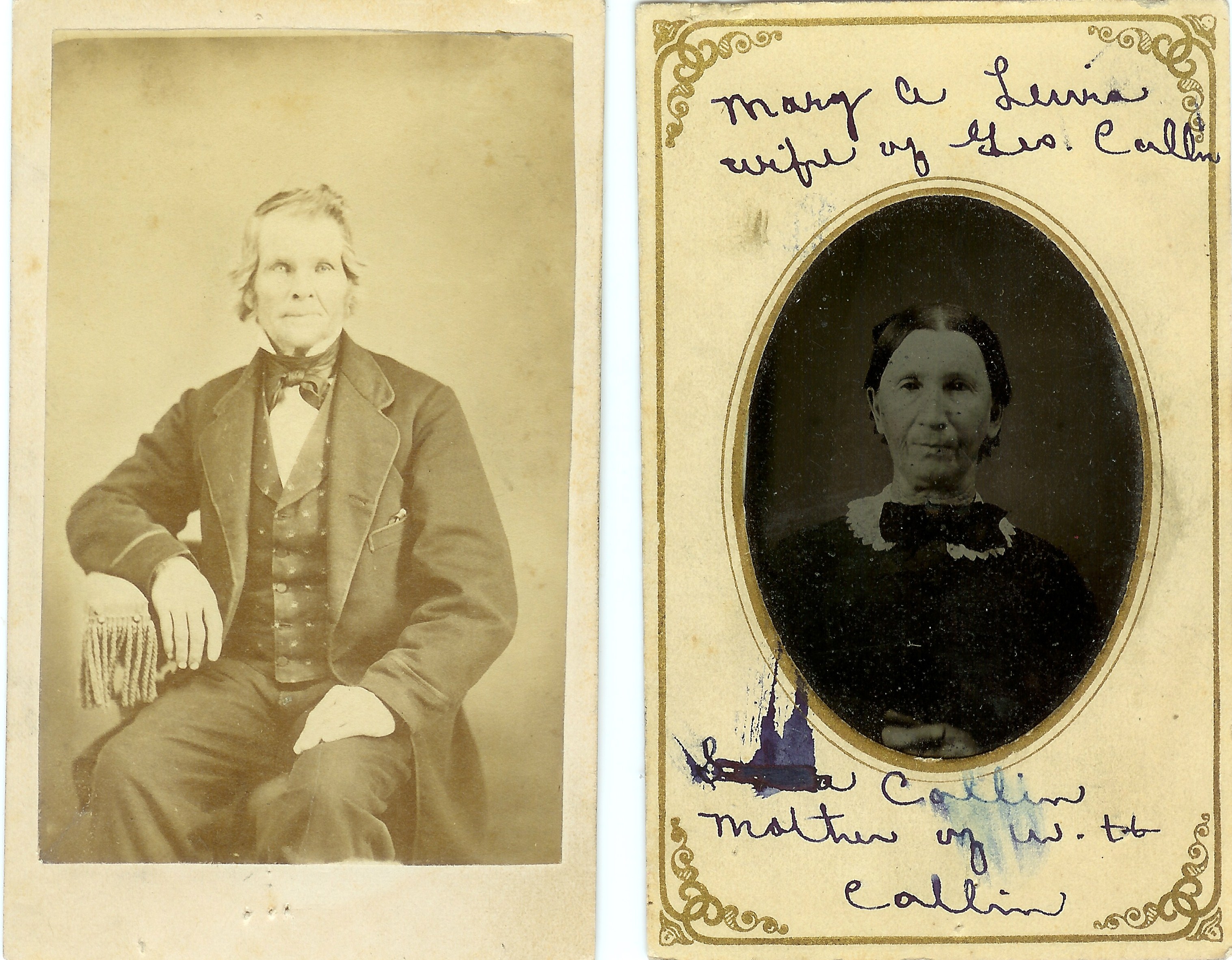
George and Polly, Likely Abolitionists
George’s wife was Mary Ann “Polly” Lewis, whose family moved to Ohio from New York. Our cousin from this branch of the family, Megan, wrote to me last time I posted about this family and offered additional info about Polly’s family:
“[Polly’s] older sister, Hannah Simons, nee Lewis, also came to the Firelands, right to the same area the Callins settled. It is my guess that they brought Mary Ann [aka Polly] to Ohio. I have no idea who got here first, the Callin or Lewis girls…Hannah Lewis’s husband, Cyrus Simmons, came to Peru in what may have been inherited ‘Sufferers Lands’ or Firelands” (they were from Litchfield, Connecticut, his father was on the NY line in the revolution)…The Simons also had a daughter, SABRA Ann (1835-1930), and another [named] Mary Ann (Polly) (1821-1882), nieces to Geo and Mary Ann Callin.”.(of course a George, too.)”
We have talked before about George and Polly’s faith1, and about the memoir by their grandniece, Rosemary Callin2, that claims their farm was a stop on the Underground Railroad, so this may not be new information for you. But Rosemary recalled being told this story by her father, George W. Callin:
Father said they were warned not to say nothing at school about it, but their cabin was a station on the Underground Railway. I don’t know whether it was William or Elizabeth, probably the latter, who awakened them softly in the middle of the night and led them to the window. The moon flashed out and they saw a white man, maybe William, leading a string of blacks through the clearing around their cabin and into the woods. They were on their way to Great Uncle George’s barn. From there he would take them onto the next stop.
Records of their marriage and where they lived before 1850 are elusive, but the 1850 Census places George and Polly in Peru Township, Huron County, Ohio. William – George’s younger brother and George W.’s father – had cleared his own farm in Milton Township (which was in Richland County in 1840), and moved to Peru Township in 1849. So Rosemary’s account almost certainly describes something that happened in the 1850s. If the story about Elizabeth taking the children to the window happened in 1855, George W. would have been about nine years old, and the youngest of the children, Zimri, would have been about five.
Peru Township is north and west of Greenwich Township, on a diagonal with one other township between them. Greenwich Township was where the Society of Friends (Quakers) operated the Firelands “Underground” Railways. Early activity would have begun in the 1830s, and increased through the end of the Civil War in 1865.
Echo of the Past
As I write this post, America in 2026 is experiencing something similar to what George and Polly, and William and Elizabeth, experienced in the late 1850s. Political divisions over who we should be as a country created sharper and starker dividing lines as a minority of people who believed that a corrupted system based on treating human beings as property pushed for nationwide enforcement of laws that the Callin family (at least THIS Callin family) considered to be immoral.
The Fugitive Slave Act of 1850 explicitly put our two Callin families, and anyone else running an underground railroad, on the wrong side of the law. Slave patrols could cross into free states and kidnap enslaved persons, even those who were legally free, as in the case of Rosetta Armstead in 1855. Studying this time in American history, I can’t avoid seeing parallels with the 2025 surge of Immigration, Customs, and Enforcement (ICE) operations to kidnap people who are in the U.S. legally, operations that exceed their legal charter, and lead to examples of violating the rights of due process guaranteed in the Bill of Rights and attacking U.S. citizens who object to this.
As more of my friends and neighbors across the country are caught up in the protest movement against ICE, I also see family and friends who are choosing to ignore the immorality and illegality of what the federal government is doing. I am gaining a new understanding of the long, slow unfolding stresses and anxiety that families like George and William Callin endured as they resisted immoral laws without knowing when or how a coming war might affect them.
The Next Generations
George and Polly had two sons and four daughters. Two of those daughters did not have children; Amelia (Callin) Horton was the youngest child, and was described as suffering from “delicate health” before her death at age 50. The other was Sabra Ann, who we discussed not long ago3.
Only one son, John C. Callin (1830-1905) had male descendants, but he only had two kids (a son and a daughter) and one grandson, Arthur James Callin, who never had children. John C.’s two children were James Callin (1855-1930) and Jennie M (Callin) Clausin Strohm (1857-1924). James raised his children in Huron County, but later moved to Chicago, Illinois, and then to Elkhart, Indiana. Jennie lived in Denison, Iowa, with her first husband, and lived in Council Bluffs, Iowa, and later, Saint Paul, Minnesota, with her second.
James’s youngest daughter, Helen (Callin) Ladd, adopted two children, and his older surviving daughter, Ada Cecilia (Callin) Forgey, did not have any children. Jennie’s granddaughters were Jean Marjorie Clausin (1909-1964), who appears not to have had any children, and Louise Harriet (Clausin) Pattee (1905-1998), whose sons were Carl Bert (1930-1993) and Lloyd Garrison Pattee Jr. (1932-1998).
George and Polly’s eldest daughter was Minerva (Callin) Smith Robinson Daggett (1834-1895). Minerva had five known children with her first husband, a blacksmith named John N Smith (1830-1867) who died in Rockford, Winnebago County, Illinois. It is possible that Minerva knew her Aunt Sarah’s family, but George W. appears to have lost touch with her after the Smiths moved away from Ohio. Minerva had two more children (that I know of) with her second husband, Dana A Robinson (1818-1891), and they lived in Burlington, Coffee County, Kansas. I have been unable to find more information about her descendants.
The second son of George and Polly was named after George’s brother (my 3rd-great-grandfather): William H Callin (1834-1919). He married an English girl4 named Ellen C. Channing (1838-1916) and they had four daughters, who they raised on their farm in Huron County:
- Lillian Florence (Callin) Richards (1861-1936)
- Anna L (Callin) Williams (1865-1908)
- Lydia Minerva (Callin) Clark (1869-1943)
- Grace M (Callin) Ritz (1880-1978)
And lastly, George and Polly’s daughter, Lovina (Callin) Rickey (1839-1877), married Ed Rickey (1831-1896) and had two sons, so there may be a smattering of cousins out there with the Rickey surname. Ed and Lovina moved to Williams County, Ohio.
The Thread of History
Most people focus on their paternal surname when they get into family history; that makes sense, of course, since that’s “your name” and most novice researchers can be easily overwhelmed by the exponential increase in the number of surnames found in each generation.
That bias towards the familiar is also compounded by geography. I’ve noticed that the people listed here that stayed in Ohio were close enough for George W. Callin to know and include in his book. Some of those who moved away were close enough to attend the Callin Family Reunions that were documented in local papers during the 1900-1910s, and their names, at least, appear in the CWF.
But those who did not remain in Ohio offer the challenge of obscurity – a challenge that only focused research can overcome.
- See “Religion: Tool and Problem” ↩︎
- See “Silk or Satin” ↩︎
- See “Two Girls Called Sabra Ann” ↩︎
- See “The Girl From England” on the old Blogger site ↩︎


Say hello, cousin!