
I found a secondary source that may help answer the questions I had when I wrote Wavetops: Amos Clark – but untangling what it says from what it means and interrogating the source on the question of how do you know that? may end up leaving me with a paradox: more information and more questions.
The question I’m trying to answer has to do with the origins of my 3rd-great-grandfather, Amos Clark (unknown DOB-1848). Here are the facts I have:
- He married “Sally Stumbough” on 8 April 1824 in Lawrence County, Ohio.
- Their family appeared in Perry Township, Lawrence County, Ohio, in 1830 and 1840.
- Amos died in 1848, and his will named his children1.
- In 1853, the local newspaper in Ironton (Lawrence County), Ohio, The Spirit of the Times carried a Notice for the estate of Amos Clark2 on 12 April… and then a few weeks later, on 31 May3, printed that “The late advertisement of Amos Clark’s estate in our paper, was not that of Amos B. Clark, who is well and favorably known to many of the citizens of this county, as some have supposed. He is still alive and kicking.”
At first, I assumed that the 1853 estate notice was for a different Amos Clark, because the husband of Sally Stumbough died in 1848, but I have seen that probate cases can take years to resolve themselves, especially when minor children are involved. So that estate notice could be for my ancestor. But we also know that we can’t assume any record for the name Amos Clark is my ancestor, because another Amos B. Clark was still alive and kicking in 1853.
The puzzle I have to solve now is “which pieces of information pertain to my Amos Clark?”
From New Jersey to Ohio
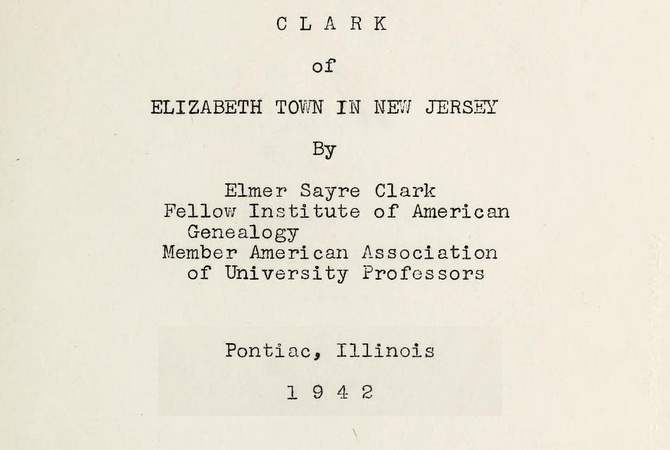
One piece of information kept popping up on various unsourced family trees, so I decided to start investigating where that information came from. Supposedly, Amos Clark was born on 3 November 1802 in Westfield, Union County, New Jersey. After coming up empty on records searches, I finally found this book: Clark of Elizabeth Town in New Jersey by Elmer Sayre Clark.
This book, published in 1942 by Professor E.S. Clark, a Fellow of the Institute of American Genealogy, is not organized like a family history document. It begins with a few pages labeled “Summary of Lineages” that lists families under 16 surnames. I assume these might be the author’s Sixteen great-great-grandparents, but he doesn’t tell us that.
After the Summary, there are three pages that provide the heraldic definitions of the coats of arms for nine of the families, and then Professor Clark turns on the fire hose. What follows is more than 200 pages of will transcripts, correspondence with descendants, lists of names with what look like inline references, and essays with the byline “By the Editor” – an undifferentiated, un-indexed mass of genealogical information. Fortunately, since the book was digitized, we can search through the text for names.
Despite these challenges, Professor Clark’s book appears to support the origin of Amos Clark that I kept seeing.
- From the “Summary of Lineages“:
- CLARK(E):
- Samuel (1768-1856), of Scoth [sic] Plains, N. J. m 1791 Mary dau. of Elias Darby of Scotch Plains, N. J.; removed to Hanging Rock, Ohio, thence to Gashland, Mo.
- SAYRE/SAYER:
- Phoebe (1797-1845), m 1814 Samuel Clark of Hanging Rock, Lawrence Co., O.”
- DARBY/D’ARBY:
- Mary (1768-1806), of [Elias] m at Westfield, N. J. 1791 Samuel Clark.
- CLARK(E):
- From the “Letter from Daniel Carpenter, Oct. 20, 1913” on page 202:
- “Samuel Clark was born in Elizabeth, N.J., March 11, 1768; died in Clinton County, Missouri, Oct. 7, 185-2, or 6… married to Mary Darby probably around 1790, who was born July 17, 1768…” [8 children were listed; I selected these five to make my case:]
- [1.] Samuel was born March 20, 1792 [married Phoebe Sayre, above]
- 2. Cornelius, born Nov. 22, 1793
- 3. Joel born Oct. 10, 1795
- 4. Hannah, born Feb. 14, 1798, m. Wm. Carpenter, 1812, d. Sept. 18, 1881
- 6. Amos, born Nov. 20, 1802
- “Cornelius, Joel and Amos lived and died in Lawrence County, Ohio, leaving a number of descendants still living there.”
This still isn’t conclusive or primary evidence, but there seems to be agreement from multiple accounts provided by people who remembered their grandparents’ stories. You can piece together from the information above that Samuel Clark (1768-1856) and Mary Darby (1768-1806) married and had their eight children, and Dan Carpenter’s letter states that they moved, along with Dan’s grandfather, Benjamin Carpenter, to Lawrence County, Ohio, about 1803-5, settling on the river about one mile above Hanging Rock.
There are more details to tease out of this book; as I said, it is densely packed with references, side comments, and details that need to be teased out and confirmed with primary source records. But the one thread that makes me think I’m on the right track comes from that 12 April 1853 Estate notice in the Spirit of the Times.
Assuming that estate is for the Amos Clark who died in 1848, the administrator’s name is Cornelius.
Tantalizing.
But Who Was Amos B. Clark?
That other item from Spirit of the Times telling us that “Amos B. Clark” was still alive in 1853 may lead to more of the information we need to solve this puzzle. There are some clues in Professor Clark’s book.
As it happens, Professor Clark includes a biographical sketch of Ephraim S. Clark, sourced from another book, “Portrait and biographical album of Livingston County, Illinois,” published in Chicago by the Chapman Brothers in 1888 (pp 198-202). On page 207 of Prof. Clark’s book, he lists the fourteen children of Samuel Clark (1792-1840) and Phoebe Sayre (1797-1845), including a son named Amos:
“Amos, born March 27, 1825, married Lucy Reither, and they have one child; Amos is a shoemaker by trade, but he is now [presumably in 1888] a travelling salesman”
That sketch states that this Clark family relocated to Indiana around 1830, so further research into Amos Clark and Lucy Reither will be needed before I can say whether he is our “Amos B. Clark” or not.
What Goes Into WikiTree
If you haven’t already done so, you should follow the link to Amos Clark’s WikiTree bio, where you can see how the page has been edited to reflect these developments. Take note that the Biography section is meant to be a narrative constructed out of facts that can be sourced to primary records, while “unknowns” and theories can be discussed in the Research Notes.
Wherever possible, I like to include as much information as possible for future researchers. You will probably notice that when I don’t know whether something is correct, I explain why I don’t think it’s correct and try to link to the sources so other researchers can examine them for themselves. I also try to provide a link to and a transcript of the relevant document, though a source citation doesn’t have to include either.
When editing your own WikiTree profiles, make sure you proofread it a few times while asking that key critical thinking question: “How do you know that?” If the text answers that question, then you’re doing something right!
- The exception is that my 2nd-great-grandfather, Joel Clark, is either not named or is mis-named as “Jacob”; see Amos’s WikiTree entry for more. ↩︎
- Newspapers.com, Spirit of the Times, Ironton, Ohio; Tue, Apr 12, 1853, Page 3, https://www.newspapers.com/article/spirit-of-the-times-amos-clarks-estate/125497327/ ↩︎
- Newspapers.com, Spirit of the Times, Ironton, Ohio; Tue, May 31, 1853, Page 2, https://www.newspapers.com/article/spirit-of-the-times-amos-clark-still-a/21733341/ ↩︎
 Mightier Acorns
Say hello, cousin!