
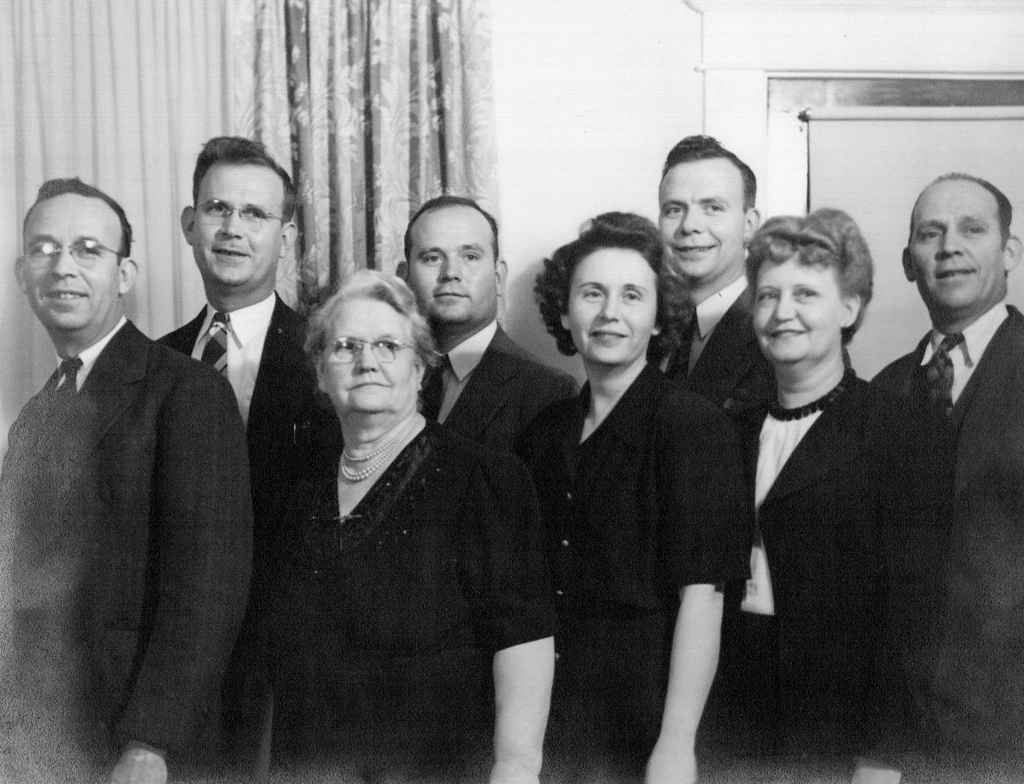
My maternal grandfather, Russell Hudson Clark, Sr., was the first of my grandparents to pass away in 2002. When he died, I was told there were several contributing health factors, including Alzheimer’s disease and lung cancer. The lung cancer was attributed to the smoking habit that he had during World War II and the decade that followed.
When I learned that fact, I remember thinking, “So that’s true, then,” because Grandpa Russ told me many things over the years, and it could be difficult to separate the strictly factual from the metaphorical. I put it that way because I don’t think his intent was to deceive me when he told me stories that weren’t strictly true; I think in his calculus, the things he told me were lessons, meant to instruct me.
Proverbs 22:6: “Train up a child in the way he should go, and when he is old he will not depart from it” (KJV/NKJV)
But good intentions don’t make things true, and metaphors do not make good source citations.
The Power of a Voice
Grandpa Russ told me, my sister, and our cousins many tales when we were growing up. Many of them involved tobacco, for reasons we never fully understood at the time.
“When I was a boy, about your age,” he said, addressing a 12-year-old me and my 8-year-old sister, “I wasn’t supposed to cut through the barns where they kept the vats of sheep dip, but I did anyway, because I had found a big plug of chewing tobacco, and I didn’t want anyone to see me try it. You know, that big, furry monster in your Star War movie is called “Chewbacca” because it’s short for “chewing tobacco,” don’t you? They’re just trying to get kids to think it’s cool to use it, but I snuck into that barn and took a bite like I’d seen the men in our town do, and I didn’t know that you were supposed to spit out the juice… and let me tell you, that made me sick at my tummy!”
When he told us stories, especially these cautionary tales, his oratory took on a cadence and style that I find reminiscent of blues singer B.B. King. I once mentioned this to him, and it made him uncomfortable. Here’s a clip to demonstrate – imagine the previous paragraph being told to you in this man’s voice:
When he told the sheep dip story, he explained that the vats held a liquid for treating parasites and that the sheep would be lowered into the vat (dipped) and then set free. Then he told us that when he took his shortcut through those barns, he went up on the walkway above the vats, and he saw a nice hat floating in one of them. He fished out the hat and wore it into town, where a woman came running out of a store, screaming at him, “Where did you find that hat?”
And, of course, the woman’s husband was the owner of the hat, and they found him in the vat when Grandpa showed them where the hat had been floating.
“He was drunk on whiskey, and fell in to drown, and that’s why you must stay away from tobacco and alcohol!”
Trust, but Verify
I never found a shred of evidence to suggest that story actually happened. It certainly could have, but I can only guess at the year (about 1932), the location (somewhere in Kentucky or Arkansas), and I only have one solid fact to look for (man drowns in a vat of sheep dip).
Most of the stories like this that Grandpa told us were unverifiable. Some were obvious retreads of morality tales, like those frequently shared by pastors from the pulpit. Some of those tales even showed up in email forwarding chains that spread around the early internet in the 1990s.
But some of them did seem true. Or “truth-adjacent”…
1 Thessalonians 5:21: “…but test everything; hold fast what is good.” (ESV)
I joined the Air Force in the summer of 1994, and Grandma and Grandpa Clark came to visit when I returned home from language school for Christmas break. At one point, Grandpa pulled me aside to share several stories about his time in the Navy.
In one, he was serving aboard a ship that was part of a convoy delivering materiel to Murmansk, Russia, under the Lend-Lease program. He described waking up one morning in a thick fog, and seeing the topsides of German U-boats passing through the convoy, looking for the American ships, but somehow unable to locate them.
In another, he was on shore leave in England around Christmas time, and he described a great alcohol-and-heroine bender in which he found himself singing in a nightclub. After hearing him sing, a U.S. Army major came up to him and offered him a job with his touring group in the USO. The major took his name and contact info, and said he was headed out the next day for several performances, but that he would be in touch. That army major’s plane disappeared, and Grandpa never did get his chance to sing with the Glenn Miller Orchestra.
These stories might have been plausible, though there is certainly room for embellishment. They carried elements of the cautionary tale (with the inexplicable new addition of heroine use) mixed with facts that could almost be checked (assuming there are records of a ship with Grandpa on it visiting Murmansk or England).
But are they “true”? And if there is no way to know, is it appropriate to repeat them in his biography?
The Hard Truths
The difficulty of documenting a life like that of Russ Clark does not lie in finding evidence to show you what is true. I have documents. I have Grandma Bert’s Travelogue. I have our stories. The difficulty lies in how you curate his stories, how you frame them, and what you lead the reader to think of him.
As a child, I was taught (in part by Grandpa Russ) that liars are bad, wicked, and evil people. Grandpa tried to teach us to watch out for evil people. The tool of storytelling he used on us sometimes put him at odds with his own definition of evil, but that contradiction led me to value the underlying truth of a story, even if it isn’t literally true.
As an adult, I can look back at the people who influenced me and see what they were trying to teach me…but also what they taught me without meaning to. No one in my family intended to make me an atheist, or set out to formally train me in critical thinking skills, but I ended up being what I am and doing what I do because I spent my childhood trying to figure out how to test everything and hold fast to what was good. That’s my inheritance from Grandpa.
Growing up in the poorest parts of America during the Great Depression with a father and older brothers who (probably) drank and (almost certainly) cheated on their wives shaped Grandpa’s idea of what a Bad Person was. “Gossiping” was part of what made a Bad Person bad, so he tried to avoid telling us directly that his father drank and left his mother to raise nearly a dozen children; but he made it pretty clear what he thought of people who would do such things.
My job is to find the facts about those people, and I try to do it in a way that demonstrates some grace for their behavior, even when it did harm to those around them. At the end of his life, there was no way to know which of the stories he told were strictly true, which were “lessons,” or which were products of the Alzheimer’s disease that crept slowly through his brain and altered his personality. As he and his siblings left us, they took most of their stories with them.
And all of this – this essay, these stories, the guesses I have to make about what was strictly true – is what we have to build on.
Nirvana, 1993: “All in all is all we are.”
 Mightier Acorns
Say hello, cousin!