

A cautionary tale about subscriptions.
Somehow, a decade or so ago, I signed up for Ancestry’s Worldwide Access membership around the holidays. That means that every Christmas, when budgets are being trimmed with tinsel and assaulted by cats, my wife would find a not-quite-$500 charge that she hadn’t taken into account.
Now that we’re a bit older and the kids are all independent, it’s not the problem that it once might have been, but it is a large expense that coincides with the holidays. My wife has been asking me to change our billing cycle, and this year, I remembered to do something about it.
Ancestry allows users to “pause” a subscription, so I did that. Rather than buy my annual membership in December, I hit pause until February. What that means is that Ancestry keeps all of my trees intact, with the sources I have attached, but I can’t view any of the sources that aren’t included in their free membership level.
And that feels like a problem, because after ten years, I have put an investment of nearly $5,000 and untold hours of my labor into building what I have built on Ancestry, and there is no mechanism for maintaining that investment of money and labor in any permanent way. At least not one that doesn’t commit my future cousins and descendants to paying Ancestry more money.
Copyright and Public Records
U.S. copyright laws are notoriously (and needlessly) complex beasts, and while I don’t like the way that complexity seems to always work against someone like me (ie, someone who is not a corporation with a fiduciary responsibility to shareholders), it’s not the fact that someone is making money off my labor that bothers me. What bothers me is the way the maze of rules and guidelines that outline “the Right Way” to do things never leads to me benefiting from my labor.
The first thing to understand is that Ancestry does not hold, and does not claim a copyright on public records – but they do claim copyright on images they made of those records and the indexes they made of those records.
Ancestry does not claim an exclusive right to images already in the public domain that it has converted into a digital format. However, the Websites contain images or documents that are protected by copyrights or that, even if in the public domain, are subject to restrictions on reuse. By agreeing to these Terms and Conditions, you agree to not reuse these images or documents except that you may reuse public domain images so long as you only use small portions of the images or documents for personal use.
(Ancestry Terms and Conditions, Revision as of August 1, 2014)
“The Right Way” to do what I do, from Ancestry’s point of view, is to pay them for access to their proprietary images and indices, and then cite them on sites like WikiTree (using their Sharing Links) or include smaller screenshots (as I often do here) with attribution.
In practice, that looks like this. For example, when I wrote about Finding John Witter, and built his WikiTree profile, the source citation looks like this – see the “Ancestry Sharing Link” in the third citation:
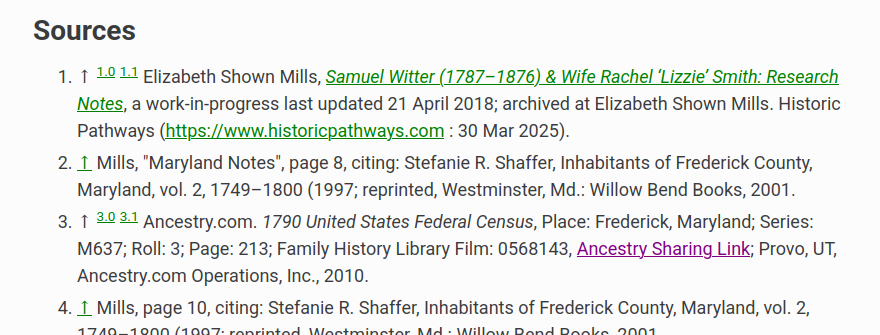
If you follow that link, you go to the Ancestry page created when I generated the link using the Sourcer App – and this is all you get unless you are also a paying Ancestry member:
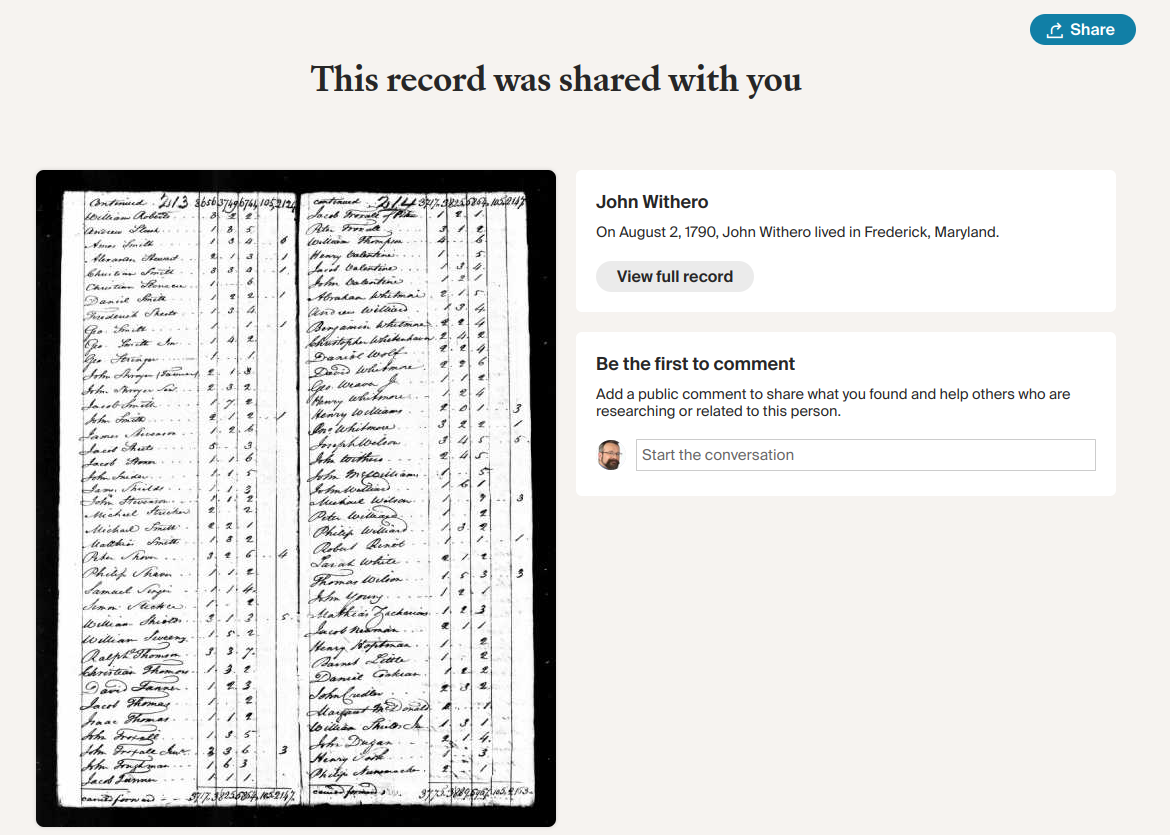
And as unsatisfying as that is, especially for those who can’t afford a full Ancestry membership, that’s the best we can expect. A few individual WikiTree profiles might be able to get away with re-uploading an image of a census page or other record, but that is a lot of work and it puts the user at risk for violating WikiTree’s terms of service about hosting copyrighted images.
You can also try to find other sources for the same records, but… if they aren’t on a free site like FamilySearch.org, you won’t have a lot of options.
The Right Way Forward
While I’m not entirely satisfied with the prospect of leaving behind a well-documented tree that no one will be able to access without paying a hefty sum to a corporation, I don’t have any other real options at this point. I’m using Ancestry and WikiTree “the right way,” and plan to keep doing so. I just need to figure out a better End Goal. I don’t know if that will end up being some form of hard copy publication or a digital Thing(tm) to pass on to posterity. I guess I will have to keep paying attention to the rest of the community to see what they are doing.
If you’re not already aware of the annual RootsTech convention, it is happening in March, and you can read about it and register here: RootsTech 2026
You can also find other writers trying to tackle the topic; here is Linda Stufflebean – Going Digital with Genealogy Research (Nov 2024).
And you can find more folks, particularly in the Substack communities, through Robin Stewart on GenStack – check out her “Your Sixteens” challenge if you need prompts for writing down the stories you have uncovered with your research.
 Mightier Acorns
Say hello, cousin!